The Iron Inheritance: A Rusted Blueprint for the Last Machine at Carnegie Technical Institute
CHAPTER 1: The Weight of Steel
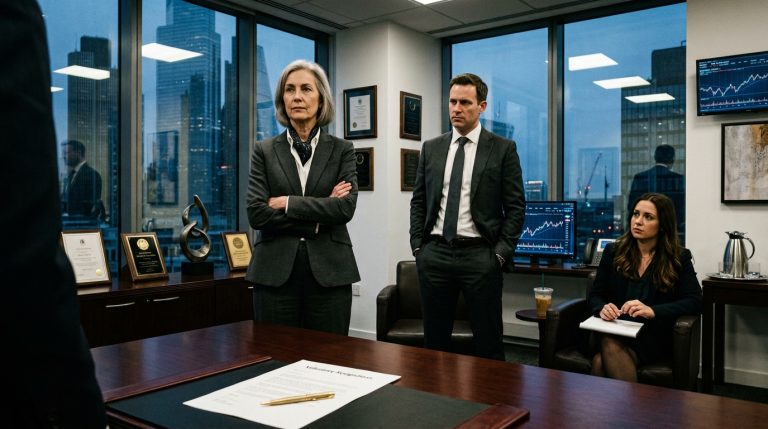
Conner’s voice didn’t just hang in the air; it grated against the silence of the Fabrication Hall. He was pacing, the sharp click of his dress shoes on the concrete floor sounding like a ticking clock. “Three years, Ray. We’re bleeding budget just to keep the lights on in this sector, and this unit is a monument to nothing but dead time.”
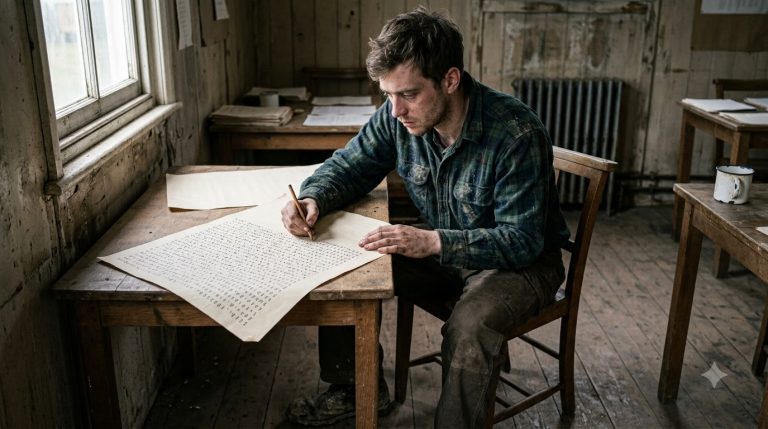
Ray kept his palms flat. The bench surface was cool, coated in a fine, gritty layer of metal dust that had settled over decades. He looked at the Lincoln A-200. It looked like a tombstone made of iron. To Conner, it was a liability. To Ray, it was the only thing in the building that was still breathing.
“It’s not a monument,” Ray said, his voice as dry as the shavings on the floor. He didn’t look back. He kept his gaze fixed on the small, irregular gap between the machine’s side panel and the base frame. A bolt was missing. It hadn’t fallen out; the threading looked sheared, as if someone had torqued it with a wrench too large for the task, deliberately stripping the housing.
Conner moved into his peripheral vision, adjusting his cuffs. He was young, polished, and entirely incapable of understanding the language of metal. “It’s a drain. The board wants the floor cleared by Friday. If it doesn’t hum, it goes to salvage. I have the requisition forms in my bag, Ray. Don’t make this a performance.”
Ray’s breath hitched, shallow and rhythmic. He felt the cold radiation of the A-200. It wasn’t the heat of a machine running; it was the ambient chill of something that had been kept dormant, shielded by layers of rust and calculated neglect. He reached into his leather tool roll and his fingers closed around a custom-ground spanner. It felt weighted, balanced.
“You want to salvage it?” Ray asked, his voice low.
“I have to,” Conner replied, his tone shifting from impatient to something sharper, more transactional. “My career isn’t going to be tied to a rusted paperweight. Move, Ray.”
Ray finally turned. His eyes weren’t on Conner, but on the man’s bag—a sleek, leather-bound satchel that seemed too heavy for simple paperwork. As he stood, Ray noticed a smear of dark, synthetic grease on the cuff of Conner’s pristine white shirt. It wasn’t shop oil. It was the distinct, shimmering blue lubricant used only for high-pressure aviation seals.
The machine wasn’t just old. It was being serviced by someone who didn’t work here.
“You aren’t here for the budget, are you?” Ray asked, stepping between Conner and the A-200.
Conner stopped, his face tightening into a mask of professional indifference. “I’m here for the truth, Ray. And the truth is, this machine needs to be opened.”
Ray felt a chill that had nothing to do with the hall’s ventilation. If Conner knew how to open it, he already knew what was buried inside the casing.
CHAPTER 2: The Ghost Frequency
Conner didn’t retreat. He didn’t even flinch. He stood his ground, the fluorescent lights overhead humming with a fluctuating frequency that, to anyone else, was just white noise. To Ray, it was the sound of a heartbeat, irregular and strained. The smear of blue lubricant on Conner’s white shirt cuff caught the light—a streak of synthetic, high-pressure sealant that had no business being in a facility that hadn’t seen a high-spec overhaul in years.
“You’re making assumptions, Ray,” Conner said, his voice dropping into that smooth, practiced register that usually signaled the end of a conversation. He took a half-step back, creating a calculated distance that allowed him to monitor the room without looking like he was checking the exits. “That mark? It’s just grease from the maintenance bay. I had to sign off on a seal replacement in Sector 4 this morning.”
Ray didn’t buy it. He knew the maintenance logs. Sector 4 hadn’t seen an active machine in months, and they certainly didn’t use blue synthetic sealant. He kept his hands on the bench, fingers feeling the microscopic pitting of the iron surface.
“Sector 4 is dry,” Ray said softly. “Has been for a long time.”
Conner’s eyes flickered—a barely perceptible twitch of his pupils that signaled he’d registered the trap. He smiled, but it didn’t reach his eyes. “Maybe I’m more diligent than the records suggest. Or maybe you’re spending too much time listening to the machinery and not enough time reading the reports.”
Ray ignored the jab. He stepped toward the Lincoln A-200. The machine was cold to the touch, but beneath the layers of rust, Ray could feel a phantom vibration. It wasn’t the steady, low-frequency hum of a connected device. It was an erratic, pulsing thrum, like the machine was trying to wake up or, perhaps, trying to signal something hidden deep within its bowels. He reached out and pressed his palm against the side casing, right where the stripped bolt hole was located.
Underneath the metal, he felt it: a rapid-fire tapping, too fast for any human finger, vibrating against the casing wall. Dot-dot-dash. A cadence.
Conner stiffened. The shift was absolute—the professional mask slipped, revealing a raw, jagged edge of panic that he quickly masked by turning toward the workbench, his movements suddenly sharp and uncoordinated. He reached for the bag on the bench, but Ray moved first. Not with aggression, but with the heavy, practiced authority of a man who owned the floor. Ray didn’t stop him from grabbing the bag; instead, he stepped directly into Conner’s space, forcing the younger man to pivot.
“You’re not here to salvage the machine,” Ray said, his voice low, vibrating with the same intensity he felt in the iron. “You’re here because it’s started talking again.”
Conner’s grip on the bag tightened until his knuckles turned bloodless. The room seemed to shrink, the vast space of the fabrication hall suddenly feeling like a narrow corridor. “You’re delusional, old man. It’s a box of wires and oxidized copper. It doesn’t ‘talk’. It’s a liability, and by Friday, it will be scrap metal, along with your job and your obsolete reputation.”
Ray looked past him, focusing on the dark, cavernous ceiling of the hall. He remembered three years ago—before the machine fell silent, before the Institute shifted toward mass-production protocols. He remembered the specific, proprietary calibration they used to run here, the kind that required a specialized, hand-forged harmonic balancer. A tool that, he realized with a jolt of cold clarity, was currently missing from his own tool roll.
He looked down at his seven pockets. The seventh slot was empty. He hadn’t just misplaced it. It had been taken.
“Where is it, Conner?” Ray asked, his voice steadying, stripping away the pretense of the argument. “The balancer. You didn’t come to salvage the unit. You came to see if the internal rig was still holding the sequence.”
Conner froze. The air in the hall shifted, the heavy, stale scent of oil and ozone feeling thicker, harder to breathe. For a second, the mask dropped entirely, and in the space between them, the shared weight of a secret heavier than any piece of iron filled the room. Conner’s face paled, the polished surface of his corporate identity cracking under the pressure of a reality he hadn’t expected to confront this early.
He opened his mouth to reply, but before the words could form, the machine beneath Ray’s hand gave a violent, metallic shriek—a long, agonizing groan of rusted steel sliding against steel. The internal pressure release valve at the back of the A-200 hissed, sending a plume of pressurized, stagnant air and blue-tinged particulate into the space between them.
The machine wasn’t just vibrating anymore. It was failing, or perhaps, it was being forced to initiate a reset that the casing wasn’t designed to handle.
“You did this,” Ray breathed, his eyes wide as the machine groaned again, the sound echoing off the rafters like a siren. “You didn’t just want to see if it was working. You’re trying to force the override.”
Conner turned toward the door, his composure shredded, his eyes darting to the darkness of the hall’s entrance where the shadow of a security patrol was just beginning to stir. “You don’t understand, Ray. The board doesn’t want the machine. They want what’s left of the sequence. If you don’t help me stabilize it, we both lose everything.”
Ray didn’t move. He stood, his heart hammering against his ribs, watching the blue smoke drift through the shop like a ghost of the secrets they were both desperately trying to bury.
CHAPTER 3: The Inventory Discrepancy
The air in the fabrication hall had turned acrid, a stinging cocktail of scorched dust and the metallic tang of ozone. Ray didn’t retreat from the machine. Instead, he shoved his tool roll into his side pocket, his hands moving with a fluid, desperate precision born of thirty years of muscle memory. The Lincoln A-200 was shuddering against its mount, a low-frequency bone-rattler that made the concrete floor beneath his feet feel unstable.
“Shut it down!” Conner shouted over the hiss of the valve. He was backing away toward the heavy sliding doors of the hall, his eyes flicking constantly toward the dark, recessed entrance where the rhythmic thud of security boots had finally begun to echo. “If the pressure spike blows the internal housing, the whole unit is trash. We lose the sequence, we lose everything!”
Ray didn’t listen. He wasn’t looking at the pressure gauge. He was looking at the junction box tucked behind the main chassis—a small, recessed panel that he had personally sealed with a lead-weighted locking pin three years ago. The seal was gone. In its place was a freshly filed notch, a telltale mark of a high-speed lock pick.
“You didn’t just come to check the sequence,” Ray said, his voice barely audible over the screaming metal. He reached out, grabbing a heavy, long-handled lug wrench from the bench—not to attack Conner, but to wedge it into the machine’s primary dampener. The metal of the wrench was cold, biting into his calloused palm. He drove it into the dampener’s cradle with a grunt of exertion.
The machine bucked, a violent lateral shift that sent a spray of sparks across the floor. Conner lunged forward, not to help, but to grab the machine’s power cable. “You’re going to kill the internal drive! Get away from it!”
Ray twisted, the lug wrench acting as a fulcrum. The sudden resistance of the dampener forced the machine to groan, its vibration oscillating into a higher, sharper frequency. For a fleeting second, Ray felt a sickening wave of vertigo. The rhythm of the machine—the dot-dot-dash he’d heard earlier—synchronized perfectly with his own pulse. It was as if he were wired into the circuit, a phantom feedback loop that made his own vision swim. He saw the hall not as a series of workbenches and shadows, but as a grid of electric potential, the very air crackling with energy that shouldn’t have been there.
He shook his head, forcing his eyes to refocus. It was just the adrenaline, he told himself. Just the strain.
“If the drive dies,” Ray snarled, his eyes locking onto Conner’s, “it’s because you choked it with that cheap sealant you’ve been pumping into the feed lines. You didn’t come for the sequence, Conner. You came to extract it, and when you couldn’t pull it, you decided to burn the evidence.”
Conner’s expression shifted, the panic giving way to a cold, hard pragmatism. He stopped trying to pull the cable and instead leaned in close, his voice dropping to a whisper that cut through the machine’s roar. “There is no ‘we’ anymore, Ray. The Institute isn’t the one looking for this sequence. It’s the contractors. If they find out the A-200 is still holding the proprietary logic from the original grid, they won’t just scrap it. They’ll erase anyone who ever operated it.”
The security boots grew louder, the heavy thuds now rhythmic and approaching. The hall’s main light flickered, cast in a dim, sickly orange, and for a moment, the shadows against the back wall seemed to stretch and shift, taking on the shape of people who hadn’t walked these halls in years. Ray blinked, the phantom image vanishing into the familiar clutter of the fabrication station.
Stay focused, he told himself. The metal. The weight. The reality.
Ray reached into the junction box, his fingers finding the familiar, cold texture of the override switch. He ignored the burning heat of the machine’s frame. He felt the notch the lock pick had left behind—the evidence of an intrusion he hadn’t authorized. But there was something else inside the box: a small, rectangular sliver of carbon fiber. A data bridge.
He pulled it out. It was warm to the touch, humming with a residual electric charge. It wasn’t standard industry equipment. It was something entirely different, something that looked like it had been salvaged from the core of a much larger, more sophisticated piece of hardware.
“Give me that,” Conner demanded, his hand darting out.
Ray pivoted, his back to the machine, the bridge palmed securely in his hand. He looked at Conner—really looked at him—and saw the tremor in the younger man’s hands. Conner wasn’t just a corporate flunky. He was terrified.
“You’re not here for the board,” Ray said, his voice quiet, deadly calm. “You’re running from someone, aren’t you?”
The security patrol rounded the corner, their flashlights cutting through the haze of blue smoke, illuminating the mess they had made of the workbench.
“Drop the tools!” one of the guards shouted, the command echoing in the vast, empty space.
Ray looked at the carbon bridge, then back at Conner. The machine groaned one last time and finally—thankfully—fell silent. The silence that followed was absolute, heavier and more dangerous than the noise had ever been.
CHAPTER 4: The Midnight Shift
The white light of the flashlights hit Ray like a physical wall, blinding him. He felt the cold bridge of carbon fiber slick against his palm, his fingers curling tightly around it. Behind him, the A-200 sat silent and inert, a hulking mass of iron that had suddenly ceased to be a machine and had become a silent witness. The guards weren’t shouting anymore; they were moving with the systematic, measured cadence of men who were paid to ensure that questions didn’t leave the floor.
“Hands where we can see them,” the lead guard said. His voice was thin, echoing against the high, vaulted ceiling of the fabrication hall. He was holding a stun-baton, the tip of it crackling with a faint, blue electric arc.
Ray slowly lifted his hands. He kept his left hand—the one clutching the bridge—tucked slightly behind the bulky frame of the Lincoln A-200. Conner, to his right, had already dropped to his knees, his hands locked behind his head. The young man’s face was slack, drained of the arrogance he’d carried moments before. He was staring at the floor, his breathing shallow, jagged.
“Check the unit,” the guard commanded, gesturing toward two others. They ignored Ray and Conner, moving directly to the A-200. They weren’t looking for sabotage; they were looking for an opening. One of them tapped the casing with a scanner, a dull, repetitive beep that seemed to pulse in time with the fading warmth of the machine.
Ray felt a surge of cold, calculated fury. He wasn’t going to let them strip the heart out of this place. Not tonight. He shifted his weight, his boots grinding into the gritty concrete.
“The unit is dead,” Ray said, his voice gravelly but steady. “You’re wasting your time. The main coil burned out during the spike. It’s scrap.”
The guard holding the flashlight stepped forward, the beam sweeping over Ray’s face, then down to his chest, and finally to his hands. “We don’t get paid to care about the state of the iron, old man. We get paid to retrieve whatever caused the surge.”
He looked at Conner. “And you? You were the one who signed the late-shift access.”
Conner looked up, his eyes glassy. “I… I was just following the directive. The audit said the machine was a risk. I was supposed to clear it.”
Ray didn’t turn his head to look at Conner. He knew the kid was lying, or at least, that he was only telling a fragment of the truth. But in that moment, the lie was a distraction. The guards were focused on Conner’s desperation, not on Ray’s silence.
Ray took a breath, the air tasting of dust and stale grease. He knew the layout of this hall better than he knew his own home. He knew that the floor grate beneath the A-200 led to the old drainage tunnels, a subterranean network that hadn’t been mapped since the institute was founded. It was dark, it was tight, and it was the only way out of the spotlight.
He didn’t wait for a signal. He didn’t wait for an opening.
Ray stepped back, his heel hooking the edge of the floor grate. He threw his weight backward, the sudden, violent movement causing the guard with the flashlight to instinctively lunge forward to catch him. As the guard moved, Ray swept his arm wide, knocking a heavy, discarded welder’s mask off the bench. It clattered to the floor with a deafening ring, a deliberate, metallic distraction.
“Now!” Ray shouted, not to the guards, but to the shadows.
He dropped his weight, the heavy iron grate clanging as it gave way under his boots. He tumbled into the darkness of the crawlspace, the smell of damp earth and stagnant water rising up to meet him. It was a plunge into nothingness, a freefall into a world of rust and forgotten plumbing. He landed hard on his shoulder, the grit of the concrete floor scraping through his coveralls.
He didn’t stop to check for broken bones. He crawled, his fingers finding the familiar, cold iron of the drainage pipes. Behind him, he heard the shouts of the guards, the heavy thud of boots hitting the floor above, and the screech of someone trying to pry the grate back open.
He was in the belly of the machine now. Everything was silent, save for the dripping of water and the distant, muffled sound of his own breathing. He looked down at his left hand and slowly opened his fingers. The carbon bridge was still there, a thin, dark line in the gloom. It wasn’t just a component. As he looked at it, the small, amber light at its center flickered, a faint, rhythmic pulse that mirrored the dot-dot-dash of the A-200.
It wasn’t scrap. It was a key. And for the first time in three years, Ray wasn’t just guarding a legacy—he was finally beginning to understand what that legacy was actually for.
CHAPTER 5: The Decoy Blueprint
The dampness of the tunnel was absolute. It soaked into the wool of Ray’s coveralls, turning the fabric into a leaden weight against his shoulders. He remained motionless, huddled against the curve of a rusted iron pipe, his pulse hammering in his ears. Above him, the grating he had plunged through was being hammered by the guards. Each strike vibrated through the structure of the floor, sending a shower of loose, gritty concrete dust down into his eyes.
He didn’t move until the hammering stopped, replaced by the low, muffled sound of radio chatter. They were organizing. They knew he was down here, and they knew the geography of the plant better than he had hoped. He pushed himself off the pipe, his movements sluggish and pained. His shoulder, struck hard during the fall, throbbed with a sharp, electric protest, but he forced the sensation into a corner of his mind. He had to keep moving.
He navigated the tunnel by touch. His hands slid over the corrugated surface of the conduits, feeling for the junction points. He wasn’t just aimlessly fleeing; he was tracing the path back to the A-200’s primary power tap. If the carbon bridge was the key, it needed the machine’s raw output to function—a circuit he knew how to bridge from the maintenance access point.
Suddenly, a section of the ceiling groaned. It wasn’t the sound of the guards; it was the building itself. The foundation, old and neglected, was giving way under the strain of the security patrol’s heavy, rhythmic stomping above. A slab of concrete, thick and jagged, tore loose from the overhead plating and crashed into the tunnel floor just feet ahead of him.
The impact was violent, a tremor that knocked the wind out of Ray and sent a wall of suffocating silt into the air. The path forward was blocked. He was forced to scramble sideways, his fingernails clawing into the wet brickwork of a secondary access chimney he’d forgotten even existed. It was a narrow, vertical shaft, barely wide enough for his frame, slick with the black, oily discharge of the factory’s waste systems.
He climbed, his breath coming in ragged, shallow gasps. As he crested the top of the shaft, he found himself not in the tunnels, but in a small, cramped service closet adjacent to the fabrication hall’s primary server room.
The light here was different—a steady, sterile white. He pulled himself out of the shaft and onto the tiled floor, shivering violently. He sat there for a moment, letting the cold air clear his head. He looked down at his hand. The carbon bridge was still glowing, that faint, amber pulse now faster, almost frantic. He pressed it against the service port of the room’s main monitor.
The screen blinked, a flicker of static-heavy imagery that rapidly resolved into a technical schematic. Ray’s heart sank. It was the wiring diagram for the A-200. But as he studied it, the reality of the sabotage hit him with the force of a physical blow.
The blueprint was a forgery. It was a perfectly detailed, highly professional document that described a system of internal failsafes and pressure-relief valves that didn’t exist in the real machine. It was a “decoy blueprint”—designed to be found by auditors or technical investigators, pointing them toward a non-existent mechanical failure.
It was proof. Someone had spent months, perhaps years, building this lie, ensuring that if anyone ever tried to troubleshoot the A-200, they would be led exactly where the architect of this deception wanted them to go.
He wasn’t just dealing with corporate cost-cutting. He was dealing with a massive, pre-meditated cover-up.
The server room door hissed open. Ray spun around, his hand instinctively going to the heavy lug wrench he’d shoved into his belt. Standing in the doorway wasn’t a guard, but Conner. The young man looked wrecked—his shirt torn, his face smeared with grease and blood—but his eyes were fixed on the screen behind Ray.
“You found it,” Conner said, his voice devoid of the corporate polish he’d worn in the hall. It was the voice of someone who had reached the end of their rope. “That’s the file they’ve been waiting for. They didn’t want the machine fixed, Ray. They wanted it to disappear, and they wanted a legitimate, documented reason for its destruction.”
“Who?” Ray asked, his voice a low, dangerous growl. “Who is ‘they’?”
Conner didn’t answer. He looked past Ray, his gaze widening as the sound of the security patrol finally reached the corridor outside. He moved toward the monitor, his hand trembling as he reached for the bridge Ray still held. “If we don’t dump this, they’ll know we’ve seen the forgery. And if they know we’ve seen the forgery, they won’t stop at just firing us.”
Ray stared at the screen, the schematic of the lie glowing in the dark room, and realized that the decoy wasn’t just a trap—it was an invitation.
CHAPTER 6: The Corporate Audit
The server room was a tomb of white plastic and buzzing fiber optics. The sterile, artificial air chilled the sweat on Ray’s skin, leaving him trembling. Beside him, Conner stared at the screen, his face a mask of absolute, hollowed-out shock. They weren’t looking at a simple mechanical failure; they were looking at a roadmap to institutional murder.
“They’re right outside,” Conner whispered, the words barely escaping his throat. He shifted his gaze toward the door, his posture collapsing into a posture of defeat. “The audit isn’t for the machine. The audit is for us.”
Ray stepped away from the console, his grip on the lug wrench tightening. He didn’t care about the audit. He cared about the fact that the institution he had dedicated his life to had been hollowed out, replaced by a shell that dealt in forgeries and silent disappearances. He looked at the carbon bridge still pulsing in his hand, its amber light a defiant, rhythmic heartbeat in the cold room.
“They can’t audit what they don’t know exists,” Ray said, his voice low and jagged.
The door to the server room shuddered as the first blow landed against it. It was a heavy, industrial sound, the thud of a hydraulic ram designed to crack reinforced steel.
Ray moved. He ignored the screen, ignoring the evidence they had spent the last hour uncovering. He realized now that the information was a trap in itself; it was designed to keep them pinned in this room until the security patrol arrived. He turned to the back wall, where the server rack was bolted into the floor with industrial-grade iron anchors.
“Conner,” Ray commanded, his voice commanding the authority of a man who had survived three decades of high-pressure fabrication. “The cable bundle behind that rack. Pull the primary feed.”
“If I pull that, the whole floor loses power,” Conner stammered, his eyes wide.
“Pull it!” Ray roared.
Conner lunged, grabbing a thick, armored conduit and wrenching it downward. There was a violent shower of sparks—a brilliant, blinding white display—and the room plunged into darkness. The hum of the cooling fans died instantly, replaced by a deafening, ringing silence. The door, now deprived of its magnetic locking system, groaned as the guards hammered against it, finally giving way with a metallic screech.
Ray didn’t wait for them to enter. He knew the layout of the room’s emergency exits, a detail he had insisted on verifying every year during the safety inspections. He grabbed Conner by the collar, dragging the younger man toward the rear maintenance hatch.
“They’re wearing jammers,” Ray whispered, feeling the static interference from the doorway as the guards’ gear activated. “Our comms are dead, and their grid is isolated. They aren’t looking for us. They’re looking to erase the incident.”
They scrambled through the hatch, tumbling into a narrow, vertical ventilation duct that smelled of damp metal and recycled ozone. It was a tight, claustrophobic slide that felt like crawling through the throat of a machine. Above them, the guards were sweeping the room with tactical, red-dot lasers, the beams cutting through the smoke like surgical scalpels.
“Why are they doing this?” Conner cried out, his voice thin, echoing in the narrow duct. “It’s just a job, Ray! It’s just hardware!”
“It was never just hardware,” Ray gritted out, pulling himself upward through the mesh of the ventilation shaft. His knuckles were raw, bloodied by the sharp edges of the steel, but he didn’t slow down. “The A-200 wasn’t built to produce parts. It was built to test the tolerances of the entire power grid. It’s a diagnostic weapon. If someone uses it to push a current through the wrong junction, they could bring down the entire district.”
The realization settled over them like a shroud of ice. The sabotage, the forgery, the security—it was all a shell game to keep the machine’s true potential hidden while someone prepared to trigger a massive, artificial failure.
They reached the roof access, the cool, midnight air hitting them like a blessing. But as Ray pushed the heavy hatch open, he stopped.
The entire skyline was pulsing. Far to the south, the city’s power grid was oscillating in the exact, rhythmic pattern of the A-200. Dot-dot-dash. The entire infrastructure was already being influenced. The machine in the shop wasn’t just a prototype; it was the master controller, and someone had successfully initialized the sequence.
Ray looked at the carbon bridge in his hand. The amber light wasn’t just pulsing anymore; it was glowing with a blinding, white intensity. He wasn’t holding a key. He was holding the remote trigger for a disaster.
CHAPTER 7: The Weight of the Inheritance
The wind on the roof was freezing, carrying the grit of the city’s industrial outskirts and the sharp, metallic tang of an approaching storm. Ray didn’t look back at the hatch. He looked at the bridge in his hand, then at the sprawling dark expanse of the Carnegie Institute below. The pulsing amber light was turning a deep, steady red—the color of a warning, the color of a fuse.
“Ray, listen to me,” Conner’s voice was broken, barely audible over the howl of the wind. The young man was clutching his side, his face white as ash, stumbling as he tried to put distance between them and the hatch. “They aren’t going to let us leave. If you hold that, you’re not just a technician. You’re a target.”
“I was always a target, Conner,” Ray replied, his voice calm, grounded in a way that felt entirely alien to the chaos behind them. He looked down at the Institute. He could see the faint, rhythmic flickering of the streetlights along the perimeter, the exact dot-dot-dash sequence of the machine. The legacy wasn’t an inheritance of iron or profit; it was a test. A diagnostic of the system’s own fragility, hidden in plain sight. “They didn’t just want the machine destroyed. They wanted to prove that the grid could be broken from the inside, and they needed a scapegoat to document the failure.”
The hatch flew open with a violent metallic bang. Three figures emerged, their silhouettes framed against the harsh industrial lighting of the stairwell. They moved with a terrifying, synchronized precision, weapons raised. They didn’t shout. They didn’t offer a chance for surrender. They were here to sanitize the site.
Ray took a half-step back, his boots finding purchase on the rain-slicked tar of the roof. He reached into his tool roll, pulling out the last of his custom-ground steel shims. His fingers, numb with cold, found the familiar weight of the metal.
“Conner, get behind the cooling tower,” Ray said, his tone shifting into the sharp, commanding register of a shop foreman.
“I can’t—”
“Go!”
Conner scrambled, diving behind the thick concrete shielding of the ventilation bank. Ray didn’t turn. He faced the security team, his posture low, balanced, the carbon bridge held steady in his left hand. He wasn’t a soldier, but he knew how to manage pressure. He knew that even the most complex system had a single, critical point of failure.
The lead guard fired—not a projectile, but a focused, high-intensity pulse of electromagnetic static intended to fry any electronics in the vicinity. The air hissed, a sharp, white-hot sting of ozone. Ray felt his wrist burn as the bridge in his hand surged, a violent, reactive jolt that traveled up his arm and slammed into his shoulder.
He didn’t drop it. He channeled the feedback.
Ray threw the carbon bridge—not at the guards, but at the rooftop’s main transformer junction, a mass of exposed, weathered copper and ceramic insulators that sat unprotected near the parapet. The bridge struck the junction with a sharp, resonant clack.
The effect was instantaneous. The bridge, overloaded by the guard’s pulse, discharged everything it had been holding—three years of stored, proprietary potential—directly into the main grid of the building.
A bolt of blue-white fire erupted from the junction, blinding in its intensity. The roof shook, the shockwave knocking the guards off their feet. The sound was a roar of iron and electricity, a sonic boom that tore through the night sky. For a split second, the entire Institute was bathed in a light so bright it erased the shadows.
When the light faded, the silence returned, heavier than before.
The guards were motionless, their weapons dead, their tactical gear scorched and smoking. The transformer junction was a twisted, molten ruin, the copper fused into a singular, glowing mass. Ray collapsed to his knees, his hands trembling violently. His skin felt like it had been scoured by sand.
He looked over at the cooling tower. Conner was slowly pulling himself up, his eyes fixed on the devastation.
“Is it done?” Conner asked, his voice a ghost of a whisper.
Ray looked at his empty hands, then back at the cooling towers of the district. The rhythmic flickering of the city lights had stopped. The grid was dead. The machine had been triggered, the diagnostic complete, and the evidence—both the machine and the forgery—was now irrecoverable.
“It’s not done,” Ray said, his voice a rasp as he pushed himself to his feet, his legs feeling as though they were made of lead. “It’s just beginning. The audit starts now. And this time, it’s not going to be on their terms.”
He looked toward the horizon, where the first gray light of dawn was beginning to bleed into the sky. The shop was gone, the secrets were buried, but the truth of what they had been doing at Carnegie was now printed into the very infrastructure of the city. They couldn’t hide it, and they couldn’t undo it.
He felt a deep, hollow exhaustion—a fatigue that reached into his marrow—but for the first time in years, the shop floor didn’t feel like a prison. It felt like a foundation.
CHAPTER 8: The Final Calibration
The dawn light was cold and unforgiving, painting the rooftop in shades of bruised purple and grey. Ray stood over the molten wreckage of the transformer, his hands steady despite the lingering tremor in his chest. Below him, the Institute was unnervingly silent. The alarms had ceased, the emergency lights had faded, and the vast industrial complex—once a beehive of clandestine activity—felt hollow.
Conner climbed up from the ledge, his movements stiff and cautious. He looked at the wreckage, then at Ray. “They’re gone, Ray. The security team… they pulled out as soon as the grid dropped. They didn’t even look back.”
“They had their orders,” Ray said, his voice flat. He knelt beside the cooling bank, his fingers brushing against a patch of rusted metal that had been scorched by the discharge. “And those orders didn’t include sticking around for an audit.”
Ray reached into his pocket and pulled out his leather tool roll. He unfurled it on the cold tar of the roof. Seven tools, each in its place. He took out a precision file and a small, heavy-duty soldering iron he’d salvaged from the server room before the power cut. The final truth wasn’t hidden in the servers or the blueprints; it was here, in the physical design of the A-200’s primary interface, which he had committed to memory over three decades.
The truth was this: The Institute had been using the A-200 as an anchor, not a machine. By linking the fabrication hall to the district grid, they had created a “dead-man’s switch” for the region’s power. If the Institute ever faced collapse, they could trigger a systemic cascade that would hold the district hostage, ensuring their own survival at the cost of the city’s stability. It wasn’t sabotage; it was blackmail on a structural scale.
“What are you doing?” Conner asked, watching as Ray began to dismantle the housing of the main junction, his movements deliberate and unhurried.
“I’m finishing the calibration,” Ray said.
He didn’t need to destroy the Institute. He needed to decouple the anchor. He worked with a quiet, meditative focus, the world around them slowing down as he stripped away the false wiring and the proprietary locks. He wasn’t just fixing a machine; he was unravelling a legacy of fear. Every screw he loosened felt like a weight lifting from his own history. He saw the face of his old mentor, the man who had first shown him how to balance the A-200, and understood now why the man had lived in such self-imposed exile. He had been guarding this truth all along.
The final connection—a delicate, hand-woven copper bridge—gave way with a sharp snap.
The roof went silent. The heavy, oppressive hum that had characterized the Institute for years vanished. In its place, the natural, ambient noise of the city returned—the distant hum of traffic, the early morning birds, the rustle of wind through the industrial vents.
Ray packed his tools away, folding the leather roll with surgical precision. He stood up, his knees popping, and looked at Conner. The young man looked younger, somehow, his eyes less frantic, more grounded.
“The grid is clean, Conner,” Ray said. “The Institute is just a factory now. Nothing more.”
“They’ll come back,” Conner said, though the fear in his voice had thinned to a mere suggestion. “They’ll try to rebuild the sequence.”
“Let them,” Ray said, turning toward the hatch. “They can build the machine again, but they can’t force the grid to bow to it. I’ve broken the frequency. It’s uncoupled for good.”
They walked down the stairwell, descending floor by floor, passing the now-defunct servers and the darkened fabrication hall. They reached the main bench where Ray had first unrolled his tools the day before. The Lincoln A-200 stood in the corner, a dark, heavy mass of iron covered in a fine, golden layer of dust.
Ray walked over to it and placed a hand on the side casing. He felt no pulse. No phantom vibration. No erratic thrum. It was just a machine. He reached into his pocket, took out a small, steel bolt he’d found in the debris, and threaded it into the hole he’d stripped years ago. It tightened with a clean, satisfying bite of metal on metal.
He looked around the hall. It was quiet, solid, and real.
“I’m going to make coffee,” Ray said, his voice echoing in the vast, empty space.
He started the small, portable brewer on the back bench. He didn’t look back at the machine. He didn’t think about the audit or the boards or the contractors. He just focused on the smell of the grounds, the sound of the water, and the simple, honest weight of the cup in his hand. He sat down at the workbench, staring out at the rising sun, feeling the solid, unshakable ground of a world that finally, at long last, belonged to itself.