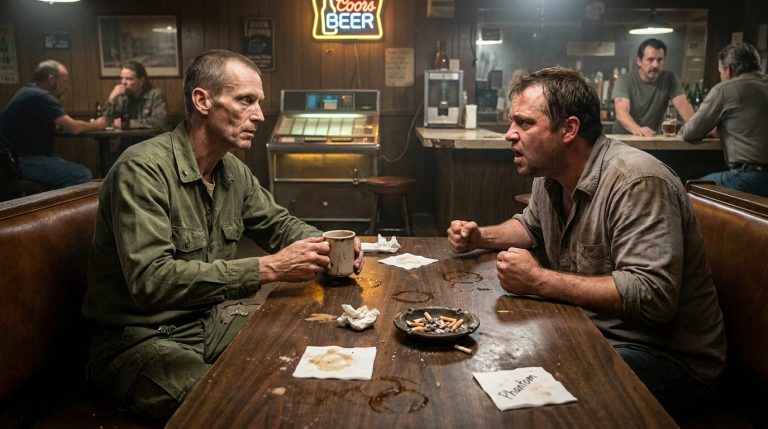
The Frozen Ridge Where One Canadian Sergeant Chose Mercy Over Orders and Saved the Enemy
CHAPTER 1: THE GRAY SHAPES
The frost bit through Macdonald’s gloves, turning his knuckles stiff and numb.
He lifted a boot out of the drift, the heavy snow sliding off the leather with a dull thud. Behind him, four men breathed in ragged, synchronized gasps that sounded like dry leaves scraping over stone.
Private Collins raised a mittened fist without a word.
Macdonald stopped instantly, his right hand sliding down the stock of his Lee-Enfield out of pure habit. His thumb brushed the scarred brass of his pocket compass where it sat in his breast pocket.
Ten paces ahead, three lumps of dark gray melted into the white expanse of the Reichswald Forest.
Pine branches groaned under frozen sleet overhead, dropping small pellets of ice onto Macdonald’s wool cap. He didn’t blink. He watched the nearest mound shift by a fraction of an inch—a microscopic twitch that no wind or settling drift could fake.
“Stay sharp,” Macdonald muttered, his voice barely carrying over the howl through the bare timber.
He moved forward, each step demanding the effort of lifting a bucket wet with cement. The air sat at eighteen below, and the moisture in his nostrils froze every time he drew a breath.
When he reached the first shape, the smell hit him before the sight did—wet wool, unwashed skin, and the distinct, coppery tang of approaching death.
A pair of teenage eyes stared up from the snow, glassy and rimmed with ice.
CHAPTER 2: SILENCE ON THE WIRE
Macdonald dropped to one knee beside the youngest German, his boots crunching sharply into the crusted snow.
The boy’s jaw was clamped so tight his lips had split into dark, jagged cracks of purple.
Collins shifted his weight behind him, the crisp pop of packed ice breaking the heavy silence of the timberline.
“Sarge,” Collins muttered, his breath pluming out in a thick, gray cloud. “The radio’s dead. Battery housing cracked clean through when we slipped down that embankment.”
Macdonald didn’t look up from the teenage soldier.
He reached into his pocket, his thumb rolling the cold brass of the compass back and forth until the metal warmed against his skin. There would be no calling Captain Williamson for authorization, no waiting for a voice over the static to debate the Geneva Convention or log enemy prisoners by the book.
“We don’t need a wire,” Macdonald said, his voice flat and low. “Give me your shelter half.”
Davies hesitated, his hands hovering over his canvas roll like the fabric itself might bite.
“They’re German, Sergeant,” Davies said, the words sharp with the lingering sting of three years of artillery and trench mud. “Command wants bodies counted and intelligence hauled back, not wrapped up like officers.”
“They’re kids with frozen lungs,” Macdonald snapped, the cold air burning the back of his throat. “Strip your pack. Now.”
The wind surged through the clearing, shaking the snow off the pine boughs and burying the edges of their boots in fresh white powder.
Macdonald forced his stiff fingers to pry open the outermost flap of the teenager’s frozen gray coat. The fabric was stiff as sheet iron, frozen solid by the melting snow that had soaked through hours before.
Every second they spent standing here debating protocol was another beat of a failing pulse under his fingertips.
He didn’t have permission, and he didn’t have a radio.
He only had four tired men and an abandoned barn two hundred meters back through the drifts.
CHAPTER 3: SMOKE IN THE RUINS
The rough timber runners scraped against the packed snow, dragging behind Collins and Davies like an anchor in deep water.
Each step toward the tree line required a conscious calculation of balance, the bitter wind blowing fine ice crystals directly into their unprotected eyes.
Macdonald walked at the rear, his right hand jammed deep into his coat pocket to wrap tightly around the cold brass compass.
“Keep the pace steady,” Macdonald warned, his voice rough from the freezing air. “Don’t let them jolt.”
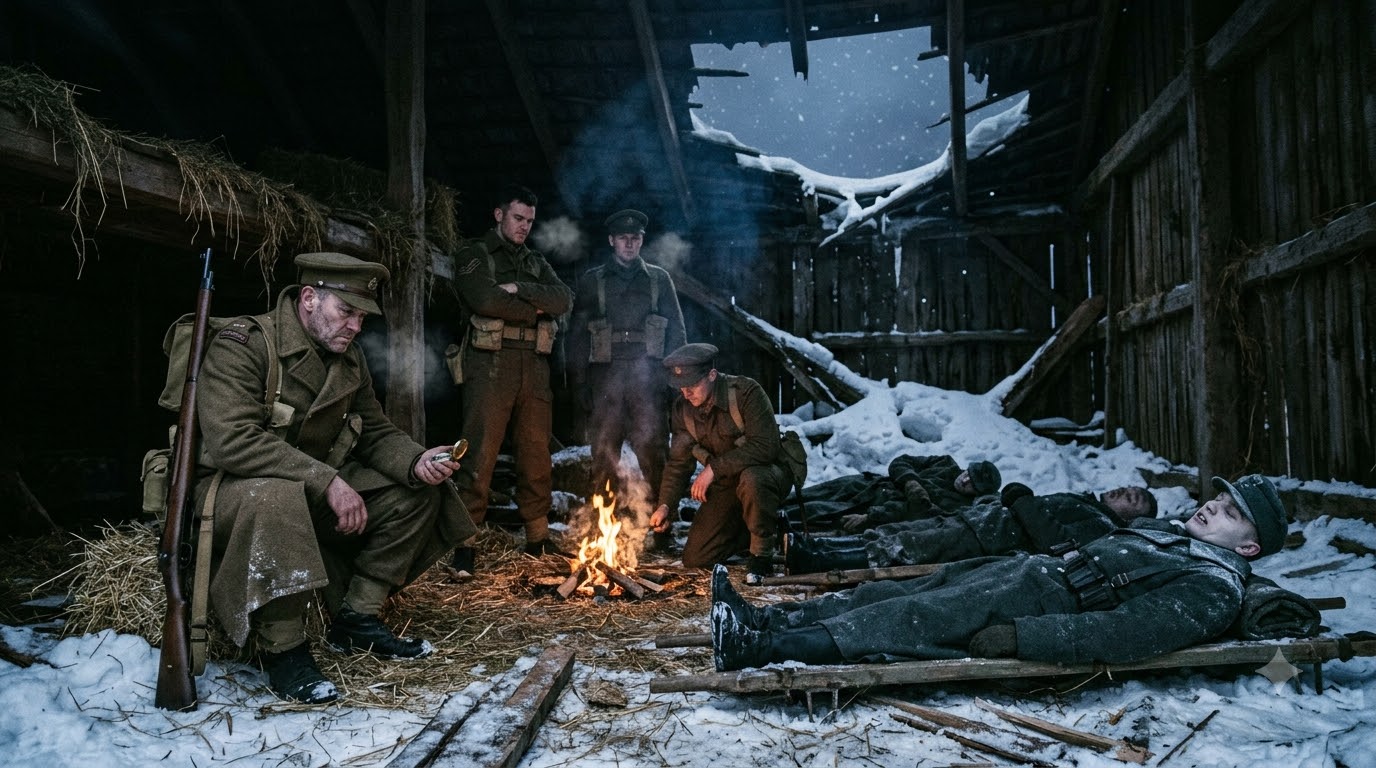
The skeletal frame of the abandoned barn loomed through the gray haze of the falling dusk, its half-collapsed roof sagging under thick drifts of white.
Inside, Bennett had managed to coax a small, sputtering blaze from damp hay and old fence posts, sending a thin column of blue smoke through the jagged hole in the timber roof.
The heat didn’t reach past the doorway, but the sudden absence of the tearing wind felt like stepping into another world.
They lowered the litters carefully onto a bed of dry straw near the back wall, keeping the distance wide enough to avoid the dangerous shock of rapid warming.
“Get the hot water ready,” Macdonald instructed, dropping to his knees beside the youngest German whose teeth clicked against each other like loose stones.
Davies wiped soot from his brow with a gloved forearm, his expression tight with lingering resentment.
“We’re burning our last dry rations for the enemy, Sarge,” Davies muttered, staring down at the pale, frost-bitten face of the teenager. “And the patrol report is already two hours overdue.”
“Let it be overdue,” Macdonald said, sliding the metal cup of melted snow toward the fire.
CHAPTER 4: THE MAJOR AUDIT
The heavy wooden door of the command tent slapped against the frozen stake outside, driven by a sharp gust of wind that smelled of wet wool and wood smoke.
Major Hrix did not look up from the leather-bound logbook spread across his folding table.
His thin fingers traced the margins of the morning patrol reports with a dry, rhythmic friction, the pencil lead scratching a sharp line across the paper.
“Sergeant Macdonald,” Hrix said, his voice flat and thin like winter ice. “Your patrol was logged back forty minutes ago. Yet your return signature is absent from the company register.”
Macdonald stood squarely in the center of the canvas floor, his boots leaving dark puddles of melted snow that soaked into the dry dirt.
His right hand remained buried in his pocket, knuckles locked hard around the cold brass of his pocket compass.
“We encountered complications on the ridge, sir,” Macdonald said, keeping his tone level against the rising pressure in the room.
“Complications,” Hrix repeated, finally lifting his head.
His eyes were pale, sharp, and entirely devoid of fatigue, fixing on Macdonald with the calculated scrutiny of an auditor checking missing inventory.
“The log missing from your squad packet indicates a stray transmission window, Sergeant. But your radio operator claims the unit was inoperable before you even cleared the second checkpoint.”
The silence in the tent stretched tight, broken only by the steady drip of melting frost running down the canvas roof.
“The radio broke during the descent, Major,” Macdonald answered, refusing to flinch under the stare. “We handled the situation on the ground.”
“By diverting squad resources to warm enemy combatants,” Hrix snapped, slamming his pencil onto the wood surface with a sharp crack. “You used fuel, rations, and time to coddle three teenage boys who belong in an intelligence pen—or a grave.”
CHAPTER 5: THE MAP IN THE DARK
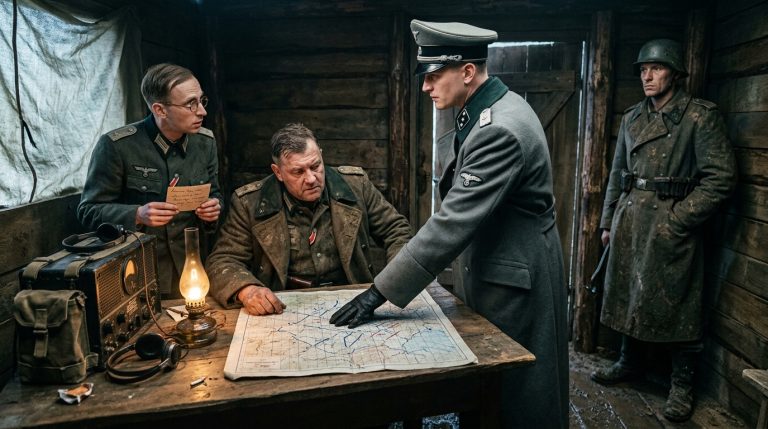
The canvas walls snapped under a heavy wave of sleet, the sound echoing like dry timber inside the cramped command tent.
Major Hrix leaned his palms against the rough wooden table, his face tight with controlled fury.
“You think a handful of freezing teenagers excuses insubordination, Sergeant?” Hrix demanded, his voice dropping to a harsh whisper. “The battalion relies on absolute order, not your personal crusade.”
Macdonald stood motionless, his boots planted firmly in the damp mud tracked from outside.
He didn’t blink as he reached into his coat pocket, pulling out a crumpled scrap of paper handed over quietly by the processing tent just an hour prior.
“The youngest boy we brought in,” Macdonald said, laying the rough pencil sketch flat on the center of the desk. “Hans Miller. He drew this before they loaded him onto the transport.”
Hrix glanced down, his thin eyebrows drawing together in a sharp line.
The paper showed a meticulous grid of the northern tree line, marking dozens of hidden pressure points beneath the snow where enemy engineers had buried high-explosive mines across the path of the advance.
“He mapped every single field between here and the ridge,” Macdonald added, his voice steady. “Twelve of our boys would have stepped straight onto those lines tomorrow morning.”
Hrix stared at the ink marks, his fingers twitching against the edge of the wood as the rigid calculation of military efficiency collided with the undeniable proof in front of him.
CHAPTER 6: THE LONG RETURN
Major Hrix stared down at the crude pencil strokes, his lips thinning into a hard, bloodless line as the tactical weight of the coordinates settled over the room.
The wind shrieked against the canvas flaps outside, driving a fresh flurry of sleet across the trench lines.
“This changes nothing regarding protocol,” Hrix muttered, though his hand lowered from the desk edge, the sudden fury draining out of his posture like water through a sieve.
“It changes the men coming back alive,” Macdonald said quietly.
He didn’t wait for a dismissal, turning on his heel and stepping out into the freezing dusk of the camp courtyard.
The transport truck idled near the main gate, its engine chugging through thick plumes of white exhaust into the darkening sky.
Macdonald walked past the rows of canvas tents, his thumb resting lightly against the scarred brass of the compass in his pocket.
There were no medals waiting for him, no formal commendations recorded in the battalion archives, and no speeches to mark the choice made in the bitter cold.
Just the heavy, honest rhythm of boots hitting the frozen mud and the quiet certainty of a job done right.
He reached his quarters, pulled off his stiff gloves, and set the small metal compass down on the rough wooden table.
The room was quiet, lit only by the faint orange glow of a small stove fighting the winter draft.
Macdonald sat down on the edge of the cot, unlaced his heavy boots, and let out a long, slow breath as the tension finally bled from his shoulders.