The Iron Fence: A Hardworking Farmer’s Silent Stand Against HOA Corruption and Petty Tyranny
CHAPTER 1: LINE IN THE DIRT
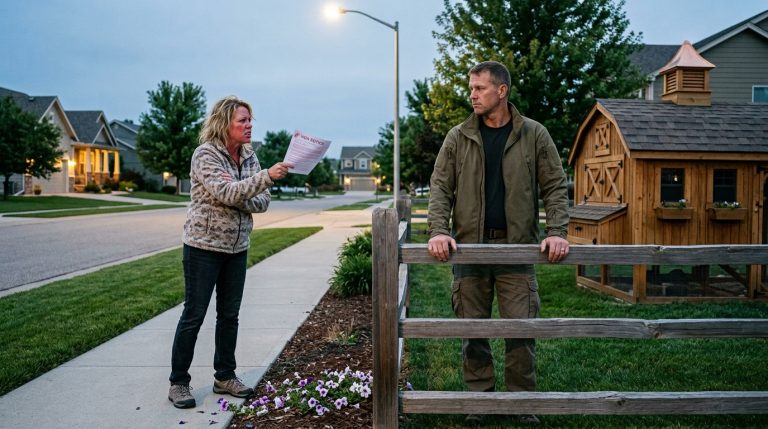
The grease on my work boots hadn’t even dried before the HOA president’s son stepped across my property line like he owned the dirt beneath them.
Tyler Klein didn’t walk like a man visiting a neighbor. He walked with his heels digging into the fresh gravel of my driveway, a shiny plastic badge pinned crooked to his windbreaker. Behind him, the sun was dipping low over the pine ridge, turning the dust from his idling SUV into a reddish haze.
“We’re doing the quarterly safety audit, Harlan,” Tyler said, not bothering to close the pasture gate behind him. He stopped three feet away, his thumbs hooked into his belt loops. “The board needs the keypad code for the armory shed back there. Community directive.”
I kept my hands on the heavy iron latch pin of the gate, feeling the cool, scarred brass in my palm. I rolled the metal pin between my thumb and forefinger, letting the iron rust bite into my calluses.
“You’re fifty yards onto private agricultural land, Tyler,” I said, keeping my voice down near my boots. “There’s no audit. And there’s no code for you.”
Tyler pulled a folded sheet of paper from his pocket and tapped it against his palm. “Section Four, Paragraph B. Emergency asset inspection. Your armory holds high-capacity equipment. My mother signed off on the sweep fifteen minutes ago.”
He jammed his thumb against his phone screen and held it out on speaker. The speaker crackled instantly with the shrill, rehearsed cadence of Marjorie Klein.
“Harlan, you will cooperate with Tyler immediately,” Marjorie’s voice cut through the quiet farmyard. “Non-compliance will be documented as an active safety hazard to the neighborhood. We will secure that structure whether you hand over the combination or not.”
“You don’t have jurisdiction over deeded farm property, Marjorie,” I said to the phone, testing the solid weight of the brass pin against my knuckles. “The state statute is clear. You drop one more notice in my box without a court order, and I file for criminal harassment.”
A beat of silence hung over the speaker—just the faint hum of Marjorie’s kitchen refrigerator three miles down the paved suburban loop.
“Consequences, Harlan,” she snapped, and the line went dead.
Tyler didn’t look bothered. He grinned, revealing small, white teeth, and took one step closer, his boot heel grinding a sharp grey rock into the dirt. “She’s not bluffing, old man. You’ve got forty-eight hours before we bring heavy equipment to clear the obstruction.”
He turned on his heel and walked back toward his vehicle, leaving the wooden gate swinging open in the wind. I didn’t yell after him. I stepped over, pulled the heavy oak frame shut, and slotted the brass pin into place with a hard, metal clink.
CHAPTER 2: PAPER WEAPONS
The oak gate frame was still vibrating against the fence post when the high-beam headlights of a black SUV cut across the treeline at the edge of my north pasture.
It didn’t turn up the drive. It pulled onto the gravel shoulder opposite my mail slot, killed its engine, and sat there with its running lights idling in the dark. A low, rhythmic ticking hummed through the damp night air as the exhaust manifold cooled.
I didn’t head down to the road. I walked back toward the farmhouse, the heels of my work boots sinking into the soft earth along the fence line. I picked up a heavy flashlight off the porch step, keeping the beam clicked off.
By sunrise, the SUV was gone, but the physical record of their visit was left sticking out of the galvanized steel mailbox.
It wasn’t a standard letter. It was a neon-yellow sheet of cardstock, stamped with heavy black ink that read URGENT NOTICE OF NON-COMPLIANCE. No signature from a board member. No vote tally. Just a blanket thirty-day ultimatum demanding full administrative access to all secondary outbuildings for “hazard mitigation.”
I carried the paper down to the armory shed, the stiff stock crackling in my work-gloved hand. The morning frost was still clinging to the metal siding, turning the grey paint white near the foundation.
That’s where I saw the fresh tire tracks. Deep, aggressive tread cuts carved into the damp soil right alongside the eastern wall of the shed, where the gravel ended and the grass began. Someone had backed a heavy quarter-ton truck off the access lane, creeping within inches of the iron door frame.
I knelt in the dirt, tracing the rubber impression with my bare thumb. The tread pattern was brand new—heavy-duty all-terrain, the kind Tyler Klein had slapped on his lifted pickup three weeks ago.
Beside the track, resting on top of a crushed fence staple, was a folded slip of white paper, smeared with grey axle grease.
I picked it up and opened it carefully. It wasn’t an HOA form. It was a hastily scribbled grid drawn on grid-lined notepad paper, listing caliber numbers in one column and rough box counts in another. No serial numbers. No legal descriptions. At the bottom, in tight, hurried handwriting, were four words: Buyer wants total inventory.
I folded the paper, slipped it into my canvas vest pocket, and let out a slow, cold breath through my teeth.
They weren’t trying to enforce community bylaws. They were sizing up a shipment.
A vehicle door slammed out by the front gate. I stood up, smoothing the front of my vest, and stepped around the corner of the armory shed to see who was trespassing now.
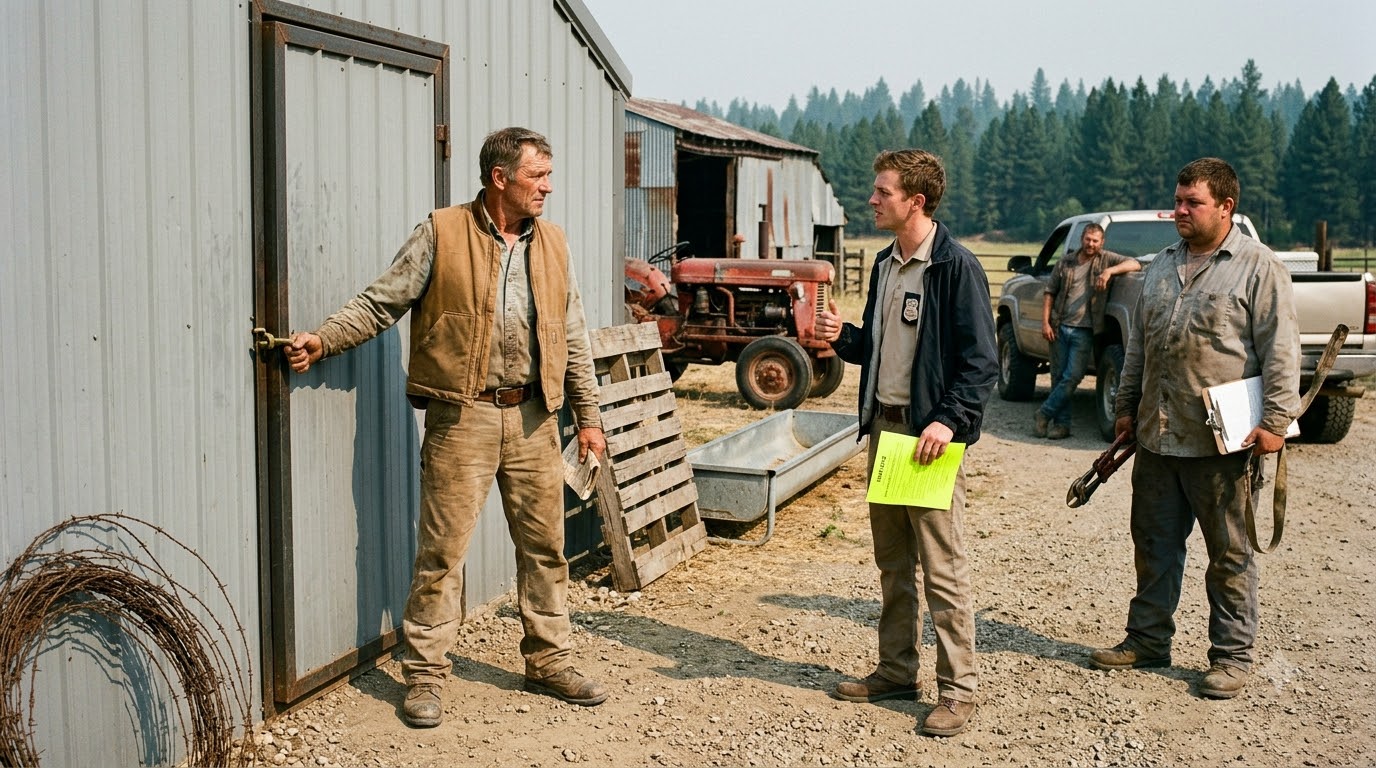
Tyler was back, but he wasn’t alone. He had two men with him this time—local hired hands who usually hauled hay for the county fairgrounds. One of them carried a heavy steel clipboard; the other had a pair of thirty-inch bolt cutters slung over his shoulder like a rifle.
“We’re serving the formal inspection directive, Harlan,” Tyler shouted across the thirty yards of gravel, his voice carrying that cheap, unearned weight of a man using his mother’s title as a shield. “You’ve got five minutes to clear the entryway.”
I didn’t reach for a tool. I didn’t raise my voice. I took three steps forward, stopping right at the edge of the crushed-stone path.
“You bring those bolt cutters one inch closer to that door latch, Tyler,” I said, pointing a calloused finger straight at his chest, “and you’ll be answering to the county sheriff for attempted commercial burglary.”
“This is HOA property management!” the man with the clipboard barked, stepping up alongside Tyler. “We’ve got administrative authority!”
“You’ve got a piece of yellow cardstock and a trespass warning,” I replied, my voice dropping an octave into a hard, flat line. “Read the deed on file at the courthouse. The HOA bounds stop at the drainage ditch. You’re on agricultural land, and you’re stepping on a felony.”
Tyler’s smile twitched, his right hand making a quick, nervous jerk toward his coat pocket before he caught himself. The man with the bolt cutters hesitated, shifting his weight from one muddy boot to the other, looking at the distance between my boots and the steel door of the armory.
“We’ll document the refusal,” Tyler said, though the cocky edge in his tone had turned thin and brittle. “Enjoy the fines, old man. They double every twenty-four hours.”
He turned and gestured for his crew to fall back toward the trucks. I stood anchored in the gravel, watching them retreat, the grease-stained paper in my vest pocket pressing cold against my ribs.
CHAPTER 3: THE SHADOW INVENTORY
I stood on the gravel drive holding the folded, grease-stained inventory note as the dual-exhaust rumble of Tyler’s truck receded down the county road.
The dust cloud took three minutes to settle over the ditch line. I smoothed out the grid-lined paper on the flat wooden hood of my tractor, tracing the handwriting again with a clean thumbnail.
It wasn’t an official record. It was a tally sheet.
I pulled the neon-yellow notice card out of my canvas vest and laid it right beside the grease-smudged grid. The ink on the yellow card was crisp, printed from a home laser printer. The note on the grid paper was written in blue ballpoint, pressed so hard into the page that the numbers left raised ridges on the back.
Two distinct handwritings. One belonged to Marjorie Klein’s administrative crusade. The other was the tight, slanted script of a man checking crate counts in a dark shed.
I took the brass latch pin from my pocket and tapped it against the tractor hood, the hollow ring echoing off the sheet-metal barn.
A silver sedan turned off the highway and pulled up beside the mailbox. My attorney, Miller, stepped out into the gravel, his worn leather briefcase tucked firmly under his arm. He didn’t bother looking at the fence line; he looked straight at the tire tracks cut deep into the grass near the armory.
“You called before eight, Harlan,” Miller said, unbuttoning his tweed jacket as he walked up to the tractor. “They cross the property line again?”
“They brought bolt cutters,” I said, sliding the two pieces of paper across the tractor hood toward him. “And they left a paper trail.”
Miller set his briefcase on the wheel hub and put on his reading glasses. He picked up the yellow HOA notice first, giving it a quick, practiced scan before dropping it back down. Then he picked up the grease-stained inventory note.
His fingers stopped moving. He turned the paper over, feeling the raised ridges on the back.
“Where’s the serial list?” Miller asked softly.
“There isn’t one,” I said. “Just counts. Caliber, crate numbers, and a note at the bottom about a buyer.”
“This isn’t board business, Harlan,” Miller said, his eyes tracking over the handwritten grid. “If an HOA board attempts to catalog or seize private property without a court order, it’s civil trespass. If they’re generating off-book inventory lists for third parties, it’s conspiracy.”
“They’re using the fake compliance notices as cover,” I said, tapping the brass pin on the hood. “Marjorie issues the paper threats to keep me defensive, while her son brings the muscle to inspect what’s inside. They aren’t trying to regulate my property. They’re trying to broker it.”
Miller took a manila folder from his briefcase, slid both papers inside, and clicked the clasp shut.
“I’m filing an emergency injunction with the county clerk before noon,” Miller said, his voice flat and deliberate. “No digital filings, no phone arguments. Hard physical copy of the deed, the trespass report, and this paper trail. If they step on this gravel again before the judge signs, it’s felony territory.”
“They won’t wait for a judge, Miller,” I said, looking down the driveway toward the pasture gate where the bison were grazing near the fence line. “Tyler’s on a clock. Buyers don’t wait when there’s six figures on the table.”
Miller locked his briefcase and looked me dead in the eye. “Then keep your gate pinned, Harlan. The law moves on paper, but night comes fast out here.”
CHAPTER 4: THE MIDNIGHT INTRUSION
The heavy brass latch pin was cold against my palm as Miller’s sedan pulled out onto the asphalt, its tail lights fading into the dark treeline at the edge of the property.
By eleven o’clock, the wind picked up off the ridge, rattling the tin roof of the armory shed. I didn’t turn on the yard lights. I sat on the porch step, rolling the brass pin across my knuckles while the dark pasture stretched out toward the fence line.
A sharp, metallic snap cut through the wind—the unmistakable screech of high-tensile perimeter wire giving way under heavy steel jaws.
I stepped off the porch into the shadows, keeping my heels quiet on the grass. Headlights sliced through the tree line as two unmarked pickup trucks rolled across the torn wire, their tires chewing through soft pasture dirt without stopping.
Four men stepped out before the engines even killed. Tyler Klein led the line, his white windbreaker glinting in the pale moonlight. Behind him were the same two hired hands from the morning, plus a fourth guy holding a low-slung hunting rifle across his chest.
“Keypad code, Harlan!” Tyler shouted, his boot crushing a fence post brace as he shoved me backward into the gravel. “Say it now!”
I caught my balance against the gate post, my fingers wrapping tight around the brass latch pin. “You’re cutting state-regulated agricultural wire, Tyler. This is armed burglary.”
“It’s a community reclamation!” Tyler yelled, his face flushed red under the truck cab lights. He gestured sharply to the guy with the rifle. “Get between him and the pasture! Move!”
The armed thug stepped in close, the cold barrel of the rifle pressing straight into the canvas fabric over my ribs. I felt the hard, circular metal bite into my sternum through my shirt, pinning me against the oak gate frame.
“Keypad,” the man grunted, his thumb resting over the rifle lock. “Rifles, ammo, everything you’re hoarding. Open the shed.”
“No,” I said.
The man raised the rifle barrel two inches, angled it past my shoulder toward the dirt beside my left boot, and squeezed the trigger.
The muzzle flash blinded the yard for a fraction of a second. The gunshot cracked like thunder against the metal shed walls, tearing through the quiet night and spraying sharp gravel against my work pants.
The earth beneath my boots bucked violently.
Behind the gate, a deep, furious bellow ripped through the dark, followed by the deafening sound of two hundred heavy hooves smashing into the timber frame.
The wooden pasture gate didn’t just swing—it shattered.
CHAPTER 5: THE RAMPAGE AND RANSOM
I pressed my spine flat against the splintered oak gate frame as fifty thousand pounds of bison herd burst through the crushed pasture fence into the farmyard.
Massive dark bodies surged through the gap, hooves tearing up six-inch chunks of wet gravel and sod. The herd didn’t care about the trucks, the bolt cutters, or the paper directives. They reacted purely to the gunshot, the shouting, and four strangers standing directly in their night path.
The thug who fired the warning shot scrambled backward, tripping over his own boots as a two-thousand-pound bull brushed past the passenger door of his truck, crumpling the side mirror like tin foil.
Tyler didn’t scream orders anymore. He scrambled onto the hood of his pickup, his white windbreaker covered in mud splatters as the herd compressed into the yard, blocking every path back to the county road.
I didn’t reach for a weapon, and I didn’t shout. I stepped behind the heavy cedar corner post, pulled my flip phone from my belt pocket with a steady thumb, and keyed three numbers into the physical pad.
“County dispatch,” I said into the receiver, keeping my eyes locked on the truck hood where Tyler was shaking. “I have an armed burglary in progress at the Harlan farmstead. Shots fired by trespassers. Send deputies.”
Before the dispatcher could reply, a phone rang out loud in the yard—not mine, but Tyler’s. The speaker was cranked so loud I could hear Marjorie Klein’s panicked shrill over the thundering hooves.
“Tyler! What is that noise?” Marjorie shrieked. “Did you secure the armory code? The buyer’s representative is waiting on the line!”
Tyler fumbled with his phone, his face pale under the truck’s cab lights. “Mom, there are animals everywhere! He let them out! Call off the deputies!”
“You put her on speaker, Tyler,” I called out from behind the cedar post, holding my open line high enough to catch every word. “Tell your mother the county sheriff’s department is listening to her buyer.”
“You’re going to pay for what you did to my son, Harlan!” Marjorie screamed through the phone speaker, her voice breaking in a desperate, unhinged pitch. “You defaulted on the inspection! That property belongs to the association!”
“The association didn’t sign that inventory paper, Marjorie,” I said, my voice cutting flat through the chaos. “Your son left the buyer’s tally sheet right by my shed door.”
On top of the truck, Tyler froze. His jaw dropped, his hand trembling so hard he almost dropped his phone into the mud below where a lead cow was rubbing her shoulder against his bumper.
In the distance, past the north ridge, red and blue strobe lights began flashing through the timberline, accompanied by the low, rising wail of county sirens.
Tyler looked down at the mud, then at the road, then at me. The entitlement was gone, replaced by the sheer, cold panic of a man who realized the ground beneath him had completely given way.
CHAPTER 6: THE IRON LATCH
I stood leaning back against the cedar corner post with the open flip phone resting in my hand as county deputy cruisers pulled through the broken fence line into the churned yard.
Red and blue strobe light washed over the churned mud, catching the steam rising off the bison herd as they slowly settled back along the north pasture line.
Deputies moved in fast, weapons unholstered but held low, cutting off every escape angle around the two trapped pickup trucks. Tyler Klein tried to slide off the hood, his boots slipping in the slop before two deputies grabbed his arms and forced him down onto the gravel, pinning his wrist behind his back.
“This is a civil issue!” Tyler yelled, his face pressed against the wet dirt. “My mother is the HOA president! She authorized this inspection!”
Marjorie Klein’s sedan came tearing down the drive ten seconds later, spraying gravel against the wooden barn before coming to a dead stop. She thrown the door open and stepped right into the mud in her leather heels, her phone held out like a weapon.
“Sergeant, unhand him immediately!” Marjorie shouted, her voice shaking with unhinged rage. “That man is an outlaw landowner harboring unregistered hazards! We have an emergency security directive!”
The lead deputy didn’t flinch. He reached into his coat pocket, pulled out the manila folder Miller had filed with the clerk five hours earlier, and held up the physical court injunction.
“There is no directive on file with the county, ma’am,” the sergeant said, his voice flat and unyielding. “Your son is under arrest for armed burglary, felony trespass, and criminal conspiracy.”
Marjorie’s face drained of color as Miller stepped out from behind the second patrol car, carrying a fresh stack of stamped legal papers. He handed one copy straight to the county investigator standing beside the lead cruiser.
“The paper trail is complete,” Miller stated clearly. “We have the handwritten inventory tally sheet with matching handwriting samples from Mr. Klein, explicitly listing crate numbers for off-book third-party sale. No board minutes, no legal standing, complete fraud.”
Marjorie opened her mouth, her hands trembling violently as she tried to point at me, then at the attorney, then at her son being pulled up from the mud in handcuffs. “He framed us! He planted those papers! I’ll sue this entire department!”
“Save it for your arraignment, Mrs. Klein,” the investigator said, stepping forward to take her phone. “The state attorney’s office has already frozen the association’s bank accounts pending a full financial audit.”
She didn’t get a final speech. A deputy guided her firm hand by hand toward the rear seat of the squad car, her authority completely dismantled in front of six neighbors who had gathered silently near the road.
By two in the morning, the tow trucks had cleared the pasture lane, the sirens had faded into the valley, and the farmyard was silent again.
I walked over to the broken pasture gate, picked up a fresh length of heavy oak timber from behind the barn, and set to work. I drove two steel braces deep into the earth with a sledgehammer, fitted the timber into place, and smoothed the rough edges with my bare thumb.
I slid the heavy brass latch pin into the new iron housing. It settled into place with a solid, honest metal clink that echoed off the quiet pasture.
I rested my hand against the cool, dark wood of the gate, looking out over the quiet herd resting under the stars, completely done with unreasonable people.