The Resonance of Silence: A Former Operative Finds Grace Beneath the Montana Sky
CHAPTER 1: THE PORCH EXHALE
The coffee was French roast, black, no sugar—the same bitter, acidic fuel that had kept her eyes open in safe houses from Prague to Budapest. It burned with a familiar heat, settling into her stomach like an anchor. Evangelene Blackwood stood on her porch, her knuckles white against the chipped ceramic of her mug. The Bitterroot Mountains watched her, their peaks jagged and indifferent, wrapped in the slow, amber breath of a Montana morning.
Seventy-three years of life had etched her face into a landscape of its own, a map of survival that only she knew how to read. She watched the spirals of steam rise and vanish into the biting cold, a fleeting dance of life against a backdrop of frozen silence. Eight years ago, William had died, and with him, the last person who had seen the woman behind the mask. Since then, her existence had been calculated, rhythmic, and perfectly, dangerously quiet.
Fifty acres of isolation. Defendable terrain. Sight lines that would make a general weep. It was a life built on the premise that if you were still, the world would eventually look past you.
The gravel in the driveway crunched—a sharp, discordant sound that didn’t belong in her meticulously curated peace.
She turned, her movements slow, deliberate, the posture of a retired nurse watching for a stray neighbor. Her eyes swept the driveway. Three heavy touring bikes lay sprawled like wounded, dying insects. The air grew thick, not just with the smell of exhaust, but with the metallic tang of fresh blood.
A man lay closest to the house, his leather vest marked with the patch of the Iron Wolves. He wasn’t moving.
Her heart didn’t race. It didn’t stutter. It simply accelerated into a state of hyper-focused clarity, the neural pathways of a lifetime of trauma-response firing in silent, perfect unison. The coffee mug in her hand felt heavy, an absurd anchor to a life she was abandoning in this exact second. She set it on the porch railing with a soft, final clack.
She didn’t run. She moved with a measured, predatory efficiency that she hadn’t touched since the warehouse fire in Budapest, a lifetime ago. As her boots hit the gravel, she felt the phantom weight of a Glock 19 at her hip, a ghost of iron and steel that had been locked away in a false-bottom dresser for three thousand nights.
She reached the first man—Reaper, the patches said—and felt the cold weight of the gravel beneath her knees. Her fingers, despite the stubborn ache of arthritis, found his carotid artery with the touch of a surgeon. The pulse was there, thready and frantic.
She looked up, scanning the driveway. It wasn’t an accident. The motorcycles were laid out with a geometric precision that mirrored the clinical violence of her own training. Someone had done this to them. Someone who wanted her to see it.
The morning air felt suddenly thin. She wasn’t a widow, and she wasn’t a nurse. She was a target, and the hunt had officially begun.
CHAPTER 2: THE ANATOMY OF A BAIT
Evangelene’s fingers lingered on Reaper’s neck. The pulse was there—a weak, flickering rhythm against her calloused fingertips—but the man beneath her was nothing more than a variable in an equation she hadn’t yet solved. She withdrew her hand, wiping a smear of dark, viscous fluid onto her jeans. The stain was bright, jarringly vibrant against the faded denim, a visual anchor to the fact that her sanctuary had been breached.
She stood, her knees popping with a sharp, dry protest that echoed in the quiet air. She didn’t look at the house. She looked at the bikes.
Professionalism had a specific texture, and this was it. The way the Harleys were arranged—not crashed, but placed, their engines disabled with surgical precision, their oil lines severed to create a specific, slow-spreading slick across the pale stones—was a language she recognized. It was a message written in wreckage. Whoever had done this hadn’t just been looking for a fight; they had been staging a scene. They had needed her to find them, to touch them, to drag them into the house where they could be documented, observed, or manipulated.
She glanced at the second rider, Axel. His breath hitched—a wet, rattling sound that signaled the internal trauma she had already noted. He was a piece of collateral, a human signpost left in her driveway to force her hand.
She turned and walked back toward the porch, her gait steady, the shuffle she used for church socials abandoned for the efficient, rolling stride of a field operative. She needed supplies. She needed the kit she had buried under a floorboard in the pantry, a box she hadn’t touched since the day she’d learned that ghosts don’t retire—they just wait.
As she stepped onto the porch, a stray thought pricked at her—a phantom sensation of cold dampness, the smell of brick dust and smoke, the sharp, acidic sting of ozone. Budapest. November, 1989. The warehouse was burning, the records were screaming into the void, and she was already dead. The memory hit her with the force of a physical blow, a sudden intrusive tremor that threatened to shake her steady hands. She gripped the railing, the wood rough and familiar beneath her palm, forcing the ghost back into the dark corner of her mind where it belonged. She was not Elena Ror anymore. She was Evangelene, and she had work to do.
Inside, the house felt suddenly small, a fragile barrier against the intrusion of the world she had spent decades fleeing. She bypassed the kitchen and moved straight to the pantry. The mason jars of raspberry preserves sat in a neat, dust-free row, a testament to the persona she had spent fifteen years perfecting. She pushed the jars aside, her hand finding the hidden latch.
The mechanism clicked—a soft, metallic sigh that seemed deafening in the silence. She pulled the floorboard up. The steel case sat there, matte-black and devoid of markings, its surface cool to the touch. When she opened it, the smell of oil and high-grade plastic hit her—a sharp, nostalgic scent that made her pulse jump.
She retrieved a field suture kit and a vacuum-sealed pack of blood-clotting gauze. Her hands, usually so stiff with the onset of the morning, moved with a sudden, fluid grace. She wasn’t thinking about the arthritic ache; she was thinking about the trajectory of the bone in Axel’s arm, the depth of the laceration on Reaper’s scalp, the potential for internal hemorrhaging. She worked the materials into her pockets, her movements economical.
She wasn’t just saving lives; she was gathering intelligence. She knew the weight of these men. She knew the quality of their leather, the make of their patches. They were Iron Wolves—the local color of a region she had chosen specifically because it was supposed to be empty. But these men were not locals. They were the kind of men who drew trouble, and the fact that they had been dumped here, on her road, was not a coincidence. It was a prompt.
She looked at her reflection in the darkened glass of the pantry door. The woman looking back was old, her hair a silver tangle, her face a web of lines. But the eyes—they were the same. The same eyes that had watched the Volulta River for hours, waiting for a signal that never came.
She exited the house, carrying the medical gear like a weapon. The morning sun was beginning to climb higher, stripping away the shadows, but the cold remained. She returned to the driveway, to the carnage that sat so precisely, so intentionally, on her land. Reaper’s eyes fluttered open as she knelt beside him again. He looked at her, his vision clouded by pain and concussion, a flicker of genuine shock in his gaze.
“Who…” he wheezed, the word lost in a spasm of pain. “Who are you?”
She didn’t look at him. She was already busy, her hands moving with surgical speed to stabilize his head. “I’m the person who keeps you breathing until you can tell me exactly which one of you decided to use my driveway as a dumping ground,” she said, her voice devoid of its usual warmth. It was flat, transactional—the voice of Nightingale.
She felt the weight of his stare, the confusion, and the fear. She didn’t care. She had a diagnostic to run, a perimeter to secure, and a ghost to exorcise. The game had shifted, and for the first time in years, the board wasn’t just in her head—it was in her driveway.
CHAPTER 3: THE RECLAMATION OF THE BARN
Evangelene did not wait for Reaper’s response. His confusion was a luxury she could not afford; the clock was already ticking, and the geometry of the crime scene suggested that someone, somewhere, was watching the results of their handiwork. She turned her back on the injured man, her joints popping like dry kindling as she stood, and walked toward the barn.
The structure stood at the edge of the property, a weathered skeleton of gray cedar and iron. To any casual observer—the rare neighbor or the occasional delivery driver—it was a storage locker for rot and rusted memories. She stepped inside, the atmosphere shifting instantly. The air here was heavy with the scent of dry hay, dormant dust, and a faint, sharp undercurrent of machine oil—a fragrance that pulled at her senses with the persistence of a recurring dream.
She navigated the floor with a rhythmic, measured cadence, her boots finding the paths worn into the dirt over fifteen years of phantom movements. The barn was a maze of her own construction. Every bale of hay, every rusted harrow, every loose board was a coordinate in a map of survival. She reached the far corner, where a stack of heavy, twine-bound bales created a fortress of shadow.
Her shoulders ached as she shifted the weight. One by one, the bales slid against each other with a sound like grinding teeth. Behind them lay a rotted canvas, its fabric brittle. She peeled it back, revealing the steel case. It sat in the half-light, a matte-black monolith that seemed to absorb the dim morning rays filtering through the gaps in the roof.
Her fingers traced the clasp. The biometric scanner was cold—a biting, surgical chill that woke the nerves in her fingertips. She pressed her thumb to the surface. There was a faint, pressurized hiss, the sound of an airtight seal being broken after a decade of stagnation. The lid fell open with a mechanical grace that felt like a betrayal of her quiet life.
There they were. The tools of Nightingale.
The medical supplies were at the top, a neatly organized tray of glass ampules and sterile dressings. Below them, resting in custom-cut foam, lay the Glock 19. The pistol was a dark weight in her hand, its balance perfectly, terrifyingly familiar. She didn’t rack the slide yet; she simply held it, the checkered grip biting into her palm. Beside it were the passports. Three faces, three names, three ghosts that she had buried in the name of peace.
She felt the shift in her own internal landscape—a V-4 divergence, a fraying of the edges. Was she Evangelene, the nurse who fretted over lavender harvests and church socials? Or was she Elena Ror, the operative who could disassemble a room’s tactical integrity in under three minutes? The lines began to blur, shimmering like heat haze over asphalt. She looked at the passports, then at her own trembling, arthritic hand, and she realized the irony: the hands were the same. The arthritis hadn’t stopped the muscle memory. The years hadn’t dulled the instinct.
She moved with a new, dangerous urgency. She packed the medical kit into a heavy-duty canvas bag, along with the weapon and one of the passports—Katherine Wolf, a woman who didn’t exist, and therefore, a woman who could never be killed.
As she closed the case and pushed the hay bales back into place, she heard it—a sound, or the absence of one. A shift in the wind outside? A snapping twig near the tree line? Her posture shifted instantaneously. The shuffle was gone. She was centered, her center of gravity dropped, her senses expanded to the very limits of the barn walls.
She exited the barn, the bag slung over her shoulder, her hand resting firmly, hidden, on the Glock. The driveway was exactly as she had left it. Reaper was staring at the sky, his breathing shallow. Axel was unconscious, his face a mask of pale, waxy exhaustion.
She walked past them, not toward the house, but toward the crest of the hill that overlooked the long, winding road leading to the main highway. If someone had been watching, they would have seen the woman. They would have seen the nurse. They would not have seen the hunter.
The wind bit at her face, cold and unforgiving. She paused at the ridge, her eyes scanning the tree line. The silence of the Bitterroot Mountains felt predatory now, a heavy, waiting thing. She realized then that the decoy wasn’t just the men in the driveway. The decoy was the house. The entire property was a stage, and she had spent fifteen years playing the lead in a play that had just been cancelled.
She didn’t feel fear. Fear was for people who had something to lose. She had already lost it all in a warehouse in Budapest in 1989. What she felt was a sudden, violent return of purpose.
She watched the horizon, her finger resting on the edge of the trigger guard. She was waiting for the next movement, the next calculation. She was waiting for the real architect of this morning to reveal themselves, and when they did, she would be ready to dismantle their work piece by piece. She had been playing the part of the widow for eight years; it was time to remember why the ghost had gone to ground in the first place.
CHAPTER 4: THE FRACTURED HORIZON
Evangelene didn’t wait for the phone to stop buzzing; she snapped the protective cover shut, the sound sharp as a gunshot in the thinning twilight. She didn’t head back to the house. Instead, she dropped into a crouch behind a cluster of scrub pine, her eyes tracing the line of the ridge. The signal wasn’t just a glitch. It was a handshake—a ping from a network that shouldn’t exist anymore, tracing her position with the ruthless efficiency of a laser.
Dmitri had not come alone. He had brought the digital ghosts of the KGB into the 21st century.
She moved back toward the ranch, but her path was no longer a straight line. She zigzagged, using the natural topography of the Bitterroot foothills to minimize her silhouette against the fading amber of the sky. Her arthritic hand, tucked deep into the pocket of her cardigan, clamped around the grip of the Glock. Every muscle in her body was screaming now, a symphony of protest against the sudden, forced shift from the rhythm of retirement to the kinetics of combat, but she silenced the pain with the same cold, operative discipline she used to bury her memories.
As she cleared the treeline and approached the rear of the barn, she caught the faint, rhythmic scraping of metal on stone. She froze, her breath coming in shallow, controlled sips of the biting air. Inside the barn, a shadow moved. It wasn’t the slow, heavy gait of Reaper, and it wasn’t the tentative shuffle of a civilian. It was the lean, predatory motion of someone who knew how to clear a corner.
She dropped her bag in the tall grass and circled toward the side entrance, moving with a silence that defied her seventy-three years. She pulled the Glock, the steel cold against her palm, and checked the chamber. One round. No safety. She was not a nurse. She was a liability that needed to be cleaned up, and she was going to be the one to do the cleaning.
She kicked the side door inward—a single, violent exertion of force—and pivoted inside, her weapon leading her gaze.
The barn was empty of life, but not of activity. The stack of hay bales she had rearranged earlier was partially dismantled, and a small, electronic device sat on the dirt floor, blinking with a steady, malevolent red light. It was a signal beacon.
Her mind raced, connecting the dots in a web of cause and effect. They hadn’t come for the bikers. They hadn’t come for her. They had come to turn the ranch into a relay station. The bikers were just the initial pressure, the catalyst to force her into her own defensive network, and now, they were using that very network to pinpoint the exact location of her safe-haven protocols.
She knelt beside the beacon. It was a compact, professional piece of kit—the kind used by special operations units to designate targets for extraction or fire support. She didn’t reach for it with her hands; she used the edge of a rusted iron pry bar she pulled from the wall. As she tilted the device, she saw the serial number etched into the casing. It was dated 1984.
The realization hit her with the weight of a falling mountain. It wasn’t a new device. It was a relic, a piece of gear she had handled forty years ago in Prague. Dmitri wasn’t just hunting her; he was re-enacting the past, using the very objects that defined their collision course to force her into a corner.
She turned the device over and found the kill-switch, a simple manual override that she triggered with a sharp flick of the pry bar. The blinking red light died, plunging the barn into a sudden, suffocating gloom.
The silence that followed was heavy, laden with the anticipation of a counter-move. She stood, her heart hammering against her ribs, and listened. Outside, the wind rattled the loose boards of the barn, a hollow, lonely sound. She had neutralized the signal, but she had lost the advantage of surprise. She was no longer watching; she was being watched by someone who knew her tactical habits better than she knew them herself.
She moved back to the side door, her hand tight on the Glock. As she reached the threshold, she stopped. The evening air felt different—thick with the ozone of a pending storm, or perhaps the static of a closing net. She realized then that the decoy had shifted. She was no longer looking for the hunter; she was looking for the mirror.
She walked out into the yard, the cold air stinging her skin. The house stood dark, a silhouette against the rising moon. She had the medical supplies, she had the weapon, but she had lost the comfort of the lie. She walked toward the porch, her boots crunching on the gravel, and for the first time in her life, she felt the weight of the years—not as a burden, but as a weapon. She would not hide in the cellar. She would not wait for the FBI. She would force the next move. She would walk into the dark, and she would find out exactly what kind of ghost was standing on the other side of the ridge.
CHAPTER 5: THE SIEGE OF SILENCE
The light died with a sharp, electronic pop, leaving the yard in a state of absolute, oppressive darkness. Evangelene stood on the porch, the transition so abrupt that for a heartbeat, her eyes struggled to adjust to the void. Then, the moonlight filtered through the pine needles—pale, ghostly silver against the ink-black landscape—and she saw them.
Movement. Not the disorganized swarm of criminals, but the disciplined, low-profile advance of a tactical team. They were emerging from the tree line, ghosts in tactical matte-black, hugging the uneven terrain of the Bitterroot slope. They were coming for the house, expecting the terrified, confused nurse to be hunkered down in the cellar, trapped in the very box she had built to hide her past.
She didn’t move. She allowed herself to become part of the structure—a silhouette indistinguishable from the weathered cedar posts of the porch. Her hand, steady as stone, gripped the Glock. She had spent the last hour meticulously preparing the terrain, not for a defense of the house, but for the dismantling of the hunter.
She took a slow, measured breath, the cold air filling her lungs and clarifying her focus. She had disconnected the main power breaker inside the barn, not just to force a blackout, but to create a sensory vacuum. These men relied on optics, on thermal, on digital feedback. Without power, they were blind in the dark.
She moved. Not toward the cellar, but toward the side yard, staying beneath the sightlines of the approaching team. She needed to draw them into the killing ground she had fashioned between the barn and the chicken coop—a zone she had mined with the very tools she had meant to leave in the past.
A shadow peeled away from the group, moving toward the house’s back entrance. This was it—the point man. He was professional, his rifle sweeping the yard with a practiced arc. He didn’t see her. He couldn’t. She was moving through the shadows like a memory. As he reached the edge of the porch, she stepped out, not with a shout or a warning, but with the silent, overwhelming force of an ending.
She didn’t use the gun. She used the weight of her body and the momentum of the environment. A sharp, tactical strike to the base of his neck, a swift leverage of his own rifle against his chest, and he was down, his tactical rig tangling in the rough brush. She didn’t kill him; she stripped his comms and his primary optic, leaving him incapacitated in the dark.
The sound of his fall was masked by the distant, wind-whipped rustle of the trees. The rest of the team didn’t notice. They continued their push, their confidence bolstered by the artificial silence of the house.
Evangelene retreated to the shadows of the barn, her heart beating a steady, rhythmic pulse. The V-3 variance—the darkness itself—was working. They were improvising now, the silence of their point man causing them to falter, their digital systems returning nothing but static. She watched from the hay loft, the Glock in her hand feeling like an extension of her own will.
She had spent fifteen years fearing the moment they would find her, believing that the truth of her identity would be the final seal on her coffin. But as she watched the mercenaries struggle with the darkness, she realized that Nightingale was not a name she had discarded. It was the only identity that had ever truly belonged to her.
One of the men stepped into the open ground of the side yard, his thermal scope held up to his eyes, his silhouette perfectly illuminated by a stray beam of moonlight hitting the gravel. He was turning, searching, his movements beginning to show the first, faint cracks of professional frustration.
Evangelene centered her sights. She didn’t fire. She waited. She allowed the tension to stretch, to become taut as a piano wire. If she fired, the position would be compromised. If she waited, they would continue to wander into the web she had spun.
She felt a sudden, strange calm—a Kintsugi grace—as she realized that her life had been a series of fractures, each one mended by the resolve to survive. She was the sum of those breaks.
The man in the yard stopped, his head snapping toward the barn. He had heard something—perhaps the intake of her breath, or the soft rustle of her clothing. He raised his rifle.
Evangelene tightened her finger on the trigger. The game was no longer being played by his rules. He was hunting a ghost, but the ghost was currently holding all the cards. She fired once—a clean, surgical shot that rang out and died instantly in the vastness of the Montana night. The man in the yard crumpled, the thud of his body hitting the gravel sounding like the final period at the end of a long, weary sentence.
The remaining team members scattered, their professional discipline shattering into a desperate, chaotic retreat. They were no longer the hunters; they were prey in a dark house they did not understand. And as Evangelene lowered the weapon, she knew that the climax was not just approaching—it had already arrived, and it was going to be exactly what she had spent forty years preparing for.
CHAPTER 6: THE GARDEN OF WHITE ROSES
The silence that followed the gunshot was not empty; it was heavy, textured with the impending arrival of the world she had spent nearly half a century avoiding. Evangelene stood amidst the churned gravel of her own driveway, the Glock feeling alien and unneeded in her hand. She watched the man—the shadow she had hunted for forty years—collapse, not with the theatrical flair of a villain, but with the hollow, defeated slump of a man whose entire universe had just been retracted.
Dimmitri Volkov lay on the pale, moonlit stones, his breath coming in ragged, wet hitches. There was no defiance left, only the exhaustion of a man who had sustained himself for four decades on the singular, caustic fuel of hatred. As she approached him, the adrenaline that had sustained her through the siege began to ebb, replaced by a sudden, aching awareness of her own age. Her knees throbbed, and her shoulder felt like a knotted mass of iron, but she walked forward with a steady, deliberate gait.
She reached him and didn’t speak. She didn’t need to. The man looked up at her, his eyes clouded, the Russian winter of his soul finally thawing into a bleak, recognition of total loss. He didn’t see the nurse, and he didn’t see the grandmother. He saw the ghost that had haunted his cage.
“It… it was never enough,” he whispered, the English thick and broken. “The list… the records… it was never about the truth.”
Evangelene knelt beside him, the physical toll of the movement making her wince, but her expression remained neutral, a mask of iron. “It was never about truth for you, Dimmitri. It was about possession. You couldn’t possess those lives, so you tried to consume them.”
She looked away, toward the line of trees where the first sirens were already beginning to wail—a shrill, insistent chorus that signaled the end of her clandestine existence. She had held Layer 2 locked away like a terminal illness, believing that the “Nightingale” persona was the only thing preventing her from shattering. But as she watched the life drain out of the man who had defined her trajectory, the walls of that prison began to dissolve. She wasn’t hiding from the past; she was simply waiting for the future to catch up.
She reached into her cardigan pocket and pulled out the photograph—the one he had carried like a relic. She placed it on the gravel beside his hand. “They lived,” she said softly. “Despite you, and because of me. That is the only balance that matters.”
The agents arrived in a whirlwind of blinding spotlights and shouted commands. They were professional, efficient, and utterly oblivious to the history that had just concluded in the gravel of a Montana ranch. Evangelene allowed them to take the weapon from her hand, her movements cooperative, even graceful. She didn’t offer a name, but she didn’t provide a cover story either. For the first time in thirty-four years, she simply was.
The denouement felt like the slow, cooling transition of metal taken from a forge. Hours bled into one another as the crime scene became a processing center. She sat on the back of an ambulance, a thin wool blanket draped over her shoulders, watching the sun begin to bleed into the horizon. The Bitterroot Mountains were purple and gold, indifferent to the men they had claimed tonight.
Caldwell found her there. He didn’t speak immediately, standing instead beside the ambulance, looking out over the property. He looked old—truly old—the weight of his own secrets mirrored in the slump of his shoulders.
“They’re taking him to a facility,” he said, his voice quiet. “Not prison. A secure hospital. He won’t last the week.”
“It doesn’t matter,” Evangelene replied. The words were not spoken with malice, but with a profound, quiet liberation. “The war ended when the gun fired, James. The rest is just cleanup.”
He nodded, a small, sad smile touching his lips. “You could have run, Eva. You could have been gone before the sun came up.”
“I was tired of the dark,” she said.
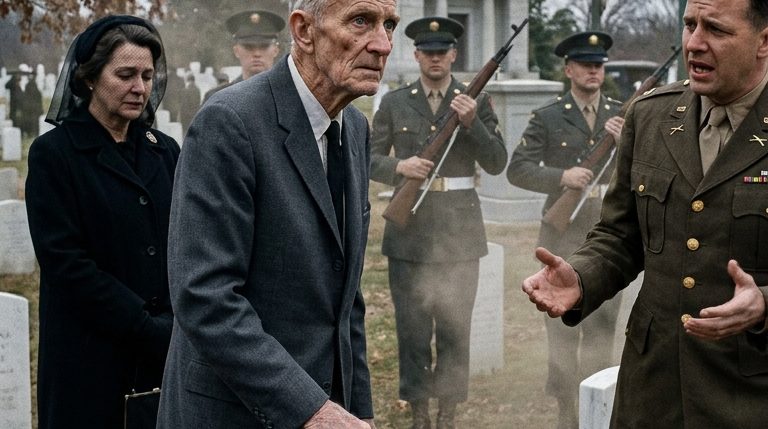
She turned and looked toward the back of the property, where her small, tended garden sat waiting. The white roses she had planted were just beginning to bud, their petals small, tightly coiled promises of bloom. She thought of the ceremony in Arlington, of the names of the children she had saved, and of the weight she had carried for so long. The ghost was gone. Nightingale had finally stopped singing, leaving only the quiet, rhythmic sound of her own steady breathing.
She walked away from the lights, toward the garden. She knelt in the soft, cooling earth, her fingers digging into the soil with a renewed, vital strength. She began to pull a stubborn weed near the base of the central rose bush, her movements slow and intentional. She was repairing the damage—not just to the garden, but to the story.
Garrett, the Iron Wolf, found her there a moment later. He didn’t interrupt her work. He stood at the edge of the garden, leaning on his good arm, watching her with a look of quiet, profound respect. He had come to offer help, to ask what happened next, but the sight of her in the dirt, surrounded by her roses, silenced him.
“We’re going to be okay,” she said, without looking up. She pulled the last weed and patted the earth firm, a small, symbolic act of restoration. She stood, brushing the dirt from her jeans, and looked at him. The lines on her face were still there—the map of a hundred different lives—but the tension that had defined her for years was gone.
“I have a ceremony to attend in Arlington,” she told him. “And after that, I think I’d like to learn how to be a neighbor.”
Garrett smiled, a genuine, warm expression that smoothed the hard edges of his own face. “I think that’s a hell of a plan, Eva.”
She turned back to her house, the morning air crisp and filled with the promise of a day that was hers to define. She was seventy-three years old. She was a woman who had burned worlds to save them, and she was finally, mercifully, at peace. The garden was still. The house was hers. And for the first time in her life, she had nothing left to hide.