The Measured Line: How a Blue-Collar Carpenter Grounded an Entitled HOA Regime
CHAPTER 1: EDGE OF THE GRAVEL
The metal tow chain snapped taut, grinding through the gravel before I even had the chance to take a breath.
My work van lurched forward, its rear differential scraping hard against the packed stone driveway. Inside the cab, two decades’ worth of brass fittings, framing hammers, and open municipal permits rattled against the steel shelving like dry bones. The yellow flatbed truck didn’t slow down, dragging my entire livelihood straight toward the county road.
I didn’t run after it. Running doesn’t stop three tons of hydraulic steel.
Instead, I stood by my fence post, my thumb resting on the worn brass casing of my tape measure in my right pocket. The metal edge was cold, notched from years of pulling layout lines across rough-sawn pine. I pulled the tab out half an inch, let the spring snap it shut with a sharp, dull click, and kept my eyes on the road.
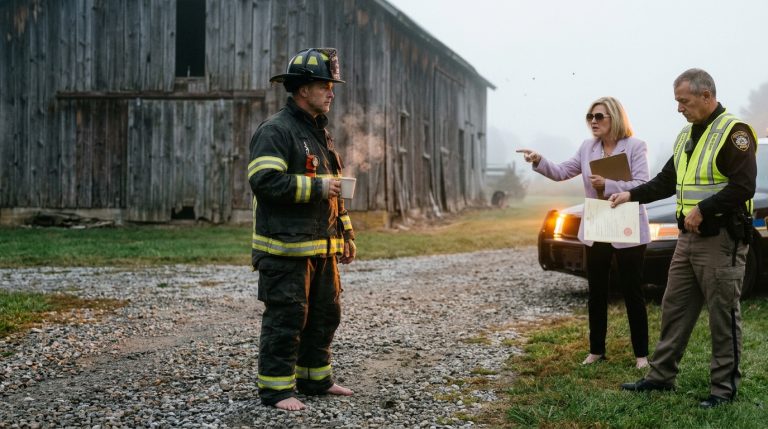
At the edge of my property, Sloan Reic stood with a thick black clipboard tucked neatly under her arm. Her gray blazer didn’t have a speck of dust on it, despite the diesel exhaust hanging heavy in the humid morning air.
“Emergency safety removal,” she said, her voice smooth, level, and entirely rehearsed. She didn’t look at the van. She looked at the top page of her clipboard. “Unapproved commercial equipment left on an active utility easement.”
“That van sits on my private driveway,” I said, my voice flat, holding back the knot of cold heat in my chest. “It’s been parked in that exact spot for twelve years.”
Sloan offered a thin, mechanical smile—the kind people give you when they believe the paper in their hand makes them immune to gravity. “Then you should have checked your boundaries, Mr. Carter. Land definitions change when community infrastructure is at risk.”
I looked down at the grass beside her sensible leather flats.
Three fresh steel rebar stakes had been driven deep into my turf, their tops painted with neon-orange caps. A tight length of yellow mason line ran between them, cutting a straight six-foot wedge out of my front yard and terminating right where my van had been parked seconds before.
Sloan followed my gaze down to the stakes, her hand shifting slightly over the aluminum lip of her clipboard. “This parcel is currently under structural review for storm water access,” she said, dropping her tone just enough to keep it private between the two of us. “Cooperate with the board, and this stays simple.”
“Who drove those stakes?” I asked.
“The community board operates under broad safety mandates,” she replied without answering the question. She pulled a laminated notice from behind her stack of paper and slapped it hard against my cedar fence gate.
The sound was sharp, like a dry branch snapping.
“Public safety review in progress,” she read from the top line, though she didn’t need to look at it. “Access beyond this boundary line is restricted pending engineering clearance.”
I didn’t touch the paper. I pulled the brass tape measure from my pocket, hooked the end against the corner of my wooden gatepost, and pulled the yellow steel ribbon out to the first rebar stake.
Fourteen feet, three inches.
My deed said my property line ended eighteen feet from that post. She was four feet deep into my dirt.
Sloan watched the yellow steel measure extend, her eyes narrowing just a fraction as the metal flexed in the air. “You can measure all day, Mr. Carter. Paperwork moves faster than a steel tape.”
She turned on her heel and walked toward her silver crossover parked at the curb, her phone already raised to her ear before her door opened. She didn’t look back to see if I was following her. She was certain the shock had already settled into my bones.
I let the tape measure retract into its brass shell with a heavy, metallic click. The tow truck was a faint rumble down the ridge, but the fresh orange paint on the steel stakes was still wet in the sun.
CHAPTER 2: PAPER WARNINGS AND WHISPERS
My thumb stayed pressed against the heavy brass edge of the retracted tape measure, the orange paint on the rebar stake practically glowing against the gray turf.
The silver crossover disappeared over the crest of the hill, leaving behind only the smell of warm asphalt and diesel. I bent down, grabbed the top of the middle rebar stake, and gave it a firm tug. It didn’t budge. They’d pounded it at least two feet into the clay with a sledgehammer.
By noon, the first citation arrived.
It wasn’t delivered by a uniformed county deputy, nor did it come through certified mail. It was slapped directly onto the tin lid of my mailbox with a strip of neon-green duct tape that left a sticky residue on the metal.
Equipment Obstruction: Final Notice. No date of inspection. No county badge number. Just the official Brookhill Ridge HOA crest printed at the top and Sloan Reic’s signature looped across the bottom in sharp, blue ink.
I peeled the paper back, the tape tearing the top corner of the sheet. She was citing me fifty dollars a day for failing to clear “designated access paths.”
At three in the afternoon, a white golf cart carrying two HOA courtesy patrol officers crawled past my gate.
The driver slowed to a walking pace, his passenger holding up an iPad to film my front yard. The lens lingered on the deep, torn ruts in the gravel where my work van used to sit. They wanted a reaction—a raised fist, a shouted curse, anything to log as verbal harassment.
I didn’t give them the satisfaction. I pulled a rusted iron wedge out of my tool bucket, sat down on the porch step, and began setting the edge with an oilstone, the steady scritch-hiss of metal on stone filling the quiet afternoon.
When the golf cart finally rattled off, a screen door creaked open across the road.
Arthur, a retired machinist who’d lived on the ridge since the roads were still unpaved dirt, stepped off his porch. He didn’t come through my gate. He stopped at the edge of the asphalt, his hands jammed deep into the pockets of his faded canvas work jacket.
“They tied orange flags to your back fence line while you were inside eating lunch,” Arthur said softly, his eyes scanning the road before meeting mine. “Every twenty feet. Straight through your gravel bed.”
“I saw them,” I said, holding the iron wedge up to the light to check the bevel.
Arthur took two steps closer, dropping his voice to a low rasp. “She’s doing it to three other lots down on the south turn. Anyone sitting where Phase 2 is supposed to tie into the main road. She tells ’em it’s mandatory drainage, but it’s a push, Carter. She’s squeezing the old-timers out.”
“Phase 2 doesn’t have county approval,” I said.
Arthur let out a short, dry bark of a laugh that ended in a cough. “Paper doesn’t matter to Sloan until somebody makes her read it out loud. She emailed a notice an hour ago. Emergency board meeting tonight at the clubhouse. Six o’clock sharp.”
I laid the iron wedge down on the wooden step beside my tape measure. “Mandatory?”
“She marked it urgent,” Arthur said, turning back toward his driveway. “Brought in some high-priced legal mouth from the city to sit at the head table. If I were you, I’d bring a thick skin.”
I didn’t answer. I reached into my pocket, pulled out the laminated notice Sloan had slapped on my fence earlier, and flipped it over.
In the bottom left corner, printed in tiny, faint violet ink, was a document filing stamp—a provisional plat overlay code. But where the six-digit county clerk indexing number was supposed to be logged, the line was completely blank.
CHAPTER 3: THE BOARDROOM AMBUSCADE
My thumb kept tracing the faint violet stamp on the paper inside my jacket pocket while the hum of the projector fan filled the packed clubhouse room.
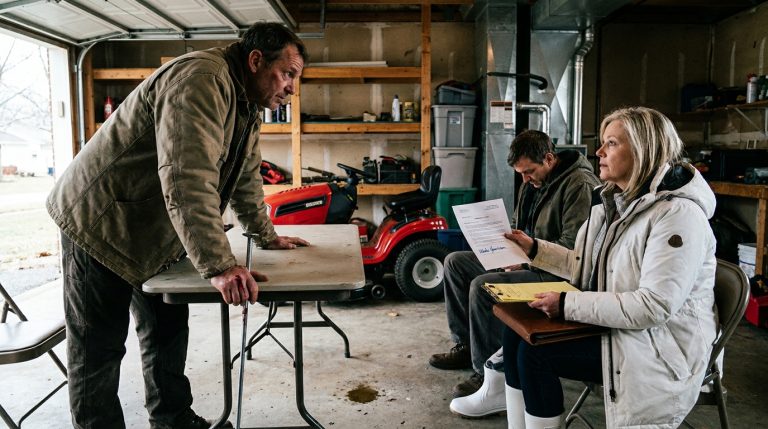
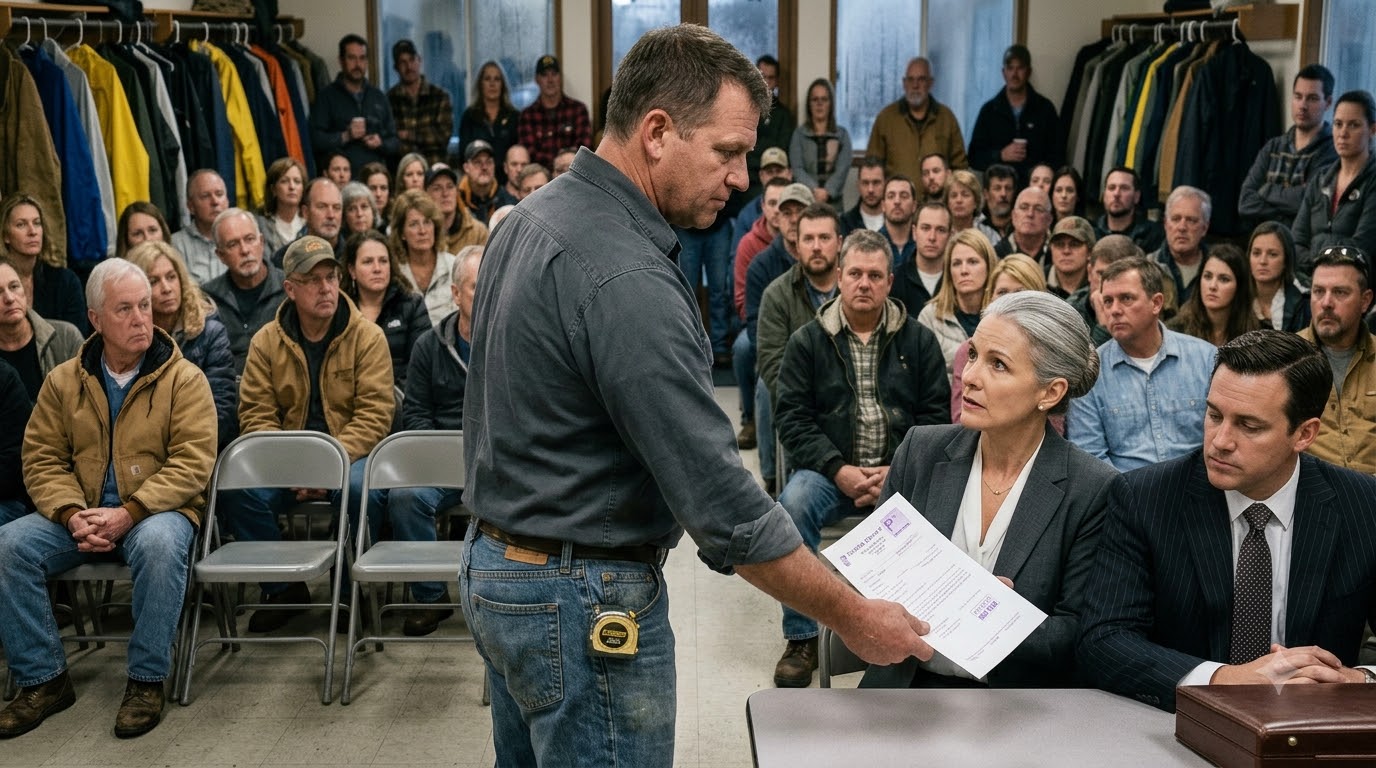
Fifty metal folding chairs were snapped open in tight rows, but thirty more homeowners stood jammed against the back coat racks and emergency exits. The air was warm, smelling of stale urn coffee and damp raincoats.
Sloan Reic stood behind a portable podium at the front, her tailored blazer immaculate under the fluorescent tubes. To her left sat a man in a pinstriped suit, his leather briefcase sitting unopened on the folding table like a guard dog.
“This amendment passed unanimously,” Sloan said, tapping a red laser pointer against the screen behind her. A digital map glowed against the white wall, a shaded blue strip running cleanly across the slope of the ridge—and straight through my lot. “The storm water corridor is critical community infrastructure. Non-compliant properties will be addressed immediately.”
I stood up from my chair near the middle aisle.
I didn’t raise my voice. “When did the board vote on that amendment, Sloan?”
Sloan didn’t move her laser pointer. She shifted her weight, her knuckles whitening slightly against the wooden edge of the podium. “Mr. Carter, floor comments are reserved for the end of the presentation.”
“It’s a simple question,” I said, stepping into the narrow center aisle. “The bylaws require a fourteen-day written notice to all lot owners before a binding vote on property easements. I checked my mail every day this month.”
The lawyer beside her uncrossed his legs and leaned toward the microphone. “Mr. Carter, the board delegated administrative authority under Section 4-B during the emergency session last Tuesday. Compliance now avoids costly litigation for the entire association.”
“Section 4-B covers fallen timber and broken water mains,” Arthur called out from three rows back, his gravelly voice cutting through the hum of the crowd. “It doesn’t let you redline deed boundaries.”
A sudden murmur rippled through the back rows, heads turning as neighbors looked between the screen and where I stood.
“We have full legal standing to clear hazards,” Sloan snapped, her voice losing its smooth polish for a fraction of a second. She clicked her remote, jumping to a slide titled Meeting Minutes & Verification. “The record is clear. The timestamps are logged.”
I pulled the folded paper from my coat, walked down the aisle, and laid it flat on the table right next to her attorney’s leather briefcase.
“That slide says the vote was certified at eight-thirty Monday morning,” I said, pointing to the unindexed violet mark at the bottom of my notice. “So why does the provisional filing code on your own citation carry a draft stamp from Sunday night? And why is the clerk’s index number missing?”
The lawyer looked down at the paper. His hand twitched toward it, but he stopped himself, his jaw tightening as he glanced up at Sloan.
Sloan didn’t look down at the document. She clicked the remote again, wiping the minutes off the wall and replacing them with a bulleted list of daily non-compliance penalties. “We are not debating administrative drafts tonight. If you refuse access to the crew tomorrow morning, the daily fines double, and any obstructing equipment will be impounded.”
“You already towed my van,” I said, holding her gaze. “And you did it before any vote was ever posted.”
Sloan leaned across the podium, her thin smile completely gone. “And we can repeat the process as many times as it takes to secure this easement, Mr. Carter.”
The room went dead silent. Nobody moved. Nobody clapped.
I took my paper off the table, folded it carefully back into my pocket, and turned toward the door. I didn’t need to argue with her in front of fifty people. She had just handed me everything I needed to look for in the county basement tomorrow morning.
CHAPTER 4: THE UNSEALED LEDGER
My thumb pressed hard against the cold laminate edge of the counter as the clerk leaned closer to her glowing monitor screen.
“That number isn’t logged in the active registry,” she said, her index finger tapping twice against the glass display. “It’s a pending digital upload. Anyone with a guest access token can drop a provisional file into the system queue.”
“Which means it hasn’t passed county review,” I said.
“It means it has zero legal weight,” she replied flatly, turning the screen just enough for me to read the red system tag in the margin: STATUS: UNVERIFIED / PENDING INDEXING.
“Look at the upload timestamp,” I said, sliding the folded copy of Sloan’s citation across the counter.
The clerk pulled on a pair of reading glasses, comparison lines deepening around her eyes. “Uploaded at eleven forty-two p.m. on Sunday. But the board minutes attached to certify it…” She paused, typing four quick keystrokes. “Those were attached on Tuesday morning. After the file was already sitting in the queue.”
She looked up at me over the rim of her glasses. “Someone backdated the authorization to match an upload that was already made.”
“Can you print the full attachment bundle?” I asked.
The laser printer behind her hummed to life, spitting out five warm sheets of paper onto the tray. I picked them up, my eyes skipping past the legal boilerplates straight to the line-item budget embedded on page three.
Project Infrastructure Reserve: $2.4M.
Sub-Contracting Line 14: Ridgeway Civil Consulting — $18,000.
Beneath the business name was a federal tax ID, and right below that, printed in tiny, crisp type, were two letters: RSR LLC.
Reic Real Estate & Land Solutions.
I stared at the numbers while the paper cooled in my hand. This wasn’t about storm water runoff or neighborhood safety. Sloan wasn’t just using HOA fines to bully homeowners—she was redirecting community reserve funds straight into her own private consulting shell, using a fake county easement to justify the expenditure before Phase 2 land development ever broke ground.
My phone vibrated in my palm. A text message from an unknown number flashed across the glass.
Don’t push this at tonight’s second session. Phase 2 happens regardless. You can’t stop a multi-million dollar infrastructure vote with a tape measure.
I locked the screen, slid the printed county records into my jacket pocket right next to my brass tape, and walked out into the bright afternoon sun.
CHAPTER 5: THE TRAP AT THE GATE
Standing in the doorway of the packed clubhouse, my hand rested inside my jacket pocket against the fresh, warm stack of county printouts while Sloan adjusted her podium microphone.
“We are reconvening this emergency session to finalize enforcement protocol,” Sloan announced, her voice booming through the ceiling speakers. She tapped her pen against the microphone twice, a sharp, metallic ring cutting across the murmurs in the room. “The board will now accept formal acknowledgments of compliance.”
I walked down the main aisle, my boots heavy against the slick linoleum floor.
Arthur sat in the second row, watching me with a tight, doubtful frown. He leaned over slightly as I passed, whispering, “She’s got three new towing notices on the table, Carter. She’s locking down the vote.”
I didn’t stop. I walked straight up to the head table, pulled the warm county sheets from my pocket, and laid them right beside her gavel.
Sloan didn’t touch the papers. She leaned back, her nostrils flaring just enough to show the twitch in her upper lip. “Mr. Carter, you are out of order. Sit down or I will have patrol escort you out.”
“I’m just submitting the required county verification,” I said, my voice steady, carrying easily across the silent room. “You said on Monday that the storm water easement was officially recorded under county authority. I brought the public record.”
Her attorney reached out to grab the bundle, but I laid my heavy brass tape measure flat on top of the pages, locking them to the table.
“Page three shows the project budget,” I said, pointing down at the line item without taking my hand off the brass casing. “Eighteen thousand dollars allocated to Ridgeway Civil Consulting. Paid on Sunday night.”
A quiet rustle went through the front rows as two board members leaned forward, trying to read the text through their bifocals.
“That is a proprietary administrative expense!” Sloan snapped, her voice spiking an octave as she slammed her palm onto the podium. “You have no right to possess internal accounting records!”
“It’s attached to the unverified plat upload you submitted to the clerk,” I said, stepping back just enough to let the room see her face. “The clerk verified that the upload has no index code. It was never approved by the county. And RSR LLC—the company receiving that eighteen thousand—is registered to your residential address.”
Sloan’s face drained of color, her eyes darting toward the side exit where her courtesy patrol guards stood. “This is a malicious misinterpretation of project management fees! The board authorized—”
“We didn’t authorize a payment to your private company, Sloan,” one of the board members cut in, his voice shaking as he pulled his glasses off his nose. He looked down at the paper under my tape measure. “You told us that money went to the county drainage engineer.”
“The vote was delegated!” Sloan yelled, her composure completely shattering as she grabbed her clipboard and struck the microphone, sending a deafening squelch through the speakers. “You all voted for Phase 2! You signed the authority waiver! You can’t undo this because a contractor complains about a driveway!”
“The county clerk placed an administrative hold on the whole filing twenty minutes ago,” I said flatly. “There is no easement. There is no corridor. And nobody is towing another truck off this ridge.”
Sloan glared at me, her teeth clenched so tight the muscles in her jaw quivered. She didn’t cry. She didn’t confess. She grabbed her leather bag, knocked her microphone stand sideways against the floor, and marched toward the back door, her heels clicking like frantic gunfire against the tile.
“This meeting is adjourned!” she screamed over her shoulder, her voice echoing off the metal folding chairs as people began to stand. “I’ll see every one of you in court!”
CHAPTER 6: HEAVY BRASS AND CLEAN LINES
I stood on my front gravel driveway at sunrise, my thumb resting on the heavy brass tape measure in my coat pocket, watching the yellow flatbed tow truck back slowly up to the fence.
The hydraulic bed tilted with a loud, hiss-and-groan of steel, and my work van rolled gently down onto the stone. The tires settled into the deep, familiar ruts they’d left behind three days ago.
The driver unhooked the axle chains, handed me a stamped release form with zero towing fees listed, and hopped back into his cab without saying a word.
Across the asphalt, Arthur walked over to my gate carrying a pair of heavy iron pliers. He didn’t ask how the board meeting ended after Sloan stormed out. He just looked at the bright orange rebar stakes still sitting in my turf.
“You want these out of your dirt now?” Arthur asked, tapping the metal jaw of his pliers against the top cap.
“Leave the holes,” I said, pulling my brass tape from my pocket. “I’m driving cedar posts in their place.”
I hooked the metal lip of the tape measure against the corner of my gate, pulled the yellow ribbon out eighteen feet to the exact deed boundary, and snapped the thumb-lock down with a crisp, heavy click.
The county clerk’s hold had officially frozen all of Sloan’s pending plat filings by six p.m. yesterday. The board had already sent out an automated notice revoking her executive authority, opening a full audit into the $18,000 transfer to her private LLC.
There were no victory speeches or celebratory neighborhood parties. Just the quiet, crisp morning air and the hum of early commuter traffic down on the county highway.
I knelt down on the damp grass, pulled a claw hammer from my belt, and knocked the orange plastic cap off the first rebar stake. The plastic shattered against the steel, falling into the mud like worthless trash.
I set the edge of a fresh cedar post against the line, swung the hammer down with two heavy, measured strikes, and drove the wood deep into my own soil.