The Iron Gatekeeper: How a Retired Public Works Director Used Property Law and Heavy Machinery to Crush His HOA
CHAPTER 1: TOXIC LINES IN THE FROST
The magnesium chloride was eating the topsoil. I knew the smell before I opened the kitchen door—acidic, industrial, sharp enough to burn the back of my throat through the freezing air.
I didn’t reach for my coat. I reached for the brass-capped survey pin on the counter.
Outside, three commercial dump trucks backed up along my property line, diesel exhaust rising in black plumes against the gray morning sky. A wall of packed, gray slush—eight feet tall and forty feet wide—sealed my garage door flat shut.
“Wade?” Grace stood at the window, her thumb rubbing a raw, red blister on her knuckle. She held an empty white pill bottle against the glass. “The delivery van isn’t coming through that, is it?”
“No,” I said. My voice was flat. Thirty years in municipal public works teaches you how to keep your heart rate down when an engine fails or a main snaps. “It’s not.”
I stepped off the porch, my work boots sinking into three inches of chemical slush.
At the edge of my lot, right where Sarah’s dormant ‘Mister Lincoln’ rose stalks slept under the mulch, stood Charlene Westbrook. White designer parka. Clean leather boots. A yellow clip-board clamped under her arm.
She didn’t look at the roses. She looked at my ten-year-old Ford F-150 parked in the open bay.
“Mr. Garrison,” Charlene said, her breath fogging in short, neat bursts. “I’m glad you’re up. The plow crews needed a central drop zone for the street clearing. Corner lots carry that operational burden under community standards.”
I didn’t answer right away. I rolled the heavy iron pin between my fingers, feeling the stamped number—Iron-Pin-4—bite into my palm.
“That’s industrial highway deicer,” I said, pointing a calloused finger at the foaming sludge melting into the soil. “Deice-X. It’s restricted for residential use by county code.”
Charlene’s smile stayed fixed. Her eyes were hard as marble.
“We’re all in this together, Wade,” she said, tapping her pen against the metal board. “Clean streets protect property values. Speaking of which—your garage obstruction violates section seven. You’ll have a notice in your box by noon. Five hundred dollars.”
“You dumped it,” I said.
“And you’re responsible for maintaining your sightlines,” she replied, turning on her heel toward her Tesla. “Have a productive morning.”
I stood alone in the freezing quiet. Inside the house, Grace tapped the empty pill bottle twice against the frame of the living room window.
I squeezed the iron pin until the metal edges bit blood out of my skin, turned back toward the house, and picked up the landline to call the county recorder.
CHAPTER 2: THE PAPER TRAIL MIRAGE
The plastic handset of the landline was ice against my ear. My thumb was still slick with the grease I’d smeared off Iron-Pin-4, leaving a dark smudge across the receiver’s white plastic casing.
On the table in front of me sat a printout I’d pulled off the county property registry two years after Sarah passed. It was a standard plat map, faded at the margins, showing my corner lot outlined in heavy black ink.
“County Recorder’s office, records clerk Miller,” a voice rattled through the speaker. Static buzzed underneath the tone, rhythmic and dry.
“This is Wade Garrison,” I said. I didn’t sit down. I kept my knees locked, my weight planted over my boots. “I need the filing history on the Meadow View Estates covenant modifications. Specifically Section Twelve.”
A heavy sigh came through the wire, followed by the clatter of a mechanical keyboard. “Meadow View. That’s a private-road subdivision, right? The county doesn’t enforce internal HOA rules, Mr. Garrison.”
“I don’t need enforcement,” I said. My left hand rested flat on the kitchen table, the palm pressing into the laminate until the wood underneath groaned. “I need the stamped filing date. Section Twelve—Community Maintenance and Snow Displacement.”
“Hold on.”
The line went silent except for the low, 60-cycle hum of the kitchen’s overhead fluorescent tube. Across the room, Grace set her empty pill bottle on the counter. Her knuckles were swollen, red around the joint. She didn’t ask who I was calling. She’d lived with a municipal worker long enough to recognize the tone I used when a contractor tried to skimp on backfill depth.
“Okay, Garrison,” Miller’s voice came back, thinner now. “I’ve got the master file up. Vanguard-87 development packet, filed October 12, 1987. I’m looking at the amendments index.”
“And?”
“There is no Section Twelve.”
I took one slow breath in through my nose. The air smelled like cold coffee and the bitter, metallic tang of the Deice-X creeping under the kitchen door frame.
“Read that back to me, Miller.”
“The original covenants run from Section One through Section Eleven,” Miller said, the sound of paper turning sharp over the line. “There are no recorded modifications on file for your parcel since 2004. If your board is citing a Section Twelve, it hasn’t been ratified through the county courthouse.”
“Thank you,” I said, and hung up before he could offer an administrative referral.
I turned the brass-capped pin over in my hand. Iron-Pin-4. It was an origin marker set by the original civil engineers back when the county laid the asphalt for the main thoroughfare.
I grabbed my heavy canvas coat off the peg by the door.
“Where are you going?” Grace asked. She was reaching for the tea kettle, her wrist stiff.
“To a board meeting,” I said. “Keep the front shades down.”
The walk to Charlene’s house took four minutes across crushed snow that felt like wet salt under my soles. Her driveway was black asphalt—not a flake of white on it, completely swept clean down to the sealant. Her white Tesla sat under the portico, glowing under a pair of halogen spotlights.
I didn’t knock on the front door. I walked straight into her attached garage, where the door was propped open three inches to let a heated air duct vent out into the driveway.
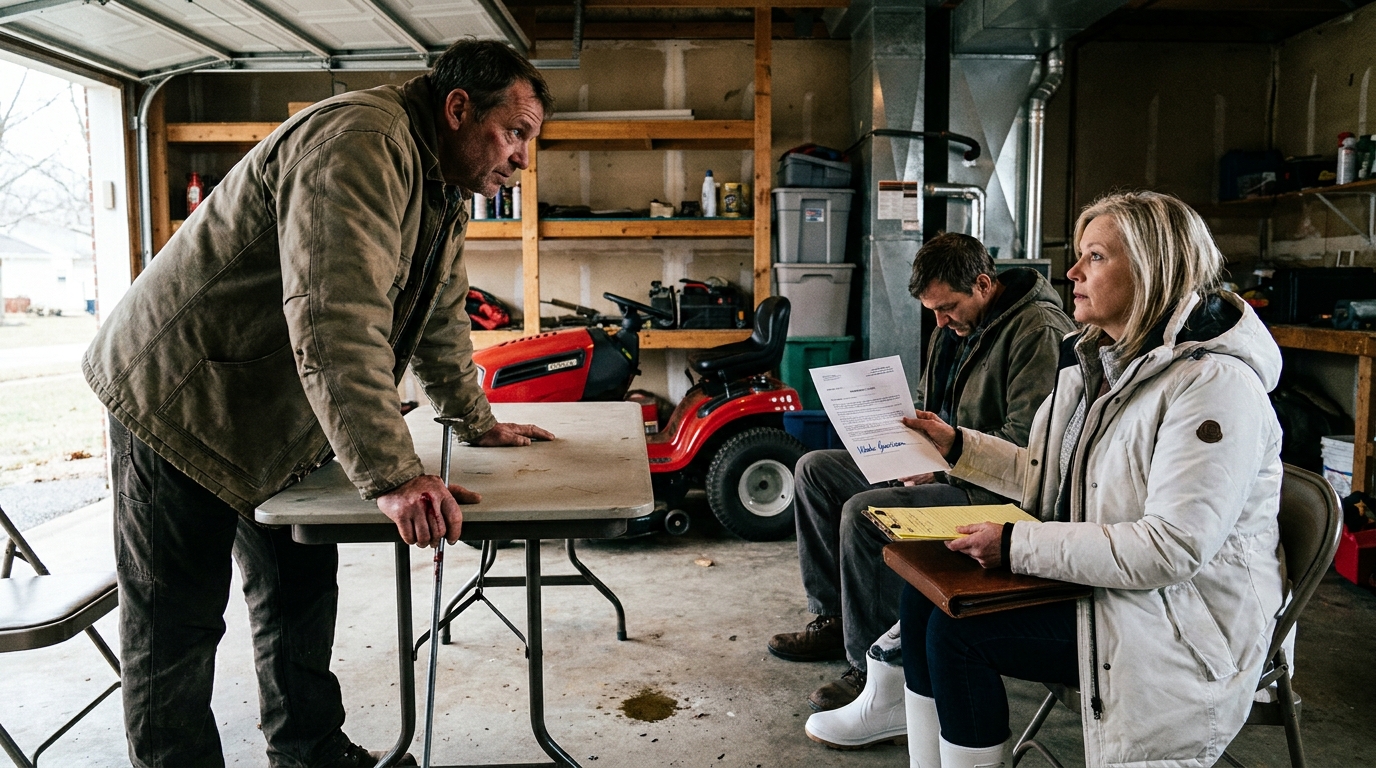
Inside, four people sat around a folding card table set up between a pristine riding lawnmower and stacked rows of plastic storage bins.
Charlene sat at the head. She had a leather portfolio open in front of her, a silver Parker pen balanced between two manicured fingers. Tom Henderson, who lived two doors down and worked in regional logistics, sat to her left, looking down at his lap.
“…which brings the total seasonal assessment to six hundred per parcel,” Charlene was saying. She stopped when my boots hit the concrete floor with a wet, heavy thud.
None of them moved for three seconds.
“Wade,” Charlene said, her voice dropping into that smooth, practiced register real estate agents use when a buyer notices water damage in the basement. “This is an executive session. Public comment is at the end of the agenda.”
I pulled a folded piece of paper out of my coat pocket and dropped it onto the middle of the card table, right over her leather portfolio.
It was the violation notice she’d stuck in my box four hours ago.
“You cited Section Twelve,” I said.
Charlene didn’t touch the paper. She leaned back, her pen clicking once against her ring. “Section Twelve covers shared infrastructure burdens. As explained this morning, corner lots receive priority clearance to maintain street throughput.”
“Section Twelve doesn’t exist,” I said.
Tom Henderson shifted in his chair, the metal frame scraping against the sealed concrete. “Wade, come on. We all signed the packet when we bought in.”
“I signed the 1987 Vanguard charter,” I said, keeping my eyes locked on Charlene’s eyes. She didn’t blink. “I built my house while the street was still crushed limestone. There is no Section Twelve on file at the county recorder’s office. Which means the five-hundred-dollar fine you just issued is paper fraud.”
Charlene’s smile thinned out until her lips were a straight, white line against her skin. She didn’t look flustered; she looked like an auditor who’d just found a math error on a subordinate’s spreadsheet.
“The board ratified the maintenance update during the October special session,” she said quietly. “Every resident received a copy for acknowledgment.”
“Show me the signature page,” I said.
“It’s archived in the legal records.”
“Show me the signature page, Charlene.”
She reached down into her briefcase, pulled out a thick stapled document, and flipped to the back. She didn’t hand it to me. She held it up, holding the bottom corner between her index finger and thumb.
At the bottom of the page, above my typed name, was a line of blue ink.
Wade Garrison.
I leaned down until I could smell her expensive perfume—vanilla masking something sharp, like rubbing alcohol.
The ‘W’ was sharp at the base. An angular wedge. I’ve written my name on municipal work orders, land deeds, and pension forms for fifty-two years. I loop the middle stroke of the ‘W’ every single time because my father taught me to write cursive with a fountain pen on a draftboard.
“That’s not my hand,” I said.
“It’s on file,” Charlene said. She snapped the folder shut with a sound like a pistol shot in the small garage. “And until you file a formal petition with the board’s legal counsel—which requires a three-hundred-dollar administrative fee—the violation stands. The snow remains your responsibility.”
Tom Henderson wouldn’t look at me. He was staring intensely at a spot of oil on the floor near his left boot.
“Grace missed her heart medication delivery today,” I said, my voice dropping an octave, coming low out of my chest. “The van couldn’t get within fifty yards of the garage.”
“Then I suggest you clear your driveway, Mr. Garrison,” Charlene said. She picked up her silver pen again. “Meeting adjourned to executive session. Please close the door on your way out. You’re letting the heat out.”
I didn’t close the door.
I walked out into the dark, the cold air hitting my face like a wet towel. I walked back toward my lot, my eyes fixed on the massive, eight-foot wall of chemical slush burying Sarah’s garden.
As I reached my driveway, a white van with red lettering on the side turned onto the street. It slowed down, its headlights sweeping across the mountain of gray snow blocking my house, then accelerated away down the main road without stopping.
The delivery service.
I stood in the dark, watching the red taillights disappear toward the gated entrance, while the chemical salt in the slush hissed softly as it settled deeper into the frozen dirt.
CHAPTER 3: THE CHEMICAL ESCALATION
The red glow of the delivery van’s taillights shrank to pinpricks, then vanished entirely behind the heavy steel gate at the neighborhood entrance.
I stood at the foot of my driveway for three full minutes while the frost built a white crust over the shoulders of my canvas coat. Inside my right pocket, my knuckles throbbed around the cold cylinder of Iron-Pin-4. The brass cap was digging into my index finger, leaving a sharp, throbbing indentation that matched the cadence of my pulse.
A sudden, high-pitched whine cut through the dark—not the sound of an engine, but the dry, sputtering cough of my home’s oil furnace struggling to pull air.
I turned back toward the house. The exhaust pipe for the heating unit emerged six inches above the foundation on the east wall—the exact side where Charlene’s three hired plows had piled the second wave of street scrapings.
The gray slush was already freezing into a solid, impenetrable mass over the intake hood.
I walked around the perimeter of the pile, my boots breaking through the brittle upper crust of salt-saturated ice. The smell hit me again: Deice-X. It wasn’t just road salt; it carried the oily, chemical tang of commercial calcium chloride additives designed for airport tarmacs. It didn’t just melt ice—it poisoned whatever it touched, stripping the protective wax off my leather boots in real time.
Inside the basement utility closet, the burner gave a wet, metallic clunk and died.
The sudden silence in the house was heavy. The temperature in the hallway was already dropping, the air turning thin and brittle.
I found Grace sitting in the kitchen wearing her wool overcoat, her breath visible in faint, grayish wisps under the yellow overhead light. She was holding a cold copper mug between both hands, her thumbs hooked through the handle to keep her fingers from shaking.
“The radiators are making a clicking noise, Wade,” she said. Her voice didn’t carry panic; it had the dry, flat quality of someone who had survived three Midwestern blizzards before I was born. “The gauge on the cellar door says sixty degrees.”
“Intake’s choked with salt-slush,” I said, pulling my heavy leather work gloves out of my coat pocket. “I’m going to clear the pipe by hand.”
“The delivery boy called from his supervisor’s office,” she added softly, not looking up from her mug. “He said the HOA access route is marked as an unmaintained hazardous zone on his GPS map now. They won’t dispatch another truck until the street is cleared by a municipal grader.”
“Municipal graders don’t come past the front gate,” I said. “This is private asphalt.”
I went out the side door with an iron spade and a five-gallon bucket of warm water from the water heater tank. The wind had picked up, driving needles of frozen sleet against the exposed skin of my neck.
It took twenty minutes of hard, rhythmic digging just to reach the metal intake hood. The Deice-X had fused the snow into a concrete-like matrix of ice, gravel, and shredded rubber from plow blades. Every strike of the shovel sent a violent shock straight up my forearms, rattling the joints in my shoulders.
When the blade finally cleared the intake opening, a blast of trapped diesel fumes blew back into my face. The pipe cleared with a harsh suction sound, and three stories down, the basement burner kicked back to life with a low, rumbling roar.
My hands were numb inside the wet leather gloves. My coat was caked in gray, chemical-laden slush that was already stiffening into a rigid shell.
I didn’t go back inside. I walked around to the front yard, where Sarah’s rose garden sat under three thousand pounds of toxic waste.
I knelt in the snow, pulled off my right glove, and shoved my bare hand six inches down into the soil near the root crowns.
The dirt wasn’t frozen soft like winter topsoil ought to be. It was a slimy, black slurry that felt slick, like machine oil mixed with cold grease. The salt concentration was so high it was keeping the water liquid at fifteen below zero, chemically burning the bark off the dormant rose canes.
A pair of headlights swept across the yard.
A white pickup truck with the crest of the county sheriff’s department on the door pulled up to the curb. The driver’s side window rolled down four inches, releasing a puff of warm air and the smell of cheap convenience-store coffee.
Deputy Miller—no relation to the clerk at the recorder’s office—looked out at me through the falling sleet.
“Wade,” he said, keeping his hands on the wheel. “Got a call from the board president. Said you were creating a public hazard with unlit obstruction equipment on the right-of-way.”
I didn’t stand up. I stayed on my knees in the slush, my bare hand covered in black, salty mud.
“Look at the street, Miller,” I said.
He flicked his spotlight toward the driveway. The white beam illuminated the eight-foot wall blocking my garage, then swept across the clear, black pavement in front of Charlene’s property down the block.
“She says it’s seasonal snow storage,” Miller said, his tone flat, exhausted. “Says it’s covered under your subdivision covenants.”
“The county recorder says Section Twelve doesn’t exist,” I replied, wiping my muddy hand on the thigh of my jeans. “And this isn’t seasonal snow. It’s industrial runoff.”
Miller sighed, the steam from his breath clouding the truck’s side mirror. “Wade, I know you worked thirty years for the city. I know you know the codes. But until there’s an injunction or a court order signed by a magistrate, this is a civil dispute between property owners. If I take a report, it sits on a desk in the county seat for six weeks.”
“Grace is out of her diltiazem,” I said. “The delivery van turned around at the gate.”
Miller’s jaw tightened. He looked past my shoulder at the dark living room window where Grace’s silhouette sat motionless under her coat.
He reached into his center console, pulled out a small, yellow plastic bottle, and held it out the window.
“My mother takes the same dosage,” Miller said quietly. “There’s four days’ worth in there. Emergency stash from my trunk kit. Take it.”
I didn’t move for two seconds. Then I stepped over the snowbank, took the bottle, and closed my fingers around it.
“This doesn’t fix the pile, Wade,” Miller added, his eyes shifting toward Charlene’s house down the street. “And Charlene called a private hauling contractor for tomorrow morning. They’re bringing in a commercial tractor to scrape the remaining turn-arounds. Guess where they’re dumping the overflow?”
“My lot,” I said.
“Your corner,” Miller corrected. He rolled up his window halfway. “Get your mother-in-law warm, Garrison. It’s going to hit twenty below before dawn.”
The deputy pulled away, his tires crunching over the salt-crusted street.
I stood in the dark, holding the yellow pill bottle in one hand and the cold iron survey pin in the other. Across the street, the automatic security lights on Charlene’s garage flicked on, illuminating the clean, black asphalt of her empty driveway.
I turned the pill bottle over in my palm. The label was crisp, clean, printed on high-gloss paper. Beneath the pharmacy name, in tiny capital letters, was the manufacturer’s distribution code: Vanguard-87.
I froze.
The same name stamped on the 1987 subdivision plat map in the county recorder’s master file.
CHAPTER 4: VANGUARD87 UNCOVERED
The yellow prescription bottle sat in the center of my kitchen table under the glare of the brass desk lamp. Beside it, the magnifying glass I used for reading small-print land deeds felt heavy and cold in my hand.
Through the glass, the code along the bottom edge of the label snapped into sharp focus: Vanguard-87 / Lot 01-A.
I didn’t blink. The draft coming under the kitchen floorboards smelled of damp crawlspace and the sulfur-like reek of the Deice-X slush melting against the foundation walls.
I pulled out the blue binder containing my original land purchase packet from thirty-eight years ago. The paper had turned the color of buttered toast at the edges, smelling of old cellulose and attic storage. I flipped past the tax assessments and the building permits until I reached the blue-line drafting sheet folded in three parts at the back.
The title block in the bottom right corner was hand-lettered in black drafting ink: VANGUARD-87 SUBDIVISION PLAT — ACCESS EASEMENT & INFRASTRUCTURE BOUNDARIES.
I traced the red ink line with my index finger.
It didn’t stop at the curb. It swept across the entire mouth of the private road, looping thirty feet inside my property line to encompass the exact strip where Charlene’s contracted trucks had dumped fifty tons of salted slush.
By 7:00 AM, the sun was a pale, frozen disk behind the overcast sky. The wind had dropped, leaving the air brittle at eighteen below.
A yellow Ford F-250 with a rotating beacon mounted on the cab pulled up along my curb. The door opened, and Mike Torres swung his legs out. He wore a grease-stained canvas coat, heavy snow boots, and carried a high-precision laser transit over his left shoulder. His tripod was scuffed down to bare aluminum from twenty-five years of field work.
“Wade,” Mike said, his breath plume thick in the morning freeze. He set the tripod down on the ice with a metallic clink. “You sounded like you were calling in a gas leak on the phone.”
“Look at the corner post, Mike,” I said, stepping off the porch. I pointed toward the brass cap buried under eight inches of chemical frost near Sarah’s rose bed. “Iron-Pin-4.”
Mike set up his level, adjusting the brass thumbscrews until the green bubble centered inside the vial. He attached a digital receiver rod and walked to the edge of the asphalt.
“I pulled the county recorder’s original easement overlay before I drove out,” Mike said, sighting through the optical lens. He clicked a handheld surveyor’s terminal against his hip. “According to the municipal filing, the HOA private street network doesn’t have a direct dedicated right-of-way to the public highway.”
“I know,” I said.
Mike stopped. He looked up from the eyepiece, his eyebrows frosted white. “You know?”
“The developer was short on frontage in eighty-seven,” I said, my hand resting flat inside my coat pocket, fingers curled around the spare survey stake. “They needed seventy feet of clearance to meet county fire codes for a gated entry. My lot had eighty-five.”
“So they took an access easement,” Mike said, his voice dropping into a low whistle. “A conditional grant.”
“Conditional on non-interference and good-faith maintenance,” I said. “Read the pin, Mike.”
Mike walked over, brushed the gray salt-crust off the top of Iron-Pin-4 with his gloved thumb, and pressed the laser rod directly against the brass cap. The terminal chimed three times—a sharp, digital beep that sounded razor-thin in the quiet morning.
“The easement isn’t just on your land, Wade,” Mike said, staring at the readout on his screen. “Your land is the easement. The entire front thirty feet of this corner—where they’ve been dumping the street scrapings—is private property owned in fee simple by you. The HOA only holds a revocable privilege to drive over it.”
“And if the land is rendered impassable or subjected to environmental degradation?” I asked.
Mike looked from his screen to the massive, eight-foot wall of gray, chemical-soaked slush burying my garage and Sarah’s garden.
“Section Four of the state property code,” Mike said quietly. “If the easement holder creates a nuisance or commits waste that threatens the primary parcel’s structural integrity or health access, the grantor has the absolute right to secure the boundary.”
“They trapped Grace inside for thirty-six hours,” I said. “And they ruined the soil.”
“Wade,” Mike said, setting his rod down against his boot. “If you revoke access or fence this line, forty-seven families can’t drive out of this subdivision. Their cars will be parked on private property without a valid transit right.”
“They aren’t my forty-seven families,” I said. “They’re Charlene’s.”
Behind us, a high-pitched hydraulic whine cut through the silence. Down the block, a heavy industrial loader—a thirty-ton yellow monster with a six-yard bucket—was backing out of a flatbed trailer.
Charlene stood on the sidewalk in front of her home, pointing her silver pen toward my lot while the loader operator revved his diesel engine, sending a thick cloud of black exhaust into the freezing air.
“She’s bringing the heavy rig to dump the main intersection overflow,” Mike said, watching the loader’s massive tires crush the snow as it turned toward us.
I reached into my coat, pulled out a three-foot steel boundary stake painted bright orange, and handed it to Mike.
“Drive the pin, Mike,” I said, my voice steady as a concrete footing. “Mark the line.”
CHAPTER 5: FAKE LAW AND REAL THREATS
The metallic clang of Mike’s sledgehammer hit hitting the steel stake echoed off the frozen asphalt. The three-foot orange post sank another inch into the ice right beside Iron-Pin-4, vibrating through the soles of my work boots.
Fifty feet down the street, the thirty-ton yellow loader ground to a halt. Its massive steel bucket, dripping with brown, salt-caked slush, hovered three feet off the ground like a suspended anvil.
The operator killed the throttle. The sudden drop in diesel roar left only the high-pitched idle of the engine and the bitter wind whipping through the power lines overhead.
Charlene didn’t wait for the operator to climb down. She marched across the packed snow in her pristine winter boots, holding a thick manila envelope stamped with red ink across the front. Her face was flushed red, but her posture was straight as a fence post.
“Mr. Garrison,” she said, her voice sharp enough to cut through the wind. She didn’t look at Mike, who was still holding the sledgehammer resting on his boot. “You are actively interfering with a contracted municipal maintenance operation.”
“Private operation,” I corrected, my hands buried deep in my canvas coat pockets. “And you’re four feet past the property boundary.”
She thrust the manila envelope toward my chest. “This was hand-delivered from Anderson, Bailey & Associates. They represent the master development group and the HOA board. You have forty-eight hours to pull those illegal posts, or the county sheriff will execute a civil removal order at your personal expense.”
I didn’t take the envelope. I let it hover between us in the cold air until she pulled it back, her fingers clutching the paper so hard the red stamp creased.
“Read it, Wade,” she sneered, her breath fogging in quick, furious puffs. “Ten thousand dollars in emergency injunctive fines per day. Section Twelve gives us full operational latitude over access strips.”
I looked down at the letterhead visible through the clear plastic window on the front.
Anderson, Bailey & Associates — Attorneys at Law.
File Ref: VNG-87-CLR
“Anderson,” I said slowly. “David Anderson?”
“Managing partner,” Charlene said, her chin tilting up. “He doesn’t play games with corner-lot holdouts.”
I reached out, took the envelope from her gloved hand, and slid my index finger under the top flap. The paper was crisp, expensive twenty-pound bond, bearing a glossy blue logo at the top.
I looked at the signature line at the bottom.
It was signed in black ballpoint ink: David M. Anderson.
My thumb moved over the seal. Thirty years in city public works means you deal with county attorneys three times a week. David Anderson had handled the municipal infrastructure bond filings for the city back in ’02. I’d sat across from him in six different planning commission hearings.
David Anderson had been paralyzed in an auto accident in 2011. He signed every document using a felt-tip auto-pen bracketed to a mouth-rig because he didn’t have use of his right hand.
The signature on this paper had the distinct, pressurized slant of a healthy, right-handed person holding a standard ballpoint pen.
“Where did you get this paper, Charlene?” I asked quietly.
“From legal counsel,” she snapped. “As you’d know if you respected board governance.”
“David Anderson uses an ink-jet auto-plotter,” I said. “He hasn’t written with a ballpoint pen in fifteen years.”
Charlene’s jaw twitched. For half a second, the calm, corporate glaze in her eyes cracked, revealing the raw, panicked calculation underneath. She reached out to snatch the letter back, but I folded the page in half and slid it inside my coat pocket.
“That is official board correspondence!” she yelled, her voice dropping its professional polish.
“It’s evidence,” I said. “And mail fraud if you sent it through the county post.”
“You’re out of your depth, Wade,” she hissed, stepping closer until I could see the tiny veins in her cheeks tightened by the cold. “You think a rusted survey pin and an old map give you the right to hold forty-seven homes hostage? You’re a retired street worker. I have three commercial firms ready to clear this road, and the board will assessment-fee you into foreclosure before spring.”
“Try to move the bucket past that orange stake,” I said, pointing down at Iron-Pin-4. “Go on. Tell the operator to drop the blade.”
She looked at the loader operator, who was leaning out of his cab window, chewing on a toothpick, watching us with quiet, disinterested eyes. He knew what a marked survey stake meant. If he drove a thirty-ton rig across a clearly defined, freshly marked private boundary, his company’s liability insurance was dead on arrival.
The operator shook his head once, pulled his head back inside, and shut the diesel engine off entirely. The heavy loader went dead quiet.
Charlene turned back to me, her teeth grinding together so hard I could hear the enamel click.
“This isn’t over, Garrison,” she whispered.
“You’re right,” I said, my voice dropping flat and cold as the iron stake at my feet. “I haven’t brought the excavator out yet.”
She turned on her heel and marched back toward her Tesla, her boots crunching violently through the frozen salt-crust.
Mike set the sledgehammer down against the tripod with a low, metallic clatter. “Wade… she’s going to double down tonight. People like that don’t cut their losses when they get caught with fake ink.”
“I know,” I said, pulling my cell phone out of my pocket with numb fingers. “That’s why I’m calling David Anderson’s real office right now.”
CHAPTER 6: MIDNIGHT MOBILIZATION
The glass in the kitchen sash rattled inside its pine frame, a high-frequency buzz that vibrated straight through the floorboards into my work boots.
Outside, twin halogen beams cut through the falling snow, illuminating the kitchen wall in stark, shifting geometric shapes. The lowboy flatbed’s air brakes released with a loud, mechanical hissed discharge that echoed down the quiet street.
I laid the receiver back onto its cradle without hanging up, letting the dial tone hum quietly into the empty room.
Grace didn’t look up from her crossword puzzle, but her pencil stopped mid-letter. The graphite tip snapped against the cheap paper.
“They brought a second rig, didn’t they?” she asked.
“Commercial tri-axle,” I said, stepping into my coat. “And a skid-steer.”
When I opened the side door, the cold hit my lungs like powdered glass. The wind was coming hard from the north now, driving freezing rain over the top of the snowpack.
Parked thirty feet from Iron-Pin-4 was a dark green commercial dump truck with no company logo on the cab doors—just fresh primer covering the door panels. Behind it, a three-ton skid-steer with rubber tracks was already rolling down the steel ramps of a tilt-bed trailer, its bucket raised high.
Charlene stood near the rear bumper of her Tesla, wrapped in a black shearling coat, holding a heavy halogen flashlight. Beside her stood a man in a grease-stained grease jacket, holding a clipboard wrapped in clear plastic to keep the freezing rain off the pages.
She wasn’t looking at the road. She was staring straight at my living room window.
“Dump it along the western easement boundary,” she told the driver, her voice carrying clear over the clatter of the skid-steer’s diesel engine. “Fill the entire setback strip. High enough to block sightlines.”
The skid-steer rotated on its tracks, its hydraulic lines groaning as it lifted a full bucket of slush. But it wasn’t just gray snow spilling over the teeth.
Clinker. Broken chunks of asphalt. Shattered cinder block. Shredded pressure-treated pine from a construction dumpster.
The pile hit the frozen ground with a dull, heavy thud that shook the soil under my feet. The chemical reek of Deice-X rose instantly, mixed with the damp, sour smell of rotted drywall and wet concrete dust.
“You’re dumping structural waste,” I said, walking down the drive until my boots hit the orange boundary line Mike had marked six hours ago.
Charlene turned the flashlight beam straight into my eyes. The glare was blinding, a sharp white disk that burned into my retinas.
“It’s clean fill for drainage remediation,” she said, her voice flat, devoid of the polite pitch she used at community meetings. “Authorized under the board’s emergency infrastructure preservation mandate.”
“You’re dumping demolition debris on a recorded private parcel,” I said, stepping around the light beam until I could see the skid-steer operator’s face through his cab glass. “The county environmental officer gets back to his desk at eight tomorrow morning.”
“The county environmental officer lives in Phase Two of Meadow View, Mr. Garrison,” Charlene said softly. She lowered the flashlight three inches, letting the beam illuminate the orange steel post beside my boot. “And he signed off on the site designation an hour ago.”
I looked at the skid-steer operator. He was young, maybe twenty-two, wearing a faded wool cap pulled low over his ears. His hands were tight on the twin control joysticks, his knuckles white under the cab’s overhead dome light.
“Son,” I called out over the engine noise. “You see that steel stake with the orange flag?”
The kid didn’t answer, but his eyes dropped to the post.
“That’s a surveyed property line,” I said, my voice steady, carrying thirty years of municipal authority. “You drop one more bucket of construction waste across that line, and you’re personally named in a criminal trespass and illegal dumping citation. The rig belongs to your boss, but the operator’s license belongs to you.”
The skid-steer froze. The hydraulic arms held a half-ton of broken cinder blocks and salted slush four feet in the air, the fluid hum of the pump straining against the relief valve.
“Keep working, Jimmy,” Charlene ordered, stepping closer to the tracks. “The board indemnifies all contracted operators.”
“The board can’t indemnify a state environmental violation,” I told the kid. “And Anderson, Bailey & Associates didn’t sign that letter in your boss’s pocket. It’s a forgery.”
The kid looked at Charlene, then down at the orange stake, then back at me. He pulled the throttle lever back. The engine dropped to a smooth, low idle.
“Hey,” the driver of the tri-axle shouted, leaning out his cab window. “We doing this or what? I got two more loads coming from the commercial site downtown.”
“Drive it off,” the kid in the skid-steer said, his voice coming thin through the cab door. He backed the tracks up three feet, setting the bucket down on the trailer bed with a hollow metallic bang. “I ain’t losing my commercial cert for a fifty-dollar gate bonus.”
Charlene’s face went white in the halogen glare. “You’re under contract!”
“Call the boss,” the kid said, shutting off the ignition. The skid-steer went dead quiet, leaving only the sound of freezing rain clicking against the hood of my truck.
I didn’t smile. I didn’t say another word to Charlene.
I reached into my pocket, pulled out my phone, and turned on the video camera. I walked the full length of the pile, recording the black exhaust soot, the broken concrete chunks, the yellow prescription code visible on a discarded shipping tag in the slush, and the exact distance between the debris and Iron-Pin-4.
Charlene didn’t try to stop me. She stood beside her Tesla, her black coat wet with freezing rain, her hand trembling as she dialed a number on her phone.
“Bring the heavy rig at dawn,” she whispered into the receiver as I walked past her back toward my porch. “I don’t care what it costs. Block the whole corner.”
I stopped at the top step, looked back over my shoulder, and let the door latch click shut behind me.
CHAPTER 7: THE CHECKMATE WALL
My hands tightened on the worn vinyl of the steering wheel. The heater fan in my F-150 gave a dry, rhythmic click against its housing, pushing lukewarm air over my frosted boots.
Across the dark street, the hydraulic ramps of a commercial flatbed dropped onto the ice with a heavy, double-stage thud.
The diesel engine of the CAT 314 excavator roared to life. A cloud of black exhaust rose forty feet into the pre-dawn darkness, lit by the amber strobe mounted on the cab roof. The machine stepped off the trailer deck on its steel tracks, the metal cleats biting into the frozen asphalt with a sound like grinding bones.
I turned off my ignition, pulled the heavy brass survey cap from my pocket, and stepped out into the freezing slush.
By 6:00 AM, the wind had died down, but the air remained razor-sharp at fourteen below. Down the street, the headlights of thirty vehicles began lining up behind the subdivision entrance gate. Commuters heading downtown, teachers, construction contractors—all idling, their exhaust plumes combining into a low, white mist over the private asphalt.
I didn’t head for the street. I walked straight up the steel access ladder of the excavator, opened the cab door, and climbed into the operator’s seat.
The hydraulic controls felt familiar in my palms—cold steel joysticks with heavy, rubberized grips. I engaged the main pump lever. The engine pitch deepened into a steady, vibrating hum that shook the cabin floor.
I swung the boom forty-five degrees to the right, dipping the wide snow bucket directly into the twenty-foot mountain of salt-slush, construction debris, and Deice-X that Charlene’s crews had dumped over Sarah’s memorial rose garden.
The teeth bit five feet deep into the frozen mass. Hydraulic fluid hissed through the high-pressure lines as I lifted three tons of packed ice and swung the boom toward the exact boundary marked by Iron-Pin-4.
I dropped the entire load squarely across the legal entrance of the private access street.
A horn blared instantly from the lead sedan fifty feet away.
By 6:30 AM, I had dumped eleven consecutive bucketfuls across the boundary line. A six-foot-tall, impenetrable wall of dense, salt-caked ice and broken cinder blocks now spanned the entire seventy-foot entry strip.
No vehicle could enter. No vehicle could leave. Forty-seven families were officially landlocked.
“Wade!”
Frank Rodriguez stood at the base of my track frame, wearing a thin dress shirt under an unbuttoned parka, his hands shoved deep into his pockets. “Wade, what are you doing? I’ve got a morning shift at the county hospital!”
I cut the throttle to idle, slid open the cab window, and looked down at him.
“This is my property, Frank,” I said, my voice carrying over the engine hum. “Your board dumped fifty tons of illegal hazardous waste across my garden. I’m simply storing community material along the legal boundary of Vanguard-87 until the easement terms are reviewed.”
“You can’t block the road!” Charlene screamed from behind Frank’s shoulder. She was stumbling through the deep snow in her designer boots, her face pale, holding a glowing smartphone above her head. “I have the sheriff on the line! This is an unlawful blockade of a public right-of-way!”
“It’s not a public right-of-way, Charlene,” I said, leaning my forearm on the cab window sill. “It’s a private ingress strip owned in fee simple by Lot 01-A under the 1987 master plat. Your easement rights were revoked six hours ago when your crew dumped toxic demolition waste across my boundary.”
The crowd of trapped residents was forty deep now. Margaret Presley stood near the front, holding her child’s backpack, staring at the shattered cinder blocks sticking out of the snow wall.
“Toxic waste?” Margaret asked, her voice cutting through the murmurs. “Charlene, you said that was clean street overflow!”
“It’s an emergency operational deposit!” Charlene yelled, her hand trembling as she waved the phone toward my tracks. “He’s committing extortion!”
A red-and-white county fire ladder truck pulled up to the outer perimeter, its red emergency beacons flashing against the snow banks. Captain Rodriguez jumped out of the passenger side, his heavy yellow bunker gear rustling as he walked up to the snow wall.
He looked at the six-foot barrier, then at the orange steel post set over Iron-Pin-4, and finally up at my cab window.
“Garrison,” Captain Rodriguez called out, his eyes narrowed against the glare of the strobes. “We got a call for a structural blockage on an emergency response route.”
“Morning, Captain,” I said. I pulled a laminated copy of the 1987 Vanguard-87 subdivision plat from my clipboard and tossed it down to him. “Check the boundary overlay on Section Four. This strip is unencumbered private real estate. The HOA’s transit privilege was contingent on good-faith maintenance and zero environmental contamination.”
Captain Rodriguez unfolded the map against the hood of his truck. He pulled a flashlight from his belt, scanned the red surveyor lines, then looked down at the chemical-stained slush forming the wall.
“This stuff reeks of industrial Deice-X,” the Captain said, wiping a finger across a chunk of melted ice and smelling it. He turned to Charlene, his tone shifting instantly from professional curiosity to cold, administrative gravity. “Ma’am, did your contractor apply highway-grade calcium chloride inside a residential drainage zone?”
“It… it was a commercial mix,” Charlene stammered, stepping back toward her Tesla as the trapped neighbors began crowding around her. “The supplier said it was compliant!”
“It’s restricted by county environmental ordinance,” Captain Rodriguez said. He turned back to me. “Wade, legally, I can’t order you to clear private property with your own equipment without a court order signed by an emergency magistrate.”
“I know, Captain,” I said.
The Channel 8 News van pulled up to the outer gate, its satellite mast extending thirty feet into the morning sky. A camera operator jumped out, panning his lens across the long line of stranded luxury sedans, the six-foot wall of debris, and the orange survey flag sticking out of the frozen ground.
Charlene backed up until her heels hit the bumper of her Tesla. Her phone was ringing constantly now, but she didn’t answer it.
“Wade,” Tom Henderson called out from the middle of the crowd, stepping past Charlene without looking at her. “What does it take to clear the line? People have jobs to get to.”
I set my hands back on the excavator joysticks, the hydraulic pumps humming in the quiet morning air.
“It takes three things,” I said, my voice echoing off the frozen windshields of forty trapped cars. “A complete cleanup of my memorial garden down to clean topsoil, full reimbursement for the damages, and a legally recorded revocation of Charlene’s forged Section Twelve agreement.”
Tom looked at Charlene, then back at the crowd of neighbors who were already pulling out their checkbooks.
“Start writing, Charlene,” Tom said quietly. “Because nobody is driving anywhere until you do.”
CHAPTER 8: THE PRICE OF THE DIRT
The cashier’s check was stiff, crisp paper, cold against my gloved thumb. Twenty-two thousand four hundred dollars, made out to the city environmental trust account, signed by Tom Henderson on behalf of the newly reformed board treasurer.
Down on the asphalt, Charlene didn’t sign her name. She stood three paces behind the TV crew’s tripod, her knuckles hooked into the pockets of her wet coat, her eyes fixed on the orange flag whipping in the northern wind over Iron-Pin-4.
She wasn’t looking at the crowd. She was looking at the white paper glued inside the news crew’s clip folder—the county recorder’s certified copy of the original 1987 Vanguard-87 subdivision plat map.
“The agreement is recorded, Wade,” Tom said, his voice raw from three hours in the sub-zero wind. He held out a second folder containing the board’s emergency vote. “Section Twelve is formally nullified and stricken from the community record. The access easement is re-indexed to state statutory limits. No commercial dumping. No unapproved deicer applications.”
I didn’t answer right away. I pulled the throttle lever back on the CAT 314. The diesel engine dropped to a smooth, low rumble, the hydraulic arms relaxing as the five-yard bucket touched the frozen ground with a dull, heavy thud.
“And the soil remediation?” I asked, looking past him toward the dark mass of Deice-X slush still resting against my garage wall.
“A municipal vacuum truck is en route from the county seats,” Tom said. He didn’t look at Charlene. “The contractor is scraping down four inches past the root line and replacing it with clean topsoil from the county forestry department. Paid out of the board reserve fund.”
Charlene stepped forward, her leather boots crunching violently over the frozen salt crust.
“This is an illegal settlement,” she spat out, her voice thin, shivering in the cold air. “The board didn’t hold a ten-day public notice period for an expenditure over five thousand dollars. I’m filing an injunction with the state magistrate before noon.”
Captain Rodriguez stepped between her and the excavator ladder. He pulled a red-stamped state bar complaint form from his clipboard and held it out until the paper rested against the front of her shearling coat.
“You can file with the magistrate when you finish answering the county prosecutor’s inquiry regarding David Anderson’s forged signature, Mrs. Westbrook,” the Captain said quietly. “Mail fraud carries a mandatory hearing date.”
Charlene’s face went rigid. She didn’t touch the paper. She turned on her heel and walked down the clear lane toward her Tesla, her boots splashing through the black salt-slush standing in her clean driveway.
I pulled the main pump lever, lifted the excavator bucket three feet off the ground, and swung the tracks forty-five degrees to the left.
With two deliberate passes of the hydraulic blade, I pushed the six-foot snow barrier clear of the private road’s entry lane, piling the salt-crust safely onto the easement setback strip where the municipal vacuum truck was already backing into position.
The lead car in the commuter line—Frank Rodriguez’s pickup—rolled forward, its tires crunching smoothly over the cleared asphalt. Frank tapped his horn twice as he passed my tracks, giving a sharp, low nod through the glass.
One by one, the thirty trapped vehicles filed out toward the main highway. None of them sped up. Every driver slowed down as they crossed the line where Iron-Pin-4 sat buried under the snow, looking at the orange surveyor’s flag fluttering against the gray winter sky.
By three o’clock that afternoon, the street was silent again.
The sun broke through the overcast deck, throwing long, low shadows across my front lawn. The heavy machinery was gone. The county vacuum truck had finished its final pass, leaving a broad, square bed of dark, rich brown topsoil where the eight-foot mountain of toxic slush had buried Sarah’s garden four days ago.
I stood on the porch step with a cup of black coffee in my hand.
Beside me, Grace sat in her wooden rocker, wrapped in a thick wool blanket, her hands resting quietly over her knees. Her pill bottle—filled with her proper prescription delivered by the county van an hour ago—sat on the small table beside her chair.
“The soil smells good, Wade,” she said softly.
“It’s good dirt,” I said. “County forestry mix. Nitrogen-heavy.”
I walked down the three porch steps, my boots sinking into the soft, un-frozen topsoil at the edge of the rose bed. I knelt in the dirt, reached into my coat pocket, and pulled out the brass-capped survey pin I’d carried for a week.
I set the base of Iron-Pin-4 into the precise center of the garden bed, right where the main root crowns of the ‘Mister Lincoln’ roses were buried six inches down in the fresh earth.
I took the small iron hand-sledge from my belt and tapped the pin down until the brass cap sat flush with the soil, solid, level, and unyielding.
The metal didn’t rattle. It sank true into the ground, anchoring the line where it belonged.
I stood up, wiped the dark earth from my calloused thumbs against the thigh of my canvas work pants, and walked back up the steps into the quiet warm house.