The Cable in the Dirt and the Quiet War for Oak Creek Estates
CHAPTER 1: THE SEVERED LINE
The hum of my industrial lathe didn’t fade—it vanished with a crack that sounded like a rifle shot across the driveway.
I set my brass dial caliper down on the workbench, the heavy metal clicking softly against the steel table. Outside, the idling diesel motor of my pickup was the only sound left in the neighborhood.
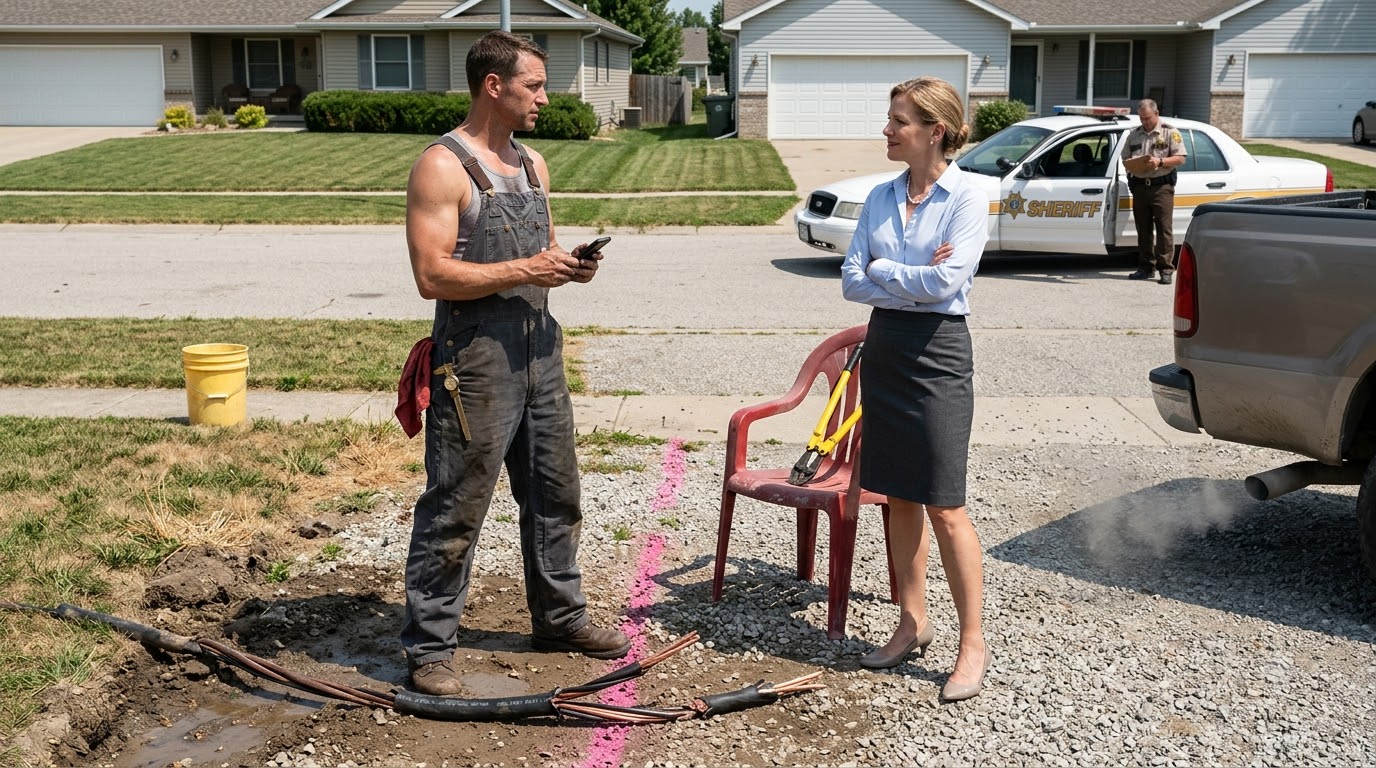
I walked out to the gravel margin where my property met the street. Karen Peterson stood near the boundary trench, holding a pair of yellow-handled bolt cutters. At her feet lay six feet of rubberized three-phase copper cable, sliced straight through to the core.
“This unsightly conduit violates community aesthetics, Mr. Miller,” she said, adjusting her pearl necklace. “I gave you notice.”
I rolled the lock nut of my caliper between my thumb and forefinger, feeling the cold brass edge. “That cable carries two hundred amps of commercial service, Karen. You could have killed yourself.”
“I am enforcing the covenants of Oak Creek Estates,” she replied, stepping over the ditch with a sharp click of her low heels. “Unapproved industrial wiring has no place on common easement.”
I pulled my phone from my shirt pocket and hit record, keeping the frame steady on the raw, copper-exposed ends resting in the damp soil. “For the record, this line sits inside a ten-foot county utility easement documented in book forty-two of the public record.”
She didn’t flinch; she simply folded her arms and smiled like a school principal watching a child make an excuse. “The board overrides county squabbles when it comes to visual harmony.”
Ten minutes later, Deputy Vance’s cruiser pulled into the turnaround. He didn’t get out right away; he sat in the air-conditioned cab for two full minutes writing on a clipboard before stepping into the heat.
“She cut the main service line to my shop, Deputy,” I said, pointing to the severed cable and the yellow tools resting on Karen’s lawn chair. “That’s deliberate destruction of commercial property.”
Vance looked at the trench, then at Karen, then back to my recorded video clip. He rubbed the back of his sun-burned neck with a heavy sigh.
“Look, Mr. Miller,” Vance said, his voice flat with mid-day boredom. “This is an HOA boundary dispute on private residential land. Sheriff’s department doesn’t get caught in the middle of neighborhood covenant fights.”
“She used bolt cutters on a live utility line,” I said, my voice dropping an octave into the flat tone I used when clearing unexploded ordnance in Fallujah. “That’s property damage over fifteen thousand dollars.”
“It’s a civil matter,” Vance repeated, already backing toward his driver’s door. “Work it out through your board or take it to magistrate court. I’m not writing a criminal ticket for lawn care politics.”
He pulled away, leaving a thin cloud of dust over the severed wire.
Karen smiled, resting one hand on her hips as she looked down at the trench. “The daily fine for unauthorized generator usage begins at six this evening, Frank.”
I didn’t answer. I just loosened the lock nut on my caliper, measured the exact diameter of the exposed copper wire in silence, and wrote the number down in my pocket notebook.
CHAPTER 2: THE PAPERWORK SIEGE
I didn’t drop the caliper. I just tightened the lock nut until the metal bit into the flesh of my thumb, watching Karen’s low heels click rhythmically down her concrete walkway until her front door slammed shut.
The silence of the dead workshop pressed against my ears. Two hundred amps of silent, industrial potential lay severed in the dirt, and the law had just driven away in a white Ford sedan.
By four o’clock, the rental flatbed backed up my driveway, its hydraulic ramps clattering against the pavement. The industrial generator on the deck was an ugly, orange steel cage housing a four-cylinder diesel engine, loud enough to wake the dead and heavy enough to crack asphalt.
I had the unit grounded, cabled, and roaring by five-thirty, the heavy exhaust pipe venting a faint blue haze into the evening air. The shop lights flickered, hummed, and settled into a steady, bright glare. Inside, the lathe spun back to life.
At 6:01 PM, a white paper envelope fluttered against the driver’s side window of my pickup, tucked firmly beneath the wiper blade.
I stepped out of the shop, wiping grease from my palms with a red shop rag. Karen stood ten feet back on the neutral turf of the asphalt street, her arms crossed over a clipboard, a pair of oversized designer sunglasses resting on top of her head despite the dusk.
“Section 4, Paragraph B,” Karen said, raising her voice over the steady, rhythmic thump-thump-thump of the diesel motor. “Unauthorized industrial equipment operating within residential view. One hundred dollars per calendar day, effective immediately.”
“It’s temporary power to mitigate emergency property damage,” I said, holding the rag still in my hands. “You cut the commercial utility feed.”
“I enforced the bylaws, Mr. Miller.” She tapped the top of her clipboard with a manicured nail. “The board does not grant variances for commercial machinery. You have twenty-four hours to cure the violation or the daily assessment doubles.”
She turned on her heel and started across the street.
“Karen,” I called out.
She paused, looking back over her shoulder with an eyebrow arched, enjoying the leverage.
“You skipped the thirty-day written cure notice required by State Statute 720,” I said, my voice staying strictly at conversational volume. “And you didn’t include the certified mail tracking receipt required by Section 12 of your own charter.”
The smirk on her face didn’t fall, but her eyes narrowed slightly behind her glasses. “The board’s legal counsel drafts our notices, Frank. Don’t waste your time playing lawyer.”
“I’m not a lawyer,” I said, stepping closer to the property line. “I’m a guy with a lot of dead air in his shop and three binders of public records.”
I watched her walk away, but my eyes didn’t follow her to her porch. They dropped to the curb directly in front of her driveway.
Right at the edge of the expansion joint, almost completely obscured by a patch of dry crabgrass, was a fresh notch cut into the concrete. Inside the notch was a dash of bright, neon-pink surveyor’s paint—faded slightly by recent rain, but undeniably fresh.
It wasn’t a utility marker. Blue was water, orange was telecom, red was electric. Pink was property boundaries for civil engineering.
And it was sitting six feet inside the HOA common green space, perfectly aligned with the trench Karen had dug to reach my cable.
I knelt in the gravel, touching the rough edge of the freshly carved concrete with my index finger. The dust on my skin turned pink.
That night, while the diesel engine chugged rhythmically outside my window, I didn’t turn on the TV. I laid out three blue three-ring binders across the kitchen table, flanked by a stack of yellow legal pads and a hot mug of black coffee.
If the law wouldn’t cross the property line, then the fight was going to happen on the paper.
I drafted seven formal dispute notices before midnight—one for the generator fine, three for procedural defects in her notice delivery, and three separate demands for full financial disclosures regarding board vendor contracts over the last twenty-four months. Under state law, an HOA president had ten business days to deliver those ledger pages, or face personal fines per statutory violation.
Around 1:00 AM, a soft knock rattled the glass of my back kitchen door.
I pulled the curtain back. Dennis was standing on the back step, wearing a faded Air Force physical training jacket, looking nervously toward the street.
I opened the door. “Dennis. It’s late.”
“Turn the porch light off, Frank,” he whispered, slipping inside without waiting for an invitation. He smelled like damp earth and stale tobacco. “If she sees my car parked down the block, she’ll issue me a fine for street parking after midnight.”
I shut the light off, leaving only the single lamp over my kitchen table illuminating the stacks of legal paper.
Dennis looked at the binders, then at me, shaking his head. “You’re wasting your time with the dispute forms, man. She’s got three board members in her pocket. They just sign whatever she puts in front of them at the quarterly meetings. Nobody even checks the receipts.”
“They’ll check these,” I said, pushing a cup of cold coffee toward him. “Why did she force you to take down your flagpole, Dennis?”
Dennis stared at the table, his knuckles whitening as he gripped his jacket zip. “Said it made the cul-de-sac look like a commercial facility. Threatened a lien on my mortgage if I didn’t pull the bracket down within forty-eight hours. My wife got so stressed out about the legal threats she couldn’t sleep for a month. So I pulled it down.”
He looked up, his eyes hard in the low light. “She’s got everyone terrified, Frank. Everyone thinks she owns the land.”
“She doesn’t own the land,” I said, pointing my brass caliper at the pink surveyor’s mark I had sketched onto a piece of grid paper on my desk. “She’s just using the rules like a crowbar. And crowbars bend if you put enough weight on the wrong end.”
“What’s the pink mark on the curb?” Dennis asked, leaning closer to the sketch.
“That’s what I’m going to the county land records office to find out at eight o’clock tomorrow morning,” I said.
CHAPTER 3: THE BROKEN PAPERWORK
The ledger binder felt like lead under my hands, its cracked vinyl cover sticking to the counter’s laminate surface as the clerk adjusted her bifocals.
“Plat Map 412, Oak Creek Estates,” she muttered, her fingernail tracing the yellowed grid lines of the county register. “Final filing, 1998.”
I adjusted my brass caliper on the counter, sliding the jaw open and shut with a faint, metronomic click. “Check the utility easement along the southern perimeter lot line. Lot 14.”
She flipped the heavy vellum page, the dry paper whispering in the quiet basement office. “Here it is. Ten-foot dedicated easement for municipal and primary distribution utilities. Grandfathered commercial access overlay attached.”
“And the recent filing?” I asked. “Three weeks ago.”
She tapped her keyboard with two fingers, staring at the amber text on her CRT monitor. Her brow furrowed. She typed another string, then reached for a manila folder sitting on a side shelf.
“Application for Easement Abandonment and Right-of-Way Dedication,” she said, pulling a stapled document from the folder. “Submitted by Oak Creek Estates HOA Board, represented by Karen Peterson.”
“Has it been approved?”
“No. It’s pending environmental review for a commercial access road,” she said, sliding the copy across the laminate counter. “A regional logistics firm filed a preliminary site plan to connect to State Route 14 through that green space.”
I looked at the blueprint attached to the application.
A sixty-foot wide heavy-vehicle access road was drawn in thick black ink directly through the ten-foot utility easement. Right over my severed power line.
My lot was the bottleneck. Karen hadn’t cut my power line because it was unsightly. She cut it because the commercial buyer required the easement clear of active three-phase high-voltage lines before completing the purchase contract.
She wasn’t protecting property values. She was clearing ground for a million-dollar land sale.
“Is the board authorized to unilaterally abandon a dedicated utility easement without a two-thirds homeowner vote?” I asked, keeping my voice low and steady.
The clerk gave me a tired, knowing look. “Not legally under state statute. But if nobody files a formal title encumbrance objection at the county recorder’s office within thirty days of notice posting, it defaults to approved.”
“When was the notice posted?”
“Twenty-eight days ago,” she said.
I picked up my brass caliper, slipped it into my front pocket, and pulled out my notebook. “I need three certified copies of this pending application and the original deed plat.”
Ten minutes later, I walked out into the bright glare of the county parking lot.
The thirty-day clock had forty-eight hours left before Karen’s unauthorized land transfer became permanent by default. She had timed the power cable demolition to force me into an expensive legal retreat or force my shop to shut down right as the deadline expired.
I pulled out my phone and dialed Dennis’s number.
“Dennis,” I said as soon as he picked up. “Get a pen.”
“What did you find?” his voice was tense, the background noise of his garage clear over the line.
“She’s selling the common green space behind my lot to a road developer,” I said, leaning against the warm hood of my truck. “And she’s using HOA funds to process the abandonment permits.”
Silence hung on the line for three seconds before Dennis swore under his breath. “That’s why she wouldn’t let Mrs. Gable build her garden fence last month. She told everyone the soil was unstable.”
“We need the original charter ledger from the board secretary,” I told him. “The one that lists the financial sign-off requirements for board contracts over ten thousand dollars.”
“Karen keeps all the board records in her house, Frank,” Dennis said hesitation bleeding through his words. “Nobody gets near those files except her.”
“She doesn’t own those records,” I said, looking at the certified plat copy in my hand. “The homeowners do.”
CHAPTER 4: THE PRESSURE TRAP
I sat in the cab of my truck as the dusk turned to full dark, the clipboard resting on my steering wheel, watching Karen’s living room light cast long yellow rectangles across her manicured lawn.
I tapped the brass caliper against the hard plastic edge of the clipboard. Three certified audit demand forms lay beneath the top clip, stamped and signed by three separate property owners in the neighborhood.
A bright orange envelope was taped to my driver’s side mirror. I didn’t need to open it to know what it said: Emergency Foreclosure Lien Notice — Non-Payment of Daily Generator Penalties.
She was pushing for a quick kill before the forty-eight-hour county title objection window closed.
My phone screen lit up on the bench seat beside me. Dennis.
“Frank,” Dennis said, his voice dropping low as if someone were listening in. “Mrs. Gable says Karen showed up at her front porch ten minutes ago with a notary form. Tried to get her to sign an affidavit saying her rose bushes were an unapproved obstruction.”
“Did she sign?”
“No,” Dennis muttered, the sound of a rustling plastic folder coming through the receiver. “Gable told her to get off her porch. But Karen told her if she didn’t sign, the board was going to assess a five-hundred-dollar emergency maintenance levy on her home next week.”
“She’s manufacturing artificial board expenses,” I said, looking at the street map I’d marked up in red ink. “She needs cash flow on the books to cover the legal fees for the easement abandonment.”
“It gets worse,” Dennis added. “Tom from down the block just called me. He said Karen sent a notice to his bank claiming his property has outstanding HOA code violations, trying to trigger a mortgage escrow review.”
“She’s playing defense,” I said, setting my clipboard on the dash. “She knows the county filing is exposed.”
“What do we do?”
“We don’t wait for her quarterly meeting,” I said. “State statute allows twenty percent of deeded owners to force an emergency special hearing if there’s a petition alleging procedural fraud.”
“You think people will sign?” Dennis hesitated. “They’re scared of her liens, Frank.”
“They’re scared because they think they’re fighting her alone,” I said. “Meet me at Tom’s driveway in ten minutes. Bring the copies of the developer blueprint from the county office.”
Ten minutes later, four of us stood under the flickering amber streetlamp at the edge of Tom’s driveway—Tom, Dennis, Mrs. Gable wrapped in her heavy wool sweater, and me.
I laid the certified county blueprint flat across the hood of my truck. The red line marking the proposed commercial access road cut straight across the green space, slicing directly behind three of their backyards.
Mrs. Gable put her reading glasses on, tracing the thick black line with a trembling finger. “A freight access road? Right behind my garden?”
“Sixteen-wheeler traffic, twenty-four hours a day,” I said. “The HOA board is transferring that easement right-of-way in two days. Unless we deliver a formal petition signed by twenty-two homeowners before five o’clock tomorrow.”
Tom looked up from the blueprint, his jaw tight. “She told us the green space was being designated a wildlife conservation buffer.”
“She lied,” I said, pulling out a pen and setting a clean signature ledger on top of the blueprint. “She’s selling the access right to a logistics developer. And if we don’t halt the board action right now, the entire neighborhood pays for the road maintenance under common assessment.”
Tom took the pen without saying another word and pressed his signature firm into the top line.
Mrs. Gable adjusted her glasses, took the clipboard next, and signed her name in neat, cursive script. “I’ve lived here twenty-four years, Frank. I’m not moving for a gravel haul road.”
By midnight, nineteen signatures were locked on the petition.
As I walked back to my driveway, a dark SUV pulled up alongside the curb, idling silently. The driver’s side window rolled down three inches.
Karen’s face was half-hidden in the shadow of the cabin, but the white-hot glare of her phone screen illuminated her tight, rigid expression.
“You’re making a catastrophic financial mistake, Mr. Miller,” she said, her voice dropping the cheerful suburban tone entirely. “You think you’re organizing a petition. All you’re doing is creating joint legal liability for every neighbor who puts their name on your paper.”
“The petition is already registered with the county clerk’s digital drop box, Karen,” I said, resting my hand on the cold bed-rail of my truck. “The thirty-day abandonment hold is active.”
She stared at me in the dark, her jaw working silently for two long seconds before she rolled the window up and accelerated down the street, her tires kicking gravel into the ditch.
CHAPTER 5: THE BOARDROOM COLLAPSE
Standing at the head of the community center assembly room, I tapped the edges of my blue binder against the wooden podium until thirty pairs of eyes locked onto the stage.
Karen sat behind the long folding table at the front, flanked by her two silent board members. Her knuckles were white where her hands gripped the edge of her mahogany gavel, her chin tilted up in a forced posture of supreme authority.
“This special session is irregular and out of order,” Karen announced, slamming the wooden block down with a sharp crack that echoed off the high ceiling. “Mr. Miller has no standing to present motions before the board.”
I didn’t raise my voice. I pulled my brass caliper from my pocket, set it flat on the podium, and picked up the top sheet from my stack.
“Under State Statute 720, Section 303, twenty-two signed petition forms from deeded homeowners automatically suspend all pending board land actions until a formal audit is conducted,” I said, pointing to Dennis, who was handing out stapled packets down the center aisle. “You are holding twenty-six certified signatures.”
Tom took his copy, holding it up so the couple in the row behind him could see the county clerk’s red digital entry stamp across the top corner.
“That petition is invalid,” Karen snapped, her voice tightening as her facial muscle twitched near her right eye. “The board was acting under emergency authority to clear an illegal, unpermitted high-voltage hazard on common grounds.”
“The three-phase power line was permitted in 1998 under County File 412,” I said, laying a large, glossy photograph onto the overhead projector surface. The wall screen behind me flooded with light, displaying a enlarged section of the developer’s site blueprint. “And the line wasn’t removed for safety. It was removed because your option contract with Northland Logistics required an unencumbered sixty-foot easement by midnight tonight.”
A collective murmur rippled through the room. Mrs. Gable stood up in the third row, pointing her finger at the table. “You told us that was a bird sanctuary extension, Karen!”
“Quiet! Order in the room!” Karen banged the gavel three times in rapid succession, but no one sat down. “That blueprint is a preliminary regional study! No land deal has been finalized!”
“No,” I said, flipping to the next page in the blue binder. “The deal hasn’t been finalized because the county recorder placed an emergency hold on the transfer two hours ago. But the earnest money deposit of forty thousand dollars was wired to the HOA operating account last month.”
Karen’s hand froze over the gavel. Her two board members looked at each other, then slowly slid their chairs three inches away from her side of the table.
“I have the bank ledger statements right here, obtained under mandatory statutory disclosure,” I continued, holding up the white ledger pages. “The forty thousand dollar deposit isn’t in the capital reserve account. It was transferred three days later to a private LLC registered under your maiden name.”
The room went dead silent. Even the hum of the overhead air conditioner seemed to drop out.
“That is a administrative fee!” Karen stood up so fast her metal chair scraped violently against the linoleum floor. Her face flushed a deep, blotchy red. “I spent three years negotiating that access deal to save this neighborhood from bankruptcy! None of you do anything! You sit in your air-conditioned houses complaining about lawn fines while I keep this entire development afloat!”
“You didn’t keep it afloat,” Dennis called out from the back row, holding up a red ledger folder. “You broke the budget, stole the deposit, and cut Frank’s power line to cover your tracks before the audit!”
“You’re all ungrateful!” Karen shrieked, her hand trembling violently as she shoved her clipboard off the table, sending papers scattering across the floor. “I am the president of this board! You can’t question my records! You can’t do any of this without my signature!”
I picked up my brass caliper from the podium and slid it into my pocket, looking her straight in the eye. “We don’t need your signature, Karen. The vote to remove you for cause is item four on tonight’s agenda.”
CHAPTER 6: THE QUIET NORMAL
I pressed the steel ruler firmly against the raw edge of the cold-rolled bar stock, the metal cool and unyielding beneath my fingers as the fluorescent overhead shop lights hummed.
There was no diesel chatter outside the window. The orange generator was gone, returned to the equipment yard three days ago after the utility company crew re-pulled two hundred feet of heavy three-phase underground service cable through a brand-new conduit.
I set the ruler down, picking up my brass caliper. I opened the jaw, slid it over the fresh copper fitting near the main breaker box, and tightened the lock nut.
Zero point zero zero inches of play. Perfectly square.
Outside, the neighborhood was still. Across the street, the yellow For Sale sign in Karen’s front yard leaned slightly in the evening breeze, its corner real estate flyer box empty.
When the new board took over the ledgers, the civil restitution process was swift and clinical. The court-ordered property judgment for the destroyed commercial line, lost business revenue, and embezzled HOA funds totalled eighty-two thousand dollars. Her secret option deal with the logistics developer dissolved the minute the county recorder formally reinstated our grandfathered utility easement.
She couldn’t stay. Without her board title or her manufactured authority, every trip to her mailbox meant facing Tom, Dennis, or Mrs. Gable working peacefully in their yards.
A quiet knock sounded against the open workshop doorframe.
Dennis leaned against the jamb, holding a steaming mug of coffee in one hand and a small cardboard box in the other. He didn’t rush in. He just stood on the concrete apron, looking at the smooth, steady spin of my industrial lathe.
“Power running clean?” he asked, his voice easy.
“Two hundred amps, rock solid,” I said, flipping the safety switch on the console. The lathe whirred down to a gentle halt. “How’s the new board meeting agenda looking for next week?”
Dennis smiled, setting the cardboard box on the corner of my assembly bench. “Three items. Fixing Mrs. Gable’s garden drainage ditch, setting up the summer block party, and approving a new bracket for my flagpole.”
He pulled a heavy iron bracket out of the box, setting it down next to my caliper. “Thought I’d bring it by to see if you could weld a reinforcement plate on the back. Wants to make sure it handles forty-knot wind gusts.”
“I can do that right now,” I said.
I picked up the iron bracket, testing its weight in my hands. It was simple work—pragmatic, clean, and built to last.
Out in the common green space where Karen had once dug her trench, the grass was already growing back over the fresh dark dirt. Kids from down the street were riding bikes along the curb, their laughter carrying clear across the quiet evening air.
I put on my welding mask, struck an arc, and watched the bright blue spark bridge the gap, locking the iron permanently in place.