A Fragment of Sun: How Marcus Steel Found the Courage to Mend What Was Broken in Dustville
CHAPTER 1: The Weight of a Morning
The diner was a study in stillness, saved only by the rhythmic, percussive hiss-thump of the coffee machine. The sunlight, filtered through dust-streaked windows, painted the checkered floor in squares of pale, tired gold. Steel sat on his stool, his fingers tracing the rim of his mug, the ceramic worn smooth by three months of the same morning ritual. The air smelled of burnt wheat toast and the faint, metallic tang of the desert heat rising outside.
When the slap echoed, it felt like the world had snagged on a jagged wire. Steel’s head jerked up, his pulse spiking—a sharp, electric jolt of adrenaline that he hadn’t felt since the days he wore colors. He watched Rosie stumble, her hand flying to her mouth, her eyes darting not toward her attacker, but toward the door, checking the exit with the instinct of a trapped animal.
The Sheriff stood over her, his uniform a starched, hollow mockery of authority. “Discipline,” he muttered, his breath hitching with the arrogance of a man who owned the air in the room.
Steel felt a phantom pressure in his chest, a sensation of fluorescent lights and the hum of a sterile hospital room where he had once stood holding a hand that was far too thin. The memory was a sudden, freezing phantom, pulling him out of the diner and back to that final night in Vegas. He saw Linda’s eyes, soft and fading, and he saw his own younger face, hardened by a life of choices that had brought him to this exact, terrible moment.
He didn’t stand up with the bluster of a hero. He stood with the deliberate, heavy grace of a man who knew exactly how much damage he was about to cause. His boots made no sound on the checkered tiles. As he stepped between Rosie and the Sheriff, he felt the heavy, fraying threads of his own quiet life snapping one by one.
“The lady asked you to leave,” Steel said. His voice wasn’t a growl; it was a low, resonant note that seemed to hum in the base of the room, vibrating against the glass sugar shakers.
The Sheriff turned, his face flushed with a bloated, easy confidence, but as his eyes met Steel’s, the air between them shifted. Steel wasn’t looking at a lawman; he was looking at a man who was afraid, who hid his fear behind a badge and a brutal, senseless exercise of power. In that split second, Steel realized the decoy secret—the idea that this was just a town bully—was a lie. The Sheriff’s hand, resting on his holster, was trembling with a rhythm that screamed of a larger, darker pressure.
Steel held his ground, his gaze steady, searching for the crack in the man’s armor. He saw it: a flicker of genuine, pathetic desperation. The Sheriff didn’t want to fight; he wanted to be feared so he wouldn’t have to face whatever was pulling his strings from the dark.
“You don’t know who you’re dealing with,” the Sheriff spat, but the words lacked conviction.
Steel felt the weight of his own scars, the silence of his daughter’s phone, and the haunting, soft smile of a dead wife. He didn’t blink. “And you,” Steel said softly, “have no idea how much I’ve stopped caring about the consequences.”
The diner held its breath. The jukebox groaned, skipping on a Pasty Cline track, a soft, distorted loop of longing. Steel knew then that the quiet life was gone. He reached out and gently moved Rosie behind him, his touch lingering for a heartbeat on the cool, fraying edge of her apron. He wasn’t just defending a waitress; he was finally, after fifteen years of running, choosing to stand still.
CHAPTER 2: The Fracture in the Routine
The diner fell into a silence so profound it felt tactile, a heavy blanket of dust settling over the checkered floor. Steel kept his hand on the back of Rosie’s apron for an extra second, his knuckles white, before pulling back. He looked at the Sheriff’s retreating back, the broad, starched shoulders disappearing through the glass door, but his focus wasn’t on the man. It was on the doorway itself—on the way the brass bell didn’t just chime, but seemed to vibrate with a discordant, warning tone.
“He won’t come back through the front door,” Steel said, his voice rasping against the quiet. It was the first time he’d spoken to Rosie without the filter of his ‘drifter’ persona. He wasn’t the man who fixed Harleys anymore; he was the man who knew what a cornered animal sounded like when it stopped growling and started sharpening its claws.
Rosie was trembling. Not the violent shaking of a woman in shock, but the fine, high-frequency vibration of someone who had lived in fear so long it had become a second nervous system. She smoothed her apron, her fingers catching on a loose thread at the hem—a fraying edge that looked too much like her own sense of safety.
“He’s been watching the garage, Steel,” she whispered, her eyes darting to the window. “I’ve seen his cruiser parked down the road, by the old Miller place, at three in the morning. He isn’t just a bully. He’s… he’s waiting for something.”
Steel stepped to the counter, his eyes scanning the space. The diner was a map of his failure to stay uninvolved. He noticed it then—a small, innocuous detail he had ignored for weeks. A logbook lay open near the register, where Rosie tracked the supply deliveries. He leaned over, his eyes narrowing. The Sheriff had been in here for his usual black coffee four times this week, but every time he sat at the counter, he had positioned himself directly in front of the supply invoices.
He flipped the page back. There were smudges of oil and graphite on the edges of the paper, consistent with the kind of grease used in heavy mechanical gear—not car grease, but industrial, high-torque lubricant used in regional logistics hubs.
“He wasn’t drinking coffee, Rosie,” Steel murmured, his mind already calculating the logistics. “He was reading your supplier manifests. He’s looking for something specific—a shipment, a route.”
A cold wind seemed to blow through the diner, despite the stifling heat of the Arizona morning. Steel realized then that the decoy secret he had built his small, quiet life around was thinner than he imagined. This wasn’t just about a town; it was about the town as a conduit. The Sheriff wasn’t just a local power-tripper; he was a gatekeeper for something far larger, and he was terrified that his gate had been breached.
Steel turned to leave, but Rosie grabbed his sleeve. Her fingers were cold, a sharp contrast to the humid air. “Don’t go to the garage yet,” she pleaded. “If he’s been watching, he’ll know you’re the one who stood up to him. He’ll go there first.”
“That’s why I need to go,” Steel said, his voice firming. He wasn’t choosing the club, he wasn’t choosing the war, he was choosing the present. “If he thinks I’m a drifter, he’ll underestimate me. If he thinks I’m a threat, he’ll make a mistake.”
He walked out the front door, the heat hitting him like a physical blow, a wave of dry, searing air that tasted of iron and salt. He didn’t head for the parking lot. Instead, he took the long way around, cutting through the narrow alleyway behind the butcher shop. He moved with the calculated, heavy steps of a man who had spent years learning how to be invisible in plain sight.
As he reached his truck, he saw it: the dust on the driver-side door was disturbed, a smudge of a fingerprint right near the lock. Someone had been here. They hadn’t forced it, which meant they had a key or they were skilled enough to pick a deadbolt in under ten seconds.
He didn’t open the door. He stood there, leaning casually against the faded, peeling paint of the truck, his eyes scanning the rooftops of Main Street. His training from the Corps surfaced—a cold, analytical clarity. He wasn’t the man who had failed his daughter in that hospital room; he was the man who had survived worse than a corrupt Sheriff in the desert.
He pulled his phone from his pocket, his thumb hovering over the contact for his daughter, Cat. He hadn’t called her in months, the weight of his own shame acting as a barrier he felt too broken to cross. He looked at the screen, at the fading battery icon, a tiny, fraying edge of his own connectivity.
Not yet, he told himself. I have to earn the right to speak to her.
He tucked the phone away and felt the cold, hard weight of a tire iron he kept beneath the seat. He moved toward the garage, his boots crunching on the dry, brittle scrub of the lot. He had to know what they had taken—or what they had planted. The routine of his life had been fractured, and he knew, with a certainty that settled in his marrow like lead, that the only way to mend the fracture was to become the very thing the Sheriff feared most: a man with nothing left to lose and everything to prove.
He reached the garage door, his hand gripping the cold metal of the handle. He took a breath, the air filling his lungs with the scent of oil and old, unfulfilled promises. He pushed the door open, the hinges screaming a protest in the quiet morning, and stepped into the shadows.
CHAPTER 3: The Echo of an Invitation
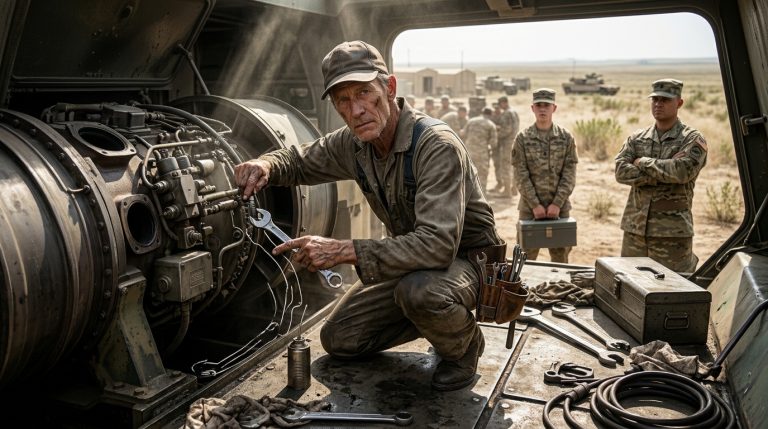
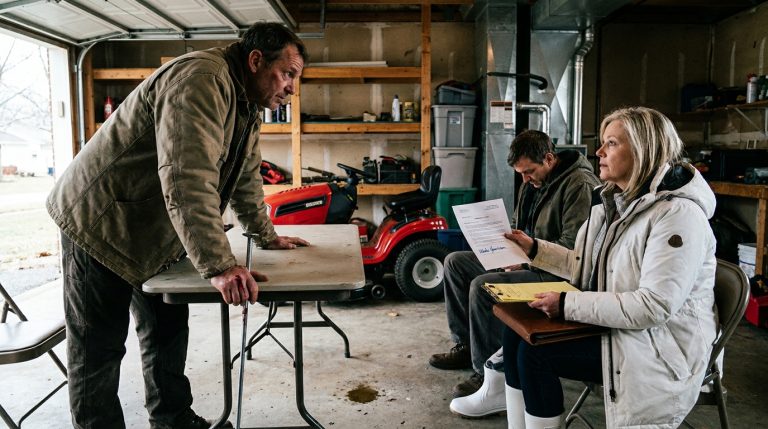
The garage door slid upward with a dry, rhythmic protest of rusted hinges. Steel stepped inside, his body angled, his eyes adjusting to the transition from the brutal Arizona noon to the cool, oil-scented gloom of his workspace. He didn’t turn on the lights. He didn’t need to. He knew the placement of every wrench, every spare gasket, every shadow in the room.
But something was wrong. It wasn’t a disarray of tools or a missing piece of equipment. It was the scent. Beneath the pervasive, familiar tang of motor oil and old rubber, there was a faint, sickly-sweet trace of antiseptic—the same sterile, chemical smell that clung to the hallways of St. Mary’s Medical Center. It was a phantom, an intruder in his sanctuary.
He moved toward the workbench, his boots quiet on the concrete. He reached for the silver-framed photo of Linda, his fingers tracing the edge, and paused. It was turned face-down.
A chill, thin as a razor blade, sliced through the stifling heat of the garage. He hadn’t touched that photo since he had arrived in Dustville; he had left it exactly as it was, a static, frozen monument to his own grief. Someone had been here. Someone who knew exactly what would unsettle him.
Suddenly, the overhead fluorescent lights flickered—a stuttering, frantic pulse of electricity—and then died completely. The darkness that rushed back into the room was absolute. A split second later, a low, ominous hum vibrated through the floorboards, the sound of a heavy industrial circuit being tripped.
Steel dropped into a crouch, his muscles coiling. The power didn’t just fail; it was forced. He reached into his jacket, his hand finding the grip of the tire iron he had retrieved from the truck. He didn’t wait for his eyes to adjust. He moved, shifting his weight with the practiced efficiency of a man who had navigated blind alleys in the dark of a desert war.
He sidestepped toward the tool rack, his hand finding the handle of a heavy crowbar. He wasn’t afraid of the darkness; he was part of it. But as he crept toward the center of the garage, the hum grew louder—a high-pitched, electric whine that set his teeth on edge. It wasn’t just a power surge; it was a distraction.
He heard it then: the soft, rhythmic click of a deadbolt on the side door, the one that led out toward the desert scrub.
Steel sprinted, his boots finding traction on the oil-stained concrete. He hit the side door with his shoulder just as it began to swing open. He didn’t burst out into the sun; he stopped, his chest heaving, his eyes scanning the blur of the heat-shimmered horizon. There, barely a hundred yards out, a dark sedan was idling, its silhouette distorted by the shimmering asphalt of the access road.
He didn’t pursue. He knew better. That was the trap—the “butterfly detour,” a minor environmental shift meant to force an impulsive, predictable action. If he ran into the desert, he was an exposed target.
Instead, Steel turned back to the garage. He walked to the center of the room and kicked his boots against the concrete, searching for a hollow sound. He found it near the spot where the old Harley was parked. He knelt, his fingernails prying at a loose corner of the concrete slab he had poured himself when he moved in.
Underneath, in a waterproof bag, sat a small, leather-bound notebook. It wasn’t his, but it was from the same supply store Rosie used. He opened it. It was filled with lists: license plate numbers, shift rotations for the Sheriff’s station, and dates that corresponded with Clayton Hartwell’s death.
It wasn’t just a list; it was a tally. Whoever had been in here hadn’t just come to turn a photo face-down; they had come to leave a message. They were watching him, counting his days.
Steel stood, the weight of the notebook feeling like a cold stone in his hand. He walked back to the workbench and finally flicked the manual toggle on his battery-powered work lamp. The warm, yellow light bled into the room, banishing the shadows. He didn’t look for the photo immediately. He looked at the wall above the bench, where he had pinned his calendar.
Three dates were circled in red.
The first was the day he had arrived in Dustville. The second was the day he had first gone to the diner. The third was today.
The realization hit him with a hollow, gut-wrenching thud. He wasn’t the hunter; he was the subject of an experiment. The Sheriff wasn’t just reacting to his actions; he was anticipating them, perhaps even encouraging them. The ‘decoy’—the idea that he was just cleaning up the town—was an elaborate, staged performance. And he had been playing his part to perfection.
He walked to the photo and turned it over. Linda’s smile was still there, vibrant and painful, a testament to a life that had ended while he was still busy chasing a hollow, metallic version of belonging. He picked up the frame, the metal cool against his calloused palms.
He had to see Hayes. Not to ask for help, but to see if the young deputy was the only one in that building who hadn’t been bought. He pulled his phone from his pocket, the battery reading a precarious 4%. He tapped the icon for the local precinct. He didn’t call. He just listened to the dial tone, a steady, rhythmic pulse that echoed the hum of the dead lights.
He wasn’t going to wait for them to come back. He was going to find the source of the rot, the connection that linked the Sheriff to the Vipers, the link that turned this town into a funnel. He started to pack his gear, his movements economical, precise. He wasn’t the man who fixed bikes anymore. He was the man who had been invited to a game he hadn’t yet realized was rigged.
And for the first time in fifteen years, he felt a strange, terrifying sense of clarity. The fear was still there, a fraying edge of his own mortality, but beneath it was something sharper—a resolve that felt like iron. He grabbed his coat, the heavy canvas stiff and comforting. The desert outside was vast, indifferent, and waiting.
He stepped out of the garage, the sun blinding, the heat of the afternoon pressing against his skin like a heavy, suffocating hand. He didn’t look back. He didn’t need to. He knew exactly what was waiting for him at the diner, and he knew exactly what he had to do to survive.
CHAPTER 4: The Architecture of Secrets
The station was a sanctuary of calculated order. The air here was thin, scrubbed clean of the desert’s raw grit, replaced by the sharp, biting scent of industrial-strength bleach and stale coffee. Steel stood for a moment in the lobby, his eyes adjusting to the artificial glare of the flickering fluorescent tubes. To any casual observer, he was just an older man in a worn canvas jacket, looking to file a mundane complaint. But to Steel, every shadow was a measurement, every open door a tactical risk.
He remembered the sterile, white-tiled corridors of St. Mary’s. The smell was the same—that aggressive, antiseptic effort to sanitize things that were inherently decaying. For a heartbeat, his resolve faltered, the memory of Linda’s hand in his—limp, warm, and fading—threatening to pull him into a paralysis of grief. He shook the image away, his jaw tightening until his teeth ached. He wasn’t here to mourn. He was here to ensure that no more lives were cut short by the kind of calculated indifference that defined this building.
“Can I help you, sir?”
The voice belonged to a desk clerk, a young woman whose name tag read Sarah. She didn’t look up from her monitor. Her typing was rhythmic, the sound of a mechanical bird pecking at a keyboard.
“I’m looking for Deputy Hayes,” Steel said, his voice a low, gravelly hum. “He asked me to drop off a delivery. A personal matter.”
Sarah paused, her fingers hovering. She looked at him then, really looked, her eyes skimming the weary lines of his face and the calloused, oil-stained hands. “Deputy Hayes is in the back processing evidence. I can page him, but he’s pretty swamped. Something about the Miller Point file.”
Miller Point. The name of the cliffside road where Clayton Hartwell had supposedly lost control of his car.
“I’ll wait,” Steel said, moving toward a row of molded plastic chairs that looked designed for maximum discomfort.
He sat, his posture relaxed, his eyes roving. He watched the flow of the room. It was a machine of bureaucracy, but beneath the surface, he saw the frayed edges. A filing cabinet in the corner was slightly askew, a drawer left a quarter-inch open—a detail that didn’t fit the station’s rigid, antiseptic veneer. He noticed the way the other deputies walked past the evidence lockers: with a wide, deliberate berth, as if the lockers themselves were leaking something toxic.
Ten minutes passed. The station began to hum with the change of shift. Men in starched uniforms drifted in, laughing, their camaraderie a thick, impenetrable wall. Steel remained still, a shadow in the corner. He wasn’t just waiting for Hayes; he was soaking in the architecture of the corruption. He noticed the way the security cameras were positioned—they covered the lobby, but the blind spot leading toward the maintenance corridor was clearly intentional.
Finally, the side door opened. Deputy Hayes emerged. He looked haggard, his uniform shirt wrinkled at the shoulders, his eyes carrying the weight of sleepless nights. He spotted Steel, and for a fleeting, terrifying second, his face went bloodless.
Hayes didn’t break stride. He walked straight toward the lobby exit, his eyes fixed on the door. “Follow me,” he murmured, his voice barely audible, as he passed within an arm’s reach of Steel.
Steel stood and tracked him. They moved through the heavy steel-framed door and into the narrow, dimly lit hallway that led to the locker room. The smell of bleach intensified here, mixed with the sharp, acidic odor of sweat and old leather.
“You shouldn’t be here,” Hayes hissed, stopping in the shadow of a cleaning closet. “The Sheriff is running a diagnostic on the network logs. He knows the server room was breached.”
“Did he find me?” Steel asked, his voice steady.
“He found the footprint. A size twelve work boot, oil-stained. He’s not looking for a hacker, Steel. He’s looking for the mechanic.” Hayes turned, his eyes wide, pleading. “I tried to scrub the log entries, but the backup server automatically mirrored the access attempt. He knows it was an inside job, or someone who had detailed knowledge of the schematics.”
Steel pulled the leather-bound notebook from his jacket and pressed it into Hayes’s hand. “This is what he’s been keeping. A tally. He’s not just a pawn, Hayes. He’s the accountant for the Vipers.”
Hayes opened the notebook, his eyes scanning the pages. His breathing hitched. “These dates… these are all the ‘accidents’ in the last six years.”
“Exactly,” Steel said. “He isn’t cleaning up the town. He’s managing the casualties.”
“What do you want me to do?” Hayes asked, his hand trembling as he tucked the notebook into his waistband.
“I need you to look at the manifest for the logistics node they’re using at the Miller Point drop. If I can find out when the next shipment is coming through, I can bypass the Sheriff entirely and hand the evidence to the state police.”
“Steel, if he catches us, we aren’t going to have ‘accidents.’ We’re going to be erased.”
“Then don’t let him catch us,” Steel replied, his voice devoid of sympathy. He felt the cold, hard weight of the reality: they were playing a game of chess against a man who had already burned the board.
He leaned closer, his shadow falling across the younger man’s face. “The Sheriff is going to try to provoke me into an act of violence, Hayes. He needs me to snap, to act like the ‘outlaw’ he claims I am. If he does, he’ll have the legal justification to take me down. I need you to document everything. Every threat, every illegal order, every discrepancy.”
Hayes swallowed hard, nodding once. “I’ll try. But be careful. He’s not at the station today. He’s out at his property, and the word is, he’s having guests.”
Steel nodded, his mind sharpening to a single, dangerous point. He turned to leave, but stopped, his eyes drifting back to the corridor that led to the server room. He felt the phantom chill again, the ghost of the hospital. He had to finish this. Not for Clayton, not even for Rosie. He had to finish this because he couldn’t survive another day as the man who had let the darkness take everything he loved.
He walked out, his steps echoing in the sterile, suffocating quiet of the hall, the image of the Sheriff’s house—the site of his impending, final confrontation—etched firmly into his mind.
CHAPTER 5: The Weight of the Evidence
Steel didn’t stop moving until he had cleared the station’s perimeter. He walked with a heavy, deliberate cadence, his eyes tracking the perimeter of the parking lot. The sun was a bloated, angry red disc dipping toward the horizon, bleeding long, distorted shadows across the asphalt. He reached the edge of the lot where he’d left his truck, but he didn’t climb in. Instead, he crouched beside the rear tire, his hand sliding underneath the chassis to ensure there was no tracker attached—a habit, a relic of a life he had tried to bury.
Nothing. Just the grit and heat of the road.
He climbed into the cab and sat in the silence, the engine ticking as it cooled. The notebook was gone, handed off to Hayes, but the weight of it—of the lives tallied in those pages—felt like a physical pressure against his sternum. He looked toward the desert. The landscape was a blur of ochre and deep violet, the heat waves still dancing like ghosts in the distance. He thought he saw a figure standing near the treeline, a dark silhouette against the fading light, but when he blinked, the figure vanished, consumed by the shifting sand.
Fatigue, he told himself. Just the heat. But the doubt scratched at him, an itchy, nagging sensation. He had spent his life reading the world like a mechanic reads an engine—looking for the slight misfire, the off-color exhaust, the subtle vibration of a failing part. And right now, the entire town of Dustville felt like an engine that was seconds away from seizing.
He started the truck and drove, not toward the garage, but toward the open desert road that bypassed the main thoroughfare. He needed the friction of the wind; he needed to feel the machine beneath him, to have the simple, linear problems of torque and traction to soothe the jagged, complex mess of his own conscience.
As he drove, the F-150’s engine surged, a steady, rhythmic protest against the uneven road. He looked at the dash clock. 6:45 PM. He was supposed to meet Rosie at the diner in an hour, but the plan felt fragile, like a piece of glass held together by spit and prayer. He realized then that he couldn’t protect her by hiding behind a plan. He had to draw the fire to himself.
He pulled over near Miller Point, the place where Clayton Hartwell had supposedly drifted off the edge. He stepped out and walked to the guardrail. The metal was rusted, flaky to the touch, and beneath it lay a sheer drop of fifty feet into a dry, jagged gulch.
He looked down, his eyes narrowing. There, caught on a sharp outcropping of rock halfway down, was a piece of white plastic—a fragment of a headlight casing. It shouldn’t have been there if the official investigation had been thorough. It was a physical contradiction, a piece of evidence that screamed of a forced collision.
He leaned over the railing, his breath hitching. A sudden, violent tremor shook the ground, or perhaps it was just the vibration of his own overtaxed nervous system. He felt dizzy, the horizon tilting, the smell of iron and dry earth rising from the gulch like an accusation.
I promised, he thought, the memory of Jake Mitchell’s face appearing in his mind’s eye. I promised I’d watch out for him.
The failure hit him then—a cold, sickening realization. He hadn’t just failed to watch over Clayton; he had been the one to create the distance, to build the wall of ‘brotherhood’ that had kept him from the only people who actually mattered. The decoy secret of the Sheriff’s corruption was finally unraveling, but the Layer 2 truth—the crushing weight of his own avoidance of forgiveness—was just beginning to take shape. He had treated his own grief as a form of penance, a wall of isolation that he thought protected him, but it had only served to leave him, and everyone he loved, exposed.
He climbed back into the truck, his hands trembling. He had to get to Rosie. He had to be the anchor. He swung the truck onto the main road and hammered the accelerator.
He didn’t notice the headlights tracking him from two miles back, moving with a calm, predatory patience. He didn’t see the way the other cars on the road moved aside, as if sensing the gravity of the situation. He just drove, the dashboard light casting a sickly, artificial green hue over his hands, his knuckles raw and white against the steering wheel.
He was heading back to the center of the trap, and for the first time, he didn’t care. He was going to walk into that diner, look at Rosie, and finally, for the first time in his life, he was going to be exactly who he needed to be. Not a hero, not a outlaw, not a protector. Just a man. And that, he suspected, was going to be the most dangerous thing he could ever be to the Sheriff of Dustville.
CHAPTER 6: The Anatomy of a Compromise
Steel moved into the house not like a ghost, but like an extension of the architecture itself—slow, deliberate, and entirely aware of the friction he generated against the silence. The living room was a monument to the Sheriff’s bloated, fraudulent success. Leather sofas, thick rugs, and the hum of an air conditioning unit that fought a losing battle against the heat outside.
He didn’t head for the office immediately. He stood in the center of the room, listening. The house felt vacant, but it carried the residual static of someone who had recently occupied the space in a state of high agitation. A glass sat on the side table, half-full of amber liquid, a thin film of condensation already evaporating. He looked at it. The Sheriff had been drinking, and he hadn’t been drinking alone.
He crept toward the study. The door was ajar.
Steel nudged it with his toe, the wood groaning in protest. The office was a chaotic mirror to the station’s rigid order. Papers were scattered across a mahogany desk, and the hum of a computer tower, left running, vibrated against his ribs. He approached the desk, his eyes darting to a wall-mounted display of awards and commendations—the badges of a man who had built his reputation on the very laws he had spent his life dismantling.
He opened the center drawer. No gun. No cash. Just a thick, leather-bound ledger.
He flipped it open, the pages stiff and yellowed. The entries weren’t just financial—they were biographical. Names, dates, and amounts, but every third page included a photograph—a grainy, handheld snapshot of a man or a woman, always leaving a building or meeting a contact. Among them, he found the faces of the three people who had died in “accidents.”
But the final page in the ledger held a different set of initials: J.D., followed by a series of coordinates that Steel recognized instantly. They were the locations of state-level distribution centers for the Vipers’ supply chain. And beneath that, a handwritten note, the ink smeared as if by a shaking hand: “The Governor doesn’t care about the cost, only the consistency.”
The truth settled in his gut like a lead weight. The Sheriff wasn’t just working for the Vipers; he was the local manager for a state-sanctioned shadow operation. The rot wasn’t just in the soil of Dustville; it reached all the way to the state capitol.
He heard the crunch of tires on gravel outside—the heavy, rhythmic sound of a vehicle slowing down in the driveway.
Steel snapped the ledger shut, his heart hammering against his ribs like a trapped bird. He moved to the window, the fabric of the heavy drapes scratching against his knuckles. A black sedan had pulled up to the porch—the same car he had seen in the distance near the garage.
He didn’t have time to leave. He didn’t have time to stash the ledger. He was backed into a corner, his options narrowing down to the simplest, most brutal calculation: confront or hide.
The front door opened. He heard the Sheriff’s voice, a gravelly, drunken drawl, speaking to someone in the hall. “I’m telling you, it’s a matter of containment. The old man is a variable we didn’t account for, and the girl… she’s becoming an inconvenient witness.”
Steel stepped back from the window, his hand hovering over his belt. He could feel the cold, reassuring weight of his pistol. He had spent years running from the responsibility of his past, but as he stood in the dark study, listening to the man who had destroyed his sense of purpose, he realized the past had finally caught up to him. He was tired of being the man who watched from the shadows.
He gripped the ledger tighter, the friction of the leather against his palm a grounding sensation. The Sheriff was in the hallway now, his heavy, stumbling footsteps echoing. Steel positioned himself behind the door, his breath shallow, his body still.
He wasn’t going to wait to be hunted. He was the one who had finally walked into the room where the truth was kept, and he was going to be the one to see it dragged out into the light. He pushed the door, not with anger, but with the measured, inexorable momentum of a storm.
CHAPTER 7: The Collision of Shadows
The Sheriff didn’t see Steel immediately; he was too occupied with the man standing beside him—a suit-clad figure, gray and anonymous as desert stone, who was checking his watch with the bored indifference of a bureaucrat. When the Sheriff finally turned, his face shifted from a mask of drunken irritation to a violent, sharp-edged realization.
Steel didn’t wait for the surprise to register. He stepped out of the study, the floorboards groaning under his weight, and moved with a kinetic, jarring momentum. He wasn’t aiming for the Sheriff; he slammed into the anonymous man, driving his shoulder into the suit’s chest, forcing him back against the heavy mahogany credenza. A pistol—a sleek, suppressed weapon—clattered to the floor, sliding across the hardwood like a dying insect.
The Sheriff roared, fumbling for his service weapon, but Steel was already moving, his hand darting out to grab the Sheriff’s wrist. They locked, a tangle of limbs and grunts in the confined space of the hallway. The Sheriff smelled of cheap whiskey and panic—a rank, nauseating blend that solidified Steel’s resolve.
“You’re done, Wade!” Steel grunted, forcing the Sheriff’s hand toward the ceiling. “The ledger is already gone. The evidence is being sorted as we speak.”
“You think you’re saving anyone?” the Sheriff hissed, his face purple with the effort of the struggle. “You’re just another piece of trash the wind is going to blow away.”
The suit-clad man recovered, kicking out at Steel’s knee. Steel absorbed the impact, his leg buckling but not breaking. He threw a sharp, punishing elbow into the Sheriff’s jaw, the sound of cartilage yielding echoing like a dry branch snapping. The Sheriff collapsed, gasping, and Steel took the opening, spinning to face the suit.
Outside, the sky had turned a bruised, impossible purple. A crack of thunder vibrated through the foundation of the house, followed instantly by the first, heavy droplets of a desert monsoon—a violent, localized deluge that slammed into the roof like handfuls of gravel.
“Get out!” Steel shouted at the suit. “Unless you want to be the one who carries the fall for this.”
The man hesitated, his eyes flicking from Steel’s raw, determined expression to the gun on the floor. He made the smart move—he turned and sprinted for the back exit, vanishing into the sudden, torrential curtain of rain.
Steel didn’t chase him. He turned his attention back to the Sheriff, who was huddled on the floor, clutching his jaw, his eyes darting toward the desk where he kept his backup piece. Steel kicked the drawer shut, the wood splintering.
“It’s over,” Steel said, his voice dropping into a register of cold, absolute finality. “The Vipers, the Governor’s office—it all ends tonight.”
“You… you don’t know,” the Sheriff wheezed, blood flecking his lips. “It’s not just an operation. It’s a legacy. You tear this down, you leave a vacuum that’s going to swallow this town whole.”
“Then let it swallow,” Steel said. “At least it’ll be clean.”
He hauled the Sheriff to his feet, ignoring the man’s weak, futile thrashing. He needed to get him to the station—not to the Sheriff’s station, but to the highway patrol office at the county line. Hayes was waiting there, he hoped. If he could bridge this gap, if he could turn the man over to someone who hadn’t yet sold their soul to the desert, maybe, just maybe, the promise to Jake Mitchell would finally be balanced.
They moved toward the front door, the Sheriff limping, his weight a heavy, agonizing burden against Steel’s side. The storm was absolute now—a wall of water that obscured the porch, the driveway, the very world outside. The rain hammered the earth, churning the red dust into a thick, treacherous slurry.
Steel kicked the door open. The roar of the storm hit them, a sensory assault that threatened to knock them off the porch. He spotted his truck, the headlights cutting through the deluge like twin needles of light.
As they stepped into the downpour, the Sheriff suddenly went limp, his weight pulling Steel down. “Look,” he rasped, gesturing toward the trees.
Headlights. Two, four, six sets of them, creeping up the driveway through the rain, their beams cutting long, yellow tunnels through the darkness. The Vipers. They hadn’t come to rescue the Sheriff; they had come to bury him.
Steel looked at the Sheriff, then at the trucks. He realized then that the decoy secret of the Sheriff’s corruption was gone; the Layer 2 truth was staring him in the face. He had spent his life trying to avoid being the man who caused pain, only to realize that by standing on the sidelines, he had been the one who allowed the carnage to continue.
He didn’t pull back. He shoved the Sheriff into the cab of the truck, jumped into the driver’s seat, and slammed the gear into reverse. The tires spun, spraying mud and red clay, the heavy frame of the Ford shuddering as it found grip on the slick earth.
He wasn’t running. He was driving toward the only truth he had left: the need to protect the life he had finally begun to build.
CHAPTER 8: The Architecture of Forgiveness
The rain began to taper off into a fine, melancholic mist as Steel steered the truck off the main highway and onto the gravel track leading toward his garage. The Sheriff, slumped in the passenger seat, was a broken marionette, his breathing shallow and rattling. Steel didn’t speak to him. There were no more words to trade; the ledger, the evidence, and the wreckage of the night had stripped their conflict down to its final, ugly foundation.
Steel pulled up to the bay door, the silence of the desert night pressing against the windows. He realized then that the “justice” he had sought was a hollow prize. The truth he had uncovered—that the corruption reached the state house—meant that the system itself was designed to fold over and swallow the light. But as he looked at the garage, he saw something else: the dim glow of a porch light, and a silhouette standing in the doorway.
It was Cat. She had driven down from the city, alerted by Hayes, a beacon of concern in a world he had tried to keep at a distance.
Steel climbed out of the truck, his limbs heavy with the dull, aching exhaustion of a man who had survived a war only to realize the real battle was the one he had been fighting inside his own head. He didn’t rush to her. He walked with the heavy, grounded step of a man finally dropping a burden he had carried for fifteen years.
“I called the state police,” Cat said, her voice steady but laced with a fragile, unmistakable relief. She didn’t look at the Sheriff in the truck; she looked at Steel, her eyes searching the weary lines of his face. “Hayes told me what you were doing. I couldn’t just sit there, Dad.”
“I told you to stay away,” Steel replied, his voice soft, lacking its usual defensive edge.
“You did,” she said, stepping off the porch. “But you also told me you were tired of standing by. I guess I learned that from you.”
Steel looked at his daughter—the woman she had become, strong, capable, and terrifyingly honest. He realized then that Layer 2 of his mystery wasn’t about the Sheriff, or the Vipers, or even his brother Jake’s ghost. It was about the fact that he had been hiding in Dustville, using the idea of penance to punish himself for the choices he’d made in that hospital room, rather than doing the hard, terrifying work of asking for forgiveness. He had been an architect of his own exile, convincing himself that he wasn’t worthy of the very connection he claimed to want.
He looked back at the truck. The Sheriff was watching them, his eyes dimming. The poetic justice was already in motion; the system would move to contain him, likely erasing him to protect the higher-ups. It was a cold, pragmatic end for a man who had built his life on the promise of authority.
Steel turned back to the garage, to the Harley—a half-assembled machine that had served as his silent, metallic anchor for years. He walked over to the workbench, picked up a heavy, steel-headed hammer, and began the work of closing the chapter. He didn’t destroy the bike; he tightened the final bolt, the metal ringing with a sharp, final ping that echoed in the quiet garage.
“It’s finished,” he said, turning to Cat.
He walked over to the workbench, picked up the silver-framed photo of Linda—the one he had been too afraid to face as a living, breathing part of his history—and set it on the small kitchen table in the house attached to the garage. He placed his hand on the frame, the glass cool, the edges fraying in his memory but the center still sharp and clear.
“I spent a long time thinking I owed a debt that had to be paid in silence,” he told Cat. “I thought if I just worked hard enough, if I just kept to myself, the guilt would eventually go away. But the guilt wasn’t the problem, Cat. The problem was that I was too proud to accept that I couldn’t fix the past.”
“You don’t have to fix it,” she said, stepping into the garage. “You just have to stop letting it dictate who you are right now.”
He felt the atmosphere in the room shift, the heavy, rusted surfaces of his life beginning to lose their grip. He looked at the workbench—at the tools he had used to maintain a facade of isolation. He had been the sovereign protector of his own pain, guarding it as if it were a treasure. But here, in the dim, warm light of the garage, with his daughter watching, the treasure turned to dust.
He had achieved the 5-pillar catharsis, though it felt less like a victory and more like an exhale. The antagonist was out of his hands, trapped by his own compromises. The atmospheric peace of the desert night washed over them, the smell of ozone and wet earth a clean, cleansing scent after the suffocating bleach of the station.
Steel reached out and touched his daughter’s hand. It was warm, real, and present. It wasn’t a repair of the past, but the beginning of something new. He had finally learned that the real promise he’d made to Linda wasn’t to “take care of Cat” in a transactional sense, but to be the kind of father who was capable of staying.
He didn’t need to be a hero. He didn’t need to be a legend. He just needed to be a man who showed up.
As the sun began to bleed over the horizon, casting the desert in a soft, forgiving gold, the garage felt less like a bunker and more like a room in a house he was finally, truly, moving into. The silence that followed wasn’t empty; it was the quiet, steady rhythm of a heart that had finally stopped running and started beating for the things that could actually be kept.