The Cold Engine Protocol: How a Decommissioned Patrol Boat Grounded a Suburban Empire
CHAPTER 1: THE ORANGE MARK
The slap of synthetic adhesive against cold marine steel sounded like a dry pistol crack in the zero-seven-hundred air.
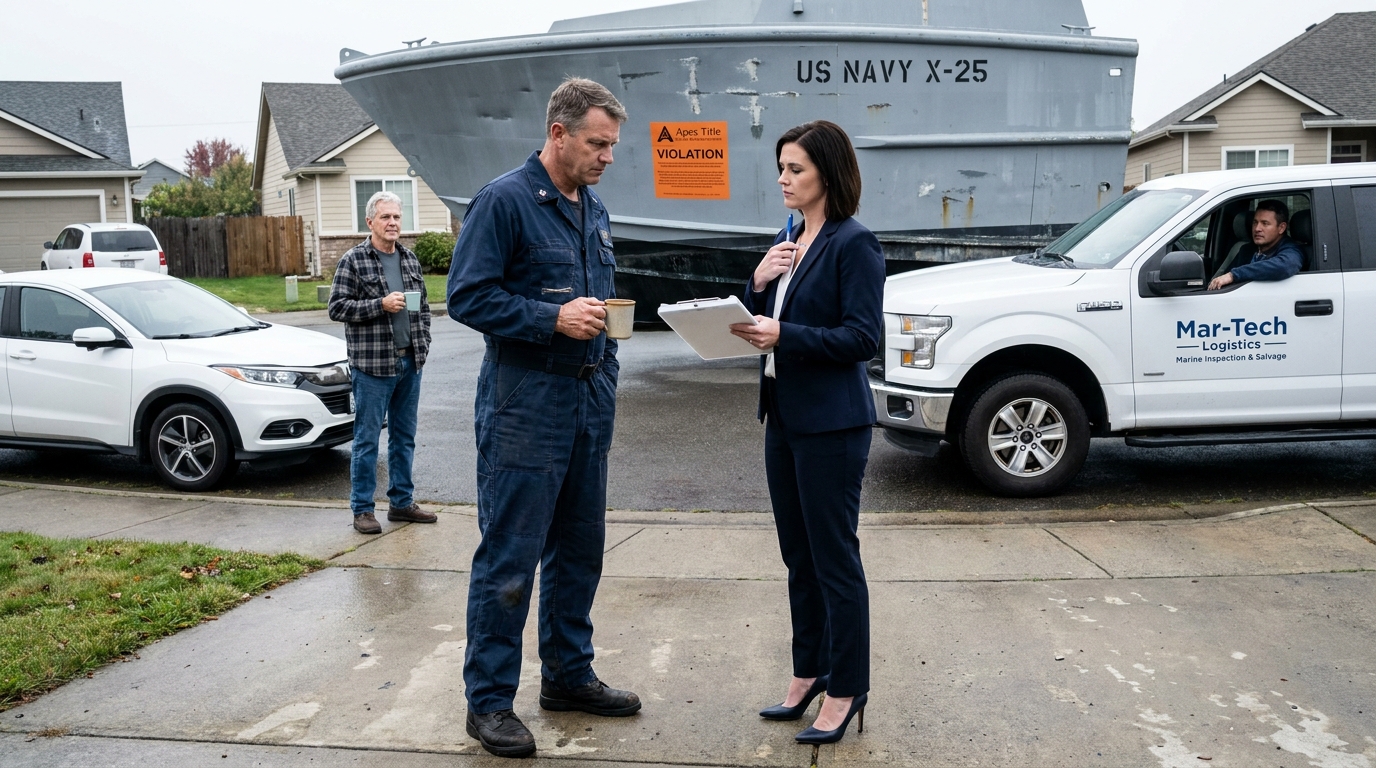
I didn’t move my boots. I kept both hands wrapped around the ceramic mug, watching the steam curl off black coffee into the October river mist. On the trailer behind my Ford, the 25-foot decommissioned craft sat high on its tandem axles. The hull was dull grey lead-alkyd paint, scarred at the waterline from saltwater runs, wearing its original hull designation in faded white stencil.
Karen Whitmore pressed her palm flat against the orange paper, smoothing the corners down against the port quarter with deliberate, heavy friction. Her clipboard clicked as her metal pen snapped back into its plastic retainer.
“Section 12C,” Karen said. Her voice didn’t carry warmth; it carried the clipped, dry cadence of an insurance adjuster denying a hail damage claim. “Commercial and oversized equipment banned in residential driveways. Five hundred dollars flat. Thirty days to remove the asset or we dispatch the county flatbed.”
I took a slow sip of the coffee. Cheap roast, bitter on the back of the tongue. I didn’t check the paper. I looked at the three-inch heels she had brought onto my damp concrete, then at the ruler sticking out of her side coat pocket alongside a digital tape measure.
“It’s not a commercial asset, Karen,” I said. My voice stayed down in my chest, low and level, built from fifteen years of deck-line commands. “It’s an active Navy hull, decommissioned under Title 10 section transfer.”
“Military people aren’t special, Commander.” She stepped back, her chin tilting up just enough to bring the cold autumn light onto her designer tortoiseshell frames. Her cheap lavender perfume hit the morning air, fighting a losing battle against the heavy smell of marine diesel and river mud. “This isn’t a base. It’s Riverside Meadows. Pay by Friday or the board attaches a lien to your deed.”
She turned on her heel, her shoes making hard, metronomic strikes against the driveway slates as she headed toward her crossover parked at the curb.
I didn’t chase her. I didn’t raise my voice.
I set the coffee mug down on the trailer tongue, reached into my canvas work bag, and pulled out a heavy brass 1/2-inch socket drive wrench. The cold metal bit into my palm, grounding the immediate spike of adrenaline into pure, static calculation.
I stepped up to the port hull. The orange sticker was high-tack industrial vinyl, placed squarely across the federal vessel registry stencil—a detail registered under federal maritime jurisdiction the moment the craft cleared the naval yard.
My thumb ran along the rough edge of the paper. She hadn’t just written a code violation. She had laid hands on a registered government-origin asset with an active serial log still pinged to the regional district office.
From the porch three doors down, Bob Fletcher leaned over his handrail, a mug of black tea in his fist. His grey hair was cropped tight, his flannel sleeves rolled to the elbows despite the fifty-degree nip in the wind.
“She hit you with the 12C?” Bob called out, his voice a low rumble across the quiet cul-de-sac.
“She hit the hull, Bob,” I replied, turning the heavy brass wrench twice in my hand before dropping it into my pocket.
“She tried measuring my trailer overhang last Tuesday,” Bob said, spitting off the side of his porch into the mulch. “Woman acts like she’s holding the lease on the air we breathe.”
“She doesn’t hold the lease,” I said, looking down at the orange paper fluttering slightly in the morning draft. “She just doesn’t know who owns the dirt yet.”
I pulled my phone from my coat, tapped the screen, and hit the speed-dial for the regional legal office at NavFac.
The line rang twice.
“Lucy,” the crisp voice answered on the third ring. Lieutenant Commander Sarah Lucy was three years behind me at Annapolis, currently handling administrative law for the district.
“Sarah,” I said, keeping my eyes fixed on the retreating white crossover at the end of the street. “I need a federal preemption check on a local residential HOA covenant.”
A short pause on the line. “Did your neighbors complain about your grass again, Thornfield?”
“No,” I said, touching the edge of the orange sticker. “The board president just slapped an enforcement lien notice on hull registration Code 4-Bravo.”
Silence held the line for five seconds. When Sarah spoke again, the humor was completely stripped from her tone.
“She attached a private civil fine to a Title 10 defense asset?”
“She gave me until Friday,” I said. “Send me the preemption packet.”
“Packet’s already coming, Jake,” she said coldly. “Don’t touch the paper on the hull. Leave it where she put it.”
I hung up, picked up my cold coffee, and took another drink. The sun was finally clearing the tops of the sweetgum trees at the edge of the lot, casting long, sharp shadows across the concrete.
CHAPTER 2: TACTICAL LINEITEM
The white crossover’s brake lights flashed red once at the corner of Oak and River, then clipped the curb as Karen took the turn too fast.
I didn’t lower the phone. My fingers remained clamped around the lukewarm ceramic of the mug, the condensation from the cooling coffee bleeding into the calluses on my palm. Diesel vapor drifted off the transom in grey, curling ribbons, cutting through the damp chill of the river bank.
“I’m uploading the registration trail now,” I told Sarah, walking slowly around the trailer tongue. My boots crunched over the gravel margin where the driveway met the grass. “Code 4-Bravo is cross-indexed with the District Maritime Reserve inventory. The hull carries an active federal tracking tag.”
“I’m looking at the database entry right now,” Sarah’s voice came back through the speaker, accompanied by the dry, rhythmic clatter of a high-speed mechanical keyboard. “The vessel is designated non-disposable defense material under loan to a retired flag officer or primary commander. That’s you. It’s non-commercial, non-recreational, and federally protected under 10 U.S.C. Section 2572.”
I stopped at the port quarter. I reached out, my thumbnail catching the bottom corner of Karen’s orange violation slip. The vinyl was heavy, military-grade adhesive—not the cheap paper stickers the local city parking enforcement used.
When I peeled the corner back two millimeters, a tiny silver seal gleamed beneath the orange backing.
Apex Title Escrow & Notary Services. Printed in micro-type around a stamped notary emblem.
I frowned, my thumb pausing on the adhesive. An HOA violation notice printed on high-tack commercial stock backed by a private escrow company’s notary paper. That wasn’t administrative zeal. That was specialized stationery bought in bulk from a commercial real estate outfit.
“Sarah,” I said, my eyes narrowing on the micro-print. “Does the preemption packet cover corporate entity interference?”
“It covers anyone attempting to levy a civil distress warrant or administrative seizure against the asset,” she said crisply. “If she places a lien on your property deed using that violation, she’s executing a state-level encumbrance on a property title that hosts a federal asset. The U.S. Attorney for the Eastern District will step in and issue a show-cause order before the ink dries.”
“Good,” I said. “Draft the notice of federal interest. Email it to me, but don’t serve her office yet.”
“Why wait, Jake?”
“Because she’s not working off standard HOA forms,” I said, peeling the corner back just enough to catch a clear photo of the silver emblem with my thumb covering the serial number. “She’s using legal stock from a private escrow house. I want to see how far down this track she wants to run.”
“Don’t play sea lawyer in a cul-de-sac, Thornfield,” Sarah warned, her voice dropping an octave into pure staff officer authority. “You serve her the federal preemption notice, she backs off, the boat stays in the driveway. Clean. Simple.”
“She won’t back off,” I said, looking down the street toward Karen’s two-story brick colonial at the head of the cul-de-sac. A fresh, black SUV with tinted glass was parked in her side turnout—a commercial rig belonging to Mar-Tech Logistics, a local marine salvage contractor. “She’s already invested in the fine.”
I hung up before Sarah could argue.
I finished the cold coffee in one swallow, set the mug on the boat’s gunwale, and reached into my pocket for the heavy brass wrench. I walked to the trailer’s winch post, checking the steel cable tension. Three turns of the ratchet brought the steel line drum-tight, a high-pitched metallic ping ringing out in the quiet morning air.
Bob Fletcher walked down his driveway, his hands shoved deep into the pockets of his faded green field jacket. He stopped at the edge of my property line, his eyes tracking the silver notary seal stuck under the orange sticker.
“She leave you a souvenir?” Bob asked, nodding toward the hull.
“A receipt,” I said. I pulled my phone out, tapped the screen, and brought up the photo of the silver emblem. “Bob, when Karen took over the board three years ago, who did she hire to handle the community deed registry?”
Bob spat into the grass, his brow furrowing as he leaned in to look at the screen. “Some outfit out of the county seat. Apex something. She claimed the old firm was overcharging us by two grand a year for title searches and covenant tracking.”
“Apex Title Escrow,” I said flatly.
“Yeah. That’s it.” Bob looked up, his grey eyes hard. “Why? What’s an escrow company got to do with a parking ticket?”
“An escrow company doesn’t issue parking tickets,” I said, dropping the wrench back into my canvas bag with a heavy iron clink. “They manage title transfers and encumbrances. Karen isn’t trying to clean up the street, Bob. She’s building a lien file.”
“A lien file for what? The boat?”
“For the property under the boat,” I said. I looked past Bob’s shoulder toward the water. My lot wasn’t just a two-car driveway and a patch of Bermuda grass. It had forty feet of deep-water bulkhead access directly connecting to the river channel—one of only three residential slips in the entire development deep enough to tie up a draft craft over twenty feet without dredging.
Bob stared at me for three seconds, his jaw tightening until the muscle below his ear twitched. “She can’t force a sale over an HOA fine, Jake. That’s illegal.”
“It’s illegal if you fight it,” I said, picking up my work bag and zipping the canvas shut. “It’s standard procedure if the homeowner is overseas on deployment and misses three certified notices.”
I turned toward my front steps. The sun was fully up now, reflecting off the grey hull of Code 4-Bravo, turning the lead-alkyd paint into a sheet of muted steel.
My phone buzzed in my hand. An incoming email from NavFac Legal Services, attachment titled: NOTICE_OF_FEDERAL_PREEMPTION_TITLE_10.PDF.
I didn’t open it. I saved the file directly to my secure local drive, walked into the house, and locked the front door behind me.
CHAPTER 3: THE PETITION ASSAULT
The deadbolt snapped home in the doorframe with a heavy, metallic click. The interior of the hallway was cold, the ambient heat from the morning furnace long gone.
I didn’t turn on the overhead lights. I moved across the hardwood, the soles of my work boots noiseless against the runner, until I reached the front parlor window. I pulled the edge of the linen drape back two inches.
At the edge of the driveway, right where the gravel met the street asphalt, Karen Whitmore was standing with a white plastic clipboard tucked under her left arm. She wasn’t alone. She had caught two neighbors at the mail kiosks—younger homeowners from the new cluster on the north side—holding out a blue ballpoint pen like a weapon.
A white commercial pickup rolled slowly past the cul-de-sac. Stenciled in black matte paint on its driver’s door was a small corporate crest: Mar-Tech Logistics — Marine Inspection & Salvage. The driver didn’t park. He slowed to five miles an hour, his eyes fixed on the transom of Code 4-Bravo sitting on its tandem axles, before accelerating around the curve toward the main gate.
I let the drape fall back into place, turned on my heel, and walked straight out the back kitchen door.
The gravel path along the garage wall was slick with morning frost. When I rounded the corner into the front yard, Karen was already stepping across my property line, her eyes locked on the clipboard. The white sheets of paper were covered in dense, single-spaced lines of legal text, a dozen signatures already trailing down the primary column.
“You’re trespassing, Karen,” I said, stepping off the grass onto the concrete pad.
She didn’t jump. She stopped five feet away, her heels clicking once on the drive before locking her knees. Up close, the powder on her jawline was thin, revealing the red, blotchy flush of cold air and pure adrenaline.
“Common property access,” she snapped, tapping the top sheet with the back of her blue pen. “As president, I am executing an official community petition under Section 4 of the bylaws. Emergency special assessment for nuisance removal.”
“Nuisance,” I repeated. My right hand remained in my jacket pocket, my fingers resting on the smooth, cold iron of the heavy brass socket wrench I’d carried out from the workbench.
“Unregistered commercial hazard,” she corrected, her voice rising half an octave to make sure the couple at the mailboxes could hear every syllable. “We have seventeen verified signatures from primary deed-holders. We are petitioning the county sheriff for an immediate impound warrant.”
“Show me the signatures,” I said.
She pulled the clipboard back against her chest, her knuckles turning chalk-white against the plastic frame. “Board records are confidential until certified at the monthly assembly.”
“You’re lying,” a deep voice boomed from the sidewalk.
Bob Fletcher walked down the incline, his hands buried deep in his field jacket. He didn’t look at Karen. He looked directly at the clipboard tucked against her ribs.
“Show him line six, Karen,” Bob said, his voice dropping into that raspy, iron-edged gravel that meant he was done talking like a neighbor. “Show him line six where you signed my name while I was taking my wife to her nine-o’clock oncology appointment.”
Karen’s head snapped toward him. “Robert, your trailer has been an unaddressed violation for three years. I extended a courtesy—”
“You extended nothing,” Bob cut her off, stepping right up to the edge of my grass, his shadow overlapping hers on the pavement. “You walked onto my porch at ten past eight, tapped on the glass, and when nobody answered, you scribbled ‘Fletcher – Lot 41’ on your little hit-list. I watched you from the kitchen window while I was packing Carmen’s oxygen tank.”
The couple at the mailbox paused, the young woman holding her utility bills mid-air, looking between Bob and Karen.
Karen’s jaw twitched. Her hand tightened on the clip until the metal spring creaked under the strain. “The board has broad authority to address systemic blights that threaten surrounding equity values. A decommissioned military boat sitting on a commercial trailer lowers the appraisal threshold for the entire cul-de-sac by four to six percent. That is a documented fact.”
“Documented by who?” I asked, taking one step forward. The space between us collapsed to less than a yard. I could smell the sharp, metallic tang of her hairspray over the damp autumn air. “Documented by Apex Title?”
Her eyes widened—just a fraction of a millimeter, the dark pupils contracting sharply behind the tortoiseshell frames. Her lower lip pressed into a thin, bloodless line.
“Apex is our retained administrative vendor,” she said, her voice dropping into a tight, clipped whisper. “Their market assessments are proprietary.”
“Their assessments are paper-shuffling for an encumbrance,” I said flatly. “You don’t have seventeen signatures, Karen. You have a handful of people you cornered before their morning commute, and two forged entries on dead-end lots.”
“This petition goes to the county clerk at noon,” she said, her voice turning icy as she took two swift steps backward, retreating toward the public pavement. “And when the flatbed arrives with a sheriff’s escort to clear this driveway, you can explain your military status to the impound officer.”
She turned, her heels striking the street with furious, uneven cracks as she marched toward her house at the end of the road.
Bob watched her go, his jaw working silently. He spat onto the asphalt, then looked over at me, his eyes dark.
“She’s going to the county, Jake,” Bob said quietly. “She’s got three stooges on that five-member board who’ll stamp whatever paper she puts under their noses.”
I reached into my pocket, my fingers tightening around the cold brass wrench. “She can take the paper to the governor, Bob. A county clerk can’t sign an impound order on a federal asset without a jurisdictional hearing.”
“She knows that?”
“She doesn’t care,” I said, watching her front door slam shut with a distance-muffled thud. “She isn’t trying to win a court case. She’s trying to build a paper trail fast enough to trigger a default before anyone checks the deed registry.”
I turned back toward Code 4-Bravo. The morning sun was hitting the grey hull at an angle now, illuminating a long, fine scratch along the port gunwale where the high-tack orange sticker sat. Beneath the sticker, the silver seal of Apex Title gleamed like a polished coin in the cold air.
CHAPTER 4: MUNICIPAL COUNTERSTRIKE
The silver foil of the Apex seal caught the cold glare of the morning sun, burning like a dropped match head against the dull lead-alkyd finish of the hull.
I didn’t step away from the trailer tongue. The gravel gave a dry crunch under my heel as a silver city sedan turned onto the cul-de-sac, its tires throwing up a spray of damp oak leaves. On the driver-side door, a faded blue decal read: City of Riverside — Building & Code Enforcement.
The car coasted to a stop right behind my Ford, blocking the driveway apron. The driver’s door opened with a worn mechanical groan, and a tall man in an ironed khaki uniform swung his boots onto the asphalt. He wore a heavy leather tool belt slung low over his hips, a brass-bound clip box gripped in his left fist.
Inspector Rodriguez didn’t rush. He stopped at the rear quarter of Code 4-Bravo, adjusting his glasses as he looked up at the grey transom, then down at the dual axles resting on heavy rubber chocks.
“Commander Thornfield?” Rodriguez asked, his voice flat, raspy from thirty years of diesel smoke and field audits.
“Rodriguez,” I acknowledged, taking two measured steps down the concrete pad. “Karen call in a municipal sweep?”
Rodriguez let out a short, tired breath that turned to steam between us. He reached into his clip box, flipping past three yellow inspection sheets until he landed on a white municipal complaint form.
“Filed at eight-fifteen this morning,” Rodriguez said, reading off the carbon print. “‘Commercial asset stored on residential driveway without municipal permit. Hazardous fluids hazard. Unregistered craft.’ She listed it as an abandoned commercial vessel.”
He looked up from the paper, his eyes traveling over the stenciled registry code on the bow.
“She told dispatch you’ve had an unregistered freighter trailer sitting here since August,” Rodriguez added, shaking his head slowly. “I told my supervisor before I drove out here that I knew your address, and I knew what was on this trailer.”
“She handed me a five-hundred-dollar HOA violation slip at seven,” I said, pointing with my thumb toward the orange vinyl still stuck to the port quarter. “Claimed Section 12C.”
Rodriguez stepped closer to the hull, his eyes narrowing as he caught the silver foil peeking out from beneath the vinyl corner. He reached out, his thick, calloused index finger tracing the edge of the seal.
“Apex Title,” Rodriguez muttered under his breath. He didn’t sound surprised; he sounded irritated. “That’s the third complaint form this month backed by an Apex notarization. They’ve been dropping encumbrance filings at the municipal clerk’s office like junk mail.”
My thumb rubbed against the seam of my jacket pocket, feeling the hard outline of the brass wrench inside. “They filing on other driveways?”
“Filing on anything with a waterfront bulkhead or an unpaved lot margin,” Rodriguez said, tapping his clipboard against his thigh. “Karen’s been running municipal code requests through our office claiming ‘neighborhood renewal.’ My supervisor is sick of reading her emails.”
He pulled a black pen from his chest pocket, drew a heavy, diagonal line across the white complaint form, and wrote VOID — FEDERAL ASSET / ACTIVE TITLE 10 in block capitals across the center.
“I’m clearing the docket entry,” Rodriguez said, snapping the clip box shut. “City code explicitly exempts military hardware under federal custody. She knows that, or her lawyers do. But here’s what you need to know, Commander.”
He stepped half a foot closer, lowering his voice below the whistle of the river wind sweeping through the sweetgums.
“She didn’t just submit this to Code Enforcement,” Rodriguez said, his dark eyes holding mine. “She filed a copy with the county health department claiming hazardous oil runoff, and she carbon-copied your homeowner insurance underwriter.”
“My underwriter?” I asked, my voice dropping into a tight, quiet register.
“Hartford Mutual,” Rodriguez said. “She submitted a signed affidavit claiming you’re storing high-octane racing fuel and active ordnance in a residential garage. If Hartford pulls your liability rider, your mortgage lender gets an automatic flag within forty-eight hours.”
The cold wind hit the side of my face, carrying the bitter scent of wet river mud and raw exhaust.
“She’s trying to force a technical default,” I said, the piece sliding into place with cold, mathematical precision. “If the insurance drops, the bank issues a thirty-day cure notice. If I’m deployed and miss the window, Apex files a trustee notice at the county courthouse.”
“That’s how the game is played when someone wants a title cleared fast,” Rodriguez said flatly. He turned, tossed his clip box onto the passenger seat of his sedan, and paused with his hand on the door frame. “I’ll file my report before noon. But you’d better call your agent before Karen’s affidavit hits their desk in Chicago.”
“I’ll call them,” I said.
Rodriguez pulled his door shut, the motor catching with a rough, metallic idle before he reversed down the cul-de-sac.
I stood on the wet concrete, watching the red taillights disappear around the curve. The driveway was quiet again, save for the dull slap of the orange vinyl corner fluttering against the grey hull in the rising wind.
My phone vibrated in my palm. A text from Bob Fletcher: Karen just posted a flyer on the mail kiosk. Emergency board assembly tonight. 1900. Community shed.
I looked down at the screen, my jaw setting hard as I tapped a three-word reply: I’ll be there.
CHAPTER 5: THE EMERGENCY HALL
The vibration of the text alert buzzed against my thumb, three sharp pulses from the phone casing.
I didn’t step back into the house immediately. I tapped out the three-word reply to Bob, slid the phone into my jacket pocket, and walked a slow perimeter around Code 4-Bravo’s dual axles. The orange vinyl notice fluttered twice against the grey lead-alkyd finish as the river draft lifted off the water.
Shadows stretched across the driveway asphalt, the short autumn afternoon collapsing quickly into twilight. Four hours of silent preparation passed in a blur of document archiving and phone calls to NavFac Legal before nineteen hundred hours arrived, the darkness bringing a damp, bitter fog that clung to the streetlamps.
The community center was nothing more than a reinforced metal shed behind the pool deck, its corrugated siding painted dark grey to match the perimeter fence. Inside, three overhead fluorescent tubes buzzed with a flat, high-frequency hum that set my teeth on edge.
Fourteen metal folding chairs were arranged in two crooked rows facing a portable wooden podium. Karen Whitmore stood behind the lectern, dressed in a charcoal wool suit, her fingers resting lightly on two enlarged foam-board prints resting on easels.
The first foam-board was a zoomed-in photograph of Code 4-Bravo’s stern, the grey paint looking ominously dark under high-contrast printing. Above it, red stencil text read: UNAUTHORIZED MILITARY ASSET — RESIDENTIAL HAZARD.
Bob Fletcher sat in the back row, his ankles crossed, his field jacket unzipped. Next to him sat Maria Santos, her leather briefcase flat across her knees, a pen positioned over a yellow legal pad.
“We will begin,” Karen announced, her voice hitting the thin drywall with flat, echoing precision. She didn’t wait for latecomers. She tapped her metal pen against the podium. “This emergency session of the Riverside Meadows Executive Board is convened under Section 8B to address an ongoing security and environmental emergency.”
Nobody moved. The room smelled of wet wool, floor wax, and stale coffee.
“For sixteen days,” Karen continued, pointing a manicured fingernail at the photo of my boat, “an unmonitored military craft has occupied driveway space on Lot 14. This is not a recreational vessel. It is an industrial hull capable of holding volatile fuel reserves and uninspected hardware.”
“It’s a decommissioned twenty-five-foot patrol craft, Karen,” Bob called out from the back, his voice cutting through the room like iron scrap sliding down a chute. “The fuel cell was drained at the naval station before he towed it home.”
“Robert, you are out of order,” Karen snapped, her chin rising two inches. “The board has received written affidavits from municipal inspectors regarding hazardous runoff risks.”
“That’s a lie,” I said, stepping through the double metal entry doors.
The room shifted. Twelve heads turned toward the back row as I walked down the center aisle. I kept my hands in my jacket pockets, my boots making clean, measured thuds against the concrete slab.
I didn’t take a seat. I stopped three feet from the podium, looking directly at the foam-board setup.
“Inspector Rodriguez cleared the municipal docket at eleven-thirty this morning,” I said, my voice low, carrying easily over the fluorescent hum. “He voided your complaint as legally invalid under federal preemption rules.”
Karen’s expression didn’t break, but her knuckles turned white where she gripped the edge of the wooden lectern. “Municipal code is distinct from private covenant enforcement, Commander. The board has a fiduciary duty to protect community equity. Having weapons-capable assets parked in plain view creates an atmosphere of instability.”
“Weapons-capable?” Maria Santos spoke up, her voice calm, measured, carrying the precise tone of a professional paralegal. She didn’t look up from her legal pad. “Karen, Section 3 of the community charter explicitly limits board oversight to unapproved structural modifications and commercial logistics. Is Code 4-Bravo being operated as a commercial enterprise?”
“It represents an unregistered security threat,” Karen insisted, her voice rising half an octave. She reached down into a banker’s box beside the podium and pulled out a stack of stapled packets, tossing them onto the front table. “The board has drafted a resolution to issue a non-compliance levy of fifty dollars per day, retroactively applied to October first, backed by a property lien administered through our legal trustee, Apex Title Escrow.”
I watched her hand as she let go of the paper. Her index finger twitched twice against her thumb—an involuntary micro-action that contradicted the flat, arrogant set of her mouth.
“Apex Title isn’t our legal trustee, Karen,” Maria said smoothly, finally turning a page on her yellow pad. “Our recorded legal trustee on file with the county recorder is Miller & Vance out of the city center. When did the board vote to assign title oversight to Apex?”
Silence fell over the metal shed. The fluorescent light overhead flickered once, casting long, harsh shadows across the concrete floor.
Karen’s jaw tightened. “Administrative vendor adjustments are within executive discretion.”
“Not when the vendor holds an active commercial service contract with Mar-Tech Logistics,” Maria said softly, her pen making a single, crisp checkmark on the paper. “Mar-Tech filed a deep-water access inquiry for Lot 14’s lot line two weeks ago.”
I looked at Karen. Her face didn’t go red; it went completely grey beneath the harsh lighting, the color draining out of her lips like water through gravel.
“This meeting is adjourned,” Karen said sharply, grabbing her banker’s box and snatching the foam-board off the easel in one swift, jerky motion. “Formal notice of the daily levy will be served by certified mail.”
She marched down the side aisle toward the emergency exit, her heels making fast, frantic cracks against the floor.
Bob Fletcher stood up slowly, looking over at me with a cold, knowing nod. “She’s running out of road, Jake.”
“No,” I said, my hand closing around the cold brass wrench in my pocket as I watched the metal emergency door slam shut. “She’s just accelerating.”
CHAPTER 6: EXPOSURE IN INK
The heavy door shuddered in its steel frame, the echo rattling the loose corrugated siding along the back wall.
Maria didn’t close her legal pad. She slid her pen into the spiral binding, her fingers steady as she looked over at the empty doorway where Karen’s heels had just ceased their frantic cadence.
“She’s heading for her car,” Bob said, his eyes tracking the dark window pane at the end of the entry corridor. “She won’t go home. She’s going to file those paper levies at the twenty-four-hour courier drop before midnight.”
“Let her drop them,” I said, my fingers releasing the heavy brass wrench in my pocket. “The moment she submits a lien backed by an unauthorized trustee, she executes a false filing under county civil code. Maria, did you pull the bank statements for the community reserve fund?”
Maria clicked her briefcase shut. “I pulled the three-year summary from the county public repository this afternoon. The reserve balance dropped eighty-two thousand dollars since March. Sixty-one thousand went directly to vendor disbursements marked ‘Code 4 Compliance & Perimeter Maintenance.'”
“Paid to who?” I asked, stepping out into the cold drizzle covering the parking lot.
“Mar-Tech Logistics,” Maria said, her heels clicking evenly against the wet asphalt beside mine. “Line-itemed as emergency shoreline hazard abatement.”
A dark sedan idling by the pool fence flicked its high beams once. A woman in a black parka stepped out, holding a digital DSLR camera wrapped in a clear plastic weather shell. A blue press-pass lanyard dangled from her coat pocket, swinging over the hood of her vehicle.
“Jessica Martinez,” Bob murmured, pointing with his chin. “City desk for the Riverside Sentinel. I called her two hours ago when Karen posted the assembly notice.”
Jessica walked over, her boots splashing through a shallow puddle on the driveway apron. “Commander Thornfield?”
“Jessica,” I acknowledged. “You capture the foam-board graphics before she took them down?”
“I got four high-res frames through the side window before your board president noticed me,” Jessica said, tapping the camera body. She pulled a small digital audio recorder from her pocket and clicked pause. “She just accused a active-duty naval officer of harbouring uninspected military hardware, on record, inside a public community assembly.”
“Did she mention the fine?” I asked.
“Five hundred upfront, fifty a day retroactive to the first,” Jessica said, her pencil already hovering over a small pocket notepad. “She also claimed your boat was an environmental hazard that dropped surrounding property assessments by five percent. Where did she get that figure?”
“She made it up,” Maria spoke up, stepping into the light of the streetlamp. “Or rather, her administrative vendor made it up. Apex Title Escrow provided the valuation statement attached to the enforcement notice. But Apex isn’t a registered municipal appraisal firm in this county.”
Jessica’s eyes sharpened. She looked from Maria to me, then down at Code 4-Bravo sitting on its axles fifty yards away under my driveway light. The lead-alkyd hull gleamed grey and wet under the cold rain.
“Is this about parking rules, Commander?” Jessica asked, her voice dropping into a tight, inquisitive pitch. “Or is your board president using public enforcement channels to target specific property deeds along the bulkhead?”
“You print what happened in that room,” I said, my voice low and carrying the hard edge of a command briefing. “Print the photos of her foam-board. Print her quotes about military personnel bringing instability to residential streets. Let the city read what Section 12C actually covers.”
Jessica looked at the grey hull, then back at her notepad, writing three quick lines in thick black ink. “The morning edition goes to print at three a.m. Front page, local section. Headline drops on the digital portal by six.”
“Make sure you spell her name right,” Bob added, his hands deep in his field jacket. “It’s Whitmore with an ‘e’.”
Jessica gave a single, sharp nod, turned, and climbed back into her sedan, her tires kicking up a fine spray of water as she backed out onto the main road.
I stood on the wet pavement, watching her red taillights vanish into the river fog. Beside me, Maria pulled a fresh file folder from her briefcase, the tab labeled: MAR-TECH / APEX CROSS-REFERENCE.
“This is the decoy, Jake,” Maria said quietly, handing me a copy of a corporate registration document. “She wants everyone looking at the eighty-two thousand dollar reserve shortfall. She wants the neighborhood fighting over embezzled maintenance fees so nobody looks at the title encumbrances Apex is dropping on the waterfront lots.”
I unfolded the paper under the yellow streetlamp. The owner of record for Apex Title Escrow was listed as a holding firm out of Delaware. But the secondary notary contact on the bottom line carried a familiar set of initials: K. W. Management Services.
My thumb pressed into the wet paper, crushing the corner until the ink ran.
“She isn’t just stealing the HOA dues, Maria,” I said, looking down the dark street toward Karen’s house. “She’s using the stolen funds to finance the title filings against my lot.”
“And if she gets a lien attached before the paper hits the newsstands tomorrow,” Bob said, his jaw tightening, “she forces an administrative freeze on your deed.”
“She won’t get the lien,” I said. “Not before six a.m.”
I turned, my boots cutting through the wet leaves on the curb as I headed back toward my driveway, the cold rain washing over the grey bow of Code 4-Bravo.
CHAPTER 7: THE BOAT RAMP STAND
The wet oak leaves gave way under my boots with a heavy, sodden squelch. Water ran in tiny rivulets off the bill of my cap, dripping onto the lead-alkyd finish of Code 4-Bravo’s transom.
The night bled away in cold, dark hours. By six in the morning, the rain had turned into a steady, needle-sharp downpour that flattened the grass along the cul-de-sac.
I backed the Ford down toward the public launch ramp at seven-fifteen, the trailer tires crunching over wet gravel and river mud. On the passenger seat, my phone sat open to the digital portal of the Riverside Sentinel. Front page, local section: HOA PRESIDENT FACES SCRUTINY OVER MILITARY VEHICLE FINES AND UNAPPROVED VENDOR DISBURSEMENTS.
Emma sat beside me, her high school backpack rested across her knees. Her green raincoat was zipped to her chin, her hands tucked tight into her pockets as she watched the side mirror.
“She’s coming down the access lane, Dad,” Emma said quietly.
In the side glass, Karen’s crossover appeared through the grey curtain of rain, her hazard lights blinking in rhythmic yellow pulses. She didn’t park in the public turnout. She drove straight down the gravel incline, pulling her front bumper within six feet of my boat trailer’s winch post.
Two orange traffic cones sat in her back seat, visible through the steamed glass.
I put the Ford in park, pulled the emergency brake lever until the ratchet clicked five times, and stepped out into the mud.
Karen hit the pavement before her driver’s door finished swinging open. She wore a transparent plastic rain poncho over her business suit, a clip board wrapped in a clear freezer bag held tight against her ribs.
“This launch is closed to non-conforming craft,” Karen shouted over the drum of rain against the hood. Her makeup was sharp, precise, but the corners of her mouth twitched with tight, nervous energy. “Municipal access regulations require a private clearance permit for vessels exceeding twenty feet.”
“This is a city easement, Karen,” I said, walking slowly toward the rear of the trailer. My boots sank an inch into the wet river silt. “Maintained by county tax funds under Section 4 Maritime Code.”
“The HOA maintains the access road,” she snapped, stepping directly between my trailer tongue and the concrete ramp. “I have filed an emergency administrative injunction with Apex Title Escrow to freeze all lot-adjacent launch privileges until the outstanding levies are settled.”
Emma opened the passenger door, stepping out onto the running board. She didn’t look at Karen’s clipboard. She pulled her phone from her coat, holding the camera steady at chest height.
“Lady,” Emma said, her sixteen-year-old voice deadpan and unbothered by the downpour, “are you seriously trying to block a public waterway with two plastic cones and a fake escrow form?”
Karen’s head snapped toward Emma, her eyes narrowing behind her wet glasses. “Young lady, go back inside the vehicle. This is a legal proceeding regarding commercial trespass.”
“It’s not a commercial vessel, and it’s not a private easement,” Emma replied, her finger holding the record button. “And my dad’s lawyer already downloaded the front page of the newspaper.”
Karen’s hand tightened on the clipboard through the plastic bag until the cardboard bowed in the middle. For a fraction of a second, her eyes darted past my shoulder toward the river channel, where a black-hulled survey craft from Mar-Tech Logistics was idling just past the no-wake buoys.
She wasn’t looking at my boat. She was watching the survey boat’s depth-sounder mast.
“You think a local newspaper article protects you, Commander?” Karen said, her voice dropping into a tight, venomous rasp that barely carried over the rain. “By noon today, your insurance underwriter will drop your property liability rider. When Apex registers the default notice at the county courthouse, this entire lot line goes into administrative custody.”
“Apex isn’t registering anything,” Bob Fletcher’s voice cut through the rain.
Bob walked down the timber steps from the upper parking area, wearing his heavy yellow oilskins and rubber deck boots. Behind him, Maria Santos stepped out from under the wooden shelter, holding a laminated county land-grant map in a sealed plastic sleeve.
“The bulkhead easement on Lot 14 isn’t part of the residential covenant, Karen,” Maria said, walking down to the edge of the slick wooden decking. “It was deeded to the Department of the Interior in 1944 and transferred under federal maritime easement. The HOA doesn’t own the dirt under the ramp, and Apex doesn’t hold the title.”
Karen took half a step back, her heel slipping on the wet pine sap covering the deck boards. She caught her balance against the hood of her crossover, her breathing coming in short, ragged hitches.
“The board has authority,” Karen insisted, her voice shrill against the wind. “The board has executive authority over neighborhood access.”
“The board has an FBI inquiry coming, Karen,” I said, stepping right up to the trailer winch. I hooked the heavy steel cable to Code 4-Bravo’s bow eye, the iron hook snapping home with a heavy, metallic clank. “Move your car.”
She stood there in the pouring rain, her plastic poncho flapping violently against her suit jacket, looking between my face, Emma’s phone camera, and the Mar-Tech boat idling out on the grey water.
She didn’t move her car. She turned, threw her clipboard into her front seat, climbed inside, and slammed the door so hard the side window rattled in its frame.
I reached for the winch handle, my hand clamping down on the cold steel crank.
“Dad,” Emma said, looking down at her phone screen as a new notification popped up. “Lieutenant Commander Lucy just emailed you a copy of a federal filing.”
I didn’t stop cranking the winch. The steel cable groaned under the tension, pulling the twenty-five-foot grey hull two inches higher on the trailer bunks.
“What’s the title on the email, Em?” I asked, my breath turning to steam in the cold air.
Emma read it off the screen: “UNITED STATES DISTRICT COURT — EMERGENCY INJUNCTION AGAINST PRIVATE TITLE ENCUMBRANCE.”
I locked the ratchet pawl into place with a sharp iron click, turned around, and looked Karen dead in the eye through her wet windshield.
CHAPTER 8: THE FEDERAL PIVOT
The rain didn’t slacken. It whipped off the hood of the crossover in heavy sheets, striking the wet windshield glass right between Karen’s knuckles and the steering wheel.
Inside the cabin, Karen didn’t put the crossover into reverse. Her eyes remained locked on mine, wide and fixed behind her fogged spectacles. Her thumb worked repeatedly against the plastic rim of her wheel, a rapid, involuntary rhythm that matched the erratic sweep of her wiper blades.
Emma stepped down off the Ford’s running board, her boots splashing through two inches of standing river mud. She held the phone under her green hood, the screen glowing bright against the dismal grey morning light.
“It came directly from the clerk’s office in Norfolk, Dad,” Emma said, her voice steady against the roar of the downpour. “It names Apex Title Escrow and K.W. Management as co-respondents.”
“Get in the truck, Em,” I said, my voice low and level.
I didn’t turn my back on Karen’s bumper. I walked a deliberate line around the trailer tongue, my boots crunching on the gravel margin, until I reached my driver’s door. As I reached for the handle, a black unmarked sedan turned off the main access road, its tires cutting a slow, heavy track through the mud before coming to a stop directly behind Karen’s crossover, boxing her vehicle against the timber ramp posts.
The driver’s door opened. A woman in a dark wool overcoat stepped out, holding a large black umbrella over a tailored suit. She didn’t hurry. Her eyes swept the ramp, taking in Code 4-Bravo sitting locked on its axles, the Mar-Tech survey vessel idling out past the buoys, and finally Karen sitting behind her fogged glass.
Agent Patricia Wells pulled a silver leather credential case from her coat pocket, flipping it open once to show the gold shield before tucking it back inside.
“Commander Thornfield?” Agent Wells asked, her voice carrying over the sound of the rain with cool, practiced authority.
“Agent Wells,” I said, stepping away from the Ford. “NavFac Legal said you’d be in the district by noon.”
“I was already in the county,” Wells replied, turning her gaze toward Karen’s driver-side door. She walked over to the crossover, her heels making slow, heavy strikes on the wet gravel. She tapped twice on the glass with her ring finger.
The window rolled down three inches, releasing a sudden wave of hot, artificial lavender perfume into the damp river air.
“Karen Whitmore?” Wells asked.
Karen’s chin trembled once before she locked her jaw. “This is private residential property. If the military thinks it can use federal agents to intimidate a homeowners association—”
“I’m not here about your HOA bylaws, Ms. Whitmore,” Wells cut her off, her voice dropping into a dry, flat cadence that made the rain sound quiet. “At nine-fifteen this morning, your national emergency call to the regional FBI field office was flagged for administrative review. You reported an active domestic terrorism cell operating out of Lot 14 under the guise of naval vessel maintenance.”
Karen’s mouth opened, but no sound came out. Her face shifted from flushed red to the dull grey of wet slate.
“Filing a knowingly false felony report with a federal law enforcement agency is a violation of Title 18, Section 1001,” Wells continued, taking a small notebook from her inner pocket. “It carries a five-year federal prison sentence. But that isn’t the primary reason I drove out here.”
Agent Wells reached out, sliding a thin white envelope from under Karen’s passenger-side wiper blade—a paper Karen must have tucked there before climbing inside. Wells opened the damp flap, pulling out a white deposit slip stamped with the logo of Apex Title Escrow.
“Your private email server was subpoenaed two hours ago under a court order,” Wells said calmly, holding the slip so Karen could see the account number at the bottom. “We have the correspondence between K.W. Management and the board of directors at Mar-Tech Logistics. You weren’t trying to clear a boat out of a driveway, Ms. Whitmore. You were using municipal complaints and fake HOA fines to trigger an administrative title encumbrance on Lot 14’s deep-water bulkhead.”
Bob Fletcher walked over, his heavy yellow oilskins dripping onto the gravel beside my boots. He looked from the deposit slip in Wells’s hand to Karen’s face.
“She’s been running the same play on three other properties up the channel, Agent,” Bob said, his voice deep and raspy. “Two retired couples moved out last spring after getting hit with six thousand dollars in ’emergency maintenance assessments’ they couldn’t afford to fight.”
“We have the county recorder files, Mr. Fletcher,” Wells said without looking away from Karen. “The straw-buyer shell company registered under Apex Title was set to execute a distressed purchase option on Lot 14 the moment Hartford Mutual canceled Commander Thornfield’s liability rider.”
Karen’s hands left the steering wheel. They dropped into her lap, her fingers clawing at the plastic rain poncho until the thin material tore along the seam.
“It was a community enhancement initiative,” Karen whispered, her voice cracking, stripped of all its crisp, professional authority. “Mar-Tech was going to build a deep-water dock facility that would have increased surrounding property values by twenty percent.”
“Mar-Tech was building a commercial barge staging area,” Maria Santos spoke up, stepping forward with her briefcase tucked under her arm. “And K.W. Management was getting a three percent equity kickback on every lot transferred through Apex Title. I submitted the ledger match to Agent Wells’s office at seven this morning.”
Karen looked at Maria, then at me, her chest heaving as she fought for breath in the air-conditioned cabin of her car.
“You can’t do this,” Karen breathed, her knuckles white as she gripped the door panel. “This is a private neighborhood. The covenants give the board executive discretion—”
“The covenants don’t override federal mail fraud statutes, Ms. Whitmore,” Agent Wells said, slipping the deposit slip into a clear evidence bag. “Or the Service Members Civil Relief Act. You have thirty minutes to secure your personal belongings before federal marshals execute a search warrant on your residence.”
Wells stepped back from the door, turning her back on Karen as if the woman had already ceased to exist. She looked over at me, her eyes lingering on the grey bow of Code 4-Bravo resting on the tandem trailer.
“Commander,” Wells said quietly, “keep the vessel where it is. It’s now designated key physical evidence in a federal racketeering investigation.”
I looked down at the brass wrench still tucked in my jacket pocket, feeling its heavy, familiar weight against my ribs.
“It’s not going anywhere, Agent,” I said.
CHAPTER 9: PAPER COUNTERINSURGENCY
The iron weight of the heavy brass socket wrench pressed through my jacket lining against my ribs as Agent Wells’s sedan tires churned through the mud apron, pulling out onto the paved access road.
Karen’s crossover remained stationary beside the timber ramp posts, her brake lights glowing dull red through the curtain of rain. Inside, her silhouette was motionless, her head bowed over the steering wheel as the white deposit slip evidence bag vanished up the lane in Wells’s custody.
“She’s not moving, Dad,” Emma said, standing under the awning of the Ford’s passenger door, her hood pulled low over her eyes.
“She’s waiting for her attorney,” I said. “Get inside. The heater’s running.”
Rain drummed against the Ford’s roof for twenty minutes while Bob Fletcher and Maria Santos stood beside my driver’s window, water dripping off Bob’s yellow oilskins in steady, rhythmic splashes onto the running board.
Maria unzipped her leather briefcase, pulling out three stapled legal briefs sealed in plastic sleeves. “Agent Wells served a preservation order on Apex Title Escrow forty minutes ago. The county recorder pulled every encumbrance filing dropped under K.W. Management’s corporate ID.”
“That stops the deed freeze on Lot 14,” I said, my thumb tracing the cold steering wheel rim. “What about the private assessment levies?”
“SCRA protection,” Maria replied, her voice firm over the drum of rain. “The Service Members Civil Relief Act attaches automatic statutory penalties to any civil lien attempted against active or reserve defense personnel during deployment or vessel assignment. Every fine she issued on Code 4-Bravo is a separate federal infraction.”
Before I could answer, a silver luxury sedan turned onto the ramp turnout, its tires cutting through the standing water before pulling flush alongside Karen’s vehicle. A man in a dry cashmere overcoat stepped out, holding a large golf umbrella.
Richard Peton didn’t look at the river or the boat. He tapped twice on Karen’s glass, waited for her to unlock the door, and slid into her passenger seat.
Four minutes passed in silent, fogged-glass conference before Peton stepped back out into the rain. He didn’t walk to his car. He walked straight to my driver’s window, his polished leather shoes sinking two inches into the grey river silt.
I rolled the window down two inches. Cold, damp air rushed into the warm cabin.
“Commander Thornfield,” Peton said, his voice smooth, resonant, trained for courtroom acoustics. He pulled a cream-colored envelope from his inner coat pocket and held it against the glass seam. “My client recognizes that administrative miscommunications have escalated beyond their intended scope.”
I didn’t reach for the envelope. “Speak plainly, Mr. Peton.”
“Inside this envelope is a ten-thousand-dollar cashier’s draft drawn on an independent trust,” Peton said, his eyes perfectly steady behind frameless lenses. “Along with a complete, recorded release of all HOA board claims, covenants, and notices against Lot 14 and Code 4-Bravo. In exchange, you execute a mutual non-disparagement agreement and issue a brief statement to the district court indicating the federal report was based on a private civil misunderstanding.”
Beside the truck, Bob Fletcher let out a dry, rasping bark of laughter that ended in a spit against the mud. “She tried to steal his bulkhead with a straw-buyer shell company, counsel. That’s not a misunderstanding.”
Peton didn’t look at Bob. He kept his eyes locked on mine. “Ten thousand covers your legal expenses and trailer maintenance three times over, Commander. If this goes to a federal indictment, litigation will lock your lot’s title in court escrow for twenty-four months. You won’t be able to sell, build, or dock.”
I looked past Peton’s shoulder at Karen sitting in her car. Her face was visible through the cleared arc of her wiper blade, her eyes fixed on the cream envelope in her attorney’s hand.
I reached into my pocket, my fingers wrapping around the cold iron of the brass wrench, feeling the notched socket drive bite into my palm.
“Tell your client three things, Peton,” I said, my voice dropping into a flat, quiet register that cut through the sound of the rain. “First, I’m not executing a release. Second, the ten thousand dollars wouldn’t cover the cost of the federal paint she tried to deface. Third, my phone has been recording this window since your shoes hit the mud.”
Peton’s posture froze. His hand stayed mid-air for one second, the cream envelope dampening under the drip from his umbrella, before his fingers tightened on the paper.
He didn’t argue. He didn’t offer a rebuttal. He pulled the envelope back, tucked it into his coat, turned on his heel, and walked back to his sedan with fast, measured strides.
“He’s going to file an emergency continuance,” Maria noted, watching Peton’s car reverse up the incline.
“He can file whatever he wants,” I said, turning the key in the ignition. The V8 motor roared to life, shaking the damp cab. “The paper trail is already in Wells’s hands.”
I pulled the Ford into gear, the trailer tires gripping the wet gravel as Code 4-Bravo rolled up the ramp behind us, the grey hull glistening under the unrelenting rain.
CHAPTER 10: CORROSIVE EVIDENCE
The V8 engine hummed against the quiet drizzle as the trailer tires cleared the top of the ramp incline. In my rear-view mirror, Code 4-Bravo’s grey transom swayed smoothly between the steel bunks, the wet hull gleaming like slate under the grey sky.
By two in the morning, the rain had tapered off into a thick, motionless fog that settled over the cul-de-sac. The neighborhood was dead silent, save for the steady drip-drip of water falling from the sweetgum branches onto my garage roof.
I woke at 0214 hours. Not to a sound, but to a sharp, chemical tang cutting through the damp air coming in through the cracked bedroom window. It wasn’t diesel exhaust and it wasn’t wood smoke. It was the harsh, acrid reek of industrial solvent eating through petroleum resin.
I didn’t turn on the house lights. I swung my legs off the bed, pulled on my work boots without tying the laces, and picked up a heavy tactical flashlight from the nightstand. My right hand instinctively found the brass socket wrench on the dresser, slipping it into my coat pocket as I moved down the hallway.
I opened the side garage door without letting the latch click.
Through the mist in the driveway, a dark figure was crouched beside Code 4-Bravo’s port quarter. The figure held a plastic chemical bottle with a hand pump nozzle, spraying a thick, gelled liquid directly onto the vessel’s registration numbers. Where the gel hit the hull, the lead-alkyd paint was already blistering, bubbling into dark, smoking crusts that sloughed off onto the concrete.
I flicked the floodlight switch on the garage wall.
Two thousand lumens of cold LED white light cut through the fog, pinning the figure against the grey hull.
Karen Whitmore flinched, dropping the plastic bottle onto the gravel. Her beige coat was stained with dark oil, her hair plastered to her forehead with sweat and fine chemical mist. In her left hand, she gripped a crumpled yellow receipt from a local hardware outlet, her fingers trembling so violently the paper rattled.
“Stay right where you are, Karen,” I said, my voice low, carrying no anger—only the hard, flat weight of a deck officer holding a suspect in the beam.
She didn’t run. Her eyes were bloodshot, pupils wide, tracking the flashlight beam as I walked down the driveway steps.
“It’s a hazard,” she whispered, her voice cracked, raspy from solvent fumes. She didn’t look at me; she looked at the blistered bare steel where Code 4-Bravo’s registry stencil had been destroyed. “It’s an environmental hazard. I’m documenting the chemical instability.”
“You’re stripping federal defense property with industrial paint remover, Karen,” I said, stopping six feet away. The acrid fumes burned the back of my throat.
On the driveway pad, right beside her dropped plastic bottle, lay her discarded crossover keys and a printed receipt showing three cans of aircraft-grade stripper purchased forty minutes earlier at a twenty-four-hour commercial depot.
My phone screen glowed in my left hand as I tapped the speed-dial for Agent Wells’s direct field line.
“Wells,” the line answered on the second ring.
“Agent Wells,” I said, keeping the light fixed squarely on Karen’s chest. “We have an active Section 1361 violation at Lot 14. Ms. Whitmore is currently in my driveway with a bottle of industrial solvent.”
A short, hard pause on the line. “Is she armed, Commander?”
“She’s holding a chemical applicator and a hardware receipt,” I replied. “The port hull is damaged.”
“Local units are three minutes out,” Wells said coldly. “Do not engage physically unless she moves toward the residence.”
Karen slowly backed away from the boat, her heels dragging through the wet gravel until her shoulders hit the passenger side of her crossover. Her hand went to her coat pocket, pulling out a folded piece of paper—a third-party insurance claim form filed under the HOA’s blanket policy, pre-dated for six a.m., claiming a catastrophic toxic spill from an abandoned military vessel.
“It was supposed to be a simple transfer,” Karen babbled, her jaw working erratically as she looked at the blistered hull. “Mar-Tech needed the bulkhead access for the Mar-Tech Logistics deep-water slip. Apex Title Escrow had the buyer lined up. It was supposed to be sixty thousand dollars for the board…”
She was laying out the entire architecture of Layer 1 and Layer 2 on my driveway pad, her mind fracturing under the weight of the federal subpoenas and the chemical fumes.
Red and blue strobe lights flickered through the fog at the mouth of the cul-de-sac. Two county cruiser engines whined as they rounded the bend, their tires screeching to a halt across my driveway apron, sealing the exit.
Inspector Rodriguez stepped out of the lead car alongside two county deputies, holding a digital camera and an evidence kit.
“Step away from the vehicle, Ms. Whitmore,” Rodriguez ordered, pulling his heavy leather belt tight as he stepped onto the concrete.
Karen didn’t argue. Her arms dropped to her sides, the crumpled claim form slipping from her fingers to float in a puddle of wet solvent and dissolved grey paint.
I stood by the trailer tongue, my hand resting on the heavy brass wrench in my pocket, watching the deputies slide the steel cuffs over her wrists in the harsh white glare of the floodlights.
CHAPTER 11: CHECKMATE IN HANDCUFFS
The steel cuffs clicked twice, a sharp, cold ratcheting that echoed off the damp corrugated siding of my garage wall.
Karen didn’t pull back. Her heels dragged through the wet river gravel as Inspector Rodriguez guided her toward the rear door of the lead county cruiser. The blue strobe lights swept rhythmically across her face, turning her bloodless skin a stark, flickering violet.
“Watch your head, Ms. Whitmore,” Rodriguez said flatly, his hand resting on the roof frame as she collapsed onto the vinyl bench inside.
The cruiser door slammed shut with a heavy pneumatic thud.
By eighteen hundred hours that evening, the community shed was packed beyond capacity for the emergency board dissolution assembly. Every metal folding chair was taken; neighbors lined the back wall three deep. Local news crews from two city outlets had tripod cameras mounted near the pool fence, their halogen lights throwing hard, white beams across the wooden lectern.
Agent Patricia Wells stood at the front table alongside Maria Santos. Between them lay three accordion files stuffed with bank ledgers, title filings, and subpoenaed communications from Apex Title Escrow.
Bob Fletcher sat in the front row, his hands resting on his knees, his face unreadable as the room settled into a tense, low hum.
“This emergency assembly of Riverside Meadows home-owners is called to order under Section 11 of the charter,” Maria announced, her voice carrying clear and steady over the hum of the portable PA system. “We have one item on tonight’s docket: the formal presentation of findings regarding executive board administration.”
Agent Wells stepped up to the microphone. She pulled a single-page court summary from her leather portfolio, her eyes scanning the room.
“At fourteen-hundred hours today, the United States Attorney for the Eastern District filed a five-count indictment against Karen Whitmore, K.W. Management Services, and the executive officers of Apex Title Escrow,” Wells stated quietly.
A collective murmur rippled through the rows of folding chairs.
“For thirty-six months,” Wells continued, “Ms. Whitmore utilized her position as board president to execute a systematic financial scheme. The eighty-two thousand dollar reserve shortfall was not spent on neighborhood maintenance. It was laundered through Apex Title Escrow to fund quiet title encumbrances against specific waterfront deeds—specifically targeting properties with deep-water bulkhead access.”
She turned the page over with a crisp, dry rustle.
“The objective was not civil compliance,” Wells said, looking directly at the news cameras. “The objective was to manufacture artificial defaults against Lot 14 and surrounding parcels, allowing a straw-buyer shell firm backed by Mar-Tech Logistics to acquire the waterfront lots at distressed prices. The harassment campaign against Commander Thornfield and Code 4-Bravo was designed to force an immediate title freeze before the annual audit.”
A woman in the third row gasped. Two neighbors on the aisle exchanged sharp, low whispers.
Richard Peton sat alone in the far corner, his cashmere overcoat folded across his lap, his briefcase unopened on the floor beside his feet. When Maria Santos picked up the microphone to call for the board dissolution vote, Peton quietly stood up, picked up his bag, and slipped out the rear exit without saying a word.
“All those in favor of immediate board dissolution and special election,” Maria called out.
Forty-seven hands went into the air simultaneously. Zero against.
Bob Fletcher stood up slowly, turning to face the room. “Motion carried. We’ll have the interim election ballots out by Tuesday.”
I stood near the back double doors, my back against the metal jamb, my fingers touching the heavy brass socket wrench in my coat pocket. Outside, the rain had finally stopped, leaving a clear, cold night sky filled with sharp, distant stars.
Agent Wells walked down the aisle, stopping beside me as the crowd began to filter out into the cool air.
“The U.S. Attorney expects a full plea agreement by Monday, Commander,” Wells said, her voice dropping into a quiet, professional tone. “She won’t see a courtroom. Peton knows the paper trail is airtight.”
“What about the damage to the hull?” I asked.
“Restitution is line-itemed in the plea terms,” Wells replied. “Apex Title’s corporate bond will settle the hull restoration and your legal fees before the month is out.”
I gave a single, measured nod. “Thank you, Agent.”
“Thank your paralegal,” Wells said, looking over at Maria as she packed her files. “She did the heavy lifting on the ledgers.”
Wells turned and walked out into the crisp night, her heels clicking evenly against the dry pavement. I stayed by the doorway, watching the dark, peaceful quiet return to the cul-de-sac.
CHAPTER 12: THE IRON HORIZON
The door frame held the cold night draft as Agent Wells’s dark sedan pulled out of the community center drive. The red tail-lights flared once at the corner of Oak, then vanished into the quiet grid of the neighborhood.
I didn’t turn back toward the empty chairs. I stepped out onto the gravel path, my boots making clean, measured strikes against the frost-covered earth as I walked down the slope toward Lot 14.
Six months moved in a steady, unhurried arc across the waterfront.
The federal plea agreement went through the district court in Norfolk without a single delay. Karen Whitmore took eighteen months at a federal camp in West Virginia for wire fraud, mail fraud, and false filing, accompanied by three years of supervised release. The court order forced the liquid distribution of K.W. Management Services, yielding one hundred and twenty-seven thousand dollars in direct restitution to the Riverside Meadows treasury, plus forty-five thousand to settle my legal fees.
Apex Title Escrow lost its corporate registration in the state. Mar-Tech Logistics pulled its survey craft off the river channel three days after the grand jury subpoenas were unsealed, leaving the deep-water bulkhead untouched.
On a crisp April Saturday, the afternoon sun sat warm against the port quarter of Code 4-Bravo.
I stood by the trailer tandem, a pint of military-grade grey marine enamel resting on the workbench beside a horsehair brush. Where Karen’s chemical solvent had blistered the lead-alkyd finish six months ago, the steel hull was sanded clean down to the bare, silver metal, treated with zinc chromate primer, and prepped for the final coat.
The heavy brass socket wrench sat on the gunwale, its iron handle gleaming in the clear spring light.
Emma walked out from the back porch, carrying a fresh cup of coffee and a rolled sheet of heavy parchment. She wore a dark blue Georgetown Law sweatshirt, her green raincoat from the winter downpours replaced by denim with the sleeves pushed up to her elbows.
“Mail came, Dad,” Emma said, handing me the coffee. Her thumb was pressed against the corner of the parchment. “Formal confirmation from the District Maritime Reserve.”
I took the cup, the warmth bleeding through the ceramic into my fingers. “What’s the verdict on the registry?”
“Code 4-Bravo is permanently designated an historical defense asset on private custody status,” Emma read off the print, a thin smile touching the corner of her mouth. “Exempt from all local municipal, regional, or private residential covenants under federal maritime easement.”
She stepped closer to the hull, reaching out to touch the smooth, grey primer ring where the old registration stencil used to be.
“Bob Fletcher said the new board approved the plaque this morning,” Emma added, looking up at the bow.
“What plaque?” I asked, taking a slow drink of the black coffee.
“Small brass plate for the trailer frame,” she said. “‘Code 4-Bravo — Protected Under Federal Law.’ Bob said he’s installing it himself before the block barbecue next weekend.”
Bob Fletcher walked down his driveway, wearing a short-sleeved work shirt and holding a pair of heavy wire cutters. He stopped at the edge of my lawn, looking over the freshly prepped steel.
“You’re using the heavy enamel, Jake?” Bob asked, nodding toward the can on the bench.
“Two coats,” I said, picking up the horsehair brush and dipping the bristles an inch into the thick grey paint. “It’ll hold against salt air for ten years.”
“Good,” Bob said, his eyes tracking across the quiet cul-de-sac. Across the street, Maria Santos was stepping out of her front door, carrying a stack of revised HOA bylaws for the afternoon board meeting. “Because nobody’s ever asking you to move this trailer again.”
I laid the first stroke of paint across the bare metal. The grey enamel went on thick, smooth, and cold, covering the last trace of the chemical burn until the steel hull looked unbroken under the sun.
I set the brush down, picked up the heavy brass wrench from the gunwale, and tightened the bow winch drum one quarter-turn until the steel cable locked with a single, permanent iron click.
The river wind swept up off the bulkhead, carrying the scent of salt marsh, fresh water, and clean paint across the driveway, completely clear of lavender perfume and damp paper notices.