Blood on the Limestone: A Texas Rancher’s War Against the Suburban Machine
CHAPTER 1: THE CHOKEHOLD AT GATE FOUR
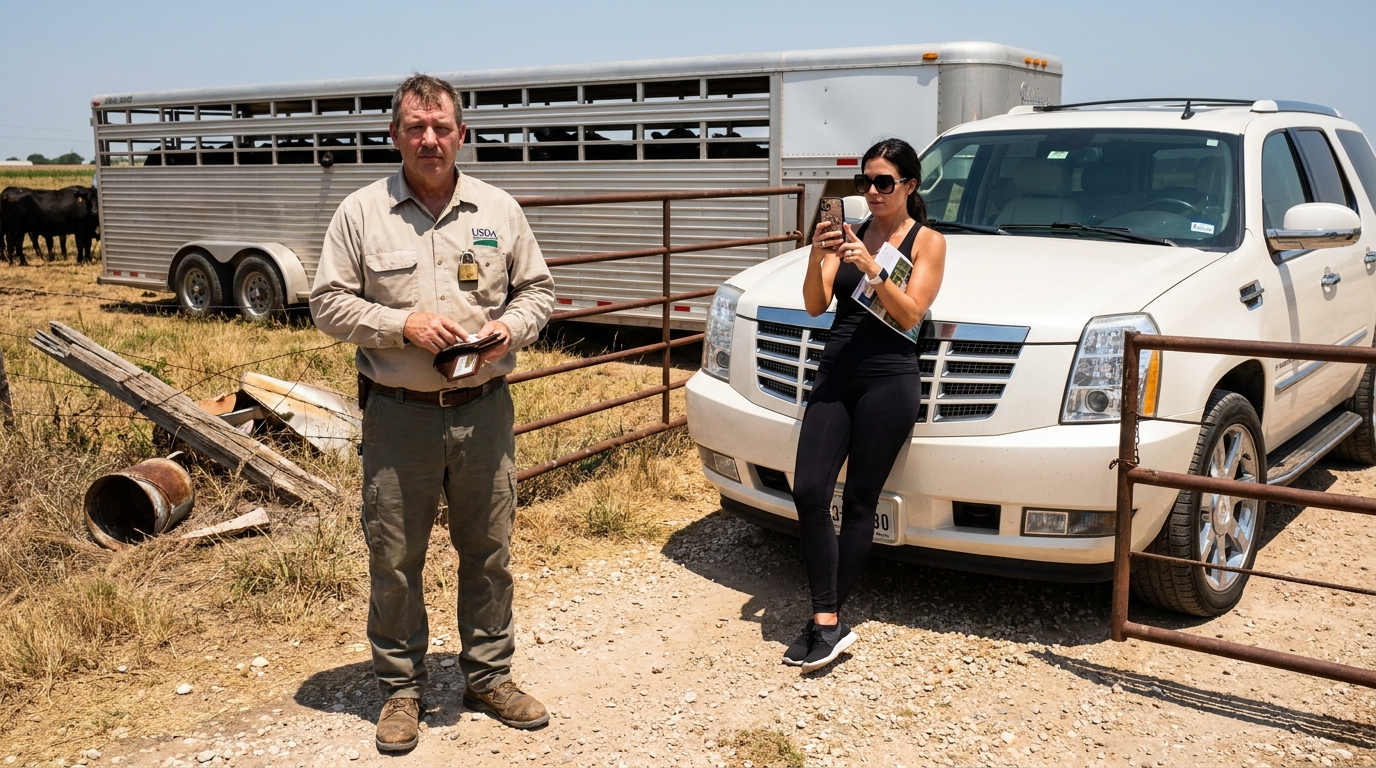
The heavy aluminum of the stock trailer shuddered. Hooves slammed against the metal grating, the frantic rhythm of forty-head of black Angus baking in the Texas sun.
Garrett shifted the F-250 into park. The diesel engine idled, a low, rattling growl that vibrated through the floorboards.
A pearl-white Escalade sat parked completely sideways across the dirt easement. The engine was running. The air conditioning dripped condensation into the limestone dust.
Bethann Whitmore leaned against the Escalade’s hood. She wore pristine, uncreased yoga pants and oversized sunglasses. A designer phone was already raised, the camera lens fixed directly on Garrett’s windshield.
Garrett stepped out. The heat radiating off the asphalt hit him like a physical blow. He walked to the rusted iron gate, his work boots grinding the gravel.
“Move the vehicle,” Garrett said. His voice was entirely flat.
“This is private HOA property now.” Bethann’s voice was bright, practiced, and loud enough for the microphone. “You’re trespassing.”
Garrett reached into his pocket. His calloused thumb traced the deep scratch on a heavy brass padlock he carried—a dead weight, cool against his sweating palm. He rolled the brass cylinder between his fingers.
“That trailer is at a hundred and ten degrees,” Garrett said, his eyes locked on the dripping condensation under her SUV. “Move the car, Bethann.”
“You’re not coming through.” She adjusted her sunglasses. Her manicured thumb dug so fiercely into the edge of her phone case that the nail bed turned completely white. “Your little right-of-way expired when we built Willowbrook.”
“Easements don’t expire,” Garrett said. He closed his fist around the brass padlock. “They’re carved into the dirt.”
“I have the property guidelines right here.” She waved a glossy pamphlet. “I suggest you turn that filthy truck around.”
Garrett calculated the turn radius. A ditch on the left, a newly installed decorative boulder on the right. V-1 Micro-Mystery: The boulder hadn’t been there yesterday. It was intentionally dragged over the property line to choke the bottleneck. She wasn’t just blocking him; she was redefining the physical geography.
A calf bellowed from the trailer—a wet, rattling sound. Shipping fever.
Garrett didn’t look at the trailer. He looked at the decorative boulder, tracing the fresh scrape marks in the dirt leading directly back to the HOA’s landscaped entrance. He noted the angle. He noted the distance.
“I’ll ask one more time,” Garrett said softly.
“Or what?” Bethann stepped forward, shoving the phone inches from his face. “You’ll assault a woman? Give me a reason.”
Garrett unclenched his jaw. He slid the brass padlock back into his pocket. He didn’t shout. He didn’t threaten. He turned his back on her and walked toward the F-250’s grill.
He grabbed the heavy steel tow chain wrapped around the front bumper.
“Don’t you dare touch my vehicle!” Bethann shrieked, breaking her practiced composure.
Garrett didn’t walk toward the Escalade. He walked toward the decorative boulder. He looped the chain around the heavy stone, the steel links clinking against the limestone.
He climbed back into the cab and threw the truck into four-wheel drive low.
The diesel engine roared. The chain snapped taut. The massive boulder dragged across the dirt with a violent, grinding screech, clearing a twelve-foot gap right through her precious landscaping.
Garrett steered the truck and the trailer through the gap, the tires crushing the manicured grass into brown mud.
Bethann stared, completely paralyzed, as the aluminum trailer rattled past her.
Garrett pulled through the gate, threw the truck in park, and finally let out a breath. He had water. The cattle would survive.
Then his phone vibrated against his leg.
He pulled it out. It was a text from Emma, sent from the house up the hill.
Dad. Two Sheriff cruisers just pulled into our driveway. They have animal control with them. They’re looking for your federal badge.
CHAPTER 2: THE INK AND THE IRON
The red and blue strobes painted the dust on my windshield in alternating flashes of crimson and ice.
I didn’t turn off the ignition immediately. I sat there in the idling F-250, the rumble of the diesel vibrating up through my spine, watching Deputy Miller’s boots hit the gravel in my side mirror. Behind him, the county animal control van sat with its high beams burning holes through the dusk.
I reached down and slid my federal USDA credentials out of the visor clip, tucking the leather bifold into my front shirt pocket alongside the heavy brass padlock.
When I opened the door, the hot evening air hit me, thick with the smell of crushed grass and raw diesel exhaust.
“Garrett,” Miller said, resting his hand on his utility belt. He wasn’t pulling a weapon, but his posture was stiff. “Got a call about a disturbance at the boundary gate. Claims of property damage, illegal transport, and livestock endangerment.”
“Deputy,” I said, stepping down into the dirt. “The stock is in the back pasture getting water. You’re welcome to check the troughs.”
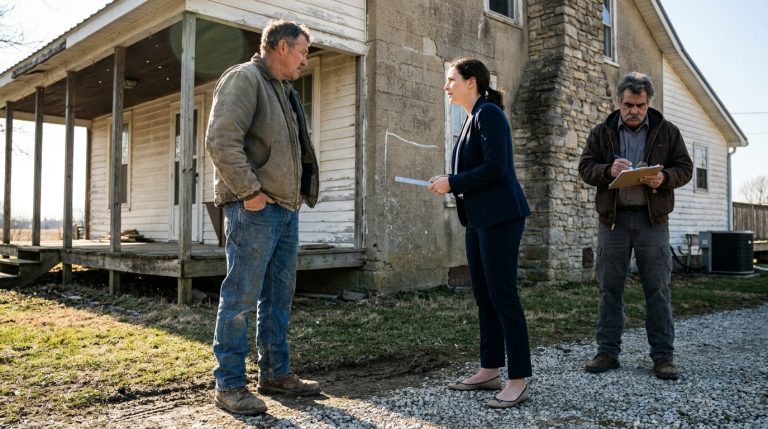
Rodriguez, the county animal control officer, stepped around the cruiser. He carried a clipboard and an inspector’s pen. His eyes swept over the heavy steel chain hanging off my front bumper, then down to the torn turf where the decorative boulder had been dragged twelve feet to the left.
“She said you threatened her with a heavy weapon,” Miller said, looking toward the gate where Bethann’s Escalade was still idling, its hazard lights blinking in rhythmic symmetry.
“I moved an obstruction off an established legal easement,” I said, keeping my voice level, stripped of heat. “Code 1952, county right-of-way. The boulder was placed across the lane within the last twenty-four hours to block agricultural transport.”
“She claims the easement was terminated when the developer recorded the Willowbrook plat,” Miller said.
I reached into my pocket, pulled out the brass padlock, and turned it once in my palm. The cool metal absorbed the heat of my skin. “A plat doesn’t extinguish an easement written into the deed chain before the developer’s grandfather was born. But if you’re writing a report, Miller, write down that forty thousand dollars of black Angus were sitting in a steel box at a hundred and ten degrees.”
Rodriguez walked past us without a word, heading down the lane toward the back pens. He knew cattle. He knew what an hour sitting on asphalt did to a calf’s lungs.
“Look, Garrett,” Miller sighed, adjusting his hat. “She’s raising hell. She’s got video of you dragging the stone.”
“Let her show the judge,” I said. “And tell her to check her mail on Monday.”
Twenty minutes later, Rodriguez walked back up the drive, clicking his pen closed. He looked at Miller and shook his head. “Cattle are watered, tagged, and clear. Facilities exceed county standards. No grounds for an impound or a citation.”
Miller looked toward the gate where Bethann was still standing by her driver’s door, phone held high, recording the whole exchange. He spat into the dust. “Keep the peace, Garrett.”
“Always do,” I said.
The next morning at seven-thirty, the county courthouse smelled of pine cleaner, ancient paper, and floor wax that had been layered on since the Eisenhower administration.
I stood at the high oak counter in the clerk’s office. A yellowed map titled The Cedar-Line Survey lay unrolled between us, held down at the corners by a pair of heavy brass paperweights.
The clerk, a woman named Martha who had filed my grandfather’s land transfers thirty years ago, adjusted her bifocals and leaned over the plot lines.
“Here it is, Garrett,” she said, her index finger tracing a faint red ink line along the western edge of Section 14. “1952 deed reservation. Unconditional right-of-way for agricultural ingress and egress. It runs with the land, not the owner.”
“Check the new filing,” I said, leaning over the counter. “Willowbrook’s master plan.”
Martha pulled up a digital plat map on her monitor, her keys clacking in the quiet room. She cross-referenced the coordinates from the 1952 survey against the developer’s recorded boundary markers.
She stopped. Her finger froze on the screen.
“That’s odd,” she muttered.
“What is?”
“The entrance structure,” she said, pointing to a set of GPS coordinates marked on the HOA’s approved landscaping permit. “The stone pillars, the decorative ironwork, and that brick sign they put up last year… they didn’t build them on their property line.”
I leaned closer, watching the blue line of the county road overlay the red boundary of Willowbrook Estates.
“They built it three feet over the line,” I said. “Right on the county’s drainage right-of-way.”
“Three feet three inches,” Martha corrected, running a soft hand over her forehead. “They’re encroaching on county property. And look here—there’s an old petition cross-referenced under Docket 88-A. Someone filed a formal boundary dispute check three weeks ago.”
“Bethann,” I said softly.
“She requested a comprehensive survey of all adjacent property lines to prove your easement was invalid,” Martha said, a dry, faint smile touching her lips. “She paid the filing fee herself out of the HOA account. But when you ask the county surveyor to audit a boundary, they don’t just look at one fence. They audit the whole block.”
I pulled out my phone and took a clear, high-resolution photograph of The Cedar-Line Survey overlaying the digital plat map. The brass padlock weighed heavy in my coat pocket—a reminder that every action leaves a mark in the record, whether you want it to or not.
By two o’clock that afternoon, I was standing in the gravel parking lot outside the County Surveyor’s office when Bethann’s Escalade pulled in, kicking up a cloud of white dust.
She slammed her door and marched toward the entrance, her high heels clicking aggressively against the concrete steps. She stopped dead when she saw me standing by the door, holding a manila folder.
“If you’re here to apologize, Sullivan, you’re too late,” she said, her voice dripping with sharp, rehearsed disdain. “My attorney is drafting the injunction for the property damage you caused yesterday.”
“You might want to hold off on paying his retainer,” I said, holding the door open for her. “The county surveyor wants to talk to you about your front sign.”
She sneered, brushing past me with a cloud of lavender perfume that failed to cover the sour edge of stress on her breath. “Our sign is award-winning architecture.”
Inside, Mr. Hargrove, the chief county surveyor, didn’t bother with greetings. He had the massive digital blueprint spread across a steel table under buzzing fluorescent tubes.
“Mrs. Whitmore,” Hargrove said, not looking up from his ruler. “We completed the preliminary audit you requested under Docket 88-A.”
“Good,” Bethann said, crossing her arms, her manicured fingers digging into the fabric of her jacket. “Then you’re ready to cite Mr. Sullivan for his illegal access?”
Hargrove finally looked up over his spectacles. “Mr. Sullivan’s easement is fully valid, recorded in 1952, and completely unassailable. But your entrance gate, the stone pillars, and the masonry wall you put up last spring are sitting three feet inside the county road allowance.”
Bethann’s face went entirely rigid. The color drained from her lips, leaving her lipstick looking like a dark, unnatural scar. “What?”
“You’re trespassing on county land, ma’am,” Hargrove said plainly. “You have thirty days to demolish or relocate the entrance structures, or the county will clear the right-of-way at the HOA’s expense. Estimated cost to move the masonry is roughly twenty thousand dollars.”
“This is ridiculous!” Bethann’s voice cracked, rising an octave into a sharp, piercing pitch. “He manipulated you! He altered the records!”
“These are state land records, Mrs. Whitmore,” Hargrove said, his tone turning cold as iron. “They’ve been in this vault since before you moved to Texas. Now, if you’ll excuse me, I have to file this citation.”
Bethann turned on her heel, her eyes wide, wild, and fixed on me. Her chest rose and fell in rapid, shallow breaths. She didn’t speak. She didn’t use the phone. She just stared at me with a raw, unadulterated fury that had dropped all its suburban polish.
“You think you won,” she whispered, her voice trembling with a cold, desperate heat.
“I didn’t start a fight, Bethann,” I said, sliding the manila folder under my arm. “I just pulled my cattle through my gate.”
She turned and stormed out the double doors, her heels slamming against the floorboards like gunfire.
I walked out to my truck ten minutes later. The sun was dipping low over the hill country, casting long, dark shadows across the limestone rocks.
My phone rang. It was Pete Miller from Miller’s Feed and Supply.
“Garrett,” Pete said, his voice low and troubled over the speaker. “I got a problem down here. That HOA woman… she just left my office. She told me if I keep selling you bulk feed and diesel, she’s filing a formal health complaint with the state agricultural board claiming your supply sacks are infested with black mold.”
I stood by my driver’s side door, feeling the heat off the hood against my legs.
“She’s trying to cut off your feed line, Garrett,” Pete said softly. “What do you want me to do?”
CHAPTER 3: THE STARVATION TACTIC
“Garrett?” Pete’s voice crackled through the speaker again, competing with the distant hum of night cicadas rising from the mesquite trees. “You still there?”
“I’m here, Pete,” I said. I reached down and rubbed my thumb along the rough, rusted seam of the F-250’s door frame, feeling the flaking paint grit under my nail. “She actually walked into your store and threatened a state health audit?”
“Word for word,” Pete replied, the sound of a heavy metal register drawer sliding shut echoing in the background. “Said if I loaded another pallet of eighteen-percent protein cubes onto your flatbed, she’d file a formal complaint alleging contaminated grain storage. Claims she saw rats in my loading bay last Tuesday. You know how state inspectors are, Garrett. They pull a sample, seal the warehouse for ten days, and I lose forty grand in grain while they run cultures.”
“I know,” I said softly.
“I can’t take that hit right now,” Pete muttered, his tone thick with genuine shame. “My boy’s second semester at Tech is due on the fifteenth.”
“I’m not asking you to take a bullet for me, Pete. Don’t sell me the feed.”
Silence hung over the line, heavy as wet felt.
“I’ll haul grain down from the mill in San Marcos,” I added, turning toward the open truck window. “It’ll cost me an extra eighty bucks a run in fuel, but it keeps your floor clean.”
“Garrett… I’m sorry. She’s crazy. She came in here wearing a business suit, holding a yellow legal pad, writing down serial numbers off my fertilizer bags.”
“It’s business, Pete. Keep your doors open.”
I ended the call and slipped the phone into my shirt pocket. The metal body of the truck creaked as it cooled in the evening breeze. I stood there alone in the county parking lot, the yellow sodium lights overhead buzzing into life with a high-pitched whine.
She wasn’t just trying to block a gate anymore. She was executing a systematic chokehold—attacking supply lines, leveraging local regulatory fear, and turning the community’s economic vulnerabilities into weapons.
When I pulled up the gravel driveway to the house twenty minutes later, the kitchen lights were amber against the dark cedar trees. Emma was sitting on the porch steps, an open textbook across her knees, holding a glass of iced tea. Beside her sat a white envelope stamped with red ink.
“It came by certified mail,” Emma said as I killed the headlights. She didn’t look up from her page, but her index finger was tapping a fast, nervous rhythm against the glass. “A deputy delivered it right after you left for the courthouse.”
I stepped onto the porch, my boots hollow against the oak decking. I picked up the envelope. The return address read Willowbrook Estates HOA Legal Counsel.
I tore the end off. Inside was a four-page formal demand notice.
It cited six municipal code violations, three nuisance claims, and a formal petition submitted to the USDA Office of Ethics and Regional Compliance. Bethann had drafted a affidavit claiming that as a Federal Agricultural Inspector, I was using government authority, federal vehicle access, and regulatory knowledge to intimidate a private residential board.
“Dad?” Emma asked softly, looking up. Her eyes were Sarah’s eyes—dark, quiet, watching every micro-expression. “Is she going to get you fired?”
“No,” I said, folding the document twice and slipping it into my back pocket next to my leather wallet. “She’s throwing mud at the wall to see what sticks.”
“She posted on the neighborhood forum line an hour ago,” Emma said, her voice dropping. “She said you were under federal investigation for land fraud. Mrs. Gable from down the road texted me asking if we were selling the back pasture.”
I reached out and rested my hand on her shoulder, feeling the tight tension in her muscles. “Go inside and finish your homework, Em. We’re not selling an inch.”
She looked at me for a long second, her bottom lip caught between her teeth, before picking up her book and sliding through the screen door. The spring snapped shut behind her with a dull thwack.
I sat down on the top step, pulled out my phone, and dialed a number I knew by heart.
Janet Morrison answered on the third ring. “Garrett. I was just about to call you.”
Janet was my regional ethics supervisor at the USDA office in San Antonio. She had thirty years in civil service, a desk made of solid steel, and zero tolerance for administrative theater.
“You got the letter,” I said.
“It hit my inbox at four p.m.,” Janet said, the sound of paper shuffling over the line. “Signed by a Bethann Whitmore. She included fourteen attached photos of your cattle trailer, your personal truck parked near the easement, and a screenshot of your official USDA employee directory page.”
“Janet, I haven’t touched a federal asset or a work hour for any of this,” I said, my voice steady, grounded in the bedrock of facts. “It’s a private easement dispute on my family’s land.”
“I know that, Garrett. Your log sheets are pristine, and your inspector credentials haven’t been scanned outside your district. But she didn’t just file an ethics complaint.”
I paused, my thumb tracing the cold rim of my thermos sitting on the porch floor. “What else did she do?”
“She attached a demand for an audit of our regional development grants,” Janet said, her tone shifting—losing its casual warmth, hardening into something precise and analytical. “She claims you used your position to steer local infrastructure funds toward your own property boundaries. Specifically, a sixty-five thousand dollar Community Development Block Grant from 2021, and a flood mitigation grant tied to The Flood-Wash Basin along Section 14.”
I sat completely still. The cicadas outside seemed to drop in volume.
The Flood-Wash Basin wasn’t on my land. It was the low-lying drainage zone that ran directly through the center of Willowbrook Estates—the exact area the developer had converted into an artificial lake with decorative fountains and imported palm trees.
“Garrett,” Janet continued, her voice lowered. “She thinks she’s exposing you. But when a civilian formally triggers a grant audit under a federal ethics complaint, the system doesn’t just look at the employee named. It automatically pulls the entire financial paper trail for the recipient organization.”
“Willowbrook Estates received those grants,” I said slowly.
“Three hundred and forty thousand dollars over four years,” Janet confirmed. “Flood mitigation, soil stabilization, and native watershed restoration. All administered through the regional office before she ever moved there.”
A cool breeze rattled the dry oak leaves above the roofline.
She had tried to drop a nuclear strike on my career to force me to give up my gate. Instead, her own fingers had pressed the button that opened the vault on four years of her HOA’s financial records.
“Janet,” I said, standing up on the dark porch. “When does the audit team flag the file?”
“Monday morning at eight a.m.,” Janet said cleanly. “I’ll need you in my office at seven. Bring your personal deed maps, your USDA logbooks, and every piece of paper you’ve ever signed regarding Section 14.”
“I’ll have them ready,” I said.
I hung up, looking out over the dark ridge toward the twinkling streetlights of Willowbrook Estates. The pearl-white Escalade was probably parked in her driveway, pristine and secure. She thought she was choking me out—cutting off my feed, threatening my daughter’s peace, shaking my job.
She didn’t know the federal machine she had just kicked into gear didn’t have a steering wheel she could turn.
CHAPTER 4: THE TOXIC LEAK
The low rumble of thunder vibrated through the deck boards under my boots before fading into the humid dark. I looked down at the glowing phone screen once more, the flash flood alert still bright against my thumb, before slipping it away and heading inside to pack my records.
By seven sharp on Monday morning, the San Antonio USDA office felt like a cold storage vault. The central air hummed a flat, monotonous C-note against the acoustic ceiling tiles, blowing air that smelled of ozone and damp carpet.
Janet Morrison didn’t bother offering coffee. She sat behind a metal desk covered in three distinct stacks of manila folders. Beside her stood Agent Vance, an investigator from the Inspector General’s office, wearing a dark gray suit with a silver lapel pin shaped like a federal shield.
“Garrett,” Janet said, nodding toward a heavy oak chair. “Sit.”
I pulled out the chair. The wood creaked under my weight. I laid my leather accordion folder flat on the desk. “I brought The Cedar-Line Survey certified copy, my personal mileage logs, and the original deed chain for Section 14.”
Agent Vance didn’t touch my folder. He opened a thick binder already sitting in front of him. “Mr. Sullivan, we’re done reviewing your ethics file. You’re completely clear. Your logs match your fuel receipts down to the mile, and your property lines are undisputed.”
I didn’t relax my shoulders. “Then why is the IG’s office sitting in your chair, Janet?”
Janet leaned back, her knuckles resting on the edge of the desk. Her thumb picked at a small tear in her blotter paper. “Because Mrs. Whitmore’s complaint didn’t just ask us to check your schedule. She attached copies of Willowbrook’s annual financial summaries to prove they were a registered entity in good standing.”
“And?”
“And she accidentally handed us a ledger that doesn’t match federal bank disbursements,” Vance said. He turned the binder toward me.
On the left side was a ledger line stamped The Flood-Wash Basin Improvement Project – 2022. On the right was an invoice from a commercial landscaping contractor out of Phoenix.
“Three hundred and forty thousand dollars,” Vance said softly. “Issued under Rural Infrastructure Block Grant 409. The terms strictly required heavy grading, culvert expansion, and deep-root native vegetation planting to handle a hundred-year flood event along Section 14.”
I looked at the invoice. The line items didn’t mention culverts or native switchgrass.
They listed twelve imported Mediterranean fan palms, two electric water-fountain pumping stations, three hundred tons of crushed white quartz gravel, and a stone decorative archway.
V-1 Micro-Mystery: Attached to the back of the invoice was a handwritten line item labeled Sub-contractor Bypass – Docket 88-A, showing a thirty-thousand-dollar cash disbursement authorized by “HOA Management” to a company that didn’t exist in the state business registry.
“They didn’t build a flood basin,” I said, my voice dropping into a hard, quiet register. “They built a ornamental lake.”
“They scooped out four feet of topsoil to make a reflecting pond for their front entrance,” Vance corrected, pointing his pen at a satellite overlay map. “They choked the natural overflow channel with decorative stone. If two inches of rain hits the Pedernales ridge in an hour, that basin won’t catch the runoff. It’ll back it up straight down the county road right-of-way.”
“Right into my lower pasture,” I said. “And right into their own front gate.”
“Precisely,” Vance said. “Now here’s where it gets complicated for you, Garrett. The original grant application was submitted six years ago by the original developer, Jim Crawford. But the compliance statements filed every October for the past three years—certifying that the flood control measures were fully operational—were signed by Bethann Whitmore as HOA Board President.”
Janet leaned forward. “Garrett, this isn’t an easement dispute anymore. This is a felony grant fraud investigation. And because you’re a federal employee on the adjacent line, you cannot intervene personally. You cannot touch her fence, you cannot speak to her board, and you cannot give her a warning.”
“She’s about to lose her house,” I said.
“She’s about to face a federal grand jury,” Vance corrected coldly. “The IG office filed a subpoena for Willowbrook’s complete bank records twenty minutes ago. We have field agents pulling soil cores at the basin by noon.”
I reached into my shirt pocket, my fingers finding the heavy brass padlock I always kept close. I squeezed the cold metal until the edges bit into my palm. “She cut off my feed supply on Friday. She told Pete Miller she’d ruin his business if he sold me grain.”
“Let her dig,” Vance said, closing his binder with a heavy, final thud that echoed off the drywall. “The bigger the hole she digs, the easier it is to drop the indictment.”
I drove back to the ranch at eleven. The sky over the Hill Country had turned the color of bruised slate. The air felt heavy, saturated with moisture, carrying the sharp, metallic tang of an approaching storm front.
As I turned down the county road toward my gate, I saw two unmarked white SUVs parked along the shoulder near Willowbrook’s entrance. Men in yellow high-visibility vests were unloading long steel soil-sampling tubes from the back.
Standing on the curb in a yellow raincoat, her phone held high like a weapon, was Bethann.
She was screaming at a young technician who was driving a three-foot steel core bit into the manicured lawn beside her stone archway. Her voice carried over the idle of my diesel engine, sharp and shrill against the wind.
“This is private property!” she shouted, waving her arm toward her house. “I know who sent you! Tell Garrett Sullivan his fake federal buddies can’t scare this board!”
I didn’t stop the truck. I didn’t roll down the window.
I slowed the F-250 to a crawl, my tires crunching over the wet gravel. Through the rain-speckled glass, our eyes met for two seconds. She had a wide, frantic smile on her face—the look of someone who thought she was standing on top of the world because she hadn’t looked down to see the ledge crumbling under her boots.
I drove through my open iron gate, parked by the barn, and stepped out into the damp wind.
Emma was standing inside the barn door, holding a heavy steel pitchfork, her knuckles pale against the wood handle.
“Dad,” she said, her voice shaking slightly as a crack of thunder rattled the tin roof overhead. “Look at the creek line.”
I walked to the back door of the barn and looked down toward the lower pasture. The dry wash that had been bone-dry for three years was already running six inches deep with brown, muddy water—and it wasn’t coming from the sky yet.
It was backing up from Willowbrook’s clogged decorative pond.
CHAPTER 5: THE MIDNIGHT CHAINSAWS
The sky didn’t just leak; it ruptured. Sheet rain hit the barn’s tin roof with a deafening roar, drowning out the sound of the cattle in the adjacent pens.
Brown water was surging across the gravel path, three inches deep and rising. I grabbed Emma by the shoulder and pulled her back into the dry entryway.
“Get the halter leads,” I shouted over the noise of the downpour. “We need to move the heifers up to the high pasture before the gulley cuts the wire.”
She didn’t hesitate. She grabbed the nylon ropes off the wall, her knuckles raw and red from the cold wind, and headed for the side pen.
I pulled my yellow oilskin coat off the peg, shoved my flashlight into my side pocket, and stepped back out into the deluge. The water in the dry wash was no longer a trickle—it was a churning, foam-flecked torrent carrying loose brush and limestone gravel down from the ridge.
It was backing up directly against Willowbrook’s property boundary.
Through the dense curtain of rain, three hundred yards down the fence line, bright halogen work lights flickered through the trees.
I wiped the water off my face and pulled myself up into the cab of the F-250. The diesel engine fired, chugging cold before catching its idle. I clicked the high beams on, shifted into four-low, and steered the truck along the muddy ridge line following the western fence.
When the headlights hit the drainage culvert at the boundary line, I stopped.
A commercial flatbed truck was parked on the HOA side of the culvert. Under the glare of portable floodlights, four men in waterproof slickers were working furiously in the knee-deep mud.
The high-pitched whine of two gas-powered chainsaws tore through the sound of the storm.
Bethann stood on the embankment under a giant black golf umbrella. Her yellow raincoat was covered in brown spatters, her hair plastered to her skull despite the shelter. She was screaming orders at the crew, pointing her phone in one hand while waving a flashlight with the other.
They weren’t fixing the culvert.
They were cutting down six twenty-year-old cedar trees that lined the bank of The Flood-Wash Basin—the very roots that held the soil embankment together—and shoving the cut timber directly into the overflow channel to hide the non-compliant ornamental stone wall.
She was trying to alter the basin’s physical footprint before the federal soil-sampling team returned in the morning.
I kept the F-250’s high beams locked on them, pinning her in two thousand lumens of cold white light.
Bethann spun around, shielding her eyes with her gloved hand. When she recognized the grill of my truck, she shoved her way down the slick muddy slope toward my driver’s side door.
I rolled the window down two inches. The smell of raw pine, wet exhaust, and churned mud poured into the cab.
“Turn those lights off!” she shrieked, her voice cracking under the roar of the rain. “This is an emergency HOA maintenance operation!”
“You’re damming a public waterway, Bethann,” I said, my voice steady, amplified by the close space of the cab.
“I’m clearing storm debris!” she yelled, her phone held close to her face, its screen glowing with a recorded video feed. “You’re trespassing on our maintenance easement! Get that truck out of here or I’ll have the sheriff arrest you for interfering with emergency repairs!”
“That debris didn’t fall,” I said, pointing through the glass at a freshly cut cedar stump sticking out of the mud, its smooth, white saw-face gleaming in the headlights. “That’s a fresh cut. And those men are pushing timber into the county drainage channel.”
One of the chainsaw operators paused, wiping grease off his visor. He looked up at my truck, saw the USDA seal on the door badge, and stepped back toward the flatbed, lowering his saw.
“Keep cutting!” Bethann screamed at him, turning back to the crew. “I’m paying you double time! Get those logs into the ditch!”
“If you touch another tree on that embankment,” I called out over the engine noise, addressing the contractor directly, “you’re tampering with a federally audited watershed under an active IG investigation. My name is Garrett Sullivan, USDA Regional Inspector. You want your license pulled by Friday?”
The contractor didn’t say a word. He clicked his saw’s kill-switch off. The engine died with a wet sputter.
“What are you doing?!” Bethann screamed at him, taking two steps toward the man. “Get back to work!”
“Lady,” the contractor spat, wiping rain off his chin. “You said this was clearing storm fall for a private pond. You didn’t say anything about a federal inspector or a land audit. Load the gear, boys. We’re done.”
“You can’t leave!” she yelled, her umbrella catching a gust of wind and twisting inside out with a loud snap. She tossed the broken umbrella into the mud, her face pale, slick with rain, her eyes wild under the glare of my headlights. “I’m the board president! I authorized this!”
“You authorized a felony,” I said softly.
I reached down, pulled my phone from the dash mount, and activated my personal camera. I held it out the window, taking three clear, high-resolution photos of the cut stumps, the contractor’s commercial license plate, and the timber jammed into the county culvert.
Bethann lunged toward the window, her mud-caked hand snapping toward my arm.
I didn’t flinch. I pulled my arm back inside three inches and clicked the power lock down with an audible clack.
Her fingers slapped against the glass, leaving a brown, wet smear across the driver’s side window. She pressed her face against the glass, her teeth clenched, her breath fogging the window pane.
“You think you’re smart, Sullivan?” she hissed, her voice muffled through the glass. “I’ve already contacted the regional news. They’re running a live segment tomorrow morning on corrupt local officials abusing power to steal suburban land. By noon, your name is trash across this whole county.”
I looked at her through the rain-streaked glass. I didn’t yell. I didn’t smile. I just shifted the F-250 into reverse, the backup beeper sounding its slow, rhythmic chime against the storm.
“See you on the news, Bethann,” I said.
I backed the truck up the ridge line, keeping my headlights locked on her as she stood alone in the mud, surrounded by cut timber and idling floodlights, as the rain continued to fill her illegal pond.
CHAPTER 6: THE PUBLIC GUILLOTINE
The rain didn’t stop until four in the morning, leaving the Hill Country wrapped in a heavy, knee-deep fog that smelled of wet limestone and crushed cedar.
I sat at the kitchen table with a cold mug of black coffee between my palms. Across from me, Emma’s laptop lay open, its screen casting a sharp blue light over the salt shakers and the faded wooden table.
On the screen, a regional news station out of Austin was running its morning broadcast banner: SPECIAL INVESTIGATION: LOCAL RANCHER VS. SUBURBAN PROPERTY RIGHTS.
“It aired twenty minutes ago,” Emma said, her voice flat, her thumbs nervously tracing the hem of her denim jacket. “They showed the video she took at the gate. They edited out the part where she blocked the trailer.”
I watched the broadcast loop. The anchor, a man with razor-sharp hair and a steel-gray suit, read from a teleprompter while a photo of my federal USDA badge flickered on the split-screen beside a shot of Willowbrook’s decorative entrance.
“This morning, residents of Willowbrook Estates are raising serious questions about government oversight,” the anchor announced. “HOA President Bethann Whitmore claims a local federal inspector is using government authority and boundary technicalities to wage a personal vendetta against a local residential board…”
The clip cut to Bethann standing near the gate in her yellow raincoat, her face carefully painted, her posture crisp despite the mud behind her.
“We are just families trying to protect our property values,” Bethann said into the reporter’s microphone, her voice carrying a quiet, trembling nobility. “When federal officials use obscure fifty-year-old easements to disrupt our community and threaten local businesses, where does it end?”
I didn’t move a muscle. I took a slow sip of cold coffee, feeling the bitter acid hit the back of my throat.
“Dad,” Emma whispered, her eyes wide as she watched the screen. “There are already two news vans parked down by the main road. I saw them when I let the dogs out.”
“Let them park,” I said, setting the mug down with a soft, quiet clack.
“They’re calling you a corrupt bureaucrat!” her voice cracked, her hand slamming flat onto the table. “They’re putting your face on TV!”
I reached out, laid my palm over her shaking hand, and squeezed gently. “Emma. Look at me.”
She looked up, her lower lip trembling slightly.
“A news camera isn’t a judge,” I said. “It’s just light on a screen. When a storm comes through, you don’t fight the wind. You hold the post.”
My phone vibrated against the table—a long, continuous buzz. The caller ID read USDA Inspector General – Field Division.
I picked it up and pressed it to my ear. “Sullivan.”
“Garrett, it’s Vance,” the investigator said. His voice was dead silent, stripped of all emotion, carrying the weight of a vault door sliding shut. “Are you watching the Austin broadcast?”
“I am.”
“Good,” Vance said cleanly. “Don’t issue a statement. Don’t go down to the gate. Don’t speak to the reporters.”
“I’m not in the habit of feeding media circuses, Agent Vance,” I said, looking out the kitchen window toward the lower pasture where the brown floodwaters were finally beginning to recede, leaving a thick layer of silt across Willowbrook’s entry lane.
“She thinks she’s backing us into a corner,” Vance said. “She called the regional TV station, she contacted a congressional representative’s local staffer, and she filed a public petition for an emergency injunction against the department.”
“And?”
“And every time she speaks into a microphone, she confirms her active knowledge of the site boundaries and the grant-funded structures,” Vance said. “She just signed her own criminal record under oath on live television. We have federal marshals executing a search warrant on the HOA accounting office in ninety minutes.”
I closed my eyes for a second, feeling the heavy brass padlock in my pocket—a anchor of solid ground in a storm of noise. “What about the emergency board meeting she called for nine o’clock?”
“We’ll be attending,” Vance said. “Bring your certified deed copy and The Cedar-Line Survey. You’re our primary technical witness.”
By eight-thirty, the sky had cleared into a hard, brilliant blue, but the ground was still a swamp. I put on a clean work shirt, pulled on my leather boots, and picked up my manila folder from the desk.
When I drove down the driveway, two reporters stepped off the shoulder of the road, pointing a camera at my windshield. I kept my eyes fixed straight ahead, my hands steady on the wheel at ten and two, and turned the F-250 onto the asphalt without tapping the brakes.
The Willowbrook Estates community center was a stone building with high glass windows and a manicured lawn now torn to ribbons by emergency flood vehicles and news vans. Over fifty residents were packed inside the folding-chair ranks, their voices a rising hum of anxiety and confusion.
At the front table sat Bethann Whitmore.
She wore a dark navy suit, her posture rigid, a microphone gripped firmly in her right hand. Beside her sat two HOA board members who looked like they wanted to crawl under the table.
When I walked through the double doors at the back of the room, the room went dead silent. Heads turned. Whispers rippled through the rows of metal chairs like wind through dry corn.
Bethann looked up, saw me standing by the door, and tapped the microphone twice. The sharp, piercing feedback echoed off the drywall.
“Mr. Sullivan,” she said into the microphone, her voice amplified across the loudspeaker system, cold and triumphant. “This is a private HOA board meeting. You are not a resident here. You are trespassing.”
I didn’t answer her. I didn’t take a step forward.
I simply reached into my folder, pulled out The Cedar-Line Survey, and held it flat against my side.
Before she could speak again, the heavy double doors behind me pushed open.
Agent Vance walked into the room, flanked by two armed Federal Marshals in dark jackets with gold lettering across the back, and Prosecutor Amanda Richardson holding a thick leather briefcase.
The collective gasp from the fifty residents in the room cut through the air conditioning’s hum like a knife.
Bethann stood up slowly, her knuckles turning bone-white against the edge of the table, her microphone drooping two inches. The color didn’t just leave her face—it evaporated, leaving her looking hollowed out under the buzzing fluorescent lights.
“Mrs. Whitmore,” Prosecutor Richardson said, her voice dropping into the quiet room like lead weights hitting floorboards. “Step away from the table. We have a federal warrant for the seizure of all records under Docket 88-A and Rural Infrastructure Grant 409.”
CHAPTER 7: THE FEDERAL HAMMER
The metallic latch of Prosecutor Richardson’s briefcase clicked open in the dead silence of the hall.
Bethann didn’t sit down. Her hands remained pressed flat against the wood veneer table, her arms rigid, her breathing shallow and ragged. She looked past the prosecutor, past the federal marshals, her bloodshot eyes locking onto me where I stood by the rear double doors.
“This is an illegal intrusion,” Bethann said. Her voice lacked its broadcast projection, coming out thin and raspy through the microphone she still held. “You have no jurisdiction over a private homeowners board.”
“Mrs. Whitmore,” Prosecutor Richardson said, lifting a blue-collated binder from her case. “This warrant is issued under Title 18, United States Code, Section 1001 for willful false statements to a federal agency, and Section 666 for theft concerning programs receiving federal funds.”
A murmur broke out across the rows of metal folding chairs. Two board members sitting beside Bethann hastily pulled their chairs back, their rubber soles scraping against the linoleum as they physically distanced themselves from her end of the table.
“I didn’t steal anything,” Bethann spat, her fingers twitching against the laminate. Her gaze darted toward the side exit where a marshal stood, feet planted shoulder-width apart, arms folded. “The developer filed those grant applications! The community received those improvements!”
“The developer filed the initial application for Rural Infrastructure Grant 409,” Richardson replied, her tone as measured as a ledger entry. “However, over the last three years, you personally executed six separate compliance certifications. You certified under penalty of perjury that three hundred and forty thousand dollars allocated for The Flood-Wash Basin were used for heavy culvert expansion, native soil stabilization, and runoff mitigation.”
Richardson laid three high-resolution aerial surveys flat on the table, sliding them across to the board members.
“Instead, the funds were diverted to construct an ornamental lake, imported palm trees, and masonry entrance structures that encroach three feet onto county property—as documented under The Cedar-Line Survey and cross-referenced in your own filing, Docket 88-A.”
Bethann’s chest heaved. “That was landscaping! It improved property values for everyone in this room!”
“It destroyed the natural watershed,” Agent Vance stepped forward, his voice cutting through her rising pitch. “And last night, when federal soil technicians arrived, you hired a contractor to fell native cedar timber and dump it into the drainage channel to conceal the non-compliant wall depth. That constitutes obstruction of a federal investigation.”
Bethann’s mouth opened, then closed. She looked out at the fifty residents sitting in the folding chairs. The faces looking back at her weren’t supportive; they were cold, stunned, and furious.
“You lied to us,” a man in the third row said, standing up. “You told us the county was trying to steal our entrance!”
“She told us the rancher was trespassing!” another woman called out.
Bethann’s composure fractured entirely. She slammed the microphone down onto the table—a loud, concussive boom echoing through the PA speakers—and grabbed her leather purse. She made a sudden, frantic break for the side hallway door.
The federal marshal didn’t rush. He simply stepped sideways, blocking the narrow doorframe with his frame.
“Bethann Louise Whitmore,” Agent Vance said calmly, stepping up behind her as the second marshal produced a pair of steel cuffs. “You are under arrest.”
The cold, double-click of the steel ratchets engaging echoed clearly off the drywall.
The room didn’t cheer. There was no theatrical applause. There was only the heavy, sober weight of an enterprise collapsing under the weight of its own deceit. The marshals escorted her out through the side doors, her designer heels dragging slightly against the tile as the news camera crew outside scrambled to capture the walk to the unmarked sedan.
I stood by the rear doors, holding The Cedar-Line Survey under my arm, watching the room slowly empty. Board members remained behind, speaking in low, urgent tones with Prosecutor Richardson about compliance remediation and insurance coverage.
An hour later, the parking lot was quiet. The news vans had packed up, chasing the federal sedan toward the county seat.
I drove the F-250 back up the ridge, the tires crunching over the gravel lane. The storm clouds had broken completely, leaving a wide, endless blue sky over the Texas Hill Country. The air smelled of wet earth, cedar pine, and clean limestone.
When I pulled up to the gate at Section 14, I got out of the truck.
The decorative boulder Bethann had moved was gone, hauled away by county road crews earlier that morning. The entrance lane was clear, wide, and open. On the heavy iron post beside the gate hung a fresh, aluminum county marker confirming the unconditional 1952 agricultural right-of-way.
Emma walked down from the porch, carrying a small toolbox and a can of dark gray rust-inhibitor paint.
She didn’t ask about the meeting. She didn’t ask about Bethann. She looked at the old split-rail fence running along the property line—the one my grandfather had set in the limestone seventy years ago.
“The bottom hinge on the gate is rusted out, Dad,” she said, setting the toolbox down on a flat rock.
I pulled the heavy brass padlock out of my shirt pocket one last time. I set it down on the fence post, picked up a steel wire brush from her toolbox, and knelt down by the iron hinge.
“Hold the gate steady, Em,” I said, applying the brush to the flaky orange rust until bright, silver steel showed underneath.
“How long will the repairs take down at the creek?” she asked, leaning her shoulder against the iron frame to keep it level.
“A couple of weeks,” I said, dipping the brush into the dark paint. “County’s putting in proper culverts. The water will flow where it’s supposed to.”
She nodded, watching the steady, deliberate stroke of the paint brush covering the old metal.
We worked in silence for an hour as the afternoon sun warmed the stone under our boots. Up on the pasture ridge, the black Angus cattle moved slowly through the fresh green grass, grazing in the quiet air of a land that belonged to itself once more.