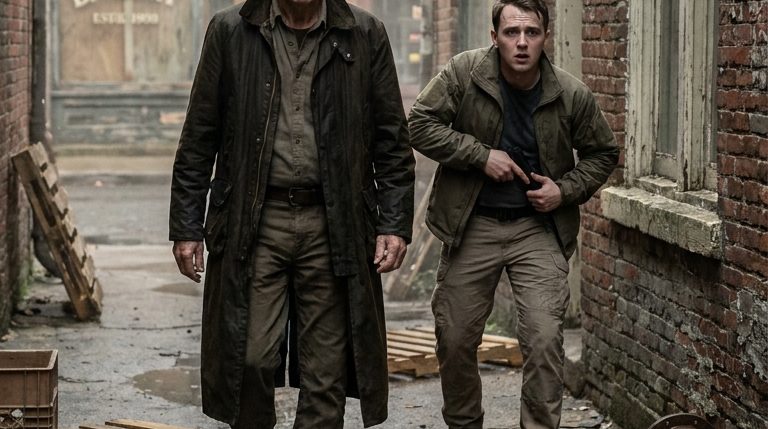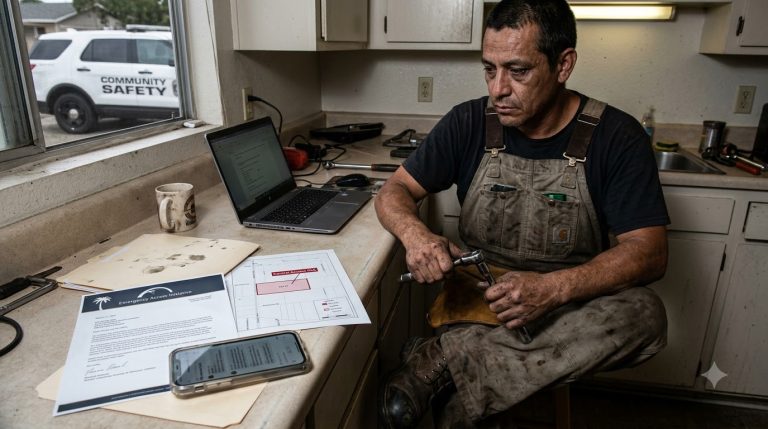
The Soil and the Steel: The Brewster Land Reversion War
CHAPTER 1: THE WEIGHT OF BRASS
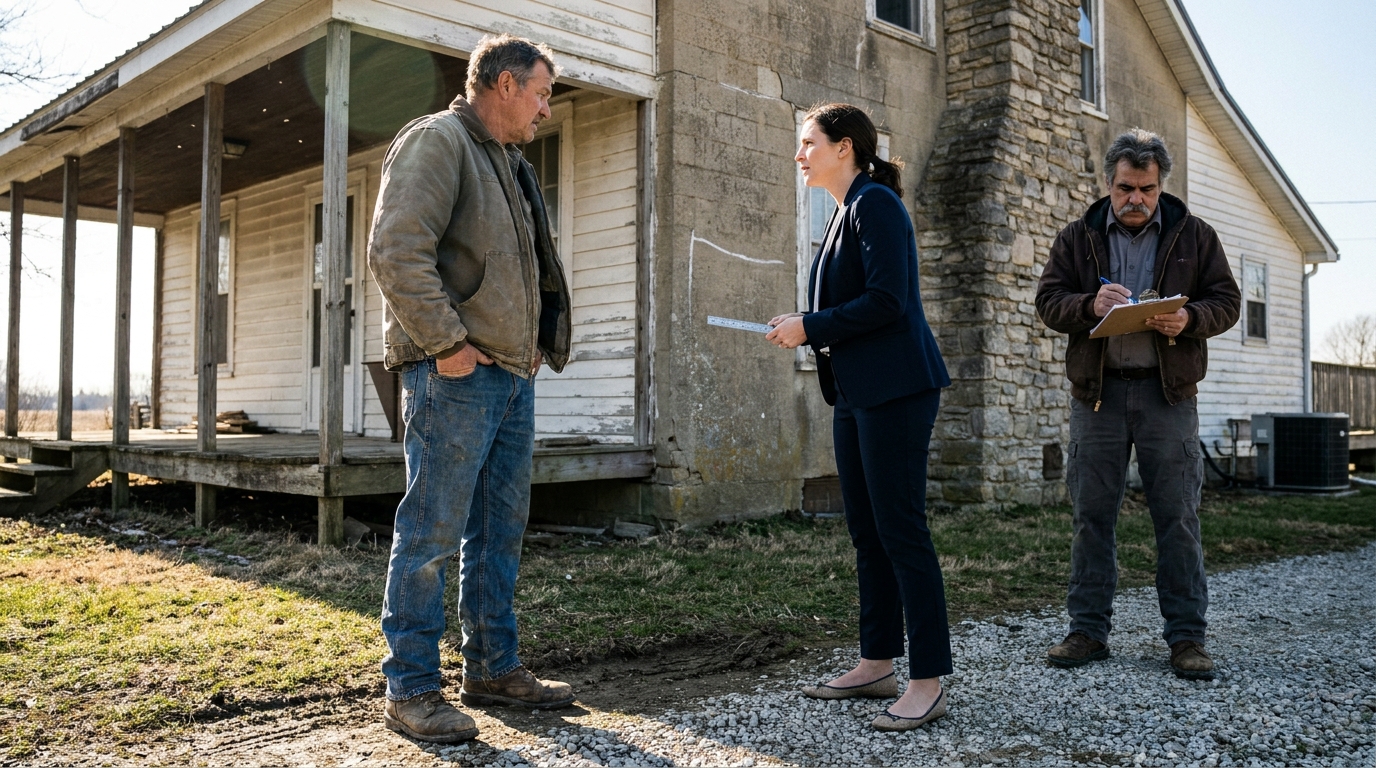
The silver ruler didn’t belong against seventy-year-old mortar.
Clayton Brewster watched the metal edge scrape the rough lime joints of the chimney. He didn’t speak. He stood on the porch, thumb rolling the pointed steel tip of a 1952 brass plumb bob in his right pocket. The brass was cold. It carried the faint, greasy smell of machine oil that three decades of farm work had never scrubbed out.
“Forty-five thousand,” Marcus said.
The city inspector didn’t look up from his clip-board. A thick mustache shadowed his top lip, graying at the edges, smelling faintly of stale coffee and diesel exhaust. He tapped the paper with a plastic pen.
“Mortar joints show advanced moisture intrusion,” Marcus added. “Non-compliant with modern structural codes. Section Four, Subsection B.”
Behind him, idling on the crushed limestone drive, a silver Lexus purred. The exhaust shimmered in the crisp morning air. Veronica Ashford stepped out, the door closing with a muted, expensive thud. Her navy blazer was pressed tight across her shoulders. Pearl earrings caught the Indiana sun, bright and surgical against her pale skin.
“We gave you ninety days for the fence, Clayton,” Veronica said. Her voice had the thin, polished edge of a kitchen knife. She stopped at the edge of the porch, her designer flats hovering half an inch from the mud. “Now we’re doing the complete perimeter. Structural, safety, access.”
Clayton turned the plumb bob over in his palm. The brass point bit into the callous on his thumb. Pain was clean. It kept his pulse below sixty.
“This chimney stood through the blizzard of ’78,” Clayton said. His voice was flat, dried out like cured cornstalks. “Didn’t drop a brick.”
“Standards change,” Veronica said. She pulled a laminated card from her pocket. The list of approved community fixtures was three pages long, bound in clear plastic. “The gravel access road is next. Emergency vehicles require paved asphalt with a four-inch sub-base. Eighty-five thousand.”
“That’s my driveway.”
“It’s an ingress route within the Willow Spring Estates boundary,” she corrected. She stepped closer, her eyes scanning the dirt path leading toward the timber tool shed. Her gaze stopped on the raised timber beds forty feet away. Dark soil sat rich under plastic mulch, green shoots of heirloom tomatoes pushing through the straw. “And that structure.”
Clayton took one step off the porch. The gravel crunched under his work boots—heavy, deliberate, the sound of iron hitting limestone.
“That’s Sarah’s garden,” he said.
“Agricultural plot,” Marcus chimed in, pencil moving across the yellow sheet. “Unpermitted irrigation lines. Vector risk for runoff. Fifteen thousand.”
Clayton didn’t look at Marcus. He kept his eyes locked on Veronica’s face. He watched the tiny pulse near her left ear—fast, shallow, the micro-tic of a predator checking for territorial friction. She thought she was measuring a house. She thought she was auditing an old man who spent his evenings watching the shadow of a barn lengthen across an empty field.
“You’re up to three hundred and fifty thousand, Clayton,” Veronica whispered, leaning in just enough so Marcus wouldn’t hear over the Lexus engine. She didn’t sound angry. She sounded like an accountant closing a ledger. “The board meets on Sunday. If the fines aren’t secured against the deed by noon, we initiate the foreclosure lien.”
“My grandfather set these corner posts in fifty-two,” Clayton said softly.
“Your grandfather didn’t plan for a luxury development,” she replied. She turned on her heel, her blazer swinging clean. “Marcus, check the wellhouse.”
Clayton felt the cold point of the brass tool dig deeper into his hand. He didn’t raise his voice. He didn’t move to block the drive. He just stood in the red dirt, watching her silver ruler leave a tiny white scratch on the old stone chimney, calculating the exact amount of force it would take to tear down a house built on someone else’s ground.
CHAPTER 2: COLD IRON IN THE SOIL
The hum of the Lexus faded into the distance, replaced by the idle chatter of cicadas in the high oak canopy.
Clayton didn’t move. He kept his hand deep in his canvas coat pocket, the sharp steel point of the plumb bob biting clean into his calloused thumb until the skin turned white. The stone chimney above him held the faint, pale scratch where Veronica’s silver ruler had scraped the mortar. A tiny line of white lime dust clung to the rough red brick like salt on a wound.
Eighty-five thousand for the road. Forty-five for the chimney. Fifteen for Sarah’s garden. Three hundred and fifty thousand total.
He pulled his hand out of his pocket and wiped a smear of thumb-blood onto the seam of his heavy denim jeans. He didn’t look at the house. He turned his back on the gravel drive and walked toward the weathered wooden shed at the edge of the tree line.
The shed smelled of dry cedar, engine oil, and old burlap. Tucked behind a stack of cedar fence posts sat his grandfather’s heavy industrial metal detector—an old analog Fisher unit with a rusted aluminum shaft and a cracked vinyl handle. Next to it lay a short-handled entrenching spade with a blade ground sharp on a bench grinder.
Clayton flipped the toggle switch. The needle twitched on the dial, and a low, uneven hum vibrated through the speaker against his hip.
He walked past Sarah’s heirloom tomatoes. The three uprooted plants sat wilting in the dirt, their leaves already curling under the hot Indiana sun. He didn’t re-plant them yet. You don’t build a wall until you know where the footing sits.
He crossed the open grass to the western edge of the lot, where a tangle of wild blackberry bushes choked the ditch separating his property from the neatly manicured lawn of Lot 42—a sprawling two-story suburban house with a zero-entry pool and a plastic play set.
He swept the coil low, sweeping it two inches above the damp clover.
Bzzzz-whine.
The frequency spiked, a high-pitched, solid feedback loop that made his fillings ache.
Clayton dropped to one knee. The damp earth soaked straight through his denim, cold and dark against his skin. He shoved the sharp edge of the spade into the root mass, cutting a six-inch plug of turf, levering it back with a dull thwack.
Four inches down, the spade struck something unyielding. Not limestone. Steel.
He used his bare fingers to scrape away the black humus. A rusted iron pipe, three inches thick, sat buried flush with the hardpan clay. Stamped deeply into the flat iron cap was a serial marker, choked with grit: Brass-Marker-Zero.
It wasn’t a standard residential boundary pin. It was a benchmark—a primary survey node set by the county road commission back in 1952.
Clayton pulled a brass folding rule from his back pocket and laid it across the iron cap. He looked up, sighting through the blackberry thicket toward the asphalt curb of the subdivision’s main thoroughfare, Crestview Drive.
According to the citation packet Marcus had handed him, the HOA’s legal easement extended twenty feet from the center of the paved road, putting Clayton’s stone chimney and gravel apron squarely inside community land.
But the iron pin didn’t lie.
Clayton sighted down the line of sight toward the eastern tree line. The paved curb of Crestview Drive didn’t run parallel to the iron benchmark. It crossed it. The developer hadn’t just built houses up to his property line; they had poured two hundred yards of municipal asphalt three feet deep inside the original Brewster farm boundary.
The subdivision wasn’t surrounding him. It was encroaching on him.
A soft rustle of gravel made Clayton turn his head.
Jake Morrison stood at the edge of the ditch, wearing a faded grease-stained cap and holding a thermal coffee mug. Jake owned the eighty acres of timber directly south, the last untouched parcel left in the township besides Clayton’s.
“Saw the silver Lexus pull out,” Jake said, his voice like two river rocks grinding together. “Veronica look like she was issuing a parking ticket or declaring martial law?”
“Both,” Clayton said, wiping his muddy fingers on his knee. He didn’t stand up. He pointed down at the exposed iron cap in the dirt. “Look at the offset.”
Jake stepped into the ditch, his heavy work boots sinking an inch into the mud. He squinted at the iron pipe, then looked toward the manicured lawn of Lot 42.
“That’s the zero-node,” Jake said softly. “Your granddad set that when they widened the old county highway.”
“The curb is three feet over,” Clayton said. “Which means their storm drain is on my dirt. Their streetlights are on my dirt. And Veronica’s entire architectural compliance map is drawn off a centerline that doesn’t legally exist.”
Jake took a slow sip from his mug, the steam rising between them. “She ain’t gonna care about an iron pipe, Clayton. She’s got a Indianapolis law firm with three floors of glass and steel behind her. They’ll file an injunction, call it an administrative error, and charge you fifty grand for the privilege of arguing about it.”
“They defaulted,” Clayton said quietly.
Jake paused, the mug halfway to his mouth. “What?”
“Clearwater Development,” Clayton said, rising slowly to his feet, his knees popping in the quiet woods. “When they went bankrupt back in ninety-one. They never finished the lot conversions. My granddad didn’t sell them the land, Jake. He leased them the dirt.”
Jake stared at him, his brow furrowing over bloodshot eyes. “Clayton… that was thirty-five years ago. Every bank in the state has written mortgages on those houses.”
“Then every bank in the state built on a cloud,” Clayton said.
He picked up the metal detector, flipped the power switch off, and wiped the spade blade clean with a handful of dry grass. The metal was cold, but the anger in his chest was turning dry and clear.
“I’m going to the courthouse,” Clayton said. “I want to see what Nancy hid in the basement.”
CHAPTER 3: THE BASEMENT RECORDS
The dry grass tore in Clayton’s fist, leaving a smear of green chlorophyll across the cold steel blade of the spade. He threw the grass into the drainage ditch, stored the tool back in the cedar shed, and climbed into the cab of his 1998 Ford F-250.
The starter churned four times before the eight-cylinder engine roared to life, shaking the rust-flaked bed. Gravel crunched beneath the heavy tires as he pulled off his land. Forty minutes of back-country asphalt slipped past the hood, the farmland gradually yielding to civic brick and asphalt. The road hummed under the tires until the rubber finally ground against the oil-stained concrete of the county courthouse parking lot.
Clayton shut off the engine. The silence in the cab was thick, broken only by the rhythmic pinging of the cooling manifold.
He walked up the broad granite steps of the courthouse, his work boots heavy against the stone. Inside, the air shifted immediately—cool, stagnant, smelling of industrial floor wax, old wool, and stale coffee. He bypassed the main elevator bank and took the concrete stairs down to the basement level, where the overhead fluorescent fixtures hummed at a low, sixty-cycle drone.
Behind a high oak counter sat Nancy, the senior records clerk. She was a woman in her late fifties with manicured acrylic nails that tapped a sharp, rhythmic clack-clack-clack against the laminate desk. A pair of reading glasses hung from a silver chain around her neck, resting against a patterned silk scarf.
“Clayton,” she said, her voice flat, practiced in civil indifference. She didn’t look up from her monitor. “You’re out of your township.”
“Need the plat books for Section Fourteen,” Clayton said. He leaned his forearms against the high counter, the worn denim of his jacket rubbing against the varnished wood. “Nineteen-eighty-seven through ninety-two.”
Nancy’s fingers froze over the mechanical keyboard. The silence between the hums of the overhead lights stretched three seconds too long. Her thumb moved involuntarily, hooking into the silver chain of her glasses, pulling the wire taut against her collarbone.
“Section Fourteen was digitized two years ago,” she said, turning her head toward him, though her eyes remained anchored to the corner of his collar. “Anything regarding Willow Spring Estates is managed through the municipal portal.”
“The portal only shows approved lot divisions,” Clayton replied quietly. “I don’t want the current tax map. I want the original record of conveyance from the Brewster estate to Clearwater Development. Box forty-two, Development Projects.”
Nancy stood up. Her skirt rustled with stiff starch. She stepped toward the row of gray steel filing cabinets lining the back wall, her heels clicking sharp on the linoleum. “Those older archival boxes were moved to off-site storage after the spring rain flooded the lower boiler room. Most of the paper from that era has moisture damage.”
“Section Fourteen wasn’t in the boiler room,” Clayton said. His voice didn’t rise; it stayed anchored in his chest, low and steady. “It was filed under county highway right-of-way easements. My grandfather made sure of it.”
Nancy reached for a drawer handle, her acrylic nail catching on the metal latch with a soft snap. She stopped, her back still turned to him.
“I can put in a request with the county archivist,” she said, her tone tightening. “It takes ten business days. You know how the backlog is, Clayton.”
“I don’t need ten days,” Clayton said. He reached into his coat pocket, pulled out a small piece of folded paper, and laid it flat on the counter between them. On it was the exact serial string he had scraped off the iron benchmark an hour ago: Section-14-Reversion / Brass-Marker-Zero. “I just need you to unlock the archival annex door.”
Nancy turned around slowly. Her eyes dropped to the paper. The color didn’t drain from her face completely, but the tight, professional composure at the corners of her mouth flickered.
“Veronica Ashford was here on Tuesday,” Clayton added softly. “She sat at that same table, didn’t she?”
Nancy swallowed, her throat moving against the silk scarf. “Mrs. Ashford was reviewing public drainage assessments for the HOA.”
“She was checking the deed chain,” Clayton corrected. “And you told her the same thing you’re telling me—that the paper was gone.”
Nancy took a slow breath, her hand dropping from the filing cabinet drawer. She stepped back toward her desk, her posture stiffening as if wrapping herself in the thin armor of her clerk’s badge.
“The basement annex is restricted to authorized personnel, Mr. Brewster,” she said, her voice dropping into formal bureaucratic coldness. “If you want access to original paper files, you’ll need a signed order from the county circuit judge. Now, if there’s nothing else—”
“There is,” Clayton said.
He didn’t argue. He didn’t raise a fist or slam the counter. He reached out, picked up his folded piece of paper, and slid it back into his pocket next to the brass plumb bob.
“Tell Marcus his survey line is three feet off my benchmark,” Clayton said. “And tell Veronica that if she wants to foreclose on my dirt, she better bring a better deed than the one Clearwater forged in ninety-one.”
He turned on his heel and walked back toward the concrete stairwell. Behind him, the rapid, uneven clack-clack-clack of Nancy’s acrylic nails resumed on the keyboard—faster now, erratic, the biometric rhythm of someone dialing a phone before the heavy door could even swing shut.
CHAPTER 4: THE PAPER INCINERATOR
The heavy door slammed shut behind him, cutting off the drone of the basement fluorescents, but the frantic, uneven cadence of Nancy’s acrylic nails still echoed in Clayton’s head.
He didn’t drive home. He backed the F-250 into a shaded bay at the far corner of the courthouse lot, killed the headlights, and left the engine idling low. Through the dusty windshield, he watched the basement exit door. Twenty-eight minutes passed before Nancy stepped out into the humid late-afternoon air. She wasn’t carrying her purse. She held a pale green cardboard transfer box tightly against her ribs, her knuckles white.
She crossed the gravel lot to her Honda Civic, popped the trunk, and dropped the box inside with a heavy, hollow thud.
Clayton waited until her brake lights cleared the perimeter gate before slipping the Ford into gear. The distance between them stayed constant—three car lengths of oily heat haze and asphalt. She didn’t head toward the highway or the residential grid. She turned south onto County Road 400, where the suburban subdivisions gave way to rusted equipment yards and the looming silhouette of the municipal waste facility.
The city dump smelled of damp ash, decomposing landfill gas, and burning rubber.
Nancy pulled through the commercial gates after hours, her tires crunching across the weigh-scale grid. Clayton stopped his truck fifty yards back, behind a mountain of crushed concrete culverts, and cut the engine. He reached into his center console, grabbed his smartphone, and stepped out into the dust.
A silver Lexus was already parked beside the commercial incinerator intake.
Veronica stood under the sodium floodlights, her navy blazer off, draped over the hood of her car. Her pearl earrings glinted against the harsh industrial light. Standing beside her was Nancy, who had pulled the green transfer box from her trunk.
Clayton rested his arm over the jagged edge of a concrete pipe, raising the phone screen. He hit record. The camera lens zoomed through the shimmering heat haze, locking onto the crisp profile of Veronica’s face.
“Is this everything from eighty-seven through ninety-one?” Veronica’s voice carried over the low rumble of the facility’s exhaust blowers.
“It’s the original master filing,” Nancy said. Her voice trembled, thin and panicked. She wiped her forehead with the back of her hand, leaving a smudge of dark dirt. “If anyone checks the state archive, the inventory numbers won’t match, Veronica. I told you—”
“The state archive only has summary abstracts,” Veronica cut in, her voice cold, surgically precise. She reached into her leather handbag, pulled out a thick, legal-sized manila envelope, and pressed it directly into Nancy’s trembling hands. “The original paper is the only thing that creates a cloud on title. Burn it.”
Nancy’s hands shook as her fingers closed around the envelope. The paper creaked under her grip—the dense, heavy bulk of hundred-dollar bills.
She turned toward the incinerator’s cast-iron hopper. The orange glow of the gas burners reflected off her glasses. She tipped the green box forward. A thick stack of yellowed, carbon-backed contracts tumbled toward the flames. On the top cover, bold black ink stamped across the binding was clearly visible on Clayton’s high-definition screen: Clearwater-1991-Bk / Development Master Lease.
Click.
Clayton locked the video recording, saved the file to local storage, and backed the video up to a remote cloud drive over the cellular network. The confirmation light flashed green on his screen just as the first burst of black, acrid ash spewed from the incinerator stack.
He didn’t step out from behind the concrete pipe. He didn’t yell. He watched the paper turn to white flakes in the draft, the ashes drifting over the hood of Veronica’s Lexus like dirty snow.
Veronica thought she was burning a contract. She had no idea she had just handed him a recorded felony on a high-definition platter.
Clayton stepped back into his truck, closed the heavy door without making a sound, and turned the key. As the engine roared, he pulled up his contacts and tapped his daughter’s number in Portland.
“Jessica,” Clayton said into the speakerphone as he backed out into the dark road. “Get on a plane. They just burned the ninety-one lease.”
CHAPTER 5: THE REVERSION FILE
The phone speaker crackled once with static before Jessica’s line went dead, leaving only the steady thrum of the V8 engine and the rhythmic slap of the tires against the dark asphalt.
Clayton drove through the night. Shadows stretched across the dashboard, and four hours of road haze broke when the tires finally crunched on the gravel apron of his homestead. The farmhouse sat dark, its outline jagged against the midnight sky.
Inside, the kitchen was cold. Clayton turned on the single overhead bulb above the worn oak table.
He didn’t sleep. He pulled two heavy cardboard file boxes out from beneath Sarah’s sewing desk in the corner. The brass plumb bob sat in the center of the table, its tarnished weight holding down a stack of yellowed survey maps from 1987. His thumb brushed the metal point mechanically as he sorted through decades of tax receipts, handwritten property notes, and land use permits.
At four in the morning, headlights swept across the kitchen window.
A cab pulled into the drive. The door clicked open, and Jessica stepped out carrying a leather briefcase and a red-eye flight garment bag. Her hair was pulled back into a tight, professional knot, but her eyes carried the sharp, bloodshot exhaustion of a seventy-mile-an-hour red-eye from Portland.
She didn’t offer a hug. She didn’t waste time on small talk. She dropped her briefcase on the oak table, popped the brass latches with two sharp clicks, and spread a thick sheaf of legal filings across the maps.
“I pulled the federal bankruptcy docket on my layover in Chicago,” Jessica said, her voice dry, precise, stripped of emotion. She tapped a finger on a certified court stamp. “Clearwater Development filed Chapter 11 on October 14, 1991. The docket was closed six months later, but the land distribution schedule was never finalized.”
Clayton leaned over the table, his forearms resting on the scarred wood. “Nancy burned the county master file tonight.”
“It doesn’t matter,” Jessica replied softly. She pulled a certified court copy from her briefcase, stamped in blue federal ink. “Because Clearwater’s bankruptcy trustee filed a master duplicate with the Federal District Court in Indianapolis under case file Clearwater-1991-Bk. The county clerk’s copy was just a courtesy draft.”
Clayton looked down at the paper. His eyes locked onto the third page, paragraph four: Estate assets restricted exclusively to temporary surface leasehold rights under Section-14-Reversion. Fee-simple underlying title remains vested in Brewster, William H., his heirs and assigns.
“They never owned the dirt,” Clayton said.
“They owned ninety-nine years of access, contingent on monthly land payments,” Jessica said. Her fingers tapped the brass plumb bob, rolling it an inch across the map. “When Clearwater went bust, the ground lease reverted automatically to Grandfather. Under Indiana property law, if a developer defaults on a master ground lease, every sublease, every architectural covenant, and every HOA board formed under that master title ceases to have legal standing.”
She pulled out a second document—a courier delivery receipt from a retired attorney in Tampa named Richard Sterling.
“Sterling had the original signed ninety-nine-year lease contract in his private vault,” Jessica added. “He overnighted the certified original directly to the federal courthouse in Indianapolis this morning. Veronica didn’t just issue illegal fines, Dad. She’s been collecting dues, issuing violations, and threatening foreclosure on land where her entire neighborhood is technically squatting on an unfulfilled lease.”
Clayton picked up his phone. On the screen, the video from the incinerator played in a silent loop: Nancy tipping the box forward, the yellowed paper falling into the orange glow of the burners, Veronica handing over the thick manila envelope.
“This proves criminal intent,” Clayton said. “Bribing an officer of the court to destroy evidence during an active title dispute.”
“It’s obstruction, destruction of public records, and bribery under color of authority,” Jessica said, her eyes tightening. “The HOA has called an emergency board meeting for Sunday night at seven. They’re voting on a twenty-five-thousand-dollar special assessment per home to fund their legal defense against you.”
Clayton looked out the kitchen window. The first grey light of dawn was bleeding across the eastern pasture, illuminating Sarah’s garden beds and the scratched stone chimney.
“They’re going to ask those families for three million dollars to fight a war they’ve already lost,” Clayton said.
“Then we don’t file a response in court,” Jessica said, her voice dropping into a cold, lethal calm. “We walk into that community center on Sunday night. We serve the board with the reversion order in front of the whole subdivision. And we bring the state police.”
Clayton picked up the brass plumb bob and slid it back into his pocket. The steel point pressed against his thumb, firm and solid.
“Get some rest, Jess,” Clayton said quietly, turning toward the door. “We’ve got a meeting to attend.”
CHAPTER 6: RENT DUE
The brass plumb bob sat in Clayton’s right coat pocket, cold against his thigh as he pushed through the double glass doors of the Willow Spring Estates Community Center.
Rain lashed the high, arched windows. Inside, the folding chairs were packed four rows deep with nearly two hundred residents. The air smelled of damp raincoats, stale urn coffee, and the sharp, metallic tang of collective anxiety. Up on the carpeted riser, behind a long folding table, sat Veronica Ashford. Her navy blazer was immaculate. The pearl earrings caught the harsh overhead glare of the fluorescent tubes. To her left sat Marcus, his fingers nervously tracing the edge of a thick, blue-bound folder.
“…a necessary defensive measure to preserve community equity,” Veronica was saying into the podium microphone. Her voice echoed off the drywall, smooth and practiced. “This three-million-dollar special assessment—twenty-five thousand per household—guarantees our legal defense against a rogue land claim.”
Clayton didn’t take a seat. He walked straight down the center aisle, his heavy work boots leaving dark, damp prints on the blue carpet. Behind him came Jessica, wearing her charcoal courtroom suit and carrying a leather accordion file, flanked by two uniformed Indiana State Police troopers.
The room went dead silent, save for the hum of the PA system.
Veronica’s hand froze on the edge of the wooden podium. Her knuckles turned white. “Mr. Brewster,” she said, her voice dropping an octave, losing its rehearsed cadence. “This is an executive board meeting for deeded homeowners. You are trespassing.”
“Nobody in this room is a deeded homeowner,” Clayton said.
His voice didn’t carry the rasp of anger. It was flat, heavy, and grounded like iron pipe driven into clay. He reached the foot of the riser and stopped, looking directly up at her.
A murmur rippled through the audience. A man in the front row—a neighbor from Lot 12—stood up, his face flushed. “Clayton, what the hell are you talking about? We’ve got deeds from Clearwater Development!”
“You’ve got paper from a ghost,” Jessica said stepping forward, her voice cutting clean through the rising noise. She unclasped her file and held up a thick sheaf of blue-stamped documents. “On October 14, 1991, Clearwater Development filed for Chapter 11 under case file Clearwater-1991-Bk. The underlying land was never sold to Clearwater. It was leased for ninety-nine years under Section-14-Reversion by William Brewster.”
Veronica slammed her palm onto the podium, the microphone screeching in protest. “That is an unverified administrative claim! Our title insurance—”
“Your title insurance was underwritten on a fraudulent deed chain,” Jessica interrupted smoothly, pulling a second paper from the file. “When Clearwater defaulted in ninety-one, the master development lease reverted automatically to the Brewster family trust. The HOA was formed by a entity that possessed zero underlying fee-simple title. Every covenant you’ve enforced, every fine you’ve issued, and every lien you’ve threatened is legally void.”
Veronica reached for her phone on the table, her thumb moving frantically across the screen, her eyes darting toward the rear emergency exit. “Marcus, call the township attorney. Have these people removed.”
Marcus didn’t touch his phone. He sat frozen, his mouth slightly open, looking at the two state troopers standing at the back of the aisle.
“She knew,” Clayton said quietly, turning to face the crowd of two hundred neighbors. “She knew three weeks ago when she hired a clerk to purge the county archives. She wanted twenty-five thousand dollars from each of you tonight to pay off a shell company before the federal reversion order hit the land office.”
Clayton reached into his jacket, pulled out a tablet, and tapped the screen. He turned it toward the front row. The video played—crisp, high-definition, lit by the sodium floodlights of the city dump: Nancy tipping the green box into the incinerator hopper, the yellowed pages of Clearwater-1991-Bk burning in the draft, and Veronica handing over the manila envelope of cash.
Gasps erupted across the hall. Mrs. Henderson from Maple Street stood up, her hand over her mouth, staring at the screen. “You made us pay eight hundred dollars last month for non-compliant window shutters, Veronica!”
Veronica’s face went hollow, the color draining until her skin looked like dry plaster. She pulled her leather handbag toward her chest, her fingers clutching the strap as if it were a life raft. “That video is an unauthenticated invasion of privacy—”
“That video is state’s evidence in an ongoing public corruption and bribery investigation,” the lead trooper said, stepping up onto the riser. He pulled a pair of steel handcuffs from his utility belt with a sharp, metallic clack. “Veronica Ashford, you are under arrest for bribery of a public official, obstruction of justice, and felony destruction of public records.”
Veronica didn’t scream. She didn’t monologue. As the trooper pulled her arms behind her back, her shoulder caught the microphone stand, sending it crashing to the carpet with a dull thud. Her navy blazer wrinkled under the trooper’s grip, and one of her pearl earrings dislodged, bouncing silently off the blue runner.
The room descended into chaotic shouting, residents leaping to their feet, demanding answers from Marcus, who buried his face in his hands on the table.
Clayton didn’t stay to watch them march her out to the cruiser. He turned his back on the riser and walked back down the center aisle, Jessica right beside him.
By midnight, the rain had stopped.
The quiet inside the old farmhouse was total, broken only by the steady tick of the wall clock above the stove. Clayton sat at the oak kitchen table. Spread out before him were the ninety-nine-year reversion maps, a pot of black coffee, and the tattered leather-bound notebook Sarah had used to log her heirloom seed harvests.
The HOA was gone, dissolved before the ink on Veronica’s booking sheet was dry. The families of Willow Spring Estates wouldn’t be evicted; Jessica was already drafting individual ground-lease buyouts at the original 1987 lot valuations—eighty-nine thousand dollars per household, fair, quiet, and clean. No fines. No architectural committees. No silver rulers.
Clayton reached into his pocket and pulled out the 1952 brass plumb bob.
He picked up a piece of fine steel wool from his workbench drawer and began to rub the tarnished brass. Slowly, methodically, three decades of oxidized dark green tarnish flaked away, revealing the bright, gleaming metal underneath. The steel point, set against the benchmark Brass-Marker-Zero, was straight and true.
He stood up, walked out onto the front porch, and looked out across the pasture.
In the dim moonlight, Sarah’s garden lay quiet. The uprooted tomato plants were back in the dark, rich soil, supported by cedar stakes he had notched himself that afternoon. The cold night air smelled of wet earth, crushed limestone, and clean rain.
Clayton set the polished brass weight down on the wooden railing of the porch, right where the shadow of the stone chimney fell across the timber. It sat solid, heavy, and anchored to the dirt beneath it.