The Architect of Retribution: Dismantling a Suburban Tyranny Through Cold Precision and Bureaucratic Warfare
CHAPTER 1: THE CEDAR AND THE CULL
The weight of the reclaimed cedar rested comfortably against my fingertips, every mortise and tenon joint a testament to patience forged in places where architectural disharmony meant immediate catastrophe. Across the pristine, perfectly manicured public sidewalk, Karen stood like a filing cabinet left out in the humidity, her arms crossed tight over fabric that strained with self-righteous indignation. In her right hand, she brandished the notice like a blade, her puffy face flushed with the intoxicating rush of minor suburban dominance. My chicken coop was not an eyesore; it was a miniature barn crowned with a copper cupola and functional window boxes meant for marigolds, built as a sanctuary for my eight-year-old daughter Emily. Yet, according to section C, paragraph 12 of the aesthetic covenants, it lacked architectural harmony, a subjective decree carrying a price tag of two hundred and fifty dollars plus fifty dollars for every day it remained standing. I rested my palms along the top rail of my own fence—the boundary she dared not cross—and kept my voice entirely level, letting the silence between us stretch thin and sharp. Twenty years as a combat engineer taught me that the loudest voice in any theater is invariably tethered to the weakest tactical position, and Karen’s volume was currently pinned at maximum elevation. She took a triumphant step forward, planting her sensible walking shoes just inches from the property line, utterly unaware that her aggressive advance had just defined the exact parameters of the engagement. The check is payable to the Oakwood Preserve HOA, she chirped, her smile tightening into a thin, predatory line as she finally dropped the crisp envelope directly onto my prize-winning petunias. I watched her march away with the stiff-backed cadence of a tyrant whose reign had never faced an organized counter-offensive, the red petals crushed beneath her heel leaving a dark smear against the mulch. Slowly, deliberately, I reached down and picked up the paper, the gears behind my eyes already locking into a cold, geometric calculation of consequence and leverage. She saw a quiet veteran who kept his head down to protect his child; she was about to discover what happened when a demolition specialist was handed a blueprint for an empire built entirely on sand. As I turned back toward the house, the front door clicked open, and Emily stepped out onto the porch holding a half-finished drawing of a hen, her bright eyes looking up at me with an innocent trust that instantly crystallized every atom of my resolve into something unbreakable.
CHAPTER 2: THE PAPER TRAIL
The front door clicked shut behind Emily, muttering the muffled sounds of a child returning to her crayons, leaving me alone in the dim perimeter of the hallway with the crushing weight ofKaren’s crumpled notice still resting in my palm like a dead battery. I did not raise my voice, nor did I allow the cold anger settling into my diaphragm to manifest as an impulsive gesture; instead, I walked straight into the home office, dropped the red-stained envelope onto the edge of the reclaimed oak desk, and opened a fresh, empty digital folder labeled HOA Engagement. In the theater of bureaucratic warfare, fury is a wasted calorie. Twenty years of military engineering taught me that structural integrity fails not from a sudden lightning strike, but from the quiet, persistent erosion of load-bearing supports. Karen had established her authority upon an unwritten foundation of fear, intimidation, and sweeping aesthetic covenants that meant everything to her and nothing to municipal law. My first tactical objective was simple: build a verifiable, unassailable paper trail that would expose the arbitrary nature of her enforcement without ever giving her the satisfaction of a visible emotional reaction.
I settled into the leather desk chair, the desk lamp casting a sharp circle of light across my keyboard as I drafted the formal appeal through the sterile, automated labyrinth of the management company’s online portal. My fingers moved with mechanical precision, translating the raw injustice of the two-hundred-and-fifty-dollar fine and the daily fifty-dollar penalties into cold, dispassionate legalistic prose. I cited the precise dimensions of the cedar coop, cross-referenced the municipal zoning codes that explicitly permitted backyard poultry on half-acre residential lots, and formally requested a comprehensive, written definition of architectural harmony alongside copies of the past twenty-four months of architectural review committee meeting minutes. The screen glowed softly against the dark window pane, reflecting the stoic lines of a man who viewed a neighborhood dispute through the exact same lens he once used to calculate load limits over hostile terrain.
When the submission confirmation flickered onto the display, I did not lean back to celebrate; I immediately pivoted to the next vector of the operation. If Karen operated by weaponizing community rules, then the state statutes governing homeowners associations were the ultimate equalizer. Under state law, every resident possessed the legal right to inspect the complete financial books, ledgers, contractor contracts, and banking records of their association—a statutory right that most residents never exercised out of intimidation or sheer exhaustion. I opened a second document and drafted a formal, sweeping request for five years of unredacted financial ledgers, bank statements, and paid vendor invoices. It was a paperwork bomb designed to land squarely on the management company’s desk, forcing them to either comply or commit an actionable statutory violation that would strip away their legal immunity.
As I reviewed the drafted document line by line, the muted chime of my phone broke the silence of the room. It was an unfamiliar number flashing across the screen, the caller ID registering a regional prefix associated with the sprawling commercial office park on the edge of town. I let it ring twice, watching the digital numbers pulse in the dark, before pressing the answer button and bringing the device to my ear with the calm, measured cadence of a high-end contractor preparing to field a corporate bid. Is this Evans Design and Build? a man’s voice inquired, carrying the crisp, strained inflection of someone accustomed to managing tight budgets and nervous committees. My pen hovered motionless over a structural calculation pad as I kept my voice entirely level and professional. This is he, I replied, my eyes fixed on the blinking cursor of the records request. The voice on the other end introduced himself as Arthur Wembley, head of the capital improvements committee for the Oakwood Preserve Homeowners Association, dropping the casual revelation that my firm had come highly recommended for their upcoming grand entryway redesign project—a multi-million-dollar endeavor meant to serve as a monument to community prestige. A slow, thin smile touched the corners of my mouth as the sheer, delicious irony of the universe settled over the room. The very woman who was currently attempting to fine me out of my home for a handmade chicken coop was about to pay my high-end construction firm a massive fee to design her grand public statement piece, completely oblivious to the fact that the humble veteran in the yard and the principal architect on the phone were one and the same man. I accepted the preliminary meeting for the following Tuesday, neatly compartmentalizing the two distinct realities I was now inhabiting, knowing full well that the bridge between them was about to become the precise lever that would bring her entire administrative empire crashing down.
CHAPTER 3: THE ALLIES OF THE FENCE
The digital display on the desk clock flickered past midnight, casting an amber glow across the blueprints and legal transcripts that covered the reclaimed oak surface. I did not move from the leather chair; the lingering vibration of Arthur Wembley’s voice still hung in the air like the residue of a spent round. In the quiet hours between midnight and dawn, the house breathed with the steady, rhythmic breathing of Emily sleeping upstairs, her safety the absolute vector around which every calculation in this study turned. Twenty years ago, operating in foreign sectors, I learned that a fortress is never breached by a direct assault against its reinforced gates; it is compromised by quietly mapping the fractures in its foundation, locating the secondary actors whose silent grievances have been ignored for years. Karen operated on the assumption that isolation was her most effective weapon—that by treating each resident as a solitary target, she could enforce compliance through exhaustion. My objective over the next forty-eight hours was to systematically dismantle that isolation.
I pushed away from the desk, the legs of the chair scraping softly against the hardwood floor, and walked over to the kitchen to pour a cup of black coffee. The ceramic mug felt heavy and cold between my palms as I stared out the dark window toward the property line where the handcrafted cedar coop stood bathed in the pale wash of the streetlamp. George’s house sat just beyond the fence to the left, a meticulously maintained property whose pristine exterior masked a history of quiet surrender. The next morning, under the pale, watery sunlight of a Saturday, I found George standing among his immaculate rose bushes, his garden shears moving with a slow, mechanical precision that betrayed a deep, institutionalized fatigue.
I stepped lightly across the damp grass, my boots making no sound against the turf until I stopped beside the low wooden divider separating our yards. George, I said, keeping my tone low to avoid carrying across the quiet morning air. He looked up, startled, his faded blue eyes blinking behind wire-rimmed glasses as if unaccustomed to being addressed without a formal warning notice attached. Oh, hello, Mark, he murmured, his glance darting nervously down the street toward Karen’s distant driveway before returning to his shears. I wanted to ask you something off the record, I continued, leaning my forearms against the top rail of the fence. Have you ever truly had a choice when the board knocks on your door? George’s hands froze, the blades hovering inches above a stem of crimson petals. A heavy, melancholic silence settled between us, thick with the unexpressed weight of memories he had buried years ago. After his wife Helen passed away, he had built a small stone memorial bench and a bird bath in the rear corner of his yard—a quiet sanctuary to feel close to her. Karen had cited it as an unapproved landscape feature, subjecting him to a relentless barrage of administrative threats until the stress broke him down entirely, forcing him to dismantle the memorial with his own hands.
She’s trying to put a lien on my house over the chicken coop, I said plainly, watching the subtle tightening of the muscles around his jaw. George let out a long, ragged sigh, the defensive posture evaporating from his shoulders. I’m sorry to hear that, son, he whispered, his voice cracking with a familiar, bitter defeat. She’s a bulldog when she gets a hold of something. I fought her for a month, but it wasn’t worth the cost to my peace of mind. I took it down last spring. The raw injustice of his confession struck with the cold friction of rusted iron, confirming every strategic assumption I had made. I am not taking my coop down, George, I replied, my voice carrying an absolute, unyielding gravity. And I am not fighting her alone anymore. But I need to know if there are others who remember what this neighborhood used to feel like before the rules became a weapon. George looked up, meeting my gaze directly for the first time, and within the dull gray of his eyes, a faint, long-dormant spark flickered back to life. You’re not alone, he said quietly, a new firmness steadying his tone. You’re just the first one willing to stand in front of the door. Talk to the Garcas at number forty-two; ask them about their son’s playset.
The trail was branching exactly as calculated. I thanked him with a single nod, turned on my heel, and walked back toward my house with the cold, clear certainty of an engineer plotting coordinates across a contested grid. Every name gathered, every suppressed grievance cataloged, and every arbitrary fine documented was another pound of pressure applied to a system built entirely on fragile vanity. The foundation was cracked; now it was time to assemble the collective weight required to bring it down.
CHAPTER 4: THE TROJAN HORSE CONTRACT
The digital archive arrived as a sprawling, deliberately convoluted gigabyte of scanned PDFs, mislabeled bank statements, and rough meeting notes scribbled hastily on legal pads—a classic bureaucratic smokescreen designed to exhaust scrutiny through sheer volume. I did not close the window or step away from the reclaimed oak desk; instead, I settled deeper into the leather chair, letting the sterile glare of the monitor cast sharp highlights across my face as I began the methodical process of cross-referencing ledger entries against approved project budgets. This was the exact intersection where tactical patience met structural engineering. Every entry had a weight, every balance sheet a specific geometry of cause and effect. By midnight, working under the steady hum of the desk lamp, the pattern revealed itself through a series of recurring, round-sum disbursements directed toward a corporate entity listed as Suburban Maintenance Solutions LLC—a company with no active website, no physical storefront, and a registered address that resolved to a narrow P.O. box in a neighboring district.
I traced the registration documents through public digital databases, following the paper trail through layers of administrative filings until the corporate veil parted to reveal the registered agent: Gerald Finny. A quick, targeted cross-reference of familial records confirmed what the ledgers had only whispered. Gerald Finny was Karen’s brother-in-law. It was a textbook, low-level grift operating entirely in plain sight, protected by the heavy curtain of association rules and enforced by manufactured fear. She was funneling community maintenance capital into a phantom shell company for services never rendered, funding her domestic security through the coerced compliance of her neighbors. Yet, discovering the embezzlement was only half the equation; the structural trap required a mechanism of absolute, inescapable enforcement.
The opportunity arrived on Tuesday afternoon, perfectly synchronized with the preliminary review meeting for the Oakwood Preserve grand entryway project. I traded my work-worn denim and simple pullovers for a tailored navy blazer, pressed slacks, and a crisp button-down shirt, stepping out of my clean Ford F-250 King Ranch into the polished parking lot of the commercial office park with a leather portfolio tucked beneath my arm. Inside the conference room, Arthur Wembley and a nervous junior committee member sat flanking Karen, whose face broke into an immediate, ingratiating smile the moment I walked through the door. Not a single flicker of recognition touched her eyes; to her, the humble resident facing property liens and the high-end architectural principal standing before her were two entirely different species. We spent an hour reviewing structural renderings, material sourcing indices, and sightline analyses, feeding her own inflated desire for prestige back to her through precise, calculated industry jargon. When the presentation concluded, I slid the comprehensive contract across the polished wood table—a document that appeared on the surface to be a standard, ironclad agreement for upscale architectural services.
Buried deep within Section 8, under project contingencies and due diligence protocols in subsection 8.4C, lay the Trojan horse. The text was drafted in dry, highly technical legal prose designed to be skimmed and dismissed by anyone eager to secure a monument to their own vanity: a mandatory precondition requiring a full, independent forensic financial audit covering the preceding twenty-four-month fiscal period, conducted by a certified accounting firm before any final construction drawings could be released. Karen barely glanced past the bold header, her mind entirely consumed by the massive price tag and the prospect of a grand groundbreaking ceremony. She smiled, praised the rigorous attention to detail, and urged Arthur to countersign immediately. The bait was set, swallowed, and locked in iron ink. She had just signed her own administrative death warrant, funding the very investigation that would dismantle her entire kingdom brick by bureaucratic brick.
CHAPTER 5: THE PUBLIC TRIBUNAL
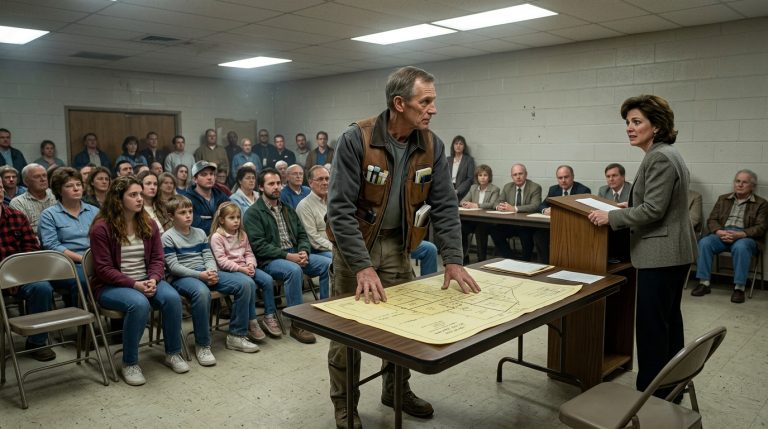
The folding chairs in the community center scraped against the linoleum floor with a sharp, metallic friction as the packed room settled into an oppressive, electrified silence. I remained standing near the rear doorway, dressed in simple khakis and a dark polo shirt, keeping my profile deliberately unassuming while the rows ahead of me filled with faces carrying the accumulated scars of administrative tyranny. At the front folding table, Karen sat flanked by her executive panel, her posture radiating an aura of absolute, unchallenged dominion as she gripped the wooden gavel. Arthur Wembley sat beside her, pale-faced and nervously tracing the rim of a water glass with a trembling thumb. When Karen struck the table to call the emergency session to order, her voice echoed through the tight space with calculated theatricality, framing the evening as a necessary defense of community standards against an uncooperative, extortionate contractor and a malicious faction of resident dissidents.
She leaned forward over the table, her eyes sweeping across the assembly as she posed the ultimate rhetorical trap: asking the room whether they would bow to outside pressure and allow a few malcontents to dismantle the pristine aesthetic framework she had spent years constructing. The silence stretched thin, heavy with the weight of manufactured guilt, until I pushed away from the back wall and stepped smoothly into the center aisle. The movement was quiet, yet the deliberate, unhurried pace drew an immediate wave of turning heads. When I spoke, my voice carried an even, measured resonance that cut straight through the fluorescent hum of the room without a single trace of raised volume. My name is Mark Evans, I announced, every syllable distinct as I stopped midway down the aisle. I reside at one-twelve Willow Creek Lane, and I believe I can shed some real light on the contractor’s true motives. Karen’s expression soured instantly, a flicker of cold annoyance tightening her mouth as she recognized the man she had fined over a chicken coop.
Mr. Evans, this is a closed procedural discussion regarding capital project defaults, she interjected, her tone razor-sharp and dismissive. If you have a personal grievance about your property citations, you may submit it through proper administrative channels. Actually, I continued, taking another slow step forward while maintaining steady, unwavering eye contact, I am not here to discuss the citations. I am the principal owner of Evans Design and Build. The impact of the disclosure hit the room like a physical shockwave, a collective intake of breath followed by an explosive murmur of astonishment that rippled through the tightly packed rows. Karen’s face cycled through disbelief, confusion, and dawning horror in rapid succession, her mouth parting soundlessly as the two separate realities she had so carefully maintained abruptly collapsed into one another. I reached into my portfolio, pulled out a certified copy of the architectural services agreement, and held it high enough for the front row to read the bold header. I am the contractor she calls unprofessional, and I am the resident she calls a malcontent, I said, my gaze sweeping across the stunned faces of my neighbors. And the extortionate demand she claims I made was simply a mandatory clause requiring an independent forensic audit of the HOA financial books—a clause that your board president personally reviewed, approved, and signed into binding contract.
Chaos erupted instantly, the carefully constructed facade shattering into a cacophony of outraged shouts and overlapping demands for transparency as the suppressed grievances of half the neighborhood boiled over at once. George stood up near the front, his voice trembling with righteous fury as he recounted the destruction of his late wife’s memorial garden; Mr. Garcia followed, shouting about the arbitrary fines levied against his son’s playset; and Maria the plumber added her voice to the rising tide, detailing months of targeted harassment over a parked work van. Karen banged the gavel furiously, her face flushed a dark, bruised crimson as she screamed that the assembly was out of order and that the board was facing illegal slander, but the authority she had wielded for years was entirely gone. Arthur Wembley, sensing the total collapse of her regime with cold political survival instinct, slowly rose from his seat, raised his hands for quiet, and formally moved to immediately suspend Karen from all presidential authority while authorizing the immediate execution of the forensic audit by Sterling Forensic Accounting. The three remaining board members seconded and voted in rapid succession, turning a deafening roar of public fury into an irreversible, legally binding coup that left the former president stranded in absolute, crushing isolation.
CHAPTER 6: THE RUSTED CROWN
The morning light broke cold and flat across the manicured lawns of Oakwood Preserve, striping the asphalt with long, sharp shadows that smelled faintly of damp earth and morning dew. I stood out in the front yard, my hands braced against the top rail of the fence as I looked down at the handmade cedar coop where six healthy hens scratched quietly against the cedar shavings, entirely unaware of the administrative earthquake that had just reshaped their world. Down the street, the plain black sedan with government plates idoun-ed silently against the curb in front of Karen’s house, its engine idling with a low, steady vibration that cut through the neighborhood silence. Two operatives in sharp gray suits stepped up to her front door, their knuckles rapping a crisp, rhythmic cadence against the wood before the door clicked open. I did not stare or cross the property line; I simply maintained my position, a quiet veteran tending his boundaries, while the structural reality of the neighborhood’s corruption was finally brought to light.
Karen appeared in the doorway, her face pale, slack, and stripped entirely of the puffed arrogance that had once defined her reign. As the federal investigators spoke to her, explaining the full extent of the indictments issued by the district attorney’s office regarding the quarter-million-dollar syndicate she had operated alongside her brother-in-law’s phantom maintenance firm, her gaze drifted down the street and locked onto mine. There was no fire left in her eyes, no tactical counter-move, only the cold, hollow realization that her empire of petty rules had been dismantled not by an equal force, but by the accumulated weight of a thousand small injustices she had thought too insignificant to notice. The investigators guided her toward the vehicle, her steps hesitant and heavy against the concrete, and as they pulled away, I gave her a single, measured nod before turning back toward my garden bed. The state white-collar crime unit had taken over the case, ensuring that her downfall was absolute and legally binding.
Within days, the fallout cascaded through the community like a cleansing rain. Arthur Wembley and the remaining compromised board members resigned under overwhelming pressure, paving the way for a special neighborhood election that swept clean the old guard. George, whose quiet resilience had anchored our insurgency, was elected president by an unassailable landslide, joined by the Garcas and Maria the plumber on a newly reconstituted board dedicated entirely to fairness. Over the next three weekends, the neighborhood gathered in the community center to strip away every trace of vague, subjective tyranny from the rulebook. We tore out the archaic covenants regarding architectural harmony, replacing them with transparent, equitable guidelines that prioritized human community over blind control. The grand entryway project was redesigned through an open, democratic vote, scaling back from an arrogant monument to a modest, beautiful stone entrance built at a fraction of the cost.
Months later, the warm afternoon sun bathed my backyard in a golden, peaceful haze during a community barbecue that felt less like a neighborhood gathering and more like a family reunion. Children dashed back and forth through the spray of a oscillating lawn sprinkler, their laughter echoing off the fence lines, while George manned the grill nearby and discussed tool-sharing frameworks with Maria. Emily ran up to me, her face flushed with excitement, holding out a freshly laid brown egg still warm from the cedar nesting box. Look, Daddy, she beamed, holding the smooth, flawless shell in her palm. Esther laid another one. Isn’t it perfect? I reached out, my fingers closing gently around the warm shell, feeling the solid, unblemished weight of it. Yes, sweetie, I replied softly, my gaze sweeping across the vibrant, united life humming quietly around our yard. It’s absolutely perfect. The war for the fence line was over, the Rusted Truth had been swept away by the friction of genuine community, and the cedar coop stood firmly at the center of a world finally at peace.