The Chemistry of Spite: One Man’s Legal Siege Against the HOA President Who Poisoned the Water
CHAPTER 1: The First Spill
The sun had barely crested the tree line, casting long, bruised shadows across the dock. I was threading a new lure—a simple silver jig, the kind that reminded me of Sarah’s favorite spinning rod—when the rhythm of the morning was shattered. Not by the splash of a bass, but by the sharp, rhythmic click of high heels against asphalt.
It was Sandra Kirkpatrick. Even at 5:12 a.m., she looked like a billboard for high-end luxury real estate, her designer jacket pressed, a clipboard tucked firmly under her arm. In her left hand, she lugged a heavy bag, the coarse paper crinkling with the weight of industrial-grade copper sulfate. She didn’t look at me. To her, I was just another piece of unwanted landscaping.
She reached the edge of the water and, with the practiced motion of someone doing something they genuinely believed was an upgrade, upended the bag. A thick, opaque plume of blue-green dust hit the surface. It didn’t ripple; it sank like a heavy secret.
The air instantly soured. The metallic, chemical burn of the sulfate hit the back of my throat, masking the sweet, damp scent of the spring water I’d known since 2019.
“It’s just algae control,” she said, her voice bright and void of reflection as she brushed off her hands. She finally turned, offering me a smile that didn’t reach her eyes. “This is a decorative pond now, Dale. Not a fishery.”
She didn’t wait for a response. She didn’t check the shoreline. She didn’t look at the small, silver bass that, within seconds, began to spiral toward the surface, gills flared in a futile attempt to breathe in liquid toxins. She just turned on her heel, her silhouette cutting a sharp line against the rising sun, and marched back toward the neighborhood.
I dropped the lure. My hands were steady, but the cold weight of the moment settled in my gut. I looked down at the water. It was already starting to turn a bruised, toxic shade of green, a color that had no place in a living ecosystem. I didn’t shout. I didn’t chase her.
Instead, I reached for my notebook, clicking my pen. Thirty years of water treatment oversight had taught me one thing: people like Sandra only ever account for what they can see. She saw a pond; I saw the map of the limestone aquifer beneath our feet. She saw property values; I saw the veins of the earth.
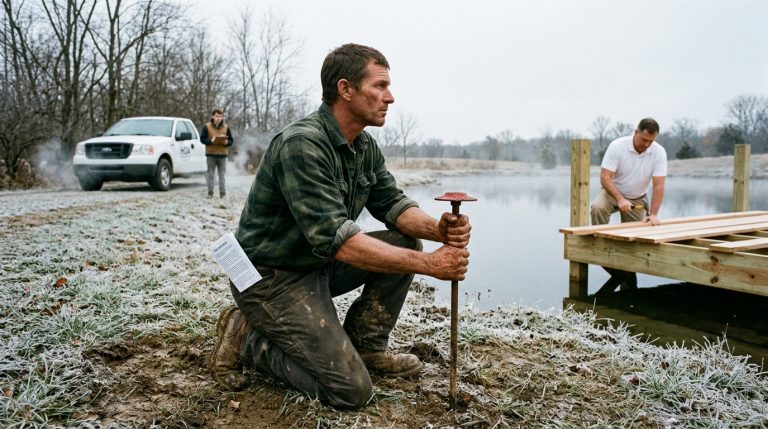
I watched her walk away, and then I turned my eyes toward the silent, floating silver belly of a bass near the dock. A small, familiar plastic vial sat in my fishing vest—an artifact of my old job, always ready for a sample. The game hadn’t started yet, but the board was set. I walked to the edge of the dock and knelt, the wood cold against my knees, and started to gather the evidence that would ultimately tear her life apart.
The smell of the chemicals intensified, a sharp, stinging reminder of the war she had just declared. As I corked the sample bottle, I realized the water beneath the dock was already beginning to draw down, pulled by the hunger of the underground springs that fed every house in this subdivision. Including hers.
CHAPTER 2: The Paper Trail
The sample vial, small and clear, sat on the workbench like a beacon of cold, scientific certainty. I didn’t look at the lake again. I didn’t need to. I had the truth in the glass. The metallic scent still clung to my fingers, a reminder that Sandra Kirkpatrick hadn’t just vandalized a pond—she had initiated a process that, by law of physics, had to go somewhere. And the “somewhere” for Pinehaven was the complex, invisible map of the limestone aquifer.
I locked the shed, the latch clicking with a finality that felt like shifting into a new gear. My truck hummed to life, the engine a steady, grounding vibration as I navigated the winding roads of Pinehaven. The subdivision looked the same as it had yesterday, but the silence between the houses felt different now. It was the silence of a hidden clock ticking.
The county courthouse was a three-story block of brutalist concrete, a place where reality was defined by ink and seal, not by Instagram filters. I parked in the back, away from the sleek, late-model SUVs, and walked through the heavy glass doors. The air inside smelled of dust and ancient, decaying paper—the scent of history, the only thing that could kill a rumor.
I went straight to the clerk’s office. I didn’t need to ask where the plat maps were; I knew the routine. Thirty years of monitoring municipal compliance had hardwired the process into my muscles. Request form, copy fee, wait time, index search.
The clerk, a woman named Miller who had been there since the early nineties, looked up over her spectacles. “Pinehaven, Dale? That’s quite a stack.”
“I have the time,” I said, my voice steady. I didn’t elaborate.
When the box arrived, it was heavy, the documents yellowed at the edges. I laid them out on the expansive wooden table in the archive room. There it was: the 1987 Original Plat. It was a beautiful piece of engineering, detailed and deliberate. I traced the property lines with a calloused finger, noting the specific codicils regarding water rights.
Most people in the subdivision lived under the delusion that the HOA president was the monarch of the estate. They saw her authority as absolute because they never read the foundational documents. But there, in plain, dense legal prose, was the truth: Lake rights and water access shall remain with lot 47 in perpetuity, including all fishing, boating, and recreational privileges.
It was a beautiful, iron-clad sentence. It stripped away Sandra’s mandate piece by piece. She wasn’t managing a common space; she was encroaching on a private one.
But it was the environmental impact study attached to the 1987 filing that caused my pulse to quicken. I turned the page, my eyes scanning the technical notes. The study highlighted the “karst topography”—the limestone foundation of the subdivision. It explained, in dry, clinical detail, how the lake acted as the primary recharge basin for the entire local well-water system.
The weight of it was immediate. I sat back, the chair groaning under me. The lake wasn’t a decorative bowl. It was the heart of the circulatory system. If Sandra poisoned the lake, she didn’t just kill fish; she pushed that poison directly into the intake pipes of forty-seven households.
My blood sugar spike was a subtle, creeping ache behind my eyes—a warning. I took a slow, calculated breath and reached for my medication. Sandra was playing a game of aesthetics, oblivious to the fact that she was playing with the lifeblood of the community. She was essentially pumping chemical waste into her own plumbing.
I spent the next two hours photographing every page, the flash of the camera a rhythmic pulse in the quiet room. I cataloged the bylaws, the survey maps, and the environmental mandates. I was building an arsenal. I wasn’t just here to prove she was wrong; I was here to prove that her “upgrades” were legally, and potentially federally, criminal.
As I packed my notes, a thought flickered in the back of my mind—a memory of Sarah. We had sat on this very dock in the early days, before the cancer, when the world felt simple. She had once told me that water remembers everything. I hadn’t understood it then. Looking at the legal maps now, with the chemical sample vial weighing down my pocket, I understood it perfectly. The water was now the witness.
I walked out of the courthouse, the afternoon sun feeling sharper, more unforgiving. I had the facts, and for a man with my background, facts were the only currency that mattered. I started the engine and headed home. The war wasn’t just about my dock anymore. It was about the fact that forty-seven families were about to find out exactly who their HOA president was, and the cost of her vanity was about to come due. The road back to Pinehaven felt longer, the air thick with the quiet, inevitable approach of the reckoning. I wasn’t going to storm the HOA gates with anger; I was going to dismantle them with the cold, hard weight of documented truth.
CHAPTER 3: The Unveiling of the Deed
The air inside the Pinehaven Community Center was thick, recycled, and aggressively scented with high-end vanilla candles. It was a suffocating, manufactured aroma that hit me the moment I pushed through the heavy double doors, a stark contrast to the sharp, bracing scent of the afternoon air outside. The room was already buzzing with the low-frequency hum of neighborhood gossip, a sound I had learned to translate into nervous energy and whispered allegiances.
Sandra had done her homework on the aesthetics. She had arranged the folding chairs in a rigid, theater-style configuration, forcing every resident to face the front where a sleek, expensive-looking projector screen dominated the room. She was standing by the podium, checking her laptop, her expression one of practiced, corporate serenity. She looked like a woman who had already won a game no one else knew they were playing.
I didn’t take a seat. I didn’t want the comfort. I stayed near the back, the hard leather strap of my briefcase cutting into my shoulder—the only weight that mattered. Inside, the photocopies from the courthouse were tucked into a thick, manila folder. They were my gravity.
As the clock ticked toward 7:00 p.m., the room hit capacity. Neighbors shuffled in, the younger families—the ones who moved here for the “values” and the “subdivision prestige”—clustering near the front. The old-timers, the people who remembered the 1987 covenants and the true nature of the spring-fed lake, stayed toward the periphery, their faces tight with the familiar weariness of watching someone try to reinvent a wheel that didn’t need changing.
Sandra tapped the microphone. The feedback shrieked, a sharp, piercing sound that made the room go deathly silent.
“Good evening, everyone,” she started, her voice smooth, calibrated for maximum persuasion. “Thank you for being here. Tonight is about growth. About realizing the full potential of Pinehaven.”
She began her presentation. It was a masterclass in deflection. She displayed gorgeous, high-resolution before-and-after mock-ups of a decorative fountain, the water photoshopped to an impossible, crystalline blue. She talked about “aesthetic harmonization” and “recreational safety guidelines” as if she were unveiling a public park, completely ignoring the fact that the lake was a living, breathing component of a two-hundred-year-old water system.
“We have received reports of… outdated recreational activities,” she continued, her gaze sweeping the room before landing briefly, dismissively, on me. “Activities that compromise the beauty of our property and our status as a premium subdivision. We are proposing a formal ban on unauthorized fishing, to be strictly enforced by the committee.”
The room murmured—a mix of hesitant agreement and bewildered silence. I felt the heat rising in my chest, not the erratic, spiking heat of a glucose swing, but the slow, focused burn of a man who had spent thirty years watching water chemistry and knew exactly what happens when you introduce a pollutant into a system that isn’t built to handle it.
I stepped forward. I didn’t shout. I didn’t need to. I walked toward the front, the silence in the room thickening with every footfall. Sandra paused, her smile faltering for a split second before she regained her corporate posture.
“Dale, we’re in the middle of a presentation,” she said, her voice dropping to a sharp, transactional register.
“This isn’t a presentation, Sandra,” I replied, my voice steady, carrying easily across the hushed room. “It’s an eviction of reality.”
I reached the front and cleared a space on her carefully curated coffee table, the one she used for her water, her sanitizer, and her clipboard. I opened the briefcase. The papers were crisp, their legal authority radiating from the black ink. I spread the original 1987 plat map across the table, the old lines clearly delineating the water rights that had been legally tethered to Lot 47 since before Pinehaven was even paved.
“You’re talking about bylaws and aesthetic guidelines,” I said, pointing to the original covenant, the ink still bold and defiant after all these decades. “But you’re ignoring the foundation. These aren’t just suggestions. They’re the legal terms of this entire subdivision’s existence.”
I looked up, meeting her eyes. For the first time, I saw it—the flash of genuine irritation that lay beneath the corporate veneer. She wasn’t just a president defending a policy; she was an architect who had just realized her blueprints were drawn on sand.
“You don’t have the authority to manage this lake,” I continued, turning to the room, watching the faces of the old-timers who were leaning forward, their eyes widening as they recognized the documents. “And more importantly, you don’t have the legal right to ban anyone from a resource that was specifically protected for this community’s longevity. This lake belongs to the land, not the HOA board.”
The room was electric now. The vanilla scent of the candles seemed to vanish, replaced by the tension of a thousand unspoken questions. Sandra’s committee members exchanged nervous glances, the kind that spoke of investments and property values being threatened by the one thing they couldn’t control: the truth.
I wasn’t done, but I knew when to stop pushing. I had planted the seed. I had shifted the architecture of the conversation. Sandra gripped the edges of her podium, her knuckles turning white, her carefully constructed illusion of total control fraying at the edges. She tried to smile, but it looked more like a grimace.
“That’s enough, Dale,” she said, though her voice lacked the previous authority. “We will address these… personal grievances later.”
“They aren’t grievances, Sandra,” I said, closing my briefcase with a soft, final thud. “They’re facts. And the water doesn’t care about your bylaws.”
I turned and walked back toward the door, leaving her standing there with her frozen fountain and her fading authority. The room remained silent as I left, the atmosphere heavy with the weight of what I had just dropped into their laps. I didn’t look back, but I could feel the eyes of the neighborhood on my back. The game had changed, and for the first time, the board was mine.
CHAPTER 4: The Imposter
The air outside the community center was crisp, carrying the scent of damp earth and the faint, lingering metallic tang that had haunted the lake since Sandra’s first chemical dump. I didn’t head straight for my truck. Instead, I stood in the shadow of the brick entryway, the adrenaline of the meeting slowly settling into a cold, focused clarity. My briefcase was lighter now, the documents having done their work, but the burden of what remained—the true, silent, and potentially lethal threat of the limestone aquifer—weighed more than ever.
As I watched, a nondescript white pickup truck, its bed cluttered with plastic buckets and telescopic poles, pulled slowly toward the entrance of the subdivision’s maintenance path. It slowed to a crawl near the gatehouse. The lettering on the side was peeling, the blue ink faded by relentless sun: “Aquatic Solutions Professional.”
I didn’t blink. I moved toward my truck, keeping to the edge of the asphalt, my footsteps swallowed by the shadows. I had seen the name on Sandra’s initial list of “consultants.” I had expected a suit, a man with a PhD and a portfolio of environmental impact studies. Seeing this—a beat-up work truck that looked like it had been pulling double duty at suburban pools all afternoon—was a physical punch to the gut.
I started my engine and pulled out, keeping a distance of two lengths. The truck wound through the streets of Pinehaven, eventually cutting toward the edge of the lake’s perimeter, near the spot where the old service dock sat. My hands tightened on the steering wheel, my knuckles white. This was the theater of her “professional management.” She was outsourcing the poisoning of the community to someone whose only experience with “aquatic solutions” was balancing chlorine levels in backyard play-pools.
The truck stopped near the boat launch. A man stepped out—Kyle, if I remembered the name from the initial HOA documents. He looked barely out of his twenties, wearing a stained polo shirt and carrying a clipboard that looked suspiciously like a logbook for residential service calls. He didn’t look like a scientist. He didn’t look like a man tasked with evaluating the health of a two-hundred-year-old aquifer. He looked like a guy who was just trying to finish his route before dinner.
I pulled over behind a hedge, my vantage point perfect. I watched as he pulled a plastic strip from his pocket, dipped it into the water, and held it up to the dying light of the day. He didn’t use a pipette, didn’t record a water temperature, and didn’t even look at the shoreline vegetation for signs of chemical distress. He just scribbled something on his clipboard, checked his watch, and went back to his truck to pull out a heavy, plastic-wrapped gallon jug.
The movement was casual—too casual. He was going to add more. He was going to tip the balance even further, unaware that he wasn’t treating a pond, but poisoning a city’s worth of plumbing.
I stepped out of my truck, my movements deliberate. I didn’t wait to see him reach for the jug. I walked straight down the service path, the crunch of gravel beneath my boots signaling my presence. Kyle jumped, his hand freezing over the open bed of his truck.
“You’re not a scientist,” I said, my voice cutting through the stillness of the evening.
He blinked, his eyes shifting from me to the lake and back. “Who are you? This is HOA property. I’m just doing the maintenance route.”
“Maintenance,” I repeated, the word tasting like ash. I kept my posture relaxed but dominant, the way I used to stand when auditing a treatment plant facility. “That strip in your hand is for pH and chlorine. You’re trying to measure a spring-fed ecosystem with a pool-cleaning kit. Do you have any idea what’s actually in this water, or do you just dump whatever Sandra tells you to?”
He looked defensive, his shoulders squaring. “Mrs. Kirkpatrick pays for a service. My company has the contract. If there’s an issue, talk to the board.”
“I don’t need to talk to the board,” I said, moving closer, my eyes locking onto his. “I need you to look at the water. Look at the edges, Kyle. Look at the lack of movement in the shallows. This isn’t a pool. This is the source for forty-seven wells. Every gallon you add, every ‘adjustment’ you make based on a pool strip, is being drawn into the taps of families three hundred yards from here.”
He hesitated. For a moment, the bravado dropped, and I saw something else—uncertainty. He looked at the lake, really looked at it, perhaps for the first time. The green tint was unmistakable, a sickly, unnatural shade that no healthy body of water should ever possess.
“She said it was just algae,” he muttered, but his grip on the gallon jug had loosened.
“She’s a real estate agent, not a biologist,” I said, my voice softer now, dangerous in its calm. “And you’re going to be the one on the hook when the EPA finishes their investigation. Do you want to be the guy who ‘serviced’ this lake, or the guy who stopped the bleeding?”
I reached into my pocket and pulled out the small, empty sample vial—the one I’d taken that morning. I didn’t need to show him the contents; I needed him to see the gravity of the documentation I was already building. The game had moved beyond bylaws and board meetings. This was now about liability, and I knew exactly how to make the prospect of federal investigation outweigh Sandra’s service fee.
He stood there for a long moment, the jug of poison heavy in his hand, the wind whipping off the water and carrying the scent of chemical death. He wasn’t the enemy—he was just a tool, and tools can be turned. The silence stretched, filled only by the distant, mocking sound of a neighbor’s sprinklers turning on—an irony that was not lost on me, as those sprinklers were likely drawing from the very contaminated source he was currently standing over.
CHAPTER 5: The Hidden Flow
I didn’t head straight home. Instead, I drove the perimeter of the Pinehaven grid, my eyes tracing the invisible lines of the limestone channels I had mapped at the courthouse. It was a mental exercise in physics: if the lake was the recharge point, then the wells were the intake valves. The water didn’t care about Sandra’s property lines or her Instagram-ready fountains; it followed the path of least resistance through the porous, fractured stone beneath our feet.
As I idled near the Patterson place, I noticed the garden. Mrs. Patterson was out front, holding a garden hose, but she wasn’t watering the flowerbeds. She was staring at a patch of yellowed, wilting azaleas, the leaves curled and spotted as if burnt from the inside out. Her face was tight, drawn into lines of quiet frustration that went beyond simple gardening woes.
I killed the engine and stepped out. The air here, closer to the mid-subdivision cluster, felt even heavier with the scent of stagnant, chemical-touched water.
“Drought’s been tough on them, hasn’t it?” I asked, keeping my voice neutral, neighborly.
Mrs. Patterson turned, and the look of surprise softened into something more guarded. “It’s not the drought, Dale. I’ve tried everything. Flushing the soil, changing the fertilizer… nothing works. And the water itself—” she gestured to the outdoor spigot “—it’s been tasting like copper. I called the utility office, but they kept telling me we’re on private wells, that it’s not their problem.”
“It’s not the utility’s problem,” I said, the words heavy. “It’s the lake’s.”
I stood there for a moment, the weight of the reality settling in. She didn’t know yet. None of them really knew. They were still treating this as a nuisance, a temporary inconvenience caused by a nosy HOA president with a grudge against a fishing rod. They weren’t seeing the system. I thought about the wellheads, the narrow, deep columns of steel and PVC extending down into the aquifer, drawing up the very water Sandra had been “treating” all morning.
The realization was a sharp, cold spike in my chest. This wasn’t just my dock, my boat, or my memories anymore. It was the coffee Mrs. Patterson was brewing, the bath she was giving her grandchildren, the ice she was putting in their drinks. The chemical contamination wasn’t a localized event—it was a circulating, cumulative cycle.
I left her there, my heart heavy with the secret I was carrying. I didn’t want to be the harbinger of this. I just wanted my peace back. But the “consequence loop” of Sandra’s actions had already engaged, and it was spinning faster than any of us could stop.
I drove further, tracing the path toward the Asher residence. The sight that greeted me there pushed the last of my patience aside. A small gathering was happening on the driveway—a group of parents huddled together, looking at a young girl whose arms were covered in a bright, angry-looking rash. I pulled over. This was the Asher family, the ones who had been most vocal about the “safety concerns” Sandra had manufactured.
“It’s just an allergy, they keep saying,” Mr. Asher said, his voice raw, jagged with exhaustion. “But it won’t go away. We’ve stopped using the soaps, stopped the new detergent, everything. It started right around the time the water began smelling like metal.”
I walked over, my movements slow, calculated. I didn’t need to see the medical charts; I had seen the lab results from the samples I had taken. I had seen how the copper sulfate interacted with the local mineral content, creating a caustic, reactive compound that would be hell on sensitive skin.
“It’s not an allergy,” I said, my voice barely above a whisper. The silence that followed was total, save for the hum of a distant lawnmower.
“What are you talking about?” Mr. Asher asked, his eyes narrowing.
“The lake,” I said, pointing toward the direction of the water, though it was hidden behind a row of manicured hedges. “Sandra hasn’t been cleaning it. She’s been poisoning it. And because of the way this subdivision is built, that poison is being pumped directly into your home. Into your daughter’s bath.”
The look on his face shifted—from frustration to confusion, then, as he looked at his daughter, to a terrifying, dawning realization. The logic was so simple, so horrifyingly linear, that it didn’t need an explanation; it only needed to be seen. I saw his gaze move from the girl’s arm to the house, to the tap, to the reality of their living situation.
The conflict wasn’t just escalating; it was folding in on itself. I had come here to document the damage, but now, the damage was documenting itself on the bodies of the people I had lived next to for years. I had to force the next step. I couldn’t wait for the EPA or the slow grind of the county health department anymore. The threshold of tolerance had been crossed.
I pulled out my phone and checked the time. The HOA meeting—the one Sandra was still planning to hold, the one where she intended to cement her control—was only hours away.
“I’m going to the meeting,” I said, meeting Mr. Asher’s eyes. “I’m going to show everyone what’s really happening. I need you to be there. I need you to show them what they’ve been drinking.”
He didn’t answer immediately. He looked down at his daughter, then back at me. He nodded, a slow, grim movement that signaled the end of the neighborhood’s compliance.
I drove away, but the adrenaline was gone, replaced by a cold, grinding determination. The “no-skip” rule was my own personal prison now—I had to witness every step of this, every bit of damage, every broken promise. I checked the rear-view mirror. The neighborhood looked clean, polished, and perfectly ordered. It was a facade. And tonight, at the meeting, I was going to strip the paint off the whole damn thing.
CHAPTER 6: The Invisible Crisis
The drive back toward the center of the subdivision felt different than it had an hour ago. Every house I passed—the manicured lawns, the pristine driveways, the quiet, suburban luxury—suddenly looked like a staging ground. I was no longer a lone observer gathering documentation; I was now the conduit for a truth that was about to shatter the neighborhood’s carefully curated peace. The radio was silent, but the hum of the truck’s tires against the asphalt sounded like a countdown.
I turned the corner and saw it: a cluster of service vehicles near the subdivision’s main irrigation pump. It wasn’t the pool maintenance truck this time. It was a local private utility van, the kind that did well-drilling and pump diagnostics. Sandra was clearly doubling down, trying to “fix” the taste issues and the discoloration without ever admitting that her chemical treatments had anything to do with it. She was treating the symptoms of the infection while ignoring the pathogen entirely.
I pulled over again, keeping my distance. I watched as a technician, a man in a grease-stained jumpsuit, hooked a pressure gauge to the main intake pipe. He looked confused, scratching his head as he tapped the dial. It was clear from his posture—the way he kept looking at the gauge, then at the pipe, then back at the dial—that he was seeing something that didn’t match the standard operation parameters. He was seeing the chemical precipitate, the copper buildup that had been hardening inside the pipes for months, choking the flow.
I didn’t need to intercept him. The evidence was right there on his gauge. I just needed to wait.
My phone vibrated in my pocket. A text from Mr. Asher: Neighbors are talking. People are starting to ask why the water’s off for “maintenance” again. What do I tell them?
I typed a reply, my thumbs steady despite the cold, sharp clarity flooding my mind. Tell them to keep their taps closed. Do not drink it. Do not wash with it. The water is compromised.
I felt a ghost of Sarah’s touch on my arm—a phantom sensation, a trick of the nerves. I had spent twenty years in water treatment, and I had seen contamination before. I had seen what happened when a facility cut corners, when a supervisor decided that “good enough” was an acceptable standard for safety. But this was different. This was personal. This was a slow-motion catastrophe happening in the kitchens and bathrooms of people who trusted their HOA president to look after their property values. They were paying for their own poisoning, one monthly assessment at a time.
I watched the technician pack up his gear. He didn’t look like he had found anything definitive, just another “anomaly” to be written off as system age or pipe degradation. He climbed into his van and pulled away, leaving behind a neighborhood that was blissfully unaware of the silent, metallic threat flowing through their veins.
I started my own truck and followed him, not to stop him, but to see where he went next. He didn’t head for the utility hub; he headed for Sandra’s house.
I parked at the end of the block and watched. Sandra was waiting on the porch, her posture rigid. As the technician spoke to her, she didn’t look like a woman who was concerned about a mechanical issue. She looked like a commander receiving a report from the front lines, her face a mask of determined, brittle arrogance. She was in deep, and she was terrified—but her terror wasn’t the healthy kind, the kind that forced a person to stop and look at their mistakes. Her fear was the kind that made her fight harder to protect the lie.
She gestured toward the lake—a sharp, imperious movement of her hand. She was blaming the system, blaming the old pipes, blaming the water quality, blaming anything but the bag of copper sulfate she had dumped into the water herself.
The weight of it was stifling. I looked at the house—the biggest one on the block, the pride of the Pinehaven Property Values Initiative—and realized that Sandra wasn’t just losing control. She was being consumed by it. She had turned the entire subdivision into a laboratory for her own hubris, and the experiment was failing.
I backed away, putting the truck in gear and slowly rolling down the street. I didn’t need to confront her. Not yet. I had the documents. I had the neighbors. And now, I had the visual proof of her continued, active denial. The meeting was in less than an hour. The room would be packed. And when the truth came out, it wouldn’t be just a legal argument anymore. It would be a reckoning.
I felt a strange, cold calm settling over me. I wasn’t the villain in this story, despite what the rumors said. I wasn’t the one being unreasonable. I was the only one paying attention to the physics of the system. And in a world built on water, the physics always win.
I turned the corner toward the community center, the lights of the building glowing in the distance like a signal fire. I wasn’t going back there to argue. I was going back to end this.
CHAPTER 7: The Final Treatment
The parking lot was already filling up when I arrived, a bizarre spectacle of suburban optimism. Brightly colored streamers were being strung up between the parking lot lights, and a catering van was unloading trays of potato salad and sliders. It was the annual summer pool party, the kind of event that usually signaled the peak of neighborhood unity. Tonight, it felt like a funeral wake for a death that hadn’t quite happened yet.
I adjusted my grip on the briefcase and walked toward the entrance. My boots crunched against the gravel, the sound muffled by the upbeat pop music blaring from a portable speaker near the catering setup. Sandra was everywhere, moving through the crowd with the frantic, high-intensity energy of a woman who was trying to outrun her own shadow. She looked vibrant, almost feverish, her designer dress sharp against the humid night air, but I saw the telltale signs—the way her hands trembled when she reached for a stack of napkins, the way her eyes darted to the entrance every time a new car pulled into the lot.
I didn’t stop for the pleasantries. I ignored the neighbors who tried to wave me over, ignored the music, and focused entirely on the double doors of the community hall. This was where the HOA meeting was set to commence—the stage Sandra had built for her grand finale.
Inside, the room was stifling. Sandra had set up a new projection screen, larger than the last, and the room was packed with nearly seventy residents, more than I had ever seen at an HOA function. They were here for the party, sure, but they were also here for the answers—the quiet, gnawing anxiety about their dry lawns and their sick children having finally reached a breaking point.
As I took my seat in the back, the door opened one more time. Agent Rodriguez and the EPA team were waiting in the shadows of the vestibule, their presence marked only by the subtle, tactical stillness of their stance. They were the silent audience for what was to come.
Sandra took the podium at exactly 7:00 p.m., her smile tight and brittle. “Welcome, everyone,” she started, her voice amplified by the room’s acoustics. “Tonight, we move past the negativity. We focus on the future. The fountain project is officially cleared for commencement tomorrow morning.”
A murmur rippled through the crowd. I stood up. The movement was slow, deliberate, the sound of my chair scraping against the concrete floor cutting through the music in the hallway like a blade. All eyes turned toward me. Sandra’s smile didn’t just fail; it vanished, replaced by a look of sharp, visceral hostility.
“Dale, I told you—”
“You told me a lot of things, Sandra,” I said, my voice steady, projecting to every corner of the room. I walked to the front, the briefcase heavy against my side. I didn’t reach for the microphone. I reached for the light switch. The room plunged into darkness, save for the blue, shimmering light of the projector.
I didn’t play her slides. I played mine. I had spent the afternoon refining the visualization—the red, pulsing map of the limestone aquifer, the data points showing the concentration of copper sulfate, and the correlation charts that laid out the last eight months of “maintenance” against the medical records of the subdivision’s children.
The room erupted. It wasn’t the sound of confusion; it was the sound of recognition. Mr. Asher stood up, his face pale, his voice trembling as he pointed to the screen. “Is that… is that the path to our well?”
“Yes,” I said, the word hitting the room with the force of a hammer. “And that red line? That’s the copper concentrate from this morning’s treatment. It’s moving through the limestone channels right now. It’s not in the pond anymore, Sandra. It’s in the taps.”
Sandra bolted from the podium, her hands scrambling for the laptop. “That’s a lie! That’s manipulation! He’s trying to sabotage the property value—”
“Stop,” a voice boomed from the back of the room. Agent Rodriguez stepped into the light, his badge glinting. The music in the hall outside had stopped, leaving a silence so profound it felt as though the oxygen had been sucked out of the room.
Sandra stood frozen, her hand hovering over the keyboard, her eyes darting to the EPA agents as they closed the distance. The room was a tableau of shock. Parents were standing, staring at the screen, at the map, at the reality of their own poisoning. I watched the color drain from Sandra’s face. She finally looked at the screen—really looked at it—and I saw the moment the delusion broke. She saw the house in the center of the red zone. She saw the house where her own daughter slept.
The fight left her in a single, ragged exhale. She sank against the table, her hands covering her face, the polished facade of the HOA president dissolving into the tremors of a woman who had just realized she had been the architect of her own family’s ruin. The “final treatment” she had so proudly carried out this morning wasn’t a renovation; it was a confession.
I didn’t feel the triumph I had expected. I only felt the cold, hard weight of the truth. I stood there, watching the chaos unfold, the agents approaching her with the quiet, professional efficiency of men doing a necessary job. The party was over. The neighborhood was awake. And the water—the cold, silent, indifferent water—continued to move beneath us, carrying the price of our ignorance into the night.
CHAPTER 8: The Aftermath and the Clearing
The room didn’t empty immediately. It fractured. Small groups of neighbors huddled together, their voices low and sharp, the collective anger giving way to a sickening, confused dread. I stayed near the back, my hands shoved deep into my pockets, feeling the empty space where the legal files had been.
Sandra was gone. They had taken her through the side exit, away from the prying eyes of the remaining pool party guests who were just now realizing that the music had stopped and the “community leader” was being escorted to a federal cruiser. The silence in the hall felt heavy, dense with the realization that the water we had all trusted—the water that had bathed our children and filled our coffee pots—had been transformed by a woman’s vanity into a source of slow, methodical sickness.
I looked toward the front, where the projection screen still flickered with the last of the data. The red lines of the aquifer map glowed in the dim light, a stark, arterial representation of the poison I had spent months chasing.
“Dale?”
I turned. Mr. Asher was standing there, his daughter clutched to his side. The rash on her arm looked even angrier under the harsh interior lights of the community center. He wasn’t looking at me with the suspicion he’d held days ago. He looked frightened, and more importantly, he looked small.
“What happens now?” he asked.
“Now?” I looked around the room, at the faces of people who had been my neighbors for decades. “Now, we get the filters installed. We get the health screenings. We get the systems flushed. And we never, ever trust someone who thinks they can improve the earth without understanding how it works.”
He nodded, a jerky, mechanical motion, and turned to lead his daughter out.
The process of the cool-down was slow, a grinding shift of gears that spanned the next few weeks. The EPA teams arrived in force, their yellow tape turning the lake perimeter into a crime scene. I watched from my dock, the early morning light hitting the water—the same light that had once been the start of my sacred time with Sarah. The restoration project was underway. Specialists in biological rehabilitation began the long, tedious process of reintroducing the native bacteria colonies that Sandra’s chemicals had wiped out.
It was strange, seeing the lake—my sanctuary—under such scrutiny. Men in pressurized suits walked the shoreline with long-handled probes, measuring the chemical decay. The stillness was no longer the peaceful quiet I had cherished; it was a clinical, monitored hush.
But with the monitoring came a strange, unexpected peace. A week after the arrest, I found myself on the dock with the old spinning rod. The water was starting to clear. Not fully—it would take months, maybe years, to fully scrub the copper from the limestone—but the fluorescent green hue had faded to a murky, translucent gray.
I saw a turtle break the surface near the submerged pilings—Winston, or one of his kind. He paddled lazily, his shell slick and clean.
I sat down, the wood beneath me still warm from the sun. I pulled a small, rusted wrench from my vest—a tool I’d kept in my shed since we first moved here to fix the dock slats Sarah loved to trip over. I spent the next hour working on the loose plank that had been rattling for three years. I tightened the bolt, the satisfying clink of metal on metal grounding me in the present.
The work of repair was quiet. It wasn’t the explosive, high-stakes combat of the courtroom or the HOA meetings; it was simple, physical labor.
I looked up as the sun began to dip below the tree line. The neighbors were starting to come by again, not to protest or complain, but to ask questions about the wells, about the filtration, about how to help. They were becoming stewards of the system, not just consumers of it.
I thought about Sandra, somewhere in a holding facility, still likely clinging to the idea that she had been wronged, that her vision had been superior to the reality of the earth. I didn’t hate her anymore. She was just another piece of the system that had broken, a gear that hadn’t fit the machinery. She had been defeated by the very things she refused to study: the law, the chemistry, and the quiet, persistent nature of the land.
I finished the last bolt. The dock didn’t rattle when I stood up. It held firm, a solid, steady platform over the water.
I cast my line out, the lure hitting the surface with a soft, natural splash. A bass broke the surface a few feet away—a small, silver flash in the fading light. It was a start.
The air was cooling, the metallic tang finally gone, replaced by the scent of pine and wet, living stone. I let the line drift, feeling the subtle, rhythmic pulse of the water against the lure. The mystery was gone, the truth was out, and the system was healing. I sat in the dusk, watching the light change on the surface, and for the first time in three years, I didn’t feel the need to document anything. I just watched the water move.