Boundaries of Sand and Slag: The Cost of Keeping the Perimeter
CHAPTER 1: THE PERIMETER LINE
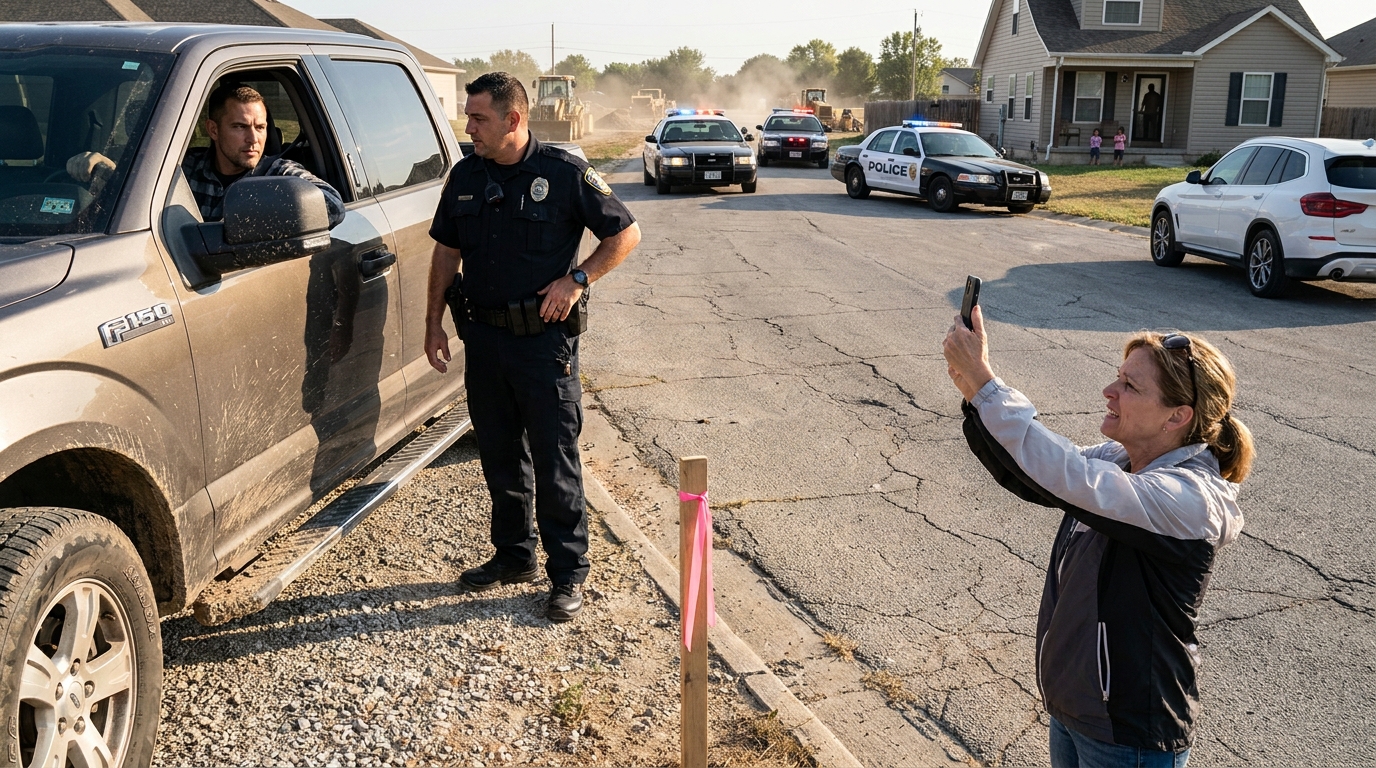
Three patrol cruisers idled across the mouth of my driveway, blocking the F-150 by six inches of crushed limestone. The exhaust fumes mixed with hot asphalt from the county roadwork down the ridge.
I didn’t turn off the diesel engine. The tachometer needle hovered at eight hundred RPM.
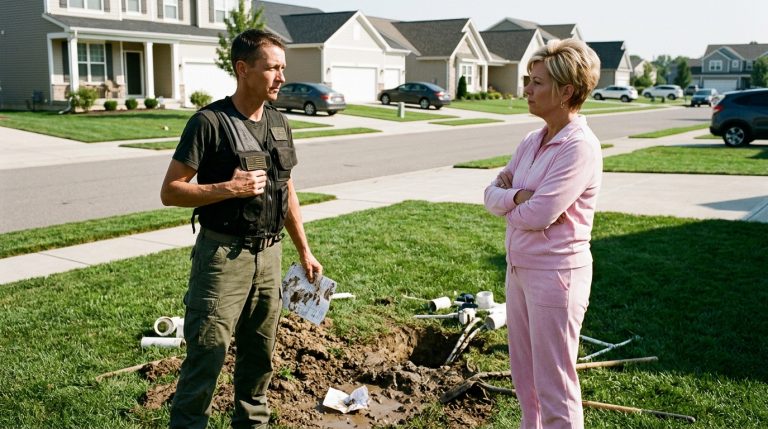
Across the street, Linda Ashford stood behind her white BMW SUV. Her arm stayed lifted, phone held at eye level, camera lens glinting in the late September glare. Her fingers tapped the glass casing.
Officer Martinez stepped out of the lead cruiser. His hand rested flat on his leather duty belt, thumb hooked near the snap of his holster. His eyes hit mine through the windshield, carrying the dull fatigue of a man forced to waste department fuel on a suburban border dispute.
“Colonel,” Martinez said, stopping three feet short of my running board. “Got a call regarding a blockage of the public right-of-way and aggressive vehicle operation.”
I rolled the window down two inches. The cool cab air escaped into the dust. “My tires are four inches inside my property pin, Officer.”
“She says you backed in at a speed intended to intimidate,” he said quietly. He didn’t look back at her. He didn’t have to. “Says the bumper extends over the sidewalk line.”
On the front porch, my ten-year-old twins sat side by side on the top step. Jake held his knees tight to his chest. Emma had her fingers twisted into the strap of her backpack. Behind them, through the screen door, the shadow of my father shifted—seventy-three years old, moving with the heavy, uneven stride of a man whose knees were ruined in the A Shau Valley.
I reached down to the console. My knuckles brushed the heavy brass of my father’s old Zippo—worn smooth on the edges, the hinge slightly loose. I rolled the brass once over my index finger, feeling the cool metal bite into the callus.
“The truck stays where it is, Martinez,” I said. My voice didn’t rise. “It’s on my deed.”
“Marcus,” Martinez muttered, leaning an inch closer so his shoulder mic wouldn’t pick up the low register. “She called dispatch three times. Claimed you were using government equipment to establish a tactical perimeter.”
I glanced across the asphalt. Linda hadn’t moved. The tight, paper-thin smile on her face didn’t reach her eyes. She thought the blue lights meant ownership of the street. She thought three patrol units constituted a victory.
She didn’t know about the manila folder sitting on my desk inside, or the seven HOA notices timestamped over the last ten days. She didn’t know I’d spent twenty-three years reading movement patterns before deciding where to lay an anchor.
“Tell her to check the county survey map,” I said, setting the truck in park with a mechanical clunk that echoed off the dry dirt. “Then tell her to move the BMW. It’s blocking my sightline to the mailbox.”
CHAPTER 2: COLD GEOMETRY
Martinez didn’t argue. He spat a thin streak of tobacco into the limestone dust near my rear tire, turned his back on Linda, and walked back to his cruiser. The three light-bars cut off in unison, leaving the driveway in the gray, flat light of late afternoon.
My boot came off the running board with a soft crunch. Across the asphalt, Linda didn’t lower her phone immediately. She held it steady for five seconds—long enough to log the departure, long enough to make sure I knew it was logged—before slipping it into the pocket of her tailored blazer. She turned on her heel and walked toward her white BMW with the stiff, cadence-driven stride of a drill instructor who knew the recruits were watching.
I cut the F-150’s ignition. The diesel engine shut down with a heavy shudder that rattled the loose tools in the truck bed.
“Dad,” I called out without turning around.
The screen door creaked open. My father stepped out onto the porch, his hand resting on the weathered pine railing. His knuckles were swollen, the skin paper-thin and liver-spotted, but his grip was firm enough to turn the wood pale under his thumbs.
“They’re taking measurements,” he said. His voice was gravel, dry from forty years of cheap tobacco and forty more of silence. He pointed a crooked index finger toward the drainage ditch that ran parallel to the county road. “Two men in yellow vests came through at 1100 hours. They had a transit on a tripod. Placed a wooden stake right by the culvert.”
I walked up the three porch steps, my boots making no sound on the painted wood. “Did they talk to you?”
“I asked for their work order,” Dad said. His eyes, usually clouded with the milky film of his age and the fog that was slowly eating his memories, flashed with a sharp, cold light. “They said county surveyor. But the truck didn’t have county plates. Private tags. Out of El Paso County.”
Jake and Emma hadn’t moved from the top step. Jake’s small hands were tucked into his denim jacket, his face turned toward the ditch. “Is Mrs. Ashford going to make us move the truck every day, Dad?”
“No,” I said. I sat down on the step beside him, leaning my elbows on my knees. The scent of motor oil and cold dirt drifted up from my jeans. “The truck stays where the land says it stays. You two go inside and set the table. Your grandfather needs his dinner at 1800.”
I waited until the screen door clicked shut behind them before I walked to the edge of the lawn.
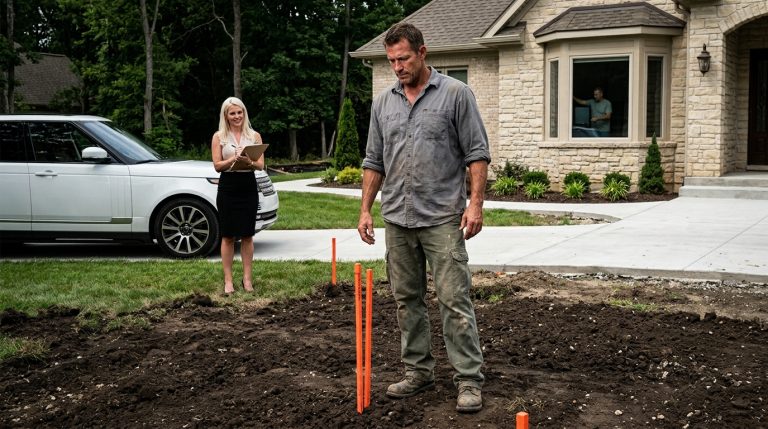
The drainage ditch was dry, filled with dead tumbleweeds and dry prairie grass. Right where the ditch met the corner of my property line, a fresh wooden survey stake stood driven four inches into the hard-packed soil. The top was painted fluorescent orange.
I knelt in the dirt, digging my fingers into the weeds at the base of the stake.
The galvanized steel boundary pin—the one driven eighteen inches deep into the earth by the county surveyor back in 2018—was gone. In its place was a shallow, freshly turned patch of dirt mixed with coarse gray gravel. Someone had dug out the official steel survey pin and replaced it with a temporary wooden marker six inches further inward, cutting half a foot of width off my frontage.
I picked up a handful of the dirt and rubbed it between my thumbs. It was loose, uncompacted. Done within the last twelve hours.
I pulled the brass Zippo from my pocket, flipping the lid open with a sharp, mechanical click that broke the quiet of the street. I didn’t light it. I just held the steel wheel under my thumb, feeling the tension of the spring.
Six inches didn’t matter for a driveway. But six inches along a seven-hundred-foot frontage line altered the easement access for the utility corridor.
My mind mapped the layout of the subdivision automatically—the grid lines, the drainage easements, the two-mile strip of undeveloped brush that separated Maplewood from the northern fence line of Fort Carson.
I stood up, wiping my soil-stained hands on my trousers. Across the street, the second-story blinds in Linda Ashford’s house twitched once.
Inside my house, the kitchen smelled of boiled potatoes and dry toast. My father sat at the oak dining table, a manila folder spread out before him under the overhead yellow lamp. He had his reading glasses perched low on his nose, holding a red ballpoint pen between his index and middle fingers like a cigarette.
“Look at this,” Dad said, tapping the paper.
I walked over and leaned over his shoulder. The document was a printout of the HOA financial ledger for the previous fiscal quarter, something I’d pulled from the public registry three days ago.
“She’s not just issuing citations,” Dad muttered, his finger tracing a column of fine print. “The legal fees are being routed through a third-party management LLC registered in Pueblo. Look at the vendor code.”
The line item read: Vanguard Compliance Systems — Legal Retainer & Boundary Enforcement.
Next to the entry was an internal reference code penned in faint ink: SEC4-ZM-009.
“Sector-4 Zoning Map,” I whispered.
Dad looked up at me, his eyes narrowing. For a second, the fog drifted back across his face—his gaze softened, wandering toward the hallway as if looking for someone who had been dead for twenty years. “The perimeter’s soft, Marcus,” he mumbled, his voice dropping an octave. “We need to check the trip flares on the ridge.”
I laid a heavy hand on his shoulder, feeling the sharp ridge of his collarbone through his flannel shirt. “The perimeter is fine, Dad. Eat your dinner.”
I pulled the ledger toward me, memorizing the reference code before folding the paper and tucking it into my back pocket.
The front doorbell rang—a short, sharp chime that made Jake drop his fork in the kitchen.
I walked to the front door, leaving the latch on as I pulled it open two inches.
Standing on the porch in the gathering dusk was Sergeant First Class Miller, our neighbor from two houses down. He was still in his operational camouflage uniform, his boots dusty, his face lined with the dark circles of a man who’d been on a forty-eight-hour shift at the base logistics depot.
“Marcus,” Miller said, keeping his voice down. “Got a minute?”
I unlatched the door and stepped out onto the porch, closing it behind me. “What’s wrong, Miller?”
Miller reached into his cargo pocket and pulled out an envelope identical to the one I’d received three days ago. “They just served my wife while I was on duty. Notice of Intent to Lien. They’re claiming my utility trailer violates the commercial vehicle covenant.”
“It’s a flatbed,” I said. “You use it for your lawnmower.”
“I know what I use it for,” Miller said, his jaw tightening until the muscle bulged beneath his skin. “They slapped a five-hundred-dollar fine on it, retroactive thirty days. If I don’t clear it by Monday, they report it to the county clerk.” He looked at me, his eyes hard. “Marcus, my deployment orders for Kuwait drop in three weeks. Sarah can’t handle a lien on the house while I’m downrange.”
I looked past Miller toward the street. The streetlights were flickering on, casting long, orange bars of light across the pavement.
“Don’t pay it,” I said.
Miller blinked. “What?”
“Don’t pay a cent,” I repeated, my voice dropping into the quiet, flat tone I used when reviewing tactical overlays before a night push. “Bring me the notice. Bring me every piece of paper they’ve sent you since June.”
“What are you going to do?”
“I’m going to measure the street,” I said, rolling the Zippo over my knuckles in the dark. “Every inch of it.”
CHAPTER 3: THE BUREAUCRATIC TRAP
Miller looked at the white envelope in his palm, his thumb tracing the sharp red ink of the urgency stamp. He didn’t offer a hand, nor did he ask another question. He simply turned, his combat boots heavy against the driveway gravel, and melted back into the shadows between the pine trees separating our lots.
I stayed on the porch until his screen door clicked shut. The cold autumn wind picked up off the prairie, rustling the dry corn stalks in Dad’s garden patch.
Inside, the house was dead silent. The kitchen clock clicked toward 1930. In the living room, Dad was already asleep in his recliner, his jaw slack, his chest rising and falling in shallow, ragged hitches. On the side table next to him sat his purple heart medal in its velvet box, left open beside an unread stack of local notices.
I pulled Miller’s lien document from my pocket, unfolding it under the kitchen bulb.
The letterhead was slick—heavy sixty-pound bond paper with an embossed emblem that mimicked a civic seal. Maplewood Estates Homeowners Association — Special Assessment Division. Beneath the formal rhetoric, the demand was simple: five hundred dollars for an unapproved trailer, or a notice of cloud on title filed with the El Paso County Clerk within five business days.
At the bottom of the second page, in small, twelve-point font, was the filing agent’s designation: Redline Management Services, Suite 400, Commerce Tower.
Redline.
I pulled out my phone, opening the offline database I’d built over three weeks of late-night cross-referencing. I typed in the name. It matched three other filings sent to active-duty families on Maple Court. Each notice carried the exact same timestamp signature, generated from an automated legal mill.
I didn’t call a lawyer. I opened a fresh Excel file on my laptop, created a new tab, and titled it: GATE-THREE PARCEL EASEMENT.
By 2045, the school board public meeting notice printed out on my desk. Linda Ashford wasn’t just sitting on the HOA board; she was listed as the interim chair for the District 11 Facility Advisory Committee. The agenda item for Wednesday evening was innocent enough on the surface: Student Population Stability & Residential Zone Adjustments.
When Wednesday came, the auditorium of Oak Creek Middle School smelled of damp floor wax, cheap floor polish, and old radiators.
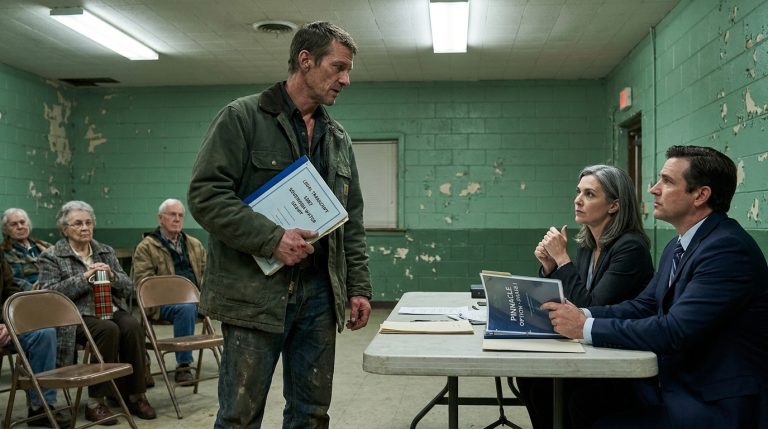
I took a seat in the back row, six feet from the double exit doors. I wore a plain gray flannel shirt and dark denim—no uniform, no military insignia. Across the basketball court floor, forty parents sat on folding metal chairs, their coats draped over their laps.
Linda Ashford sat behind a long oak table on the stage, flanked by two men in dark suits. A microphone stood three inches from her mouth, amplifyng her brisk, clipped breathing across the gym speakers.
“…and so when we evaluate long-term district investment,” Linda was saying, her manicured hand gesturing toward a projector screen showing a bar graph in shades of blue, “we must address the metric of neighborhood cohesion. Families in transient housing arrangements—specifically short-term leaseholders and temporary military reassignments—simply do not yield the same long-term property tax stability as permanent deedholders.”
Beside me, a woman whose husband was currently deployed with the 4th Infantry Division stiffened. Her hand tightened on the strap of her purse until her knuckles turned yellow.
Linda shifted the slide. A map appeared on the screen—a high-resolution aerial overlay of our subdivision, outlined in bright yellow border lines.
“We are proposing a redistricting overlay for Sector-4,” Linda continued, her voice cool, practiced, and rhythmic. “Students residing in non-conforming or high-turnover residential clusters will be rerouted to the Westside Annex starting next term. This ensures our core facilities maintain predictable enrollment metrics for municipal bond ratings.”
I leaned forward, my elbows resting on my knees.
The map on the screen wasn’t a school district boundary map. It was a property parcel breakdown. The highlighted yellow zone didn’t cover the entire subdivision—it specifically traced thirty-two lots along the eastern perimeter, directly abutting the two-mile strip of undeveloped land that led to Fort Carson’s Gate Three.
Every single lot highlighted in yellow belonged to a military family currently facing HOA compliance citations.
I stood up. The metal legs of my folding chair scraped against the hardwood floor with a sharp, screaming screech that cut right through Linda’s sentence.
The auditorium went dead quiet. Forty heads turned toward the back row.
Linda paused, her fingers resting on the slide clicker. “Sir, public comments are reserved for the end of the session. Please remain seated.”
I didn’t move toward the microphone in the aisle. I stayed right where I was, my voice carrying clear and flat across the open rafters.
“Mrs. Ashford,” I said. “Where did you get that aerial map?”
Linda’s eyes narrowed behind her thin-rimmed glasses. “This is standard county planning data, Colonel Hendricks. As I said, public comment—”
“County planning maps don’t list easement buffer designations for federal property,” I interrupted. I took two slow steps down the wooden bleacher stairs, my boots striking the floor with a rhythmic, heavy thud. “That overlay includes the preliminary survey lines for the Gate-Three Parcel expansion. That data hasn’t been released to the public board.”
The man sitting to Linda’s left—a thin, balding operator with a silver lapel pin—subtly reached out and touched her arm. He whispered something into her ear.
Linda’s posture didn’t break, but her throat moved as she swallowed hard. “The board utilizes various commercial consulting services to project land use. That is entirely standard.”
“It’s standard for land speculators,” I said, reaching the foot of the stage. I pulled a folded single-sheet printout from my jacket pocket and laid it flat on the edge of the speaker’s table right in front of her. “It’s not standard for a middle school redistricting committee.”
The paper was a copy of the filing page from the Pueblo Registry—the one listing Vanguard Compliance Systems and its cross-referenced corporate entity, Redline Management.
Linda didn’t look down at the paper. Her eyes stayed locked on mine, two hard chips of ice. “You are out of order, Marcus.”
“The meeting is out of order,” I replied softly, ensuring the microphone three feet away picked up every word. “Because in five minutes, every parent in this room is going to realize that their kids aren’t being moved for test scores. They’re being moved so their houses can be appraised as distressed properties before the commercial buyout.”
A murmur rippled through the front three rows. A man in a field jacket stood up two rows ahead of me.
Linda pressed the button on her microphone, killing the audio with a sharp, static pop. She leaned across the table, her voice dropping into a razor-thin whisper that didn’t travel past the edge of the stage.
“You think you’re protecting your block, Colonel?” she hissed. “Check your front gate. Your father is out on the road again, and he doesn’t know where he is.”
CHAPTER 4: THE SECTOR4 CRACK
My boot struck the bleacher floor once, twice, cracking the thin plywood veneer beneath my weight as I pivoted away from the stage. The double doors of the gymnasium swung wide under the slam of my palm, cold autumn rain hitting my face before the heavy oak doors even clicked against the exterior wall.
I pulled my phone from my pocket while crossing the wet asphalt of the school parking lot. The screen flickered green under the sodium floodlights. Three missed calls from Sergeant Miller. One text timestamped six minutes ago: Dad’s at the drainage ditch. Two guys in high-vis vests are standing over him.
I cleared the perimeter gate on foot, my flannel shirt soaking through within forty seconds.
By the time the F-150’s tires tore into the gravel driveway at 2012 hours, a yellow municipal utility truck sat parked diagonally across my property line, idling hard with its diesel engine clattering like loose nails in a tin bucket. A pair of flashing amber strobes cut rhythmic bars of orange through the dark.
Dad stood in the mud at the ditch line. He wore his old brown corduroy jacket—no hat, his thin white hair plastered flat to his skull by the rain. His hands were stuffed deep into his pockets, his posture stiff as a fence post.
Standing three feet in front of him was a man holding a steel measuring tape and a digital clipboard, wearing a bright yellow vest over a grease-stained canvas jacket.
“I told you, old timer,” the man was saying, his voice loud enough to carry over the idle of the truck engine. “City code authority. We got a report of an unpermitted structural hazard in the easement zone.”
I didn’t turn off the F-150’s lights. The high beams caught both men square in the chest, casting their long shadows clear across the asphalt to Linda’s front yard.
I killed the driver’s side door with a heavy slam that rattled the window frame. “Get off my property,” I said.
The man with the clipboard didn’t flinch, but his eyes cut toward the truck’s front bumper. “Colonel Hendricks? I’m Dave Patterson. Building and Safety inspector for El Paso County. We’re responding to an urgent hazard report filed through the municipal portal.”
“You’re thirty miles outside municipal jurisdiction,” I said, stepping into the mud between Dad and Patterson. The clay sucked at the soles of my boots. “And county building inspectors don’t operate out of an unmarked Ford F-250 with private commercial plates.”
Patterson’s fingers twitched on the frame of his clipboard. His thumb covered a small printed label on the top corner of the tablet housing. “We’re sub-contracted through the Sector-4 Infrastructure Task Force. You have a thirty-foot easement violation starting at your frontage line.”
I reached down, grabbed his clipboard by the top edge, and twisted it forty-five degrees until the high-beam headlights illuminated the small white label he’d been hiding.
Printed in black dot-matrix ink was the asset tracking code: PROPERTY OF VANGUARD COMPLIANCE — REDLINE LEDGER ID: 09-G3P.
Redline Ledger. Gate-Three Parcel.
“Who gave you this asset list, Patterson?” I asked, my voice dropping into a register so low it was almost lost beneath the engine rattle.
Patterson tried to pull the tablet back, but my grip on the casing didn’t yield an inch. The plastic creaked under the pressure of my thumb. “It’s a public work order,” he stammered, his posture shrinking two inches into his collar. “We were given a list of parcels requiring immediate setback audits before the zoning board meeting next Tuesday.”
“Who gave you the list?”
“The chair,” Patterson blurted out, his eyes darting toward Linda’s house across the street. “Mrs. Ashford’s office emailed the site package at 1600 hours today. She said the base requested an emergency boundary verification for the Gate-Three expansion.”
Beside me, Dad shifted his weight, his old corduroy sleeve brushing mine. His thumb was working the seam of his pocket, rubbing the fabric raw, but his eyes were clear. “He’s lying, Marcus,” Dad said softly. “The base doesn’t do boundary audits through Pueblo. They use the Corps of Engineers out of Omaha.”
Patterson’s jaw went slack. He looked from Dad to me, the color draining out of his face under the yellow glare of the amber strobe.
“My father’s right,” I said, letting go of the clipboard. Patterson stumbled back half a step into the wet weeds. “The Corps of Engineers handles federal boundary lines. Which means Linda Ashford didn’t get this map from the city. She got it from someone inside the base procurement office.”
I turned my back on Patterson, taking Dad by the elbow. His arm was cold through the damp corduroy, but his frame was steady.
“Go inside, Dad,” I said quietly. “Jake and Emma are waiting.”
Dad nodded once, turning toward the porch steps without a word.
I didn’t go inside. I walked around the rear of the municipal truck, my boots leaving deep prints in the wet earth. On the passenger side dashboard, partially covered by an empty paper coffee cup, sat a blue-backed ledger binder.
Printed across the spine in gold foil block letters was the title: Sector-4 Zoning Map & Redline Ledger — Gate-Three Parcel Acquisition Schedule.
Layer 1 was gone. This wasn’t a bitter HOA officer using minor violations to settle a neighborhood grudge or pad a local legal account. The citations, the school board redistricting, the fake building inspections—they were all part of a systematic land-clearing operation designed to force military families into default before the federal government finalized the purchase of the Gate-Three corridor.
And Linda Ashford was just the field coordinator holding the clipboards.
I reached through the open passenger window, took the blue ledger off the dash, and walked back to my truck.
Patterson didn’t move to stop me. He scrambled into the driver’s seat of his utility truck, threw the transmission into reverse, and backed out onto the county road so fast his rear tires threw wet gravel twenty feet into the air.
I sat in the cab of the F-150, the blue ledger resting on my lap under the dim interior dome light. I opened the cover.
On page three, listed under the primary stakeholders for the Vanguard holding company, was a signature I recognised from seven years of garrison operations.
Not a civilian name. A military staff officer’s mark.
CHAPTER 5: LEVERAGED ASSETS
The signature at the bottom of the Vanguard holding agreement was written in black fountain ink—a thick, sloping capital V followed by the tight, jagged tail of a man who’d spent twenty years signing requisitions.
Major Victor Vance. Chief Procurement Officer, Logistics Directorate, Fort Carson.
I sat in the idling cab, my thumb tracing the embossed seal beside his name. The paper was dry, crisp, and cold. Outside, the rain had turned into a fine prairie sleet, ticking against the windshield with the sound of thrown sand.
Vance wasn’t a land speculator. He was the officer who approved base boundary realignments. Every time the garrison expanded its northern perimeter, Vance’s office drafted the preliminary land appraisal before sending the acquisition file to the Department of the Army.
He had access to the Sector-4 Zoning Map before the county clerk ever stamped it. He knew exactly which private parcels sat in the path of the Gate-Three expansion two years before the funding was appropriated.
And Linda Ashford’s Vanguard LLC was the private broom sweeping the perimeter clean—using fines, liens, and school redistricting pressure to force military homeowners to sell at sixty cents on the dollar before Vance’s office cut the government checks.
My phone vibrated on the passenger seat, jumping two inches across the leather console.
I picked it up without taking my eyes off Vance’s signature. “Hendricks.”
“Marcus,” Miller’s voice came through, thin and distorted by the storm interference. “We got a problem on Maple Court. Two tow trucks just pulled up in front of Bailey’s house. They’ve got a private impound warrant from the county deputy.”
“On what grounds?” I asked, my fingers closing around the blue ledger’s spine.
“Unauthorized commercial vehicle storage,” Miller said, his breathing hard, erratic. “Lieutenant Bailey’s deployed in Poland, Marcus. His wife is inside with two toddlers, and these guys are wrapping chains around his dually right now. They brought a off-duty deputy to sign off on the asset seizure.”
“Tell her not to unlock the door,” I said, setting the truck in gear. “I’m five minutes out.”
I didn’t turn on my high beams when I pulled onto Maple Court. The street was dark, save for the flashing red and blue strobe of a single unmarked squad car parked across Bailey’s lawn. A flatbed tow truck was backed up to the driveway, its steel winch cable humming as it pulled taught against the front axle of Bailey’s diesel pickup.
An off-duty county deputy stood on the sidewalk, holding a clipboard and a heavy flash light. Next to him, wearing a dark wool overcoat against the sleet, stood Major Victor Vance.
Vance was holding a paper cup of coffee, his polished leather shoes stepping carefully around the mud puddles at the curb. He looked like an executive inspecting a construction site—calm, detached, completely at home in the dark.
I parked the F-150 across the mouth of the driveway, cutting the engine. The silence that followed was heavy, broken only by the hydraulic whine of the tow truck’s lift arm.
I stepped out, the blue ledger tucked under my arm, and walked straight toward the winch controls.
“Colonel Hendricks,” Vance said, his voice smooth, unhurried. He didn’t take his hand out of his coat pocket. “This is a civil enforcement matter. I suggest you return to your residence.”
I reached the tow truck operator—a burly kid in a grease-stained hoodie—and laid my palm flat over the hydraulic lever, locking it in neutral. The winch stopped with a metallic clunk.
“Hey!” the operator yelled, taking a step back. “Touch that again and—”
“Quiet,” I said, not looking at him. My eyes stayed locked on Vance. “Major Vance. Does the Garrison Commander know you’re conducting private asset seizures during off-duty hours?”
Vance took a slow sip of his coffee, the steam rising between us in the freezing air. “I’m here as a private representative of the Redline Management Group, Colonel. The property owner defaulted on three consecutive compliance assessments. The county issued the order.”
“The county issued an order based on a fraudulent survey map,” I said. I pulled the blue ledger from under my arm and tossed it onto the hood of the deputy’s squad car. It landed with a dull, heavy thud that made the deputy flinch. “Page three, Vance. Your signature on the Gate-Three Parcel acquisition list.”
The deputy looked down at the ledger, then at Vance. “Major? What’s he talking about?”
Vance didn’t look at the ledger. His expression didn’t shift by a millimeter. “The Colonel is confused. He thinks military jurisdiction applies to municipal zoning disputes.”
“No,” I said, taking one step closer to Vance until I could smell the stale coffee and expensive aftershave on his collar. “I know that selling advance notice of federal land acquisitions is a violation of Title 18, Section 208 of the United States Code. Conflict of interest. Wire fraud. And conspiracy to defraud military dependents under the Servicemembers Civil Relief Act.”
Vance set his coffee cup on the roof of the squad car. His posture straightened, the easy, casual slouch disappearing into the rigid alignment of a senior officer preparing for an engagement.
“You have a notebook full of copy-pasted public filings, Hendricks,” Vance said quietly, his voice dropping below the sound of the wind. “You have zero proof of financial routing. You have no federal standing. And by sunrise tomorrow, your father’s property is going to be cited for three structural violations that will freeze his VA housing grant before you can file a response.”
“Try it,” I said.
Vance smiled—a cold, paper-thin twitch of his mouth that carried no warmth at all. “I don’t have to try. Linda already filed the paperwork with the county registrar at 1700 hours. The lien is recorded. You’re fighting a fire that already burned your house down.”
Behind us, the door to Bailey’s house opened two inches. Mrs. Bailey stood in the shadow of the porch light, holding a crying infant against her shoulder, her face white in the glare of the tow truck’s work lights.
I looked at her, then back at Vance. My hand went into my pocket, my knuckles wrapping around the worn brass of my father’s Zippo. I didn’t roll it. I gripped it tight enough to feel the steel hinge bite into my palm.
“Deputy,” I said, turning my head slightly toward the officer. “Are you going to haul a deployed soldier’s truck off his property based on an unverified civil lien?”
The deputy looked at the ledger on his hood, then at Mrs. Bailey, then at Vance. His thumb hooked into his duty belt, his jaw working as he hesitated.
“The warrant is valid, Deputy,” Vance said sharply, the smoothness slipping from his tone for the first time. “Execute the order.”
The deputy didn’t move. “I need to verify this with the shift sergeant first, Major. Stand by.” He reached for his shoulder mic.
Vance’s face darkened. He didn’t argue. He turned on his heel, stepped into his dark sedan parked across the street, and slammed the door. The engine roared to life, and the car pulled away into the sleet, its rear tires spraying black slush across the curb.
I looked at the tow truck operator. “Unhook the truck.”
The operator didn’t wait for the deputy. He hit the release lever, let the cable go slack, and climbed into his cab without saying a word.
Miller stepped out from the shadows beside Bailey’s house, carrying a heavy iron pry bar in his right hand. He walked over to me, looking down the street where Vance’s taillights were disappearing into the dark.
“Is it over?” Miller asked, his breathing slow now, heavy.
“No,” I said, picking up the blue ledger from the squad car’s hood and tucking it back under my arm. “Vance just called in his final chip. Tomorrow at 1400 hours, we go to Garrison Command.”
CHAPTER 6: CHECKMATE ON SLAG
The sleet had turned into a steady, freezing drizzle by 1345 hours when I pulled into the command staff parking lot at Fort Carson.
I didn’t take the F-150. I took my father’s old 1998 sedan, the heater blowing lukewarm air against a frosted windshield that smelled of stale tobacco and dry foam padding. Under my right arm rested the blue binder, alongside Miller’s notice of intent, the Pueblo corporate registry sheets, and the original county boundary survey from 2018.
Garrison Command Headquarters smelled of wool coats, floor wax, and industrial brass cleaner.
At 1358 hours, I stood outside Conference Room B on the second floor. The brass plate on the dark oak door read: Logistics & Installation Planning Directorate.
Inside, sitting at the head of a polished mahogany conference table, sat Major Victor Vance. He wore his Class A service uniform, ribbons straight, collar brass pinned to the exact millimeter. Next to him sat Linda Ashford, wearing a sharp gray wool suit, a leather briefcase resting open on the chair beside her.
Between them sat a two-star general from the Army Corps of Engineers and a regional field representative from the Department of Housing and Urban Development.
Vance didn’t stand up when I opened the door. He picked up a Parker fountain pen from a leather desk blotter and uncapped it with a precise, metallic click.
“Colonel Hendricks,” Vance said, his voice resonant, entirely devoid of the cold bite it held on Maple Court twelve hours ago. “You were invited here as a courtesy to discuss community boundary relations before the formal land acquisition hearing.”
“It’s not a courtesy, Vance,” I said, closing the heavy oak door behind me until the latch clicked home. “It’s a summons under Title 10.”
Linda Ashford straightened her spine, her manicured nails tapping once against the armrest of her chair. “Colonel, your personal conduct in Maplewood has reached the desk of the city council. The board has already voted to proceed with the easement clearing.”
“The board voted on a forged document,” I said.
I walked to the table, pulled the blue ledger from my jacket, and laid it flat in the center of the mahogany surface, right between the General’s coffee cup and Vance’s blotter.
“General,” I said, looking directly at the two-star officer. “That is the Redline Ledger. It details twenty-four private residential properties along the northern boundary fence.”
The General frowned, leaning forward to touch the edge of the blue cover. “Major Vance, what is this?”
Vance didn’t blink. His hand stayed steady on his fountain pen. “It’s an internal working draft, General. Preliminary assessment data compiled by our civilian liaison team.”
“It’s a financial routing sheet,” I said, opening the ledger directly to page three. My index finger landed on the black fountain-pen signature. “Major Vance signed off on the Sector-4 Zoning Map six months before the Corps of Engineers finalized the Gate-Three Parcel expansion. He routed the advance boundary coordinates to Vanguard Compliance LLC—a front company registered to Linda Ashford’s husband in Pueblo.”
Linda’s eyes darted toward Vance, her composure cracking for a micro-second as her thumb dug into the leather strap of her briefcase. “That is a routine commercial consulting retainer—”
“It’s wire fraud,” I interrupted, my voice flat, unhurried, carrying the dry weight of twenty-three years of reading intelligence logs. “You used selective HOA fines and fraudulent municipal setback citations to artificially cloud the titles on those twenty-four lots. Once the homeowners were threatened with liens, Vanguard offered cash buyouts at forty percent below market value. Then Vance’s office approved the federal acquisition at full appraisal price, pocketing the spread through Redline Management.”
The room went dead quiet. The only sound was the low, electric hum of the fluorescent light tubes overhead.
The General picked up the ledger, flipping slowly through the pages. His face hardened as his eyes scanned the cross-referenced property codes matching the Gate-Three Parcel file on his own tablet.
“Major Vance,” the General said, his voice dropping into a register that made the room feel twenty degrees colder. “Is this your signature?”
Vance stared at me across the table. For three seconds, his jaw worked silently—the corner of his mouth twitching as he calculated the remaining leverage in his hand. He didn’t look at Linda. He didn’t look at the General.
He capped his fountain pen with a sharp snap. “The acquisitions were structured within standard commercial development guidelines, sir. The land was required for national security infrastructure.”
“You targeted active-duty families while their spouses were deployed,” I said. “You put a lien on Lieutenant Bailey’s home while he was in Poland.”
Vance slowly gathered his papers, stacking them into a neat, squared pile between his hands. “The market dictates property value, Colonel. Not sentiment.”
“The Inspector General’s office dictates criminal liability,” the General said, standing up from his chair. He pulled his secure phone from his belt and tapped the screen twice. “Major Vance, you are relieved of your duties effective immediately. You will remain in this room until the Provost Marshal arrives.”
Linda Ashford stood up so fast her chair scraped three feet back across the carpet. She reached for her briefcase, her voice pitching up into a sharp, desperate strain. “I am a civilian property owner! I have no military obligation to—”
“The CID agents waiting in the lobby have a federal warrant for the Pueblo bank records, Mrs. Ashford,” I said quietly. “Your husband is already being interviewed at the county clerk’s office.”
Linda’s hands froze on the latch of her briefcase. The color left her face completely, leaving her looking old, small, and utterly exhausted under the harsh overhead lights. She sat back down slowly, her eyes staring blankly at the polished wood of the table.
By 1730 hours, the rain had cleared off the prairie, leaving the sky over Maplewood a deep, bruised violet.
The three patrol cars were gone from the cul-de-sac. The municipal utility truck was gone.
I stood on the edge of my driveway, my boots planted on the damp gravel right where the old survey line used to sit. Next to me, Sergeant Miller held a heavy steel sledgehammer, its head resting on the dirt.
I reached into my truck bed and pulled out a fresh, eighteen-inch galvanized steel boundary pin—heavy, solid, stamped with the official seal of the county surveyor.
I set the pin deep into the hole where the original marker had been dug out, holding it vertical with my left hand while Miller raised the sledgehammer.
Clang.
The steel rang out across the quiet street, the sound echoing off the wet pine trees and the dark windows of Linda’s empty house across the road.
Clang.
The pin sank six inches into the hard clay.
Clang.
Miller wiped his brow with the back of his sleeve, stepping back with a short, nod. “That’s eighteen inches deep. Nobody’s moving that with a shovel.”
From the porch, the screen door creaked open. My father stepped out onto the top step, holding a steaming mug of black coffee in both hands. He wasn’t wearing his corduroy jacket—just his gray flannel shirt, his sleeves rolled up to his elbows.
He walked down the three steps, his boots making a steady, even sound on the painted wood. He stopped at the edge of the lawn, looking down at the flush steel pin driven into the dirt.
“Is the perimeter set, Marcus?” Dad asked.
I pulled the old brass Zippo from my pocket, flipped the lid, and struck the wheel. The small flame burned bright and steady against the cold evening air, lighting the worn brass casing in my palm. I snapped it shut with a clean, sharp click.
“The perimeter is locked, Dad,” I said. “Nobody’s moving the line.”
Dad looked across the road toward the dark mountains on the horizon, his eyes clear, sharp, and resting in the quiet space of a man who finally knew he was home.
“Good,” he said, taking a slow sip from his mug. “Let’s go inside and eat.”