The Survey of Shadows: A Veteran’s Cold Calculus to Reclaim Stolen Ground from a Suburban Predator
CHAPTER 1: The Return
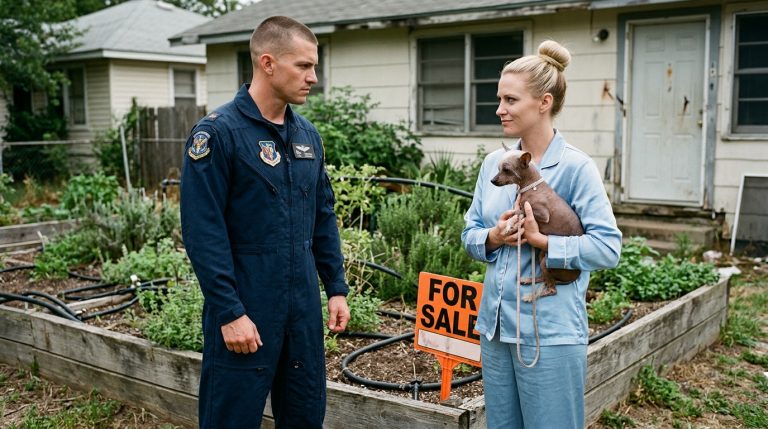
I stood at the edge of the driveway, the engine of my truck ticking as it cooled in the humid afternoon. The silence here was different than the desert; it was heavy, suffocating, and manicured to a lethal degree. A white Range Rover sat idling near the curb, its paint job so polished it felt like a deliberate insult. Vivien Ashworth stepped out. Her hair was a jagged, platinum blonde, cut to frame a face that didn’t know how to age, only how to hunt.
She didn’t see a combat veteran; she saw a depreciation factor.
“Marcus,” she said, her voice smooth enough to slide over a blade. “I assume you’ve seen the improvements. We really had to move on the abandonment issues while you were… away.”
I didn’t look at her. I looked at the survey stakes hammered into the earth, their orange plastic tops screaming against the dark, disturbed soil. My gaze tracked the line where the lawn met the foundation of the house that wasn’t supposed to be here. It was a clean, precise, and entirely illegal intrusion.
“Improvements,” I repeated, the word tasting like copper.
“Property values in the meadow are up forty percent,” she continued, clicking her pen against a clipboard as if she were tallying my surrender. “You’ve been gone a long time, Marcus. People move on.”
She didn’t know about the locker in the basement. She didn’t know about the 1952 deed, or the way the soil under my boots felt like a physical extension of my own bones. She was playing a game of real estate; I was playing a game of attrition.
I looked at the house—a towering monstrosity of beige siding and faux-stone accents. Through the bay window, a man was adjusting a television, his life unaware that he was occupying a graveyard. The tension in my chest tightened, a familiar coil of focus I hadn’t felt since my last patrol. I suppressed the urge to look at the exact spot beneath the oak tree. That grief was a weapon now, sharp and focused, not a vulnerability.
“You should be thanking us, really,” she added, her smile failing to reach her eyes. “We did the neighborhood a favor.”
I finally shifted my focus to her. I didn’t let my expression waver, keeping my face as flat as a desert horizon. I had spent twelve months calculating risk-reward ratios for supply chains in a warzone. Vivien was just another logistics problem.
“I’m not looking for thanks, Vivien,” I said softly, the silence stretching between us, punctuated only by the distant hum of a lawnmower. “I’m looking for the survey maps.”
Her smile didn’t break, but the air around her seemed to harden. “The county records are public, Marcus. But I doubt you’ll find what you’re looking for. Some things are best left forgotten.”
She turned, her heels clicking against the freshly poured concrete as she walked toward her car. I watched the way she moved—the calculated stride of someone who thought the ground belonged to her. I looked down at my hands, still dusty from the road, and the realization hit me with the force of a sudden, violent epiphany. She wasn’t just protecting property values. She was hiding a breach.
I glanced toward the tree line, toward the hidden corner of the property where the old surveying stakes should have been. They were gone, replaced by new markers that didn’t align with the ancient treeline. My pulse jumped—a single, rhythmic thrum of adrenaline. She hadn’t just built on my land. She had moved the border.
CHAPTER 2: The Audit of Deceit
The silence of the meadow was no longer a sanctuary; it was a tactical disadvantage. I stood motionless as Vivien’s Range Rover vanished down the cul-de-sac, the receding hum of the engine leaving behind a stillness so sharp it felt like a serrated blade pressed against my skin. I didn’t move. I kept my hand hovering over the disturbed earth where the stake had been, the phantom texture of the missing orange plastic still etched into my fingertips.
I reached into my back pocket and pulled out the small, worn leather notebook I’d carried through three different time zones. I flipped past the scribbled supply manifests of a war that now felt like a fever dream and turned to the back, where I had sketched the neighborhood boundary lines from memory before leaving.
The math didn’t hold.
My pulse spiked—a cold, rhythmic hammer against my ribs. I looked at the house again. The foundation sat exactly where my grandfather’s vegetable garden used to be. The transition from the old property markers to these new, artificial boundaries was too clean, too deliberate. This wasn’t a mistake; it was an extraction. I knelt, pushing aside a clump of mulch to expose the soil. It was loose, aerated, and smelled of cheap chemical fertilizer—the telltale scent of a site recently graded to conceal evidence.
A sudden, jarring intrusive memory hit me: the sound of a transport truck in the desert, idling before dawn, the same feeling of something being moved out while I was busy looking at the horizon. I stood up, the movement fluid and calculated. My joints ached, a reminder of the terrain I’d crossed, but my mind was sharpening.
I walked toward the edge of my lot, tracing the invisible line toward the county records building. If she had used the HOA’s “abandoned property” protocols, there would be a paper trail. Every notice, every certified letter, every committee vote would be cataloged in the city’s archives.
The commute to the recorder’s office was a exercise in restraint. I kept the truck at exactly the speed limit, my eyes tracking every rearview mirror check, every lane change. When I finally stepped into the dim, climate-controlled air of the county building, the smell of ozone and rotting paper greeted me. It was the smell of truth before it was buried.
The clerk behind the counter, a woman with tired eyes and a name tag that read Brenda, didn’t look up from her monitor. “Public records search is in the back left, near the microfilm,” she droned.
I didn’t head for the microfilm. Instead, I walked to the counter, placing my hands flat on the cool, polished laminate. “I need the file for the abatement lean on the Holloway corner lot,” I said, my voice steady, stripped of the fatigue that had been hollowing me out since I pulled into the driveway. “Block 4, lot 12.”
Brenda paused, her fingers hovering over the keyboard. She looked at me then, really looked at me, scanning the dust on my jacket and the hard set of my jaw. “That’s an active case. The HOA office handles the documentation.”
“I am the property owner,” I replied, the weight of the statement hanging in the air like a dead-drop wire. “And I’m auditing my records.”
She hesitated, then tapped a command into the terminal. The printer behind her whirred to life, a mechanical groan of gears and rollers. It took long, agonizing seconds for the paper to feed through the output slot. She handed it over, her eyes flickering toward the exit.
I took the pages. The first was a standard violation notice, citing “overgrowth and lack of maintenance.” I flipped it, my eyes locking onto the second sheet. It was a formal abatement lean, signed and notarized three months ago.
I stopped breathing. The signature at the bottom wasn’t just a scribble; it was a formal stamp of authority. I recognized the name immediately: Derek Ashworth, Municipal Inspector.
The metallic taste of rage bloomed in my mouth, hot and intoxicating. It wasn’t just corruption; it was nepotism, a family-run ecosystem of theft. Derek wasn’t just any inspector; he was Vivien’s brother-in-law, the man who had supposedly “verified” the decay of my land while I was overseas. The document was dated exactly one week after the last time I’d been able to get a signal on my sat-phone.
I folded the paper, the crease sharp and decisive. The audit wasn’t just a search for facts; it was a map of the trap. I walked back to my truck, the weight of the document in my jacket pocket feeling like a heavy, cold anchor.
As I climbed into the cab, I caught a glimpse of myself in the rearview mirror. I looked older, my eyes harder, my expression a mask of calculated neutrality. I started the engine and watched the county building recede in the glass. I didn’t have the full truth yet, but I had the first thread. And in my experience, if you pull a thread hard enough, the entire garment unravels.
I drove back toward the meadow, but I didn’t stop at my house. I pulled into a side street, killing the lights a block away from Vivien’s office. I watched the windows. A single, amber light glowed from behind the blinds—a beacon for the predator. I reached into my pocket and touched the cold edge of the forged lean. The game wasn’t about property anymore. It was about the architecture of their failure. I sat in the darkness, letting the silence settle into my bones, waiting for the exact moment the light would flicker out, giving me the opening to move.
CHAPTER 3: The Tactical Recon
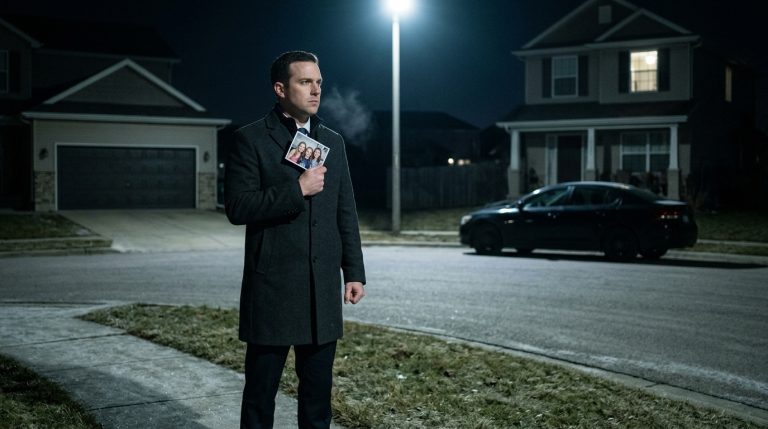
The darkness inside the truck was absolute, save for the faint glow of the dashboard clock, which ticked forward with agonizing deliberation. I didn’t shift. I didn’t reach for the radio or the ignition. I sat with my hands resting on the steering wheel, my breathing kept to a rhythmic, steady count—a habit formed in silence and reinforced by necessity. My eyes remained locked on the converted garage where Vivien Ashworth managed her empire of paper and deceit.
The light behind the blinds finally vanished. The sudden absence of that amber glow was a signal, as distinct as a flare in the night. I waited exactly three minutes—enough time for her to secure the deadbolt and reach her car—before I turned the key. The engine kicked over with a low, controlled thrum that I kept as quiet as possible, rolling slowly out of the side street and onto the main road.
I didn’t head for the office door. I headed for the perimeter.
I drove the length of the new mansions, moving at a crawl. The streetlights cast harsh, angular shadows across the fresh stonework, emphasizing the unnatural geometry of the structures. Every porch was perfectly staged; every walkway was swept clean of debris. It was a masterpiece of suburban camouflage, but as I rolled past the boundary line—the space where the original treeline should have been—I saw the friction.
I pulled to a stop at the edge of the construction easement. I killed the lights and stepped out. The air here was colder, biting at my neck, smelling of newly turned earth and the synthetic, sterile scent of fresh limestone. I moved with a practiced, low-profile gait, my boots finding purchase on the gravel that hadn’t yet settled into the dirt.
I stopped at the corner stake—the one I had inspected hours earlier. I knelt, the gravel biting into my knees. I pulled out a small, high-intensity penlight, shielding the beam with my palm so that only a sliver of light escaped. I didn’t illuminate the stake itself; I illuminated the ground around it.
There. A faint, indented line in the soil, barely perceptible to an untrained eye. It was the mark of a surveyor’s chain, dragged across the ground. But it didn’t align with the current markers. It was skewed by at least forty feet.
My breath hitched. The entire mansion development was positioned on a shift. They hadn’t just built on my land; they had rotated the entire block to maximize the view of the valley, effectively slicing a wedge out of the protected zone and pushing it onto the neighboring parcels. It was a bold, aggressive maneuver that relied entirely on the assumption that no one would bother to check the original county survey maps.
I stood up, the movement fluid and silent. I wasn’t just dealing with an HOA president with a grudge; I was dealing with a structural architect of fraud. The forged lean I’d found earlier was just the cover story—the administrative excuse to keep me off the land while they solidified the physical encroachment.
I walked the length of the fence line, my mind cataloging the discrepancies: the placement of the septic runoff pipes, the deviation of the stone retaining wall, the way the driveway encroached upon the original access easement. Each violation was a tactical point of failure. I didn’t need to storm the front office with accusations. I needed to document the physical evidence of the breach before they could “correct” the markers again.
I pulled my phone from my jacket. I didn’t use the camera; I used the GPS logging software I’d kept from my time in the field. I walked the precise trajectory of the old boundary, recording the waypoints at ten-foot intervals. The screen glowed softly in my palm, a digital record of the truth.
As I circled back toward my truck, a sound broke the silence—the distant, metallic clink of a latch.
I went still. I pressed myself into the shadow of a large decorative pine, my heart rate steady, my breathing shallow. Fifty yards away, a side door to the office building opened. A figure stepped out—not Vivien, but a man. He walked with a heavy, deliberate gait, his silhouette framed by the porch light. It was Derek.
He carried a heavy canvas bag, the kind used for tools or files. He looked around, his head turning with a rapid, predatory jerkiness. He moved toward the back of the building, toward the fire pit where Mrs. Naomi had mentioned the smoke. He wasn’t just leaving for the night; he was doing a sweep.
I didn’t move. I watched him approach the pit. He didn’t build a fire; he just stood there for a long moment, staring down into the ash. Then, he reached into the bag, pulled out a stack of documents, and began methodically tearing them into tiny, unrecognizable shreds. He didn’t throw them in; he worked them into the dirt with the heel of his boot, grinding the paper into the soil until it was indistinguishable from the mulch.
It was an autopsy of evidence.
I gripped the edge of my jacket, the cold metal of the survey wheel in the truck bed calling to me, but I didn’t move. I needed him to finish. I needed him to leave the site exactly as it was. Because every piece of shredded paper, every attempt to bury the history of that land, was a confession.
He turned back toward the office, his pace slower now, satisfied. The door clicked shut, the lock engaging with a sound that seemed to echo in the sudden void of the night.
I remained in the shadow for another five minutes, letting the adrenaline subside, letting the scene solidify in my memory. I had the GPS waypoints. I had the confirmation of the forge-master’s work. And I knew exactly where he was hiding the remnants of his crimes.
I walked back to the truck, the crunch of gravel under my boots sounding like a warning I was only too happy to ignore. I didn’t start the engine immediately. I sat in the dark, watching the office building, letting the tactical map of the next move crystallize. She had the local infrastructure, the forged documents, and the confidence of the neighborhood.
But she didn’t have the high ground. And for the first time since I’d come home, I knew exactly how to take it. I put the truck in gear and pulled away, the tires barely whispering against the pavement, heading back toward the quiet, shadow-filled sanctuary of my grandfather’s workshop to begin the real audit.
CHAPTER 4: The First Breach
I didn’t turn the key. I sat in the cab for a long moment, the engine ticking as it cooled in the humid, stagnant night air. The office behind me was a tomb of buried paper, but Derek’s hand—his arrogant, bureaucratic hand—was on every single file. If he was tearing up the paper trail, he was afraid. Fear was a tactical variable. Fear meant he was making mistakes.
I shifted the truck into gear and pulled away, but not toward home. I drove toward the municipal administration annex, a building that smelled perpetually of floor wax and stale coffee. I didn’t enter the building. I parked in the shadows of the adjacent lot, watching the security lights. The night shift guard, a man I’d seen a dozen times in the neighborhood, was busy with a crossword in the lobby.
My target wasn’t the office. It was the public access terminal in the lobby, the one used for permit verification.
I waited until he stood up to make a round of the perimeter. The moment the lobby was clear, I moved. I didn’t jog—I walked with a purpose that discouraged inquiry, my jacket pulled tight. I slipped through the glass doors, the chime echoing softly in the empty space. I reached the terminal, my fingers tapping the screen.
Verification request: Inspector ID 492-D. Derek Ashworth.
The system blinked. I entered the permit number for my own property, the one he had signed three months ago. A screen flashed, displaying the permit details. My eyes scanned the data, searching for the anomaly I had sensed since I first looked at the abatement lean.
There.
The digital timestamp on the permit was 2:14 AM on a Tuesday. I looked at the system log. The permit had been entered into the database, but it lacked the standard department head countersignature. It was a phantom permit—a document that existed on paper but had never been formally processed through the county workflow.
It was a blatant, amateurish bypass of departmental oversight. He hadn’t even bothered to hide the lack of a secondary audit. He’d simply pushed it through, relying on the fact that no one would look, and no one would care.
I tapped the screen, pulling up the file on the “abatement project” he had billed to my property. The costs were broken down by line item: Debris removal, environmental assessment, structural site audit. Each line item was inflated by three hundred percent. I watched the numbers, the cold calculation of his greed becoming clear. He was billing the county for work that hadn’t been done, and he was billing me for the privilege of his “service.”
The back door clicked. I didn’t panic. I stepped back, my shadow merging with the dark wood of the display case, and watched as the guard passed by, his flashlight beam sweeping across the floorboards. He didn’t see me. He didn’t even look toward the terminal.
I waited until the light vanished before I stepped back, my pulse thrumming in my ears like a drum. I had enough. I didn’t need to download the file—the digital footprint was already there, tied to his credentials.
I walked out the way I had come, the cool night air hitting my face like a reprieve. The walk back to the truck felt different now. The tension was still there, but it was organized. I had his ID, I had the timestamp, and I had the proof of a fraudulent, non-compliant administrative bypass.
When I reached the truck, I pulled out my notebook and recorded the details in quick, abbreviated shorthand. I looked at the address of the annex building, then back toward the mansions in the distance. They looked like hollow shells now, skeletons built on a foundation of administrative fraud.
I started the engine, the sound low and powerful. I wasn’t going home. I was going to find Bill Kowalsski. If Derek was forging permits, he was likely doing it for more than just my property. And if Bill had been threatened for questioning the boundary markers, he was the key to unlocking the rest of the neighborhood’s secrets.
The drive to Bill’s house was a blur of calculated motion. The streets were empty, the houses dark, the world asleep while the rot continued to spread. I felt the weight of the forged permit in my mind, a heavy, jagged piece of the puzzle. Derek thought he was untouchable because he wore the badge and held the pen. He didn’t realize that in my world, the pen was just a different kind of weapon—one that left a paper trail that could hang a man faster than any bullet.
I pulled into Bill’s driveway, the gravel crunching beneath the tires. His house was small, unpretentious, and dark. I cut the engine and sat in the silence. The game had shifted from defensive to offensive. I had the breach. Now, I needed the momentum to keep it open. I opened the door and stepped out, the air crisp and biting. It was time to find out exactly how deep the corruption went.
CHAPTER 5: The Midpoint
The porch light flickered, casting a sickly, jaundiced yellow glow over the peeling paint of Bill’s front door. I didn’t knock; I waited, my hand resting near the frame. The house felt dormant, the kind of stillness that only exists when someone is trying very hard not to be seen. After a moment, the lock clicked. Bill opened the door only a few inches, his face a map of weathered anxiety, his eyes darting to the street before settling on me.
“Marcus,” he whispered, his voice raspy. “You shouldn’t be here. They’re watching.”
“Who, Bill?” I asked, keeping my voice low, my posture relaxed but ready. “Who’s watching?”
He didn’t answer. He just opened the door wide enough for me to slip inside. The air in his living room smelled of damp wood and medicinal tea. It was a space defined by narrow margins and the crushing weight of small, daily sacrifices. He closed the door and locked it with a double-turn of the deadbolt.
“They know you’re digging,” he said, moving to the kitchen. His hands were shaking as he poured water into a kettle. “Vivien’s crew. I saw a black sedan parked at the corner for three hours today. And Derek… he was at the hardware store when I was there. He followed me home, Marcus.”
I didn’t let the tension pull me toward anger. I stayed in the zone of cold, tactical focus. “Derek’s an inspector, Bill, not a secret agent. If he’s following you, it’s because he’s scared of what you know. You told me you questioned the stakes when they were grading the land. Tell me exactly what you saw.”
Bill sat at the table, his fingers tracing the grain of the wood. “It wasn’t just the lines. It was the equipment. They weren’t using standard survey gear. They had these custom-made trackers—I recognized the brand from when I worked the industrial contracts. They were mapping the underground. Not for foundations. For water flow.”
My gut tightened. The pieces of the puzzle were shifting, revealing a picture much larger than a simple property theft. “Water flow? You mean the stream?”
“It’s not just a stream,” Bill murmured, looking up at me, his eyes wide. “It’s a main line. If they tap into that, they can divert the entire watershed for the luxury development. It’s worth millions in infrastructure alone.”
Before I could process the gravity of the admission, a sharp, rhythmic thud echoed from the porch. My instincts flared—a cold, instantaneous surge of adrenaline. I lunged toward the light switch, plunging the kitchen into darkness, and grabbed Bill by the shoulder, pulling him toward the back hallway.
“Stay low,” I hissed.
Outside, the thud was followed by the sound of glass shattering—not the front door, but the living room window. A dark object, the size of a brick, tumbled across the floor, trailing a thin, acrid plume of gray smoke. My training took over, a reflex of muscle and memory. I didn’t think about the fire; I acted. I grabbed a thick, wet floor rug from the laundry alcove, leaped toward the smoldering object, and slammed the rug down on top of it, smothering the chemical flare before it could ignite the curtains.
The room remained dark, but the air was filling with a stinging, sulfurous odor. It wasn’t just smoke—it was a tear-gas irritant. A tactical denial of space.
“They’re not here to talk, Bill,” I said, my voice barely audible over the thumping in my own chest.
“They’ll kill us,” he gasped, huddled against the wall.
I moved to the side window, peering through the slats of the blinds. A black sedan was idling at the curb, its lights off, the engine humming with a low, predatory vibration. Two men in dark windbreakers were moving toward the house, their silhouettes sharp against the artificial glow of the streetlamp. They weren’t police; they were cleanup.
The V-3 variance—the butterfly detour I hadn’t prepared for—had arrived. My plan to audit the neighborhood had been shredded by a move of raw, violent escalation. I realized then that Vivien wasn’t playing the game of real estate anymore; she was playing the game of total elimination.
“Do you have a back exit?” I asked, my voice as calm as a stone.
Bill pointed toward the mudroom. “Through the garage, but the door is padlocked.”
“Give me the key.”
He fumbled in his pocket, handing over a cold, jagged piece of metal. I moved through the mudroom, my boots soundless. As I reached for the padlock, the sound of a heavy shoulder slamming against the front door vibrated through the frame of the house. The wood groaned under the pressure.
I didn’t have time for a perfect extraction. I had to create a distraction. I grabbed a heavy iron pry bar from the wall mount, wedged it into the hasp of the padlock, and put my entire weight into the leverage. The steel shrieked—a high, piercing sound that cut through the night.
The lock snapped.
The front door gave way with a crash, the frame splintering like dry twigs. I pulled Bill into the garage, but as I reached for the door handle, the house went silent. They weren’t rushing anymore. They were waiting. They had us cornered in the one place with no secondary exit. The realization hit me with a crushing weight—I had walked into a trap, and now I had to find a way to turn the kill zone into an escape route. I reached for the workbench, my fingers closing around a high-powered work light and a coil of copper wire. It wasn’t much, but it was enough to light the dark.
CHAPTER 6: The Coalition of Shadows
The garage interior was a graveyard of abandoned suburban projects—half-finished shelves, stacks of forgotten holiday decorations, and a thick layer of dust that felt like silt on a riverbed. I didn’t look back at the door. I knew the rhythm of a breach; they were listening, waiting for me to make the first move. I signaled Bill to stay behind a workbench. He was breathing in sharp, jagged gasps, his eyes wide with a terror that I couldn’t afford to mirror.
“Get to the back corner,” I whispered, my voice barely a vibration in the dark. “If you hear glass break, move to the neighbors’ fence line. Do not stop for me.”
“Marcus, don’t—”
“Go.”
I didn’t wait for him to comply. I turned my attention to the heavy work light I’d grabbed. I stripped a section of the copper wire and wrapped it around the light’s frame, creating a makeshift shunt. It was a crude, desperate maneuver, but it would create a momentary surge if bridged to the main breaker. I moved toward the breaker box on the wall, my footsteps soft on the concrete.
The front door groaned as it finally yielded. The sound of heavy boots hit the mudroom floor.
I didn’t panic. I watched the shadows, my perception feeling strangely heightened, the edges of the room sharpening into geometric planes of light and dark. My skin prickled with a sudden, irrational sense that the room was changing, that the shadows were creeping closer to me than they should have been—a flicker of paranoia, a ghost of the desert that had no business being here. I shook it off. Focus.
Clack.
The safety on a weapon.
I bridged the wires to the breaker. The garage light flared, a brilliant, blinding flash of white that popped the bulb with a sound like a small-caliber gunshot. The sudden plunge into darkness felt absolute, a heavy, velvet curtain dropping over the space.
The men in the mudroom shouted, their voices sharp and confused. I didn’t head for them; I headed for the side window I’d marked earlier. I hit the latch with the pry bar, the metal singing as it gave way, and shoved the frame outward. It swung wide, revealing the damp, cool night air of the backyard.
I climbed through, my boots hitting the soft mulch of the garden bed. Behind me, I heard the men scramble into the garage, their heavy beams of light cutting frantic, disorganized arcs through the smoke and dust. I moved along the fence line, my body low, my eyes tracking the movement inside the house.
They weren’t looking for Bill. They were looking for me.
I crept toward the front of the property, my goal no longer to document, but to disrupt. I needed to see if the sedan was still there, if there was a driver left behind. I reached the edge of the driveway and peered through the dense foliage of a hedge. The sedan sat in the same spot, its driver’s side window rolled down just enough to let a plume of cigarette smoke drift into the night.
The driver was hunched over, his face illuminated by the faint glow of a phone screen. He was sending a message.
I reached into my pocket and touched the crumpled, forged permit. It was the key to their entire house of cards, and they were here to burn it. The irrational paranoia from inside the garage flared again, a whisper at the back of my mind telling me that the driver was waiting for me to step into the light, that I was being lured into a final, inescapable failure.
I shook it off. Focus.
I moved from the hedge to the shadow of a parked delivery van across the street. I was close enough now to see the driver’s face—a sharp, angular profile I’d seen at the county records office a week ago. Not a thug. A clerk. An administrative hand working for the Ashworths. They weren’t using muscle; they were using their own staff to do the dirty work.
I saw him pull a weapon from the passenger seat—a heavy, matte-black canister. They weren’t here to beat me. They were here to flush me out and neutralize the threat to their infrastructure.
The men from the house emerged, their movements coordinated now, sweeping the yard with their lights. I watched, my heart rate steadying into the cold, clinical rhythm of a threat assessment. I couldn’t fight them, but I could make them regret the breach. I pulled my phone and dialed the one number I knew would force a move.
“Agent Naomi,” I said, my voice steady as the phone connected. “I have two men breaking and entering, armed with chemical agents, and a vehicle obstructing a public roadway. I’m at the Kowalsski residence. I need an extraction and a containment unit, now.”
The silence on the line was brief. “Marcus? Is this happening right now?”
“Now,” I said, watching the man near the hedge turn his head toward the street. “And Agent? I have the proof of the permit forgery you asked for. I suggest you hurry.”
I ended the call and melted into the shadows of the neighboring property, my eyes fixed on the sedan. The driver had seen the movement in the street. He was starting the car. The trap was about to spring, and for the first time, I wasn’t the one caught inside it. I moved back toward the perimeter, every muscle coiled, ready to watch the house of cards finally start to lean.
CHAPTER 7: The Federal Hammer
The sedan skidded to a halt as a pair of dark SUVs cut off its exit, their lights strobing in a violent, synchronized pulse that turned the suburban night into a forensic theater. I stayed low, flattened against the brickwork of the neighbor’s house, watching as federal agents poured out with their weapons drawn—not aggressive, but surgical, their movements synchronized and efficient. The driver of the sedan didn’t even try to reach for the door handle. He sat with his hands visible, his face pale, as the reality of federal intervention dismantled his leverage in real time.
“Federal Agent! Hands in the air! Step away from the vehicle!”
The voice was cool, authoritative, and final. I stood up slowly, keeping my hands visible as I walked into the light. Agent Naomi was there, her gaze sweeping the yard with the cold, diagnostic precision of someone who had spent her career deconstructing criminal networks. She didn’t look at me; she looked at the men, then at the house, then at the sedan.
She saw the scene exactly as it was: a coordinated attempt to neutralize a witness.
“Marcus,” she said, her tone professional, stripped of the relief she might have felt. “You’re in one piece. That’s good.”
“The documents are in my truck,” I replied, my voice steady, though my muscles were screaming with the residual tension of the last hour. “And the evidence of the permit forgery is logged on the municipal terminal.”
Naomi nodded to the agents, who began securing the scene. They moved with a clinical detachment that rendered the violence of the last few minutes irrelevant. I watched as they pulled the man from the sedan, his protests muffled and useless against the weight of federal authority.
“They were cleaning up, Naomi,” I said, pointing toward the fire pit in Vivien’s yard. “The office is full of records they’re actively destroying. If you move now, you catch the source.”
She looked at me, a flicker of something human passing through her eyes—not pity, but a hard, tempered respect. “We’re already moving, Marcus. You didn’t just give us a case; you gave us the entire structure. The Department of Justice authorized the warrant twenty minutes ago. Vivien’s office is already being contained.”
I felt the adrenaline begin to bleed out of me, replaced by a sudden, jarring exhaustion. My knees felt weak, and for the first time, the cold night air seemed to penetrate my skin. The fight, which had felt like an impossible, claustrophobic struggle in the dark, was now a matter of administrative processing.
I turned toward the house. Bill was standing on the porch, his face illuminated by the police strobes, his shoulders slumped in a posture of profound relief. I walked to him, my gait heavy but deliberate. The house that had felt like a fortress moments ago now felt like just another building, stripped of its menace by the arrival of the law.
“It’s over, Bill,” I said, my voice barely a rasp. “They’re going to document everything.”
Bill looked at the agents, then back at me. He didn’t smile, but his breathing finally slowed. “You really did it, didn’t you? You brought the house down.”
I didn’t answer. I reached into my pocket, pulled out the forged permit, and handed it to one of the approaching agents. It was a flimsy, ink-stained piece of paper, but it was the heaviest thing I had ever carried. As I watched them bag it as evidence, I felt the phantom pressure in my hand—the weight of the survey wheel, the grip of the pry bar, the friction of the gear—slowly begin to dissipate.
The scene began to transform from an active conflict zone to an organized investigation. Flashlights bounced off the siding of the mansion, highlighting the seams of the construction, the gaps in the stonework, and the brutal, artificial geometry of the encroachment. For the first time, the houses looked exactly like what they were: illegal, unsustainable, and fragile.
I looked toward the meadow. In the distance, the oak tree stood as a silent, monolithic sentinel against the dark sky. The storm had passed, but the ground was still scarred. I knew the process of restoration would be slow, a long, arduous march toward reclaiming what was lost, but the path was finally clear. The corruption had been exposed, the perpetrators were being dismantled, and the truth—the cold, objective truth—was no longer buried in the mud.
Naomi approached me, a tablet in her hand. “We have the warrants for the office. We’re going to need a full statement, Marcus. Not just about tonight, but about everything you discovered. We have enough to initiate the reclamation process for the federal covenant.”
I nodded, the word ‘reclamation’ ringing in my head like a bell. “I’ll be ready.”
As I turned to follow her toward the lights, I took one last look at the street. The sedan was being loaded onto a flatbed, the men were in the back of the vans, and the neighbor’s house was dark again. The suburban facade was returning, but it was hollow now, a stage set awaiting the wrecking ball. I walked toward the agents, my stride leveling out. The war was over, but the work—the real work of memory and restoration—was only just beginning.
CHAPTER 8: The Final Settlement
The chaos of the federal raid had settled into a disciplined, systematic disassembly. I stood at the edge of the driveway, the cold air biting at my cheeks, watching as federal marshals moved through Vivien Ashworth’s office, carrying out boxes of evidence that had once been the bedrock of her power. Vivien stood near her Range Rover, her hands cuffed, the designer silk of her pajamas stained by the damp evening air. She wasn’t fighting anymore. She was watching her world being packed into cardboard containers, her gaze empty of the predator’s fire that had defined her for so long.
I walked toward her, the sound of my boots on the gravel a rhythmic count of the time I had lost. She looked at me, her eyes tracking my movement. There was no arrogance left, only the hollow, shivering resignation of someone who had gambled everything on a lie and found the table suddenly empty.
“You didn’t have to go this far,” she said, her voice thin, stripped of its practiced sweetness. “It was just business, Marcus. A neighborhood needs a vision.”
“It wasn’t business,” I replied, my voice steady, stripped of the anger that had driven me for weeks. “It was an extraction. You treated people’s lives like supply chain assets, and you forgot that assets can break back.”
She looked away, toward the meadow where the floodlights illuminated the survey stakes. The 1952 covenant—the hidden, federal absolute—was already being processed by legal teams who were effectively undoing every permit she had ever touched. The three mansions were already marked with orange tape, destined for the wrecking ball. The poetic justice wasn’t in her imprisonment; it was in the total erasure of her “vision.”
I turned away from her and walked toward the oak tree. The ground was still churned from the construction, but the silence beneath the branches was already beginning to mend. I reached into my pocket and felt the small, worn key to my grandfather’s locker—the only artifact of his that had truly mattered.
The process of denouement followed in the weeks that passed, a slow, meticulous cooling of the neighborhood’s fever. The federal marshals finalized the property reclamation, and the mansion families were guided through the transition to legitimate housing. David, the tech executive from the house that had sat over Sarah’s garden, had approached me days after the raid, his expression sobered by the reality of the fraud.
“I didn’t know,” he had said, his voice quiet. “I just wanted a place for my daughters.”
“I know,” I had replied. And I did. I had helped him secure a rental property until the final relocation was complete, the bitterness I’d once felt toward him replaced by the pragmatic understanding that we were both, in different ways, victims of the same rot.
The restoration of the meadow began in the spring. I worked alongside the environmental specialists, my hands once again comfortable with the weight of a spade, the friction of the soil, the smell of damp earth that heralded growth. We pulled out the concrete foundations and the artificial piping, watching as the ancient, hidden stream finally broke the surface, its water cool and clear.
One afternoon, I sat on the bench we had installed near the oak tree. I was holding a small, granite marker—the one I had spent the last month polishing in the workshop. It was simple, the inscription deep and clean. As I pressed it into the earth, I felt the sharp edges of the stone, the texture of the history I was burying.
Emily, the environmental engineer who had helped map the waterway, walked up the path, her boots light on the trail. She stopped beside me, her hand resting on my shoulder. The cool spring wind ruffled her hair, and for the first time in years, the metallic, anxious taste that had permanently colored my world was gone.
“It looks like it’s always been here,” she said, looking out over the nascent sanctuary.
“It has,” I said. “It just needed someone to see it.”
I stood up, the movement fluid, the ache in my joints a dull, manageable weight. We walked back toward the house, the sun setting behind the tree line, painting the sky in colors of amber and bruised purple. The house looked different now. The workshop was organized, the tools hung with precise, military care, and the desk was clear of the maps and evidence of the fight.
I stopped at the doorway and looked back at the meadow one final time. The legacy wasn’t the land; it was the ability to hold it, to protect it, and to know when the battle was truly over. I walked inside, the door closing behind me with a firm, solid click. I left the past in the soil, and for the first time since returning from the desert, I stepped into the house and felt only the quiet, steady warmth of home.