The Architect of Ruins: A Systematic Campaign to Dismantle a Tyrant’s Hollow Kingdom
CHAPTER 1: THE FIELD OF DECAY
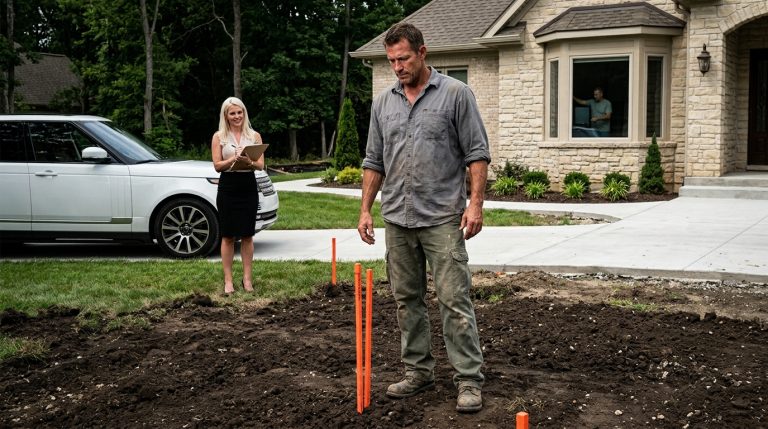
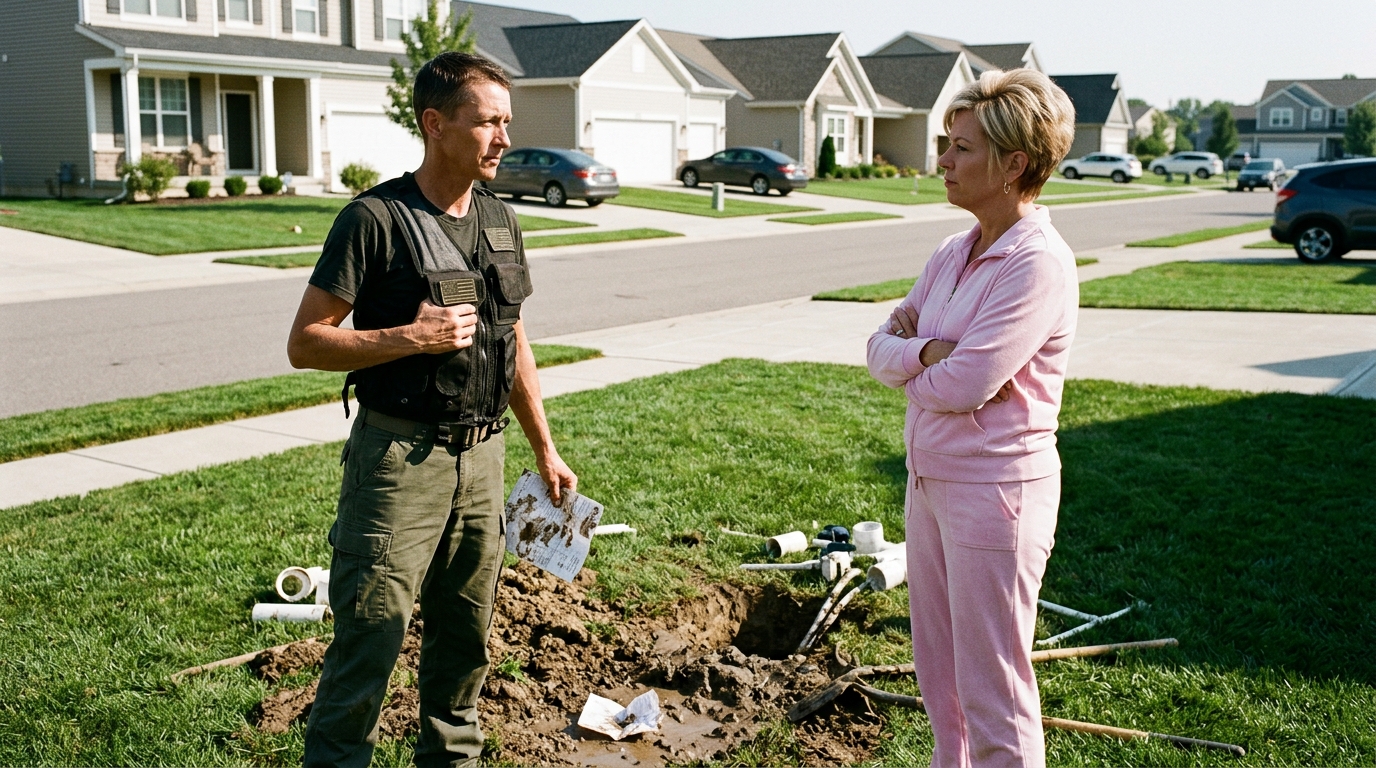
The silence was heavier than the desert heat I had carried for twenty-five years. I stood at the edge of the abyss—a muddy, gaping hole where, twelve hours ago, ten thousand gallons of water and a decade of my life had existed. The filtration system, once the heart of a perfectly balanced ecosystem, lay scattered across the cracked earth like shrapnel.
I didn’t shout. I didn’t pace. I let the adrenaline, that familiar, metallic taste of combat, flood my system and then, with practiced ease, I locked it away. My Marine Corps training hadn’t left me; it had merely been waiting for a new theater of operations.
I took a slow, deliberate breath. The air held the sickly, sweet tang of decay. It wasn’t just the smell of dead fish; it was the smell of a boundary violated.
I raised my camera. The shutter click sounded like a rifle bolt in the oppressive quiet.
Focus.
I caught the way the Jin Rin Kohaku’s pearlescent scales had lost their luster, dulling under the harsh afternoon sun. I captured the jagged, intentional cut in the pond liner—a signature. It wasn’t just an “abatement.” It was a surgical strike designed to maximize psychological damage.
Karen Miller stood on my flagstone path, her pastel pink tracksuit jarring against the muted tones of my ruined garden. She looked at the carnage not with horror, but with the smug, detached satisfaction of a landlord surveying a tenant’s eviction. Her blonde hair was a rigid helmet, unmoved by the slight breeze that stirred the scent of death.
“Your little fish were making the neighborhood look untidy, Mr. Davies,” she said, her voice a syrupy thin coating over steel. “We simply tidied up.”
My fist tightened, the leather of my gloves creaking. I imagined her, standing here in the dark, watching the water drain, thinking she had bested a retiree. She saw a man who collected fish; she didn’t see the engineer who had managed logistics in Okinawa. She didn’t see the man who knew that every structure, no matter how imposing, has a structural weakness.
“You destroyed private property,” I said, my voice dangerously low. I kept my eyes on her, noting the slight twitch in her jaw when I didn’t explode in rage. She wanted a scene. She wanted a screaming, irrational neighbor she could point to and call unstable.
I gave her cold silence instead.
“The bylaws are quite clear,” she insisted, her arms folding over her chest, the posture of a petty god. “The architectural control committee has broad discretion.”
She turned, her victory lap already in progress, oblivious to the fact that she had just left her flank wide open. She walked away, but I didn’t look at her back. I looked at the notice she had pinned to my door—a piece of paper that was about to become the cornerstone of her undoing.
I crouched back down, checking the aperture on my lens. My hands were perfectly still. The war wasn’t coming; it had already started. And as I looked at the destruction, I noticed a small, out-of-place receipt from a local landscaping firm tucked into the mud near the pump. It wasn’t HOA stationery. It was a personal invoice, stamped with a name I hadn’t expected to see here.
Gary Slater.
The name sparked a memory from a neighborhood directory I’d filed away years ago. Slater wasn’t just a vendor. He was family.
The connection tightened in my chest like a coiled spring. She wasn’t just cleaning up the neighborhood. She was laundering her own greed. I framed the receipt in my viewfinder and clicked.
CHAPTER 2: THE RECONNAISSANCE OF RUIN
The sun was dipping toward the horizon, casting the backyard in long, skeletal shadows. I stood motionless on the flagstone path, the paper vibrating slightly in my grip as the wind picked up. It was a simple, tri-fold slip of carbon copy, now stained with the silt that had been the funeral shroud of my Nishiki koi.
Gary Slater.
I looked up at the quiet suburban street. The houses across the way were perfectly uniform, their lawns manicured to a level of unnatural perfection that now felt less like a neighborhood and more like a garrison. Karen lived three doors down. She likely had the blinds drawn, sipping chilled wine, feeling the smug warmth of a victory well-earned. She had no idea that by hiring her brother-in-law to destroy my pond, she had left a breadcrumb trail that led straight to the heart of her influence.
I didn’t head inside to vent. I didn’t call Sarah, even though I could hear her moving about in the kitchen, preparing dinner in a house that felt suddenly smaller, emptier. Instead, I walked to the garage. The concrete floor was cool beneath my boots. I switched on the overhead light, and the space revealed itself in all its familiar, structured glory.
This was my command center. Steel workbenches were organized with the precision of a field hospital. Every tool had its shadow etched into the pegboard. I laid the mud-stained invoice on the central table and pulled a magnifying glass from the top drawer.
The invoice was dated three days ago. It was for “Emergency Abatement – Architectural Violation,” signed with a heavy, confident hand. Beneath the total—a figure that was laughably inflated for a morning’s worth of work—was the business address. My eyes scanned the lines, checking for inconsistencies. It was too clean. The formatting was too professional for a local lawn care service, yet the paper quality was cheap.
My mind slipped, unbidden, back to a command post in Ramadi. We had spent weeks mapping the supply lines of the insurgency, looking for the one delivery truck that didn’t match the rotation. You don’t take a hill by charging the center; you take it by cutting the legs out from under the supply chain.
I pulled out my digital camera and hooked it to the laptop on my desk. I downloaded the photos from the yard—the dead koi, the sliced liner, the pump. As the images materialized on the screen, a chilling realization took hold. The pump hadn’t been removed; it had been dismantled, its internal wiring deliberately shorted to ensure total failure. This wasn’t a cleanup; it was a targeted sabotage.
I reached for my personal binder—my koi journal. I opened it to the very last page, where I kept the copies of every communication I’d had with the HOA for the last five years. I laid the landscaping invoice next to the original CC&Rs. The font styles didn’t match, but the bureaucratic tone was identical. Karen wasn’t just using her own vendor; she was ghostwriting the association’s official notices.
A shadow fell across the garage doorway. I didn’t startle, but I pivoted, my hand coming to rest on the edge of the workbench. Sarah stood there, a bowl of soup in her hands, her eyes tracing the lines of my face.
“Jack,” she whispered, her voice catching. “The police were useless. They said it’s a civil matter. You can’t keep doing this to yourself. Sitting out there in the dark, staring at the mud…”
“I’m not staring at the mud, Sarah,” I said, my voice as steady as the foundation of the house I’d built with my own hands. I tapped the invoice with my index finger. “I’m identifying the supply line.”
She stepped into the garage, setting the bowl down on a secondary workbench. She looked at the photos of our fish—our beautiful, silent jewels—and then back to me. She was a woman who had learned to live with the quiet intensity I brought home from the service, but I saw the flicker of fear in her eyes. It wasn’t fear of Karen; it was fear of the man I was becoming again. The man who solved problems by dismantling the opposition.
“She’s a neighborhood bully, Jack. She’s not an enemy combatant.”
“To the people she’s fining, there is no difference,” I replied. I closed the laptop, the screen going black, reflecting the cold, calculated focus in my eyes. “She decided to make my property a battlefield. She doesn’t get to choose how the war is fought.”
I walked over to the back wall and grabbed a heavy-duty flashlight. I wasn’t done. I needed to know the layout of the “territory.” I needed to see how Karen’s Clean Cut Landscaping operated in the daylight, and I needed to find out who else in this neighborhood was walking on eggshells.
I stepped back out into the cool night air. The crickets were chirping—a sound that, only forty-eight hours ago, had been part of the symphony of my garden. Now, it just sounded like silence. I walked the perimeter of my five-acre lot, checking the fence line, the drainage ditches, and the hidden back access point that opened onto the edge of the development.
I was looking for the weak points. I was looking for the people who, like me, had been told to be silent. And as I reached the edge of the property, looking out toward the rows of identical, darkened homes, I saw a light flicker in a window two doors down. Mrs. Gable. She was standing by her lamp, her silhouette motionless.
She was waiting for something, or perhaps she was just afraid of the dark. In that moment, I knew: this wasn’t just about my fish. It was about the fact that she was standing there, in her own home, looking over her shoulder.
I turned back toward my house, my pace brisk and determined. I had the start of a map. I had a name. And by morning, I would have a strategy.
CHAPTER 3: THE ARTILLERY OF RECORD
I didn’t enter the house through the front door. I slipped into the mudroom, peeling off my boots with rhythmic, practiced movements. The house was quiet, the only sound the low, steady ticking of the grandfather clock in the hallway—a sound that felt uncomfortably like a countdown. Sarah was in the living room, her face illuminated by the soft glow of her tablet. She didn’t look up when I entered, but the tension in her shoulders told me she was waiting for the inevitable.
“I’m going to the study,” I said, my voice low. “Don’t wait up.”
I bypassed the kitchen and moved directly to the small room at the back of the house, the one I used to call my office before it became a sanctuary for blueprints and logistics. I sat at the desk, the leather chair groaning slightly under my weight. Before me lay the stack of covenants, conditions, and restrictions—the CC&Rs—that Karen wielded like a broadsword.
I turned on the desk lamp, a sharp, focused beam that cut through the darkness of the room, highlighting the dust motes dancing in the air. I needed to isolate her. The HOA board wasn’t a monolithic entity; it was a group of individuals, each with their own fears, each likely cowed by the weight of Karen’s personality. If I wanted to dismantle her, I couldn’t attack the HOA as a whole. I had to peel away her support structure, one member at a time.
I opened my laptop and began to type. The email wasn’t a demand; that would come later. This was reconnaissance. I addressed it to the four other members of the HOA board of directors. The tone was professional, sterile, and cold. I introduced myself not as the aggrieved neighbor with the dead fish, but as an engineer presenting a procedural inquiry regarding the emergency abatement conducted on my property.
I attached a copy of Article 11, specifically the section requiring a thirty-day written notice and a documented majority vote. I asked—politely, pointedly—where I might find the meeting minutes that authorized the emergency action. I CC’d my own personal email, creating a paper trail that could not be purged or ignored.
My fingers didn’t tremble. I was operating on muscle memory. In the Corps, we learned that information is a projectile. If you fire it correctly, the target’s own reaction does the heavy lifting for you. By asking for the minutes, I was forcing them to either admit they didn’t exist or to fabricate them—which would then be a felony.
I leaned back, the blue light of the monitor reflecting in my glasses. I had the landscaping invoice from the yard. It was the “smoking gun” of the operation, but it needed to be linked to a decision-making process. I spent the next two hours cross-referencing the HOA’s quarterly financial reports, which were available on the neighborhood’s antiquated website. The numbers were a mess of obfuscation, but the pattern was there. Whenever a “maintenance” invoice spiked, Karen’s signature appeared on the authorization line shortly after.
I pulled out a notepad and began to draw a flow chart. Karen at the top. The Landscaping company to the right. The board members, dangling like puppets, in the middle. The lines of influence were visible now, like cracks in a foundation.
A soft knock at the door broke my concentration. Sarah stood there, holding a mug of tea. She didn’t come inside, just hovered at the threshold, looking at the array of papers spread across my desk.
“You’re not sleeping,” she said.
“This isn’t about sleep, Sarah. This is about establishing a legal baseline. If I don’t document every step, they’ll just call it a neighborly dispute and move on.”
“And if they call it that anyway?”
“Then I’ll be ready for them to take it to court,” I said, turning back to the screen.
She sighed, a sound of resignation that stung more than any argument would have. “You’re building a fortress, Jack. I just hope you don’t forget how to open the gate.”
She walked away, and I was left alone with the silence. I looked at the draft of the email again. It was perfect. It was the first volley, meant to provoke a defensive reaction from a board that was almost certainly unprepared for a rigorous audit. I clicked ‘Send.’
The progress bar crawled across the screen—a tiny, digital pulse. Sent.
I stared at the confirmation, the adrenaline of the day finally beginning to taper into a hollow, aching fatigue. I looked down at my hands. They were stained with the same dark, silty earth that had been in my pond. I wiped them on a rag, but the residue of the day remained.
I wasn’t just a retired Marine anymore. I was a man who had been pushed into a corner, and I had realized that in a world of rules and procedures, the one who knows the manual best is the one who holds the weapon. I checked the time—past midnight. I knew the emails wouldn’t be read until morning, but the clock was ticking. Tomorrow, the board would have to decide whether to support Karen or whether to acknowledge that the rules they had been ignoring were about to be used to dismantle their own authority.
I left the desk, the room feeling smaller than it had when I started. As I walked out, I paused by the window, looking out toward the dark, uniform houses of Oakwood Creek. Somewhere in one of those, Karen was sleeping, secure in her self-built castle. She had no idea that I had just begun the process of systematically undermining the ground beneath her.
CHAPTER 4: THE DIGITAL PAPER TRAIL
The morning light hit the desk with a clinical, unyielding brightness, exposing every speck of dust on the monitor. I hadn’t moved from the chair in four hours. My coffee, cold and black, sat untouched beside a pile of printed bank statements I had pulled from the HOA’s public records.
I was looking for the overlap. In logistics, you never look for the big mistake; you look for the persistent, small deviation that hints at a larger pattern. Karen had been careful, but arrogance breeds sloppy bookkeeping.
I leaned forward, my eyes tracing the columns. There it was—a recurring payment to ‘Clean Cut Landscaping’ for thirty-four hundred dollars, labeled ‘General Grounds Upkeep.’ It occurred every third Tuesday. I highlighted it with a red pen. Then, I pulled up the secondary file I had been building: the personal accounts of one Gary Slater.
It wasn’t a direct transfer—that would be too easy. She was using a circular route. The HOA paid the landscaping firm. The landscaping firm paid a consultant’s fee to a shell entity registered under a misspelled variation of her middle name, ‘K. M. Miller.’
The discrepancy wasn’t large enough for a casual observer to spot, but it was consistent. It was a digital fingerprint. She wasn’t just skimming; she was building a retirement fund on the backs of people like Mrs. Gable, who was currently losing sleep over the height of her gnomes.
The realization didn’t bring me joy. It brought me a cold, clarifying focus. I reached for my phone and dialed the number Mike Tanaka had left on my desk two days prior.
“Tanaka,” he answered on the first ring, his voice crisp.
“Mike, it’s Jack. I’ve got the pattern. The ‘Consulting’ account matches the timing of the HOA disbursements to within forty-eight hours every single cycle for the past eighteen months.”
There was a pause on the other end, the sound of keyboard clicks audible before he spoke again. “That’s a direct link to wire fraud, Jack. If I can get the bank to verify the signatory on that shell account, you won’t just have an HOA dispute. You’ll have a criminal case. But you need to be careful. The moment you start pulling at the bank threads, she’s going to feel the tension.”
“Let her feel it,” I said. “She’s the one who decided to tear up my yard. I’m just tidying up her records.”
I hung up and looked at the wall of documents. My study was beginning to look like a war room. I stood up, stretching my stiff muscles, and walked to the window. Across the street, Karen’s house looked perfectly serene. I saw her walk out to the mailbox, dressed in a crisp, white linen shirt, checking the contents with the same practiced efficiency she used to torment the neighborhood.
She looked satisfied. She thought the abatement of my pond had gone off without a hitch—a clean, surgical removal of a problem. She had no idea that the “untidy feature” she sought to eliminate had been the catalyst for an investigation that was currently cataloging her financial ruin.
I needed one more piece of physical evidence—the original contract for the landscaping work. It was supposed to be in the HOA’s public archives, but when I had checked the website, the document was conspicuously missing, replaced by a generic summary.
I walked into the kitchen, my movements purposeful. Sarah was at the table, reading a book. She looked up, her expression guarded.
“I need to go to the community center,” I said. “The HOA has an office there. I want to see the original paper files.”
“Jack, please,” she said, finally closing the book. “The board members are already whispering. They know you’re digging. They’re going to try to shut you down. What happens when they lock the doors? What happens when you’re seen as the guy who won’t let go?”
“Then I’ll be the guy who’s right,” I said, grabbing my keys.
“Right doesn’t mean safe,” she countered, her voice rising slightly. “You’re acting like you’re back in the service. You’re treating our life like a mission. What happens when the mission is over? Who are you going to be then?”
I looked at her, really looked at her, and saw the weariness in her face—a weariness that I had caused. I wanted to tell her that I was doing this for us, for the sanctity of the home we’d built, but the words felt hollow even to me. It was for the fish, it was for the yard, but mostly, it was for the principle. I couldn’t let Karen win because if she did, the world she represented—a world of petty, arbitrary, and corrupt power—would be the one we were forced to live in.
“I’ll be the man who made sure the neighborhood was fair, Sarah,” I said, softer this time.
I walked out of the house into the mid-morning heat. The air felt thick, charged. As I backed the truck out of the driveway, I noticed a silver sedan parked three houses down. It didn’t belong to any of our neighbors. It sat idling for a moment, then pulled away as soon as I turned onto the main road.
I didn’t panic. I checked my mirrors, my pulse barely quickening. If Karen had hired someone to keep an eye on me, that was just another tactical error. It meant she was worried. It meant she was watching. And if she was watching, she was close enough to be burned when the trap finally closed.
I drove toward the community center, the engine humming a steady, rhythmic beat. I wasn’t just going to look for a file; I was going to force the HOA’s hand. Every action they took to stop me would be another record, another piece of evidence, another line in the ledger of their undoing. The campaign was shifting. The reconnaissance was done. Now, it was time to make them flinch.
CHAPTER 5: THE COALITIONS BURDEN
I didn’t turn the engine off immediately. I sat in the cab, my hands gripping the wheel until my knuckles ached, watching the silver sedan. It didn’t move. No one got out. It was a classic surveillance posture—static, waiting, designed to exert pressure without ever making a move. It was Karen’s signature. She didn’t need to break the law; she just needed to make me feel watched, to make me doubt the sanity of my own crusade.
I took a breath, the air in the cab smelling of stale coffee and my own rising tension. I pushed the door open and stepped out. The asphalt was baking in the midday sun, radiating a dry, oppressive heat. I didn’t glance toward the sedan again. I walked toward the community center entrance with the measured, rhythmic gait of a man who had nothing to hide and everything to gain.
Inside, the lobby was a sanctuary of air-conditioned air and muted beige walls. It was the heart of the HOA’s administrative power, a place where paperwork went to die and where Karen had built her throne. I bypassed the main administrative desk and moved toward the glass doors leading to the archives.
A clerk, a young woman who looked like she would rather be anywhere else in the world, looked up from a computer screen.
“The archives are by appointment only, sir,” she said, her voice robotic.
“I’m Jack Davies,” I replied, keeping my tone civil, though I felt the sharp edges of my resolve cutting through the polite veneer. “I have a standing request for access to the board’s official maintenance contracts, as per the public record act of this county. I’m not here to browse; I’m here to inspect.”
She hesitated, her fingers hovering over the keyboard. She clearly knew who I was—the news of the “pond incident” had likely made me a pariah in these halls. She reached for the phone, probably to call Karen, but I leaned forward, resting my palms on the cool surface of the desk.
“If you make that call, you’re involving yourself in a procedural obstruction,” I said, my voice low and steady. “I’m not a disruption, I’m a resident. And I’m entitled to these documents. Now, either you provide the access, or I go directly to the County Auditor’s office and explain exactly why the HOA is hiding their vendor contracts.”
Her gaze flickered, a moment of genuine indecision. She looked toward the glass offices at the back, where I could see the silhouette of a board member—Gerald, the accountant—fiddling with a stack of papers. She clearly didn’t want to be the one to hold the line for Karen.
“I’ll get the key,” she muttered, grabbing a heavy brass ring from a drawer.
As I followed her down the hall, the paranoia I’d felt in the truck returned. Every shadow in the hallway seemed to stretch too far; every creak of the floorboards sounded like a footstep. I felt like I was being watched from the vents, from the corners, from the very walls that Karen had plastered with notices of violations. I wasn’t just investigating a crime; I was navigating a minefield of my own creation.
We reached the archive room—a cramped, windowless space filled with filing cabinets that smelled of dry paper and neglect. She unlocked the door and stepped aside.
“You have twenty minutes,” she said, before retreating back to the safety of her desk.
I didn’t waste a second. I bypassed the files labeled ‘Maintenance’ and went straight to the ones marked ‘Capital Expenditures.’ I found the contract for the landscaping work, but as I pulled it from the folder, the hair on the back of my neck stood up. The document wasn’t an original. It was a digital printout on standard bond paper—a copy of a copy, designed to hide the ink density of a real signature.
I flipped to the back, to the page that should have contained the competitive bid signatures from the three vendors. There were signatures, but they were all in the same hand. The same looped ‘G’ on Gary Slater’s line appeared on the other two, albeit slightly altered.
She wasn’t just funnelling money; she was forging the entire process.
I pulled my phone out and started scanning the pages, the camera’s flash popping in the dim room like a strobe light. Each page was a new piece of the puzzle, a new layer of the deception being stripped away. I was so engrossed in the work that I didn’t hear the door creak open until it was too late.
“Mr. Davies.”
I spun around. Gerald, the board accountant, stood in the doorway, his face pale and his hands trembling. He wasn’t looking at me; he was looking at the files spread across the table.
“You shouldn’t be here,” he said, his voice cracking. “Karen… she has ways of making sure people who ask too many questions end up finding themselves in very difficult positions. You’re overstepping.”
“I’m doing the job the board should have done years ago, Gerald,” I said, dropping the last page onto the table. “You knew. You all knew. You just preferred the quiet life to the truth.”
“It’s not that simple,” he stammered, stepping into the room and closing the door behind him. “She has files on everyone. Not just financial—personal. She’s been collecting, Jack. If you think this is just about money, you’re missing the scale of what she’s built.”
The room seemed to shrink. Files on everyone. That wasn’t just a grift; it was a blackmail operation. My strategic pursuit just got a lot more dangerous. I looked at Gerald and saw not an antagonist, but a broken man—a man who was terrified of the very structure he had helped maintain.
“Tell me,” I said, stepping closer to him, my voice dropping to a dangerous, intimate whisper. “Tell me everything you know, Gerald. Because right now, you’re the only person who can walk away from this with your reputation intact. If you wait, you’re just another casualty in her collapse.”
He looked at the door, then back at the table, his resolve visibly fraying. The silence in the room was absolute, a heavy, suffocating pressure that seemed to demand a choice. I waited, holding my breath, knowing that in the next few seconds, the entire landscape of this war was about to shift.
CHAPTER 6: THE FRACTURED FRONT
Gerald’s eyes darted toward the door, then back to the scattered files on the table. He was breathing in short, shallow bursts, his hands pressed flat against the cool surface of the archive table to stop them from shaking. The news of the meeting’s cancellation wasn’t just a tactical setback; it was a signal that Karen knew. She had seen the pressure mounting, and she was moving to neutralize the battlefield before we could even step onto it.
“She cancelled it,” Gerald whispered, his voice devoid of color. “She knew you were digging. She’s locking down the board, Jack. She’s going to make this a closed-door executive session. You won’t get a chance to present the findings.”
“She can cancel the meeting,” I said, my voice cold, anchoring the room. I quickly swept the documents back into their folders, my movements efficient and focused. “But she can’t cancel the audit. She can’t delete the paper trail that already exists in the county records.”
“You don’t understand,” Gerald snapped, his fear curdling into a desperate, frantic edge. “She doesn’t play by the rules she writes for us. If you push her into a corner, she’ll do something… something you can’t recover from. I’ve seen her destroy people before. She doesn’t just win; she erases them.”
I paused, looking at him. He wasn’t just a coward; he was a man who had seen the abyss and decided to live in it rather than fight it. I didn’t have time for his trauma. I needed the final piece—the confirmation of the secret account number that tied the kickbacks directly to her personal tax filings.
“I need the signature card, Gerald,” I said, stepping into his space. “The bank records show the flow, but I need the name on the account. Give me that, and I can promise you’ll have a chance to testify before the state board of accountancy instead of the district attorney.”
He swallowed hard, his Adam’s apple bobbing. He reached into his blazer pocket and pulled out a small, encrypted thumb drive. “It’s all here. Every transfer, every offshore routing code, every ‘consulting fee.’ She didn’t trust the cloud, so she kept an offline mirror.”
I took the drive. It was small, cold, and possessed a weight that felt like the pivot point of the entire campaign. As I tucked it into my jacket, the archive room door suddenly shook with a hard, aggressive knock.
“Gerald?” It was Karen’s voice. Sharp, demanding, and utterly devoid of the syrupy sweetness she usually wore. “I saw your car in the lot. We need to discuss the quarterly audit. Now.”
Gerald turned a shade of grey that looked like ash. He looked at me, a silent, pleading expression in his eyes. He was trapped between the tyrant who had made him and the man who was about to dismantle her.
“Go,” I whispered, gesturing toward the back ventilation duct. It was a narrow, cramped path, but it led to the loading dock. “If she sees you with me, you’re finished. Get out, and don’t look back.”
He hesitated for a heartbeat, then scrambled toward the back of the room, fumbling with the vent cover. I watched him vanish into the dark, cramped space, then turned to face the door. I smoothed my jacket, took a steadying breath, and prepared myself.
The door burst open. Karen stood there, her pink tracksuit replaced by a dark, severe pantsuit that looked like armor. She didn’t look like a neighborhood president; she looked like a CEO surveying a hostile takeover. Her eyes swept the room, landing on the empty chair, the disturbed files, and then finally, me.
“Mr. Davies,” she said, her voice a razor. “Trespassing is a bold move for someone who already owes the association thousands in damages and fines. I assume you’re looking for a way to mitigate your liability?”
She stepped into the room, her presence filling the cramped space. She was calculated, controlled, and completely unaware that I had the one piece of evidence that would turn her ‘architectural control’ into a criminal enterprise.
“I’m looking for the truth, Karen,” I said, my voice steady. “And I think I’ve found quite a lot of it.”
She laughed—a short, brittle sound. “The truth? You’re a man in a shed playing with toy boats and dead fish. You have no power here. This board, this neighborhood, this charter—it’s all mine. You’re just a footnote in a story about order.”
“A story that’s about to be redacted,” I countered, taking a step forward.
She didn’t flinch. She just stood there, her eyes narrow and predatory. She thought she had the upper hand, but she was fighting on ground I had already mined. The battle for the community center was just a distraction; the real war was on that thumb drive. And as she began to move toward the files, her confidence already beginning to fray at the edges, I knew the moment of reckoning wasn’t coming—it was already here.
CHAPTER 7: THE COLLAPSE OF THE FORTRESS
“You’re a long way from home, Mr. Davies,” Karen said, her voice dropping into a register of dangerous, measured calm. She didn’t look at the files on the table. She looked at me, her eyes tracking the slight shift in my posture as I braced for her next move. “You think you’ve found a trail. You think you’ve found a secret. But all you’ve found is a set of coincidences that you’re too stubborn to let go of.”
She moved toward the table, her fingers trailing along the edge of the folders. “You want to talk about truth? The truth is that this community is a machine. It requires maintenance. It requires the removal of obstacles that don’t fit the design. You were an obstacle, Jack. A loud, stubborn, untidy obstacle.”
I stood my ground, my hands folded across my chest. The memory of a supply convoy in Ramadi flashed behind my eyes—the moment we realized the route was compromised, the feeling of the engine stall that left us exposed. I felt that same cold, creeping realization now. I had the drive, but she had the infrastructure. She didn’t need to be right; she just needed to outlast the scrutiny.
“You’re not a designer, Karen,” I said, my voice cutting through the stillness. “You’re a squatter. You’ve been siphoning the dues of hard-working families to pay for your brother-in-law’s substandard work, and you’ve been using that money to build a safety net of kickbacks. I have the records. Not coincidences. Records.”
She stopped, her hand frozen on the folder. A flicker of genuine uncertainty crossed her face, a chink in the armor she’d spent years constructing. She turned to face me fully, her expression hardening into something sharper, something more desperate.
“Records can be interpreted. They can be contextualized. And they can be disappeared,” she said. She reached into her blazer pocket, not for a phone, but for a slim, black folder. She placed it on the table, sliding it toward me. “Do you know what’s in here, Jack? It’s not financial records. It’s the history of every person who has dared to cross me in this neighborhood. Mrs. Gable’s ‘unauthorized’ landscaping that she was actually using to hide a property line encroachment. The Rodriguez boys’ father—the construction foreman who’s been doing work for neighbors without the proper county permits. I have everything. If you leak those files, you don’t just take me down. You take down everyone who stood with you.”
The psychological weight hit me like a physical blow. She wasn’t just defending herself; she was holding the entire neighborhood hostage. If I released the embezzlement proof, she would execute a scorched-earth policy, using the personal files to dismantle the lives of the very people I had tried to help. It was a classic trap: the choice between a pyrrhic victory and a principled defeat.
“You’re not a president,” I said, my voice barely a whisper. “You’re a terrorist.”
“I’m a survivor,” she countered, her eyes gleaming with a manic light. “And I have no intention of going down alone.”
She stepped back, her phone suddenly in her hand. “I’m calling the police, Jack. You’ve broken into the HOA archives, you’ve threatened me, and you’re in possession of sensitive association property. Let’s see how your ‘justice’ holds up when you’re the one in handcuffs.”
The room tilted. I saw the endgame she had engineered: a complete reversal of the narrative. She would frame me as the aggressor, the unstable veteran having a breakdown over a few fish, while she played the victim of a vindictive, dangerous man.
I looked at the ventilation duct where Gerald had escaped, then back at Karen. I had the drive, but she had the momentum. I had to force an opening, not by fighting her head-on, but by shattering the assumption that she was still in control of the room.
“Call them,” I said, my voice firming, discarding the defensive posture. I pulled my own phone out, holding it up. “But before you do, you should know that Mike Tanaka isn’t just an investigator. He’s a former cyber-warfare specialist. The moment you walked into this room, the entire contents of this archive were synced to a secure server. If anything happens to me, or if you try to initiate a smear campaign, that data goes to the District Attorney’s office—and to every single resident in this neighborhood.”
Her hand stopped in mid-air. The mask she wore—the one of the untouchable, righteous leader—cracked.
“You’re bluffing,” she breathed, though her voice lacked its earlier conviction.
“Am I?” I asked, taking a step toward her. I didn’t rush. I didn’t raise my voice. I projected the calm, unyielding presence of a man who had already accounted for the risk. “I’ve spent twenty-five years learning how to neutralize threats, Karen. You’re not a threat anymore. You’re a liability.”
The tension in the room was electric, the air vibrating with the fallout of the choice she now had to make. She stood there, trapped between the law she had manipulated and the consequences she had ignored. She knew the game was over, and for the first time, she had no counter-move left to play. She looked at the door, then at me, her shoulders slumping just enough to signal the absolute, crushing weight of her own defeat.
CHAPTER 8: THE SETTLEMENT OF SILENCE
Karen’s breath hitched, a tiny, involuntary gasp that shattered the last of her composure. She didn’t look at the files anymore; she looked at the door, her eyes searching for an exit that no longer existed. The authority she had wielded for years was gone, replaced by the naked, shivering reality of a person who had spent too long looking down on the world and had finally fallen off the ledge.
“You think this wins you anything?” she whispered, though the bite was gone, replaced by a hollow, rasping fatigue. “You’ve destroyed the order I spent years creating. You’ve brought chaos into this neighborhood. You think you’re the hero, Jack? You’re just another piece of debris.”
“I’m the person who stopped the leak,” I said, my voice steady, stripped of the anger that had defined the last several months. I walked past her, my shoulders brushing hers—a contact that felt like nothing more than the bumping of two objects in a dark room. I picked up the files she had laid out on the table—the ones containing the dirt on the Rodriguez family, on Mrs. Gable, on everyone who had dared to be human in her presence. I shoved them into my briefcase. “And I’m the person who’s going to make sure the records are corrected.”
She didn’t try to stop me. She watched, her frame slumped against the archive shelves, as I walked toward the exit. I paused at the threshold, the weight of the thumb drive in my pocket a singular, grounding force. I didn’t look back. I didn’t need to see her face to know that the transformation was complete. She wasn’t an antagonist anymore; she was a variable that had been effectively removed from the equation.
I stepped out into the lobby. The clerk was still at her desk, her eyes wide as she saw me emerge. I didn’t acknowledge her. I pushed through the heavy glass doors and into the searing, brilliant light of the afternoon.
The drive home was a slow, deliberate exercise in decompression. The silver sedan was gone. The neighborhood was quiet, the lawns perfectly manicured, the streets orderly and still. But as I pulled into my driveway, I saw the changes. Mrs. Gable was in her garden, unhooking a gnome she had been hiding behind a rose bush, placing it back in the sunlight. Mr. Rodriguez was in his driveway, his two boys playing basketball, the rhythmic thump-thump of the ball against the asphalt sounding like the heartbeat of a neighborhood that had finally begun to breathe again.
I walked into the backyard. The new, crystal-clear water of the pond shimmered in the late-day sun. The water was vibrant, teeming with the promise of the new koi that had begun to claim the depths as their own. I reached into my pocket, pulled out the thumb drive, and looked at it one last time—the record of all the corruption, all the petty malice, all the secrets that had been used to hold this community in a state of suspended animation.
I didn’t throw it in the trash. I didn’t bury it. I walked to the edge of the pond and felt the cold, sharp texture of the stone I had laid myself. I felt the weight of the last twenty-five years—the logistics, the maps, the combat, the cold, calculating discipline I had brought home like a disease—and I let it go.
I took the drive to my garage, placed it on the anvil I used for metalwork, and brought a heavy hammer down on it. Once, twice, three times. The plastic casing splintered, the internal memory chip pulverized into silver dust. It wasn’t about erasing the evidence—the servers were already in the hands of the authorities—it was about erasing the power the information had held over me.
Sarah found me in the garage a few minutes later. She stood in the doorway, the light from the kitchen casting a long, soft shadow across the floor. She watched as I laid the hammer down, my hands finally, completely steady.
“It’s over, isn’t it?” she asked, her voice barely audible.
I turned to her. I saw the relief in her eyes, the way her posture softened, the way she finally allowed herself to stop waiting for the next shoe to drop. I realized then that the victory wasn’t the lawsuit, or the removal of a tyrant, or the restoration of the bylaws. It was the ability to stop being a field commander and start being a husband again.
“The campaign is over,” I said, walking to her and taking her hand. Her skin was warm, a texture that stood in sharp contrast to the cold metal and hard plastic I had been dealing with for so long. “And the garden is finally quiet.”
We walked back into the house together. Behind us, the pond hummed with the gentle, rhythmic music of the waterfall, a sound that was no longer an echo of my discipline, but a part of the world as it should be. The sun dipped below the horizon, painting the sky in deep, bruised purples and burnt oranges, and for the first time since the day the water was drained, I didn’t look at the geometry of the yard. I looked at the horizon, and I realized that I didn’t need to be in control of the future. I just needed to be present for it.
The silence that followed wasn’t the silence of decay, or the silence of a standoff. It was the silence of peace—the kind that settles in the cracks of a mended vessel, binding the shards together until the damage is no longer a wound, but a part of the history of the whole. The fortress was gone, but the home remained. And in the quiet, methodical settling of the world, I finally found the one thing I hadn’t realized I was fighting for all along: the ability to walk away from the war and simply exist.