The Cold Iron Edge of Mirror Lake: A Sovereign Legacy of Water and Blood
CHAPTER 1: THE BRASS KEY
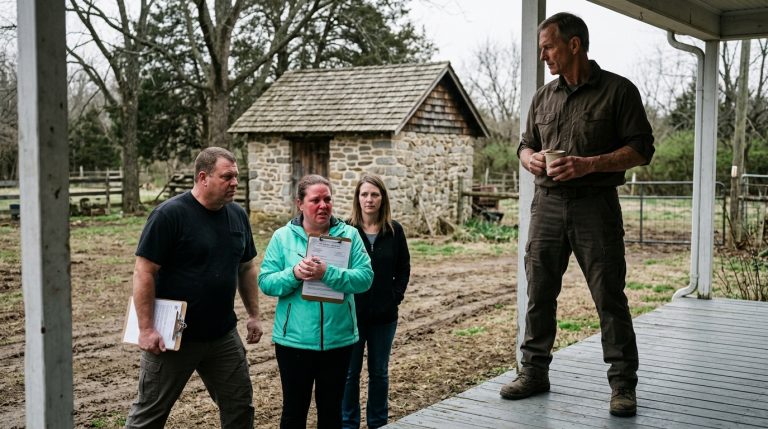
The fresh tread marks were four inches wide, deep enough to slice through forty years of packed river gravel. Dual axle. Heavy frame. The white Escalade hadn’t slowed down for the oak bend, and it hadn’t cared about the dust.
I didn’t stop turning the brass key in my right hand.
It was eight inches long, heavy, notched with four iron teeth that fit the spindle of the 1887 Sentinel Gate submerged fifty yards off the dock. My thumb ran over the cold, pitted alloy, resting on the worn stamped letters: S. WHITMORE – 1887.
The Escalade door slammed. The air smelled of burnt transmission fluid and expensive lavender perfume.
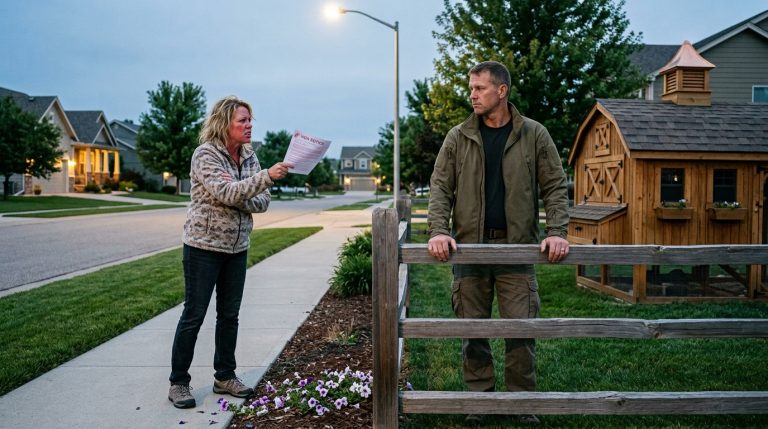
“Mr. Whitmore.” Cordelia Blackwood didn’t offer a hand. She held a red-inked paper folded in thirds, her nails manicured to sharp, bloodless points. “You’re parked on a designated community access path.”
“This gravel was laid by my uncle in seventy-two,” I said. My voice stayed down, flat, locked behind my teeth. “It sits six feet inside my deeded line.”
“Your deeded line is subject to the 2008 Lakeshore Estates Master Covenant.” She snapped the paper flat. The white sheet crackled in the damp breeze off the water. “Unapproved dock structure. Hazardous timber decay. Monthly water-use assessment: five hundred dollars, retroactive to your uncle’s death.”
“Five hundred.” I turned the brass key once. The metal bit into my palm, grounding the heat behind my ribs. “For water my great-grandfather bought before this county had a paved road.”
“The lake is a shared community asset, Ezra.” Her eyes were slate-grey, completely unblinking behind wire-rimmed glasses. “Your private dock violates safety code 14-A. You have thirty days to demolish the structure, or the association will clear it at your expense. Plus daily fines.”
“Code 14-A applies to residential subdivisions,” I said. I stepped off the gravel, my boots crunching softly on the pine needles. The distance between us closed to four feet. “This lot isn’t in a subdivision.”
“Every lot on Mirror Lake is under HOA oversight,” she said. She didn’t step back. Her chin stayed tilted up, her designer blazer pristine against the backdrop of rotting pine bark and grey water. “You sign the acknowledgment, or the lien process begins on Monday.”
“Show me the county filing.”
“You can view the filings at the board office,” she replied instantly. “During business hours.”
She thrust the paper forward. I didn’t reach for it. I let it hover between us while the lake water slapped rhythmically against the hand-hewn oak pylons below the dock—a steady, hollow thud that had outlasted three generations of men who knew how to measure land.
“Leave the paper on the truck hood, Cordelia,” I said. “And keep your tires off my gravel.”
Her mouth tightened into a thin, colorless line. She didn’t argue. She slapped the paper onto my driver’s side glass, turned on her heel, and climbed back into the Escalade. The engine roared, tires spitting river stone into the weeds as she reversed back down the lane.
I stood there until the dust settled back into the pine needles. Then I looked down at the paper on the glass.
Stamped across the bottom in red ink was a single reference code: Ref: Section 12-B Pending Adjustment.
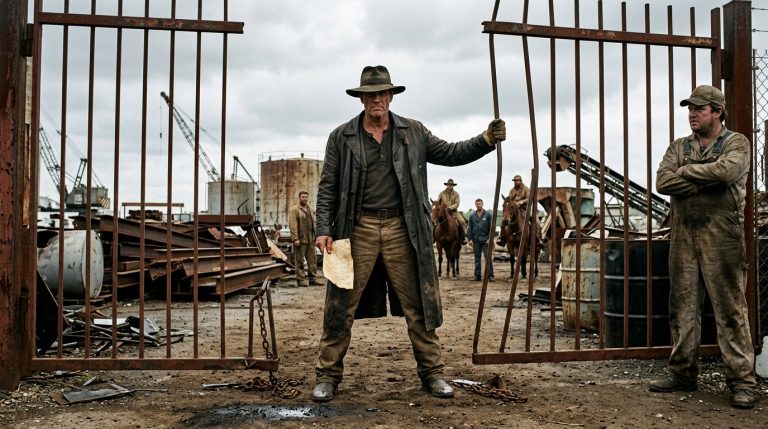
I squeezed the brass key until the edges dug raw against my knuckle. The fight wasn’t about a dock. It was about who controlled the gate.
CHAPTER 2: VAULT OF SILENT PAPER
The dust from Cordelia’s tires took forty-two seconds to clear the oak branch. I timed it by the steady, hollow thump of the lake against the dockpiles behind me.
I folded the red-inked notice into my coat pocket, right beside the 1887 brass key. The key’s heavy teeth pressed hard against my floating rib through the canvas liner. Cold iron. Unyielding.
I didn’t take the truck back toward the main road. Instead, I cut through the back trail, past the old timber line where the county asphalt ended and the original dirt easement began. Twenty minutes later, I was pulling into the gravel lot of the county recorder’s building in Oakhaven.
The basement smelled like forty years of decomposing pulp, damp concrete, and the ozone tang of cheap fluorescent bulbs buzzing at sixty hertz.
“We don’t pull plat maps after four, Ezra,” Martha said from behind the Formica counter. She’d been sitting at that same metal desk when my father brought me in here to register my first hauling permit in ninety-six. Her bifocals hung on a beaded silver chain, resting against a faded knit cardigan. “System shuts down.”
“I don’t need the computer, Martha,” I said, leaning my forearms against the scuffed laminate. “I need the physical deed books. Volume 4, page 112. Silas Whitmore.”
She paused, her hand hovering over a half-eaten sleeve of soda crackers. Her grey eyebrows knit together. “That’s in the vault.”
“I brought a flashlight.”
She looked at me for three seconds—reading the grease on my knuckles, the red dust still caked on the cuffs of my canvas coat, the flat set of my jaw. She didn’t ask questions. She just reached into her desk drawer, pulled out a brass skeleton key worn down to a smooth thumb-print, and laid it on the counter.
“Aisle six. Bottom shelf. Mind the moisture on the floor,” she said softly. “The county cut the dehumidifier budget last spring.”
The vault door was six inches of solid iron, painted green during the New Deal and never repainted since. It swung open on grease-slick hinges with a low, heavy groan that rattled in my teeth.
Inside, the air was ten degrees colder than the hallway. Row after row of bound leather volumes stood like gravestones, their gold-leaf spines cracked and dark with age. My flashlight beam cut through the hanging dust, highlighting the white bloom of mold creeping up the lower shelves.
I found Aisle Six. The volume was thick—four inches of heavy, acid-free rag paper bound in split cowhide. I lifted it off the bottom shelf, my back muscles tightening as I swung the thirty-pound book onto the oak viewing table in the center of the room.
I turned the thick, yellowed pages carefully, the paper rustling like dry corn husks. Page 112.
Silas Whitmore. October 14, 1887.
The copperplate handwriting was sharp, dark, penned in iron gall ink that had eaten slightly into the fiber. I ran my index finger along the boundary lines: …thence north thirty-four degrees east to the margin of Mirror Lake, including all riparian authority, water-gate controls, and the bed of said lake to a depth of two hundred feet below low-water mark…
Right below the seal, inked in a smaller, tighter script, was a marginal note from 1922: Ref: Watershed Control Exception, Section 12-B.
There it was again. Section 12-B.
“Fascinating, isn’t it?”
The voice came from the vault doorway. High-tenor, rapid, with the nervous edge of a man who drank his coffee too fast.
I didn’t jump. I kept my hand flat on the 1887 deed, turning my head slowly.
A young man in a charcoal suit that was a size too big around the shoulders stood in the doorway. He was clutching a battered leather briefcase, his hair slightly damp from the evening mist outside. Tommy Reeves. He’d passed the bar eight months ago and opened a one-room office above the hardware store downtown.
“You’re trespassing in the historical archive, Tommy,” I said.
“Martha let me in,” he said, stepping into the cold air of the vault. His eyes were wide, scanning the ledger. “She told me you came in looking like you were ready to dig up a body. I figured you might need someone who knows how to read the Latin phrases in those old property grants.”
“I don’t need Latin,” I said, tapping the ink. “I need to know why an HOA created in 2008 thinks it has jurisdiction over a land grant signed by the governor in 1887.”
Tommy walked over, leaning over the heavy book. He pulled a small penlight from his breast pocket and clicked it on, inspecting the margin. He smelled like mints and printer toner.
“They rely on the Grandfather Limitation Act of ’94,” Tommy murmured, his eyes scanning the lines like a hawk on a fence post. “It automatically incorporates non-registered parcels into newly formed municipal districts if the owner fails to file an exemption notice within five years of creation.”
“My uncle Morris never filed an exemption,” I said.
“He didn’t have to,” Tommy countered, his voice suddenly sharpening. He pointed a thin, ink-stained finger at the bottom of the page. “Look at the seal, Ezra. That’s a Sovereign Water Grant. Under state constitutional law, a Sovereign Grant can’t be modified by a municipal covenant or an HOA board unless the state legislature explicitly revokes the original charter.”
“Did they revoke it?”
“If they had, the county water district would own the lake, not Cordelia Blackwood,” Tommy said, a slow smile spreading across his face. “Cordelia is operating on a bluff. She’s using the threat of daily fines and foreclosure to force long-time owners into signing voluntary accession agreements.”
“And if they sign?”
“If they sign, they surrender their pre-1900 water rights to the association,” Tommy whispered. He looked up, his eyes catching the harsh beam of my flashlight. “Ezra, if she gets your parcel, she controls the flow for the entire south basin. Every cabin, every dock, every intake valve.”
I looked down at the old ink. S. Whitmore. My great-grandfather hadn’t just bought land; he’d locked the key and thrown away the lock.
“She’s calling a board meeting tonight,” Tommy added, dropping his voice even lower. “Seven-thirty at the community hall. It wasn’t on the public calendar. She’s planning to vote on a special assessment for ‘lake maintenance’ before anyone realizes what she’s doing.”
I closed the heavy ledger. The sound was like a rifle shot in the small stone room, blowing a puff of ancient dust straight into the air.
“Get your briefcase, Tommy,” I said, reaching into my coat and feeling the cold, hard teeth of the brass valve key against my ribs. “We’re going to a meeting.”
CHAPTER 3: THE AMBUSH AT SEVENTHIRTY
The heavy iron vault door groaned shut behind us, locking the smell of ninety-year-old paper back into the stone.
Outside, the mist had turned into a steady, freezing drizzle. The headlights of my F-150 cut through the dark as we navigated the three miles of rutted gravel back toward the lake. Tommy sat in the passenger seat, his knees jammed against his scuffed briefcase, frantically organizing photocopies by the weak amber glow of the cab light.
“We have twelve minutes before she calls the meeting to order,” Tommy said, his index finger tracing a highlighted line on a certified land-plat duplicate. “If she establishes a quorum before we enter, she can push the procedural vote through under emergency bylaws.”
“She won’t have a quorum,” I said, shifting into third gear as the truck climbed the ridge over the lake. “Mavis Lane hasn’t missed a meeting in forty years. If Cordelia didn’t give her seventy-two hours’ written notice, the entire assembly is dead on arrival.”
We pulled into the gravel lot of the Mirror Lake Civic Center at seven-twenty-eight.
The building was a cinder-block box built in the late fifties, painted a dull pine green that flaked off in long strips along the northern wall. Six cars were parked out front—Cordelia’s pristine white Escalade sat directly under the halogen security flood, flanked by three identical grey sedans belonging to her executive committee.
We didn’t use the main double doors. I pushed open the side fire exit, the rusted latch giving way with a metallic clack that echoed down the hollow hallway.
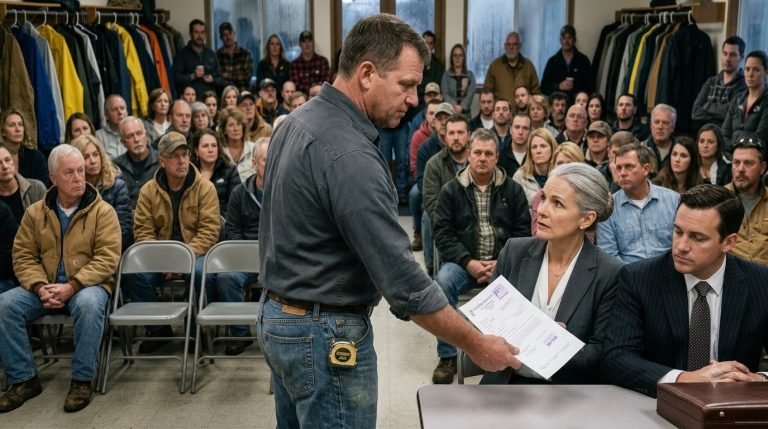
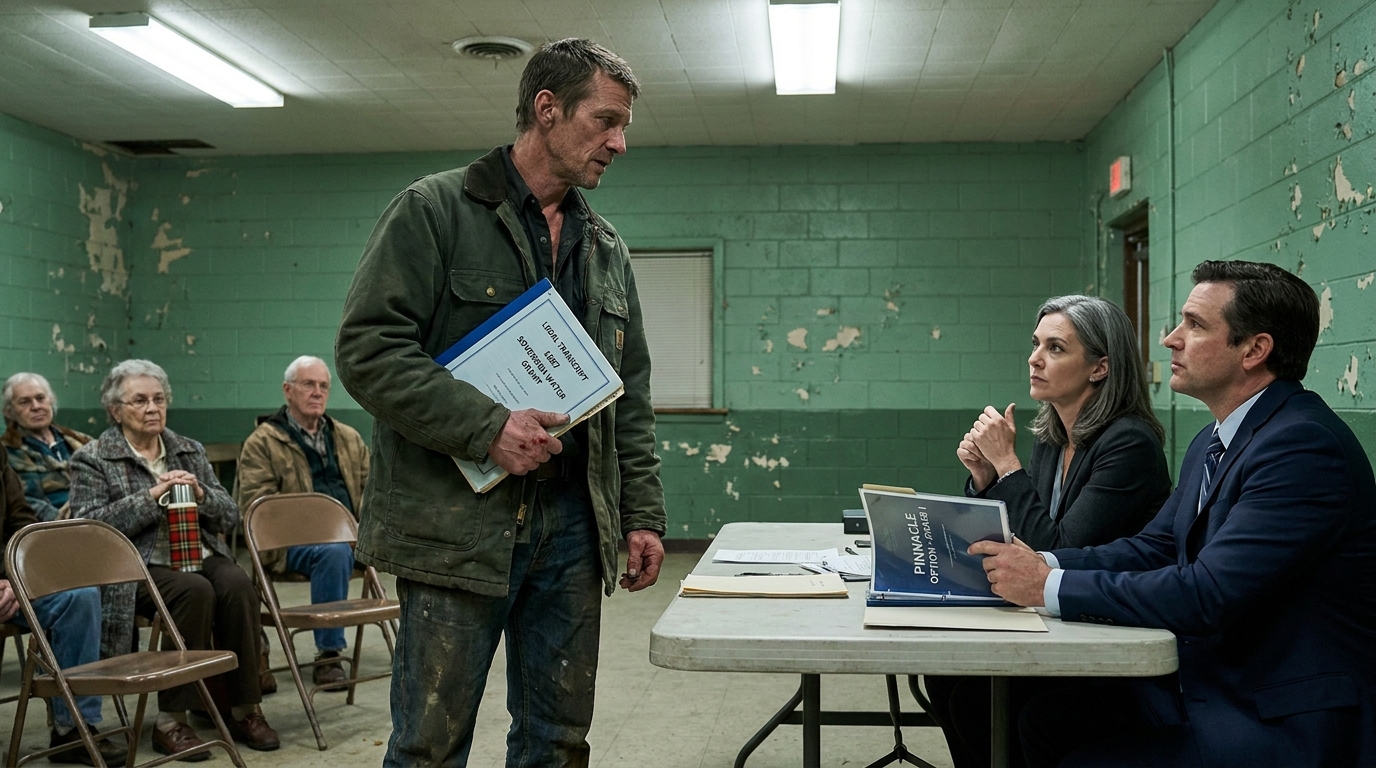
The main hall smelled of damp wool, industrial floor wax, and lukewarm instant coffee. Four rows of brown metal folding chairs faced a long folding table at the front. Cordelia Blackwood sat dead-center behind three thick binder stacks, her designer glasses resting on a gold chain around her neck. Sitting to her left was a man in a tailor-fitted navy suit holding a slick, gloss-laminated proposal folder labeled Pinnacle Option – Phase I.
There were only eight residents in the audience—mostly elderly property owners sitting near the back radiators, shivering in their coats. Mavis Lane sat in the third row, her wrinkled hands wrapped tight around a plaid thermos.
“…and so the special assessment of twelve hundred dollars per parcel will cover the mandatory environmental remediation,” Cordelia was saying, her sharp voice bouncing off the metal rafters. She didn’t look up from her script. “As outlined in Code 14-A, failure to remit within thirty days will—”
“Code 14-A doesn’t apply to unplatted watershed boundaries, Cordelia,” I said, my boots striking the linoleum floor with a slow, heavy rhythm.
The entire room turned.
Cordelia’s head snapped up. Her expression didn’t shatter—she was too practiced for that—but her fingers twitched once, creasing the edge of her printed agenda.
“This is a closed executive session, Mr. Whitmore,” she said, her voice dropping an octave into a smooth, practiced baritone. “Non-registered occupants are required to clear the floor.”
“I’m not a non-registered occupant,” I said. I stopped ten feet from her table, letting my canvas coat hang open. “And this isn’t a closed session. Under Section 4 of the state Non-Profit Corporations Act, any assessment vote affecting shared drainage boundaries requires a public notice filed with the county clerk seventy-two hours prior.”
Tommy stepped up beside me. He unlatched his briefcase with two sharp clicks that sounded like handcuffs snapping shut in the quiet room.
“We just came from the county vault, Ms. Blackwood,” Tommy said, his voice trembling slightly before finding its footing. He pulled three blue-bound sheets from his folder and laid them flat on the center table, directly over her printed agenda. “Here is the certified transcript of the 1887 Sovereign Water Grant for Parcel 04-B. The Whitmore estate holds exclusive riparian authority over the southern basin. The association has no legal right to levy environmental assessments on property it does not own.”
The man in the navy suit next to Cordelia—the one holding the Pinnacle Option folder—slid his chair back three inches. His eyes didn’t look at Cordelia; they dropped straight to the blue-bound legal transcript Tommy had dropped on the table.
“These documents are antiquated historical artifacts, Mr. Reeves,” Cordelia said calmly, though her thumb began rubbing a raw, red circle into the flesh of her index knuckle. “They were superseded by the 2008 municipal alignment survey.”
“Show us the signed alignment deed, then,” Mavis Lane called out from the back, her voice raspy but clear. She stood up, her plaid thermos clinking against the metal chair. “Show us where Silas Whitmore’s heirs signed away the water rights. Because I’ve lived on this lake for seventy-eight years, Cordelia, and I know for a fact Morris Whitmore never signed a damn thing.”
A low murmur broke out among the elderly residents near the radiators.
Cordelia didn’t look at Mavis. She looked straight at me, her slate-grey eyes cold, calculating, and completely devoid of panic. She picked up her pen, clicked it once, and neatly closed her central binder.
“The board will take these submissions under advisement,” Cordelia said smoothly. “This meeting is adjourned.”
“We’re not done, Cordelia,” I said, stepping two inches closer to the table until I could smell the sharp, artificial lavender perfume clinging to her collar. “You sent a notice to my dock this morning citing Section 12-B. I want to know who authorized that code update.”
She stood up, pulling her leather handbag over her shoulder. She looked down her nose at me, her lips curling into a microscopic smile that never reached her eyes.
“The county building inspector will be at your property at eight o’clock tomorrow morning, Ezra,” she murmured, low enough that only Tommy and I could hear. “Let’s see how well your 1887 paper holds up against three code violations and a condemned septic line.”
She turned and walked toward the side exit, her high heels clicking a steady, rhythmic march across the floor. The man with the Pinnacle Option folder picked up his papers, tucked them under his arm without saying a word, and followed her into the dark.
CHAPTER 4: THE AMBUSH ON THE GRAVEL
At seven-fifty-eight, the fog was still low enough to swallow the lower posts of the dock.
I stood on the gravel driveway, a mug of black coffee steaming in my right hand, my left thumb resting against the 1887 brass key in my coat pocket. The gravel didn’t lie; three engines were grinding up the grade in second gear.
The convoy pulled through the oak bend right on eight. A county building inspection van, a state environmental utility truck, and Deputy Roy Hutchkins’ white-and-gold patrol cruiser riding tail.
Pete Vance climbed out of the lead van before the suspension even settled. He was fifty-eight, wore a stained canvas jacket with an inspector’s badge pinned to the pocket, and held a brass-tipped measuring tape in his calloused hand. He didn’t look at me; he looked at the ground, his boots grinding into the stones.
“Ezra,” Pete said, his voice as rough as dry cedar.
“Pete.” I didn’t move off the porch steps. “You’re six miles outside your district.”
“Got an emergency dispatch at six-thirty,” Pete muttered, pulling a stiff yellow clip-board from under his arm. He tapped a printed sheet with a dirty thumbnail. “Anonymous report filed under Municipal Code 14-A. Unpermitted shoreline modification, structural decay on a commercial access point, potential septic runoff into a public watershed.”
Deputy Roy Hutchkins stepped out of the cruiser, shutting his door with a heavy, metallic latch. He hitched his duty belt, his eyes cutting across the property line toward the treeline before meeting mine.
“Three calls to the county desk since yesterday afternoon, Ezra,” Roy said softly, stepping up beside Pete. “All coming through the same anonymous online portal. All citing the exact same code sub-clauses.”
“Who’s the second truck?” I asked.
A younger guy in a clean, high-visibility vest stepped out of the environmental utility vehicle, carrying a soil probe and three sealed plastic sample jars. He looked like he’d spent more time reading manuals than stepping in mud.
“Department of Environmental Quality,” the kid said, flexing his jaw. “We have a mandated protocol for unverified discharge claims on lakefront parcels.”
“Go ahead and probe,” I said, pointing toward the south bank. “The septic tank was poured in ninety-eight by Miller & Sons. Pre-cast reinforced concrete, four hundred feet back from the high-water line, baffled and vented to state specification. You’ll find the inspection plaque buried three inches under the turf by the big cedar.”
Pete sighed, rubbing the back of his neck. He walked down to the dock, his heavy boots echoing hollowly on the hand-hewn oak planks. I followed him down, Roy walking two paces behind us while the kid with the soil probe headed toward the cedar grove.
Pete knelt at the edge of the dock, dropping his measuring tape down the face of the lead pylon. He pulled it up, checked the marking, then squinted at the joists beneath the deck.
“White oak,” Pete muttered, running his fingers along the grain. “Not a grain of rot. Frame is solid steel-bolted. This structure could hold a loaded dump truck.”
“Does it violate Code 14-A?” I asked.
“Code 14-A is for pressure-treated pine docks built on foam floats,” Pete said, looking up at me over his glasses. “This thing is anchored directly to bedrock. Ezra, whoever filed this complaint didn’t even look at the dock. They just pulled a form letter off a database.”
“Look at the header on that dispatch sheet, Pete,” Roy said, stepping up to the edge of the planks. He pointed his thumb toward the clip-board in Pete’s hand. “What’s the routing code at the top?”
Pete flipped the cover sheet. Stamped in light grey dot-matrix ink across the top margin was a filing index: ROUTING: DIST-4 / SUB-REF: SECTION 12-B / APPL: BLACKWOOD-SOLUTIONS.
Roy looked at me, his face grim. “Blackwood Environmental Solutions. That’s a private consultancy registered out of Oakhaven.”
“She’s using private audit filings to trigger public county dispatches,” I said, the cold iron key feeling heavier in my pocket. “She files the complaint under her company name, the county is legally obligated to inspect, and then she uses the inspection dispatch notice as proof of an ‘ongoing violation’ to the HOA board.”
“It’s a paper loop,” Roy said flatly. “She creates the paper on one end, forces us to serve it on the other, and uses the middle to squeeze you out.”
The kid from DEQ came walking back from the cedar grove, his soil probe dripping with dark, rich loam. He looked at his sample jar, then at Pete, scratching his ear in confusion.
“Nitrate levels are completely baseline,” the kid admitted, his voice dropping. “System is tighter than my house in town.”
CHAPTER 5: THE IRON AT THE SENTINEL GATE
The carbon slip from Deputy Roy’s desk log stayed tucked in my watch pocket, stiff against my hip as I walked the south bank.
I followed the waterline past my dock, where the pine roots knotted into the red clay like exposed veins. Five hundred yards down the shore, where the creek channel cut a narrow trough into the basin, a thick stand of weeping willows bowed into the grey water.
Hidden inside that tangle of swamp oak and willow roots stood a cast-iron housing, six feet tall and black with green river-moss. The Sentinel Gate.
My great-grandfather had set the footings in 1887, pouring three tons of hydraulic cement into the granite bedrock before bolting the gears down with two-inch iron studs. The housing was pitted like old anvil steel, cold enough to draw the warmth straight out of my palm through my leather work glove.
I cleared the wet willow leaves from the access hatch, exposing the heavy brass spindle.
I pulled the 1887 brass key from my coat. The four notched teeth lined up perfectly with the internal keyway. I slid it home—a heavy, grease-smooth thunk that resonated deep down in the submerged gear housing six feet under the silt.
I didn’t turn it yet. I stood there listening.
Across the water, half a mile toward the eastern point, a sleek red motorboat was idling along the shoreline. It wasn’t fishing. It was traveling at three knots, trailing a yellow hydrographic sonar torpedo behind its stern. The letters on the side of the hull were crisp, white, and unmistakable: PINNACLE SURVEY CORP.
They were mapping the water depth right up to the edge of my property line.
I leaned against the iron valve housing, watching the wake cut through the glassy water. They weren’t checking for fish. They were measuring the draft for a sixty-slip luxury marina. If Cordelia delivered the water rights, Pinnacle would dredge four feet of granite shelf right off my boundary, draining the marshland and dropping the basin’s baseline level by three feet.
“You shouldn’t be messing with that valve, Ezra.”
The voice came from behind the willow trunk. Mavis Lane stepped through the wet branches, wearing an oilskin yellow slicker over her flannel shirt, carrying a pair of heavy garden shears. Her boots sank two inches into the mud, but she didn’t care; she was eighty-two, and this shore had been her backyard before the county laid its first paved mile.
“It’s my valve, Mavis,” I said, my hand resting on the key handle.
“It’s the lake’s valve,” she corrected, her voice gravelly and sharp. She stepped closer, her breath plume rising in the chill air. “Your great-grandfather built it so the farmers downstream wouldn’t lose their crops when the spring floods came. Silas didn’t build it to sell to a corporation.”
“I’m not selling.”
“Cordelia thinks you are,” Mavis said. She reached into her slicker pocket and pulled out a folded flyer printed on glossy cardstock. She handed it over. “These were stuck in every mailbox along the north road at noon.”
I unfolded the card. It was a mock-up brochure printed by Pinnacle Lake Development. Across the front was an artist’s rendering of multi-story glass condominiums lining the southern shore, complete with a private boardwalk right over the area where my dock stood.
In the fine print at the bottom of the back page, my eye caught the legal disclaimer: Waterway Access and Flow Realignment Subject to Pending Final Acquisition under Section 12-B Municipal Waiver.
“She’s listing your land as ‘acquired under option’ in her prospectus to investors,” Mavis said, watching my face. “She’s taking millions in private backing on the promise that you’ll break under the pressure.”
“She’s using money she stole from the HOA to pay the option fees,” I said, the pieces locking together in my head. “The forty-eight thousand Roy found in Blackwood Environmental… that was just the retainer. She’s using community maintenance dues to keep the land option agreements active until Pinnacle closes the financing.”
Mavis’s jaw tightened, her wrinkled skin pulling taut over her cheekbones. “She’s using our own dues to buy the rope to hang us with.”
“She needs the water level locked at fourteen feet to make their dock draft work,” I said. I looked down at the brass key sticking out of the iron gate. “If the water drops below twelve, their marina project is worthless. The draft won’t take a twenty-foot cruiser.”
“What are you going to do, Ezra?”
I gripped the T-handle of the 1887 key with both hands. I braced my boots against the mossy concrete pad and leaned my weight into it.
The gears inside the submerged housing groaned—a deep, iron-on-iron screech of ancient teeth turning in thick tallow grease. One quarter-turn counter-clockwise.
A low rumble shook the ground beneath our boots. Fifty yards out in the channel, a surge of dark, silt-heavy water boiled up from the bottom as the underwater bypass sluice opened six inches. The surface of Mirror Lake shuddered, a long ripple spreading toward the eastern point where the survey boat was idling.
The boat’s depth alarm began to sound across the water—a faint, high-pitched ping-ping-ping carried on the wind as the water level around their sonar array instantly dropped two inches.
I left the key locked in the valve and turned to Mavis.
“I’m going to call Tommy,” I said, my voice flat as cold slate. “Tell him to pull the banking records for Blackwood Environmental. It’s time to see where the rest of that two hundred thousand went.”
CHAPTER 6: THE TRAIL OF SHELL COMPANIES
The gear rumble of the Sentinel Gate was still vibrating in the soles of my work boots when I climbed the wooden stairs above Oakhaven Hardware.
Rain lashed against the single pane of glass at the end of the hallway, carrying the smell of wet cedar and hot coal smoke from the stove below. The frosted glass door read THOMAS REEVES, ATTORNEY AT LAW in fresh gold vinyl that was already peeling at the corners.
Tommy didn’t look up when I pushed the door open. He was sitting behind a oak desk piled four feet high with blue ledger folders, a cold half-eaten sandwich sitting on a stack of bank receipts. His tie was loose, his collar unbuttoned, his eyes red-rimmed behind his wire glasses.
“I pulled the public corporate disclosures for Blackwood Environmental, Ezra,” Tommy said without greeting. His voice was hoarse, dry from four hours of reading numbers. “It’s not just forty-eight thousand.”
I pulled a wooden folding chair up to the desk, the legs screeching against the bare pine floorboards. I sat down, leaning my elbows on the edge of the scuffed laminate.
“How much?” I asked.
Tommy slid three printed bank ledgers across the desk. The paper was cold to the touch, fresh off his inkjet printer.
“Two hundred and twelve thousand dollars,” Tommy said softly. “Transferred over thirty-six months from the Lakeshore Estates Capital Reserve Account directly to an operating account registered at First Oakhaven Bank under the name Blackwood Environmental Solutions LLC.”
I ran my thumb along the line items. Monthly withdrawals. Always kept just under ten thousand dollars—the exact threshold that triggers mandatory federal reporting. Nine thousand eight hundred. Nine thousand five hundred.
“What was the memo on the vouchers?”
“Consulting,” Tommy laughed—a short, bitter bark that held zero humor. “Sub-surface hydrological assessment. Watershed impact studies. Administrative compliance under Section 12-B.”
“And where did Blackwood Environmental send the money?”
Tommy reached into his drawer and pulled out a second stack—these were certified county real estate transfer records. He laid them out side-by-side like a hand of cards.
“Option agreements,” Tommy said, pointing his pen at the land parcel numbers. “Six three-acre waterfront lots on the south point. All currently owned by long-time residents—the Hendersons, the Martinez family, old man Vance. Cordelia used the HOA’s reserve cash to buy three-year exclusive purchase options on those parcels under the corporate name Pinnacle Option Partners LLC.”
I looked at the corporate filings. The registered agent for Pinnacle Option Partners was a legal firm in Oakhaven, but the sole managing member listed on the tax schedule was Cordelia Blackwood.
“She didn’t just steal the money,” I said, feeling my back muscles lock down hard against the chair. “She used the community’s own reserve fund to buy up the land options she needed to hand the entire south basin over to Pinnacle Lake Development.”
“It’s self-dealing,” Tommy said, his hand trembling as he picked up his coffee cup, taking a sip before realizing it was stone-cold. He set it down with a sharp clack. “It’s a clear breach of fiduciary duty under state corporate law. But here’s the catch, Ezra.”
“What catch?”
“The option agreements contain an automatic execution clause,” Tommy said, leaning forward. His pen tip tapped a paragraph highlighted in yellow on the top document. “If the master water rights for Parcel 04-B—your land—are brought under association jurisdiction by the end of this month, Pinnacle Lake Development pays a five-hundred-thousand-dollar finder’s fee directly to Pinnacle Option Partners. To Cordelia.”
“And if I don’t sign?”
“If you don’t sign, the option agreements expire. Cordelia loses the option deposits—over a hundred grand of stolen HOA money—and Pinnacle Development walks away. The HOA goes bankrupt because its reserve account is bone-dry, and Cordelia is left holding the bag for two hundred thousand in embezzled funds.”
The radiator in the corner hissed, a burst of wet steam escaping the valve.
I stood up slowly, the leather of my coat creaking in the quiet room. The pieces were all on the table now. Cordelia wasn’t a bureaucrat defending community standards. She was a cornered gambler who had bet the entire neighborhood’s money on a deal that required my neck in the noose.
“She’s not going to wait for the end of the month, Tommy,” I said, looking out the rain-streaked window toward the dark outline of the lake ridge. “She’s out of time.”
“What are you going to do?”
“I’m going to put a lock on the Sentinel Gate,” I said. “And then I’m going to invite Deputy Roy to take a look at these bank ledgers.”
CHAPTER 7: NIGHT SHADOWS ON THE WATER
The steel chain I had wrapped around the spindle of the Sentinel Gate was three-eighths-inch hardened alloy. The brass padlock clicked shut with a dull, heavy thunk that echoed across the dark water.
Rain was still falling, a steady freezing needle-spray that turned the clay along the bank into slick mud. I stood by the willow trunk, watching the black surface of the lake. The survey boat from Pinnacle was gone, but the silence felt thin, stretched tight like a rusted wire under load.
It was two-fifteen in the morning when the engine cut out over by the south cove.
Not a big diesel. A small outboard, killed early, letting a flat-bottom aluminium skiff drift in on the current. The muffled slap of water against a hull carried across the basin, sharp in the cold stillness.
I didn’t flash a light. I stayed in the shadow of the swamp oak, my boots wedged into the mud, my hand buried in my coat pocket around the smooth brass edges of the valve key.
The skiff hit the edge of my dock with a soft, hollow bump.
A shadow moved on the deck—one man, short, wearing a heavy hooded coat. He stepped onto the hand-hewn white oak planks, his boots making a wet squelch against the timber. He carried a heavy canvas tool bag in one hand and a battery-powered angle grinder in the other.
He didn’t head for the cabin. He went straight for the primary support pylon—the one anchored to the granite bed.
I moved down the bank, my steps silent on the wet pine needles. The wind was coming off the water, carrying the sharp, metallic tang of cold river water and fresh grease.
The man knelt on the deck, unzipping the tool bag. He pulled out a pair of heavy bolt cutters, setting them beside the grinder. He reached down to clamp the jaws onto the steel tie-rod that anchored the main dock frame to the shore.
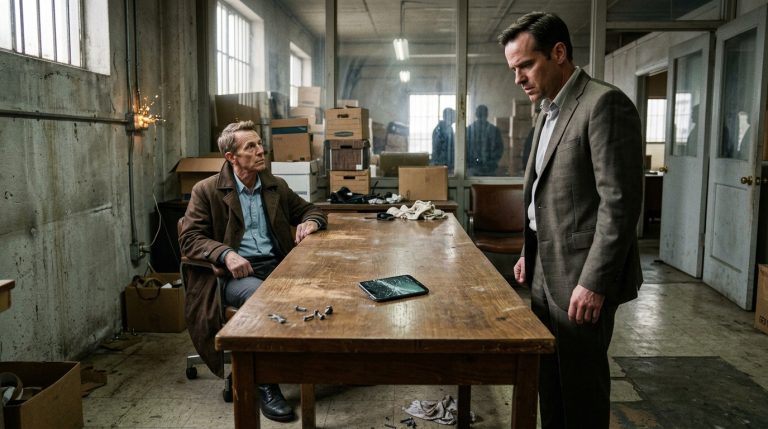
“That rod is structural steel, friend,” I said, my voice flat and quiet as I stepped onto the first plank of the dock. “You’ll ruin those jaws before you nick the galvanizing.”
The man flinched hard, his head snapping around. The hood fell back an inch, catching the pale, grey moonlight filtering through the clouds.
Marcus Webb. The private investigator Cordelia had hired—the guy in the rumpled suit who’d been sitting outside the diner three days ago. Only tonight he wasn’t carrying a camera; he was holding six pounds of hardened steel.
“Whitmore,” he rasped, his voice tight, his breath coming in fast white plumes. He didn’t drop the tool bag, but his hands stayed low, hovering near the cutter handles. “You shouldn’t be out here.”
“It’s my dock,” I said. I took two slow steps forward. The wood didn’t creak under my boots; Silas Whitmore had built the joists out of six-by-twelve oak. “And those are my tie-rods.”
“Look, man,” Webb said, his thumb twitching against his coat seam as he backed up two inches toward the skiff. “I’m just clearing a job order. Structural hazard removal under Section 12-B.”
“Section 12-B doesn’t give you authority to cut steel on private property, Webb.”
“She paid me fifteen hundred in cash to drop this dock into the channel tonight,” Webb blurted out, his teeth clicking slightly in the cold. He looked down at the bolt cutters, then back at my face. “She said if the dock was floating loose by dawn, the county safety officer would issue an immediate emergency seizure order under the municipal hazard clause.”
“And you believed her?”
“I don’t care about her clauses!” Webb’s voice rose, cracking against the quiet roar of the rain on the lake. “I care that she’s got five grand of my back-billed invoices sitting on her desk, and she told me I don’t get paid a dime until this structure is detached.”
“She’s broke, Webb,” I said, stepping into the space between him and his skiff. “Tommy Reeves pulled her corporate accounts today. Blackwood Environmental is empty. Pinnacle Option Partners is in default on three parcel payments. She doesn’t have your five grand, and she won’t have it on the first of the month.”
Webb froze. His hand, still gripping the handle of the bolt cutters, went completely slack. The heavy steel jaws clattered against the oak planks with a loud, metallic ring.
“She… she signed a corporate draft,” Webb muttered, his eyes darting toward the dark water as if looking for an exit that wasn’t there. “Two days ago.”
“The draft will bounce,” I said. “And when Deputy Roy comes down this drive tomorrow morning to investigate a felony sabotage report on a Sovereign Water Grant, you’re the one who’s going to be sitting in the county lockup while Cordelia sits in her air-conditioned office.”
Webb looked at the cutters on the floor, then at his own grease-stained hands. He swallowed hard, his throat making a dry, clicking sound.
“She’s crazy, Whitmore,” he whispered, stepping back until his heels hit the gunwale of his skiff. “She’s got files on everyone. The Martinez family, old man Vance, the county clerk… she hired me to track their bank accounts, their mortgages, finding anything she could use to press them into signing those options.”
“Where are those files?” I asked.
Webb reached slowly into his heavy coat, pulled out a thick manila envelope wrapped in rubber bands, and dropped it onto the dock between us.
“In there,” Webb said, his voice dropping to a whisper. “Payment receipts, instruction sheets, hit lists for the option press. I’m done. I’m taking my boat and I’m clearing out.”
He didn’t wait for an answer. He dropped into the skiff, yanked the pull-cord on the outboard, and pushed off into the dark. The motor sputtered, caught, and hummed away toward the north shore, leaving only the smell of burnt two-stroke oil lingering on the wet air.
I knelt down, picked up the manila envelope, and felt its weight in my hands. The paper was damp from the rain, but the ink inside was dry enough to burn down Cordelia’s entire empire.
CHAPTER 8: THE FILES IN THE CAB
The paper was damp where my thumb pressed into the corner of the manila envelope, but the rubber bands held it tight.
I sat in the cab of my F-150 with the dome light off, rain drumming against the steel roof in a steady, heavy rhythm. Down on the water, the ripples from Marcus Webb’s outboard were flattening out into the dark.
I snapped the two thick rubber bands off the envelope. They hit the dash with a soft flick.
Inside were forty-two pages of targeted surveillance reports, printed bank wire confirmations, and handwritten memo sheets. I flipped the dome light on, keeping the beam low with my left palm.
The top sheet was a bank transfer receipt dated March 14th: DEBIT: LAKESHIRE ESTATES MAINT ACCOUNT / CREDIT: BLACKWOOD ENV LLC / MEMO: SPECIAL CONSULTING – SECTION 12-B EXPANSION. Attached to it was a handwritten list of names in Cordelia’s sharp, slanted cursive.
Henderson, Vance, Martinez, Whitmore.
Beside each name was a dollar figure representing their remaining mortgage balance, followed by a notation of their municipal tax status. She hadn’t just been tracking who was behind on dues; she’d been pulling county lien records to calculate the exact financial pressure required to force a foreclosure sale under HOA bylaws.
I turned the page. A copy of a contract proposal from Pinnacle Option Partners sat underneath, stamped CONFIDENTIAL – NOT FOR DISTRIBUTION.
My eye caught a clause near the middle of page three: …upon execution of the unified parcel option under Section 12-B, Pinnacle Lake Development agrees to extinguish all outstanding municipal tax liabilities generated by the 2008 Realignment Survey…
I froze. The paper felt cold under my fingers.
The 2008 Realignment Survey.
Every argument Cordelia had made—every notice she had slapped on windshields, every threat of code violations—referenced the authority granted to the association under the 2008 survey. But here, in a private agreement with her development partner, she wasn’t treating the survey as established law. She was treating it as a liability that needed to be extinguished.
Why would a developer pay to extinguish a survey that gave them legal authority?
Unless the survey itself was a fraud.
I reached for my phone, my thumb dialing Tommy’s number before my brain even processed the impulse. He answered on the second ring, his voice sharp against the background hum of rain outside his window.
“Ezra? Did you lock the gate?”
“Tommy,” I said, my voice dead quiet in the cab. “Get back in your car and go to the county clerk’s office.”
“It’s three in the morning, Ezra.”
“I don’t care if it’s three in the morning. I’ve got Webb’s files in my lap,” I said, running my fingers over the printed contract. “Cordelia isn’t just embezzling dues to buy options. She’s hiding something in the 2008 Realignment Survey. The Pinnacle contract explicitly calls for extinguishing tax liabilities tied to that specific filing.”
There was a long silence on the line. I could hear the faint scratch of Tommy’s pencil against paper as he calculated the timeline.
“The 2008 survey was filed by Miller & Associates,” Tommy said slowly, his voice dropping an octave. “The same firm Cordelia used for her private land audits last year.”
“And who signed the county approval stamp on that survey, Tommy?”
“I… I don’t know,” Tommy admitted. “The plat map in the vault was a photocopy. The original was checked out by the association’s legal counsel six months ago.”
“It was never returned,” I said. “Check the county clerk’s sign-out ledger. I bet my truck that Cordelia personally pulled the original 2008 plat map and replaced it with a modified print.”
“If she altered an official county boundary record…” Tommy paused, a sharp intake of breath coming through the speaker. “Ezra, that’s not an administrative violation. That’s a class-three felony. It voids the entire municipal alignment. Every fee, every lien, every code enforcement action the HOA has taken since 2008 becomes totally illegal.”
“She didn’t just overstep her authority, Tommy,” I said, looking through the wet windshield at the dark, swollen outline of Mirror Lake. “She made it up.”
“She’s scheduled the emergency ’eminent domain’ vote for seven o’clock tonight at the annual meeting,” Tommy said, his voice rising with urgent energy. “She’s going to try to force the parcel seizure before anyone realizes the 2008 survey is a fake.”
“Let her call the vote,” I said, placing the manila envelope flat on the seat beside me and snapping the truck’s headlights on. “We’re going to that meeting with the original deed, the bank ledgers, and Webb’s file.”
I shifted into gear, the tires grinding into the gravel as I backed out of the dock lane. The rain was washing the dust off the hood, clearing the glass for the road ahead.
CHAPTER 9: THE EXECUTION AT SEVEN OCLOCK
Shadows stretched across the dashboard as the afternoon bled into rain, and four hours of tense prep broke when my truck tires finally crunched on the gravel outside the Oakhaven Community Center at six-forty-five.
The parking lot was packed forty cars deep. A Channel 7 news van was parked near the main doors, its satellite mast raised like a black spear against the dark clouds.
Inside, the hall was stifling. Two hundred metal folding chairs were arranged in rigid rows under buzzing halogen tubes. A camera crew was stationed on a riser near the center aisle, their LED floodlights painting the room in a harsh, unforgiving white glare.
Cordelia Blackwood stood behind a podium at the front, flanked by three poster boards covered in charts. She wore a tailored ivory suit, her silver hair lacquered into place, her wire-rimmed glasses catching the spotlight. Standing to her right was the representative from Pinnacle Lake Development, adjusting his tie while checking his watch.
“…and under the emergency provisions of Section 12-B,” Cordelia’s voice boomed through the PA speakers, sharp and smooth as polished ice, “the board is legally compelled to initiate immediate eminent domain acquisition of non-compliant shoreline parcels to preserve community valuation.”
I didn’t take a seat. I walked down the center aisle, my heavy canvas coat open, my work boots making a slow, steady thud-thud-thud against the linoleum floor. Tommy Reeves walked beside me, his scuffed leather briefcase locked in his right hand. Deputy Roy Hutchkins slipped through the rear entrance, taking a position against the back wall with his hands resting casually near his duty belt.
“Point of order, Ms. Blackwood,” I called out.
The room went dead silent. The Channel 7 camera operator swung his lens away from the podium, locking onto us as we reached the front row.
Cordelia’s expression didn’t crumble, but her hand twitched, her index finger pressing so hard into the podium wood that her knuckle turned dead white.
“This is an executive board vote, Mr. Whitmore,” Cordelia said, her voice dropping into a tight, controlled register. “Non-members may observe, but you have no standing on this floor.”
“I have standing under state property law,” Tommy said, stepping past me and setting his briefcase flat on the front table. He unlatched the brass clips with two loud snaps that echoed through the PA microphone. “And so does every property owner sitting in this room who paid dues under the 2008 Realignment Survey.”
“The 2008 survey is a recorded county document,” Cordelia snapped, leaning into her microphone. “It established municipal authority over the entire watershed basin. The time to challenge that filing passed sixteen years ago.”
“It would have passed,” Tommy said, pulling a blue-bound ledger from his briefcase and opening it flat for the Channel 7 camera to see, “if the 2008 survey was real.”
A rustle went through the audience. Mavis Lane leaned forward from the second row, her thermos clinking against her metal chair.
“What are you implying, Mr. Reeves?” Cordelia asked, her eyes narrowing into slits behind her glasses.
“I’m not implying anything,” Tommy said flatly. “At two o’clock this morning, the county clerk verified the original 2008 master plat map in the vault. The survey filed under Section 12-B was never approved by the county commission. The seal on your master covenant is a high-resolution forgery copied from a 1994 road easement.”
Cordelia’s jaw locked. Her mouth opened, closed, then set into a rigid, bloodless line. “That is a slanderous fabrication—”
“The original 1887 Sovereign Water Grant for Silas Whitmore remains the only legal survey on record for Parcel 04-B and the Sentinel Gate,” Tommy continued, his voice rising, crisp and authoritative. “Because your 2008 survey is legally void, this association has had zero corporate jurisdiction over any property on Mirror Lake for sixteen years. Every fee collected, every lien filed, and every code assessment levied under Section 12-B constitutes civil and criminal fraud.”
“You have no proof!” Cordelia slammed her palm onto the podium, her voice finally cracking, dropping the smooth polish. “The board acted in good faith based on legal counsel—”
“We have Marcus Webb’s surveillance files,” I said, stepping forward until I was four feet from her podium. I pulled the manila envelope from my coat and laid it beside Tommy’s ledger. “We have the bank transfer receipts showing two hundred and twelve thousand dollars funneled from the HOA maintenance account into Blackwood Environmental LLC. And we have the option agreement with Pinnacle Option Partners showing you used stolen community money to secure land deals for your own personal profit.”
The crowd erupted. Mrs. Martinez stood up, shouting over the noise; old man Vance waved a fist near the back. The representative from Pinnacle Lake Development backed away from the podium, grabbed his trench coat, and slipped quietly out the side exit.
Cordelia stood frozen in the beam of the TV floodlights. Her mask didn’t just crack—it shattered. Her chest heaved, her hands shaking uncontrollably as she tried to gather her printed charts, spilling papers across the floor.
“This meeting is adjourned!” she screamed over the noise, her voice raw. “Clear the hall! Clear the hall immediately!”
Deputy Roy Hutchkins stepped out from the back wall, his heavy boots sounding a deliberate rhythm as he walked down the aisle. He pulled a pair of steel handcuffs from his utility belt, the metal clicking sharply in the quiet that suddenly fell over the room.
“Cordelia Blackwood,” Roy said, his voice carrying the full, cold weight of the law. “You are under arrest for grand larceny, corporate embezzlement, and criminal fraud. You have the right to remain silent.”
The Channel 7 camera captured every second as Roy turned her around, pulled her hands behind her back, and clicked the steel cuffs over her manicured wrists. She didn’t look at the crowd; she kept her eyes fixed on the floor, her teeth biting into her bottom lip until a drop of dark blood appeared.
As Roy led her out through the double doors, the room broke into applause.
Tommy looked at me, a long, ragged exhale escaping his chest as he closed his briefcase.
“It’s over, Ezra,” Tommy whispered.
“Not quite,” I said, looking out the window toward the dark expanse of Mirror Lake. “We still have a gate to reset.”
CHAPTER 10: THE WATERS OF SILAS WHITMORE
The echoes of the community center had faded by the time sunrise broke over the eastern ridge, turning the grey fog above Mirror Lake into ribbons of pale gold.
I stood on the white oak deck my great-grandfather had laid in 1887. The air was sharp, smelling of wet cedar, damp earth, and pine needles. Down below, the water lapped against the thick pylon footings with a steady, hollow rhythm—a sound that had outlasted three generations of men, and one that would outlast me.
The heavy steel bolt cutters Marcus Webb had abandoned were still sitting on the bench by the cabin door. I picked them up, walked to the tool shed, and wiped the rain off their handles before oiling the pivot pin and placing them back on the pegboard.
A blue sedan pulled into the gravel drive at seven-thirty.
Tommy Reeves stepped out, wearing a plain grey sweater instead of his charcoal suit. He carried a fresh manila folder under his arm, his gait slow and unhurried as he walked down the path toward the dock.
“State Attorney General’s office filed formal indictment papers at six this morning,” Tommy said, leaning his shoulder against the handrail. “Cordelia’s bail was set at two hundred thousand dollars. Pinnacle Lake Development pulled their option offers before midnight and issued a statement dissolving their local venture.”
“And the 2008 survey?” I asked, looking out over the glassy water.
“Stripped from county records,” Tommy replied, opening the folder. “The court signed the emergency declaratory judgment. The forged filings under Section 12-B are expunged. Every parcel on Mirror Lake reverts back to its original metes-and-bounds deed. The HOA as a regulatory body is legally defunct.”
He pulled out a single sheet of heavy parchment, crisp and fresh, carrying the official seal of the state land registrar.
“What’s that?”
“The charter papers for the Mirror Lake Conservation Trust,” Tommy said, handing the sheet to me. “Mavis Lane signed as interim trustee an hour ago. Every family—the Hendersons, the Vance estate, the Martinez family—they’ve all transferred their shoreline management rights into a perpetual trust. No corporate buyouts. No high-density development. No private covenants.”
“Who’s listed as master of the watershed?”
“You are, Ezra,” Tommy smiled softly, tapping the bottom line. “Sovereign riparian authority remains exactly where Silas Whitmore left it.”
I looked down at the paper. My name was inked neatly at the bottom, right above the seal. The price had been steep—weeks of legal threats, cold nights on the dock, and a war against a bureaucrat who thought paperwork could override history—but the land was whole again.
Tommy nodded toward the treeline, then turned and walked back toward his car, leaving me alone on the planks as the sun cleared the pines.
I walked five hundred yards down the bank to the willow grove.
The cast-iron housing of the Sentinel Gate stood solid in the marshland, moss-draped and black against the morning light. The alloy chain was still wrapped around the spindle, the heavy padlock glinting in the sun.
I reached into my canvas coat pocket and pulled out the 1887 brass key.
The alloy was warm from my hand. I fitted the four notched teeth into the spindle keyway, slid the key home, and unlocked the heavy padlock, unwinding the chain from the housing.
I gripped the T-handle with both hands, set my boots against the mossy pad, and turned the valve two full turns clockwise.
Deep under the silt, six feet below the surface, the ancient iron gears meshed with a smooth, heavy hum. The underwater sluice settled into its stone seat, closing the bypass. Fifty yards out in the channel, the water smoothed into a sheet of pure, crystal glass, reflecting the sky and the tall pines without a single ripple.
The lake had found its level.
I pulled the key from the gate, rubbed the brass smooth against my sleeve, and slipped it back into my pocket.