The Silent Anchor: Admiral Leah Cartwright’s Journey from the Shadows to the Reshaped Horizon
CHAPTER 1: THE GATE
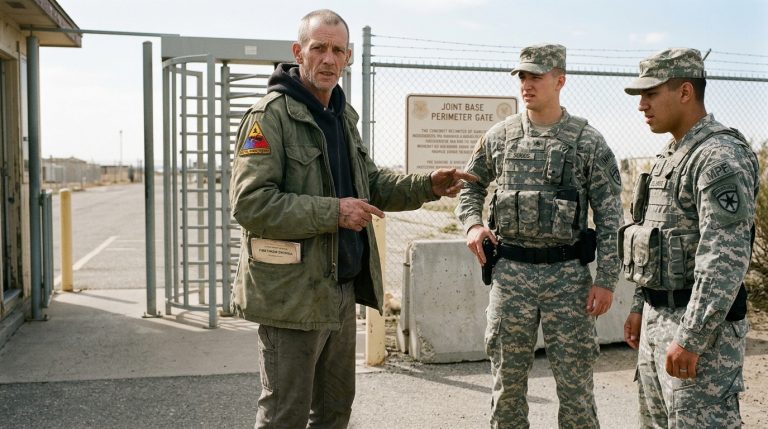
The Virginia sun was a physical weight, pressing down on the shoulders of the dress uniform I had kept hidden beneath a civilian trench coat for the entirety of the long flight. I stood at the threshold of the Grand Naval Parade Grounds, watching the petty officer’s eyes dart across his tablet with increasing desperation. He was young, perhaps too young to understand the gravity of the man he was currently keeping out.
“I’m sorry, ma’am,” he said, his voice straining to maintain the practiced, polite monotone of a gatekeeper. “There is no ‘Leah Cartwright’ on the guest list for the Commander’s promotion ceremony.”
I didn’t offer an explanation. I didn’t pull out a badge or make a scene. I simply adjusted the strap of my coat, feeling the subtle, cold bite of the silver stars beneath the heavy wool. I watched the flow of humanity moving past us: retired officers with chests full of medals, mothers clutching tiny flags, and my own parents walking with that familiar, curated ease. They looked right through me, their gaze sliding over my silhouette as if I were merely a flaw in the landscape.
Then, the center of the orbit arrived. Marcus.
He moved with the practiced grace of a man who had never once questioned his trajectory. His white dress uniform was impeccable, a stark contrast to the dust on my boots from the long walk to the perimeter. He didn’t stop; he didn’t even slow down. He merely brushed past me, his voice a low, biting murmur meant only for his wife’s ear, yet tuned perfectly to catch my own.
“Leah forgot to RSVP. Some people never learn the chain of command.”
A sharp, humorless laugh threatened to break from my throat. I had spent a decade operating in the classified dark—writing the very chain of command he so naively celebrated. I didn’t flinch. I stepped back, letting the crowd swallow the golden boy and his family. I was the invisible variable in their perfect, predictable equation.
I moved into the shadow of the stone gate, ready to turn and walk away, when a black government SUV pulled to the curb with the silent, heavy finality of an anchor dropping into sand. The driver didn’t rush. The passenger door opened, and Admiral Raburn stepped out. He was iron-gray and possessed a silence that seemed to turn the very air around us static.
He didn’t look at the gate. He looked directly at me.
“Admiral Cartwright,” he said, his voice cutting through the noise of the parade crowd like a blade. “We were starting to think you’d skip your brother’s big day.”
The petty officer’s face went the color of ash. His hand, shaking, let the clipboard slide from his grip, the plastic clattering against the concrete. I unfastened the top button of my trench coat, letting the cool breeze catch the deep, formal navy of my true rank, and for the first time in ten years, I stopped hiding.
CHAPTER 2: THE CROSSING
The silence that followed Admiral Raburn’s introduction was not empty; it was pressurized, like the air in a deep-sea submersible. The petty officer remained frozen, his gaze flicking from the silver stars on my shoulders to the expectant, steel-eyed stare of the Admiral. The clipboard he had dropped lay at our feet, a mundane artifact of a reality that no longer applied to this moment.
“Shall we?” Raburn repeated, his voice low, lacking the performative boom of a man used to public speeches. He didn’t wait for my confirmation, but turned and began to walk.
I followed, the motion of my stride feeling heavy, precise. As I stepped through the threshold, the world shifted. The Virginia sun seemed to lose its glare, replaced by the shaded, structured atmosphere of the VIP enclosure. My coat, once a shield, felt suddenly like a weight I was shedding. Beneath the fabric, the deep navy of my formal dress uniform felt stiff, familiar, and unyielding—a second skin I had worn in classified rooms for a decade, now exposed to the unfiltered light of a public day.
The sensory details of the promenade hit me in fragments: the faint, metallic tang of the nearby naval harbor, the polished sheen of the reserved chairs, and the sudden, rhythmic clinking of medals as retired officers shifted to get a better look at the intruder. A fleeting, sharp memory surfaced—the smell of polish, the sting of a tin’s edge against my thumb when I was eight, sitting on the stairs watching Marcus learn to shine his boots. The phantom sensation of that cold, abrasive metal against my skin made my hand twitch. I balled my fist, tucking the sensation away behind a wall of clinical detachment.
People were turning. Not the casual curiosity of a crowd, but the precise, instinctive pivot of military personnel sensing a shift in the hierarchy. Conversations that had been bubbling with the warmth of a reunion died out, leaving behind a brittle, expectant hum. I walked with my chin level, eyes tracking the horizon of the stage. My pulse was a steady, rhythmic drum—a heartbeat of absolute, earned control.
“They didn’t expect you,” Raburn remarked softly, not looking back. His tone was almost amused.
“They expected a version of me that didn’t exist,” I replied, my voice cool and steady, barely carrying beyond the two of us.
“And now?”
“Now, they’ll have to adjust.”
As we approached the front row, I saw them. My mother, Elellanor, sat with her posture so rigid it looked painful, her eyes fixed on the stage with a concentration that betrayed her anxiety. My father, Captain Thomas Cartwright, stood nearby, his hands clasped behind his back. The fabric of his old uniform was frayed at the cuffs—a detail I noticed with a pang of detached pity. When he turned, his eyes caught mine, and for a fraction of a second, the mask of the stoic commander slipped. His gaze fell to the twin stars on my shoulder, then back to my face, and I saw the internal collapse of his own logic. He had built his world on the assumption that I was the one who had drifted away, that I was the failure in the family narrative.
Marcus stood a few yards off, the center of the orbit, still laughing at something one of his peers had said. He hadn’t seen me yet. The distance between us was only twenty yards, but in the hierarchy of the crowd, it was a chasm.
A junior lieutenant, standing guard near the front-row chairs, shifted as we approached. His eyes locked onto the stars on my shoulders, and he snapped to attention with such sudden, reflexive force that his boots echoed against the pavement. He stepped aside, his face pale, his breath hitched.
I took my seat. The chair was cold, the fabric worn thin by decades of use. I sat with my shoulders square, my posture a mirror of the discipline my father had always preached but never applied to me. I wasn’t there to disrupt the ceremony—I was there to witness the end of the script.
Around me, the murmurs began to grow. Who is she? Is that the daughter? I thought she worked in—
I didn’t turn my head. I stared at the back of Marcus’s white uniform, watching the way he tilted his head. He was leaning toward his wife, Lauren, and for a moment, he stopped moving. He was sensing the shift in the air, the way the crowd’s energy had pivoted away from him. He turned his head slowly, and then, he saw me.
His jaw tightened. It was the micro-adjustment I had known since childhood—the sign that the reality of the moment was failing to match his prepared internal draft. He looked at Raburn, then back at me, his eyes searching for an answer, a reason, a sign that this was a mistake.
I gave him nothing. I sat as still as a statue, my presence a weight that began to settle over the entire enclosure. The band struck the first note of the national anthem, a soaring, brassy cry that demanded everyone rise. As the crowd stood, the movement was a wave, but it felt jagged, interrupted. I rose with them, eyes forward, heart cold and calm. I had spent my life standing in the shadows of this family, holding the polish, watching them shine. Now, the light was on me.
And they were all going to have to look.
CHAPTER 3: THE ECHO OF THE ANTHEM
The final note of the anthem hung in the humid Virginia air, a brassy, lingering vibration that seemed to settle into the marrow of my bones. For a heartbeat, there was nothing—only the absolute, terrifying stillness of three hundred people holding their breath. I stood, my shoulders braced, my eyes locked onto a point just above the horizon line. Then, the silence shattered.
Applause broke out, jagged and disjointed, lacking the cohesive rhythm of a crowd that knew exactly what to celebrate. From the corner of my eye, I watched the sea of white uniforms and soft-colored dresses shift. The movement was a frantic, nervous energy, a collective search for direction. They were looking for Marcus, the familiar anchor, but the air was heavy with the weight of the anomaly sitting in the front row.
I felt the prickle of heat at the back of my neck. My perception, usually honed to the sharpness of a razor, felt slightly frayed at the edges. Was it the humidity, or was I seeing the scene through a lens of my own hyper-vigilance? I noticed the way the photographer’s hand trembled as he adjusted his lens, his focus shifting from the stage to me, then back to the stage, unable to decide which image was the true story of the day. It was a distortion, a ripple in the fabric of the ceremony, and I was the stone that had dropped into the water.
“That was quite the arrival,” a voice murmured beside me.
I turned slightly. Admiral Raburn had not moved, his hands still clasped behind his back, his profile as carved and unyielding as the stone pillars of the gatehouse. He didn’t look at me, but his presence was a steady, immovable weight.
“It was a scheduled one,” I replied, my voice a neutral register.
“Indeed. Though the schedule seems to have been written by someone else until about ten minutes ago.” He turned his head, his sharp eyes catching the light. “Do you feel it? The dissonance?”
I didn’t answer immediately. I looked at my father, who was still standing near the podium. He had finally moved, his hand resting on the back of a chair, the leather creaking under the pressure of his grip. He was staring at the floor, his face devoid of the pride he wore like a uniform. The dissonance was not in the music; it was in the silence he wasn’t filling.
I felt a phantom tug of my mother’s hand, a memory of her guiding me away from the center of a room as a child, her whisper telling me that some things are better left unseen. I pushed the thought down. That version of me—the one who lived in the margins—was an artifact.
“The dissonance is necessary,” I said, finally. “It’s the sound of a frame being reset.”
Raburn gave a ghost of a smile—a thin, almost imperceptible contraction of his lips. “And what happens when the frame holds more than the picture was meant to?”
I didn’t have time to consider the question, because Marcus was moving. The ceremony was transitioning into the formal commendations, and he was stepping down from the stage, his path leading directly toward the front row. He moved with a speed that bordered on the reckless, his stride uncharacteristically long. He wasn’t looking at the Vice Admiral who had just awarded him his medal; he was looking at me.
His face was a roadmap of controlled confusion. Every muscle in his jaw was working, his lips pressed into a thin, white line. He reached the edge of the row, and the junior lieutenant who had guarded my seat earlier actually stepped aside, clearing the way for him. It was a tactical concession—a recognition of the hierarchy, and perhaps, a sign that the officers around us were beginning to sense the shift in command.
Marcus stopped three feet from me. He didn’t offer a hand. He didn’t offer the practiced, recruitment-poster smile that had defined his life. He looked down at me, and for a fleeting second, the polished, confident commander vanished, replaced by the boy who had once been terrified of the dark.
“Why?” he asked. The word was barely a breath, but it contained a decade of unanswered questions.
“Why what, Marcus?” I remained seated, my posture relaxed but ready. I wanted him to see that I was not a threat to his promotion; I was the proof that his perspective had been too narrow to hold the truth.
“Why show up now? Why here?” He glanced at the crowd, then back at me, his eyes darting to the stars on my shoulder as if they were a foreign language he was struggling to translate. “You could have done this anywhere. You could have—you could have just called.”
“Would you have listened?”
He opened his mouth, then closed it, his throat working as he swallowed. The dissonance of the day seemed to reach a peak—the murmur of the crowd, the clinking of glasses from the reception area, the way the wind caught the flag above the stage. It was all noise. The only thing that mattered was the tension in his shoulders, the way he was physically vibrating with the effort of holding his composure.
“I had a script,” he said, his voice dropping further. “We all did. You were supposed to be the one who left. The one who wasn’t part of it.”
“That was never the truth,” I said, and as the words left my lips, I felt a strange, chilling clarity. “That was just the story you were told.”
He looked at me then, truly looked at me, and I saw the first genuine crack in his armor. It wasn’t hate. It wasn’t even anger. It was fear—the terrifying, raw realization that the foundation he had been building his life upon was made of nothing more than silence and expectation.
He turned his head as our father approached, his boots heavy on the grass. The weight of the moment shifted again, triangulating between us. I stood up, the movement effortless, and for the first time, I looked at them from a level plane. I was no longer the girl on the stairs with the polish tin. I was the officer they hadn’t bothered to look for, and the silence that had lived in this house for twenty years was finally, irrevocably, breaking.
CHAPTER 4: THE CONFRONTATION
The air in the reception lawn, which moments before had been a pleasant cocktail of sunlight and polite conversation, suddenly felt thin and charged. A low, guttural roll of thunder echoed from the direction of the Atlantic—not a summer storm, but something colder, sharper. The wind picked up, swirling napkins across the linen-covered tables and making the white dress uniforms of the guests ripple like waves.
“The reception is moving,” Marcus said, his voice flat, his gaze still locked on mine. He didn’t blink. The panic in his eyes had been replaced by a hardened, defensive edge—a soldier realizing he was in a losing position and digging in. “Inside. Now.”
He turned, not waiting for my answer, his hand gesturing for my father to follow. My father remained still for a second longer. He looked at me, his eyes scanning my uniform as if looking for a seam to tear open. He didn’t say a word, but the weight of his silence was an indictment. He was struggling with the reality that the daughter he had kept in the periphery for years now stood in the center of his world, wearing the same rank that he had spent his life worshiping from a distance.
“You’ve chosen a poor day for a demonstration,” my father said finally, his voice dry.
“I didn’t choose the day, Father. I chose to show up,” I replied. My heart was steady. The Kintsugi logic I had lived by for ten years—the process of taking the broken, discarded pieces of myself and rebuilding them into something stronger—felt solid beneath my skin. I didn’t need their approval; I only needed them to acknowledge that the person they had erased was the one who had finally returned.
The storm broke in a sudden, violent deluge of rain. People began to scramble, the orderly, choreographed movement of the ceremony dissolving into the chaotic rush of guests seeking shelter. I didn’t run. I stepped into the lee of a nearby decorative stone wall, watching the water turn the manicured lawn into a muddy, unrecognizable mess.
Marcus was trying to regain control, shouting orders to a detail of junior officers to secure the equipment, his voice cracking slightly. He was trying to command the weather, trying to force the chaos back into the tidy, scripted box of his promotion. It was a futile gesture, and I watched him with a strange, aching empathy. He wasn’t a villain; he was a mirror, reflecting the same rigid, fear-based conditioning that had once defined my own existence.
I saw Lauren, his wife, standing under the awning of the main pavilion. She was watching me, her expression not of anger, but of intense, piercing curiosity. She was the one who had seen me at the gate—the one who had realized, perhaps before Marcus even did, that the narrative had been permanently altered. She caught my eye and offered a hesitant, almost imperceptible nod. It was a tiny, fragile bridge, but it was there.
The transition to the indoor ballroom was a blur of noise, cold water, and the smell of damp fabric. The space inside was warmer, lit by crystal chandeliers that cast long, distorted shadows across the mahogany floor. I walked into the room, my boots echoing with a sharp, rhythmic precision that made heads turn. I didn’t head for the bar or the buffet; I headed for the center of the floor, where the family had retreated.
Marcus was there, flanked by my parents. They stood in a tight, protective triangle. I stopped five feet away. The rain drummed against the tall glass windows, a constant, rhythmic distraction that served to focus the silence between us.
“You’re not going to talk about it,” I said. It wasn’t a question. “You’re going to keep acting as if I’m a ghost who just happened to walk through the front door.”
“We’re having a celebration,” my father snapped, his fingers clenching the stem of a glass until his knuckles turned white. “This is not the time or the place for… whatever this is.”
“There is no other time,” I said, my voice rising just enough to carry to the small cluster of senior officers nearby. “You spent ten years ensuring there was no place for me. You erased the record. You assumed I had failed because I didn’t fit the mold you had cast for the family.”
“I did what I had to do to protect this family’s standing!” My father’s voice finally erupted, a jagged, raw sound that stripped away the last of his composure. He took a step toward me, his face flushed. “You were always the one who wanted to look at the world through a microscope, to hide behind classified seals and intelligence reports. You didn’t understand that the Navy is about visibility, about the standard we set. You were never going to set that standard.”
“I didn’t want to set your standard,” I replied, the heat of the moment rising in me, yet contained, channeled. “I wanted to set my own. And I did.”
Marcus looked between us, his face a mask of conflict. He saw the truth in what I was saying, but the weight of his allegiance to our father—to the idea of the legacy he had inherited—was a massive, crushing force. He stepped between us, his hand coming up in a gesture that was half-warning, half-plea.
“Leah, enough,” he whispered, his eyes pleading. “We’re in public. If you want to do this, we do it later. We do it privately.”
“There is no private version of this,” I said, turning to look at him. “The secret is the problem, Marcus. The fact that you all built a life on the belief that I wasn’t enough was the lie that weakened us all.”
I could see the others watching us—the dignitaries, the old friends of the family, the junior officers. The veneer of the celebration was gone. In its place was the messy, painful, and absolutely necessary truth. I saw the disappointment in my mother’s eyes, but beneath it, a flicker of something else—a recognition, perhaps, of the strength she had spent years pretending wasn’t there.
I stood there, the weight of the moment pressing in from all sides, and I realized that I hadn’t come here to destroy them. I had come to finish the process of my own construction. The confrontation wasn’t the end; it was the final, critical step in the assembly of the person I had become. And as Marcus looked at me, his jaw trembling, I knew that the bridge I had been building wasn’t just for me—it was for all of us.
CHAPTER 5: THE NEW BLUEPRINT
The flight to Washington was not a journey of distance, but of decompression. I sat in the cabin of the military transport, the low vibration of the engines a steady, grounding frequency that allowed the adrenaline of the reception to slowly bleed away. I watched the clouds drift beneath us, their shapes shifting and reforming with an indifference that felt strangely comforting. Marcus had sent me a brief, encrypted message before takeoff: We need to talk. Not about the family. About the unit. It was a start. A small, tentative probe into the territory we had just opened.
When I stepped into the Pentagon, the air was as I remembered it—filtered, temperature-controlled, and utterly devoid of the messy, human unpredictability of the ballroom. It was a space designed for data, not emotions. My office was waiting, a quiet corner of the facility where the weight of the Naval Cyber Intelligence Division was concentrated into clean lines and glowing screens.
Admiral Raburn was waiting for me. He was standing by my desk, a thick manila folder resting on the polished surface like a landmine. He didn’t offer a greeting. He just looked at me, his eyes searching my face for signs of the friction I had left behind in Virginia.
“You left a mark, Admiral,” he said, tapping the folder.
“I established a position,” I corrected, stepping to the desk. The folder’s seal was embossed with a mark I hadn’t expected to see: Strategic Command Integration.
“They’re moving pieces,” Raburn continued, his voice dropping into the register of a man who dealt in threats that never made the news. “The reception in Virginia didn’t just rattle your father’s nerves. It rattled the board. They’re grooming a successor for the Pacific Hybrid Operations unit. Someone they think will be more… compliant.”
I opened the folder. Inside were the overlays—satellite imagery of the Gulf, strategic gap analyses of our current regional presence, and a series of memos detailing the reassignment of my key intelligence assets. It was a surgical strike. They weren’t fighting me directly; they were dismantling the infrastructure I had built to support my command.
“This is an unauthorized maneuver,” I said, my voice cold, precise.
“It’s an internal directive,” Raburn countered. “They have the clearance to authorize it, provided they frame it as an integration update.”
I stood there, the weight of the folders in my hand, and felt the familiar, clinical rush of a tactical problem. This was not the chaotic, emotional mess of the ballroom. This was a chess game, and I knew the pieces. I reached for my terminal, my fingers finding the keys with the muscle memory of ten years of covert warfare. I began to pull up the access logs associated with the directive.
There, buried in the metadata, was a signature I hadn’t expected: a deputy chief from the very department that had supposedly ‘lost’ my files a decade ago. It was a micro-discrepancy—a flaw in the document’s lineage. Someone had tried to force this change through without checking the audit trail, betting that I would be too preoccupied with the fallout of the parade to notice.
I looked up at Raburn. “They made a mistake. They assumed I was still operating within the framework they built for me.”
“And if you’re not?” Raburn asked, his expression unreadable.
“Then I have to burn the framework.”
I began to draft the counter-directive. My movements were fluid, devoid of the hesitation that had once defined my interactions with my family. I knew exactly where the leverage lay—not in rank, not in ceremony, but in the truth of the operations themselves. If they wanted a revolution, I would give them one that was as quiet, and as inevitable, as the tides.
As I worked, the room began to feel smaller, the sterile air tightening. I realized that the fight I had initiated at the parade grounds was only the prologue. The real conflict was here, in the shadows of the bureaucracy, where the weapons were memos, classified seals, and the calculated rewriting of history. I wasn’t fighting for a seat at their table anymore. I was fighting to ensure that when the dust settled, the table was the one I had built.
I saved the file and looked at the clock. It was 3:00 AM. Outside the window, the lights of Washington shimmered like a grid of distant, cold stars. I thought of Marcus, of the way he had looked at me in the ballroom, and I wondered if he had any idea of the storm that was about to break over the institution he so revered. He wanted to serve in my chain of command? Then he was about to learn that my chain of command didn’t bow to the old guard.
I stood up, the chair scraping against the floor with a sound that felt like a declaration. I had a phone call to make, and it wouldn’t be to my father. It would be to the one person who still held a piece of the architecture I needed to dismantle. The blueprint was changing, and I was holding the pen.
CHAPTER 6: THE UNBROKEN DINNER
I stood on the front porch of the Cartwright home, the same porch where I had spent years watching Marcus depart for glories I was never invited to share. The wood was solid, familiar, but the perspective had shifted. I wasn’t waiting for an invitation, nor was I anticipating a cold reception. I simply reached out and pushed the door open.
Inside, the house felt smaller than I remembered. The scent of roasted rosemary and chicken was thick in the air, a nostalgic fragrance that usually signaled a performance, but today, it felt strangely honest. My father stood at the head of the dining table, his uniform jacket discarded, his shirtsleeves rolled up in a way I had never seen in twenty years. He was setting the silverware with a deliberation that bordered on reverence.
He looked up as I entered. He didn’t stiffen. He didn’t reach for the rehearsed gravity of his captain’s voice. He simply stopped, his gaze meeting mine with a clarity that made the air feel suddenly, beautifully, still.
“You’re on time,” he said, and there was no performative weight to the words. Just a statement.
“I’m early,” I replied.
From the kitchen, my mother emerged, a dish towel in her hands. She stopped, her eyes finding mine, and for the first time, I saw that her composure wasn’t a mask—it was a fraying attempt to bridge the gap she had been too afraid to acknowledge. She looked at my uniform, then at my face, and the pride I had always wanted to see in her eyes wasn’t for the stars on my shoulders, but for the person who had survived the silence.
“Marcus is in the back,” she said softly. “He’s been waiting.”
I walked through the living room, past the mantelpiece lined with medals and photographs—images of Marcus in his uniform, Marcus at the academy, Marcus, the jewel of the house. I paused at the mantel, picking up a photograph of the four of us from years ago. I looked at the young girl in the back, the one who held the polish tin, and I felt no resentment. I felt only a profound, detached peace. I set the frame back down, not in its original position, but tilted slightly, a small, permanent defiance.
Marcus was in the small sunroom off the kitchen, looking out at the yard. He turned when he heard me, his face showing the exhaustion of a man who had finally stopped trying to maintain an impossible script. He wasn’t wearing his uniform, just a plain button-down shirt. He looked less like a commander and more like a brother.
“I read the directive,” he said, not greeting me, just diving into the heart of the matter. “The one you filed at the Pentagon. It’s brilliant, Leah. It doesn’t just dismantle the integration order; it exposes the entire chain of logistical failures that led to the Gulf incident.”
“I know,” I said. “I wasn’t trying to bury them. I was trying to fix them.”
“You did,” he said, and he looked at me, a genuine, unguarded smile touching his lips. “You made them look at the math. They can’t argue with the data.”
We sat at the dinner table, the four of us. The silence was not the heavy, brittle silence of the past, but a quiet, living thing. My mother served the meal, and for the first time, no one spoke of the Navy, or the legacy, or the chain of command. We talked about the garden, the house, the small, mundane textures of life that I had been excluded from while I was busy building my own world in the dark.
Over dessert, a simple peach cobbler, my father set down his fork. He looked at me, and I saw him finally accept the new geometry of the room. He wasn’t the captain of this ship anymore. We were all just people, sitting in a room, trying to make sense of the damage we had collectively allowed to persist.
“I thought,” he began, his voice raspy, “that if I could keep you in the frame I built, I could protect you from the parts of this life that break people.”
“You didn’t protect me, Father,” I said, my voice steady, no longer carrying the edge of combat. “You just forced me to break myself to grow.”
He nodded, a slow, heavy movement of his head. “I see that now. We were all wrong. But the name—the Cartwright name—it’s always been about endurance. I just never realized that endurance wasn’t about holding onto the past. It was about allowing for the future.”
My mother reached across the table, her hand covering mine. Her touch was warm, human, and for the first time, I didn’t pull away. I didn’t need to. I had earned my place at this table, not by the rank I held, but by the resilience I had cultivated in the quiet, empty spaces they had left for me.
The final pillar of the catharsis was the interaction. After dinner, I went to the small utility cabinet in the hallway. I found the old, rusted polish tin I had kept for all these years, the one that had witnessed my childhood at the sidelines. I took it into the dining room. I sat down on the floor, the space where I had once sat to watch Marcus, and I opened the tin. The smell of the wax was thick, sharp, and timeless.
I pulled off my boots—the boots I had worn to the Pentagon, the boots I had walked into the parade ground in—and I began to polish the leather. I did it slowly, carefully, the motion a rhythmic, meditative act. My father watched from the table, his expression unreadable, until finally, he stood up.
He didn’t speak. He walked over, knelt down on the rug beside me, and watched my hands. He didn’t take the tin. He didn’t try to take over. He just watched, a silent participant in the ritual of my independence.
“It’s good work,” he said, his voice barely a whisper. “To take care of what carries you.”
“Yes,” I said, looking up at him, a small, genuine smile forming on my face. “It is.”
I felt the weight of the last decade dissolve into the smell of the wax and the quiet, steady rhythm of the cloth against the leather. The mystery of their absence, the decoy secret of their malice—it all felt like a story from someone else’s life. I was no longer the daughter who was undecorated. I was the architect of my own truth. And as the house settled into a rare, atmospheric peace, I knew that tomorrow, the work would continue, but for tonight, I was finally, unequivocally, home.