The Architect of Ruin: A Cold Calculus of Justice Within the Shadow of Golden Meadows
CHAPTER 1: THE CRIMSON SCAR
The smell hit me first—acrid, synthetic, and suffocatingly sweet. It was the scent of cheap aerosol, the kind that promised permanence on the porous, weathered surface of 150-year-old oak. My barn, a monument to the resilience of fieldstone and hand-hewn timber, now stood branded by a garish, weeping crimson mark. Eyesore. The word wasn’t just painted; it was carved into the barn’s flank with a smug, gloating flourish.
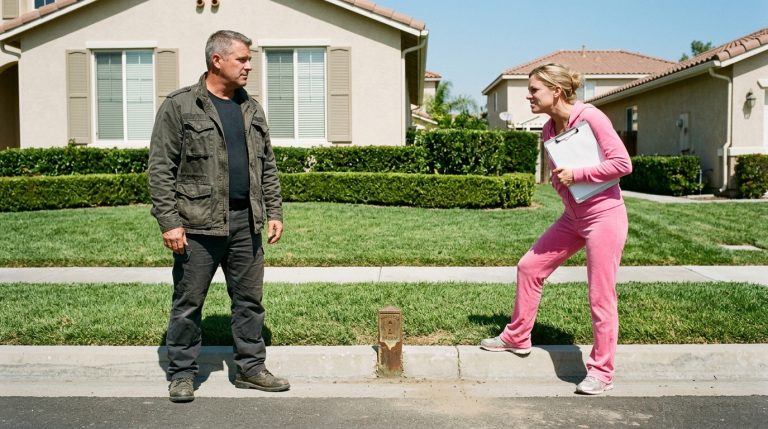
Fifty yards away, Karen stood on the edge of my property, a monument to the petty tyranny that defined this subdivision. Her pastel pink tracksuit shimmered under the morning sun—a malevolent disco ball reflecting the light of a world she thought she controlled. She lowered the spray can, the nozzle hissing as it cleared. She held my gaze, her face flushed with the kind of victory that only exists in the minds of the delusional.
I stood on my porch, my boots feeling the solid, unforgiving wood beneath me. My pulse remained perfectly flat. There was no spike of rage, no hot, irrational desire to charge across the lawn and reclaim my dignity. Instead, a familiar, glacial calm settled over my chest—the same stillness I had felt while deconstructing enemy fortifications in the desert.
She was waiting for a reaction. She wanted the confrontation, the shouting match that would validate her authority and paint me as the volatile, non-compliant outsider.
I didn’t give it to her.
Instead, my mind shifted into the procedural loop. I noted the angle of her stance, the tremor in her hands as she capped the can, and the specific brand of paint visible on her glove. Every data point was a component of the structure I was about to dismantle. She thought this was a battle over property values. She was blissfully unaware that she had just provided the exact weight and material density needed to calculate the load-bearing point of her own destruction.
“Major,” she called out, her voice dripping with a rehearsed, smug satisfaction. “I trust you understand the implications of this warning.”
I looked at the barn, then back at her. The shadow of the barn’s gable fell across my face, hiding the slight tightening of my jaw. The silence stretched, heavy and expectant. The wind rustled through the manicured grass of the subdivision, the only movement in an otherwise static scene.
I took a slow, deliberate breath, drawing in the smell of the paint and the crisp, damp earth. I wasn’t just looking at a ruined barn. I was looking at a contract. The red paint was a signature, and in seventy-two hours, the interest on that debt was going to be astronomical.
“I hear you, Karen,” I said, my voice intentionally devoid of heat. It was thin, precise, and cut through the morning air like a scalpel.
Her confidence wavered, if only for a fraction of a second. She had expected anger. She had expected to be the protagonist of this interaction. My refusal to participate in her narrative left her visibly unsettled. She turned, her movements a bit too sharp, and began the long walk back toward her McMansion, leaving me alone with the graffiti.
I walked down the steps, my boots crunching on the gravel path. I approached the barn, stopping just inches from the fresh, still-tacky crimson letters. I reached out, pressing a fingertip to the wet paint. It was cold, viscous, and absolutely damning.
I looked up at the barn’s ridge line. It tilted slightly, as it had for over a century, leaning into the wind with a stubborn, quiet defiance. It had survived blizzards, droughts, and the slow, grinding indifference of time. It wasn’t going to fall because of a can of spray paint.
As I stared at the red letters, a realization clicked into place—a piece of the puzzle I hadn’t even known was missing. I hadn’t seen the neighborhood management committee’s financial records in months, but the way she leaned on that spray can, the way she treated the property line as a tactical border—it wasn’t just about the rules. It was about concealment.
She wasn’t trying to enforce community standards. She was trying to hide something, and this vandalism was the panicked, erratic move of someone who knew the walls were closing in. I pulled my phone from my pocket and snapped a photo of the graffiti, the flash illuminating the barn’s textured wood.
The game had changed. I wasn’t fighting for my barn anymore. I was fighting for her silence. And as I turned back toward the house, a shadow flickered in the upstairs window of her residence—she was watching. She was waiting to see if I would crack.
I didn’t look up. I walked inside, locked the door, and went straight to my office, leaving the red mark to dry in the morning sun.
CHAPTER 2: THE FORENSIC SCAN
The glow of the dual monitors cast a harsh, clinical light over the kitchen table, highlighting the coffee stains and the frantic, jagged lines of my own handwriting. I sat in the dark, the house around me silent, save for the rhythmic humming of the hard drive and the distant, lonely cry of an owl. Karen had meant for that red paint to be a taunt, a visual anchor to drag my focus toward the barn. Instead, it had acted as a lighthouse, guiding me directly into the storm I had been waiting for.
I opened the folder labeled Golden Meadows: Financial Disclosures. For weeks, I had treated these documents like secondary noise—the mundane, droning background of suburban life. Now, under the sharp, predatory lens of my current focus, the numbers began to talk.
The HOA’s financial reporting was a masterclass in obfuscation. I cross-referenced the line items for “Common Area Maintenance” against the public record of the county’s infrastructure permits. A pattern began to emerge, subtle as a hairline fracture in a concrete abutment. Payments were flowing from the homeowners’ dues into an entity called Lawn and Order LLC, then evaporating into a series of smaller, unlisted contractors.
My fingers moved across the keyboard with the steady, disciplined pace of a man inspecting a bridge’s substructure for fatigue. I remembered a project in Kandahar—a bridge we were tasked with reinforcing against insurgent sabotage. I had spent days staring at the structural schematics, looking for the one weakness, the one connection that held the entire load. This was no different.
The memory of that bridge—the grit of the sand, the smell of diesel, the palpable tension of knowing a single miscalculation meant collapse—surged into my mind, unbidden. V-2: The Psychological Phantom. I gripped the edge of the table, my knuckles whitening. Karen wasn’t just a neighbor. She was a structural liability, and she had built her entire reputation on a foundation of sand.
She had authorized a series of “aesthetic upgrades” to the community tennis courts, priced at nearly three times the market rate for materials and labor. I pulled up the invoices. The concrete supplier listed was a shell company with an address that linked directly to a P.O. box in her own name.
I leaned back, the chair groaning in the stillness. A cold, metallic taste filled my mouth. This wasn’t just a petty dispute over mailbox dimensions or barn aesthetics. This was a systematic, calculated grift—a predatory parasite feeding on the very people who had trusted her to manage their shared investment. She wasn’t just a tyrant; she was a thief. And by trying to force me to demolish my barn—a structure that represented an independent, historical variable she couldn’t account for—she had effectively tripped the circuit breaker on her own operation.
I looked at the photograph of the graffiti again. The red paint was a desperate, panicked attempt to assert dominance. Why? Why now? The 90-day demolition ultimatum she had issued wasn’t just a whim; it was a deadline for some other, larger project she needed to complete. She was clearing the neighborhood of anything “non-compliant” before a larger financial audit or a property transfer could take place.
My eyes burned, but I didn’t reach for the coffee. I started a new spreadsheet. I began mapping the connections, linking the dates of the “covenant violations” to the timing of her major infrastructure “upgrades.” The correlation was almost perfect. Every time a homeowner challenged her, she hit them with a fine. Every time she needed a surge in cash flow to cover the overruns on her husband’s company projects, she intensified the enforcement.
The sheer, staggering arrogance of it was breathtaking. She had lived in this bubble of absolute control for so long that she had forgotten the simple, physical law of causality: every action has a reaction, and force, when misapplied, always leads to fracture.
I didn’t stop until the sun began to bleed over the horizon, turning the sky a bruised purple. I had enough here to sink her, but not enough to bury her. I needed to know what was in the files she had refused to provide. I needed the meeting minutes, the private communications, the internal memos. If she had been running this scam for five years, there was a trail of breadcrumbs—emails, text messages, recorded voices—that would lead directly to her throat.
I stood up, my legs stiff, and walked to the window. The barn stood in the pale, early light, the crimson graffiti looking like dried blood against the dark wood. It was an eyesore to her, but to me, it was now the cornerstone of my defense.
I picked up the phone. It was too early to call Marcus Thorne, but I started drafting the email. I needed the state attorney general’s office to open a preliminary inquiry. I needed a reason for an audit that she couldn’t dismiss as a “personal dispute.”
The war wasn’t in the streets or on the lawns of Golden Meadows. It was here, in the cold, hard numbers, in the digital paper trail that she had been arrogant enough to leave behind. She thought she was the architect of this community. I was going to show her exactly how it felt to be the one who got torn down.
I turned away from the window, my mind already running the calculations for the next step. I would force her to engage, force her to make another mistake, and wait for her to overreach just enough to snap the load-bearing beam of her credibility.
CHAPTER 3: THE FIRST SALVO
I pulled my fingers away from the keyboard, the silence in the office feeling suddenly fragile. The email was sent. There was no retracting it, no softening the blow; I had initiated the inquiry with the clinical detachment of an engineer setting a demolition charge. My coffee had long gone cold, a dark, stagnant pool in the bottom of the mug. I left it there and stood, my joints popping in the quiet room. The barn was waiting. The reality of the red paint wasn’t going to fix itself.
Stepping out onto the porch, the air hit me—sharp, biting, and smelling of damp cedar. The sun was clearing the horizon, casting long, bruised shadows across the Golden Meadows landscape. My neighbors’ houses sat in rows of identical, manicured perfection, a suburban grid that felt, in this light, less like a community and more like a carefully constructed set. I walked down the steps, the gravel crunching under my boots with a sound that felt entirely too loud in the morning hush.
I wasn’t surprised to see the black, faux-cast-iron mailbox standing sentinel at the edge of my driveway—a $350 monument to the first skirmish I had lost. I traced the top of it with my palm, feeling the cold, cheap metal. Karen had won that round by forcing me to play by her rules. I wouldn’t make that mistake again. I wasn’t just going to play; I was going to rewrite the ledger.
My phone vibrated in my pocket. A notification from the HOA management portal. I tapped it, a cold, familiar burn rising in my chest.
Notice of Covenant Violation: Subject Property [10-A]. Unauthorized exterior modification (Roofing Material). Compliance Deadline: 24 Hours.
They were watching. They had likely seen the roofing crew from two days ago, their sentinels in the golf carts marking the progress of my restoration. I didn’t respond. I walked past the mailbox, past the edge of the property line, and toward the barn.
The wood felt rough and solid under my hands as I reached the main wall. The red Eyesore remained, a mocking scar in the morning light. I had ordered a professional historical preservation survey the night before, an objective, third-party report that would provide the legal cover I needed to halt any demolition orders. That report was due by noon. Until then, I had to occupy the space.
I began to prep the surface, not to remove the paint, but to measure the depth of the damage. I used a small, precision scraper, taking light passes at the edge of the E. The paint didn’t just sit on the surface; it had seeped into the grain of the century-old oak. It was a vicious, deep-set mark. As I worked, I felt eyes on me.
I didn’t look toward the street. I didn’t have to. I knew the rhythm of their surveillance—the slow, creeping pace of a golf cart at the edge of the property, the pause, the inevitable radio chatter.
When the preservation specialist, a quiet man named Elias, pulled his truck up to the barn later that morning, I felt the tension shift. He was a veteran of the trade, a man who treated timber with more reverence than most people treated their own kin. He stepped out, his eyes immediately going to the graffiti. He didn’t speak. He just walked to the wall, placed a gloved hand on the wood, and sighed.
“It’s an insult, Mr. Davis,” he said, his voice gravelly. “Not just to the structure. To the history.”
“Can you stabilize it?” I asked.
“I can,” he said. “But the report is what you need. If this structure is officially recognized as a historical landmark, the HOA can’t touch it without a state-level review. And that review process? It takes months, sometimes years.”
He started his survey, unfolding intricate measuring tools and pulling out archival photos of the farm from the 1870s. As he worked, I shadowed him, taking notes, observing the way he pointed out the integrity of the original joints. We were building a fortress, one line of objective, documented truth at a time.
Around mid-morning, Karen’s black sedan rolled slowly down the street, pausing at the curb just outside my property line. She didn’t get out. She just sat there, her face a mask of pale, frozen expectation. She was waiting for me to panic. She was waiting for me to shout, to plead, to try and negotiate.
I ignored her. I stood under the eaves of the barn, holding a structural diagram for Elias, discussing the load-bearing capacity of the main beams. I felt her gaze, sharp and desperate, but I kept my focus on the preservationist.
“The structural integrity is sound,” Elias said, his voice carrying clearly in the crisp air. “It’s a remarkably resilient build. The foundation is a bit settled, but there’s no structural rot.”
I glanced toward the car. Karen’s window was cracked just enough for her to hear. I knew she was recording this. I leaned in, my voice level and deliberate. “That’s good to hear, Elias. We’ll proceed with the restorative work as planned. The HOA’s concerns about ‘dilapidation’ are, as the survey will show, entirely without merit.”
The sedan sped off, the tires kicking up a spray of gravel that rattled against the pavement. It was a reaction—a momentary slip in her composure. She was realizing that the rules she had used to build her kingdom were now the very things that would be used to dismantle it.
I looked back at the barn. The Eyesore still marred the wood, but it looked smaller now. It looked less like a declaration and more like the frantic graffiti of a criminal who knew the police were on their way.
The first salvo had been fired. I had the survey in motion, the complaint with the Attorney General filed, and I had publicly, methodically, and legally dismantled her primary justification for the demolition. I walked back toward the house, my pace steady. The next 24 hours would be a test of how far she was willing to go to maintain the illusion. I was ready.
CHAPTER 4: THE SURVEILLANCE GRID
I didn’t turn on the lights. The office, usually a sanctuary of controlled variables and structural plans, felt altered. My eyes were locked on the bank of monitors arrayed before me, the four-panel grid of the night-vision security feed flickering with a grainy, emerald-tinted reality. The wind had picked up, and the trees at the edge of the property swayed in a hypnotic, jagged dance, casting shifting patterns across the barn’s freshly painted, charcoal-gray roof.
I hit the playback command on the primary feed, the one covering the property line. It was 2:15 AM. The footage was nothing but the steady, unchanging stillness of the night. My finger hovered over the mouse, ready to scrub through the hours, but the hesitation caught me. Was I watching for a thief, or was I waiting for a mirror?
V-4: The Unreliable Perception. The thought rippled through me, sharp and intrusive. I had spent days building a case against Karen, mapping her corruption, tracing the money to the shell companies, and turning the bureaucracy against her. But as I sat here, bathed in the sickly glow of the monitors, I felt the thinness of the line I was walking. I was becoming the system I despised—calculating, observant, detached.
I scrubbed forward. The feed jumped in increments—the deer passing through the far corner, a neighbor’s cat crossing the lawn, the rhythmic swaying of the barn’s new siding. I slowed the speed to real-time. My stomach tightened.
There was a movement on the side of the screen, near the dense hedge line that marked the transition between my land and the subdivision’s manicured common area. It wasn’t a deer. It was too vertical, too deliberate. A figure, dark against the dark, paused at the property marker. I didn’t zoom in yet. I watched, my breath held. The figure stood there for a full minute, motionless, facing the barn.
It wasn’t Karen. The silhouette was wrong—too tall, too angular. My pulse, which had remained a steady, rhythmic thrum through the entire ordeal, finally spiked. I zoomed in, the pixelation tearing at the edges of the image. The figure wore a nondescript hoodie, the hood pulled deep, but their head turned, scanning the perimeter of my barn. They weren’t looking at the house. They were looking at the roof, specifically where the new standing-seam metal met the old timber frame.
The figure reached out, touching the fence post, and then, as if they knew exactly where the camera was aimed, they turned and walked away into the shadows of the subdivision.
I sat there, the blood draining from my face. My hands, usually steady when handling a transit level or a blueprint, were shaking. I wasn’t just being watched by the president of an HOA; I was being surveyed.
I checked the timestamp against the internal logs. Whoever this was, they had been there every night for the last three days, always at the same hour, always at the same spot. They weren’t vandalizing. They were measuring.
The implication hit me with the weight of a falling girder. Karen wasn’t just a petty tyrant playing with a spray can. She was part of something larger—a sequence of events I hadn’t fully grasped. If they were surveying my roof, they weren’t looking for building code violations. They were looking for structural vulnerabilities. They were preparing for something that required the barn to be either removed or integrated into whatever financial shell game they were running.
I stood up and moved to the window, peering out into the absolute blackness of the yard. The house felt exposed. I realized then that my “counter-offensive” had been too predictable. I had played by the rules of the game—the letters, the legal filings, the preservation reports. I had assumed Karen was the only player.
I turned back to the monitors, my gaze sweeping over the four quadrants of my life. The green light washed over the office, making everything look like a blueprint. I had mapped the financial flow, but I hadn’t mapped the desperation. A cornered animal doesn’t just bite; it changes its environment.
I sat back down, my mind shifting from defense to a cold, hard tactical reality. I needed to know who that figure was. I reached into the desk drawer and pulled out a small, handheld digital recorder—a relic from my days as a project lead. I didn’t need more lawyers right now; I needed eyes on the ground that the HOA didn’t know about.
I spent the next two hours recalibrating the cameras. I moved the focus from the barn’s exterior to the perimeter itself, linking the motion sensors to a secondary, encrypted alert system on my phone. If that figure returned, I would know the moment they stepped across the line.
But as I sat there, watching the screen, the silence of the house felt different—heavy, expectant. I realized with a jarring clarity that I was no longer the one conducting the survey. I was the one being surveyed. The game had shifted from a battle of bureaucratic attrition to a physical standoff. And for the first time since this nightmare began, I felt the cold, sharp edge of uncertainty.
I looked at the barn again on the screen. It looked vulnerable, an ancient, wooden object caught in the crosshairs of a modern, electronic war. I wasn’t going to let them take it. I leaned into the desk, my resolve hardening into something colder, more dangerous. If they wanted a survey, I would give them one. I started typing out a new plan, one that didn’t involve the state attorney general or legal filings. It involved traps.
CHAPTER 5: THE NIGHT RAID
The storm didn’t arrive; it ambushed. One moment the night was a stagnant, humid stillness, and the next, the heavens shattered. Lightning turned the yard into a stark, overexposed negative, the barn’s silhouette etched against a strobe-lit sky. I was still at the desk, the infrared feed on my monitor suddenly blinded by the heavy downpour, when the first alert tripped—a motion trigger on the property’s north quadrant.
I didn’t waste time on tactical gear. I grabbed the flashlight, a heavy, solid thing, and moved. My boots hit the floorboards with a dull thud. The house felt smaller, tighter, as the wind clawed at the siding. I reached the mudroom and cracked the door, the storm immediately lashing the interior with a cold, insistent spray.
The figure wasn’t at the barn this time. They were at the edge of the property line, near the fence line where the drainage swale sat. Even in the driving rain, their silhouette was unmistakable—the same angular, deliberate posture from the night before. They weren’t holding a bag or a tool. They were holding a surveyor’s laser level, the red dot dancing erratically against the barn’s main timber frame despite the wind.
My heart hammered against my ribs, a chaotic syncopation to the thunder. They were checking for foundation sag. They were marking the structure for demolition, not by law, but by the physical reality of the ground beneath it.
I didn’t yell. I didn’t announce my presence. I moved with the silent, practiced economy of a man who had spent years navigating hostile terrain in the dark. I bypassed the main walkway, slipping through the side garden where the tall grass would swallow my form. The rain acted as a curtain, muffling the sound of my approach, turning the world into a series of blurred, light-starved shapes.
I closed the distance. The figure was focused on the timber, their head tilted as they read the laser’s output. They were so intent on the structure that they hadn’t accounted for the variables of the storm—the muffled sound of my footfalls, the lack of light.
I was ten feet away when a flash of lightning illuminated them fully. It wasn’t a stranger. It was a man I recognized—one of the contractors from the subdivision’s maintenance crew, a man I’d seen working on the tennis court project. A pawn.
I made my move. I didn’t tackle him; I simply stepped into his field of vision, the flashlight beam cutting through the rain like a white blade. I caught him in the center of the beam.
“You’re trespassing,” I said. My voice was calm, a sharp, cold spike in the middle of the storm’s roar.
The man jerked, his hands flying up. The laser level skittered across the wet ground, landing in the mud. He squinted against the light, his face a mask of reflexive, animal panic. “I… I was just checking the grading,” he stammered, his words struggling to reach me over the thunder. “President Weatherbe, she said the drainage—”
“Pick up the laser,” I commanded, stepping forward. I didn’t care about the explanation. I cared about the evidence.
He moved to reach for it, but a sudden, violent crash of thunder shook the ground beneath us. In that moment of distraction, he didn’t reach for the device; he scrambled backward, slipping on the slick, rain-drenched slope of the drainage swale. He went down hard, his feet kicking up mud as he slid into the ditch.
I stood over him, the flashlight beam pinned to his chest. “Stay down.”
He didn’t need the order. He was already breathless, his eyes wide, looking not at me, but at the barn looming behind me, dark and towering in the storm. “You don’t know what you’re dealing with,” he gasped, the rain plastering his hair to his forehead. “She isn’t checking the foundation, Davis. She’s checking if it’s going to hold long enough to be condemned.”
“Who told you that?”
“She did!” he shouted, the sound cracking. “She’s terrified of what’s in those historical records. She said if the barn is deemed unstable—physically unstable—the historical designation won’t matter.”
He was scrambling to his feet now, his fear overriding his caution. I started to reach for him, but he pivoted, sprinting toward the fence line with a desperate, frantic energy. I didn’t chase. I stood there, the flashlight beam wavering as I watched him vanish into the darkness of the subdivision.
I walked over to the laser level. It was half-buried in the mud, still humming with a faint, red pulse. I picked it up. My hands were finally shaking, but not from fear. It was the vibration of a system finally reaching its breaking point.
The rain continued to hammer the barn, but for the first time, I looked at it not as a project to be saved, but as a bait. She was trying to force a structural failure. She was trying to make the barn look like it was falling down so she could use her manufactured evidence to finalize the demolition.
The realization settled over me, cold and heavy. This was the decoy. The barn was the decoy. She was using the threat of its collapse to hide the fact that the entire subdivision was built on a series of similarly compromised foundations—both structural and financial.
I looked up at the barn. It stood firm, the new roof taking the brunt of the storm with a solid, resounding bass beat. It was going to hold. But the war had just accelerated. She knew I was onto her, and she was no longer hiding behind the bureaucracy. She was moving to the final, physical phase of her campaign.
I stood in the rain, the laser level heavy in my hand, and realized I was no longer the one on the defensive. I had the witness, I had the evidence of intent, and I had the proof of her direct involvement.
I turned back toward the house, the light of the kitchen glowing in the distance like a fading star. I was going to call Marcus. I was going to trigger the class action. But first, I was going to secure the barn. I spent the next four hours in the dark, reinforcing the doors, double-checking the locks, and setting the secondary sensors. The storm continued to rage, but as I worked, I felt a grim, singular focus. The game was reaching its zenith, and I was finally playing by my own rules.
CHAPTER 6: THE LEGAL AMBUSH
I didn’t turn on the living room lights. I went straight to the study, my skin prickling from the lingering dampness of the storm. The house felt like a shell—empty, vulnerable, and waiting. Marcus had sent the files as an encrypted package, and as I opened them, the reality of the situation expanded into something far more dangerous than simple neighborhood politics.
The invoice wasn’t just a forgery; it was a ghost. It was for a major structural renovation of the Golden Meadows clubhouse—a project that, according to the official records, had never happened. Yet, there it was, processed, signed, and paid out to a holding company that mapped to an offshore account in the Caymans. My jaw tightened. Karen hadn’t just been stealing; she had been laundering funds through the HOA as a front.
The weight of it was suffocating. I sat at the desk, the soft blue light of the laptop carving deep shadows into my face. This was the leverage I needed, but it was also the point of no return. If I pulled this trigger, there would be no quiet resolution, no amicable settlement, and no way back to the quiet life I had promised Sarah and Lily.
I looked at the clock. 4:12 AM. The house was dead silent, but my mind was screaming. Every document I opened was another piece of the structure collapsing. The “management” of Golden Meadows was a parasitic organism, and Karen was its nervous system.
I printed the documents. I needed the physical weight of them—the paper, the signatures, the proof. As the printer hummed, its mechanical repetition sounding like a slow, steady heartbeat, I began to build the affidavit. I needed signatures from the other homeowners—Mr. Henderson, the Millers, the families who had been bullied and fined into submission.
I didn’t wait for the morning. I started crafting the narrative for the homeowners. I didn’t focus on the high-level financial fraud; I focused on the cost to them. I focused on the $350 mailboxes, the $3,000 fence penalties, the “maintenance” fees that had eaten their equity. I drafted a document that wasn’t just a legal filing, but a rallying cry.
As the morning light began to gray the windows, I left the house. I walked from door to door, the air thick and heavy with the aftermath of the storm. I started with Mr. Henderson. He opened the door, his eyes tired, his hand trembling as he leaned on his cane. He didn’t say a word when I handed him the printouts. He just looked at the signature on the invoice—the one that belonged to Karen’s brother-in-law, a man who hadn’t been in the state in three years.
“I knew it,” he whispered, his voice cracking. “I knew we were being played.”
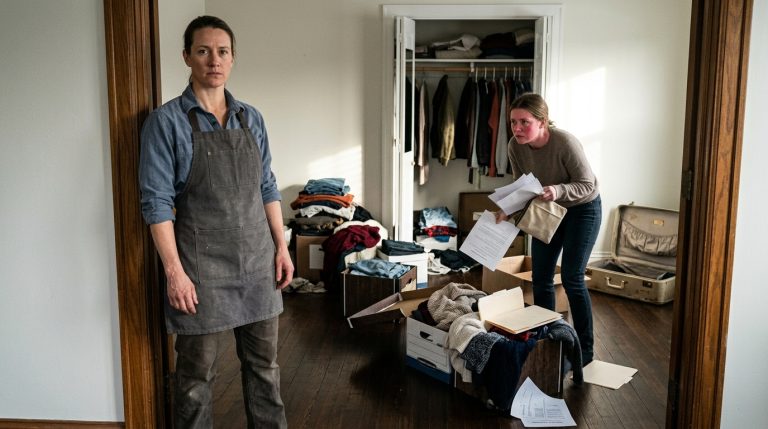
I moved on. The Millers were awake, their kitchen a chaotic mess of half-packed boxes; they were planning to move because they couldn’t afford the HOA’s constant, arbitrary fines. When I showed them the invoice, the look on their faces shifted from defeat to a sharp, cold rage. By the time the sun had fully crested the horizon, I had six signatures.
I returned home to find a certified letter taped to my front door. My hand was steady as I ripped it open. It wasn’t a fine. It was an eviction notice—not for the house, but a “Notice of Lien” against the property for the “unapproved construction” of the roof. It was a bluff, a final, frantic attempt to scare me into backing down before the legal hammer fell.
I laughed. The sound was dry, empty of humor, but it felt right. She was afraid. She had seen the surveyor, she had seen the storm, and she had seen the cracks in her own defense. She was pushing back because she had nowhere left to go.
I took the letter, crumpled it, and tossed it into the trash. I sat back at the computer and sent the completed packet—the affidavits, the invoices, the records—to Marcus. He called me within thirty seconds.
“Jack,” he said, his voice unusually sharp. “This isn’t a civil suit anymore. This is a criminal referral. You’ve given us everything we need to bypass the local courts and take this straight to the state board of regulators. They’ll freeze the HOA’s assets within twenty-four hours.”
“Do it,” I said.
“I have to warn you,” Marcus cautioned. “Once this goes public, you’re the face of it. They’ll come for you, Jack. Not with letters, but with everything else they’ve got left.”
“Let them come,” I said, my gaze moving to the window. The barn stood in the distance, defiant, its charcoal roof shining in the morning sun. “I’m done waiting for them to play by their own rules.”
I hung up, the silence in the office returning, but it felt different now. The air was charged, the tension physical and thick. I stood up and walked to the wall of the office, pulling down the master plan of the subdivision I had pinned up months ago. I traced the lines—the grid of the streets, the location of the clubhouse, the way the entire layout funneled the resources of the community into that one, centralized authority.
It was a cage. And I had finally found the mechanism to open the door. I walked out to the barn, the grass still wet under my feet, and sat on the threshold. I watched the neighborhood wake up—the cars pulling out of garages, the neighbors walking dogs, the suburban choreography playing out exactly as it had every morning for the last year.
But I knew the truth now. I knew the weight of every shingle, the cost of every curb, the price of the silence that held this place together. And I was the only one with the key. I wasn’t going to let them move forward until the rot was exposed. The ambush was set; I just had to wait for her to walk into it.
CHAPTER 7: THE FOYER NEGOTIATION
The knock was rhythmic, measured—three strikes against the heavy, ornate brass. It echoed inside the hollow chamber of the entryway, a sound that carried the weight of impending collapse. Marcus stood beside me, his suit a sharp, charcoal-gray armor, his face devoid of the professional warmth he usually reserved for clients. Beside him, I felt like a blunt instrument—my jeans, my work-worn hands, the lingering scent of wood dust and gasoline still clinging to my jacket.
The door swung inward, and the sudden shift in light revealed Karen. She was in a silk robe, the kind that cost more than the materials I’d put into the barn’s new siding. Her hair was pulled back in a severe, haphazard knot, and her face—usually a carefully painted mask of suburban perfection—was raw, pale, and stripped of all pretense. When she saw me, her eyes didn’t widen; they dulled. She knew.
“Major,” she said, her voice a fragile, brittle thing. She didn’t look at Marcus. She looked at me, as if I were the one who had finally stripped away the architecture of her life.
“We aren’t here for a conversation, Karen,” Marcus said, his tone clinical, professional. He didn’t wait for an invitation. He stepped into the foyer, his polished shoes clicking against the cold, white marble. I followed, closing the door behind us with a soft, final thud that seemed to seal the space off from the rest of the world.
The interior was ostentatious—a cavern of gilded mirrors, velvet settees, and light fixtures that caught the dawn and shattered it into a thousand sharp, blinding reflections. It was a palace built on fines, liens, and the systematic theft of neighbors’ livelihoods.
Karen retreated to a chair, an ornate, claw-footed thing that looked like it had been lifted from a museum. She sank into it, the silk of her robe pooling around her like water. I stood, my feet planted firmly on the cold stone, watching her. V-2: The Psychological Phantom. The image of a bridge foundation I’d condemned years ago flashed in my mind—a massive, sprawling structure that had looked perfect from the road but had been hollowed out by termites from the inside. That was Karen. She wasn’t just a neighbor; she was a structural failure wrapped in fine silk.
“You have the documents,” I said, my voice flat.
Marcus stepped forward, his briefcase snapping open with a sound like a pistol shot. He laid the papers out on the marble-topped console table. The civil complaint, the class-action draft, the sworn affidavits—they sat there, white, stark, and final.
“Every penny, Karen,” Marcus said, his voice dropping into the quiet, lethal tone he used for final negotiations. “Every contract you funneled through your family, every fine you levied for profit, and the total cost of the restitution for the neighborhood. You sign, you write the check, and you leave. We don’t file the criminal referrals. We don’t call the Sheriff. You get to keep what’s left of your reputation, provided you move tonight.”
She looked at the papers, then at the pen Marcus placed beside them. She didn’t argue. She didn’t make a villain’s speech. She simply looked up at me, her eyes brimming with a sudden, sharp clarity.
“You think you’ve won,” she whispered. “You think this is about justice. But you’re just like me, Major. You broke every rule to make sure this house of cards came down. You’re just a different kind of architect.”
The words struck home, but they didn’t shake me. I didn’t care about the morality of the path; I cared about the structure of the truth. She had built her power on the idea that the rules were a cage for everyone else, and the moment I turned those same rules against her, she realized she was as trapped as anyone else.
“I’m an engineer,” I said, my voice steady, unyielding. “I just identified the load-bearing flaw in your design. If you didn’t want the structure to fall, you should have built it on something other than greed.”
She stared at me, the silence in the foyer stretching, heavy with the sound of the house’s HVAC humming in the walls. Then, with a slow, mechanical movement, she reached for the pen. Her hand was trembling—a fine, jagged tremor that made her signature stutter across the bottom of the resignation letter.
I watched the ink bleed into the paper, a slow, dark stain of finality. She signed the affidavit, then the check, then the settlement agreement. Each stroke of the pen was a structural beam being pulled from the foundation. When she was finished, she pushed the documents toward Marcus, her chest rising and falling in shallow, ragged breaths.
Marcus checked the documents, his eyes scanning the signatures with the speed of a machine. He folded them, placed them back in the briefcase, and looked at me. “It’s done.”
I picked up the check from the table. I didn’t feel a rush of triumph. I felt only a profound, hollow weight. The house was quiet, the gilded furniture cast in the long, gray light of the morning. Karen sat in the claw-footed chair, her head bowed, staring at the empty marble tabletop. She looked small. She looked like a ghost in her own home.
We turned to leave. I didn’t say goodbye. I didn’t offer a final insult. I opened the door, the cool, morning air of the neighborhood rushing in, smelling of pine needles and damp earth—the smell of the life I had fought to protect. We stepped out onto the porch, leaving her behind in the silent, ornate tomb she had built for herself. The lion-head knocker caught the light, and for a moment, it looked like it was laughing.
CHAPTER 8: THE FINAL FOUNDATION
The drive back to the house felt like moving through a different city. The streets of Golden Meadows, once a claustrophobic grid of identical expectations, looked merely like streets again. The manicured lawns, the pristine mailboxes, the uniform beige of the McMansions—it was all just material now, stripped of the heavy, suffocating weight of the HOA’s manufactured “aesthetic harmony.”
When I pulled into my driveway, the barn was waiting. The charcoal-gray roof caught the late-afternoon sun, glowing with a soft, steady warmth. It looked anchored, a monolith of permanence in a world that had tried to legislate its existence out of reality. I sat in the truck for a long moment, the engine ticking as it cooled. The $275,000 check in my pocket felt like nothing more than paper—the medium of exchange for a debt that had been settled in sweat and strategy.
I walked to the barn. The door hinges, once rusted and stubborn, moved with a silent, weighted smoothness. Inside, the space smelled of pine shavings, linseed oil, and the sharp, clean scent of cedar. It was a cathedral of labor. The workshop was organized, the tools hung on the wall in their designated positions, the concrete floor swept clean. On the opposite side, the living space was filled with the soft, golden light filtering through the new skylights, reflecting off Sarah’s canvases.
I walked to the workbench and picked up a block of oak—the same type of timber that made up the barn’s main frame. I felt the grain, the rough, unyielding texture of history. Karen had wanted to destroy this. She had wanted to replace the soul of this property with the hollowed-out uniformity of her own design. She had viewed the barn as an eyesore because it was a reminder of something she could never possess: an origin.
I set the wood down and walked out to the main support beam where the crimson paint had once wept. The professional crew had finished the restoration weeks ago. The wood was clean, treated, and sealed—the scar gone, leaving only the natural, weathered pattern of the oak. I placed my hand against it, feeling the solid, vibrant hum of the structure. It wasn’t just standing; it was thriving.
Sarah walked in, her footsteps echoing softly on the new floor. She didn’t say anything. She just stood beside me, watching the light move across the beams.
“Is it over?” she asked, her voice barely a whisper.
“It’s over,” I said. “The files are gone, the board is being dismantled, and she’s already packed. By tomorrow, she’ll be a ghost.”
“And us?”
“We stay.”
I picked up a wood plane from the bench—a tool that had been in my grandfather’s collection, now restored to its former precision. I held it with both hands, the weight familiar and grounding. I began to work a piece of scrap wood, the shavings curling up in thin, delicate ribbons of amber.
The process of restoration was the true justice. It wasn’t about the check, or the resignation letter, or the humiliation Karen had suffered. It was about the work. It was about taking a damaged, ignored thing and committing to the long, slow, necessary process of making it whole. The neighborhood outside was changing, too. The Millers were staying, their kids now playing in the yard with a new, emboldened sense of ownership. Mr. Henderson was out on his porch, not hiding, but watching the street with a quiet, observant pride.
The reign of terror hadn’t just ended; it had been replaced by a tentative, growing resilience. I stopped the plane and looked at the wood. It was smooth, perfectly square, and ready for use.
I thought of Karen, sitting in the silence of that gilded foyer, her world reduced to the size of her own regrets. She had tried to enforce a standard of perfection that was inherently hollow, and in doing so, she had become the very thing she claimed to despise—a structural liability. Her life hadn’t just fallen apart; it had been deconstructed by the very rules she had used to build it. There was no poetry in her defeat, only the cold, logical outcome of a flawed design.
The sun began to dip behind the tree line, casting the interior of the barn in a long, soft amber. I hung the plane back on the rack and walked to the door. I felt a lightness in my chest that had been absent for years—the end of the tactical vigilance, the cessation of the internal calculations, the quiet relief of a mission complete.
I walked to the garden where Sarah had spent the afternoon. The flowers were blooming, their colors vibrant and uncontrolled—a deliberate, beautiful rebellion against the beige uniformity of the subdivision. I sat on the bench, watching the shadows stretch across the lawn. The barn behind me stood tall, a monument not to the conflict, but to the endurance. I had won in every way that mattered. We were here, we were safe, and for the first time in a long time, the future wasn’t something to be calculated. It was something to be built.