The Iron Network: A Weary Veteran’s Gritty Struggle Against An Unstoppable American Machine
CHAPTER 1: SHADOWS IN THE MUD
Rain tasted like burnt powder and pine sap, but Klaus Bremer kept his mouth shut while he dragged fifty pounds of American iron through the mud.
The weight pulled at his shoulder socket with every step.
Beside him, Gefreiter Müller stumbled over a slick spruce root, his hand catching Bremer’s wool coat to steady himself.
“Keep moving,” Bremer grunted, his voice barely louder than the patter of water against steel helmets.
He didn’t look back at the creek bed they had just left.
The heavy American radio sat wedged inside Bremer’s canvas sack, its olive-drab casing cold against his lower spine.
They had found it half-submerged in grey muck, abandoned alongside five spent brass casings and three distinct tread marks from heavy American combat boots.
A sudden whistle tore through the canopy overhead—high, sharp, and short.
Bremer slammed himself into the dirt before his mind even processed the sound.
The detonation hit two hundred meters to the north, shaking loose a shower of pine needles and wet bark that blanketed his back.
He dug his fingernails into the damp earth, feeling the vibration thrum through his chest.
It was the third registration round in ten minutes.
They weren’t aiming for targets; they were feeling out the grid.
“They saw us,” Müller whispered, his face pressed against a patch of rotting leaves, his breath hitching.
“They didn’t see anything,” Bremer said, turning his head just enough to check his squad. “If they saw us, that shell would have hit your boots.”
He reached into his pocket and felt the cold steel of the small American pry bar he’d kept since Normandy.
His thumb traced the deep scratch along its curved claw, using the sharp metal edge to anchor his racing pulse.
Five meters to the left, Gefreiter Langer crouched behind a moss-covered boulder, his Mauser pointed uselessly into the dense green mist.
“Unteroffizier,” Langer called, his voice tight. “The radio’s back panel is loose. Something’s sticking out.”
Bremer crawled across the muddy gap, keeping his chest low to the ground.
He unzipped the canvas cover just enough to expose the heavy olive metal of the SCR-300.
A corner of heavy white paper was trapped in the rubber seal of the battery compartment, fluttering slightly in the damp wind.
It wasn’t standard military stencil.
It was a scrap of cardboard, tucked deliberately into the seam.
Bremer didn’t pull it free. He shoved the paper back inside and tightened the canvas flap.
“We don’t touch it here,” Bremer said, his tone leaving no room for argument. “We move.”
He stood up, his knees popping under the weight of three years of infantry mud.
The American guns to the west went quiet, but the silence felt heavier than the artillery.
It was the kind of quiet that meant somebody, somewhere in a dry tent three miles away, was writing numbers down on a pad.
Bremer clamped his hand over the pry bar in his pocket and pushed forward into the gray mist of the Hurtgen.
CHAPTER 2: THE COMMAND POST DESK
Water pooled on the brim of Bremer’s helmet, trembling until the heavy drop broke and splashed directly onto the toe of his mud-caked left boot.
He didn’t shake it off.
Inside the ruined farmhouse that served as the forward command post for the 275th sector, the smell of damp wool, stale tobacco, and cold sweat was thick enough to chew.
Across the rough timber table, Major Westerhaus didn’t look up immediately.
The Major was fifty-three years old, built like a crumbling brick wall, his shoulders permanently hunched in a slight, bracing lean—the posture of a man who had stopped expecting good news sometime during the winter of forty-two.
Bremer unslung the canvas sack from his shoulder and set the SCR-300 onto the map.
The heavy thud of metal meeting paper cut cleanly through the wet flapping of the canvas tarpaulin cover where the farmhouse’s eastern wall used to be.
Westerhaus looked up then, his narrow eyes settling on the dark green metal case with the slow, deliberate attention of a doctor examining an incurable spot on a lung.
“Where?” Westerhaus asked. His voice was low, scraped raw by cheap cigarettes and cold night air.
“Dry creek bed, grid four-four-seven,” Bremer said, keeping his posture straight despite the dull ache in his lower back. “Eight hundred meters inside our screen. Boot prints heading west. They left it when Langer’s machine gun crew opened up on the ridge.”
Westerhaus reached out, his thick, calloused fingers tracing the clean white stenciling on the American metal.
He turned the radio slightly, noticing the pristine brass latch and the rubberized weather seals that kept out the Ardennes rain.
“Vogel!” Westerhaus barked toward the dark doorway behind him.
Hauptmann Ernst Vogel appeared within seconds, adjusting his thin, wire-framed glasses with a quick, nervous twitch of his forefinger.
The signals officer was a thin, bird-like man who had spent the pre-war years designing circuit breakers in Essen.
Vogel took one look at the olive-drab unit on the map table, and his right hand froze mid-air.
“SCR-300,” Vogel murmured, stepping closer as if drawn by a magnet. “Frequency modulated. Man-portable.”
“Give me the short version, Ernst,” Westerhaus said, pulling a crushed cigarette from his tunic pocket and leaving it unlit between his lips. “What does it mean for my sector?”
“It means,” Vogel said, his voice dropping into that quiet, terrifying tone technical men use when they recognize something vast, “that a nineteen-year-old American squad leader can talk to his division artillery with the same clarity I have speaking to you across this table.”
Vogel unlatched the radio’s back panel with practiced ease, his fingers moving over the crisp internal wiring, the dedicated battery housing, and the spare fuse clips nested neatly inside.
“They don’t use Morse. They don’t use runners. They speak into a hand-mic, give a map grid, and steel arrives in three minutes.” Vogel wiped his fogged glasses on his sleeve, his face pale in the dim light of the oil lamp. “We received an intelligence summary in July. Production runs in the tens of thousands.”
Westerhaus stared at the radio, then down at his worn grid map where small blue and red pencil marks showed his scattered, under-strength companies.
“Every squad,” Westerhaus said quietly. It wasn’t a question.
“At minimum, every platoon,” Vogel corrected, his throat clicking as he swallowed. “They aren’t running lines of copper wire through the brush, Major. They’re moving a network through the trees.”
Bremer stood by the door, his hand buried in his coat pocket, his thumb running over the notched claw of his stolen American pry bar.
He watched Westerhaus’s face—watched the old veteran calculate what it meant to fight an enemy that treated complex radio technology not as a rare luxury for high command, but as standard issue for ordinary farm boys from Iowa.
The tarpaulin flapped hard against the timber frame as a gust of wind swept through the forest, carrying with it the faint, rhythmic thrumming of distant American engines.
Westerhaus leaned his heavy hands on the edge of the table, his knuckles turning white under the grime.
“Keep the set in the back room,” Westerhaus commanded slowly. “If staff headquarters finds out we have a functional American FM unit, they’ll spend three days writing reports while we sit under their registration fire.”
“And the battery scrap?” Bremer spoke up, taking half a step forward.
Westerhaus paused, his dark eyes shifting to Bremer. “What scrap?”
Bremer reached over and tapped the edge of the back panel where the small piece of stiff cardboard remained wedged in the rubber gasket.
“It was tucked in the seal when we picked it up,” Bremer said simply. “American handwriting.”
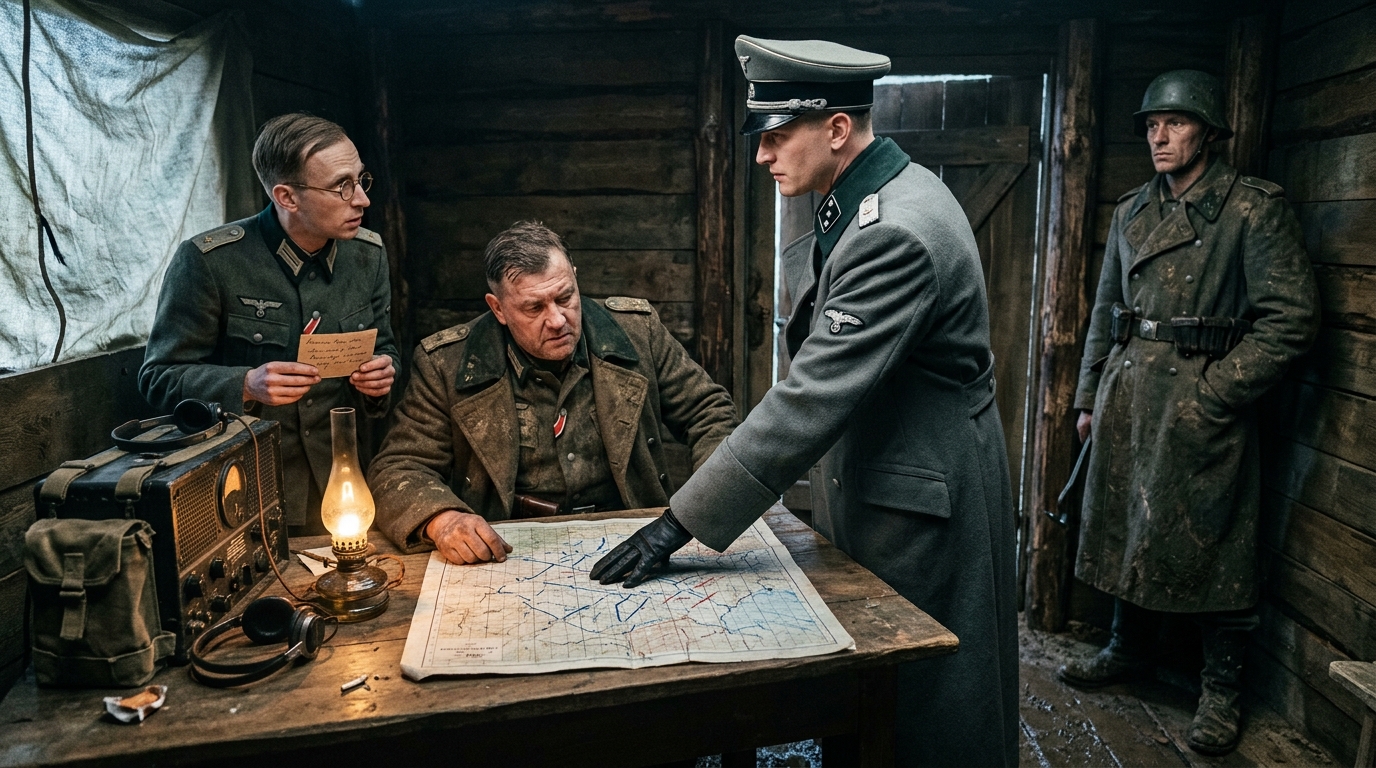
Vogel leaned down, pulling the scrap free with two fingers and laying it beneath the yellow glow of the oil lamp.
CHAPTER 3: THE ZEALOTS MANDATE
Hauptmann Vogel held the cardboard scrap under the flickering yellow glow of the oil lamp, his fingers trembling so hard the shadow on the wet map table danced like a twitching corpse.
Major Westerhaus squinted down at the blue pencil markings scrawled across the American paper.
“Target grid,” Westerhaus muttered, his voice flat. “Pencil hasn’t even smudged yet.”
Before Vogel could answer, the wooden door frame rattled violently as a boot kicked it open.
Sturmbannführer Brandt stepped inside, trailing the reek of wet leather, expensive polish, and cold arrogance.
He was thirty-two years old, wearing a immaculate gray coat despite the Hurtgen mud, his SS collar tabs gleaming like silver pins against the gloom.
Brandt didn’t remove his gloves. He looked at the ruined farmhouse, at Westerhaus’s unlit cigarette, and finally at the heavy olive radio sitting on the map.
“You’ve been holding an operational enemy communications hub for twenty minutes without reporting to sector command, Major,” Brandt said. His voice was smooth, devoid of the exhaustion that dragged down every other man in the room.
“It’s an SCR-300,” Westerhaus said, not standing up, not offering a salute. “We’re evaluating its origin.”
“It is evidence of an imminent penetration,” Brandt snapped, stepping forward and placing his gloved palm directly over the map, covering the red tactical marks. “Division intelligence reports two American infantry battalions organizing in sector grid four-four-seven.”
Bremer stayed by the wall, his hand tightening around the steel pry bar in his coat pocket.
He knew that grid. He’d just dragged fifty pounds of American iron out of its mud. There weren’t two battalions in that creek bed.
“They aren’t massing infantry, Sturmbannführer,” Bremer said quietly.
Brandt’s head turned slowly, his eyes locking onto Bremer’s worn rank insignia with open disdain.
“An Unteroffizier speaks only when invited,” Brandt spat, his jaw tightening. He turned back to Westerhaus. “The capture of this unit proves their forward command post is overextended. The Führer’s orders for the Hurtgen defense are explicit: zero backward movement. Every lost foot of soil must be met with an immediate counter-stroke.”
“A counter-stroke into grid four-four-seven is suicide,” Westerhaus said, his voice dropping an octave, heavy with dangerous weight. “My men have four rounds per mortar left. We advance into that ravine, and we’re walking straight into an open pocket.”
“They are retreating!” Brandt raised his voice, his posture rigid with ideological entitlement. “They abandoned high-value signal equipment! A disciplined German force pushes through that hesitation and takes the ridge.”
Vogel cleared his throat, holding up the scrap of cardboard with subtle hesitation. “Sturmbannführer, the markings here—”
“I don’t care about your technical pedantry, Hauptmann!” Brandt cut him off with a slice of his gloved hand. “You will assemble your remaining squad leaders, Westerhaus. You will launch a violent assault across the creek bed at dawn.”
Bremer watched Brandt’s face—the complete lack of sweat, the pristine uniform, the blind, absurd insistence that words written on a memo in Berlin could rewrite the physical reality of American artillery sitting two miles west.
Brandt was going to sacrifice every remaining man in the 275th just to write a glowing action report for his superiors.
“And if we refuse to throw thirty exhausted men into an open field?” Westerhaus asked softly, his hand resting inches from his holstered pistol.
“Then I assume command of this sector under emergency authority,” Brandt said, his hand sliding smoothly over the flap of his own sidearm holster. “And you will face a court-martial before the sun clears the tree line.”
The canvas wall flapped violently in the wind, letting in a spray of cold rain that hissed against the hot chimney of the oil lamp.
CHAPTER 4: THE SILENT DISCREPANCY
Bremer stood in the dark corner of the back room, his fingers tracing the cold metal chassis of the SCR-300 while Sturmbannführer Brandt’s voice cut through the wooden partition like a dull saw.
“The order is written, Westerhaus!” Brandt barked from the main room, his gloved hand slamming onto the table. “You will deploy two platoons into grid four-four-seven at dawn, or I will personally file the charge of cowardice!”
Bremer ignored the shouting.
He slipped the heavy American pry bar from his pocket, using its flat claw to gently lever open the radio’s lower battery compartment.
The oil lamp flickered as rain rattled against the single glass pane in the back wall.
Inside the housing, sitting right beside the heavy dry-cell block, was the paper scrap Vogel had pulled earlier.
Bremer pulled a second folded scrap from his pocket—one he had quietly palmed from the bottom of the crate back at the French barn weeks ago.
He laid them side-by-side on the dull metal surface.
The handwriting was identical.
Not field scrawl. Not a panicked note written under fire.
It was a pre-printed grid matrix, filled in with dark blue grease pencil, listing specific elevation angles and battery battery-code offsets.
Grid four-four-seven wasn’t listed as an assembly point for American infantry.
It was labeled as an impact target zone.
Bremer’s thumb pressed hard into the notched steel of his pry bar as the truth crystallized with brutal, common-sense clarity.
The Americans hadn’t lost this radio in a panicked retreat.
They had left it in that muddy creek bed on purpose—a physical lure to drag German forces into an open pocket where every foot of terrain had already been calculated down to the millimeter.
Layer 1 was Brandt’s blind fantasy of an American retreat.
Layer 2 was a cold, industrial meat grinder waiting to turn sixty men into ash the moment they stepped across the ridge.
“Unteroffizier!”
Brandt stood in the doorway, his chest puffed out, his jaw set in a rigid line of ideological zeal.
“Why are you idling back here while combat operational plans are being finalized?” Brandt demanded, pointing a single gloved finger at Bremer’s face.
Bremer slowly slid the pry bar into his pocket and turned around, keeping his posture grounded.
“I was checking the weight of the frame, Sturmbannführer,” Bremer said, his tone dry and even. “It’s too light.”
“What are you rambling about?” Brandt took two swift steps into the room, his boots crunching on loose mortar.
“The Americans don’t leave fifty pounds of functional equipment behind unless they want you to find it,” Bremer said, holding up the cardboard scrap. “These aren’t retreat coordinates. They’re registration codes for their heavy guns.”
Brandt snatching the paper from Bremer’s hand, his eyes scanning the numbers for barely two seconds before crumpled it into a ball and tossing it onto the dirt floor.
“Defeatist nonsense!” Brandt sneered, his voice rising in manufactured rage. “You infantry conscripts have grown soft from retreating! You see traps in every shadow because you lack the will to fight!”
“My men lack ammunition, sir,” Bremer replied flatly, refusing to blink. “Not common sense.”
Brandt stepped close enough that Bremer could smell the peppermint on his breath, his eyes wide with fanatical arrogance.
“At dawn, your squad leads the point element across that creek,” Brandt whispered, his authority weaponized like a blade. “And if you hesitate for one second, Bremer, I will shoot you myself.”
Outside, the first faint whistle of an incoming registration shell cut through the rain.
CHAPTER 5: THE COLLAPSE OF AUTHORITY
Bremer leaned against the damp doorframe at dawn, watching Sturmbannführer Brandt inspect the squad’s bolt-action rifles in the pouring rain with a white cloth tucked between his leather-gloved fingers.
“Mud on the receiver plate, Gefreiter,” Brandt declared, tossing Müller’s Mauser back into the kid’s chest. “Inexcusable for a soldier of the Reich.”
Müller caught the rifle against his ribs with a breathless gasp, his boots sliding back an inch in the grey soup.
“We advance in three minutes,” Brandt ordered, turning toward the ridge with his chin held high. “Unteroffizier Bremer, take the lead line.”
Bremer didn’t move toward the open ridge.
Instead, he reached out, grabbed Müller by the shoulder straps of his canvas webbing, and hauled the younger soldier backward into the shadow of a half-collapsed stone drainage culvert.
“Get down,” Bremer said quietly to the rest of his squad, signaling Langer to hold his machine gun crew inside the culvert mouth.
“What is the meaning of this insolence?” Brandt roared, whirling around with his leather coat whipping against his calves. “I gave an explicit directive to cross the crest!”
“Listen,” Bremer said flatly.
He didn’t yell. He didn’t point to a map. He just held up his right hand, his thumb resting against the notched edge of the stolen American pry bar in his coat pocket.
From two miles west, a series of dull thuds echoed across the valley—less like thunder, more like heavy iron doors slamming shut in a long concrete hallway.
Boom. Boom. Boom. Boom.
Four distinct pops of displaced air, followed instantly by a sound like tearing bedsheets high above the tree line.
Brandt’s eyes flared with sudden, desperate arrogance. “That’s splash fire! They’re shooting blind! Forward, you fools!”
“That isn’t splash fire,” Bremer said, his voice dropping into a cold, steady register. “That’s a quad-battery battery salvo. They’re firing on the cardboard grid.”
The air around them split open.
The first shell didn’t hit the culvert; it detonated directly on the crest of the ridge where Brandt had ordered the squad to assemble—a wall of black earth, shattered pine branches, and white-hot steel shrapnel tearing through the fog.
The shockwave slapped against Bremer’s chest like a wet plank, knocking the breath from his lungs and showering the culvert with flying gravel.
A second later, three more heavy detonations slammed into the open field beyond the creek, walking in a precise, mathematical box.
Grid four-four-seven was erased in four seconds.
Inside the smoke-filled culvert, Müller was shaking, his hands clamped over his ears, his teeth chattering against his lower lip.
Brandt was pressed against the muddy stone wall, his immaculate coat smeared with yellow clay, his posture broken as he stared at the flaming crater fifteen yards away where he had just stood.
“They… they couldn’t have known,” Brandt stammered, his voice losing its polished edge, pitching up into a high, frantic whine. “The intelligence report… the tactical assessment…”
“They didn’t need intelligence, Sturmbannführer,” Bremer said, stepping over a fallen pine branch until he stood inches from the SS officer. “They left a box on a hill, waited for an arrogant man to order his troops into it, and pulled a lanyard.”
“You… you disobeyed a direct command!” Brandt shrieked, his hand scrambling wildly for the holster at his hip, his fingers slipping against the wet leather flap. “I will have you shot for treason!”
Bremer didn’t draw a gun.
He simply reached out with his left hand, grabbed the leather strap of Brandt’s holster, and wedged the steel claw of his American pry bar straight into the brass buckle mechanism, jamming it solid.
Brandt tugged desperately at his sidearm, his face turning red, but the mechanism wouldn’t budge.
“You’re done ordering men to die for your reports, sir,” Bremer said, his voice as hard and unyielding as the iron in his pocket.
Major Westerhaus stepped out from the smoke behind them, his face caked in grey ash, holding his service pistol resting loosely at his side.
“Sector command is destroyed, Brandt,” Westerhaus said, his dark eyes fixed on the struggling SS officer. “The artillery wiped out the upper bunker five minutes ago.”
Brandt stared between Westerhaus and Bremer, his mouth opening and closing like a landed carp, his fanatical authority stripped away by thirty pounds of American high explosive.
“We move east,” Westerhaus told Bremer, turning his back on Brandt entirely. “Through the timber line. Away from the roads.”
CHAPTER 6: RUSTED TRUTH
Bremer knelt inside a damp concrete bunker alcove, wiping grease off his Mauser bolt with a dry rag while the squad rested in the shadows.
The heavy, metallic clicking of the bolt sliding back into the receiver was the only sound inside the chamber.
Ten feet away, Sturmbannführer Brandt sat on an overturned wooden crate, his hands trembling violently in his lap as he tried—and failed—to wipe yellow Hurtgen mud off his silk-lined collar.
The fanatical threats, the emergency authority, the grand speeches about victory and court-martials—all of it had dissolved into the cold, damp silence of the bunker.
Brandt looked up, his face pale and sunken under the grime, his eyes darting toward Bremer’s pocket where the small steel pry bar sat.
“You’re going to abandon the ridge?” Brandt rasped, his voice thin, stripped of all its toxic weight. “If we fall back… if we don’t report to division…”
“Division isn’t answering, Sturmbannführer,” Major Westerhaus said from the entrance, his shadow stretching long across the floor. He didn’t even look back at Brandt. “And there is no ridge left to hold.”
Vogel sat near the door, quietly tearing the wire leads out of an old German field telephone that had gone dead hours ago.
“The Americans don’t care about our doctrine,” Vogel murmured, adjusting his glasses with a slow, tired hand. “They don’t care about our willingness to die on a line. They have factories, networks, and radios in every squad. They turn war into arithmetic.”
Müller leaned his head against the concrete wall, chewing on a piece of hard tack, his eyes fixed on Bremer.
“What do we do now, Unteroffizier?” Müller asked quietly.
Bremer slid the Mauser bolt home with a clean, solid snap.
He didn’t offer a dramatic speech about the Fatherland, nor did he pretend they were going to win the war.
He reached into his pocket, pulled out the heavy steel pry bar, and set it on the concrete floor beside his boot.
“We keep moving east,” Bremer said, his voice practical, grounded, and steady. “We stay in the trees. We keep our boots dry when we can, and we keep each other alive.”
Brandt opened his mouth as if to protest one last time, to claim some lingering shred of official rank, but when Bremer looked at him, the SS officer simply swallowed hard and looked down at his ruined coat.
The entitlement had run out of ground to stand on.
Outside, miles to the west, the rhythmic walking of the American guns continued—methodical, industrial, and patient.
Boom. Boom. Boom.
Bremer picked up his rifle, stood up, and took the first step toward the rear exit, leading his men into the cold, quiet woods.