The Dusty Gray Horizon: How Broken Men Found a New Measure of Truth in the Cold Canadian Prairie
CHAPTER 1: THE COLD DOCK
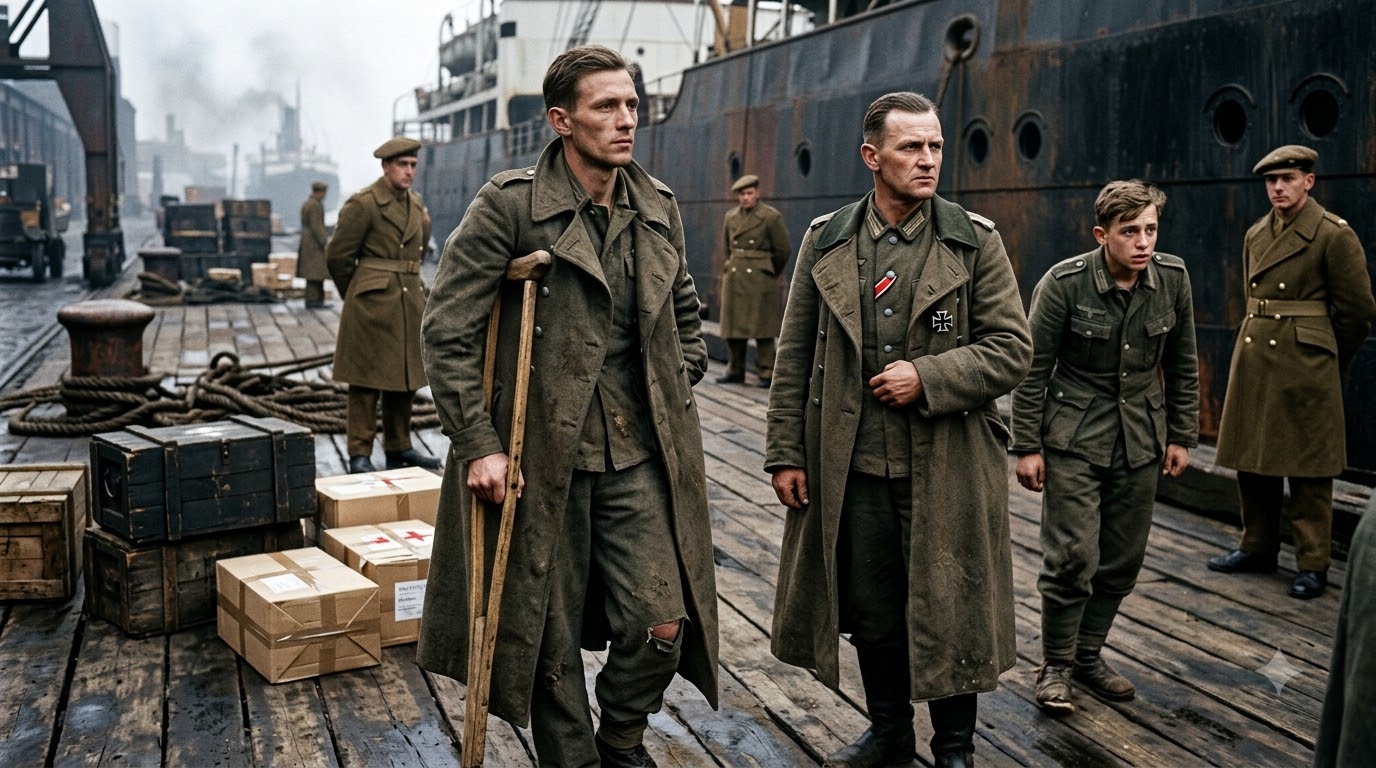
The wooden crutch dug sharply into Hans Miller’s armpit as he shifted his weight against the damp October wind. His left leg ended just below the knee, a jagged souvenir from a British shell at Normandy three months ago. The stump throbbed a dull, rhythmic ache through the cold fabric of his trousers. Around him on the Liverpool dock, two hundred disabled German men stood like broken pieces of a discarded army, waiting for the gray transport ship to haul them toward what the propaganda officers called a frozen wasteland of savage colonial troops.
Oberfeldwebel Carl Weber stood nearby, his right sleeve pinned neatly to his worn uniform jacket where an iron cross sat forgotten against the gray wool. Weber’s eyes remained fixed on the rusted hull of the vessel ahead, his jaw tight with the quiet resignation of a career soldier who had stopped hoping for mercy. Beside them, twenty-two-year-old Friedrich Kleine dragged his injured foot across the damp timber, his youthful face twisted in a bitter mask of fear and defiance. “They will torture us first,” Fritz muttered, his voice shaking with a nervous energy that refused to settle. “That is what the enemy does to the weak.” Hans said nothing, his fingers tightening around the scarred wood of his crutch as the British guards began shouting sharp commands in English, prodding the line forward toward the gangplank. Every instinct told him to brace for the worst, to prepare for a descent into darkness from which none of them would return. He dragged his heavy boot across the wet dock, forced his aching body forward, and took the first step toward the gray horizon.
CHAPTER 2: UNCHARTED WATERS
The heavy iron hatch swung shut behind them with a muffled, echoing thud that rattled straight up through Hans Miller’s wooden crutch. Down in the lower deck, the air tasted of stale wool, oil, and boiled potatoes. Corporal McKenzie stepped down the steep metal stairs without a weapon drawn, his red hair catching the dim glow of an overhead bulb. “Easy there with the stairs, fellows,” the young guard said, steadying Hans by the elbow with a firm, matter-of-fact grip. “These steps are murder when the swell picks up.” Hans stared at the hand holding his arm, waiting for the shove, the curse, or the mockery that every prisoner learned to expect from a victor’s army. Instead, McKenzie simply let go once his footing was secure and nodded toward a row of metal bunks built cleanly into the hull.
Oberfeldwebel Carl Weber stood by the lowest tier, his single hand brushing tentatively across the surface of a rough wool blanket. “This is wrong,” Friedrich Kleine muttered, his voice cracking as he dragged his injured foot across the floorboards to claim the opposite bunk. “They are fattening us before the slaughter. It is a psychological game.” Weber said nothing, his tired eyes tracking a pair of guards moving down the corridor with stacked cardboard crates. One of the guards handed a small, taped box to an older German soldier with a bandaged hand, offering a brief, silent nod before moving to the next berth.
Hans reached out and pulled open his assigned parcel on the mattress. Inside sat a small bar of soap smelling faintly of lavender and a square of Swiss chocolate wrapped in paper printed with German text. His hands shook as he broke off a corner, the sudden sweetness catching the back of his throat with an intensity that felt entirely unearned. Across the aisle, Fritz ripped open his own box and immediately shoved a piece of chocolate into his mouth, chewing with aggressive, exaggerated defiance while his eyes darted nervously toward the corridor. “It means nothing,” Fritz whispered, though the anger in his voice lacked its previous weight. “They expect us to be grateful cattle.” Weber lowered himself onto the edge of his mattress, watching the chocolate melt between his fingers while the distant thrum of the ship’s engines pushed them steadily deeper into the cold unknown.
CHAPTER 3: THE PRAIRIE BARRACKS
The train brakes ground against the iron tracks with a metallic shriek that echoed across the open Medicine Hat platform. Hans Miller caught his balance by gripping the back of a wooden seat, his wooden crutch wedged tightly against the floorboards. Outside, flat miles of snow-dusted prairie stretched toward distant mountains under a massive, unrelenting sky devoid of bomb craters or burnt ruins.
Carl Weber stepped down from the carriage first, his single hand steadying the metal handrail as the crisp northern air hit his face. Friedrich Kleine followed behind, dragging his injured foot onto the gravel with a sullen scowl. “There are no guard towers with machine guns,” Fritz muttered, scanning the simple wooden fence line of the compound ahead with a look of deep suspicion. “It is a facade. A trick to lower our guard.”
Hans limped past the open gate where a single Canadian guard glanced briefly at their transfer papers before waving them through with a casual wave. Inside the thirty-acre compound, regular brown and green barracks stood beneath a clear afternoon sun. Other disabled prisoners moved freely between the buildings, some tending a garden patch near the fence line without looking starved or broken.
The heavy oak door of Barrack 12 swung inward, revealing a long room lined with actual metal bed frames, soft mattresses, and neatly folded wool blankets. Hans sat down slowly on the edge of the nearest mattress, testing its weight as the springs gave way beneath him. Down the hall, an older German prisoner looked up from a wooden locker and called out over the sound of a radio playing soft music from the corner shelf. “Pick a bunk, fellows,” the man said, gesturing to the empty spaces. “Dinner is across the yard in an hour, and they are very strict about the bell.”
CHAPTER 4: THE BREAKING POINT
Corporal McKenzie sat down uninvited across the bare wood, his own tray loaded with the exact same rations served to the prisoners down the line. The red-haired guard rested his forearms on the table, setting down a small, worn photograph between their plates without a word of preamble. “My brother, Tommy,” McKenzie said, his voice dropping into a flat, steady register that cut through the low hum of the mess hall. “He died at Dieppe in forty-two. Nineteen years old.”
Hans stared at the cardboard edges of the snapshot, his fingers tightening reflexively around the handle of his fork. Across the aisle, Carl Weber leaned forward, his single hand flat against the table as his gaze locked onto the image of the smiling young soldier in a Canadian uniform. “German machine guns killed him on the beach,” McKenzie continued, his eyes meeting Hans’s with an exhausted, unflinching clarity. “I had every reason to want revenge. Every reason to treat you like animals.”
The ambient noise of the room seemed to pull back, leaving only the sound of breathing and the heavy weight of unearned grace pressing down on the table. Friedrich Kleine sat rigid beside them, his jaw clenching so hard a muscle twitched violently beneath his skin. “You should hate us,” Hans whispered, the words scraping raw against his throat as the long-built walls of military indoctrination began to buckle under the strain. “We fought for the monsters who destroyed your family.”
“You’re just a kid with one leg trying to survive a rich man’s war,” McKenzie replied, sliding the photograph back into his breast pocket with a quiet scrape of fabric. “If we become monsters to defeat monsters, then we lose everything anyway.” The silence that followed was absolute, heavy with a realization more devastating than any physical blow. Hans dropped his head into his hands, the sudden release of years of compressed terror breaking open behind his eyes as quiet, unstoppable tears hit the wood.
CHAPTER 5: THE IDEOLOGICAL FRACTURE
An SS officer with three missing fingers on his right hand stepped directly into Hans Miller’s workspace, his uniform jacket buttoned stiffly against the winter chill. “You disgrace the fatherland,” the officer hissed, his remaining fingers twitching over the edge of the wood. “Learning their language, planning to abandon your home—you are nothing more than a coward.” Hans lowered his saw against the timber, the metal blade cold and steady beneath his palm. “The fatherland lied to us about everything,” Hans answered, his voice dropping into a flat, unyielding register. “Germany built death camps. I refused to be part of the machine.”
Across the camp library, Carl Weber stared at the open pages of a seized journal detailing the atrocities, his single hand gripping the desk edge until his knuckles turned bone-white. Lieutenant Morrison watched quietly from the doorway, offering no empty comforts as the crushing reality of Layer 2 leaked entirely into the open. “I wore the uniform that did this,” Weber whispered, his breath catching in a dry rasp. “I chose not to see the signs because the lies were easier.”
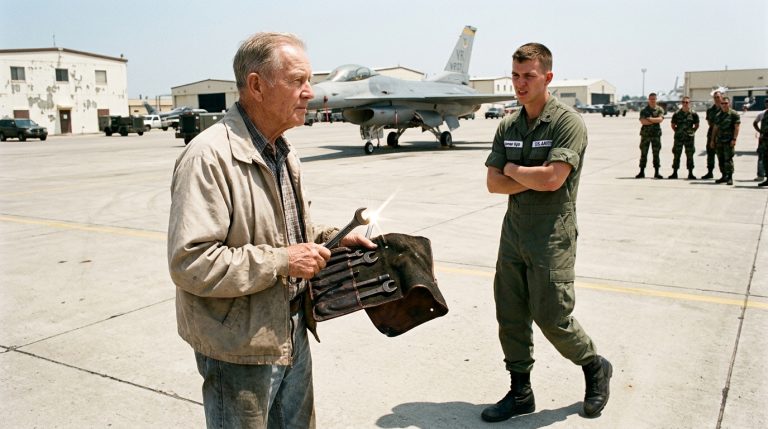
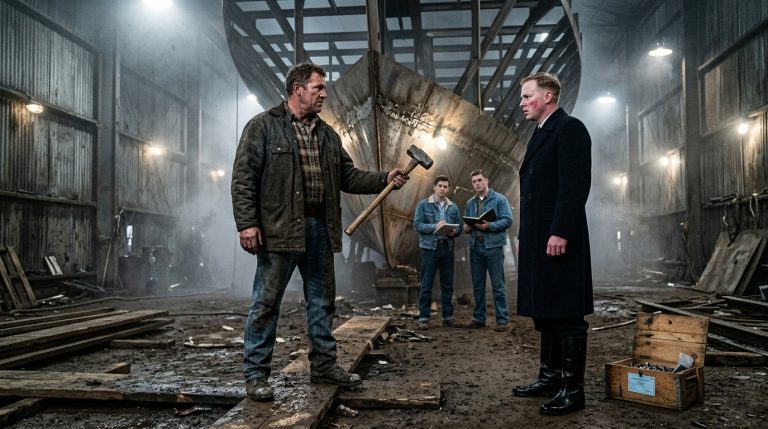
Back in the carpentry shop, the SS officer raised his hand to strike, but Henderson stepped smoothly between them with a heavy wooden mallet resting casually against his thigh. The Canadian supervisor pointed a blunt finger toward the exit, his face locked in unyielding stone. The officer spat on the sawdust and stormed out into the snow, leaving a heavy, suffocating silence in his wake. Hans picked up his chisel, his hands steady as he measured the next joint, knowing the final reckoning was fast approaching.
CHAPTER 6: THE RUSTED THRESHOLD
The radio crackled across the common room on May 7th, 1945, announcing the unconditional surrender of Germany with a flat, final gravity that drained the air from the room. Around them, former prisoners reacted with silent shock or quiet tears, while the hardline holdouts retreated behind locked doors and bitter denials. Friedrich Kleine lay curled on his bunk with a wool blanket pulled tight over his face, refusing to acknowledge the reality echoing from the speakers. Carl Weber sat motionless in the library for hours, staring blindly at a blank page in his journal while the crushing weight of Layer 2 settled permanently over his shoulders.
The camp commander gathered them the following morning under a slate-gray sky, explicitly confirming that no reprisals or punishments awaited them. “You are still under our protection,” the commander stated through an interpreter, establishing a final, immovable boundary of human decency that shattered the last vestiges of wartime hatred. Hans stood quietly on his Canadian-made prosthetic leg, his fingers sliding across the smooth wood of Henderson’s carpentry tools packed safely in his bag.
When Corporal McKenzie walked past the barracks later that evening with a quiet nod, Hans looked out past the perimeter fence toward the endless horizon. The old life of blind obedience and nationalist fury was dead beneath the ashes of Europe, replaced by a gritty, hard-earned truth that required no weapons to defend. Hans gripped his crutch, turned his back on the bitter remnants of the past, and took his first deliberate step toward a new beginning built entirely on grace.