The Iron Pipeline: How an Unyielding Blue-Collar Crew Crushed High-Society Entitlement and Won the War at Sea
CHAPTER 1: COLD STEEL ON THE SLIPWAY
The 3:00 a.m. fog off San Francisco Bay didn’t roll in like smoke; it hit the shipyard like wet wool, heavy with the smell of salt and diesel.
Thomas Weaver adjusted his grip on the heavy pneumatic riveter, his worn leather work gloves stiff with freeze.
Across the staging area of Slipway 2, a pair of polished, mirror-shine leather boots stepped cleanly over a puddle of slush, completely out of place against the mud and iron filings.
Lieutenant Commander Sterling Vance adjusted the collar of his pristine wool overcoat, avoiding the raw frame of the half-assembled deckhouse as if the fresh paint might contaminate his uniform.
“Weaver,” Vance said, his voice carrying that sharp, practiced cadence of a man who had never swung a hammer in his life. “Your third-shift production numbers are five percent below the Maritime Commission’s mandatory baseline.”
Thomas didn’t stop his work. He clicked the release valve on the air line, letting the pressurized hose hiss into the damp night air, then pulled the brass pocket watch from his heavy canvas coat.
He flipped the cracked cover open with his thumb, checked the face, and let the metal casing snap shut with a clear, sharp ring that echoed off the hull.
“We’re three hours ahead on the lower hull plating, Commander,” Thomas said, keeping his tone as flat as a rolled steel sheet. “The deckhouse section was staged twenty minutes ago.”
Vance smiled, a small, paper-thin expression that didn’t reach his pale eyes.
“The Commission doesn’t measure progress by your rough estimates, Weaver. I’ve just reviewed the seam quality on the forward bulkhead, and frankly, it looks like it was executed by farm hands who learned the trade yesterday.”
Thomas took a single step forward, his heavy steel-toed boots sinking two inches into the dirt.
He didn’t raise his voice, but he didn’t pull back either, letting the six-foot frame built by forty years of manual labor settle into the space between them.
“Those ‘farm hands’ are working fourteen-hour shifts in thirty-degree mud so your friends in Washington have something to stand on when they give speeches,” Thomas said softly.
Vance’s eyes narrowed slightly, his right hand twitching toward the leather clipboard tucked under his arm.
“Mind your tongue, foreman. You’re a civilian contractor on a government slipway, and I can have this entire berth shut down for a quality audit before the sun comes up.”
Thomas looked down at the clip on Vance’s board, then back up to the man’s immaculate white gloves.
Deep inside the open crate of structural rivets sitting between them, half-buried under a layer of industrial grease, a small slip of stiff paper caught his eye—a pristine, blue-stamped naval requisition tag marked for a shipyard three hundred miles south, where private yachts were still being fitted out for retired admirals.
He didn’t touch the paper. He just set his thumb on the cold casing of his watch and clicked it open once more.
“You shut down Slipway 2, Commander, and you’re the one who explains to Admiral Land why forty thousand barrels of fuel oil are sitting on the dock without a hull to carry them.”
Vance’s jaw tightened, the smooth skin around his mouth flinching just enough to shatter his relaxed posture.
“We’ll see what the morning report says, Weaver,” Vance spat, turning sharply on his heel to head back toward the dry warmth of the administrative trailer. “Make sure those seams are scraped clean by 0600, or I write the violation myself.”
Thomas watched the dark silhouette of the officer retreat into the gray mist, the steady clack of his leather soles lost in the distant, rhythmic roar of the overhead cranes.
He reached down into the rivet crate, his gloved fingers brushing past the cold iron to pull out the grease-stained tag.
CHAPTER 2: THE AUDIT OF ARROGANCE
The paper was stiff, unbending, and clean enough to smell of fresh ink despite the diesel haze on the dock.
I pulled it free, shielding it against my sleeve as the heavy shadow of a pre-fabricated bulkhead swung overhead, blotting out the high arc lamps.
“Weaver!”
Vance’s voice cut through the thud of the pneumatic hammers before he even reached the foot of the staging ramp. He hadn’t left. He’d brought two junior yard inspectors with him, young men in clean denim jackets who looked like they’d never worked a twelve-hour shift in their lives.
“Step back from the assembly,” Vance ordered, pointing a gloved finger at the forward seam of the hull. “We’re executing an immediate structural holding audit on Slipway 2.”
Dennis, my lead riveter—a thirty-year veteran with hands so calloused they looked like dry oak—dropped his hammer onto the wooden staging with a dull thump.
“We’re forty minutes from setting the main deck plate, Commander,” Dennis said, his voice raspy from forty-eight hours of breathing zinc fumes. “You hold us now, and the crane crew loses their shift window.”
“Then they lose it,” Vance snapped, not even looking at Dennis. “The Maritime Commission doesn’t build floating coffins because a few union hands want to hit their production bonus.”
Vance stepped up onto the staging plank, his shiny leather boots slipping slightly on the frost before he caught his balance against the cold iron.
He tapped his wooden ruler against a flush-welded joint, the sharp clack echoing inside the empty steel hull.
“This weld is porous,” Vance declared, turning to his junior inspectors. “Look at the edge profile. It’s pitted. The thermal penetration wasn’t met. You’re rushing the heat to save time.”
The two young inspectors nodded mechanically, taking out their small blue notebooks to jot down the notes.
I stepped up onto the plank, letting the heavy oak board flex under my weight until Vance had to shift his feet to stay upright.
“That’s a ground seam, Vance,” I said, my thumb tracing the worn metal rim of the brass watch in my coat pocket. “It’s pitted on the surface because it’s high-sulfur scrap plate. The kind the Commission shipped us from the Eastern yards last Tuesday.”
“Are you questioning the quality of our state-allocated raw materials, Weaver?” Vance’s voice pitched higher, a thin red stain creeping up his neck above his wool collar.
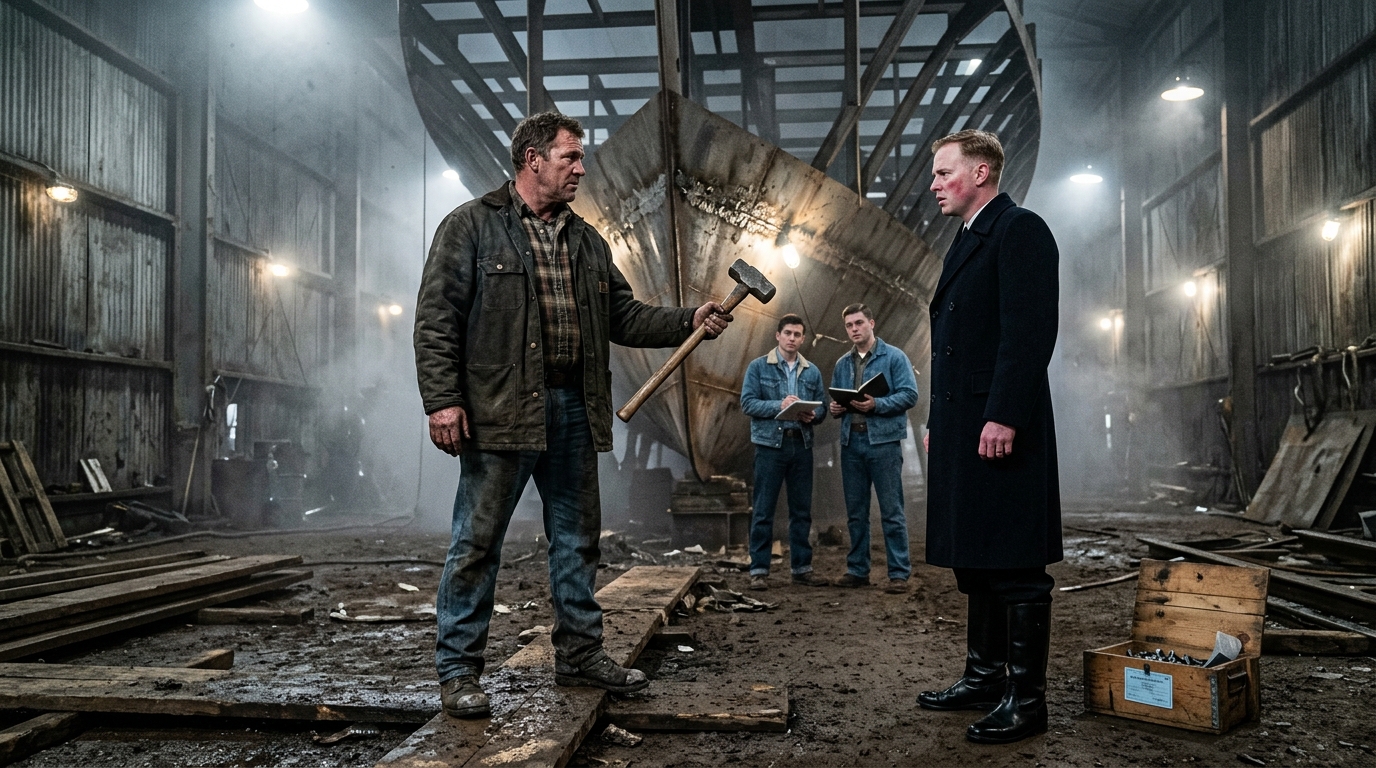
“I’m telling you the weld is deeper than the sulfur pocket,” I said. I picked up a eight-pound sledge hammer resting against the staging frame and held it out toward him, handle first. “Prove me wrong. Strike it. If it fractures, you log the violation and shut the slipway.”
Vance stared at the solid iron head of the hammer as if I’d offered him a coiled snake.
His hand twitched at his side, his fingers flexing inside his clean leather glove, but he didn’t reach for the wood.
“I don’t perform manual tests, foreman,” Vance said, his voice tight, refusing to yield an inch of his polished authority. “I issue administrative holds. And right now, this seam is flagged.”
Dennis took a step forward, his jaw set, but I raised my hand just enough to stop him.
“You flag this seam,” I said quietly, dropping the sledge back onto the deck with a heavy, shivering clang, “and you have to file a formal material rejection report with the regional supply board in San Francisco. That means tracing the mill lot back to the harbor depot.”
I reached into my pocket, my fingers brushing the blue-stamped requisition tag I’d pulled from the rivet crate—the one bearing the private shipyard mark in Baltimore—and let just the edge of the stiff paper show between my knuckles.
Vance’s eyes dropped to my hand.
The color drained out of his cheeks so fast the pale gray fog behind him almost matched his skin.
“You have six hours to finish the forward assembly, Weaver,” Vance said, his voice dropping into a harsh, dry whisper as he stepped back off the wooden plank. “If there’s a single crack in that seam when the morning shift arrives, I’ll have you blacklisted from every dock on the West Coast.”
He turned and walked away down the mud-slick lane, his two junior inspectors scrambling to keep pace behind him.
Dennis spat into the slush at his feet and shook his head. “He’s going to break us, Thomas. He’s looking for a reason.”
“He’s looking for a cover,” I said, folding the blue tag carefully before sliding it deep into my inner pocket. “Get the torch crew up here. We’re welding the deck plate before he comes back.”
CHAPTER 3: CRACKED PLATES AND EMPTY PROMISES
Dennis wiped a sleeve across his forehead, leaving a broad streak of black grease and sweat across his graying temples.
“The weld took,” Dennis said, nodding toward the smooth bead along the lower frame. “She’ll hold forty thousand tons of oil, Thomas. Vance can bring whoever he wants at six.”
I didn’t answer right away.
I knelt on the frost-dusted staging plank, pulling my pocket knife from my trousers.
I scraped the brass blade against the raw margin where the steel plate met the frame, peeling back a curl of heavy mill-scale.
Underneath the dark outer coat, the metal didn’t shine silver like tempered structural grade.
It showed a chalky, pale gray grain, peppered with microscopic hairline fractures running parallel to the edge.
Dennis leaned down, his eye catching the dull reflection under the arc lamps. His grin vanished.
“That’s not sulfur pitting,” Dennis breathed, his hand halting on his tool belt. “That’s brittleness from high-carbon cooling. This plate was rejected at the foundry.”
“It’s structural waste,” I said, sliding the knife back into my coat. “The kind meant for scrap yards or non-load interior bulkheads.”
“Vance didn’t just flag this seam because he hates union hands,” Dennis said, his voice dropping into a harsh rasp. “He’s feeding us scrap for main structural frames. If this ship hits a North Atlantic swell at full load, the hull snaps under her own weight.”
I stood up slowly, the cold air biting into my lungs as I pulled the blue-stamped requisition tag out from under my coat lining.
“Layer one was Vance claiming my crew was sabotaging welds for overtime,” I said, showing Dennis the blue ink marking the private Baltimore contract. “The real play is where the good steel went.”
“He’s diverting the high-grade plate,” Dennis said, his knuckles tightening around his wrench until his joints turned white. “And leaving us to build floating coffins out of trash.”
From the top of the access gantry, a sharp whistle cut through the morning air.
Vance stood fifty feet above us on the steel catwalk, flanked by two armed yard guards wearing civilian deputy badges.
He held a fresh white envelope in his leather-gloved hand.
“Weaver!” Vance called down, his voice echoing off the hollow hull. “Your shift is officially suspended pending a federal material investigation. Step away from the slipway immediately.”
Dennis took a hard step toward the ladder, but I grabbed his shoulder, my fingers digging into the heavy canvas of his jacket.
“Let him come down,” I said softly, my thumb flicking the brass watch cover open and shut inside my pocket with a steady, quiet click. “He thinks he’s walking us off the dock.”
CHAPTER 4: MALICIOUS COMPLIANCE
“This staging is clear,” Vance announced, hitting the dirt with a quiet thump and unfolding the document in his white-gloved hands. “By executive order under War Production Directive 104, I am placing Slipway 2 under immediate quarantine until every load-bearing plate is recertified.”
Dennis took a quick step forward, his jaw tight, but I reached out and planted my forearm flat against his chest.
“You heard the Commander, Dennis,” I said, my voice carrying over the rumble of the gantry cranes. “Directive 104. Stand the crew down.”
Vance’s mouth twitched upward, a smug flicker of satisfaction softening his sharp posture. “I’m glad to see you recognize federal authority, Weaver. Clear your men off the frame.”
“We’re clearing,” I replied smoothly, pulling my brass watch from my pocket and letting it dangle by its tarnished chain. “But Directive 104 doesn’t just halt assembly, Commander. Section Four specifies that all flagged material must be immediately rendered inert to prevent yard hazards.”
Vance blinked, his thin eyebrows pulling together. “What are you talking about?”
“The forward deck section is hanging on Crane Three’s primary load cable,” I said, pointing up at the ten-ton steel plate suspended thirty feet above our heads. “Section Four mandates that suspended flagged assets must be safely lowered and bolted to the bed frame before any personnel leave the slipway.”
Dennis caught on instantly, his shoulders relaxing as a slow grin broke through the grease on his face. “That’s right. And Section Eight requires a certified inspector to sign off on every tie-down bolt in real time.”
Vance’s eyes darted toward the towering crane cab, then back to the three dozen workers standing in a silent circle around the mud-slick staging area.
“I don’t have time to inspect individual tie-down bolts, Weaver—”
“Then the crane stays occupied,” I interrupted softly, flipping the watch cover open with a sharp clack. “Which means Crane Three can’t move the timber loads for Slipways One and Three. The whole yard stops. Unless, of course, you execute the individual bolt sign-offs right now.”
A murmur ran through the crowd of mud-spattered men, cold hands pulling deeper into canvas coats as they stepped closer, framing Vance against the cold iron of the hull.
Vance looked at the two armed guards beside him, but they were local yard boys, their eyes fixed on the ground, unwilling to lock gaze with fifty exhausted shipbuilders.
“Get your wrench, Weaver,” Vance hissed, a thin bead of cold sweat running down from his hairline despite the freezing Bay wind. “We do this by the book.”
“By the book, Commander,” I said, turning toward the tool rack. “Every single bolt.”
CHAPTER 5: THE NIGHT SHIFT TRAP
“That’s forty-two bolts, Commander,” Dennis said, setting his heavy iron wrench against the deck frame with a dull, ringing thud. “Only ninety-six more to satisfy Section Eight before you can lock the gate.”
Vance wiped his forehead with the back of his mud-smeared sleeve, leaving a streak of black sludge across his temple. His posture had lost its sharp, rigid line.
“This is obstruction, Weaver,” Vance snarled, pushing himself up from the slush, his voice raspy from hours in the icy wind. “You’re deliberately abusing safety protocols to hold this slipway hostage.”
“I’m following your orders by the letter, Commander,” I said, stepping onto the staging platform beside him. “You wanted every inch of this hull certified before dawn.”
I pulled the blue-stamped requisition tag from my inner pocket, along with a folded manifest I’d taken from the yard office an hour ago, and laid them flat against the cold steel beam between us.
Vance’s gaze locked onto the blue ink. His breath hitched, a harsh, shallow sound against the roar of the bay wind.
“This requisition stamp matches the lot numbers on those brittle plates,” I said, pointing to the chalky seam we’d opened. “It’s a direct transfer order routing high-grade structural iron to the private harbor facility in Baltimore.”
“That’s an administrative routing memo,” Vance shot back, his jaw clenching as he tried to pull his old authority around himself like a shield. “You don’t understand government allocation chains, Weaver. You’re a civilian hand.”
“I understand numbers, Vance,” I said softly, my thumb clicking the brass watch open and shut in my coat pocket. “Sixteen tons of prime plate left our yard depot on Tuesday. Signed out under your name. And sixteen tons of scrap showed up on Slipway Two in its place.”
Dennis stepped up onto the staging plank behind Vance, his heavy boots blocking the narrow walkway back to the access ladder.
Vance looked at Dennis, then at the two yard guards standing at the foot of the ramp—the same young local boys who were now watching Vance with cold, quiet disgust.
“You think anyone in Washington is going to take the word of a disgruntled yard foreman over a commissioned officer?” Vance sneered, his voice rising into a sharp, desperate pitch. “I’ll have this entire shift fired by sunrise!”
“You can fire us at six,” I replied, holding my ground against the freezing draft coming off the water. “But at five, the Maritime Commission auditor arrives for the scheduled shift inspection. And every piece of this paper is sitting right here on the deck.”
Vance reached out, his hand darting forward to snatch the manifest off the beam, but Dennis slammed his heavy iron wrench down onto the paper an inch from Vance’s fingers.
“Leave it,” Dennis said.
Vance pulled his hand back, his chest heaving as he stared at the two of us, his face pale and twisted with pure rage. He didn’t sign another bolt. He didn’t say another word. He stood trapped on the cold platform, backed against the brittle hull he had tried to hide.
CHAPTER 6: THE UNBROKEN HULL
Vance’s eyes darted frantically toward the foot of the gantry ramp as footsteps echoed up the wooden planks.
“You think this changes anything, Weaver?” Vance snarled, his voice cracking with desperation as he lunged forward, grabbing the corner of the paper under the wrench. “I am the appointed authority here! You’re a hired hand, a nobody with a toolbox! I’ll file an emergency injunction for industrial espionage before breakfast!”
Dennis didn’t move the wrench an inch. He simply leaned his hard, stone-like weight onto the steel handle.
“Injunction won’t re-route those sixteen tons of prime plate back from Baltimore, Commander,” I said, stepping between Vance and the staging ladder.
Vance’s face went crimson. He spun toward the two local yard guards standing near the edge of the platform. “Arrest them! Both of them! Seize these documents under wartime security protocols!”
The two guards didn’t move. One of them pulled his hands deep into his wool coat pockets and looked out toward the dark bay waters, completely ignoring the order.
“They don’t work for your private family contractor in Maryland, Vance,” I said flatly. “They work for this yard.”
Vance’s mouth worked silently for a second, his entitlement crumbling into raw, ugly panic. He lunged to grab the blue requisition tag off the cold beam, his foot catching on a tie-down bolt. He stumbled hard, his knee smashing into the slush, his pristine coat dragging through the black grease on the deck.
He scrambled back up, wiping his mud-caked face, his breathing coming in ragged, high-pitched gasps.
“I’ll have the Maritime Board pull every federal contract from this yard!” Vance shrieked, backing toward the rear ladder as the first morning shift workers began filling the slipway below. “You won’t lay another keel on this coast!”
“The keel is already laid, Commander,” I said, taking my brass pocket watch out one last time.
I flipped the cover open, checked the face, and let the brass cap snap shut.
I signaled up to the cab of Crane Three.
The operator pulled the main lever. With a massive, deafening groan of steel cables and winches, the lower timber locks disengaged.
The hull of the Liberty ship slid four inches down the greased slipway tracks, settling firmly onto her permanent keel blocks with a deep, thunderous shudder that rattled the staging beneath Vance’s mud-stained boots.
The structural frame held perfectly. Not a seam popped. Not a single plate buckled.
Vance backed down the ladder steps one by one, his hands shaking so violently he almost missed the rungs, his high-society authority completely stripped away by thirty tons of honest iron and fifty silent men watching him retreat.
Dennis wiped his grease-blackened hands on a rag and looked at the solid, unbroken line of the hull resting in the dawn light.
“She’ll cross the North Atlantic, Thomas,” Dennis said quietly, setting his iron wrench back into his belt.
“Yeah,” I said, sliding the brass watch back into my pocket where it belonged. “She will.”
I picked up the oil can off the tool crate, leaned over the forward frame, and began greasing the lower cable guide for the morning crew.