The Cold Ridge: A Miner’s Son Holds the Line in Belgium
CHAPTER 1: THE SHATTERED LINE
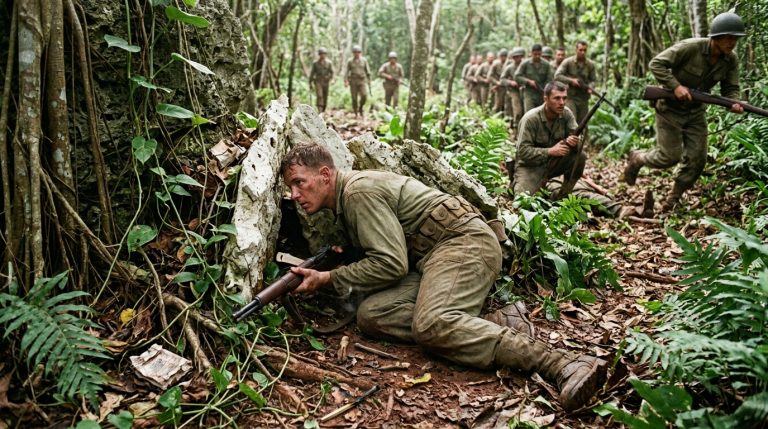
The brass coal-miner’s tally tag in my left pocket pressed hard against my thigh every time I shifted weight on the muddy lip of the foxhole.
“They’re coming through the gully!” Daniels yelled over the mechanical roar of an MG 42 ripping through the brush sixty yards out. His fingers fumbled with the canvas webbing of a fresh ammunition belt, dark mud caked under his fingernails.
I didn’t answer him. I kept my cheek pressed against the cold steel receiver of the Browning 1919, my eye lined up on the dark gap between two shattered oak trees. A flare popped overhead, casting a harsh, chemical white glare across the wet grass of Sars-la-Brière.
Shapes moved in the treeline—grey wool coats, low helmets, moving fast.
I squeezed the spade grip. The gun hammered against my shoulder, spitting heavy .30 caliber rounds into the treeline at four hundred rounds a minute. The sudden noise vibrated straight through my jawbone. Down the slope, three figures crumpled into the high weeds, but more took their place immediately.
“Wire’s dead, Gino!” the squad leader screamed from three foxholes over, dragging his phone receiver by its severed rubber cord. “The line’s cut! Command’s pulling back!”
Rifle fire from our seven support men was sporadic, thin, and useless against the wall of automatic fire chewing up the dirt embankment. A mortar shell detonated twenty yards to the right with a wet, heavy thud, throwing cold mud and shredded roots across my back.
“We gotta drop the gun and run!” one of the riflemen shouted, his voice cracking as he scrambled out of his hole on all fours. “They’re behind us already!”
“Nobody touches the gun,” I said. My voice sounded flat, buried under the ringing in my ears. I reached into my pocket, my thumb tracing the stamped numbers on my father’s Scranton miner tag. “Feed the belt, Daniels.”
“Gino, look!” Daniels gasped, pointing a trembling hand toward the rear slope.
Eight men from our section were standing up out of their holes, their rifles dropped into the muck. Their hands were stretched high over their heads into the white glare of the illumination flares. German voices barked out commands in harsh, clipped German, weapons raised as they swept up the hillside to herd them away.
Daniels looked at me, his eyes wide, his lips white. “What do we do?”
“Keep feeding,” I said, swinging the barrel toward the open gap.
CHAPTER 2: DEATH IN THE MUD
My right palm slammed flat into the wet dirt lip, my fingers locking onto the Browning’s iron spade grip before Daniels could drop his end of the cloth belt.
“Don’t look at them,” I said, my teeth clicking together from the damp chill rising out of the soil. “Look at the feed pawl. Keep the web straight.”
Down in the gully, the shadows moved with methodical speed. The eight men from our section were already being prodded past the broken oak tree, their arms stretched stiff toward the sky, forced into a single-file march toward the German rear lines. They walked with their shoulders hunched, waiting for a bullet that wasn’t coming. They were out of the fight.
“They’re taking them,” Daniels whispered. His chest heaved against the muddy bank, his eyes locked on the disappearing coats of our squad. “Gino, they took the whole squad. We’re the only two left on this side of the ridge.”
“We still have four hundred rounds,” I told him, shifting my knees to dig the steel toes of my boots into the bank for leverage. I pulled my father’s coal tag out of my pocket with my left hand, pressed the cold, stamped brass against my cheek to kill the surge of adrenaline, and shoved it back into my wool trousers. “They think this hole is empty now. They think everyone quit.”
“They’re coming up the ditch!” Daniels gasped.
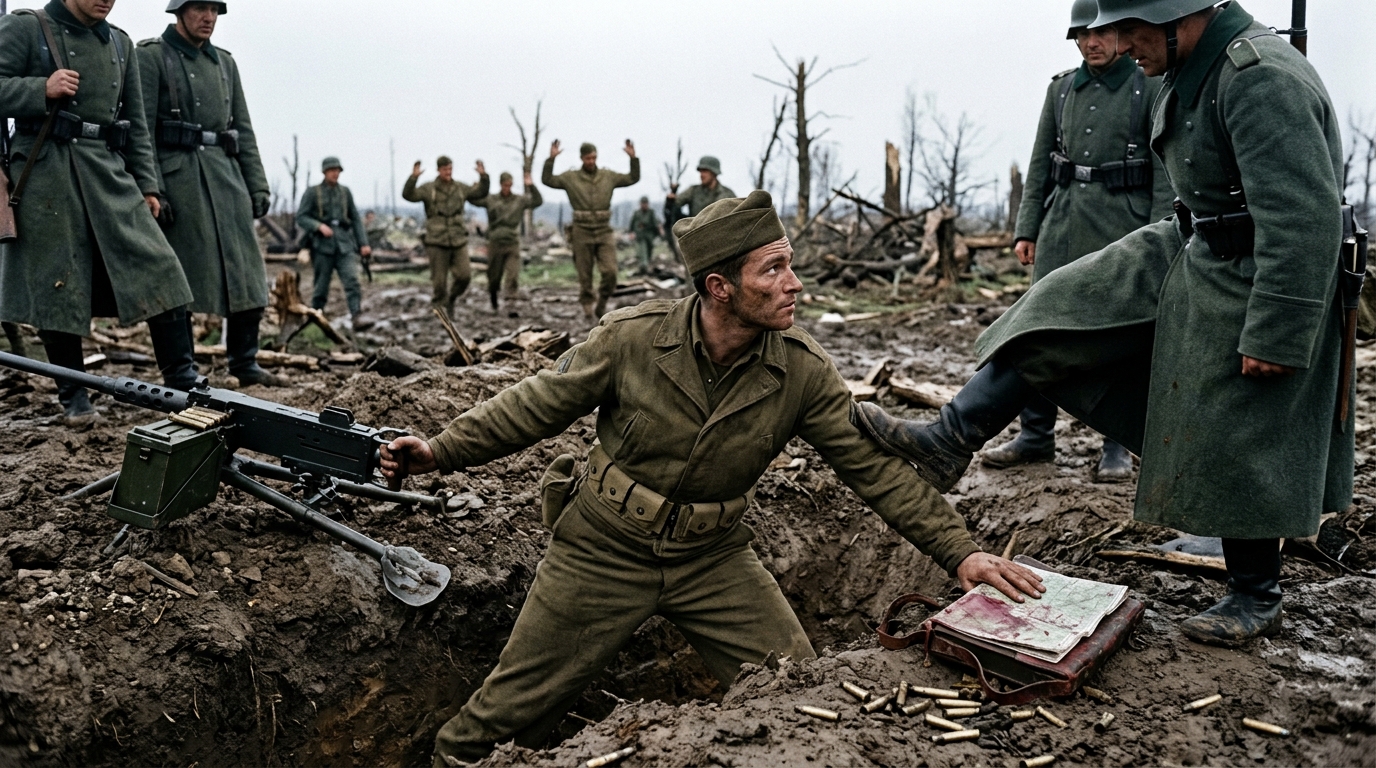
A sharp, metallic clatter echoed from thirty yards out—boot nails striking shale. A German squad leader stepped over the crest, his silhouette dark against the burning horizon. He didn’t have his rifle raised. He carried a heavy leather dispatch map case swung over one shoulder, its flap unbuckled and dripping dark crimson down the strap.
He swung his arm forward, gesturing for five men behind him to sweep the embankment. They weren’t taking cover anymore. They were walking upright, assuming the sector was secured.
A mortar shell tore through the canopy overhead, detonating fifty yards to the left with a wet, deafening roar. A spray of hot steel and shrapnel whistled through the air, shearing through the birch saplings above our foxhole.
Daniels didn’t scream. He just let out a long, shuddering exhale and slumped sideways, his shoulder knocking hard against my right knee. The canvas belt slipped from his fingers, falling into the pool of muddy water at the bottom of the trench.
I didn’t turn my head to look at his eyes. I knew the sound of a chest hit. I’d heard it in the coal towns when a timber gave way, and I’d heard it in the orchards of Normandy.
“Daniels,” I said quietly.
No answer. The water in the pit lapped against his wool uniform.
The German squad was twenty yards away now. Their boots crunched through the wet leaf litter, their heavy wool coats smelling of wet sheep and cordite. They spoke in short, gutteral snaps, relaxed, arrogant, convinced the machine gun position was just another abandoned pile of sandbags.
I let go of the spade grip, grabbed Daniels by the collar, and pulled his dead weight over my torso. I dragged myself flat into the bottom of the foxhole, pressing my nose into the icy, metallic-tasting mud beneath his shoulder.
I locked my limbs straight. I stopped my breathing, letting my lungs empty until my ribs pressed hard against the frozen dirt.
Heavy iron-nailed boots stopped on the dirt lip inches above my head. A rifle butt slammed down against the brass casing of a spent .30 caliber round, shoving it into the mud right beside my ear.
A boot kicked my left calf, hard enough to rattle my kneecap against a rock. I didn’t twitch. I kept my eyes wide open, staring at a single blade of crushed grass two inches from my face, letting the muddy water pool beneath my open eyelids without blinking.
The German soldier grunted, spoke a phrase to his sergeant, and stepped over the lip. The heavy leather map case carried by the squad leader caught on a splintered timber, snapping its strap. It dropped into the mud three feet from my outstretched fingers, the stiff leather stained dark with fresh blood.
Their footsteps faded as they moved five paces toward the secondary treeline, their voices growing careless in the dark.
I waited sixty seconds. I counted every pulse of blood hammering against the inside of my throat.
Then I shoved Daniels’ shoulder aside, reached up, and wrapped my fingers back around the Browning’s cold steel trigger.
CHAPTER 3: THE GHOST AT THE TRIGGER
The heavy recoil drove the iron tripod feet two inches deep into the soft topsoil of the foxhole.
Tracer fire whipped through the dark at belly-height, cutting through the low brush and striking the six-man patrol at point-blank range. Four went down before they could raise their arms. The other two scrambled backward toward the ditch, their heavy boots slipping against the muddy shale bank as they shouted blind warnings into the dark.
I didn’t hold the trigger down. I snapped my hand off the grip, letting the barrel cool while the mechanical chatter echoed across the entire valley.
“They think there’s a company up here,” I muttered to the dark, reaching down to grab the blood-stained map case the squad leader had dropped. The cold leather cracked under my fingers as I dragged it over the dirt embankment.
Inside, beneath a crumpled pocket knife and a handful of loose rifle rounds, was a thick cardstock map marked with heavy grease-pencil arrows. They weren’t holding the ridge to regroup. They were setting a pocket. The red lines circled Company H’s exact retreat vector through the southern timber, pointing straight into an assembly of three anti-tank positions hiding along the lower tree line.
If Company H pulled back through that gap, they were walking straight into a crossfire with nowhere to run.
“Gino,” I whispered to myself, pulling my father’s coal tag from my pocket and running my thumbnail over the stamped brass edges. “You leave this gun, they drive right over the boys.”
A pair of whistle blasts shrilled from the tree line eighty yards down the slope. German voices began barking coordinates, short and sharp, trying to pinpoint the exact flash of my muzzle. They knew someone was still alive, but they couldn’t tell if it was one gun or a secondary line setup.
I picked up the Browning’s forward casing, ignoring the scorching heat that bit into my palm, and wedged it beneath the rear sight elevation dial to tilt the barrel five degrees to the left.
Footsteps rushed up the ditch on my right flank—three men trying to use the blind spot behind the shattered oak tree.
I waited until the rustle of dry leaves reached the fifteen-yard mark. I reached out, grabbed the spade grip with my right hand, and squeezed off a three-round burst, then immediately dragged the rear tripod legs two feet to the left before squeezing another three rounds.
The sudden shift in angle caught the lead man mid-stride. He hit the dirt hard, his mess kit clattering across the stones, while the other two threw themselves back into the gully, screaming for mortar cover.
To them, the machine gun was moving along an organized trench line. To them, they were fighting a full squad holding prepared positions.
I lay back down in the mud beside Daniels’ motionless shoulder, my chest heaving against the cold dirt as heavy machine-gun fire from the German treeline began chewing up the sandbags above my head. Splinters and hot iron rained down over my back, but I held my hand clear of the trigger, keeping completely silent in the black pit.
Let them shoot at the ghost.
CHAPTER 4: THE SECOND SHADOW
The sound wasn’t a random probe. It was a synchronized sweep, orchestrated by someone who had finally realized the machine gun wasn’t retreating.
“Hier ist niemand,” a voice grunted from the right embankment—There’s no one here.
“Quatsch,” another snapped from the rear—Nonsense. “Der schießt immer noch.” He’s still shooting.
A steel helmet brim cut through the dark six feet above my face. The officer held a long stick grenade, his left hand hovering over the pull-cord ring at the wooden base. Beside him, an infantryman pointed the sharp, dark muzzle of an MP 40 submachine gun straight down into the foxhole.
I didn’t move a muscle. I let my jaw relax completely, my cheek half-buried in the freezing liquid lapping against Daniels’ coat.
The officer jumped down into the hole, his heavy iron heels landing six inches from my left shoulder. The sudden weight displaced the mud, splashing cold water directly across my open left eye.
I didn’t blink. I forced my eyeball to remain completely still, tracking the dull grey wool of his trousers through the blur of muddy water.
He leaned down, grabbing the strap of the Browning’s receiver to lift the barrel. He muttered something under his breath about the tripod mount being wedged tight, then swung his boot back and kicked Daniels’ side to push him clear.
When Daniels’ dead weight shifted, my father’s brass coal tag slipped out from under my sleeve, its metallic edge glinting under the faint grey light of the horizon.
The officer froze. He dropped to one knee, his leather glove reaching toward the brass tag.
I didn’t wait for his fingers to touch it.
I drove my right elbow straight up into the soft crook beneath his knee, using his momentum to throw him off balance into the muddy wall of the trench. His stick grenade tumbled into the water with a dull splash.
The infantryman above us gasped, snapping his submachine gun barrel downward—but he couldn’t fire without hitting his own officer struggling in the tight pit.
I grabbed the heavy iron tripod leg, braced my heels against the frozen dirt wall, and hauled the thirty-pound Browning upward with everything left in my shoulders.
The metal receiver slammed into the soldier’s chest before he could pull the bolt back, throwing him backward off the embankment into the high weeds.
The officer scrambler backward on his hands and knees, screaming orders into the dark, but I was already back over the spades.
I dragged the gun across the rear rim of the foxhole, locked my thumbs onto the trigger, and drove a twenty-round burst through the crest of the hill.
CHAPTER 5: THE LONG WATCH
One hundred and eighty rounds left. Three short belts linked together with rusted steel pins, dripping gray water into my lap.
I sat back against the cold dirt wall of the trench, my throat dry as sulfur, listening to the heavy silence settle over the ridge. The German squad leaders had stopped shouting. Down in the valley, the engine thrum of their light armored vehicles had cut out entirely, replaced by the distant, rhythmic clink of shovel blades hitting rock.
They weren’t trying to rush the slope anymore. They were digging in at the base, setting up a perimeter to hold me until first light.
I pulled my father’s coal tag from my pocket and wedged it tightly under the watch crystal on my left wrist. The stamped brass felt solid against my pulse. Thirty years down in the dark at Scranton, work didn’t stop because the timber bracing creaked. You cleared the vein until the shift ended, or you didn’t go home.
A faint rustle of wet grass sounded forty yards to the left—a creeping probe, two men trying to draw fire to test my ammunition count.
I didn’t reach for the spade grip. I picked up a chunk of heavy slate from the wall of the foxhole and tossed it over the embankment into the brush twenty feet behind me.
The slate hit a dry branch with a sharp crack.
A sudden flare of submachine gun fire instantly chewed up the empty bush where the rock landed, three German gunners burning fifty rounds of ammunition into nothing. I kept my mouth shut, letting them shoot at shadows while I fed the last belt into the Browning’s feed tray, pulling the bolt handle back until it locked into place with a dry, mechanical click.
They thought they had all night to figure out who was holding the hill.
I reached into my coat, feeling the stiff cardstock map inside the blood-stained leather dispatch case. The grease-pencil lines showed their main line sitting right where Company H was scheduled to retreat at dawn.
The horizon was beginning to turn a dull, bruising purple over the treeline. The dark wasn’t going to hide me much longer.
A whistle blew twice from the bottom of the gully—sharp, loud, and demanding.
CHAPTER 6: THE BROKEN WAVE
The white flag fluttered on a broken pine branch fifty yards down the slope.
Behind it, a tall German officer in a mud-streaked grey coat stepped slowly onto the ridge, his hands raised palms-out, followed by a scattered line of forty infantrymen dragging their weapons behind them. They looked past the treeline toward the south, where the rumble of heavy American engines was echoing through the valley.
A three-man vanguard from Company H cleared the treeline to my right—the battalion captain leading with his Colt pistol drawn, flanked by two lieutenants carrying carbines.
The captain stopped dead in his tracks ten paces from my hole. His eyes swept over the torn earth, the discarded casings, and the perimeter surrounding the lone Browning mount.
“Son,” the captain said, his voice dropping into the quiet morning air as he stepped around the sandbags. “Where is the rest of your section?”
I unclamped my fingers from the spade grips, my knuckles pale and cracked from nine hours of cold mud. “They surrendered around nine-forty-five last night, sir.”
He stared at me, his eyes shifting to the quiet shape covered by canvas beside the trench. “And you stayed?”
“Yes, sir,” I said, reaching down into my field coat. I pulled out the blood-stained German dispatch case and handed it across the lip of the pit. “The gun needed defending. They were setting up an anti-tank pocket down in the southern timber for your retreat vector.”
The captain unbuckled the case, unrolled the grease-pencil map, and looked from the red arrows back to the lone tripod standing in the mud. He didn’t say another word. He just turned to his lieutenant and motioned toward the surrendering column down the hill.
I sat back on the edge of the embankment, resting my elbows on my knees. I reached under my watch strap, pulled out my father’s brass Scranton coal tag, and rubbed the dried mud from its stamped surface.
The shift was over. The vein was cleared.