The Price of Patience: How a Weary Writer Turned Her Ex-Husband’s Greed into His Own Trap
CHAPTER 1: THE BUSINESS CARD ON THE SHEET
The card slid across the stiff white blanket, coming to rest right over my left knee.
“Divorcing a wife who doesn’t work,” John said, resting his hand casually on the brass footboard of my hospital bed. “Pay me a thousand a month as alimony. Sounds fair, right?”
Beside him, Emily adjusted the strap of her leather purse, linking her arm through his with a short, practiced nod. Her knuckles were neatly manicured, her eyes fixed on the small plastic tray table where my untouched broth was cooling.
“I’ve got things to handle, Sarah,” John added, his eyes scanning the narrow room without meeting mine. “We need this wrapped up fast.”
I picked up the card between two fingers. The heavy stock paper was smooth, printed with dark blue ink that felt slightly raised against the surface. My thumb traced the embossed edge as I looked at the three lines of black text.
“Fine,” I said. “Let’s divorce then.”
John paused, his brow knotting for a fraction of a second as he glanced down at me. “Just like that?”
“Just like that.” I placed the card on the bedside table next to my stainless-steel call button strap. I picked up the thick blue lanyard attached to the button, slowly wrapping the cord around my right index finger, feeling the stiff nylon dig into my skin as my pulse held steady. “I’ll sign whatever the lawyer sends over.”
Emily smiled, a quick, tight curve of her lips that faded the moment she checked her gold watch. “Good. We have a lot of errands to run before five.”
“Don’t worry about my things at the apartment,” I said softly, unwinding the lanyard one loop at a time. “Take whatever you need.”
John let out a short, scoffing breath and turned toward the door. “Yeah, well, make sure that alimony transfer is set up by the first of the month.”
The door clicked shut behind them, the heavy rubber seal on the frame muffling the sound of their footsteps down the linoleum hallway. I reached over, took my phone from the charging dock, and dialed my real estate broker’s direct line.
“Mr. Vance,” I said into the receiver, watching the grey rain streak against the windowpane. “The workspace lease on Elm Street. Terminate it today.”
CHAPTER 2: THE LOCK ON THE FRONT DOOR
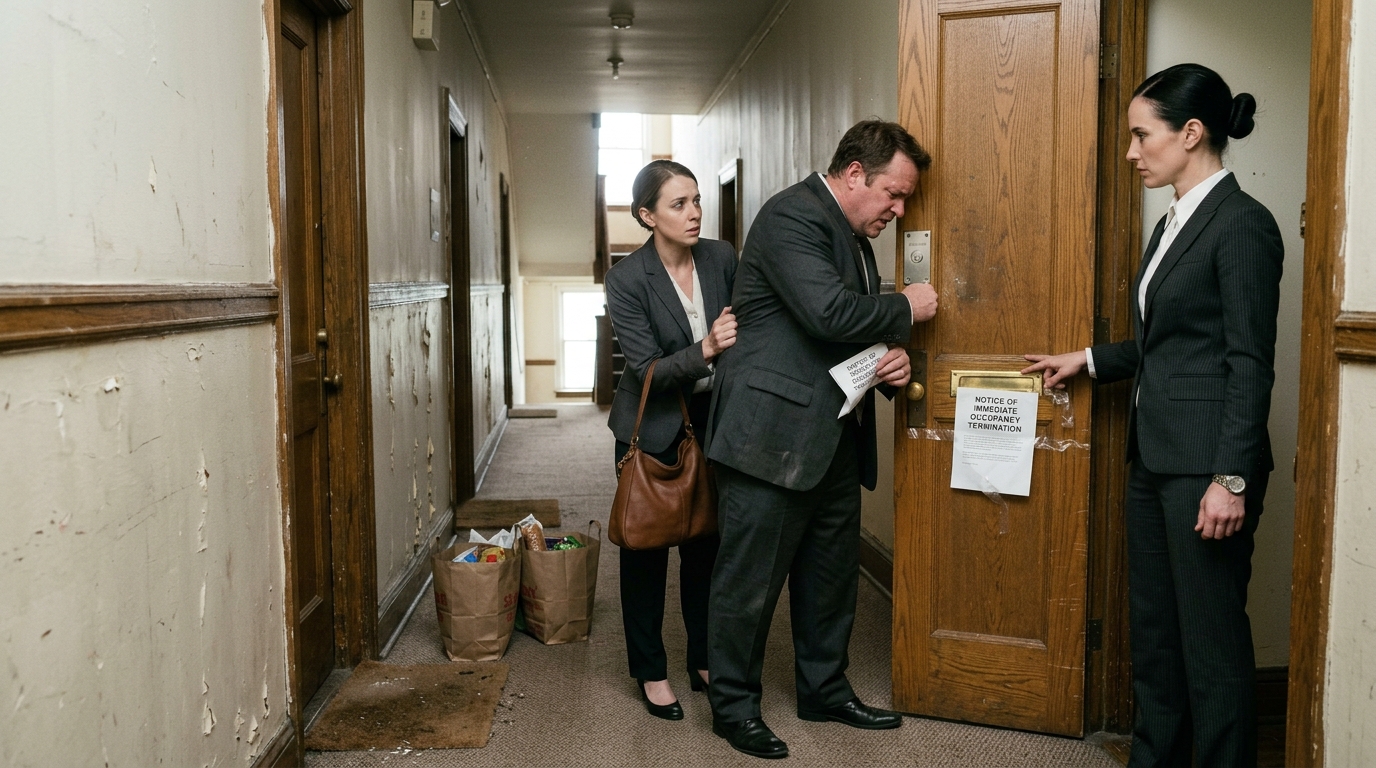
John slipped the key into the deadbolt of the Elm Street workspace, expecting the smooth metal turn he’d relied on for three years.
The brass cylinder didn’t budge.
He rattled the brass handle twice, his shoulder slamming hard against the solid oak frame, but the latch stayed heavy and dead. Beside him, Emily set down two heavy shopping bags onto the dusty doormat, her fingernails tapping a sharp, impatient rhythm against her leather purse.
“Did you force the lock again?” she asked, her voice tight with the heat of the unventilated hallway. “It’s ninety degrees out here, John.”
“No, I didn’t force it,” John muttered, sweat glinting on the back of his neck as he jammed the key in a second time, applying his full weight until the metal groaned. “The key isn’t engaging the pins. It’s like the inner tumbler was swapped out.”
A white piece of cardstock, folded twice and taped directly over the brass mail slot at eye level, fluttered in the draft from the stairwell. John ripped it off the door, tearing the clear tape with a jagged rasp.
The printed letterhead bore the official seal of Vance Commercial Properties.
Notice of Immediate Occupancy Termination. Leaseholder: Wolf Illustration & Media LLC. Premises secured by property management per written instruction of primary corporate guarantor.
“What the hell is Wolf Media?” Emily stepped closer, her eyes scanning the black text line by line before her jaw set hard. “That’s Sarah’s freelance name.”
“She doesn’t own this place,” John said, his voice dropping into a low, raspy pitch as he shoved the paper into his pocket and kicked the base of the door frame. “She just draws pictures in the back room. I live here.”
“John, all my clothes are inside,” Emily said, her calm facade fracturing as she reached for the handle herself, twisting it uselessly against the hardened steel lock. “My jewelry. Emma’s school uniform for next week.”
John pulled his phone from his belt clip, his thumb pounding the screen as he paced the narrow, carpeted hallway. He held the phone to his ear, listening to the monotonous, rhythmic ring that went straight to a recorded operator notice.
“She turned her phone off,” he spat, leaning his forehead against the cool, painted wood of the closed door. “She actually turned her phone off.”
“Call her lawyer then,” Emily demanded, grabbing his arm with enough force to crease his suit jacket. “We paid for the hotel through yesterday, John. We don’t have a key to anywhere else.”
John stared at the solid brass lock plate, the small stamped serial number on the fresh metal shining back at him in the dim hallway light—a clear, unyielding boundary he couldn’t talk his way through.
“She doesn’t have the guts to do this,” John said, though his hand trembled slightly as he dialed the number again, only to hear the same hollow busy tone fill the quiet hall. “She’s in a hospital bed. She can’t even stand up on her own.”
CHAPTER 3: THE COLD LEDGER
George pulled the vinyl visitor’s chair to the side of my bed, setting the heavy folder onto my lap without a word.
“I picked these up from the central branch bank manager this morning,” he said, adjusting his glasses with a tired thumb. “Physical ledger printouts. Certified paper copies going back seven years.”
I opened the folder, the crisp smell of fresh ink and paper pulp filling the sterile air. My finger moved down the column of hand-stamped teller transactions, tracing the recurring monthly transfers out of George’s primary business account.
“Every month,” I murmured, watching the numbers line up in neat black ink. “Five hundred dollars twice a month, withdrawn directly at the teller counter.”
“Emily had full signing authority on the domestic management sub-account,” George said, his jaw tightening as he pointed to the bottom signature line on a yellowed deposit slip from four years ago. “Look at the seal on the back. It’s an expired corporate tax stamp from John’s father’s old logistics office.”
I held the paper up to the fluorescent light overhead, tracing the faint red ink circle that had bled slightly into the thick paper fiber.
“She wasn’t paying household bills with it,” I said, looking across at George. “She was running cash directly to John’s unrecorded debts.”
George took a slow, deep breath, his eyes fixed on the small plastic water pitcher on my tray table. “For ten years, Sarah. Ten years I thought I was funding Emma’s private tutoring and extracurricular savings.”
“Emma knows,” I said softly, coiling the blue cord of my call button tighter around my palm. “She’s fifteen, George. She sees who shows up and who stays away.”
“She asked me yesterday why her mother always locked the desk drawer in the foyer,” George replied, pulling a smaller, square paper envelope from his coat pocket and placing it over the ledger. “I didn’t break the lock. I just brought the entire drawer’s paper contents to you.”
I reached for the envelope, feeling the thick, creased edges of old commercial receipts tucked inside—physical proof that didn’t rely on a single server, cell tower, or satellite trail.
“John’s parents invited me over for tea on Thursday,” I said, setting the envelope flat on top of the financial ledger. “They think we’re just finalizing division of personal property.”
George looked at me, a cold, quiet understanding passing between us as he nodded once. “I’ll have Emma ready.”
CHAPTER 4: THE PARLOR CONFRONTATION
Arthur pointed toward the formal dining table without a word of greeting, his knuckles white against his walking cane.
John and Emily were already seated on the far side of the dark mahogany table, a folded sheet of hotel stationery resting between them like a challenge. Behind them, John’s mother sat on the arm of the velvet sofa, her breathing shallow and uneven as her fingers picked at the fringe of her shawl.
“You tell him taking my parents into this is a low blow,” John snapped, slamming his palm flat against the wood as I took the seat nearest the hallway. “I just reported that we got divorced.”
“I came to report it myself, John,” I said, setting my purse on the floor beside my feet. “Your parents treated me like family for twenty years. They deserve the truth directly from me, not secondhand demands.”
“Truth?” Emily let out a short, high-pitched laugh, clutching her leather handbag tight against her ribs. “You’re living in a hospital room, Sarah. John and I are starting over with Emma as a real family.”
Arthur leaned heavy on his cane, the brass ferrule digging into the thick Persian rug. “What are you talking about, John? Your only family is Sarah. She’s been your wife since you were twenty-five.”
“She’s not my family anymore,” John said, tossing the folded paper across the table toward me. “And since you’re so worried about fairness, Sarah, you can pay this. It’s the bill from the grand suite at the downtown hotel. We had to stay there three weeks because you pulled that stunt with the lock.”
My thumb caught the corner of the paper, unfolding the itemized charges. Four thousand dollars for extended lodging, room service, and valet parking, billed directly to John’s name.
“I didn’t lock you out of your house, John,” I said quietly, looking up from the bill. “I canceled the commercial lease on my workspace. You never paid rent there. You never signed the master agreement.”
John’s mother gasped, her hand flying to her throat as she looked from John to Arthur. “John… you told us you bought that workspace five years ago.”
“It doesn’t matter who signed what!” John yelled, his face flushing red as he stood up, knocking his wooden chair back two inches against the sideboard. “We need cash to secure a new lease, and Mom, you’re getting a real blood grandchild out of this anyway! Aren’t you happy?”
“A blood grandchild?” Arthur’s voice dropped an octave, cold and dangerous as he stepped between the table and his son. “You think that excuses what you’ve done to this family?”
Emily stood up beside John, her voice rising to match his momentum. “Emma is his daughter! She belongs with us, not with George, and certainly not with an invalid who can’t even leave a medical ward!”
From the dark corner near the hallway archway, a quiet, sharp voice broke through the noise.
“Enough already,” Emma said, stepping out from behind the heavy velvet curtain, her eyes fixed entirely on her mother. “It’s disgusting.”
CHAPTER 5: THE TRAP AT THE DINING TABLE
“George is the only one I consider my father,” Emma said, standing straight as she looked past Emily. “Whether we share blood or not, he’s the one who was there every single night.”
Emily’s face tightened, her hand dropping off the back of John’s chair as she took a small step forward. “Emma, sweetie, you don’t understand what happened. John was the one at your kindergarten events—”
“—Because you lied to Dad about the dates,” Emma interrupted, pulling a small folded paper calendar from her pocket and setting it flat on the table next to the hotel bill. “I heard you talking to John on the back porch three years ago. You kept the school schedules in your private drawer so Dad wouldn’t show up.”
John let out a harsh laugh, leaning over the table toward George. “So what? You think a fifteen-year-old’s speech changes anything? You can’t support her on your mid-level salary anyway, George. You two are broke.”
George reached into his jacket, pulling out a sealed paper folder stamped with a bank registry mark. He laid it flat beside Emma’s calendar.
“My annual consulting retainer doubled two years ago, John,” George said, his tone dry and unhurried. “And I don’t have five hundred dollars disappearing from my account every two weeks anymore.”
Emily’s eyes darted to the folder, her chin jerking upward. “You think you can just keep my daughter from me? I’m her mother! We’re filing for full custody, and Sarah is going to pay the legal fees out of her alimony!”
I reached into my bag, pulled out my current tax statement ledger, and slid the printed summary across the mahogany grain until it rested right under John’s hands.
“My annual royalty revenue was five hundred thousand dollars last year, John,” I said, my thumb resting quietly on the leather strap of my purse. “From the picture book series and the syndicate rights.”
John stared down at the black ink numbers stamped on the official state revenue paper, his mouth opening slightly before he snapped it shut. “You… you’re lying. You draw children’s books in a back room.”
“I own the publishing rights, John,” I replied. “And the commercial lease on Elm Street was registered to my corporate account from day one. You haven’t paid a single month of rent in ten years.”
“Sarah—” John shifted his weight, his voice abruptly dropping its sharp edge, his hands smoothing out the front of his wrinkled shirt. “Sarah, look, we can talk about this privately. We don’t need lawyers involved. We’re childhood friends, all of us—”
“No,” Arthur broke in, his cane striking the floorboards with a heavy, final thud that made the china cabinet rattle. “You’re done talking, John. Get your things out of this house.”
John spun around toward his father, his face twisting into an ugly, desperate mask. “Dad! You’re taking her side over your own son?”
“She paid your debts for a decade while you lied about owning a workspace,” Arthur said, turning his back on John to face the window. “You’re off the company payroll as of five o’clock today.”
Emily grabbed John’s forearm, her fingers digging deep into his sleeve as she glared across the table at me, her eyes wide and burning with desperate, unyielding fury. “This isn’t over! We have rights to that property! We’ll sue for wrongful eviction!”
“The eviction notice was signed by the municipal housing board four days ago,” I said, standing up and taking Emma’s hand. “You have until noon tomorrow to clear your personal bags off the sidewalk.”
CHAPTER 6: THE QUIET AFTERMATH
George pulled two glass cups from the side cabinet, filling them with tap water from the pitcher before handing one to me.
Emma sat near the open window, her lap spread wide with university translation brochures, her graphite pencil making a steady, rhythmic rasping sound against the margins of her notebook.
“John’s father finalized the corporate transfer this morning,” George said, sitting in the visitor’s chair with his sleeves rolled up to his elbows. “John signed the severance release. He accepted the placement on the offshore commercial vessel rather than face the unrecorded debt audit.”
I took a slow sip from the glass, the water cold against my throat. “And Emily?”
“She tried to contest the lease termination through small-claims court on Monday,” George replied, adjusting his watch band. “The clerk threw the filing out before noon. She’s living in a sub-leased studio near the freight yards, working shift work at the packing plant to meet the court’s child support baseline.”
Emma looked up from her brochure, her thumb turning a page with a sharp, dry crease. “She called my school office twice last week trying to leave messages. I told the secretary to log the calls and file them with the family court officer.”
“Good,” I said, setting my glass onto the bedside coaster.
I uncapped my drawing pen, resting the fine ink tip against the clean grain of the heavy watercolor paper. The afternoon light shifted across the windowsill, bright and steady, completely free of the noise that used to fill the day.
George reached over, setting a newly stamped royalty statement onto the edge of the table without interrupting my work.
“The illustrator’s agreement for the foreign translation run came through,” he said softly, watching the pen move across the page. “We sign the final papers when you get discharged next month.”
I nodded once, letting the black ink flow smoothly across the paper, tracing the clear, simple lines of the story unfolding right under my hand.