Echoes of the Valley: A Quiet Legacy of Wind, Wood, and the Lessons of a Ghost
CHAPTER 1: THE WEIGHT OF THE WIND
The heat shimmering off the gravel at Whiskey Jack Range was more than a nuisance; it was a physical barrier, a wall of distorted air that turned 1,700 yards into a blurry, impossible smudge. Gunnery Sergeant Miller paced the firing line, his ballistic computer strapped to his wrist like a digital lifeline, blinking a series of red errors that mocked his professional pride.
“It’s not one wind,” a voice rumbled behind him. It wasn’t the voice of a Marine. It was the low, gravelly timbre of a man who had spent eight decades listening to the earth rather than a screen.
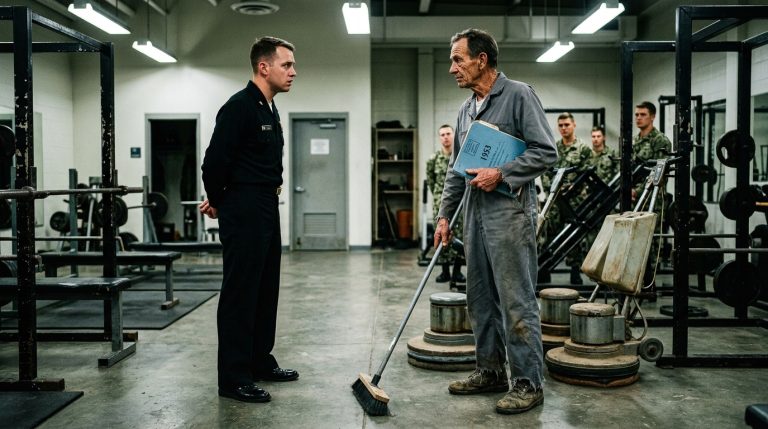
Miller spun, his face a mask of calculated aggression. Dean Peters stood there, his faded work shirt hanging loosely over thin shoulders, his hands cradling a long, cloth-wrapped bundle. The groundskeeper looked entirely out of place against the backdrop of modern combat gear and hardened young snipers.
“We have equipment for this,” Miller snapped, pointing at his wrist. “Coriolis, spin drift, barometric pressure. It’s all computed. Civilian presence is prohibited. Leave. Now.”
Dean’s gaze didn’t waver. His pale blue eyes seemed to look through the heat shimmer, past the steel target, and into the ravine beyond. “That computer of yours can’t see the thermal updraft off those rocks at 1,000 yards. And it can’t feel the downdraft from the ravine. The flag at the target is lying to you, Gunny. It’s showing a left-to-right, but the valley is funneling a current in the opposite direction just this side of it.”
Miller let out a sharp, incredulous laugh, the sound rattling in his chest. He looked at the young Marines, who were staring at their own unresponsive devices. “Folk wisdom doesn’t win wars, old man. Technology does.”
“Technology is a crutch,” Dean replied, his voice calm, untouched by Miller’s rising ire. He began to unwrap the cloth. As the fabric fell away, a ripple of silence moved down the line. It wasn’t the sleek, tactical nightmare of modern weaponry. It was an M40—dark, oil-stained walnut, scarred by a deep, jagged gouge near the bolt.
Miller reached out, his finger stabbing at the mark on the stock. “Look at this piece of junk. This is a liability. You’re going to get yourself hurt with this museum piece.”
The moment Miller’s finger made contact with the wood, the dry, blistering heat of the range vanished. The air thickened. The scent of dust and diesel was replaced by the cloying, damp rot of a jungle. Dean wasn’t eighty-two. He was nineteen. The rain was cold and incessant, plastering his uniform to his skin, and the gouge beneath his thumb wasn’t a relic—it was a fresh, biting memory of mortar fire that had nearly ended him minutes ago.
He was in the ferns, the world narrowing down to the crosshairs. He didn’t need a computer. He watched the way the rain slanted against the canopy, the way a single, trembling leaf betrayed the unseen currents of the air.
He was ready.
Back on the range, the sunlight intensified, snapping the memory shut. Dean refocused on Miller, whose hand was still on the rifle. The Gunny’s arrogance was a physical weight, but Dean didn’t feel the sting of it. He felt the cold, familiar pull of a trigger he had squeezed a thousand times before.
Then, Lance Corporal Evans, standing nearby with a spotting scope that had betrayed him all morning, lowered his gaze. He saw something in Dean’s eyes—a depth that made him realize the old man wasn’t just a groundskeeper. He was watching the wind like a man who knew its secrets.
“Gunny,” Evans said, his voice hesitant, “I need to take my scope to the armory. The seals are gone.”
Miller, fueled by the sting of his own failure, didn’t even look at him. He shoved his face inches from Dean’s. “You’re done, sir. I’m giving you one last order. Put that weapon down, or I’ll have you removed by force.”
Dean didn’t move. He looked down at the hand on his shoulder, then back at Miller. The old man’s expression was a silent, terrifying mirror—a void of pity that left Miller trembling with an anger he couldn’t quite name. Then, from the distance, the first low, urgent wail of a siren began to tear through the silence of the valley.
CHAPTER 2: THE CONVOYS SHADOW
The siren was not merely a sound; it was a physical intrusion. It sliced through the dry, stagnant air of Whiskey Jack Range like a blade, forcing the heat shimmer to swirl and dance in panicked patterns. For a heartbeat, the world seemed to freeze. Gunnery Sergeant Miller’s hand, which had been clamped firmly onto Dean’s shoulder, twitched. His fingers lost their aggressive rigidity, the skin going pale against the worn fabric of the old man’s shirt.
Dean did not turn his head. He didn’t even blink. He remained a statue of faded denim and stillness, his gaze fixed on the plume of dust billowing from the distant main road. His breathing remained rhythmic, slow—a stark contrast to the sudden, chaotic spike in heart rates among the Marines on the line.
“Gunny?” Lance Corporal Evans whispered from behind a nearby Humvee, his hand still gripped tightly around the cold, textured casing of his spotting scope. He hadn’t gone to the armory. He hadn’t moved at all. He felt like a man who had ignited a fuse and was now watching the flame race toward a crate of high explosives. He saw Miller’s face—the arrogance that had defined the morning was being rapidly stripped away, replaced by a dawning, frantic recognition.
The convoy of black command Humvees tore through the perimeter, the tires spitting gravel and dust into the air. They didn’t slow down as they entered the range; they executed a precision stop that sprayed the firing line in a fine, gritty curtain of dirt.
The first door swung open. Colonel Marcus Hayes stepped out. He was a man of sharp angles and immaculate creases, but his eyes were what drew the soul—they were cold, focused, and carried the weight of a command that felt, to Miller, like the onset of a winter storm. Behind him, the base sergeant major emerged, his face a granite mask of discipline that suggested he was already weighing the cost of whatever disaster had unfolded here.
Miller’s hand fell away from Dean’s shoulder as if he had touched a live wire. He tried to straighten his back, but the movement was disjointed, clumsy. His pride, which had felt like an impenetrable fortress minutes ago, felt paper-thin now.
“Colonel,” Miller started, his voice cracking. It was a reflex, a desperate attempt to regain control of his narrative, to frame the incident before someone else could. “Sir, we were in the middle of a—”
Colonel Hayes didn’t look at him. He didn’t even acknowledge the Gunnery Sergeant’s existence. He walked past Miller, his boots crunching rhythmically on the gravel, the sound amplified by the sudden, suffocating silence of the range. The colonel stopped dead in front of Dean Peters.
Dean stood there, his posture unchanged, the weight of the rifle hanging naturally by his side. The contrast was jarring: the pristine, high-ranking commander and the weathered man who smelled of linseed oil and damp earth.
Dean felt the shift in his own memory, the ghost of the jungle pressing in. The sirens were not sirens; they were the mechanical, rhythmic clatter of a Huey taking flight, the rotors beating against the humid air. He felt the phantom ache in his shoulder, a souvenir from a war that the young men standing before him only read about in history books. He saw the way the colonel’s jaw tightened. He recognized the look in Hayes’s eyes—it was the look of a man who remembered the stories, the hushed whispers in the dark corners of the command center about a man who had turned the tide in the AA Valley with nothing but a rifle and the wind.
Colonel Hayes raised his hand. It was a movement of breathtaking precision, a salute so sharp it seemed to cut the very air.
“Mr. Peters,” the colonel said, his voice deep, vibrating with a profound, unadulterated respect. “Sir, I apologize for the conduct of my Marines. There is no excuse for the disrespect you have been shown here today.”
The silence that followed was total. Miller looked as if he had been physically struck. He was a Gunny with fifteen years of service, a man who believed in the hierarchy of power, but in this moment, the hierarchy had inverted. The ground beneath his feet seemed to shift, and for the first time in his career, he realized he didn’t know the rank of the man standing in front of him.
The sergeant major stepped closer to Miller, his voice dropping into that terrifying, low whisper that signaled the end of a career. “Gunnery Sergeant, what in God’s name did you think you were doing?”
Miller couldn’t answer. His throat was dry, his lungs tight. He watched as Colonel Hayes held his salute, waiting, patient, until Dean gave that slow, weary nod. It was a signal that the moment of tension had passed, but for the Marines on the range, the real trial was only beginning.
Dean turned his head slightly, his pale blue eyes catching Evans’s gaze behind the Humvee. There was no accusation in them, just a quiet, heavy recognition. Evans felt the knot in his stomach tighten. He hadn’t just reported an incident; he had pulled a pin on a grenade, and now, they were all waiting to see who would be left standing when the smoke cleared.
The colonel turned, his face hardening as he swept his gaze across the line of snipers. “Marines,” he began, his voice cold, hard, and devoid of the indulgence he had shown Dean. “You have been failing this test all morning. And you have been failing it because you have forgotten what it means to lead.”
Miller stood rigid, his face an ashen mask of shame. He had wanted to teach them a lesson about precision, about the superiority of the new doctrine, but he was currently the subject of the most painful lesson of his life.
CHAPTER 3: THE PROOF OF THE UNSEEN
Dean didn’t wait for a formal invitation, nor did he offer one. He simply walked toward the firing position that Gunnery Sergeant Miller had abandoned. His movement was a study in economy—each step deliberate, his shoulders hunched slightly against the memory of a pack he hadn’t carried in decades. He moved with a quiet, grounded rhythm that felt entirely at odds with the frantic, high-strung energy radiating from the rest of the range.
Miller remained frozen, his back stiff as a board, his eyes fixed on the gravel near his boots. The shame coloring his face was deep, a dark, bruised shade of regret that he couldn’t hide. He didn’t look at the Colonel, and he certainly didn’t look at Dean. He was trapped in the vacuum of his own ego, his reality shattered by the realization that he had been standing in the shadow of a legend without ever bothering to look up.
Dean lowered himself onto the firing mat. He didn’t use the high-tech bipod mounted on the modern rifles; instead, he knelt and unslung the old rucksack he’d been carrying. With a series of practiced, tactile movements, he positioned the bag, resting the wooden forend of the M40 upon it. It was a soft, makeshift support that absorbed the heat of the earth, a texture of worn canvas and old sweat that had accompanied him through terrains far more unforgiving than a curated military range.
“Your computers are looking for data,” Dean said, his voice low, pitched not for the Colonel or Miller, but for the circle of young Marines who had drifted closer, their curiosity finally outweighing their fear of the Gunny’s wrath. “They want hard numbers. They want clean, linear inputs. But the wind isn’t a line. It’s a loop. It’s a conversation between the rocks, the trees, and the heat.”
Lance Corporal Evans watched, his breath caught in his throat. He saw the way Dean’s fingers traced the worn edges of the elevation turret—not with the mechanical detachment of a technician, but with the familiarity of a man touching an old friend’s face. Dean’s skin was paper-thin, spotted with age, yet as he adjusted the knob, his movements were fluid, precise, and devoid of the tremors that usually came with eighty-two years.
“See that shimmer over the rocks at 1,000 yards?” Dean pointed toward the heat-baked terrain. “It’s flowing right-to-left. That’s a thermal rising. But look at the grass on that berm at 1,500.” He paused, his eyes narrowing. “It’s leaning toward us. The wind is rolling back on itself there. It’s a head fake. If you aim for the target based on the flag, you’re shooting at the ghost of where the wind was ten seconds ago.”
The Marines followed his gaze, their own spotting scopes largely forgotten. For the first time all morning, they weren’t looking at their screens. They were looking at the environment. They saw the way the dry grass bent, the subtle, undulating waves in the mirage that they had dismissed as noise.
Dean didn’t use a rangefinder. He didn’t check the barometric pressure. He simply settled his cheek against the scarred, linseed-oiled wood of the stock. He became a part of the rifle, a singular entity of steel and bone and memory. The range went silent—so silent that the distant chirp of a bird in the scrub brush sounded like a gunshot.
Dean took a breath. It was a long, slow intake that seemed to draw the very atmosphere into his lungs. He let half of it out, his body going completely still. In that moment, he was no longer an old man on a base in the states; he was a young corporal in a monsoon, the taste of mud on his tongue, the sound of the jungle pressing in.
Crack.
The sound of the M40 firing was distinct—dry, sharp, and nostalgic. It wasn’t the muffled report of a suppressed modern rifle; it was the raw, unvarnished voice of a different era. The bullet transitioned into the air, a silent, invisible arc of energy.
Everyone on the line held their breath. Colonel Hayes remained rigid, his eyes locked on the distant silhouette. Miller finally looked up, his jaw slack, his hands balled into white-knuckled fists at his sides.
Two and a half seconds passed—an eternity of heat and shimmering light. Then, a faint, metallic ping echoed back across the distance. It was a clean, perfect strike. A dead-center hit on the steel that had thwarted every high-tech solution the team had attempted all morning.
The tension on the range broke. It didn’t explode into chaos; it exhaled. A wave of spontaneous applause erupted from the younger Marines—a visceral, genuine reaction that couldn’t be commanded or suppressed. Even Evans found himself cheering, the knot in his stomach loosening into a sudden, overwhelming sense of relief.
Colonel Hayes allowed himself a small, rare smile. He turned to Miller, his expression shifting from a mask of cold fury to one of measured, expectant discipline.
“You see that, Gunnery Sergeant?” the Colonel asked, his voice low but carrying the weight of an anvil. “That wasn’t a computer. That was an understanding.”
Miller didn’t speak. He couldn’t. He looked at Dean, who was already pushing himself up from the mat, his joints protesting with soft, audible pops. The groundskeeper began to pack his rifle away, wrapping it carefully back in the old cloth, his movements once again slow and aged. He had proven his point, yet he seemed entirely uninterested in the victory.
He was just a man who had done what he knew how to do, and as he stood there, the distance between his quiet, fading world and the high-tech, rigid world of the Marines felt like an unbridgeable chasm. Dean began the slow, uneven walk toward the barracks, leaving the Marines to grapple with the aftermath of a reality that had just been fundamentally altered.
CHAPTER 4: THE LESSON OF THE GALE
Miller remained rooted to the spot long after Dean had disappeared into the shimmering haze toward the barracks. His hands, still balled into tight fists, ached with a tension that refused to dissipate. Around him, the young Marines were not packing up; they were huddled in small, uneasy groups, their voices low, their eyes constantly darting toward the path the old groundskeeper had taken.
The air itself seemed to have grown heavy. The dry, baked heat that had dominated the morning was being displaced by an erratic, cooling breeze that tasted of ozone and impending rain. It was the kind of atmospheric shift that usually sent everyone scrambling for cover, but Miller found himself unable to move. He looked down at the firing mat where Dean had laid his rucksack. The indentations in the grit were still visible, a lingering mark of a man who had moved through the world with a lightness and precision that made Miller’s own fifteen-year career feel like a frantic, noisy struggle.
“Gunny?” It was Evans. He was closer now, his voice tentative, stripping away the hierarchy that Miller had used as armor all morning. “What do we do? We were supposed to hit that target, but…”
“But nothing,” Miller snapped, though the bite was gone from his tone. It was hollow, the reflex of a man who had forgotten how to lead without the crutch of a rigid, predefined rulebook. He looked at the long, empty stretch of the range. The steel silhouette stood defiant at 1,700 yards, mocking them. “The Colonel gave an order. We report for remedial training. This isn’t over.”
As he spoke, a flash of lightning illuminated the bruised purple clouds rolling over the distant mountains. The wind surged, not in the steady, predictable way his Kestrel meter liked, but in wild, unpredictable gusts that tossed sand into their eyes and tugged at their tactical gear.
This was the “three winds” Dean had spoken of. Miller felt the shift against his skin—the cold, descending downdraft from the ravine, the rising thermal from the baking rocks, and the main current funneling through the valley. It was a chaotic, invisible architecture of movement that his ballistic solver couldn’t possibly account for. He realized with a sick, sinking feeling in his gut that he had spent years teaching his men to fight a mathematical model, rather than the living, breathing world.
“Get the gear,” Miller commanded, his voice barely audible over the sudden whistle of the wind. “We aren’t going to the armory. We’re going to the barracks. Find him.”
The journey back was not a march; it was a retreat from their own incompetence. As they walked, the sky opened up, a light, lukewarm drizzle turning the surface of the gravel into a slick, treacherous sheen. The atmosphere shifted from the harsh, high-contrast glare of the sun to the soft, muted grays of the coming storm. The transition made everything feel older, more tactile—the smell of wet dust, the cooling metal of the rifles, the weight of their own uniforms.
When they reached the maintenance shed where Dean often worked, the sight that greeted them was almost too simple to be true. The old man was sitting on a wooden stool, a small pile of tomato seed packets in his lap. He was sorting them with the same slow, deliberate economy he had used to adjust the knobs on his M40.
He didn’t look up as the group of Marines approached. He simply continued his task, his fingers calloused and steady. Miller stopped, his boots kicking up a small cloud of wet mud. He stood in the threshold of the shed, feeling entirely out of place in his modern tactical kit, a machine of war standing before a man who was busy preparing for a harvest.
“Mr. Peters,” Miller said. The formality felt different this time; it wasn’t the rigid, sharp-edged tone of a superior, but the quiet, awkward inflection of a student.
Dean looked up. His eyes were pale, reflecting the dim, gray light of the storm-drenched sky. There was no judgment in them, only a calm, patient recognition that made Miller feel like he was being read—every mistake, every shred of arrogance, every failure of his career laid bare.
“The wind is picking up, Gunny,” Dean said, his voice as steady as the slow, rhythmic patter of rain on the tin roof. “It’s going to be a difficult night for anyone who doesn’t know how to keep their footing.”
Miller felt the weight of the moment pressing down on him. He had come here to demand answers, to find out how an old groundskeeper could be a legend, but looking at Dean now, surrounded by the simple, fragile potential of seeds, the question seemed irrelevant. The mystery wasn’t about the man; it was about the legacy he represented.
“We don’t know how to listen,” Miller confessed, the words tasting bitter but necessary. “We were taught to look, but we were never taught to listen. Will you teach us?”
Dean didn’t answer immediately. He went back to his seeds, his focus absolute. Outside, the storm intensified, the rain turning from a drizzle into a steady, soaking wash that blurred the world into a landscape of soft, faded textures. The silence in the shed was not empty; it was filled with the sound of the rain and the realization that they were on the cusp of something far more challenging than any firing test.
CHAPTER 5: THE CLASSROOM OF THE STORM
The rain drummed a relentless, hollow rhythm against the corrugated tin roof of the maintenance shed. Inside, the world was small, lit by a single, flickering bulb that cast long, jagged shadows against the walls. Gunnery Sergeant Miller stood just inside the door, his tactical gear dripping water onto the concrete floor. He felt out of place, an armored relic standing in a sanctuary of patience.
Dean did not look up immediately. He continued to move the packets of seeds, his hands steady despite the intensity of the storm outside. The sound of his movements was muted, rhythmic—a stark contrast to the sharp, mechanical clatter of Miller’s gear.
“You think you’re here to learn a skill, Gunny,” Dean said, his voice quiet, almost swallowed by the patter of the rain. “But you’re only here because you’ve stopped trusting yourself.”
Miller shifted his weight, his boots squeaking on the wet concrete. He felt a profound, aching frustration—not with Dean, but with the version of himself that had stood on the range hours ago, shouting orders and relying on a screen to tell him the truth about the world. “I was trained to rely on the data,” Miller muttered, his voice rough. “We were all trained that way. It’s what keeps the team safe. It’s how we quantify the impossible.”
“And yet,” Dean replied, finally setting the last packet down, “you’re here. Because the data failed you.”
He gestured to the stool across from him. Miller hesitated, then sat. He felt ridiculous, a man of fifteen years of active service sitting in a drafty shed listening to a gardener talk about the wind. But the urgency he had felt during the Colonel’s visit, the weight of the silence after the shot, and the sheer, undeniable reality of Dean’s marksmanship kept him grounded.
“The wind doesn’t care about your ballistic software,” Dean continued, his eyes meeting Miller’s. They were pale, ancient-looking, and held a depth that made Miller feel like he was looking into a mirror of his own insecurities. “It follows the heat, the terrain, the pressure. It has a rhythm. If you only look at the numbers, you’ll always be a second behind the reality.”
Dean stood up and walked to a small, dusty shelf in the corner. He reached up and pulled down a worn, canvas-bound notebook. It was tattered, the pages yellowed and dog-eared, smelling of old paper and dried leaves. He placed it in front of Miller.
Miller reached out and touched the cover. It was rough, worn through years of use. He opened it, and his breath hitched. The pages were filled with hand-drawn maps of terrain—ridges, ravines, and plateaus—marked with intricate, delicate symbols. They were notes on wind patterns, thermals, and light conditions. Each entry was dated from a time when the equipment Miller used hadn’t even been a concept.
“I didn’t keep these because I wanted to remember the shots,” Dean said. “I kept them because I needed to remember the world. Every valley has its own voice. If you take the time to listen, it will tell you everything you need to know before you ever even touch the trigger.”
Miller looked at the notebook, his heart hammering against his ribs. He felt the weight of his own ignorance. He had spent his entire career believing he was at the cutting edge of marksmanship, but looking at these pages, he saw a depth of knowledge that was entirely organic, entirely human.
“Why stay?” Miller asked, his voice barely a whisper. “After everything… why work as a groundskeeper? Why stay in the shadows?”
Dean gave a faint, weary smile. “Because someone has to keep the ground ready for the next harvest, Gunny. And because even in the shadows, you can still see the wind.”
Outside, the storm groaned, a sudden gust shaking the shed. Miller looked at the notebook, then at his own hands, calloused from years of gripping rifles and checking computers. He realized then that the decoy secret of who Dean Peters was—the “ghost” of the AA Valley—wasn’t the point. The secret was that the world hadn’t changed; only their perception of it had. The wind still whispered; they had simply stopped being able to hear it.
Miller reached out and touched the pages. “Teach me,” he said, and for the first time in his life, he meant it not as a demand, but as a plea.
CHAPTER 6: THE FINAL HARVEST
The storm had passed, leaving behind a world slick with rain and muted in the soft, post-dusk glow. Inside the maintenance shed, the air was cool, smelling of damp cedar and the sharp, metallic tang of gun oil. Dean sat on his stool, his movements unhurried, as he finished cleaning the bolt of the M40. The steel caught the dim light, gleaming with a dark, lived-in luster.
Miller watched him, his posture finally relaxed. The tension that had defined his entire week—the frantic need for validation, the fear of inadequacy—had drained away, leaving him feeling hollow but strangely grounded. He realized now that he hadn’t been fighting a war for the range; he had been fighting a war against the passage of time and the inevitable obsolescence of his own certainty.
“You look different, Gunny,” Dean said, his voice quiet, lacking any trace of the instructional edge he’d used during their long sessions. He wiped the bolt with a clean, soft cloth and slid it back into the action of the rifle with a satisfying, metallic snick.
“I feel different,” Miller admitted, leaning against the workbench. He looked at the rifle, really looked at it, seeing past the gouges and the worn wood to the decades of history it held. “I spent my career thinking the rifle was the weapon. I was wrong.”
Dean stood up, the old chair creaking under his weight. He walked over to Miller and, with a motion that felt both ceremonial and inevitable, held out the M40. “The weapon is the intent, son. The rifle is just the bridge.”
As Miller reached out, his hands didn’t tremble. He felt the weight of the walnut stock, the familiar cold bite of the steel, and the undeniable sense of responsibility that came with holding such a legacy. He remembered the story of the Master Sergeant at the Chosen Reservoir passing this rifle to a young Dean, and now, the circle was closing.
“I can’t take this,” Miller said, though his hands had already accepted the weight.
“It’s not a gift,” Dean replied, his pale eyes searching Miller’s face, satisfied by what he found there. “It’s a maintenance request. Every generation needs someone to keep the ground ready. The wind is still going to blow, and the data will still be wrong sometimes. You’re the one who has to listen.”
Miller looked down at the gouge in the stock—the same one he had mocked days ago. It no longer looked like damage; it looked like a map of survival. He realized that this was the Layer 2 truth he had been circling: Dean wasn’t holding onto the past to be a relic; he was holding onto it to ensure the future didn’t lose its way. The “Ghost of the AA Valley” wasn’t a legend to be feared, but a standard to be carried.
Dean walked to the shed door and looked out at the drying landscape. The moon was beginning to break through the retreating clouds, casting a soft, silver light over the range. “There’s work to be done in the garden tomorrow, Gunny. The rain did good, but the soil needs turning.”
Miller followed him to the door. He felt a sudden, profound peace. The career-defining crises of the week, the Colonel’s arrival, the humiliation on the range—all of it had been necessary to strip away the noise. He reached out and placed a steadying hand on Dean’s shoulder, a gesture that mirrored the one he had once used in anger, but now, it was an anchor of genuine, hard-earned respect.
“I’ll be here at dawn,” Miller said.
Dean nodded, his smile slow and genuine. He turned back into the shed, his shadow stretching long against the workbench where he kept his seeds. Miller walked out into the cool, damp air, the rifle held firmly at his side. He didn’t feel like a Gunny defending a perimeter anymore; he felt like a man who had finally learned how to stand still.
The range was quiet. The silence wasn’t a challenge; it was a conversation, one he now understood how to participate in. He walked toward the barracks, the weight of the rifle a comforting, heavy reminder of the legacy he was now charged to keep. The wind brushed past his cheek—not as a mathematical variable, but as a greeting, and for the first time, he answered it with a quiet, knowing nod. The harvest, both in the garden and the field, would be steady, provided one knew how to wait for the right breeze.