The Weight of the Trident: A Retired Frogman Finds Honor in the Quiet Corners of Service
CHAPTER 1: THE ECHO OF THE BRUSH
The floor of the naval amphibious base gym was a landscape of gray concrete, usually marked only by the scuff of rubber soles and the occasional chalk-dust ghost of a deadlift. Today, it held the shadow of a man who had stood outside of time. Vernon Ford moved with a rhythmic, hypnotic cadence, the bristles of the broom kissing the floor in a sequence he had perfected over three years of invisibility.
Every swipe was an act of penance. Every gathering of dust was a way to keep the world tidy, to keep the edges of his life from fraying into the chaos of the memory-storms that still visited him at night. But today, the rhythm was broken.
The air in the gym had cooled, as if the oxygen had been pulled out to feed the sudden, sharp presence of Commander Jacobs. Vernon kept his eyes down. He knew the look—that wide-eyed, terrified reverence that only came when a man realized he was standing in front of a ghost.
“Mr. Ford.” The Commander’s voice was too loud for the space, cracking through the quiet like a whip.
Vernon stopped. He didn’t drop the broom; he braced it against the floor, feeling the familiar, smooth grain of the wood against his calloused palm. He felt the weight of the air, the way the nearby trainees had stopped their movements, their pulses visible in the cords of their necks. They were waiting for him to break. They were waiting for him to be the legend.
“Sir,” Vernon said. His voice was a rasp, a sound of dry leaves on pavement. He didn’t salute. He didn’t bow. He simply stood, a man in a janitor’s uniform, carrying the invisible history of a unit that wasn’t supposed to exist.
Jacobs took a step forward, his boot clicking sharply on the polished surface. He was a man who lived by the rulebook, by the crisp lines of protocol, but right now, his eyes were drifting toward the back of Vernon’s neck. The tattoo was faded, a serpent coiled in an eternal, silent strike, but to the Commander, it was a brand of absolute authority.
“The history books,” Jacobs started, then stopped, his throat working. He seemed to realize that any word he chose would be an insult. He looked around the gym, at the young men who thought they were the pinnacle of endurance, and then back to the old man.
Vernon felt the pull of the past—the biting cold of the Korean waters, the smell of burning oil, the weight of the explosives on his chest—but he pushed it back. He locked it away, the way he had been taught.
“The floors, Commander,” Vernon said, his gaze shifting to the corner of the gym where a small pile of dust remained, a perfect little mound of grit. “They need finishing. If you’ll excuse me.”
He stepped past the Commander, his movements precise, deliberate, and entirely unhurried. He was not a hero in this moment; he was a worker. He picked up his dustpan, the metal clinking softly—a sound that echoed like a bell. As he turned, he caught the eye of Petty Officer Slate, who was still standing near the weight rack. Slate’s face was pale, his arrogance having been replaced by a raw, vibrating fear.
Vernon paused. He leaned slightly toward the young man, his eyes steady, pale, and ancient.
“The dust,” Vernon whispered, low enough that only Slate could hear, “it always settles, son. But it’s what you choose to sweep away that matters.”
He turned and walked toward the supply closet, the broom held like a staff. He didn’t look back when the gym doors swung open again to admit the Marine guard, nor when he heard the Commander begin a frantic, hushed conversation on his radio. He reached the closet, his fingers finding the key on his ring, and as he stepped into the small, dark room, he felt a sudden, sharp draft.
The door to the back of the gym, which should have been locked, was cracked open by an inch. And there, sitting on a stack of floor buffers, was a folder—blue, stamped with a classification that had been obsolete for forty years. It was waiting for him.
CHAPTER 2: THE WEIGHT OF THE FILE
The closet was small, a narrow throat of space filled with the smell of floor wax and industrial-strength disinfectant. Vernon stood in the dark, the door barely cracked, a sliver of light from the main gym floor cutting across his calloused hands. In his grip, the blue folder felt heavier than the broom. It was a dense, physical reminder of a world that had tried its best to disappear him.
He didn’t open it. Not yet. He could feel the paper’s texture against his thumb—thick, archival grade, edges slightly softened by the humidity of the storage room. It was an anomaly. Files like this didn’t just appear on a buffer rack in a modern gym. Someone had placed it here, a deliberate, quiet gesture.
He closed his eyes. The scent of the wax faded, replaced by something visceral and sharp: the smell of damp wool and kerosene.
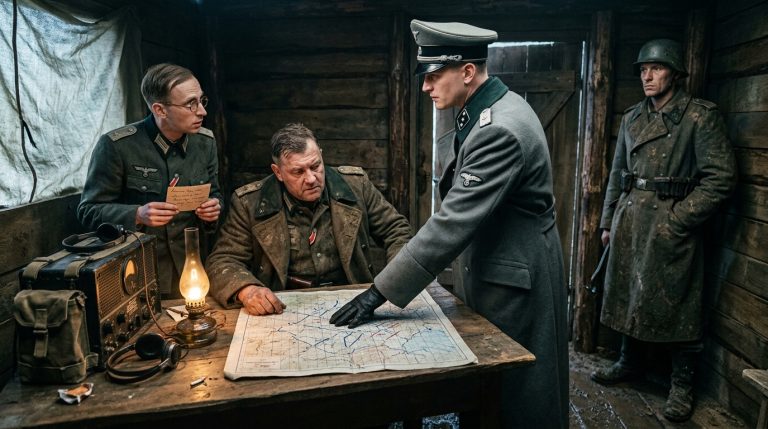
1953. The tent was lit by a single, flickering lamp that threw long, jagged shadows against the canvas walls. They were ghosts, the three of them—the men of the Mako unit. They weren’t soldiers anymore; they were liquid, intended to flow into the harbor, break the machinery of the enemy, and evaporate before the sun rose.
Vernon’s breath hitched. He kept his eyes shut, his hand tightening on the folder until the cardboard crinkled. He remembered the Chief, a man with skin like cured leather, handing him a compass that didn’t work and a packet of explosives that he had assembled by hand. “If you make it back,” the Chief had whispered, his voice barely audible over the distant rumble of artillery, “don’t ever look for credit. You’ll only find a grave.”
The memory was a sudden, physical blow. It was the “Phantom,” the one he had spent seventy years keeping under lock and key. He opened his eyes, the darkness of the closet rushing back to greet him. The gym floor was quiet now. The trainees had cleared out, the showers had stopped running, and the only sound left was the distant, rhythmic hum of the base’s ventilation system.
He stepped out of the closet. The gym was cavernous, a vast, empty expanse of gray that felt, for the first time in three years, like a trap.
Commander Jacobs was standing by the heavy metal entrance doors, his silhouette framed by the harsh fluorescent light of the hallway. He was pacing, the leather of his shoes squeaking against the concrete with a sound like a small, trapped animal. He was waiting. He knew the file was in the room, and he knew who had to have it.
Vernon felt the weight of the situation. He could walk out the side exit, vanish into the humid night air, and continue his life as the quiet man with the broom. He had mastered the art of being invisible; he could do it again. But the file—the specific, archival-grade weight of it—demanded something else. It was an anchor.
He walked toward the Commander. His gait was slow, deliberate. With every step, the reality of the present returned. The smell of the ocean, the cold mud of Wansan, the memory of the Chief—all of it faded, pushed back into the dark corners of his mind by the sheer, grinding reality of his service.
“Mr. Ford,” Jacobs said, stopping in his tracks. He didn’t look at the file. He looked at Vernon’s face, searching for a sign of the man he had been told existed in the classified records. “I… I apologize. This place is not what it used to be. The discipline, the perspective—it’s lost.”
Vernon stopped three paces away. He remained silent, allowing the Commander to carry the burden of the conversation. He noticed the tremor in Jacobs’s hands; they were gripped behind his back, but the tension in the man’s shoulders betrayed him.
“The records,” Vernon said, his voice raspy and thin in the high-ceilinged room. “You shouldn’t have gone looking for them.”
Jacobs stiffened. “I didn’t have a choice. When I saw that mark—when I understood what it meant—”
“You understood nothing,” Vernon interrupted. It wasn’t a rebuke; it was a simple, flat statement of fact. “You saw a ghost and you decided you wanted to interview it. But ghosts don’t have answers, Commander. They only have baggage.”
Vernon looked down at the folder. He felt the cold reality of the paper. This wasn’t just a document. It was a ticking clock. If it was here, in the open, it meant the walls he had built around his life were already crumbling. The declassification—the whispers of it—wasn’t just a political rumor. It was an active purge.
“They’re scrubbing the drives,” Vernon said, more to himself than to Jacobs. He realized now why the file had been left out. It was a test, or a warning. Someone wanted to see if he would reach for it. “They’re clearing the archives of anything that doesn’t fit the current narrative.”
“I can protect you,” Jacobs said, his voice lowering, turning into the tone of a conspirator. “I have the clearance to move you to a secure facility. We can ensure that your service remains shielded.”
Vernon looked at the Commander, his pale blue eyes reflecting the flickering fluorescent lights. He saw the genuine, panicked desire to do the right thing, to be the hero who saved the legend. But he also saw the ambition. Jacobs wanted to be the man who owned the Mako secret.
“I don’t need a shield, Commander,” Vernon said. He turned, the broom still in his left hand, the file tucked securely under his right arm. “I need to sweep the floor. The dust doesn’t care about medals, and it doesn’t care about ghost stories.”
He began to walk toward the exit, ignoring the Commander’s protest. He didn’t go to the side door. He walked straight toward the main entrance, his boots hitting the concrete with a rhythmic, steady cadence that didn’t falter. He was moving toward the night, toward the truth that he had spent a lifetime keeping buried, and for the first time in seventy years, he wasn’t looking for a place to hide. He was looking for the architect of this game.
He knew who had left the file. It wasn’t Jacobs. It was someone who knew the exact, specific texture of the 1953 mission, someone who knew that Vernon Ford was the only man alive who could testify to what actually happened in those freezing, black waters.
As he reached the heavy doors, he felt a sudden shift in the air. A shadow moved near the weight racks. A man stood there, watching, his face obscured by the dim light of the back gym. It was Thorne. The Master Chief hadn’t left. He was waiting, his arms crossed over his chest, his gaze not on the Commander, but on the file tucked beneath Vernon’s arm.
Vernon paused, the door half-open, the cool night air rushing in to meet the heat of the gym. He met Thorne’s eyes for a fleeting second—a moment of recognition, a silent, mutual understanding that the floor was no longer just for sweeping. The war wasn’t over. It was just changing its shape.
CHAPTER 3: THE UNSEEN REPAIR
Vernon didn’t step through the doorway immediately. He stood on the threshold, the metal frame of the gym door cool against his shoulder, holding the space between the sterile, light-drenched interior and the encroaching shadow of the base grounds. Thorne remained by the racks, his posture no longer the relaxed stance of a supervisor, but the coiled readiness of an operator waiting for a signal.
“You’re a long way from the supply closet, Master Chief,” Vernon said. His voice was steady, lacking any tremor.
Thorne took a slow step forward. The rubber of his boots made a dull, muted sound against the floor. “And you’re a long way from being just a janitor, Mr. Ford. I didn’t spend twenty years in the Teams without learning how to recognize a man who’s still carrying his kit.”
Vernon didn’t respond. He shifted the weight of the file under his arm, his fingers feeling the sharp corner of the cardboard through the fabric of his uniform. He knew that any acknowledgement of Thorne’s observation would be a crack in the armor he had spent three years polishing. He had come here to be the man who swept the floors, not the man who was remembered.
“The gym is empty, Thorne,” Vernon said, his eyes scanning the cavernous room. The lights buzzed overhead, a persistent, low-frequency hum that seemed to vibrate in his very marrow. “If you have something to say, say it to the machines. They’re the only things that don’t talk back.”
Thorne stopped a few feet away. His face, usually a mask of professional neutrality, softened, though the intensity in his eyes remained. He glanced at the blue file, then back to the faded, ink-smeared trident on Vernon’s neck. “The Commander is panicking. He’s looking at his career, his retirement, the neat little rows of his service record. He doesn’t know what to do with a piece of history that refuses to be archived.”
“He doesn’t need to do anything,” Vernon replied. He finally stepped out into the night air. The transition was sharp—from the recirculated, stale oxygen of the gym to the damp, salt-heavy breeze of the coast. “The mission is over, Master Chief. It ended in 1953. Everything since then is just… cleanup.”
“Is that what this is?” Thorne gestured toward the file. “Cleanup?”
Vernon didn’t look back. He walked toward the maintenance shed, his footsteps crunching on the gravel path that wound between the gymnasium and the barracks. Thorne followed, keeping a tactical distance, his presence a constant, heavy weight at Vernon’s back.
The maintenance shed was a low-slung, corrugated structure, smelling of grease and iron. Vernon unlocked the heavy padlock, the metal sliding back with a sound of grinding friction. Inside, the space was orderly. Every tool had a designated shadow on the pegboard, every rag was folded with a precision that bordered on the obsessive. This was his sanctuary—a place where the chaos of the world was filtered down to the simple, binary task of repair.
He set the broom in the corner and placed the blue file on his small, scarred workbench. He stood there for a long moment, his hands resting on the edge of the wood. The room was illuminated by a single, bare bulb that cast harsh, yellow light over the various implements of his trade.
Thorne stood in the doorway, blocking the entrance. “I can’t let you keep that, Mr. Ford. Not if you want to walk out of this base on your own terms. The moment the brass realizes you have it, they won’t treat you like a hero. They’ll treat you like a liability.”
Vernon turned. He looked at the younger man—a man who had inherited a legacy he didn’t fully understand. Thorne was a product of the modern era, a man of refined tools and satellite guidance, who thought that history was something you could read in a book or store in a digital archive. He didn’t know that history was a living thing, something that bled if you cut it deep enough.
“You think they’re trying to hide what happened in Wansan,” Vernon said, his voice quiet. He picked up a rag and began to wipe down the workbench, his movements methodical. “You think it’s about a political error, or a botched net clearance.”
Thorne hesitated. “Isn’t it?”
Vernon let out a short, dry laugh—a sound that felt like sandpaper on stone. “If it were just a mission gone wrong, they would have buried it under a standard administrative oversight. They wouldn’t have scrubbed the records. They wouldn’t have sent someone to plant this file where I could find it.”
He stopped wiping and looked at Thorne. “Someone wants me to speak. Someone wants the ‘sole survivor’ to confirm the official story, because they know that if the truth comes out—the real truth, the one that isn’t written in these files—it won’t just ruin a Commander’s career. It will unravel the very foundation of the unit you call home.”
Thorne’s jaw tightened. “What are you saying?”
“I’m saying that the Mako unit wasn’t just a demolition squad,” Vernon said, his voice dropping to a low, intense register. “We were a test. We were the ones who were supposed to see how much of a man you could burn away before he stopped serving the purpose.”
He reached out and tapped the file. “You want to help, Master Chief? Don’t ask me to give this back. Go find out who has the key to the ‘X-ray 7’ addendum. That’s the only way you’ll understand why they’re so afraid of an old man with a broom.”
Thorne stood frozen for a beat, his mind clearly racing as he processed the implications. He had come here to protect a legend, only to find he was standing in the path of a storm. He looked at Vernon, then at the workbench, and finally, he gave a slow, measured nod. He turned and walked out into the darkness, leaving Vernon alone in the shed.
Vernon exhaled, the sound trembling slightly. He reached out and finally opened the folder. The first page was a photograph—black and white, grainy, showing three men standing on a beach that he hadn’t seen in over seventy years. He reached into his pocket, pulled out a small, worn whetstone, and began to sharpen a blade he kept hidden under the bench. He had work to do. Not for the Navy, and not for the history books. He had to ensure that the secrets he’d carried through the ice and the salt remained buried, no matter who came looking for them.
CHAPTER 4: THE BROKEN SILENCE
The blade caught the light of the bare bulb—a thin, silver sliver of steel that Vernon had kept sharp through decades of forced domesticity. He stopped the motion of the whetstone, the sudden silence in the shed feeling heavier than the noise. He held the blade flat, the metal cool against his thumb, and listened.
Beyond the corrugated walls of the shed, the base was settling into the deep, artificial quiet of the small hours. Yet, there was something else—a faint, rhythmic thrumming that didn’t belong to the cooling pipes or the distant hum of the hangar bay. It was a vibration. A low, persistent frequency that hummed against the workbench.
Vernon moved with the fluid, calculated economy of a man who had once navigated a harbor floor by the feel of the current against his skin. He set the blade down, not with a clatter, but with a precise, soundless placement. He didn’t turn around. He didn’t reach for the light. Instead, he reached into the underside of the workbench, his fingers trailing over the smooth, sanded wood until they found a small, recessed groove he had cut years ago.
His fingertips brushed against something that didn’t belong—a tiny, circular ridge of plastic, barely larger than a coin.
A bug.
He didn’t pull it. He didn’t acknowledge it. He simply leaned back, letting out a long, slow breath that he shaped into a ragged, tired sigh. He leaned his weight against the bench, making the wood groan—a calculated sound meant to mask the subtle movement of his hand as he slid a heavy, rusted wrench across the surface, effectively shielding the device from the direct line of the shed’s entrance.
“You’re working late, Mr. Ford,” a voice said from the doorway.
Vernon didn’t startle. He turned slowly, his face composed into a mask of weary, civilian indifference. Petty Officer Slate stood in the opening, his silhouette framed by the ambient orange glow of the distant floodlights. He wasn’t in uniform. He wore civilian sweats, and his eyes were missing the manic, arrogant fire that had characterized his earlier aggression. He looked tired. He looked like a man who hadn’t slept in forty-eight hours.
“The floors don’t sweep themselves,” Vernon said, his voice raspy. He wiped his hands on a grease-stained rag. “And the Master Chief expects the shed to be organized by the morning shift.”
Slate stepped inside. He didn’t make a move to close the door. He scanned the room, his eyes darting to the workbench, then to the file, and finally, lingering on the broom that stood in the corner like a sentry. “They’re watching the archive access,” Slate said, his voice dropping to a whisper. “I saw the command logs. Jacobs isn’t the only one who knows you have that file. The ‘X-ray 7’ addendum… it was requested by someone in the Pentagon ten minutes after your confrontation at the gym.”
Vernon remained still. He felt the weight of the bug behind him, its cold, electronic heart pulsing against the wood. “Why are you telling me this, son?”
Slate hesitated. He took another step forward, the smell of damp earth and stale sweat clinging to him. “Because I saw the look on the Commander’s face. Because I saw the way Thorne—a man who never bows to anyone—looked at you.” Slate leaned in, his voice urgent. “I don’t care about the history books. I just want to know why a hero like you is scrubbing floors while the people who erased your unit are sitting in comfortable offices signing off on the next generation of ‘ghosts’.”
Vernon felt the tug of the old pain—the visceral, sharp memory of the Mako unit, the three of them huddling under a poncho, the rain drumming against the canvas, the Chief’s hands trembling as he etched the trident into Vernon’s neck. They hadn’t been fighting for glory. They hadn’t even been fighting for their country, not in the way the recruiters told the young men today. They were fighting because they had been given a choice: disappear or die.
“You think you want the truth,” Vernon said, his voice barely audible over the hum of the shed. “But the truth is a weight, Slate. It has a gravity all its own. You pick it up, and you’ll never be able to put it down again.”
“I’m already carrying it,” Slate countered. He pointed to his own shoulder, where a fresh, angry-looking scrape from the gym floor was still visible. “I’m already in the crosshairs. If you have the data that explains the Wansan harbor incident, you have to let me see it. If I can take it to someone who isn’t bought, we can burn the whole system down.”
Vernon looked at the young man, really looked at him. He saw the same hunger that had once driven him to volunteer for the Mako program—the desperate, naive belief that one man could change the trajectory of an institution by simply knowing the truth. It was a beautiful, lethal delusion.
“You’re asking me to hand you a bomb and expecting it to light a candle,” Vernon said.
He walked over to the workbench. He didn’t pick up the file. Instead, he picked up the small, sharp blade he had been whetting. He turned his back to Slate, shielding his hands, and with a swift, subtle motion, he pried the plastic bug from the wood. He didn’t crush it. He dropped it into a jar of viscous, black motor oil sitting on the corner of the bench. The electronic hum died instantly.
Slate jumped, his hand going to his side, his training kicking in as he realized the shed had just gone dark in the electronic spectrum.
“Who sent you?” Vernon asked, his voice now devoid of any raspy pretense. It was flat, hard, and cold—the voice of a combat operator from a forgotten war.
Slate froze. “No one. I swear—”
Vernon moved. He was across the shed in a heartbeat, his hand pinning Slate against the corrugated wall, not with violence, but with a suffocating, immovable leverage. He held the blade inches from Slate’s throat, not as a threat, but as a pointer to the truth.
“You’re not here for the truth,” Vernon said, his eyes scanning Slate’s pupils, looking for the tell-tale flicker of a handler’s influence. “You’re here to ensure that whatever file I found doesn’t contain the names of the people who authorized the Wansan raid.”
Slate’s expression didn’t change to fear. It changed to a cold, resigned acknowledgement. He leaned his head back against the wall, a ghost of a smirk appearing on his lips. “You really are as good as the legends say, aren’t you, Mr. Ford?”
The silence that followed was absolute. The base continued its rhythmic thrum, but in the shed, the air had grown dense and still. Vernon hadn’t just uncovered a decoy secret; he had triggered the trap. He realized then that the file hadn’t been planted to tempt him. It had been planted to trace him.
CHAPTER 5: THE STORM BREAKS
The shed shuddered. A bolt of lightning, close enough to make the metal roof whine, turned the dim interior into a strobe-lit stage. Vernon didn’t blink. He watched Slate’s pulse thrum against his thumb, a frantic, irregular rhythm that betrayed the younger man’s attempt at composure.
“You’re shaking, son,” Vernon said, his voice flat, stripped of all warmth.
Slate swallowed, his eyes darting to the blade. “It’s not just me. You feel that? The power grid. They’re cutting the perimeter lights.”
Vernon listened. Beyond the walls, the steady hum of the base had changed. The low-frequency drone that had persisted for three years was dying out, replaced by the chaotic, rhythmic ticking of circuit breakers tripping in sequence. The base was going dark. The “archival purge” wasn’t just a digital erasure—it was a physical one. They were going to wipe the evidence, and anyone associated with it, under the cover of a storm.
Vernon released Slate, shoving him back with enough force to send him stumbling into a rack of heavy floor-buffing equipment. The metal groaned in protest.
“They’re not just coming for the file,” Vernon said, turning back to his workbench. He grabbed a heavy canvas bag and began sweeping his essential tools into it—not for a flight, but for a fight. “They’re coming to ensure that the Mako unit stays buried in the harbor, just like the Navy wanted it to be for the last seventy years.”
“If we stay here, we’re targets,” Slate hissed, recovering his balance. He looked at the door, then at the dark, rain-lashed expanse of the base. “The armory is three blocks away. If we can reach the command bunker, we can trigger the emergency declassification protocol—it’s the only thing that can stop an extraction team.”
Vernon paused. He looked at the younger man, seeing the desperate logic in his eyes. It was a classic gambit: sacrifice the minor position to hold the ground. But the Mako unit had never played by the rules of the command structure.
“You think they’re trying to stop us?” Vernon asked. He picked up the heavy wrench he’d used to shield the bug and tossed it to Slate. “They’re trying to draw us out. The moment we step into that rain, we’re off the map.”
As if on cue, the shed’s door blew open, the latch splintering under the pressure of the wind and the weight of someone standing on the other side. A silhouette appeared in the doorway—not a guard, not a SEAL, but someone dressed in the nondescript tactical gray of a private security firm. The man held a suppressed carbine with the practiced ease of a professional.
Vernon didn’t think. He didn’t weigh the moral ambiguity. He moved with the muscle memory of 1953. He kicked the workbench, sending the heavy, oil-slicked wooden table careening into the intruder’s legs. The man went down, his weapon clattering across the concrete floor, but before he could recover, Vernon was over the bench, his movements blurred by the shadows.
He didn’t use the blade. He used the environment—the slick floor, the weight of the tools, the darkness. He slammed the man into the corrugated metal wall, a dull, sickening thud that was swallowed by another crash of thunder.
“Who sent you?” Vernon demanded, his voice a low, terrifying growl.
The man didn’t speak. He reached for a secondary blade hidden in his tactical vest.
Slate was already moving. He vaulted over the fallen intruder, his face contorted in a mask of primal, defensive fury, and brought the heavy wrench down in a wide, sweeping arc. It wasn’t clean, and it wasn’t a tactical maneuver—it was the frantic, messy violence of a man who had realized that his entire life was a lie.
The security operative collapsed, unconscious. The shed fell into a sudden, eerie silence, save for the frantic drumming of rain on the roof.
Vernon stood over the man, his breath hitching, his chest heaving with a fatigue that went deeper than his bones. He looked at his hands. They were stained with oil and rain. For seventy years, he had kept these hands clean, had kept them moving in the simple, repetitive circles of a janitor, convincing himself that he was a man of peace.
“He’s one of the contractors,” Slate whispered, his voice trembling as he leaned against the wall, clutching the wrench. “They’re using external teams so there’s no paper trail. It’s a total deniability play.”
Vernon walked to the door and looked out into the storm. The base was a landscape of jagged shadows. The perimeter lights were dead, but the emergency beacons on the hangars were flickering, painting the rain in long, rhythmic strokes of red.
“They’re closing the trap,” Vernon said. He looked at Slate. “We aren’t going to the armory. If we go there, we walk into a kill-box.”
“Then where are we going?”
Vernon turned back to the shed. He walked to the corner and pulled up a floorboard that had been hidden by years of heavy, oil-stained toolboxes. Beneath it sat a small, sealed container of plastic explosive—the same type they had carried into the harbor at Wansan. It was a relic, a piece of the past that had been waiting for the exact moment the future caught up to it.
“We’re going back to the harbor,” Vernon said, his eyes hard and unblinking. “If they want to erase the Mako unit, I’m going to show them that some things aren’t built to be buried.”
He didn’t wait for Slate’s reaction. He stepped out into the rain, the storm soaking through his uniform in seconds. He felt the cold, familiar bite of the water against his skin—a sensation that hadn’t changed in seventy years. He wasn’t a janitor anymore. He was the ghost of Wansan, and he was walking straight into the heart of the storm.
CHAPTER 6: THE VIGIL OF THE LOST
The base was a tomb of steel and shadow. The rain, now a freezing deluge, hammered against the corrugated metal of the hangars, creating a deafening white noise that masked the movement of anything not meant to be seen. Vernon led the way, his pace a measured, agonizing grind. Every step through the deep, water-filled potholes of the base road sent a spike of white-hot agony through his hip—a reminder that he had been sweeping gym floors for three years while his body had been waiting for the strain of 1953 to resurface.
Slate followed close behind, his breath hitching in the cold. He looked small against the backdrop of the massive, looming hangars. “We should have taken the utility vehicle,” he whispered, his voice barely audible over the gale. “At this rate, we won’t reach the docks before the sweep team reaches the perimeter gate.”
“The vehicles have transponders,” Vernon replied, his voice raspy, focused. He didn’t look back. “They’ll be tracking the signature the moment a key turns in the ignition. We stay on foot. We stay in the dark.”
Vernon navigated the base with an uncanny, intuitive precision. He ignored the paved roads, instead cutting through the narrow, debris-choked service alleys between the barracks and the logistics warehouses. These were the veins of the base—spaces he had cleaned, maintained, and observed from the shadows for years. He knew where the cameras had blind spots; he knew which fences were held up by nothing more than oxidized bolts and stubborn habit.
As they reached the edge of the secondary logistics compound, Vernon stopped. A single, high-powered spotlight from a guard tower swept the ground ahead, the beam cutting through the rain like a searchlight. He ducked into the shadow of a fuel tanker, pulling Slate with him.
“Look,” Vernon whispered, pointing toward the gate.
A black sedan, its lights extinguished, sat idling near the entrance to the docks. Two men stood by the trunk, their silhouettes sharp and professional. They weren’t wearing naval uniforms. They were dressed in the same matte-gray tactical gear as the intruder in the shed. They were waiting.
“They’ve locked down the water,” Slate said, his voice tight. “They know you’re going to try to reach the old demolition training area. They’ve turned the entire harbor into a trap.”
Vernon watched the men. He felt the phantom ache in his hands—the way his fingers wanted to curl around the familiar, cold steel of a detonator. He realized then that Layer 1—the archival purge—was exactly what Slate had suspected: a decoy. The command didn’t care about the files anymore. The files were the bait. They wanted Vernon Ford, the last living piece of evidence of Operation Mako, and they wanted him gone before the morning shift started.
“They’re waiting for us to make a play for the water,” Vernon said. “They think I’m going to try to swim it, just like I did in Wansan.”
“Isn’t that the plan?”
Vernon looked at the harbor. The water was a black, churning expanse, reflecting the flickering emergency strobes of the base. “That was the plan seventy years ago. But the harbor has changed, and so have I.”
He looked at Slate. The young man was shivering, his skin pale, his eyes wide with a mix of terror and something else—a nascent, desperate respect. Vernon realized with a jolt of clarity that he couldn’t do this alone. His body was failing, his joints were screaming under the assault of the cold, and the tactical complexity of the base’s current security grid was far beyond what a man with a broom could overcome.
“You’re going to be the distraction,” Vernon said, his voice flat.
Slate went still. “What?”
“They’re looking for a veteran who thinks like a frogman,” Vernon said. He pulled the plastic explosive from his bag and pressed it into Slate’s hands. “You’re going to walk into the light. You’re going to make sure they see you at the northern gate. You have to be loud, you have to be fast, and you have to be convincing.”
“And you?”
“I’m going to go underneath,” Vernon said. He looked toward the underground drainage pipe that fed the base’s gray-water system directly into the harbor. It was a dark, narrow, and foul-smelling passage, one he had walked past a thousand times while scrubbing the exterior grates. It was the only way into the harbor that wasn’t monitored by the thermal imaging systems.
“Vernon, if I go out there, they’ll shoot me,” Slate said.
“They’ll take you alive,” Vernon corrected him. “They want the ‘sole survivor.’ They want to know what I told you. Use that. Give them a story, give them a direction—anything that keeps their eyes off the water for ten minutes.”
Vernon pressed the wrench into Slate’s hand. “This is your choice, son. You wanted to know what it meant to carry the weight. This is the first lesson.”
He didn’t wait for a response. He turned and vanished into the darkness of the drainage tunnel, his boots splashing softly into the shallow, stagnant water. The smell was suffocating—a mix of industrial runoff and decaying organic matter—but it was the smell of cover. As he moved deeper into the tunnel, the sound of the rain faded into a distant, muffled roar. He was back in the dark, back in the belly of the beast, waiting for the moment the storm would finally break over the surface.
CHAPTER 7: THE FINAL RECKONING
The tunnel was a claustrophobic throat of iron and concrete, slick with a layer of moss that made every step a gamble. Vernon moved by feel, his hands tracing the cold, weeping walls of the drainage pipe. He knew the structural layout of this harbor better than any architect; he knew where the rusted grates gave way to the deep, silent current, and he knew that the harbor’s exit was guarded not just by sensors, but by the cold, heavy reality of the pressure differential.
He reached the end of the line—a heavy iron grate caked in decades of harbor silt and barnacles. Beyond it, the black, swirling water of the harbor roared like a living thing. Vernon braced his shoulders against the iron, his muscles screaming under the strain of the forced position. The grates were wedged by years of sediment, but he didn’t need to move them—he only needed them to give.
He pulled the small, waterproofed charge from his bag. It was old, the plastic hardened by time, but the blasting cap was as pristine as the day he had set it aside in the damp, dark earth of a different life. He rigged it to the frame of the grate, his movements precise, almost tender.
As he worked, he heard the faint, distorted sound of sirens drifting down from the surface. They were erratic, frantic—Slate was doing his job. He was playing the part of the desperate veteran, drawing the attention of every security team on the base toward the northern gates.
“Just a little longer, son,” Vernon whispered into the dark.
He didn’t wait for the timer. He didn’t use a clock. He relied on the feel of the current and the tension in the water. He struck the flint, the spark blooming in the damp air, and retreated into the narrowest part of the pipe.
The explosion was a dull, heavy thud—a pressure wave that hit him like a physical hand, ringing his ears and shaking the concrete beneath him. The water rushed in, violent and freezing, carrying with it the shattered iron of the grate and the sediment of a hundred years.
Vernon went with it. He let the current take him, a ragdoll in the grip of the harbor he had once cleared. He surfaced in the blackness, his lungs screaming for air, his skin numb from the instantaneous shock of the cold. He was in the harbor—the same harbor he had swum into as a twenty-year-old, the same water that had claimed his brothers in the Mako unit.
The surface was a nightmare of searching spotlights. The base had gone fully dark, but the patrol boats were already churning the water, their engines a low, menacing thrum that vibrated in his chest. He stayed submerged, his movements slow and economical, fighting the urge to gasp for air. He wasn’t swimming; he was drifting, using the chaotic wake of the explosion to blend into the debris.
He saw the sedan again—the same one he had spotted from the fuel tanker. It was parked at the edge of the pier, its trunk open, revealing a cache of high-end surveillance gear. Two men were scanning the harbor, their infrared goggles painting the water in shades of glowing orange and ghost-white.
Vernon reached the pilings of the old demolition pier, the wood rotting and slick. He pulled himself up, his movements agonized, his body a map of old scars and new exhaustion. He was no longer the janitor, and he wasn’t yet the ghost. He was the survivor, and he was holding the only thing that mattered.
He saw Thorne.
The Master Chief was standing on the pier, his sidearm drawn, his gaze fixed on the water. But he wasn’t looking for Vernon. He was looking at the security team. He stepped into the light of the sedan’s open trunk, his voice booming over the sound of the rain.
“Stand down,” Thorne commanded, his authority cutting through the wind like a razor. “This operation is unauthorized. I’ve reached out to the Admiral. There is no declassification purge. There is only a cover-up.”
The security men didn’t hesitate. They leveled their weapons at Thorne. The standoff was immediate, lethal, and absolute.
Vernon crested the pier, his boots wet and heavy, his uniform clinging to his frame. He didn’t look like a hero. He looked like a man who had walked out of the harbor and into a nightmare. He stood in the shadows, his hand resting on the final charge in his bag—a charge that could shatter the foundation of the pier itself and bring the entire security infrastructure crashing into the dark, churning water.
“Master Chief,” Vernon said, his voice quiet, calm, and terrifyingly steady.
Every head turned. The security men pivoted, their weapons tracking the movement, but Thorne’s expression didn’t change. He looked at Vernon, and for a fleeting second, the two men—one who had built the legacy, and one who had fought to preserve it—shared a moment of profound, wordless acknowledgment.
“It’s over, Vernon,” Thorne said.
“It’s not over until the record is clear,” Vernon replied. He held the charge up, the black, molded plastic gleaming in the red light of the emergency beacons. “You want to talk about Mako? You want to know what happened in Wansan? Then tell them to put the weapons down. If we go out, we go out with the truth, not in the dark.”
The security men hesitated. The standoff hung in the balance, the weight of the past colliding with the cold, calculated present. Vernon felt the rain on his face, the salt in his lungs, and the steady, unbreakable rhythm of his own heart. He was a Mako frogman, and he was the final piece of the mission. And he was not going to disappear again.
CHAPTER 8: ECHOES OF THE SEA
The rain had softened to a mist, a gray veil that clung to the pier and muted the harsh red strobes of the beacons. The security team, caught between the implicit command of their unseen employers and the raw, dangerous reality of the man standing before them, shifted in the dark. Their leader, a man whose face was hidden by a tactical mask, stepped forward, his weapon lowered but his posture still predatory.
“You’re making a mistake, Ford,” the man said, his voice synthesized and cold. “If you trigger that, you’re not just taking us out. You’re destroying the very evidence that justifies your life. You’ll be the one responsible for the final erasure.”
Vernon didn’t flinch. He looked at the leader, then at Thorne, who hadn’t moved his hand from his sidearm. The truth, the “Layer 2” reality, hung in the air—the Mako mission hadn’t been about clearing submarine nets. It had been a controlled detonation of an experimental weapon, an unsanctioned test conducted in civilian waters that the Navy had needed to keep secret. Vernon wasn’t the sole survivor of a heroic demolition; he was the only witness to a war crime that the institution had built its modern prestige upon.
“The evidence isn’t in this charge,” Vernon said, his voice resonant in the quiet. “The evidence is in the history that you’ve spent seventy years trying to redact. I’m not here to blow up the pier. I’m here to make sure you have to explain why you were sent to kill a janitor.”
With a sudden, decisive motion, Vernon dropped the charge into the harbor. It splashed, sinking into the black depths, harmless. The tension in the air shattered. The leader of the security team hesitated, his leverage gone. Thorne stepped forward, his badge visible in the dim light. “Drop the weapons,” he ordered, his voice echoing off the hangars. “There are eyes on this pier now. The Admiral is on the line, and the base command is no longer under your control.”
The security men exchanged a look, their cohesion fracturing. They saw the end. They saw the light of a truth that no amount of shadow could hide. They laid their weapons on the wet wood of the pier, their movements sullen and defeated.
The Payoff came not in the sound of gunfire, but in the sound of sirens—not from the base, but from the civilian authorities. Slate, battered and soaked, emerged from the shadow of the fuel tanker, his hand holding a small, portable camera he’d taken from the security sedan. He had captured it all: the standoff, the unauthorized team, the tactical attempt to silence a man who had already seen too much.
“Poetic justice,” Vernon whispered.
The Denouement began as the sun started to bleed over the horizon, painting the harbor in soft, muted hues of orange and gold. The base was in a state of quiet, disciplined chaos. Command staff were arriving; the security team was being processed by military police; and the narrative of the night was being rewritten in real-time.
Vernon sat on the edge of the pier, his boots dangling over the water. His hip ached, and his chest felt hollow, but for the first time in seven decades, the silence in his head was peaceful. Thorne approached him, his demeanor changed from a superior officer to a man witnessing a transformation. He didn’t speak. He simply sat beside him, watching the mist clear from the water.
“It’s over, Mr. Ford,” Thorne said quietly.
Vernon nodded. He reached into his pocket and pulled out his whetstone. He looked at the blade he had carried—a tool of work, a tool of survival. He took the wooden handle of his broom, which he had retrieved from the shed, and with slow, deliberate strokes, he sanded away the rough, splintered edge that had been snagging for years. It was a small thing—a minor, mundane repair—but it felt like the final act of a long, arduous journey.
“It’s not just over,” Vernon said, his voice soft. “It’s balanced.”
The Symbolic Closure was complete. He had fixed the tool that had defined his present, and in doing so, he had reconciled it with the weapon that had defined his past. The repair was small, but it was physical, tangible, and earned.
The final moment of Character Arc was a quiet reflection. Vernon looked at his hands, no longer shaking. He realized that the “sole survivor” didn’t have to be a ghost. He could be a man who had finally put his brothers to rest. He turned to Thorne and gave him a faint, tired smile. The world was still gray, still rusted, and still heavy with the weight of time, but the dust had settled. He stood up, picked up his broom, and began to walk away from the harbor, not as a janitor, not as a frogman, but as a man whose story was finally, truly his own.