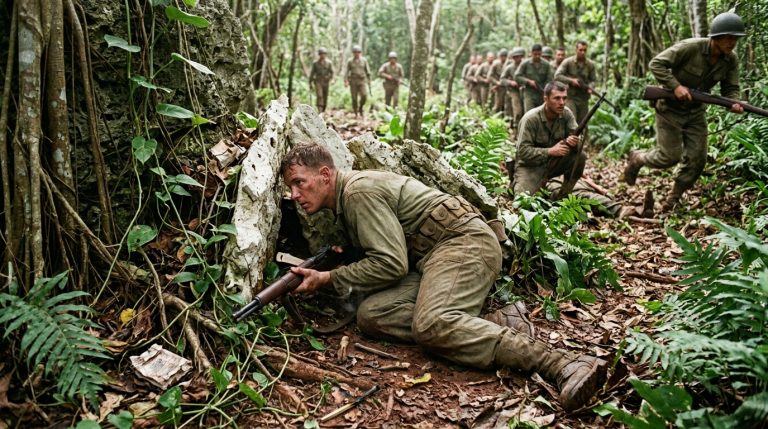
The Quiet Weight of Honor: A Veteran’s Grace in a World of Faded Echoes and Resilience
CHAPTER 1: THE FRACTURED SILENCE
The courtroom was a sterile expanse of wood and misery, smelling faintly of lemon floor wax and the trapped, stale breath of people waiting to be judged. Fred Hudson stood at the center of it, his back a rigid, iron-straight line that defied his eighty-four years. The denim of his jacket felt heavy against his shoulders, a texture of memory and grit that felt out of place in this polished theater.
Judge Albbright leaned over his dais, a man whose skin possessed the waxen, translucent quality of someone who had never had to work for his own warmth. His gaze, flicking over Fred’s chest with a smirk of practiced disdain, settled on the three rows of ribbons and the single star hanging from a pale blue ribbon.
“Are those supposed to be real?” Albbright asked. The question was a scalpel, designed to peel away the layers of a man’s dignity before the gallery could even register the wound.
Fred didn’t blink. His eyes, clear and gray as the winter sky over a landscape he hadn’t seen in decades, remained fixed on the state flag behind the judge’s head. He heard the ripples of laughter in the back—a mix of pity and cheap amusement—but they were distant, like the hum of a fly in another room. He wasn’t insulted; he was simply somewhere else, somewhere the sterile air of this room couldn’t touch.
“I asked you a question, sir,” the judge pressed, his voice rising, carrying that jagged edge of petty, small-town authority. “Are you going to answer me, or are you as deaf as you are decorated?”
Sarah Jenkins, the public defender, shifted beside him. Her hand was balled into a fist at her side, the knuckles white. She was a tremor of kinetic energy in a room that demanded static submission. “Your honor, this is irrelevant,” she said, her voice strained.
Albbright didn’t even look at her. “Respect is earned, counselor. And parading around with a chest full of tin doesn’t automatically earn it here.”
Fred’s hand brushed his collar as he shifted his weight. His fingers grazed the edge of a small, discreet pin—a crest of a sword behind a castle tower. It was the only thing that felt real in this entire, performative space. He thought of the weight of the rain, the sucking, thick mud, and the feeling of a young man’s heart hammering against his own back. That was real. This—the wood, the gavel, the judge’s sneering, blotchy face—was a hallucination.
The bailiff stepped forward, his expression caught between duty and a flicker of genuine unease. He looked at Fred’s hands, gnarled and speckled with the marks of time, and then up at his face.
“Take the jacket off,” the judge commanded, his eyes gleaming with the cruelty of a man who needed to see the armor fall.
Fred’s breath hitched, just for a second. The fabric of the jacket was a barrier, not just against the cold, but against the intrusion of a world that didn’t understand what it meant to carry a shadow. He didn’t move. His silence hung in the room, heavy and absolute, creating a void that seemed to pull the oxygen from the judge’s lungs.
The bailiff hovered. The gallery held its breath. Then, a sharp, dissonant sound tore through the room: the frantic, rhythmic click of Sarah’s heels as she suddenly turned toward the door, her eyes wide with a realization she hadn’t yet named. She was heading for the hall, toward the cold, hard data of a past that hadn’t been written down.
CHAPTER 2: THE TANG OF CORDITE
Sarah Jenkins did not look back. If she had, she might have seen the bailiff shift his weight, his eyes lingering on the back of the old man’s head with a dawning, uncomfortable suspicion. Instead, she pushed into the cramped, shadowed alcove, her chest heaving as if she had just run a marathon. Her phone was a cold, smooth weight in her palm. The silence of the hallway was total, a stark departure from the performative cruelty of the courtroom, yet it felt heavier, charged with the static of an impending storm.
She didn’t know what she was looking for, only that the pin on Fred’s collar—the small, silver sword and tower—had acted like a key, turning a lock in her mind she hadn’t realized was jammed.
Her fingers trembled as she tapped the search bar. The screen’s glare washed out her face, making her look like a ghost in the dim light. She typed in the description: US Army crest, sword, castle tower. The blue light flickered, and then the results flooded the screen. First Special Forces Group. The Green Berets. The words seemed to vibrate against the glass.
As she read, the sounds of the courthouse began to distort. The distant, muted murmurs of clerks and the muffled thud of footsteps didn’t reach her ears as mundane noise. Instead, she heard the low, guttural whine of a distant rotor blade and the dry, rhythmic crackle of leaves being crushed underfoot. It was a phantom noise, a trick of the mind triggered by the sterile, antiseptic smell of the alcove floor cleaner that reminded her of the descriptions of field infirmaries she had studied in law school.
She closed her eyes. For a heartbeat, the image of Fred Hudson standing perfectly still under the judge’s glare replaced the mundane reality of her career ambitions. She felt a phantom weight on her own shoulders, a crushing pressure that she couldn’t identify. It was the weight of a man’s life, carried through a jungle where the sky was only a sliver of blue, impossibly far away.
The blue of the medal’s ribbon, she realized, her heart stuttering. It wasn’t a choice. It was a witness.
She opened her eyes, shaking the sensation away like water. This wasn’t about her. It was about the way the judge had looked at him—like he was a piece of trash to be swept out. She felt a surge of protective fury that felt almost alien in its intensity. She wasn’t just a public defender anymore; she was a witness to an act of erasure.
She found the number for Fort Lewis. Her thumb hovered over the screen. If she called, she was stepping out of the bounds of a simple traffic infraction case. She was invoking a ghost. The specialist who answered the phone sounded bored, a man who had heard a thousand complaints about speeding tickets and minor administrative errors.
“Fort Lewis Public Affairs, Specialist Miller speaking.”
Sarah’s voice came out as a whisper, then she caught it and steadied her breath. “My name is Sarah Jenkins. I’m a public defender in Northwood County. I have a client here—a veteran. He’s being held in contempt. The judge is trying to strip him of his dignity because he doesn’t believe his medals are real.”
“Ma’am,” the specialist replied, the tone flat, professional, and entirely detached. “We don’t get involved in civilian legal matters. If there’s a dispute over service records, the family needs to submit a FOIA request. We can’t—”
“He’s wearing a First Special Forces Group pin,” Sarah interrupted. Her voice was brittle, thin as parchment. “He’s an old man. They’re mocking him. He’s standing there like he’s in the middle of a war zone, and they’re laughing at him.”
There was a silence on the other end, but it wasn’t the silence of boredom. It was a sudden, sharp intake of air—a pause that signaled a shift in the gravity of the conversation.
“What is his name?” The voice was no longer flat. It was guarded, tight.
“Fred Hudson,” Sarah said, the name sounding small in the vast, empty hallway.
She heard the sound of a keyboard, but it wasn’t a casual tap-tap. It was the frantic, aggressive clatter of a man who was searching for something that might be dangerous. Then, the specialist’s breath caught again, a jagged sound.
“Do not let him leave,” the specialist said, his voice dropping, carrying an urgent, crystalline clarity. “Do not let them move him. Do not let them take his jacket. Do you understand me? We are on our way.”
The line went dead, leaving only the hum of the dial tone and the oppressive, hollow quiet of the courthouse. Sarah looked at her phone, then down at her own hand. It was shaking. The transition from the mundane to the impossible had happened in the space of a heartbeat. She had opened a door she couldn’t close.
She turned back toward the courtroom doors, the polished wood looming ahead of her like the entrance to a vault. She didn’t know what kind of hurricane she had just invited into the building, but she knew one thing with the cold, hard certainty of a falling stone: Judge Albbright had no idea what he had just started.
CHAPTER 3: THE URGENT BRIDGE
Sarah pulled the phone away from her ear as if the plastic had suddenly turned red-hot. The silence that rushed into the gap was more terrifying than the specialist’s voice had been. She stared at the screen, the display dimming to black, and felt a profound, physical disorientation. The corridor of the Northwood County Courthouse, which had felt like a mundane passageway just ten minutes ago, now seemed to stretch into an infinite, suffocating tunnel.
Every step she took back toward Courtroom C felt like walking into the mouth of a furnace. She had to navigate the transition—from a public defender operating within the bounds of a local traffic dispute to a person who had just activated a military protocol she didn’t fully understand. Her hands were cold, her breath shallow. She could hear the muffled, rhythmic thud of her own pulse behind her ears, a frantic, uneven beat that kept time with the fluorescent lights buzzing overhead.
The door to the courtroom was a barrier of heavy, stained oak. She paused, pressing her palm against the wood. It was cool, unyielding. On the other side, Judge Albbright was still holding court. She could hear the muffled, pompous cadence of his voice, the sound of a man who was utterly convinced of his own permanence. He was currently in the act of reasserting his petty power, oblivious to the fact that the architecture of his world had just been marked for demolition.
Sarah closed her eyes, forcing herself to visualize the pin on Fred’s collar again. She needed to be steady. If she walked in there with the frantic energy of the hallway, she would give the judge exactly the leverage he wanted. He would paint her as emotional, irrational—the perfect foil to his “rational” authority. She took a long, slow breath, tasting the metallic tang of old building dust and floor wax. She had to embody the gravity of what she now knew.
She pushed the door open.
The sound of her entry was a sharp, intrusive creak that drew a dozen heads toward her. The air inside the courtroom was thick, stagnant, and humid, trapped by the high ceilings and the lack of ventilation. It felt like walking into a different climate.
Fred Hudson was still standing at the defense table. His silhouette against the flag was unchanged, an unmoving statue in a room full of shifting, nervous energy. He didn’t look at her when she entered, but his shoulders seemed to settle, a microscopic shift in tension that suggested he had been waiting for the return of a specific variable.
Judge Albbright paused mid-sentence, his gaze flicking toward her with the annoyance of a man interrupted. “Back so soon, counselor?” he asked, his voice dripping with a condescending, practiced sweetness. “Did you find the costume shop receipt you were looking for, or did you realize your client’s lack of respect is as fundamental as his lack of honesty?”
Sarah didn’t answer him. She walked toward the defense table, her movements deliberate, stripping away the frantic pace of her earlier exit. She had to anchor herself. She stopped beside Fred, and for the first time, she looked at the medals on his chest not as decorations, but as weight. She could see the way the light caught the worn edges of the ribbons, the way the metal hung with a gravity that seemed to pull the very air toward it.
“Your Honor,” Sarah said. Her voice was steady, clearer than it had been all morning. “I have not found a receipt. What I have found is a context that this court seems to have overlooked.”
The judge’s eyes narrowed, his brow furrowing in a mask of theatrical confusion. He leaned forward, the leather of his chair creaking. “Context? Counselor, the speed limit is not a matter of context. It is a matter of the law.”
“The law is a matter of record, Your Honor,” Sarah countered. She stood her ground, feeling the eyes of the gallery—mostly people waiting for their own cases—boring into her back. She didn’t look at them. She kept her focus on the judge, noticing for the first time the slight, nervous tick of his jaw—a sign that his own performative confidence was beginning to fray at the edges, even if he didn’t know why.
She realized then that the decoy secret—the idea that he was a fraud—was the only thing holding Albbright’s reality together. If she could just delay, just hold the space until the reality she had summoned through the phone call reached the building, the house of cards would collapse on its own.
“I am requesting a brief recess,” she said, her voice devoid of the pleading note she had used earlier. It was a statement of intent. “I have someone who wishes to enter a statement into the record. An expert witness on the matter of service decorations.”
The judge barked a short, mocking laugh. “An expert witness? For a traffic ticket? You are wasting this court’s time, Ms. Jenkins. I’ve had quite enough of this theater.” He raised his gavel.
Sarah saw the motion—the slight twitch in his shoulder, the way his knuckles whitened around the wood. He was going to hammer it down, to seal the contempt charge before the reality could break through. She braced herself, her hands gripping the edge of the defense table, feeling the rough grain of the wood under her fingers. The tension in the room wasn’t just anticipation anymore; it was the sharp, jagged edge of a climax.
CHAPTER 4: THE NIGHTINGALE PROTOCOL
The gavel remained suspended at the apex of its arc, a piece of polished wood that suddenly felt as heavy as a lead weight. Judge Albbright’s eyes locked onto Sarah’s. The air in the courtroom had stopped circulating; the hum of the ventilation system seemed to vanish, replaced by a vacuum that pulled at the senses. For a man who had built his life on the certainty of his own voice, the judge’s sudden hesitation was a crack in the glass.
He looked at Sarah, really looked at her, and for a fleeting moment, he didn’t see a public defender. He saw the cold, unyielding resolve of someone who had already calculated the outcome and found him wanting. The silence in the room wasn’t just quiet; it was a physical pressure, a warning.
“An expert witness,” the judge repeated, his voice losing its sharp, rhythmic cadence. He brought the gavel down, not with the crushing authority he had intended, but with a dull, hollow thud that didn’t even echo. “On what grounds, Ms. Jenkins? This is a municipal court, not a military tribunal.”
“On the grounds that this court has questioned the validity of an honor that it is not equipped to judge,” Sarah replied. She didn’t move. She stood as a bridge between the judge and the man in the denim jacket.
Fred Hudson didn’t flinch. He hadn’t blinked. He remained in his state of profound, unshakable calm, his hands resting on the table as if he were waiting for a storm he had already weathered a dozen times before. The sight of him—this old man with the frayed jacket and the quiet, gray-sky eyes—began to affect the room. The gallery, which had been snickering only minutes ago, was now perfectly still. A woman in the third row leaned forward, her hand covering her mouth as if she were witnessing something sacred.
The judge felt the shift. He felt the eyes of the room moving from him to the defendant, and the realization hit him with a sickening, internal thud: he had lost the audience. The theater he had meticulously constructed was coming apart at the seams.
“Very well,” Albbright muttered, his face a blotchy, mottled red. He pushed his chair back, the wood screeching against the floor, a sound that grated against the nerves. “Ten minutes. If your ‘witness’ is not here to provide a relevant, admissible statement, I will proceed with the contempt order and the remand. Do not test my patience, counselor.”
He stood up, his robes swishing with a sound like dry leaves, and retreated behind the heavy oak partition into his chambers. The moment the door clicked shut, the courtroom erupted into a low, dissonant buzz. It wasn’t the sound of a crowd waiting; it was the sound of a crowd sensing a change in the tides.
Sarah turned to Fred. She wanted to ask him if he was afraid, if he knew what was coming, but the question died in her throat. He looked at her, and in his eyes, she saw a depth of patience that made her own stress feel like a child’s tantrum.
“It will be alright, miss,” he said, his voice a soft, low rasp that seemed to carry the weight of the years. “There is no need for such hurry.”
“They’re coming, Fred,” Sarah whispered, leaning closer, her voice barely audible over the hum of the room. “The people I called—they knew your name. The moment I said it, everything changed.”
Fred’s expression didn’t shift, but there was a flicker in his gaze, a ghost of something—a memory or perhaps a regret—that darkened his eyes for a fraction of a second. “That was a long time ago,” he said, his focus drifting back toward the flag. “Some ghosts are better left in the dark.”
Sarah walked away from the table, pacing the narrow aisle between the rows of seats. She needed to be active, to do something, anything, to bridge the remaining time. She pulled her phone out again. Her thumb hovered over the notification center. The specialist had said they were on their way, but she had no idea what that meant. A phone call? A car? A literal rescue?
She looked at the exit doors. They remained closed, heavy, and silent. The institutional weight of the courthouse seemed to be pressing down on her, the cold, marble walls vibrating with the passage of time. Every tick of the wall clock was a step closer to the judge’s return, closer to the psychiatric evaluation he was so determined to force upon Fred.
She found herself walking toward the bailiff, a man whose indifference had been his defining trait until moments ago. She stopped in front of him. “You’ve seen a lot of people in this room,” she said, her voice dropping, discarding the legal formality. “Have you ever seen one that wasn’t what they appeared to be?”
The bailiff didn’t look at her. He kept his eyes on the courtroom doors, his jaw tight. “I’ve seen plenty of liars, ma’am,” he said, his voice hard. “And I’ve seen plenty of people who think they’re special because of some ribbons they bought at a garage sale.”
“Look at him,” Sarah pressed, gesturing toward Fred with a subtle movement of her chin. “Look at the way he holds himself. Look at his hands. Do you really think he’s a liar?”
The bailiff hesitated. He looked toward the defense table. For a second, the mask of the enforcer slipped, and Sarah saw the genuine, raw uncertainty beneath it. “He’s different,” the bailiff admitted, his voice so low she almost missed it. “But the judge… the judge makes the rules, ma’am. And I’m just here to see they’re followed.”
“The rules are supposed to serve justice, not ego,” Sarah said. She turned back to the room. The ten-minute recess was already bleeding away. She felt a phantom vibration in the floor—or maybe it was just her own nerves—but the building felt alive, tense, as if the very steel and concrete of Northwood County were waiting for an arrival that would rewrite the local reality. She walked back to Fred, her path clear, her resolve settling into a cold, focused diamond. She had set the bridge in place; now, she had to wait to see what would cross it.
CHAPTER 5: THE ARRIVAL OF ECHOES
The air in Courtroom C had shifted from humid and stagnant to something sharp and thin, like air at a high altitude. Sarah stood by the defense table, her muscles coiled tight, every fiber of her being attuned to the sound of the corridor. The ten-minute recess had been an eternity of shallow breaths and side-long glances, but the sudden cessation of the background hum—the distant murmur of the courthouse staff, the rolling carts, the clatter of keyboards—signaled that the outside world had finally reached the threshold.
Then, the sound arrived. It wasn’t the uneven, frantic footsteps of a civilian, nor the slow, shuffling gait of a clerk. It was a singular, rhythmic percussion: click-clack, click-clack. It was the sound of iron meeting stone, a cadence so precise and authoritative that it seemed to vibrate through the soles of Sarah’s shoes.
Beside her, Fred Hudson didn’t turn his head, but his posture changed. The slight slump of his shoulders, the weariness that had been etched into his frame, vanished. He straightened, his chin lifting just a fraction, his gaze sharpening. It was the posture of a man who had heard a call sign he hadn’t expected to hear for thirty years.
The courtroom doors, which had been latched, didn’t just open; they were pushed inward with a violence that made the wood groan. Two figures stepped into the light. They were dressed in immaculate Army dress blues, the fabric so dark it seemed to absorb the dim light of the courtroom. They moved with a terrifying, synchronized grace, one peeling off to the left, the other to the right, taking up positions that effectively sealed the room. Their faces were impassive, their eyes locked on the space just above the horizon.
A hush fell over the room that was absolute. It was the silence of a congregation watching a storm break the roof.
Then, a third figure walked down the center aisle. He was tall, his broad shoulders filling the space of the aisle, his uniform a display of service that made the judge’s desk look like a child’s craft project. General Marcus Thorne walked with a rhythmic, measured stride that echoed like heartbeats against the tile. Each step he took felt like an indictment of the proceedings.
Sarah’s breath hitched. She watched the General’s face—a mask of granite and controlled fury. He didn’t look at the judge, nor at the gallery. He didn’t look at her. His gaze was a laser, cutting through the stagnant air until it locked onto Fred.
Judge Albbright stumbled out of his chambers, his robes rustling. He started to speak, a protest already forming on his lips, but the moment he saw the man in the aisle, the words died. The judge’s face, already pale, drained of all color until he looked like a wax figure caught in a flickering light. He stopped, his mouth hanging open, his hand still clutching the handle of his chambers door.
General Thorne stopped two feet from the defense table. He didn’t look down at the judge. He didn’t acknowledge the room. He stared at Fred, and the granite in the General’s expression began to soften, transformed by a flicker of reverence that was more jarring than his anger. In that space, the two men stood as the only inhabitants of the room, leaving the judge, the bailiff, and the gallery as nothing more than background noise.
The General brought his hand up—a salute so crisp, so sharp, it looked like it could slice the air.
“Sergeant Major Hudson.” The General’s voice was a low, resonant boom, unamplified yet clearly reaching the farthest corners of the room. “It is an honor to be in your presence, sir.”
The courtroom was frozen. Sarah felt a shiver trace its way down her spine. The “Nightingale” protocol—the term the specialist had used on the phone—wasn’t just a secret; it was a ghost story made manifest. The judge, finally finding his voice, sputtered, “What—what is this? This is a court of law! Who are you to disrupt these proceedings?”
General Thorne didn’t turn his head. He held the salute, his eyes locked on Fred. Only after Fred, with a movement that was stiff but no less precise, returned the gesture, did the General finally lower his arm. He turned slowly, and the shift in his gaze as it landed on the judge was like the temperature dropping twenty degrees.
“I am the man who has come to witness the dignity you have so carelessly discarded,” the General said, his voice dangerously, unnervingly quiet. He reached into his inner pocket and withdrew a single, heavy envelope. “And I am here to ensure that this court understands exactly what it has been mocking.”
Sarah watched the judge’s eyes dart to the envelope. The authority in the room was being shredded in real-time, the institutional power of the gavel rendered toothless by the sheer, unadulterated weight of history standing in the aisle. She felt a surge of triumph, but beneath it, a cold, nagging realization: they hadn’t just broken the judge’s world; they had irrevocably changed hers. There was no going back to the way things were before the doors opened. The truth of who Fred Hudson was—the reality he had spent three decades hiding—was now hanging in the air, waiting for the General to let it loose.
CHAPTER 6: THE UNMASKING
Judge Albbright stood trapped behind his own dais, his hands hovering over the wood as if he were trying to push the heavy oak structure forward to use as a shield. The room had become a tomb for his authority. The General didn’t move toward him. He simply stood there, an anchor of immovable reality in a room that had been floating on the judge’s delusions.
“I am waiting, Your Honor,” the General said, his voice dropping into that low, dangerous register that made the air feel electrified. “You asked for the context of these medals. I have provided the record. Are you going to read it, or is the weight of the truth too much for your courtroom to support?”
Sarah saw the judge’s fingers tremble as he reached out to touch the edge of the envelope. The paper was crisp, official, and it seemed to absorb the dim, artificial light of the room. When Albbright finally pulled the document from the sleeve, the sound of the paper sliding against paper was the only thing audible—a dry, rasping noise that felt like bones scraping together.
He began to read. Sarah watched his face, documenting the slow, agonizing disintegration of his ego. At first, his eyes darted rapidly, his mouth set in a thin line of defiance. But as the lines of the citation—the names of the operations, the citations for valor, the sheer, staggering list of decorations—sank in, his focus slowed. His gaze stayed on the page longer, shifting back to the first line, then the last, as if he were trying to find a misprint, a lie, anything to validate his earlier, cruel mockery.
He couldn’t find one.
Fred stood perfectly still. He wasn’t watching the judge. He was looking at his own hands, the skin translucent and mapped with veins, looking as if he were surprised to find them still attached to his body. Sarah caught a glance of his face—the gray eyes were no longer fixed on the flag. They were distant, pulled inward by the weight of the General’s recitation. She realized then that the truth was not a triumph for Fred; it was a burden, a return to the noise and the smoke he had spent his retirement trying to silence.
“Sergeant Major Fred Hudson,” the General continued, his voice resonating through the room, unprompted by the judge. He began to read aloud, his tone shifting from cold professionalism to a rhythmic, almost chant-like cadence of respect. “Enlisted United States Army, 1958. Three tours in Vietnam. Fifth Special Forces Group.”
The gallery gasped. The sound was a collective intake of air, a sudden, sharp clarity that washed through the room. People were standing up now, moving instinctively, drawn by a gravity they couldn’t name. The local reporter in the back, who had been scribbling frantically, had stopped writing. He was just watching, his pen hovering over the pad, his mouth slightly open.
“And this,” the General said, his hand gesturing toward the star-shaped metal on the blue ribbon, “is the Medal of Honor.”
The judge’s face had gone from red to a pasty, sickly white. He looked up from the paper, his eyes wide and unfocused, as if he were seeing the room for the first time. The arrogance that had fueled his entire judicial tenure had evaporated, leaving behind a hollow, trembling man who suddenly understood that he had not just insulted a veteran—he had attacked a legend.
“February 4th, 1968,” the General recited, his voice steady, the words hanging in the air like stones. “Near the city of Hue. Sergeant Hudson, with complete disregard for his own safety, single-handedly charged two enemy machine gun nests…”
With each detail, the room seemed to shrink. The smell of the floor polish vanished, replaced in Sarah’s mind by a phantom, acrid scent of cordite and wet earth. The judge slumped. He didn’t drop to his knees, but he seemed to shrink into his chair, his shoulders hunching as if he were being pelted with rocks.
“This man,” the General concluded, staring directly at the judge, “has carried the weight of this nation’s honor on his chest for decades. And you, in your vanity, decided it was a costume.”
The silence that followed was heavy, a suffocating blanket of shame that touched everyone in the room. The judge’s hands, still holding the citation, shook so violently that the paper crackled, a sharp, repetitive sound that mirrored the ticking of the wall clock.
“I—I did not know,” Albbright whispered. It was a pathetic, empty sound. It wasn’t an apology; it was the last, desperate grasp for an excuse.
General Thorne stepped closer, his boots hitting the floor with a finality that silenced the judge’s plea before it was fully formed. “Ignorance is a choice, Your Honor. And in this case, it was a choice that has consequences.”
The General pulled a secondary document from his inner pocket—a blue-backed legal folder that Sarah recognized immediately. It wasn’t a request; it was a directive. “The Office of the Governor and the Judicial Conduct Commission have already been notified of today’s transcript. Your career of public service, as you call it, is officially under review.”
Sarah felt a chill that had nothing to do with the temperature of the room. She looked at Fred. He was looking at the General now, a faint, sad smile playing on his lips. It was the smile of a man who understood that justice was rarely a tidy, clean event—it was usually just the aftermath of a wreck. The judge was finished, his reputation a ruin, but the weight of the moment was settling on the room, thick and permanent. The decoy secret—the facade of the fraud—was dead. But the absolute final reality, the reason Fred had lived his life in the shadows, was still locked behind his gray, weary eyes. And Sarah knew, with a sudden, sinking dread, that the General was only halfway through his work.
CHAPTER 7: THE COOLING EMBER
Judge Albbright’s retreat into the chair was slow, a surrender of physics. He didn’t look like a man of the law anymore; he looked like a man who had suddenly realized the floor beneath him had been removed. His hands, still clutching the citation, rested on the mahogany desk, but the wood no longer provided the buffer of authority. It was just wood—dead, cold, and heavy.
The gallery had become a chorus of shifting bodies and hushed, frantic whispers. The local reporter was no longer taking notes; he was staring at the General, his expression a mixture of profound shock and the dawning realization that the story of his life had just walked into his local courthouse. Sarah stood still at the defense table, her heart hammering a frantic, uneven rhythm against her ribs. She had expected the confrontation to escalate, but she hadn’t anticipated the sheer, absolute vacuum that would follow the General’s declaration. The room felt as though it had been scrubbed clean of all its previous heat, leaving only a clinical, biting chill.
General Thorne didn’t relish the victory. He didn’t look at the gallery for applause, nor at the judge for confirmation. His focus remained entirely, unnervingly, on Fred. He stood at ease now, his hands clasped behind his back, a silent guardian of a history that the rest of the world was only just beginning to comprehend.
Fred Hudson took a slow, deep breath. It was a rhythmic, measured intake of air that seemed to signal a shift in his own internal landscape. He looked toward the General, then down at his own hands, which were steadying themselves against the table. “You didn’t have to come all this way, Marcus,” he said, his voice quiet. It lacked the rasp of his earlier exhaustion; it was clear, sharp, and possessed a quiet authority that mirrored the General’s own.
“We couldn’t let it stand, Sergeant Major,” the General replied, his voice softening, the sharp, metallic edge of his military command replaced by a tone of profound, historical deference. “The institution—the nation—would have been smaller for allowing this to persist. We don’t forget.”
“It’s just a ticket,” Fred said, a small, sad smile touching his lips. He looked around the courtroom, his eyes passing over the faces of the people who had come here to watch a man be humiliated and had instead found themselves witness to a living monument. “The law is a difficult thing to master. The judge… he didn’t know what he was looking at. Most people don’t.”
Albbright tried to speak, but the sound was strangled, a raspy, pathetic attempt at self-defense. “I—I acted within the guidelines—”
The General turned his head, and the judge withered under the glare. It wasn’t an attack; it was a simple, absolute erasure of the judge’s ability to defend himself. “You acted with the arrogance of a man who thought his station exempted him from the requirements of basic human decency,” the General stated, his voice flat and devoid of malice. “The commission will decide the extent of your failure. My only interest is that you understand the error of your perspective.”
Sarah looked at the bailiff. The man who had been so adamant about his duty to the judge was leaning against the wall, his arms crossed over his chest, his gaze fixed on the floor. He looked diminished. The entire courtroom, once the domain of Albbright’s petty tyranny, had been transformed into a space of sober, quiet reflection. The veneer of municipal power had been stripped away, leaving only the raw, uncomfortable truth of what it means to lead, and what it means to serve.
General Thorne turned back to Sarah, his gaze assessing. For a second, the intensity of his focus made her feel as though she were being weighed, measured against the standards of an institution she had only glimpsed from the outside. “Counselor,” he said, and the word held a weight of acknowledgment. “See to it that the records reflect the dismissal. We will handle the logistics of the fallout.”
Sarah nodded, her tongue feeling heavy in her mouth. She couldn’t find the words to respond, so she simply pulled the case file toward her. The paper felt fragile, a piece of detritus in the wake of the hurricane.
The General turned back to Fred. The interaction was brief—a nod, a silent, imperceptible communication that bridged the gap between the legendary soldier and the current leader. Then, with a turn so precise it was almost musical, the General pivoted and began to walk back up the aisle. His two guards fell into step behind him, their boots striking the tile in a rhythmic, fading echo of authority.
The doors opened, and the light from the hallway—bright, harsh, and unfiltered—poured into the courtroom. For a moment, the three men were silhouetted against the glare, like figures exiting a stage. Then, the doors swung shut, leaving behind a silence so dense it felt like a ringing in the ears.
Albbright sat in his chair, his head bowed, his hands still on the citation, his world fundamentally, permanently broken. Fred looked at Sarah, his gray eyes clear and calm. “Shall we go, miss?” he asked, his voice gentle. “I think we’ve taken up enough of this room’s time.”
Sarah picked up her bag. She didn’t look at the judge. She didn’t look at the reporter. She walked out of the courtroom, her heels clicking on the tile, the sound now echoing in a space that no longer felt like a court, but like a museum to a past that had just demanded to be remembered. She reached the threshold, pushed open the doors, and stepped out into the hallway, the cool air of the courthouse lobby hitting her face like a promise of something new.
CHAPTER 8: THE DINER BOOTH
The world outside the Northwood County Courthouse moved at its own sluggish, indifferent pace, unaware of the structural collapse that had just occurred within Courtroom C. Sarah watched Fred’s profile as they walked down the stone steps together into the brisk afternoon air. The state flags above the portico fluttered with a dry, papery rasp. Fred did not rush. He descended the stairs with a rhythmic, unhurried precision, his old motorcycle boots gripping the concrete securely.
“Mr. Hudson,” Sarah began, her voice a fragile thing in the vast open space of the plaza. “What happens now?”
Fred paused at the bottom step, looking out toward the small town square where a few cars drifted past. The denim of his jacket caught the pale sunlight, highlighting the subtle frays at the cuffs and the tiny, pale puncture marks where his ribbons had rested. “The same thing that always happens, miss. The dust settles, and we keep moving.” He offered her a small, remarkably gentle nod, turning toward the small gravel lot where his motorcycle sat waiting—a quiet machine worn down to its functional essentials. “Thank you for the call, Sarah. You didn’t have to.”
“Yes, I did,” she said, but he was already stepping away, not into a spectacular sunset, but back into the comforting obscurity of a life chosen, rather than forced.
Four weeks bled away in real-time increments of administrative cleanup, public interest, and a quiet restructuring of the local district. The local reporter’s article had rippled across the wire services, forcing the judicial conduct commission to act with unprecedented velocity. Judge Albbright had avoided a public trial by entering into an immediate, disgraced retirement, his name stripped from the local registers. But for Fred, none of the noise mattered. The real resolution didn’t take place in the headlines or the legislative halls where “Hudson’s Law” was being drafted; it took place on a damp Tuesday morning inside the worn vinyl interior of the corner diner.
The bell above the heavy glass door chimed, a familiar, clear copper tone. Fred sat in his usual corner booth, a white porcelain mug cradled between his calloused hands. The steam rose in a lazy, winding spiral, carrying the rich, bitter scent of dark roast coffee and toasted rye. He didn’t look up when the footsteps slowed beside his table. They weren’t the sharp, aggressive clicks of a man in power, nor the disciplined thuds of an honor guard. They were hesitant, slightly uneven, dragging against the thin commercial carpet.
“Mr. Hudson,” a voice said.
Fred raised his head slowly. The man standing at the edge of the booth wore a plain gray polo shirt and khakis. Without his heavy black robes, stripped of the imposing heights of the judicial bench, Arthur Albbright looked remarkably small. His hair seemed thinner, his shoulders slightly hunched as if trying to shield himself from the judgment of the ordinary patrons scattered throughout the diner. The arrogance that had once defined his face had dissolved, leaving behind a map of pale lines and a deep, exhausting weariness.
Fred didn’t offer a dramatic glare. He didn’t rise to demand an apology. He simply gestured with a slight, open-handed motion to the empty bench across from him. “The coffee’s fresh,” Fred said, his tone entirely neutral, flat as a prairie road. “Sit down, Arthur.”
Albbright slid into the booth, his movements stiff and self-conscious. He didn’t slide his hands onto the table; he kept his fingers knotted together in his lap, out of sight. The silence between them wasn’t weaponized anymore; it was a vast, open space waiting to be filled.
“I didn’t think you’d speak to me,” Albbright muttered, his eyes fixed firmly on the paper placemat between them, which detailed the breakfast specials in faded blue ink. “After what I did. What I said. There isn’t an excuse for it. I’ve spent the last month trying to find a piece of paper or an old law to hide behind, but there isn’t one. I was small, Mr. Hudson. I was cruel.”
Fred took a slow, deliberate sip from his mug. He set it down without a sound, his thumb tracing the smooth, chipped edge of the handle. This was the symbolic repair—the patching of a world that Albbright had tried to break with his gavel. “A man shouldn’t keep a seat he doesn’t have the heart for,” Fred said softly. “You looked at those medals and you saw an insult to your authority. But the medals aren’t the point. They never were.”
Albbright finally looked up, his eyes rimmed with red, searching the old man’s face for a trace of the vindication or triumph he expected to find. There was none. Only the gray-sky clarity of an eighty-four-year-old soldier who had seen empires crumble and knew that pride was the first thing to rot.
“The honors belong to the ones who didn’t get to come back and order breakfast,” Fred continued, his voice dropping into a quiet, humanistic resonance. He reached across the table, his gnarled hand pushing the small glass sugar pourer toward Albbright’s side, an offer of a shared burden. “Respect isn’t something you demand with a piece of wood, Arthur. It’s something you give to the person standing right in front of you. A general, a judge, or the kid clearing the plates. We’re all just trying to make it to the next marker.”
Albbright’s chest rose and fell in a long, shuddering breath. The defensive wall he had spent a lifetime building—the veneer of professional perfection and judicial infallibility—shattered completely, not with a crash, but with a soft, quiet surrender. He nodded once, a single tear escaping his eye and tracing a path down his cheek before he could wipe it away with the back of his hand. “I’m sorry,” he whispered, and for the first time in his life, the words cost him everything, and earned him his humanity.
Fred watched him, his expression softened by an ancient empathy. He reached into his pocket and pulled out his keys, the small leather fob jingling softly against the porcelain mug. Tomorrow, he would be back in his garage, the smell of motor oil and old iron keeping him company while he tightened the chain on his motorcycle. The world would go on spinning, drafting its laws and printing its papers, but in this quiet corner, the Kintsugi was complete. The fracture had been filled with gold.
“Eat something, Arthur,” Fred said gently, sliding the laminated menu across the worn Formica. “It’s a long road back, and you’re going to need the energy.”
Arthur Albbright took the menu, his hands finally steadying as he met the veteran’s gaze with genuine, unforced respect. The bell above the diner door chimed again, letting in the soft hum of the street, but the silence inside the booth remained perfectly, beautifully at peace.