The Quiet Ridge: How an Appalachian Hunter Outsmarted Encirclement on Peleliu’s Coral Crags
CHAPTER 1: THE MOUNTAIN CREED
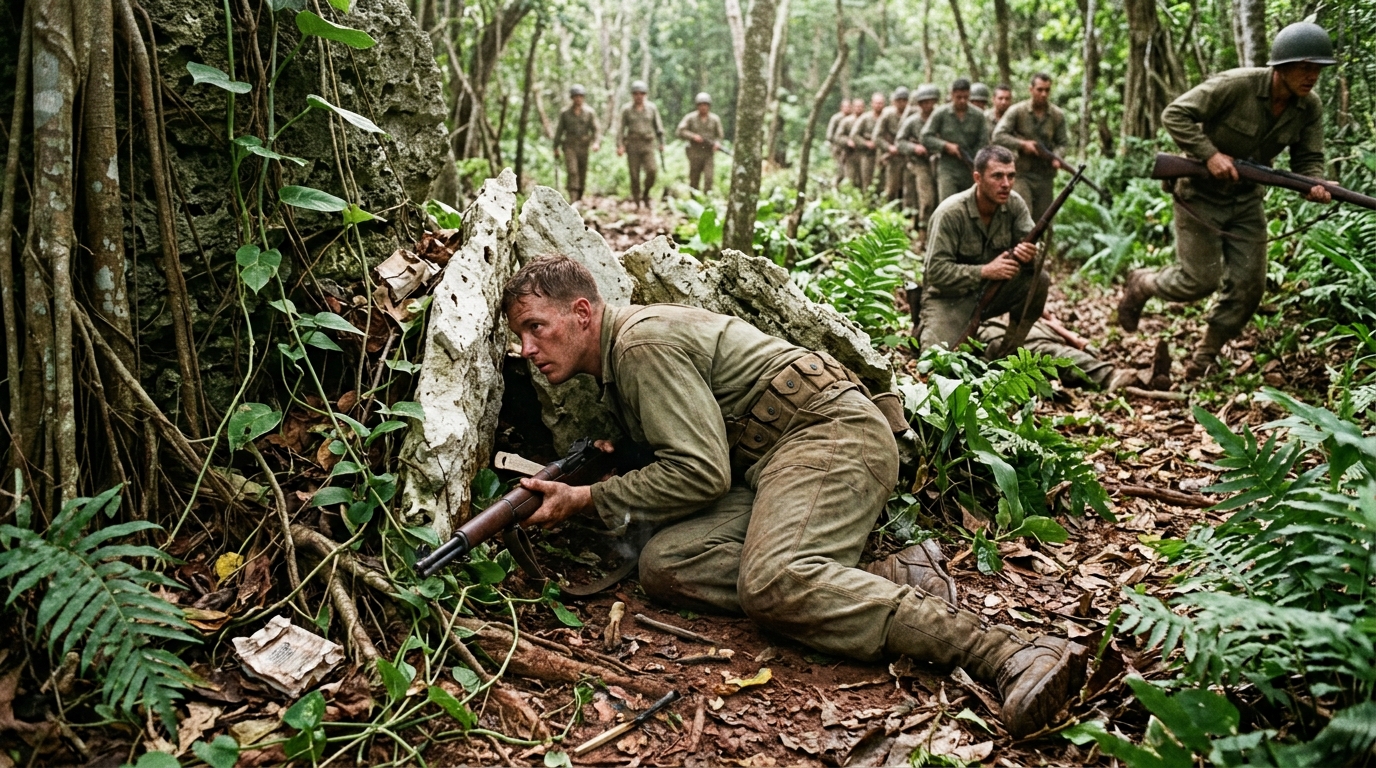
The sharp edge of the coral rock bit straight through the canvas of my trousers, but I didn’t shift an inch. Moving meant noise, and noise in this choked humidity got a man buried. Forty yards behind me, Lieutenant Morrison was running his thumb over the brass casings in his belt, his jaw set so tight the muscle twitched under his sunburned skin.
“We line up and we punch through that gap,” Sergeant Miller muttered, crouched low in the sharp red dirt beside me. He slapped a green bug off his forearm, the crack of skin on skin loud as a pistol shot in the dead air. “Standard doctrine, Caldwell. You don’t win a fight by laying in the brush like a dog waiting for rain.”
“Standard doctrine assumes you’ve got a supply truck behind you, Sergeant,” I said softly, my voice barely carrying over the hum of the flies. I took the smooth, notched bone striker out of my pocket, rolling the cool turkey-call wood between my thumb and forefinger. “You charge that narrow neck now, and their heavy guns chop us into dog meat before we hit twenty paces. Out here, you don’t chase the game. You let it walk into your sight.”
“This ain’t West Virginia, turkey hunter,” Miller spat, though he stayed down. “Those aren’t birds out there.”
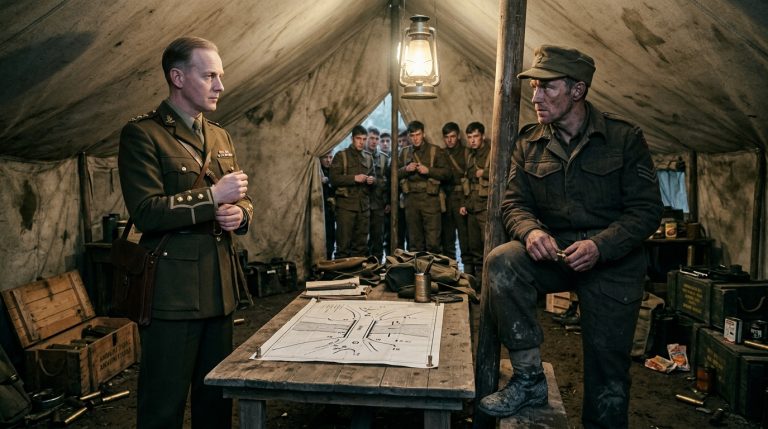
Lieutenant Morrison crawled up between us, the stink of sweat and salt heavy on his green utility shirt. He looked at the high ridge framing our little box canyon, then down at the six hand grenades lined up on his poncho like tin cans on a fence rail. No radio meant no brass in our ear, no artillery support coming over the hill, and no rescue party coming until somebody noticed our mess kit was missing at roll call.
“Morrison,” I said, catching his eye before he could order the charge. “Give me until noon. I go out past the perimeter alone. No noise, no bursts. Just one rifle.”
Morrison stared at me for three long seconds, his fingers digging into the sharp white coral. “You plan on just hiding out there, Daniel?”
“I plan on hunting,” I said, sliding my M1 Garand forward through the tangled green vines. “And if I do it right, they won’t ever know where the shots are coming from.”
CHAPTER 2: FIRST BLOOD IN THE CORAL
A man moving through jungle thinks he’s being quiet if he doesn’t snap a branch. He forgets about his equipment clinking, his breath coming too fast, or the way his shoulders brush the wet underside of the broad-leaf fern.
Four of them. Moving in a loose file, rifles held high, heads pivoting like skittish white-tailed deer in the opening week of November.
I didn’t lift my head. In the Monongahela, if you raise your chin to peek over a log, a turkey’s sharp eyes will catch that flash of pale skin from a hundred yards away. You keep your head down, your eyes low, and you let them walk straight into the frame of your sight.
They passed so close I could smell the stale fish oil and wet canvas on their uniforms. One man—the rear guard—stopped near a rotting stump nineteen yards out. He pulled a crumpled paper pack from his pocket, slipped out a stick of tobacco, and flicked a match.
Mistake. The sulfur hit my nose a second before the tiny puff of gray smoke drifted through the brush.
I rolled the notched bone striker between my thumb and palm, feeling the deep groves worn into the turkey call. Control the breath. Wait for the isolation.
The three forward scouts pushed deeper toward Morrison’s line, leaving the smoker alone to guard their back. He took a drag, his shoulders slumping just an inch as the heat of the morning hit him.
I squeezed the trigger.
The Garand cracked, heavy and dry. The back-guard collapsed into the fern patch without a sound, his match still smoldering in the dirt.
Before the sound had even bounced off the sharp coral walls of the canyon, I pushed off my toes and rolled sideways six feet into a shallow wash beneath a banyan root.
Rounds whipped through the leaves where my shoulder had been half a second ago, chewing up the soft wood and scattering white dust into the humid air.
I didn’t fire back. I didn’t even look up. I lay flat in the mud, my cheek pressed against the decaying leaves, listening to the frantic, ragged shouting of three men who knew somebody was out there, but had no idea where the woods had opened up and swallowed their partner.
CHAPTER 3: THE GHOST ON THE FLANK
They spread into a tight semi-circle around the dead leaves, rifles raised, boot soles sliding on the wet coral. One man dropped to a knee, his fingers hovering over the back-guard’s collar, his jaw locked in a hard line. The other two backed up shoulder-to-shoulder, scanning the green canopy, their muzzles wavering as the humidity stung their eyes.
In the mountains, when a flock gets spooked by a fox, they don’t fly off right away. They freeze, stare at the grass, and wait for something to break the silence. The hunter who moves during that pause goes home empty-handed.
I slid my left hand down my web belt, my thumb catching the rough edge of the notched bone striker. I didn’t press it. I just held the weight of it, grounding my pulse against the dead air.
The kneeling man reached for his comrade’s shoulder, turning his face sideways to call out.
I squeezed.
The Garand cracked once. The man on his knee went limp over the back-guard.
The remaining two bolted in opposite directions—one diving left toward the canyon wall, the other sprinting straight back up the trail, his boots tearing through the undergrowth in a blind panic.
I didn’t chase the runner. A spooked bird leading a flock back into the thicket just spreads the fear. I tracked the man on the right, keeping his chest in the crosshairs as he stumbled over a exposed root thirty yards out.
The second shot cut his run short.
Silence slammed back down over the ridge like a wet wool blanket. Three dead in four minutes, and not a single one had seen the flash.
I didn’t linger to count them. I pulled my boots back, keeping my stomach flush against the red clay, and slithered twenty yards east into a natural notch between two coral slabs. The white rock was jagged, biting into my elbows as I pulled the rifle up and settled into the dark shadow of a trailing vine.
Below, through a gap in the broad leaves, a larger group was moving up from the valley floor—fifteen men, moving in tight, disciplined pairs. But their paces were short. Their eyes weren’t searching the ridge; they were staring at the ground, watching for the next shadow to open fire.
They weren’t trying to overrun us anymore. They were terrified.
CHAPTER 4: THE PRESSURE SHIFT
Two men at the head of the column began shouting commands, waving their arms to split the unit into two sweeping arcs. They were going to try a double flank, forcing the brush from both sides.
I didn’t wait for them to form up. I eased back out of the notch, dragging my elbows over the rough limestone until the slope dropped off into a narrow, muddy gulley behind me.
A heavy rain burst—the kind that hits the island like a dropped bucket—slammed down through the canopy. The sudden deluge rattled against the broad leaves, drowning out every sound beyond five paces and turning the red clay beneath my knees into slick grease.
It was the same rain that used to turn the Monongahela hollows into mud slides. You don’t fight the weather; you use the noise to move twice as fast.
I crawled low through the gulley, keeping the crest of the ridge between my spine and the valley floor. Fifty yards to the west, where the canyon wall narrowed into a choked bottleneck, a cluster of officers was standing behind a clump of wild banana trees, maps spread across a wooden crate.
Without radio support or battalion guns to shell that ridge, Morrison’s boys back in the canyon were relying entirely on me to break their rhythm. If those officers coordinated the assault, forty men would hit our perimeter all at once.
I pulled myself up against the slick bark of a fallen trunk, wiping the mud and rainwater from my eyebrows with the back of my wrist.
The lead officer was raising a pair of brass binoculars, pointing toward the gap where Miller was holding the line.
I took a deep breath, letting the rain wash over my face, and squeezed the trigger.
The Garand cracked through the roar of the downpour. The officer dropped the glass and slumped sideways over the crate.
Chaos took the assembly area in a single second. Men scattered into the brush, blind-firing into the trees behind me, completely unable to pinpoint where the round had come from through the curtain of rain.
I rolled backward down the slope, letting gravity slide me six feet into a fresh hollow, my thumb already pressing a fresh eight-round clip down into the open breech.
CHAPTER 5: BREAKING THE SIEGE
The heavy booms off the coast meant the relief column was pushing through the southern flats. The opposing unit heard it too.
Through the thinning rain, I saw three NCOs frantically gesturing toward the rear trails, attempting to form a rear guard near an abandoned supply crate. They were setting up an organized fallback line—holding the narrow mouth of the canyon just long enough to drag their wounded back into the northern caves.
If they held that choke point, Morrison’s platoon would stay pinned inside that coral trap while the main force slipped away to fight another day.
An NCO with a thick leather map case strapped to his belt stepped up onto a limestone shelf, blowing a whistle to rally four riflemen into a firing line facing our perimeter.
I rolled the bone striker in my pocket one last time, feeling the worn ridges. In the mountain woods, when a flock breaks toward the thicket, you don’t shoot the tail birds. You take the lead hen directing the run.
I eased up against the coral outcropping, aligning the front sight post with the center of the NCO’s webbing. Range: twenty-nine yards.
I pulled the trigger.
The round struck true. The NCO collapsed against the limestone, his whistle dropping into the red mud.
The four riflemen spun around, their eyes wide as they sprayed blind bursts into the dripping fern fronds twenty feet wide of my hide. They were exhausted, low on ammunition, and convinced an entire squad of ghosts had encircled their position.
Instead of staying to hold the gap, the four men broke formation, scrambling backward into the ravine as the retreat collapsed into complete disarray.
Down in the canyon bed, Sergeant Miller’s voice echoed against the white rock walls as first platoon began pushing forward through the brush, their bayonets fixed, finally clearing the mouth of the pass without taking a single hit.
I didn’t cheer. I slid back down into the damp leaves, resting my forehead against the cool wooden stock, letting the exhaustion wash over my shoulders as the heavy boots of our relief column finally thundered up the trail.
CHAPTER 6: THE LONG QUIET
Morrison knelt beside me in the mud, his helmet tilted back, wiping red dust from his eyes with a grime-streaked sleeve. He looked down at the spent brass casings scattered across the coral shelf, then out at the silent, dripping treeline where the opposing firing line had completely collapsed.
“Thirty-seven casings, Daniel,” Morrison said, his voice raspy from twenty-six hours of shouting orders over mortar fire. “The commander says they counted thirty-one bodies along the approach. They thought they were running into a fortified heavy weapons team.”
“They were running into a man who knew how to wait,” I said softly, sliding the empty clip out of the receiver with a small metallic click.
I reached into my pocket, pulling out the small, notched bone striker. The smooth surface was stained dark with mud and sweat, the edges softened by years of thumbing it along the ridges of the Monongahela woods.
Morrison took a long drink from his canteen, water spilling over his chin into the dirt. “They’re gonna ask how you did it out here without artillery support or a radio link to guide you.”
“Tell them I was hunting turkeys,” I said, rubbing a smudge of wet soil off the wooden stock of the Garand. “Tell them when you’re outnumbered, you don’t go stomping through the brush trying to prove how loud you can yell. You sit still. You let them make the mistakes.”
The relief commander stepped over a fallen log, looking at the unstamped paper cigarette pack sitting cold in the mud beside my boot—the small detail that had told me hours ago their supply lines were running dry before they ever launched that final charge. He shook his head, looking from the thick jungle canopy back to my quiet posture.
“Scout sniper school is going to want those methods written down on paper, Corporal,” the commander said, resting a heavy hand on his belt.
“They can write down whatever doctrine they like,” I replied, slipping the bone striker back into my pocket. “Principles don’t change whether you’re wearing green utilities or flannel.”
I stood up slowly, the joints in my knees popping in the quiet morning air. I turned my face toward the open valley, breathing in the damp, mossy scent of the mountain ridge back home, knowing the long silence had finally returned.