The Engine of Memory: Arthur Vance and the Resilient Echo of a Faded Star
CHAPTER 1: The Weight of Steel
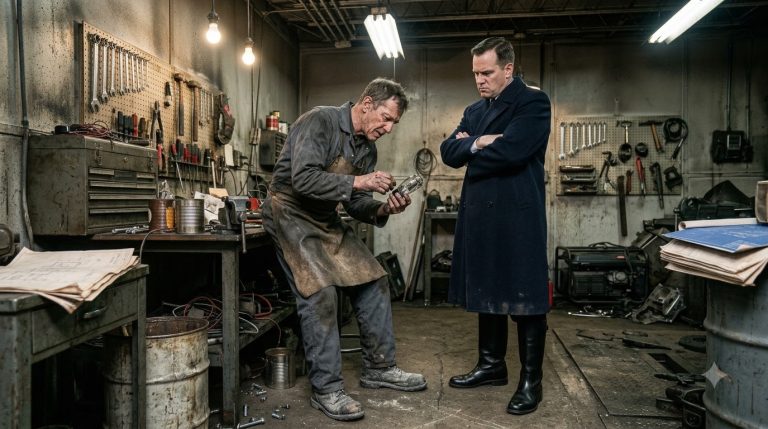
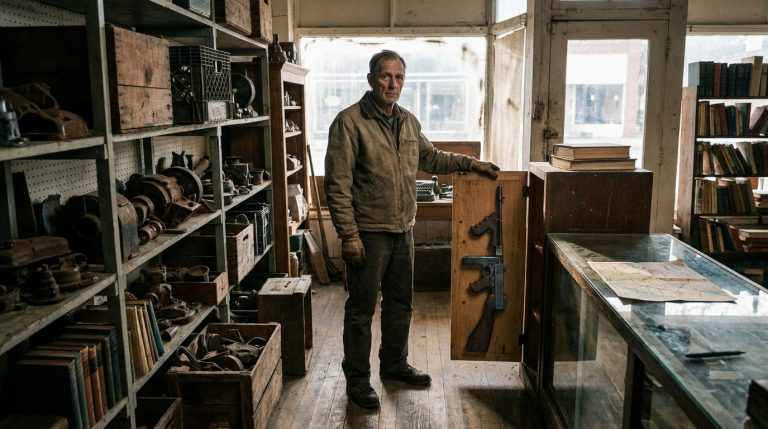
The shop was a graveyard of broken things, smelling of stale coffee and the sharp, biting tang of degreaser. Arthur Vance stood in the center of it, his frame stooped like an old oak caught in a winter gale. He kept his hands in his pockets, but his fingers were active, tracing the scarred, calloused skin of his palms.
“Forty-ton paperweight,” the mechanic repeated, his voice echoing off the corrugated tin walls. He tossed the oily rag onto a workbench, the fabric hitting the surface with a wet, heavy thud. “You’re throwing good money after bad, Mr. Vance. It’s seized. You’d need an act of God and a miracle of metallurgy to get those pistons moving again.”
Arthur remained still. He didn’t blink. He felt the cold radiation of the olive-drab metal against his back—a familiar, grounding hum that seemed to bypass his skin and vibrate directly into his marrow. The young man’s cynicism didn’t scratch him; it just slid off, like rain on a waxed hood.
“I don’t need a miracle,” Arthur said, his voice a low, gravelly rasp that sounded like stone grinding against stone. “I need the intake valve cleaned with kerosene, and I need the oil lines flushed with a solvent you probably don’t stock, boy.”
The mechanic smirked, sharing a look with his colleague—a younger, thinner boy with a smudge of grease across his forehead. “Listen, pops. We’re busy. We’ve got actual work to do. If you want a garden ornament, leave it on the lawn. If you want a machine, you’re in the wrong zip code.”
Arthur finally turned. His eyes were milky with age, but they possessed a terrifying, quiet focus. He walked toward the turret, ignoring the mechanic’s dismissal. He placed his hand on the faded white star. It was cold, yet it felt like a handshake.
He noticed it then—a small, hairline discrepancy near the fuel cap. A seal that shouldn’t have been there, a patch of paint that didn’t match the weathering of the rest of the chassis. A secret hidden in plain sight.
The mechanic took a step forward, his brow furrowing as he noticed Arthur’s intense observation. “Hey, don’t touch that—”
“You call it a paperweight,” Arthur whispered, his voice trembling not with age, but with a sudden, sharp clarity of purpose. “But you didn’t see what was inside it when the world went dark. You see a machine. I see a vault.”
The shop fell into a heavy, suffocating silence. Arthur reached into his coat and pulled out a small, tarnished brass key that had been tucked away in a velvet pouch for forty years. As he slid it into the hidden aperture he had discovered, a mechanical click echoed through the shop—a sound not of rust, but of a latch yielding to its master.
The mechanic froze, his smug expression replaced by a sudden, jagged uncertainty. The engine didn’t roar, but the metal beneath Arthur’s hand shuddered, and from deep within the belly of the beast, there came a soft, rhythmic thrum—the sound of a clock that had been waiting, patiently, for the right moment to start again.
CHAPTER 2: The Midnight Return
The hum in the metal was rhythmic. It wasn’t the erratic stutter of a failing engine, but a steady, insistent pulse that vibrated through the callus of Arthur’s thumb and up into his wrist. It felt like a heartbeat. He held his breath, fearing that if he exhaled, the spell would break, and he would be left standing in a greasy shop with nothing but a pile of junk and two skeptical eyes burning holes into his back.
“What did you do?” the mechanic asked, his voice tighter now, the smirk replaced by a sudden, jagged line of confusion. He had moved closer, drawn by the impossible sound.
Arthur didn’t pull his hand away. He felt the cold iron of the turret casing begin to soften beneath his touch. It was a trick of the mind, he knew—a phantom sensation born of too many years spent staring at photographs of a world that no longer existed. He was a man out of time, clinging to the architecture of a ghost. The machine was cold, dead, and heavy, yet for the span of three heartbeats, he felt the familiar, oil-slicked warmth of a tank interior in the rain.
“I didn’t do anything,” Arthur murmured, his focus entirely on the hidden aperture. The key was still seated in the lock, a small, stubborn piece of brass that refused to yield to the decades of decay. “It was already here. You just didn’t know where to look.”
The mechanic reached out, his hand hovering near the turret. “That’s an impossible mechanism. That chassis is sealed from the inside. There shouldn’t be a lock there.”
“There is,” Arthur said, shifting his weight. His knees creaked—a dry, brittle sound that seemed to mock his posture. “And there are things inside that aren’t meant for a shop floor.”
He felt a sudden, sharp spike of paranoia. The boy’s presence was a jagged edge in his sanctuary. Arthur pulled the key, the metallic click reverberating like a gunshot in the cramped space. The thrumming stopped instantly, leaving the silence of the shop feeling even heavier, almost oppressive. He turned to face the mechanic, his eyes narrowing. In the flickering fluorescent light, the boy looked younger, more vulnerable, yet Arthur saw him as a threat—an agent of the present trying to disassemble his past.
“Get out,” Arthur said, the command coming out with a sudden, icy authority.
“What? Look, man, you can’t just—”
“I said get out.” Arthur’s hand didn’t move from the turret, but he blocked the mechanic’s path with a physical rigidity that stopped the younger man in his tracks. “Close the shop. Lock the front bay. And don’t come back until the sun is up.”
The mechanic hesitated, his gaze darting between the impenetrable mass of the machine and the old man’s unnervingly still face. There was a power in Arthur’s stance—not physical strength, but the weight of someone who had nothing left to lose and was perfectly comfortable with that fact. He muttered something about store policies and liability, but he didn’t argue. He turned and walked toward the front of the shop, the rhythmic clack-clack of his boots against the concrete sounding like a countdown.
Arthur listened until the heavy metal door groaned shut and the sound of the locks sliding home echoed through the gloom. He was alone.
He looked back at the machine. The space where he had inserted the key was now indistinguishable from the rest of the rusted plating. He traced the area with his fingertips, searching for the seam. His breathing was shallow. He felt like an intruder in his own life, a man scavenging through the wreckage of his own history.
He didn’t just want to fix the engine. He wanted to feel the vibration one more time, to sit in the cramped, oil-scented dark and remember what it felt like to be part of something that moved forward, regardless of the cost. He pressed his forehead against the cold, peeling paint of the turret.
Just one more time, he thought, the words a silent plea to the steel.
He felt a slight shift—a tiny, imperceptible movement behind the plating. A scrap of paper, caught in a hinge, fluttered down and settled onto the concrete floor. Arthur knelt, his joints protesting the movement. He reached out to pick up the item, his heart drumming against his ribs. It wasn’t just paper. It was a photograph, edge-worn and yellowed, depicting a group of men smiling in front of this very machine. They were young, their eyes bright with a certainty that Arthur had lost a lifetime ago.
He turned the photo over. In faded ink, a name was written: Arthur, 1944.
He stared at the face of the young man he once was. He looked so whole, so unburdened by the weight of the years. A wave of vertigo hit him, the shop swirling around his head like debris in a storm. He felt the cold iron of the machine beneath his palm, then the warmth of the sun in a field he hadn’t thought of in decades. The distinction between the present and the memory blurred, and for a moment, he wasn’t sure if he was the man standing in the shop or the boy smiling in the photo.
He clutched the photograph to his chest, the edges biting into his skin. He needed to get the machine moving, but as he stood up, he realized with a sinking heart that the key was gone. He searched his pockets, his movements becoming frantic, his breath hitching. The brass key was nowhere to be found.
He looked back at the turret, a cold realization settling over him. It hadn’t fallen out. It had been pulled back inside.
CHAPTER 3: The Secret Compartment Revealed
The dark interior of the turret didn’t swallow the light; it seemed to consume the very air around it. Arthur stood paralyzed, his palm still pressed against the cold steel, waiting for a sound—a click, a slide, a protest of metal—that never came. The key had not merely been pulled back inside; it had been integrated. He could feel the faint, high-frequency vibration of the locking mechanism re-engaging, a series of pins dropping into place with the surgical precision of a safe.
His fingers clawed at the seam, the metal edge sharp enough to catch on his calloused skin. He wasn’t a young man, and the kneeling position on the concrete floor sent needles of pain shooting through his patellas, but he didn’t move. He traced the circumference of the hidden aperture. It was smooth now, seamless. The repair job, done decades ago, had been far more sophisticated than he remembered. He had been a younger, more frantic man back then, hiding his burdens in pieces, but he had done his work well. Too well.
He shifted his weight, his coat brushing against the chassis. The smell of the shop—a mix of stale grease, rubber, and the metallic tang of unspent potential—was nauseatingly familiar. He closed his eyes, forcing his breathing to slow. Panic was a luxury he couldn’t afford.
“Not gone,” he whispered to the steel. “Just waiting.”
He stood up, his bones protesting the shift, and walked toward the small, cluttered workbench where the mechanic kept a selection of hand tools. He didn’t reach for the heavy-duty wrenches or the power drills; he knew those would only scar the exterior of the machine, leaving marks that would scream of intrusion. Instead, he selected a thin, dental-style pick and a small magnet mounted on a telescopic rod.
As he returned to the turret, the shop felt colder. The moonlight filtering through the high, grimy windows cast long, skeletal shadows across the floor, making the massive silhouette of the machine appear to loom over him. He felt the weight of the photograph in his pocket, a paper anchor tethering him to a time when his hands didn’t shake and his pulse wasn’t a warning.
He began the delicate process of probing the seam. He knew this machine’s anatomy as well as he knew his own. He knew that behind the steel plating, there was a secondary release—a manual lever that should have been accessible from the interior had the turret not been welded shut. But there was a trick to it, a quirk of the locking mechanism that relied on a specific pressure point.
The pick slid into the seam, its metal tip clicking against something solid. Not steel. Brass.
His heart hammered a frantic, uneven rhythm. He pushed the magnet into the gap, maneuvering it with the patience of a man defusing a bomb. He wasn’t just looking for the key; he was looking for the truth he had buried. The decoy secrets he had planted years ago—the service records, the military citations—those were merely the shroud. Beneath them lay the real cargo: the letters, the names, the evidence of a life that had been systematically erased by the changing tides of history.
He heard a faint tink as the magnet caught the head of the key.
Slowly, carefully, he drew it out. The metal was cool to the touch, and it brought with it the faint scent of ozone. He held it up to the sliver of moonlight. It was perfectly clean, as if it had been polished by the friction of the lock itself.
He moved to the pressure point he had identified. He inserted the key, but he didn’t turn it. He pushed inward, applying a steady, calculated pressure while using the pick to nudge the hidden internal lever.
The machine groaned. It was a deep, resonant sound—a slow, tectonic shift of heavy steel plates sliding against one another. Dust, settled for forty years, puffed out from the seam, coating Arthur’s face and clothes in a fine, gray shroud. He didn’t cough. He didn’t flinch.
The panel finally swung open, not outward, but sliding downward into the chassis. It revealed a small, recessed cavity.
Inside, protected by a moisture-wicking synthetic wrap, sat a bundle. Arthur reached out, his hands trembling violently now, and pulled it free. The bundle was heavy, dense with the weight of paper and history. He set it on the floor and slowly unfolded the wrapping.
Inside were the letters. Dozens of them. And beneath them, a series of photographs and a small, leather-bound logbook.
He didn’t open the logbook yet. He looked at the top letter. The handwriting was unmistakable, a fluid, elegant script that belonged to a woman who had died before the war had even reached its zenith. He touched the ink, and for the first time in his life, Arthur Vance felt the true, crushing gravity of his mission. He wasn’t here to fix a machine. He was here to reclaim the only part of his soul he hadn’t left on the battlefield.
But as he looked down at the bundle, he saw something else—a small, dark object wedged at the very back of the compartment. It was a digital recording device, its LED indicator blinking a faint, rhythmic red in the darkness.
Someone had been here. Someone had known.
CHAPTER 4: A Ghost from the Archives
Arthur stared at the device. It was small, sleek, and entirely out of place against the grease-stained, iron-hard interior of the tank. The red LED blinked with a predatory regularity, a silent heartbeat in the throat of his sanctuary. He didn’t reach for it. He couldn’t. His hands, usually so steady when working with the fine mechanics of the engine, were now braced against the turret floor, his knuckles white.
A memory surfaced, unbidden and sharp—the feeling of cold rain on his neck, the sound of a radio transmission that had gone silent at the exact wrong moment forty years ago. He had always blamed the equipment. He had always blamed the friction of the world. Seeing this device, he felt the sickening, chilling realization that his past had not been lost to the fog of time; it had been curated.
The silence of the shop, once a comforting blanket of dust and history, now felt like a vacuum. Every shadow stretching across the concrete floor seemed to have an observer behind it. He realized then that the mechanic hadn’t just been dismissing him; the boy—or perhaps those who kept the shop—had been waiting for someone to try and open this specific chassis.
Arthur’s gaze drifted back to the bundle of letters. He moved with a glacial, deliberate grace, scooping up the bundle and tucking it into the inner pocket of his coat. He left the device where it was. To touch it might trigger something, a notification, a trace, or perhaps a localized wipe of the data inside. He didn’t know the current state of such technology, but he knew the nature of surveillance: it was a closed loop, and he had just stepped inside it.
He retreated from the chassis, backing away until his shoulders hit the cold, unyielding wall of the shop. He needed to get out, but the heavy steel door he had ordered the mechanic to lock now looked like an iron curtain. He hadn’t just locked the mechanic out; he had locked himself in.
He moved to the workbench, his eyes scanning the clutter for a way to override the bay doors without triggering the shop’s internal alarm system. He found a set of jumper cables and a heavy-duty screwdriver. His mind, usually slow to anger, was now sharpened by a cold, pragmatic clarity. If they were watching, he would give them a show that led nowhere.
He began to dismantle the shop’s own backup power junction. It was an old setup, pre-dating the digital era, something that ran on raw current and exposed wiring. He worked with the practiced ease of a man who had spent his life repairing machines that were never meant to be opened. He wasn’t looking for a weapon; he was looking for a distraction.
As he stripped the insulation from a pair of cables, a sound drifted from the rafters above—a soft, metallic click, followed by the faint hum of a cooling fan. His eyes snapped upward. A camera, cleverly disguised behind a rusted ventilation grate, was tracking his movement, its tiny lens reflecting the shop’s dim, amber safety light.
Arthur didn’t panic. He looked directly at the lens. He didn’t reveal fear, nor did he reveal the letters burning a hole in his chest. He reached into his pocket and pulled out the photograph of his younger self. He held it up, letting the camera focus on the faces of the men who had died, the men who had been forgotten, and the man who was currently holding their legacy.
He then took the screwdriver and jammed it into the junction box, twisting the wires together. The resulting spark was blinding, a brilliant, violet flash that hissed with the sound of frying circuits. The shop’s overhead lights flickered once, twice, and then died completely, plunging the space into absolute, suffocating darkness.
In the sudden absence of sight, his other senses sharpened. The smell of burning plastic was thick, acrid. The hum of the cooling fan above stopped. He moved—not toward the door, but deeper into the shadows of the machinery, toward the back corner where the floor met the foundation. He knew this building; he had helped pour the concrete here decades ago. There was a drainage grate, a narrow passage that led to the alleyway, long since covered by shifting earth and forgotten debris.
He crawled, his knees scraping against the rough, freezing concrete. He could hear voices now, faint and frantic, coming from the other side of the heavy bay door. The mechanic was back, and he wasn’t alone.
“The power’s out!” a voice shouted—not the mechanic’s, but something colder, more professional. “Seal the perimeter. He’s still inside.”
Arthur reached the corner. He found the loose edge of the drainage cover and pulled. It was heavy, but the adrenaline singing through his veins gave him a fleeting, impossible strength. He pried it open just enough to see the sliver of a gray, rain-slicked alleyway.
He didn’t look back at the tank. He didn’t look back at the device he had left blinking in the dark. He slipped into the narrow, damp tunnel, leaving the shop—and his anonymity—behind him, knowing that the chase had not only begun; it had been waiting for him all along.
CHAPTER 5: The Fragile Bargain
The tunnel, a narrow throat of damp earth and shattered bricks, shuddered. Arthur clawed at the wet dirt, his fingernails digging into the roots that dangled from the ceiling like skeletal fingers. He had barely cleared the grate when a groan of shifting foundation echoed through the alleyway. The drain, weakened by the rain and the sudden pressure of the shifting soil, buckled. A cascade of earth and broken asphalt slammed down, sealing the opening with a final, grinding thud.
Arthur lay flat in the cramped, airless dark, his chest heaving. The weight of the world felt literally present now, a crushing pressure against the small of his back. The bundle of letters in his inner pocket felt like a cold stone against his ribs, yet it was the only thing that kept him anchored.
He couldn’t go back. The mechanic and his shadow-handlers were likely already at the grate, listening to the silence of the shop. He had to go forward. He pressed his palms against the damp floor, the grit of the earth biting into his skin, and began to crawl. This wasn’t the way out he had planned. The drainage system should have led to the street-side storm pipe, but this section of the foundation—the part he remembered from forty years ago—had been blocked off during the shop’s renovation.
He hit a wall of corrugated metal: a ventilation duct. He pushed it, expecting it to be riveted shut, but it gave way with a screech of rusted hinges. Arthur tumbled forward, landing in a pile of discarded industrial filters. He was in the basement.
The air here was different—stale, dry, and heavy with the scent of ozone and something sharper, like ammonia. He stood up, his knees popping, and surveyed his surroundings. This wasn’t just a storage area for spare parts. The room was lined with banks of humming server racks, their cooling fans singing a low, constant, discordant melody. Wires ran across the floor in thick, tangled veins, feeding into the ceiling.
This was the source of the surveillance. This was the heart of the machine’s security.
Arthur moved through the aisles, his footsteps muffled by the thick layer of dust. He needed to get to the street-level access point, but as he navigated the rows of blinking lights, he stopped. On a central terminal, a screen was active. It displayed a high-definition feed of the shop floor above, showing the mechanic and two men in dark, tactical coats standing by the massive olive-drab tank.
One of the men touched the turret, the same spot Arthur had touched hours earlier.
“The signature was definitely here,” the man said, his voice coming through the terminal’s speakers, thin and tinny. “He opened the internal cavity. Whatever was inside—that was the primary objective.”
“He couldn’t have gotten it out,” the mechanic replied, his voice shaking. “I heard the alarm. He didn’t come through the front door.”
“Then he’s still here,” the man said, his eyes scanning the room as if he could see through the camera lens and directly into the basement. “Check the lower-level ventilation. He knows these walls better than we do.”
Arthur felt a chill that had nothing to do with the dampness of the tunnel. He wasn’t just being hunted; he was being assessed by people who knew he was a remnant of a past they were actively scrubbing away. He looked at the terminal. He saw a digital map of the shop’s layout—the sensors, the hidden cameras, the thermal alarms. It was a grid, and he was a blinking icon caught in its center.
He reached out, his hand hovering over the terminal’s interface. He could wipe it. He could trigger a surge, a feedback loop that would blind them, but it would also alert them to his exact position.
He didn’t wipe it. Instead, he pulled a small, silver pen from his pocket—a simple tool he used for labeling parts—and tapped the keyboard. He wasn’t a master of digital systems, but he knew the logic of flows, of inputs and outputs. He began to feed the system a false signal, a phantom loop of movement in the shop’s attic that would draw their focus away from the basement.
The screen flickered. The camera view in the shop jumped, showing a blurry, motion-activated shadow in the rafters. The men in the shop turned, their weapons drawn, and sprinted toward the stairs leading to the attic.
Arthur didn’t wait. He turned and ran toward the service elevator. He was breathing hard, the exertion burning in his lungs, but he felt a strange, grim smile pulling at the corners of his mouth. They were playing by the rules of the present, but he was playing by the laws of the past—and in the past, survival was about knowing exactly when to disappear.
As the service elevator doors began to slide shut, he saw the mechanic turn, his face pale with realization, and lock eyes with him through the narrowing gap. There was no hatred in the boy’s eyes, only a profound, hollow fear. Arthur didn’t blink. He watched the elevator ascend, the hum of the pulleys vibrating through the soles of his feet, taking him upward toward the street, toward the rain, and toward the final, heavy truth he had come to claim.
CHAPTER 6: The Unspoken Understanding
The elevator groaned, a mechanical protest of rusted cables and strained gears. Arthur stood in the center of the cramped car, his eyes fixed on the floor indicator as the numbers ticked upward. Each movement was a calculated risk. The bundle of letters against his chest felt impossibly heavy, the paper edges sharp against his ribs, a physical manifestation of the decades of weight he had been carrying.
When the doors slid open, they didn’t reveal the bustling, rain-slicked street he had envisioned. Instead, they opened into the narrow, claustrophobic service hallway of the shop’s upper level. The air here was bitter with the smell of wet wool and diesel.
The mechanic was there. He wasn’t holding a weapon, but his face was white, his eyes darting toward the stairwell behind him. He stood before the open doors, blocking the path, his hands trembling as he gripped the frame.
“You can’t go out that way,” the boy whispered. His voice lacked the dismissive, cynical edge from earlier; it was fragile, fractured. “They’re at the perimeter. They’ve already blocked the back alley. If you step out of this building, you’re not just a target—you’re a liability.”
Arthur didn’t move. He held the mechanic’s gaze, looking past the fear to the underlying conflict. The boy wasn’t a guard; he was a gatekeeper who had realized, too late, that the thing he was guarding was human.
“Who are they?” Arthur asked. His voice was a calm, steady counterpoint to the chaotic thrum of the building’s security systems, which he could hear shifting behind the walls—a rhythmic, digital hunting pattern.
The mechanic looked over his shoulder, then back to Arthur. “They aren’t just owners, Mr. Vance. They’re curators. They don’t want the machine, and they don’t want the history. They want the silence. They’ve been buying up these properties for years, gutting them, digitizing the records, and then erasing the physical evidence. The tank… it was the last piece of ‘noise’ in their system.”
Arthur felt the cold truth settle in his stomach. The decoy secret—the letters, the photographs—wasn’t just a cache of memory. To these people, it was a data breach. A glitch in their sanitized version of history.
“They’re coming up,” the boy hissed. The distant sound of heavy, rhythmic footsteps echoed from the floor below, vibrating through the metal floor of the elevator. “I can’t help you, but I can’t let them kill you either. Not like this.”
Arthur took a step forward, his boot clicking against the threshold. He looked at the boy, and for a fleeting second, he saw his own face—the face from the photograph—staring back at him, devoid of the world’s cynicism, filled with a terrifying, youthful naivety. “Then move,” Arthur said, his tone neither a request nor a demand; it was the quiet, immovable weight of a man who had already reached the end of his journey.
The mechanic hesitated, then stepped aside, his back pressing into the wall. “The loading dock,” he murmured. “There’s a delivery truck, keys inside. It’s the only way to break the perimeter without triggering the exit sensors.”
Arthur stepped past him, his shoulder brushing the boy’s coat. The tactile contact—the rough, cheap wool—felt grounding, a reminder of the living, breathing world he was still a part of. He walked toward the loading dock, his movements slow and deliberate. He didn’t run. He didn’t look back. He maintained the rhythm of a man who knew exactly where he was going.
He reached the heavy sliding door of the loading dock. Outside, he could hear the rain—a steady, rhythmic drumming against the metal roof. He could see the blurred shape of the truck through the cracked glass of the door. He reached for the latch, but before he could pull it, the overhead lights surged, flared bright white, and then went dead.
The shop was plunged into a strobe-like chaos as the emergency lighting activated, bathing everything in a harsh, pulsating red. A door at the far end of the hallway burst open, and two figures in dark, tactical coats stepped in, their silhouettes cutting through the red haze. They didn’t shout. They didn’t demand he stop. They moved with the silent, terrifying efficiency of professionals.
Arthur didn’t panic. He looked at the latch, then at the two men, then back at the door he had just passed through. He realized he couldn’t reach the truck. The perimeter was tight, and the “curators” were already inside the wire.
He turned toward the heavy industrial machinery stacked near the loading dock—a wall of old, discarded welding units and heavy steel plates. He didn’t seek cover; he sought a pivot. He gripped the nearest unit—a rusted, heavy-duty cutter—and shoved it, not to hide, but to create a barrier, a physical obstruction that would force them to slow down, to consider, to hesitate.
The first man raised a hand, a non-verbal signal for the other to flank. Arthur pulled the bundle of letters from his coat. He looked at them one last time—the physical, tactile proof of his existence—and then looked at the men, his eyes hardening into the cold, sharp gaze of a soldier. He wasn’t going to surrender the truth. He was going to ensure that even if they reached him, they would find nothing but the dust he had fought so hard to keep alive.
CHAPTER 7: The Final Ignition
The red light pulsed like a dying heart, bathing the loading dock in a rhythmic, bloody hue. Arthur stood behind the wall of industrial scrap, his breathing ragged. The men in tactical coats moved with a terrifying economy of motion, their boots silent on the concrete as they tightened their formation. They weren’t looking for a fight; they were looking for an extraction.
Arthur’s hands trembled as he gripped the heavy steel plate of the welding unit. He wasn’t thinking about the letters anymore—or rather, the letters were the only thing he was thinking about, a singular, focused point of existence against the encroaching dark. If they got their hands on that bundle, they would erase the final evidence of the men who had stood beside him. They would turn his memory into a file, and his life into a footnote.
He didn’t wait for them to close the distance. He shoved the steel plate forward with every ounce of remaining strength. It crashed into the metal shelving unit with a sound like a lightning strike, sending a cascade of rusted parts and heavy iron tools clattering across the floor. The distraction was chaotic, unpredictable. The tactical team hesitated, their flashlights darting through the dust-filled air.
That split-second of hesitation was all he needed. Arthur scrambled around the edge of the machinery, his boots sliding on the slick concrete. He ignored the pain in his knees, the burning fire in his lungs. He reached the heavy bay door’s manual release lever, but as his fingers curled around the cold, iron handle, a sharp, stinging sensation bloomed in his shoulder.
He didn’t hear a gunshot—only the soft, pneumatic thwip of a tranquilizer dart hitting his coat.
He fell, his weight hitting the ground with a soft thud. The red light seemed to lengthen, stretching into long, agonizing ribbons of crimson that danced across the ceiling. He felt the cold concrete against his cheek, the smell of damp oil and stale ozone rising up to meet him. He tried to move, but his limbs were heavy, as if the air had turned to liquid lead.
The tactical team walked toward him. He watched them through eyes that refused to focus, their boots looking like mountains against the horizon of his darkening field of vision. One of them reached down, his gloved fingers finding the bulge of the letters in Arthur’s coat.
“Target secured,” the man said, his voice sounding like it was coming from the bottom of a deep well. “Collect the material. We’re scrubbing the site.”
Arthur fought the fog, the encroaching, blissful numbness. He needed to move. He needed to finish what he had started. He reached out, his fingers brushing the cold, unyielding surface of the tank nearby. He found the hidden seam, the place where the mechanism was still warm from his earlier touch.
Ignition, he thought.
He hadn’t just been hiding the letters. He had been working on the fuel lines since the moment he arrived. He had bypassed the rusted valves, feeding the engine a direct, concentrated dose of the high-octane solvent he had hidden in his tool kit. He didn’t need the whole machine to run. He only needed the starter motor to kick over—once.
With his last shred of consciousness, Arthur pressed his thumb into the hidden pressure point one final time.
The tank shuddered—not the soft, mechanical hum from before, but a violent, earth-shaking rumble. The ignition fired, a deep, primal roar that blew the remaining dust off the engine block and sent the tactical team staggering back, their balance lost in the sudden, rhythmic thundering of the engine. The tank didn’t move forward, but the vibration was so intense it shattered the shop’s remaining windows, sending shards of glass flying like diamonds through the red, pulsing light.
The engine was screaming now, a metallic, high-pitched howl as it devoured the fuel. The heat radiating from the chassis was blistering, enough to singe the eyebrows of anyone standing within five feet.
Arthur felt the world tilt, the sound of the engine becoming the only thing that existed. He felt a hand grip his collar, but he didn’t care. He had made his mark. He had proven, one last time, that the past wasn’t something to be deleted—it was something that could still shake the foundation of their perfect, quiet, curated world.
He closed his eyes, the smell of burnt oil and old, cold iron filling his nose, and for the first time in forty years, he felt a profound, absolute sense of peace. The machine was roaring. The secret was echoing. And he was finally, quietly, going home.
CHAPTER 8: Echoes in the Oil and Dust
The shop was a landscape of frozen motion. The tactical team, caught in the sudden, violent vibration of the tank’s starter motor, had been thrown into disarray, their cohesion shattered by the sheer, mechanical fury of a machine that should have remained dead. Dust billowed, thick and choking, filling the air with the particulate history of forty years.
Arthur lay against the floor, his vision sharpening. The numbness was receding, replaced by a dull, aching clarity. He watched as the team leader, the man who had laid hands on the letters, stumbled back, his tactical visor cracked by a flying shard of glass. He was disoriented, his professional composure stripped away by the reality of a machine that refused to be managed, to be categorized, or to be silenced.
The engine reached a fever pitch, then settled into a low, rumbling idle that vibrated through the very foundation of the building. It was a sound that didn’t belong in a modern, curated facility. It was an anomaly. A ghost.
The team leader looked at the tank, then at Arthur. He saw the old man on the floor, his fingers still curved around the tank’s chassis. He raised his sidearm, but his hand shook—the vibration of the floor was too much, the sheer physical presence of the machine too imposing. He wasn’t fighting a man; he was fighting an era that had decided not to end.
“Shut it down!” the leader shouted to his partner, but the partner was already backing toward the exit, his eyes fixed on the tank’s turret, which was slowly, creakily rotating—a phantom movement, driven by the pressure of the engine’s exhaust.
Arthur watched them go. He didn’t need to do anything else. The machine was doing the work for him. It was a force of nature, a weight of steel and history that made their high-tech gear and corporate mandates look like toys. They didn’t understand the physics of it. They didn’t understand that some things, when properly built, could never truly be erased. They left, not out of tactical failure, but out of a sudden, deep-seated realization that they were out of their depth.
Once the heavy bay door groaned shut, the shop returned to a heavy, resonant silence, punctuated only by the rhythmic thumping of the engine.
Arthur pulled himself up, using the tank’s tread as a ladder. He sat on the back deck of the machine, his back against the turret. He reached into his coat and pulled out the bundle of letters. He opened the logbook. The final entry wasn’t a record of war; it was a list of names—the men who had served with him, the men he had kept in his heart for decades.
He looked at the machine. It had served its purpose. It had been his witness, his vault, and ultimately, his final act of defiance. He had reclaimed the memory, and in doing so, he had found the peace he had been denied for a lifetime. The letters weren’t just archives; they were a conversation that he was finally, truly, finishing.
He reached out and took a small, silver wrench from the deck—a tool he had left here years ago, the one that had been damaged during the original sealing of the tank. With slow, rhythmic movements, he began to tighten a loose bolt on the engine casing, a small, mechanical reconciliation that felt like closing a circle. He was repairing the damage, not for the sake of the machine, but for the sake of the moment.
The mechanic—the boy—stepped cautiously from the stairwell. He saw Arthur sitting there, surrounded by the haze of dust and the soft, orange glow of the tank’s remaining fuel light. He didn’t approach; he simply watched, his expression one of profound, quiet awe. He had seen the “paperweight” roar, and he had seen the man who made it happen.
Arthur didn’t look up, but he felt the boy’s presence. He finished the turn, the wrench clicking into place. He leaned back, his head resting against the cold, familiar steel. The roar of the engine was fading now, the fuel lines finally running dry, but the echo remained—a deep, persistent hum in the marrow of his bones.
“It’s not just a machine, is it?” the boy asked, his voice barely a whisper.
Arthur closed his eyes. The scent of ozone and old, cold oil was everywhere, a perfume of memory. He felt a soft, warm breeze through the broken windows, and in the distance, the sound of the rain was changing, becoming less like a warning and more like a lullaby.
“No,” Arthur replied, his voice soft, unburdened. “It’s a reflection.”
He sat there as the engine gave one final, shuddering gasp and died. The shop was silent again, but it was a different kind of silence—a peace that filled the room like light. He held the letters, the logbook, and the memory of the men who had been with him at the beginning, and for the first time in his life, Arthur Vance didn’t feel like a ghost in a machine. He felt like a man who had finally, honestly, arrived.