The Dusty Garage Workshop Where A Band Of Farm Boys Built The War-Winning Impossible Radio Fuse
CHAPTER 1: THE BROKEN PRAIRIE BLUEPRINT
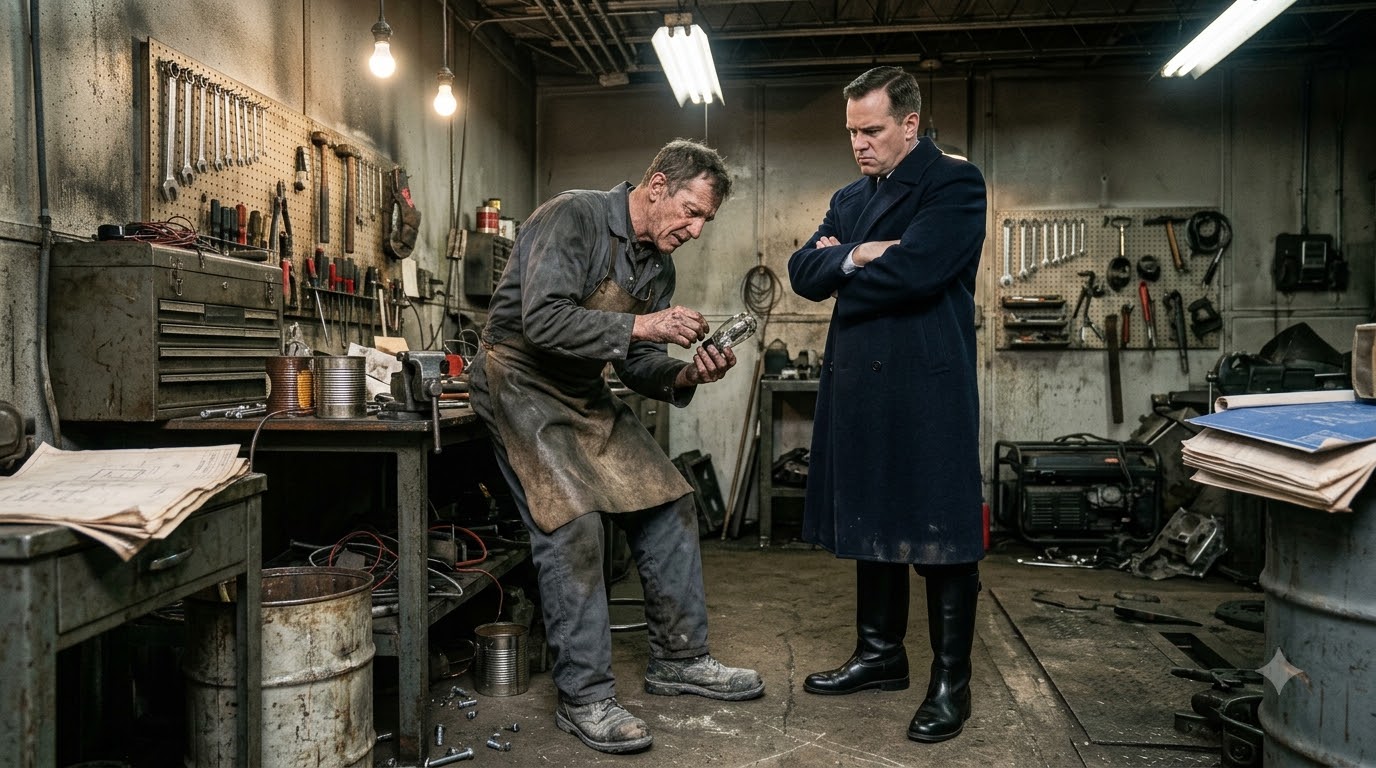
The metal surface of the workbench was scarred by decades of discarded tools and dried grease.
Merl Tuve rolled a scarred steel bolt between his thumb and forefinger, feeling the cold weight of it.
Across the room, Dick Roberts dropped a handful of exhausted dry cells into a rusted bin with a dull clatter.
The air smelled of stale coffee, machine oil, and damp wool.
Outside the heavy wooden doors, the routine of wartime Washington carried on with comfortable bureaucratic blindness.
The admirals in their polished shoes had already declared the problem officially unsolvable.
They wanted time fuses calculated by human hands that missed their mark by a hundred yards.
Merl wiped a smudge of soot from his forehead with the back of a cracked hand.
He didn’t care about military titles or theoretical perfection.
He cared about the raw, stubborn physics of a five-inch artillery shell spinning at thirty thousand revolutions per minute.
“They say the glass will turn to powder before it clears the barrel,” Dick muttered, wiping his glasses on a greasy rag.
“They haven’t dropped enough tubes yet,” Merl said, his voice flat and steady.
He picked up a fragile glass vacuum tube no larger than a pencil eraser.
It looked hopelessly delicate against the harsh glare of the overhead incandescent bulb.
He didn’t offer a soaring speech or a heroic promise.
He simply placed the tiny tube squarely in the center of a heavy steel plate on the concrete floor.
CHAPTER 2: DROPPING TUBES ONTO STEEL
The shockwave of the drop rattled up through the cold concrete apron and into Merl’s wrists.
Dick squinted down at the tiny cylinder resting in the dust.
The filament inside was a microscopic thread of tungsten, suspended in a vacuum no thicker than an eyelash.
If the internal grid shifted even a hair’s breadth under impact, the test was a failure.
“Still in one piece,” Dick murmured, using the tip of a pencil to nudge the glass.
Merl bent down, his knees popping in the damp air, and picked up the tiny piece of hardware.
He held it to his eye, turning it against the gray light filtering through the garage windows.
There was no magical formula here, only the brute physics of twenty thousand Gs waiting to smash it into dust.
A faint scuff of gravel outside the heavy wooden doors interrupted the silence.
Captain Hoover’s polished boots stopped just short of the threshold, tracking mud onto the clean sweep of the floor.
“The Bureau wants a progress report, Tuve,” Hoover said, his arms crossed over a wool overcoat. “Not broken glass.”
Merl set the tiny tube down on the scarred wood with deliberate slowness.
“The glass only breaks if you design it for a drawing room, Captain,” Merl said, his voice flat. “This isn’t a drawing room.”
Hoover stared at the crude testing setup on the floor, his jaw tightening against the civilian’s stubborn tone.
“The brass still maintains an artillery shell cannot carry delicate electronics through thirty thousand RPM without turning to ash.”
“Then the brass hasn’t seen what a hearing aid manufacturer in Chicago can do when you pack the tubes in wax,” Merl replied, picking up a second glass cylinder.
He didn’t wait for an answer, turning back to the heavy steel plate with the tube poised between his thumb and forefinger.
CHAPTER 3: THE VIRGINIA FARM TEST
The cold wind cut across the seventy-four-acre Virginia pasture, carrying the dry smell of frosted grass and burnt gunpowder.
Dick hauled the iron leg of the modified howitzer back an inch, locking the rusted mount into the frozen mud.
Around them, researchers stood in pairs, holding wide wooden observation panels directly overhead.
The logic was as crude as the equipment: shoot the experimental rounds straight up and let gravity handle the descent.
“If the seal fails on the ascent, the pressure differential will blow the filament to atoms before it even peaks,” Dick said, his breath pluming white in the crisp air.
Merl didn’t answer, wiping a smear of dark oil from his cheek with the back of his sleeve.
He checked the firing lanyard looped over his thumb, his gaze fixed on the low-hanging gray clouds overhead.
The military bureaucrats back in Washington were sitting in heated offices, waiting for failure reports to justify their skepticism.
A distant engine whined along the boundary road, signaling the arrival of an unannounced inspection car from the ordnance board.
Captain Hoover stepped out of the vehicle, his boots crunching loudly over the frozen turf as he crossed the field.
“You are wasting ordinance and taxpayer funds firing blind into the clouds, Tuve,” Hoover shouted over the wind.
“We aren’t firing blind, Captain,” Merl said, his voice dropping into a flat, steady register. “We’re letting gravity check our math.”
Hoover pointed a gloved finger toward the open sky, his face hardening against the freezing draft.
“If those tubes come down intact, the board might listen. If they shatter, this entire site gets shut down by nightfall.”
Merl pulled the lanyard without a word, sending a one-pound test round howling straight into the gray expanse above.
CHAPTER 4: THE CHRISTMAS LIGHT SECRET
The frozen ground shuddered against their boots.
Captain Hoover flinched, stumbling backward into the icy rut of a tractor tire.
Merl and Dick didn’t flinch. They simply raised the thin wooden panels over their heads and stared at the empty clouds.
Fourteen seconds of heavy, agonizing silence ticked by.
The returning shell announced itself with a vicious shriek, slamming into the frosted mud thirty yards to their left with a dull, heavy thud.
Merl dropped his wooden board and crossed the field, ignoring Hoover’s pale face.
He dug the cold, mud-caked casing out of the dirt with a rusted crowbar and cracked the housing open on the bumper of their truck.
The wax-potted hearing aid tube sat inside the casing, perfectly intact.
The impossible barrier was broken—the tubes could survive the crushing gravity of a launch.
Hoover wiped his nose, his jaw set in a stubborn line as he refused to yield an inch of his bureaucratic leverage.
“A surviving tube is useless without a power source, Tuve,” Hoover snapped, pulling his collar up against the biting wind. “Standard dry batteries will be pulverized in the barrel, and a wet cell will leak acid into the circuitry before it even clears the muzzle. You’re at a dead end.”
The heavy metal doors of a converted Christmas ornament factory in Ohio slammed shut, locking out the winter wind.
Merl sat under a buzzing fluorescent bulb, rolling a tiny, fragile glass ampule between his calloused fingers.
The answer wasn’t to fight the crushing physics of the cannon; the answer was to use it.
Fill the glass ampule with liquid electrolyte and seal it inside the battery casing.
When the artillery shell fired, the violent twenty-thousand-G shockwave would shatter the glass, and the centrifugal spin of the bullet would force the acid outward into the battery plates.
The weapon wouldn’t just survive the violence of the launch—it required the violence to wake up.
Merl set the ampule down on a grease-stained schematic just as Dick walked up to the workbench, his face uncharacteristically pale.
Dick dropped a misrouted logistics manifest onto the table, tapping a wrinkled finger against a requisition order signed by top military brass.
“We have a problem,” Dick muttered, his voice barely rising over the hum of the factory machinery. “A big one.”
Merl pulled the paper closer, his eyes scanning the cold, typewritten ink authorizing priority funding for a laboratory at Harvard.
The project title was listed plainly: Salisbury Countermeasure – Proximity Jamming Field.
The top brass wasn’t just waiting around for Merl’s team to fail.
The admirals were so terrified of this new technology falling into enemy hands that they were secretly building a radio jammer to instantly neutralize it.
If the military had an easy way to defeat the fuse, they would permanently bury the project to avoid the risk, ensuring the weapon never saw the front lines.
CHAPTER 5: CHESAPEAKE BAY SHAKEDOWN
The salt spray whipped across the open deck, stinging Merl’s eyes as he watched the launch rail.
Dick stood beside him, clutching a clipboard with numb fingers while the naval crew muttered among themselves.
The battery technicians had never seen an unannounced trial conducted over open water without top-level admirals present.
Only four target drones sat on the catapults instead of the requested six.
The drone handlers crossed their arms, convinced the expensive gear was about to be blasted into scrap for nothing.
“Captain Parsons says the test starts now or not at all,” Dick said, his voice straining against the roar of the cruiser’s engines.
Merl didn’t look back at the bridge. He kept his eyes locked on the horizon where the first drone lifted off the rail.
The five-inch gun turret swung around with a deep, mechanical groan that vibrated right through the deck plates.
Eighty rounds were loaded into the hoist, each one packed with the fragile glass tubes they had baked and tested in a dirt-floor garage.
The first drone pitched sideways into the gray water, a mechanical failure before the guns even barked.
A murmur of cynical laughter rippled through the Navy gunners leaning against the bulkhead.
“Waste of good hardware,” muttered a senior gunner, spitting tobacco juice into the foam.
Merl ignored the noise, sliding his thumb over the edge of the manifest in his pocket to ground his focus.
The second drone climbed into the cloud cover at three thousand yards.
Lieutenant Deak Parsons raised his binoculars, his jaw clenched so tight the muscle twitched.
“Fire,” Parsons barked.
The five-inch battery let loose with a shockwave that rattled the teeth in Merl’s skull.
Three shells detonated three hundred feet off the drone’s right flank without a single direct impact.
The lethal shrapnel cloud tore through the target’s wings, turning the aircraft into a flaming spiral of debris.
The laughter on the deck died instantly, replaced by a stunned, heavy silence.
The third drone barely cleared the water before a high-altitude burst shredded its engine block into twisted metal.
The drone handler lunged forward, his face red with fury as he slammed his fist onto the railing.
—You just wrecked two of my targets! That cost a fortune!
“We aren’t here to save targets,” Merl said, his voice dropping into a cold, flat register. “We’re here to stop the blitz.”
CHAPTER 6: THE BULGE ARTILLERY STORM
The grey waters of the river rushed past the broken timbers of the bridge below.
Across the valley, enemy columns pushed frantically through the sleet, believing the bad weather shielded them from observation.
Colonel Axelson stood by the battery control post, his boots sinking into the freezing mud.
“The ordnance embargo is still holding in the rear, Tuve,” Axelson shouted over the howling gale, his breath frosting in the air. “We use these proximity rounds now, or we lose the ridge.”
Merl did not hesitate. He pulled the authorization manifest from his heavy wool pocket and dropped it into the wet mud.
“Fire on command,” Merl said.
The ninety-millimeter artillery pieces behind them let loose with a thunderous roar that shook the frost from the pine trees.
The shells screamed across the valley, detonating thirty feet above the riverbanks with blinding, silent efficiency.
There were no direct impacts, and no time calculations were wasted.
The air bursts rained a devastating pattern of metal shrapnel down upon the crossing enemy columns.
The opposing commanders screamed frantic orders into their field radios, trying to scatter troops that had nowhere to hide from the descending fire.
They had spent years claiming a radio fuse was an impossible dream under high gravity.
Now, their own unyielding arrogance and refusal to adapt collapsed entirely under the weight of common-sense engineering.
The enemy lines broke in panic, fleeing back into the freezing timber as the air bursts chased them step by step.
Merl wiped a layer of sleet from his brow, his gaze steady on the quiet horizon.
The war would end not with grand political speeches, but with the quiet, grueling work of ordinary men refusing to accept that something could not be done.
He turned back toward the workshop door behind the battery lines, leaving the mud and the noise behind.
He picked up a clean, empty glass tube from the wooden crate, turning it slowly between his fingers until the cold weight of it faded.