Thirty-Seven Years of Silence Ended with a Brass Pen and a Paper Trail
CHAPTER 1: THE WEIGHT OF THIRTYSEVEN YEARS
Seven hundred pages of client filings sat between my keyboard and the edge of the desk, and Tom didn’t even have the decency to look me in the eye when he dropped them.
The heavy manila folders hit the laminate surface with a dull, hollow thud that made my cold coffee slosh over the rim of my ceramic mug. Outside the third-floor window, the streetlights were just turning on, casting a grainy orange film over the rain-slicked glass.
“End of the month,” Tom said, his thumb flicking through the notification badges on his personal phone. He was thirty-seven, seven years younger than the time I’d spent inside this building, and his tie was loosened just enough to look like a man pretending to carry the company on his back. “Needs to be cleared before the morning ledger pull.”
I didn’t reach for the stack. I kept my right thumb rested against the worn barrel of my brass Parker pen, feeling the smooth notch where thirty-seven years of daily use had rubbed down the plating. “These are Emily’s quarterly declarations. The corporate tax returns for the Henderson Group were due on the fifteenth.”
“They’re yours now, Lily,” Emily’s voice chimed from the doorway, sharp and airy. She leaned against the doorframe, holding a fresh iced cup from the espresso bar down the street, her manicured nails tapping rhythmic clicks against the plastic lid. “Tom streamlined the department workflow this afternoon. Legacy staff handles high-volume filing so senior management can focus on client retention.”
“I handle forty-five active accounts,” I said softly, my voice barely carrying over the hum of the overhead fluorescent tubes. “You handle eight.”
Tom stepped closer, placing both palms flat on the corner of my desk. The smell of cheap aftershave and warm damp wool rolled off his suit jacket. “The new president is looking at payroll metrics at nine tomorrow morning. Anyone sitting on eighty hours of overtime this month is going to look like a drain on operating capital. You want to stay on the roster, Lily? You clean up the backlog. On regular hours.”
“You assigned this work two hours before the cutoff,” I said.
“Then I suggest you start typing faster,” Emily said, letting out a short, quiet laugh as she turned toward the elevators. “Some of us have dinner reservations.”
Tom didn’t offer a single word of clarification. He adjusted his cuff links, turned his back on my desk, and walked out behind her, the heavy glass doors of the tax department clicking shut behind them with a final, mechanical seal.
I sat alone in the quiet hum of the server racks. I picked up the top folder, opened the brass clip, and looked at the date stamp. Emily hadn’t touched the pages in three weeks.
I picked up the brass pen, clicked the top once, and wrote the current time on the top right margin of the first sheet.
CHAPTER 2: THE AMBUSH IN THE GLASS BOX
My right thumb pressed hard against the worn notch of the brass Parker pen, the ink tip resting on the top right margin of the Henderson file, right beneath the stamp that Emily had conveniently forgotten to sign.
The desk phone didn’t ring; it buzzed with a sharp, double-tone internal intercom ping that rattled the metal tray of paperclips beside my monitor.
“Lily. Executive suite. Now.”
The line clicked dead before I could pull my thumb off the brass casing. The president’s secretary didn’t give details, but she didn’t have to; the low, humming quiet of the empty floor behind me said enough.
I stood up, slid the brass pen into my sweater pocket, and left the seven hundred pages sitting under the dead fluorescent light of my desk.
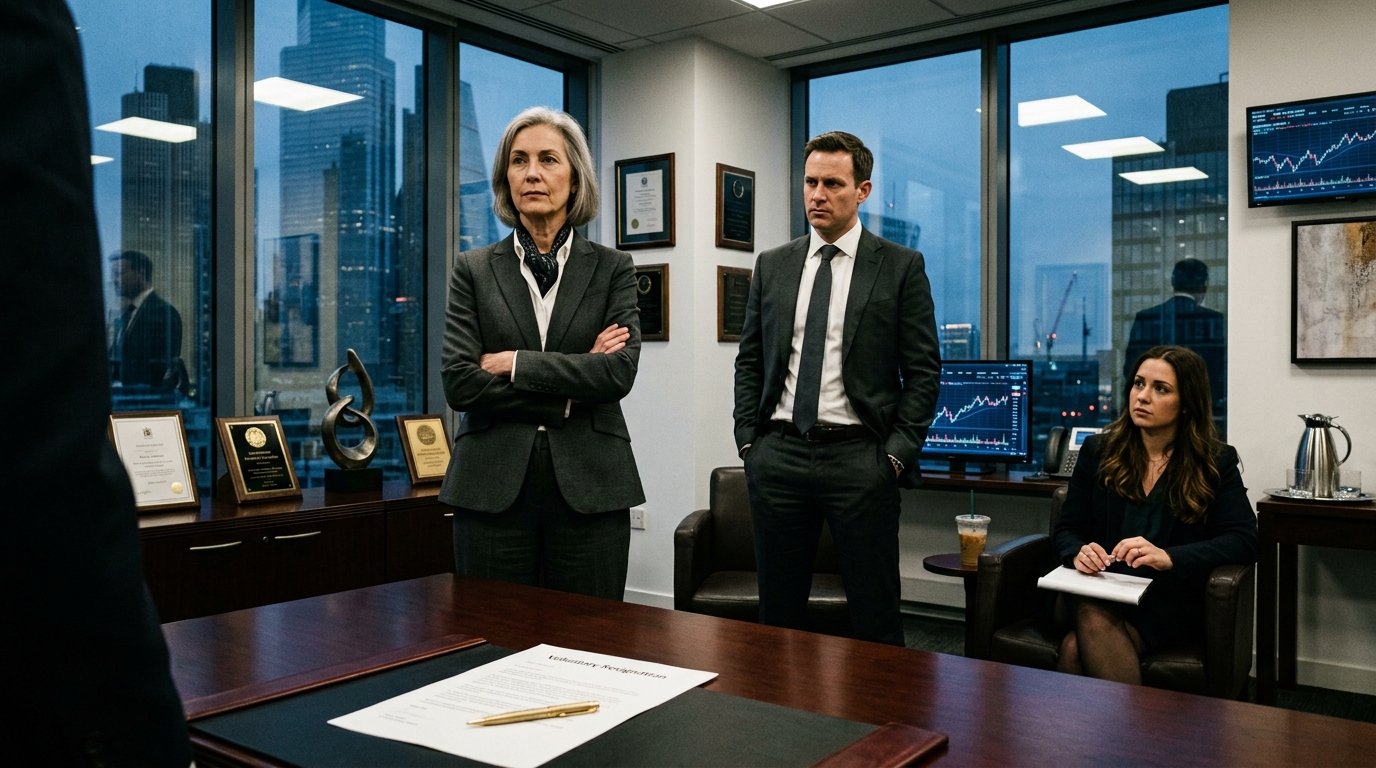
The fourth floor smelled like high-end furniture polish and expensive carpet adhesive—the fresh scent of a kid who had inherited a forty-year-old firm two months ago and thought a new mahogany table made him a CEO. Through the floor-to-ceiling glass paneling of the corner office, I could see Tom standing near the leather armchair, his posture rigid, his arms crossed over his chest like a soldier waiting for a medal. Emily sat in the leather guest chair, a pristine white notepad resting on her knees, her eyes fixed on the ceiling tiles as if she were trying to hide a smirk.
I knocked once and pushed the glass door open.
“Sit down, Lily,” President Arthur said. He was thirty-two, wearing a fitted charcoal suit that still had the tailor’s chalk marks invisible to anyone who hadn’t spent four decades watching executives pretend to work. He didn’t look up from his tablet screen.
I didn’t sit. I kept my hands folded over the front of my cardigan, feeling the cold metal cylinder of my Parker pen pressing through the knit wool against my ribs. “You wanted to see me, Mr. Arthur?”
“Tom tells me we have a structural compliance issue,” Arthur said, sliding the tablet across the polished wood. It stopped three inches from the edge. “He ran the quarterly labor efficiency report twenty minutes ago. You logged eighty-four hours of overtime this pay cycle, Lily. The entire rest of the tax division combined logged fourteen.”
“I managed forty-five active client files this month,” I said, my voice steady, stripped of any tone that could be twisted into defensive hesitation. “Tom assigned thirty-one of those files to my queue after five o’clock over the last three weeks. Including the Henderson Group quarterly audit prep, which was sitting on Emily’s desk since the fourth.”
Tom took half a step forward, his polished shoe digging into the pile carpet. “That’s a mischaracterization of standard workflow distribution, Mr. Arthur. Lily’s processing speed has dropped nearly forty percent over the last two quarters. Emily and I have had to step in repeatedly to audit her entries because she’s relying on manual cross-referencing instead of the new automated tax modules.”
“The automated module doesn’t flag regional asset depreciation exemptions for multi-state entities,” I said, looking straight at Tom. His left eye twitched—a tiny, biological glitch he couldn’t hide behind his tailored jacket. “If I used your system preset on the Henderson file, the client would have overpaid state franchise taxes by sixty-two thousand dollars.”
“It’s about basic time management, Lily,” Emily chimed in, her voice dripping with soft, practiced concern as she turned toward Arthur. “We all want to support legacy staff, but when one employee’s overtime budget consumes the margin for two junior hires, it drags the performance metrics of the entire department down. It makes us look inefficient to the board.”
Arthur leaned back in his leather chair, interlocking his fingers over his stomach. He looked at Tom, then at Emily, and finally at me. He didn’t ask for the paper logs. He didn’t ask to see the physical timecards stamped at the side door. He saw two young people who spoke his corporate vocabulary and one fifty-nine-year-old woman holding a cheap brass pen.
“We need to streamline,” Arthur said, the sentence falling flat and cold in the sterile air of the office. “I can’t justify an eighty-hour billing anomaly on the ledger to the executive committee next week. Given the discrepancy in production speed, Lily… I think it’s best if we accept your voluntary resignation by the end of the month.”
The silence in the room didn’t feel heavy; it felt thin, like stretched plastic about to snap.
Tom didn’t look at me, but his fingers unclasped from his chest, settling into his pockets with a subtle shift of his weight. Emily took a slow sip from her paper cup, the soft hiss of the plastic lid echoing against the glass walls.
“Voluntary,” I repeated.
“It protects your severance package,” Arthur said, sliding a single sheet of pre-printed company letterhead toward me. “And it keeps your employment record clean. No administrative reviews. No dispute logs.”
I reached into my pocket, pulled out the brass Parker pen, and clicked the top button. The sharp, mechanical thwack of the spring mechanism cut through the room like a small firecracker.
I didn’t sign the paper. I set the pen down flat on top of the letterhead, exactly parallel to the top margin.
“I won’t need until the end of the month,” I said softly. “I’ll be out of my office by five o’clock today.”
CHAPTER 3: THE COLD HANDOVER
I left the brass Parker pen sitting parallel to the unsigned letterhead on Arthur’s mahogany desk, turned my heel on the pile carpet, and walked out before either Tom or Emily could process the silence.
The third-floor office floor was cold. Down in the cubicle farm, the quiet hum of computer towers felt heavier now, like the whole room was holding its breath waiting for a storm.
I pulled a flat, white cardboard archive box from under my desk and set it next to the keyboard.
Tom didn’t wait two minutes. The heavy glass doors of the executive elevator swung open, and his footsteps clicked fast across the linoleum, sharp and impatient. Emily walked half a step behind him, her arms folded tight over her chest, holding a thick stack of blue transfer slips.
“We need all digital token keys surrendered before you clear your drawers, Lily,” Tom said, stopping at the edge of my partition. His tie was pulled down another inch, his throat red where the collar choked him. “Company policy. No unmonitored external drives, no physical ledger copies.”
“The ledger copies belong to the state tax board,” I said, without looking up. I packed three framed photographs of my late husband into the box, wrapping them in plain packing paper. “They aren’t company property. They’re client records.”
“Everything generated on these workstations belongs to the firm,” Emily snapped. She set a heavy ring of brass keycards onto my desk with a loud, metallic clatter. “Tom is taking over the primary sign-offs for Henderson effective five minutes ago. You don’t touch those files again.”
I reached into my top drawer, pulled out a stack of forty-five plain white envelopes, and set them next to the keyboard. Each envelope had a handwritten address on the front—not the corporate office addresses, but the direct personal contacts of every owner, operator, and chief financial officer I’d served since 1989.
Tom’s eyes locked onto the white envelopes. His hand twitched toward them, his fingers curling in. “What are those?”
“Direct handover notices,” I said, slid my thumb under the top envelope, and sealed it down flat with a soft press of my palm. “Informing my clients that my personal service agreement with them has terminated. Standard professional courtesy.”
“You can’t send those,” Emily said, her voice jumping half an octave. Her manicured hand darted out to snatch the stack, but I laid my forearm across the paper before her fingers touched the edge.
“I can,” I said, my voice dropping into a quiet, icy register that stopped her hand mid-air. “Because I didn’t print them on company paper, and I didn’t use company postage. I wrote them on my lunch break.”
Tom stepped between Emily and the desk, his jaw set hard as he stared down at me. “You think forty-five accounts give a damn about a single clerk leaving? They care about the firm’s seal, Lily. They care about Arthur’s name on the building.”
I reached into my pocket, pulled out a spare black felt-tip pen, and tapped the top envelope once. “They care about who saves them sixty-two thousand dollars on regional asset depreciation, Tom. They don’t know who Arthur is. They’ve never seen your face.”
Under the edge of Tom’s keyboard, partially tucked beneath a stack of blank letterhead, the corner of a mint-green folder caught the harsh overhead light. It didn’t have a standard client tracking barcode on the tab—just a hand-stamped red seal that read AUDIT PENDING.
I didn’t reach for it. I didn’t mention it. I simply noted the missing client code and the fact that Emily’s initials were scrawled in the sign-off box with fresh blue ink.
“Get your personal items and get out,” Tom said, his chest rising and falling in shallow, agitated breaths. “If you’re on the premises past five-thirty, I’m calling security to escort you to the street.”
“It’s five-twentyeight,” I said, checking my wrist watch.
I picked up the white cardboard box, tucked it under my left arm, and picked up my stack of forty-five sealed white envelopes with my right hand. I didn’t look at Tom, and I didn’t look at Emily.
As I walked toward the glass doors, the heavy mechanical lock clicked shut behind me, sealing the tax department in cold, dead silence.
CHAPTER 4: THE PHONE CALL FROM THE RUINS
I sat on the quiet porch holding a steaming mug of tea, watching the rain hit the front steps as the cell phone on the porch table vibrated incessantly with an internal company caller ID.
The screen flashed Arthur’s office number for the fourth time in ten minutes. I wrapped both hands around the warm ceramic mug, feeling the steam rise against my chin, and let it ring out into the empty evening air.
When it finally stopped, my personal mobile buzzed instantly with a direct line—Tom’s private cell.
I reached out, picked up the phone with two fingers, and thumbed the green accept button before setting it flat on the wooden table beside my tea.
“Lily,” President Arthur’s voice didn’t carry its usual executive smoothness; it was thin, frantic, and clipped with raw panic. “Where are you? Who exactly are you talking to?”
“I’m sitting on my front porch, Mr. Arthur,” I said, my voice level and dry against the patter of the rain. “I’m unemployed. You reminded me of that status quite clearly seven days ago.”
“Forty-nine corporate accounts have pulled their transactional authority since twelve o’clock,” Arthur shouted over the line, the sound of paper rustling frantically in the background indicating someone was pacing a hardwood floor. “They aren’t just suspending payments—they’re demanding a complete asset transfer to independent regional firms. Henderson, Vance Manufacturing, the entire logistics portfolio. They’re saying they won’t clear a single tax declaration unless you sign off on the audit sheets.”
“They were my clients for thirty-seven years,” I said, taking a slow sip of my tea. “They didn’t trust a corporate logo. They trusted the math.”
“Tom insisted your workload was replaceable!” Arthur’s voice cracked, a sudden spike of unfiltered rage bleeding through the corporate veneer. “He and Emily assured me the automation modules could handle the volume without missing a beat. But the state tax board just flagged three consecutive quarters of misallocated municipal deductions on Tom’s desk. The entire department is locked down.”
“Automation is efficient when you know how to read the exemptions,” I said.
“Get back here, Lily,” Arthur demanded, dropping the volume into a harsh, commanding whisper. “Name your salary. Name whatever bonus structure you want. Walk back through those double doors tomorrow morning and fix this mess before the board gets wind of it.”
“I don’t work for free, Mr. Arthur,” I said, looking out at the dark streetlamp flickering through the wet maples. “And I certainly don’t fix other people’s bookkeeping from the outside.”
“Then come to the office,” Arthur snapped, the line shaking with his impatience. “Tom and Emily are waiting in the executive suite right now. Bring whatever files you think you’re holding, and we’ll straighten this out face-to-face.”
The line clicked. He didn’t wait for my answer.
I picked up the phone, placed it face down on the wooden table, and took another quiet sip of tea.
CHAPTER 5: THE AUDIT ROOM CONFRONTATION
I stood inside the glass doors of the executive suite, looking down at Arthur’s mahogany desk where Tom and Emily stood with pale faces and dark circles under their eyes.
The room smelled of stale coffee and indoor sweat. Tom’s suit jacket was unbuttoned, his tie pulled completely askew, revealing a damp collar.
“She’s here,” Tom spat out, his voice cracking with a sharp, ragged edge as he stepped toward the glass partition. “President Arthur, make her hand over the client access codes. She’s sabotaging the database remotely.”
“I don’t have remote access, Tom,” I said, sliding my hands into my cardigan pockets and resting my right thumb against the worn notch of my brass pen. “I surrendered my token key at five-thirty last Tuesday.”
Arthur looked up from the center of the desk, his hands trembling slightly as he held a printed bank reconciliation statement. “Lily. The regional tax authority just flagged forty-nine accounts for irregular retainer transfers. Funds routed through unmonitored subsidiary accounts matching Emily’s digital sign-off.”
Emily stepped back, her fingers clutching the edge of the leather guest chair until her knuckles turned white. “That’s a lie. Lily manipulated the system entries before she walked out. She’s trying to frame us for her own processing backlog.”
I pulled the mint-green audit folder from under my arm—the one left under Tom’s keyboard a week ago—and dropped it flat onto the center of Arthur’s mahogany desk.
“You forgot to file the quarterly fee disclosures, Emily,” I said softly, looking straight into her wide, panicked eyes. “And Tom forgot that bank routing numbers leave a paper trail even when you delete the user cache.”
Tom lunged forward across the desk, his face flushing a dark, ugly red. “Shut your mouth, you bitter old woman! You don’t know anything about department management!”
“Tom,” Arthur warned, his voice dropping into a dangerous, icy register as he stared down at the open folder. “Explain why the Henderson retainer fees were diverted into an account matching your personal home address.”
“It’s a consulting stipend!” Tom yelled, his fists slamming down onto the wood with a heavy crack that rattled the ceramic coffee mugs. “It’s standard executive bonus structuring!”
“It’s felony embezzlement,” I said, my voice cutting through his shouting like a dry razor. “And every single client who pulled their contract today did it because your automated modules missed three years of state compliance penalties.”
Arthur didn’t look at Tom anymore. He picked up the desk phone, his fingers punching three digits with cold, rigid precision. “Security. Escort Mr. Evans and Ms. Vance to the ground floor immediately. And hold all department access cards.”
Tom grabbed the edge of the desk, his knees buckling slightly as the reality of the paper trail finally hit him. “You can’t do this! I have a family! Lily, tell him it’s a misunderstanding—tell him!”
“You told me to start typing faster, Tom,” I said, turning my back on the desk and walking toward the glass exit. “It’s just Karma. What goes around comes around.”
CHAPTER 6: A QUIET CUP OF COFFEE
I sat in a bright, quiet independent consulting office, holding a fresh cup of black coffee, clicking the brass Parker pen once against the polished wooden desk.
The morning sunlight cut cleanly through the window panes, illuminating the small room without the sterile hum of overhead fluorescent tubes. There were no glass partitions, no corporate escalation charts, and no hurried footsteps clicking across the floor outside.
My phone rested face-down near the blotter. Earlier that morning, Emily’s voice had come through the speaker in a desperate, tearful plea for intervention regarding her sudden termination and the collapse of her livelihood at the construction day-labor site.
I hadn’t picked it up. You cannot unring a bell, and some ledgers cannot be re-balanced once the ink has dried.
Across town, Tom was facing the harsh reality of industry blacklisting and divorce litigation, paying the true cost of unearned entitlement and fraudulentshortcuts. They had gambled their futures on intimidation and the assumption that quiet dedication was a weakness.
The brass pen felt balanced and steady beneath my fingers. I set the cap back onto the barrel with a crisp, final click, leaving the metal housing smooth and cold.
On the corner of the desk sat three clean client intake files waiting for my review. I opened the top folder, picked up the pen, and began to write my own name at the top of the page.