The Ghost of the Armory: A Tactical Sabotage of Silicon-Based Hubris and Human Error
CHAPTER 1: THE FRICTION OF GRAPHITE
Staff Sergeant Miller looked at the rifle in the vice, then at the man standing over it. The armory was freezing, the air conditioning set to a precise sixty-two degrees to protect the electronics, but Miller felt sweat prickling the back of his neck.
“You’re contaminating the finish,” Miller said, his voice flat, professional, and entirely ignored.
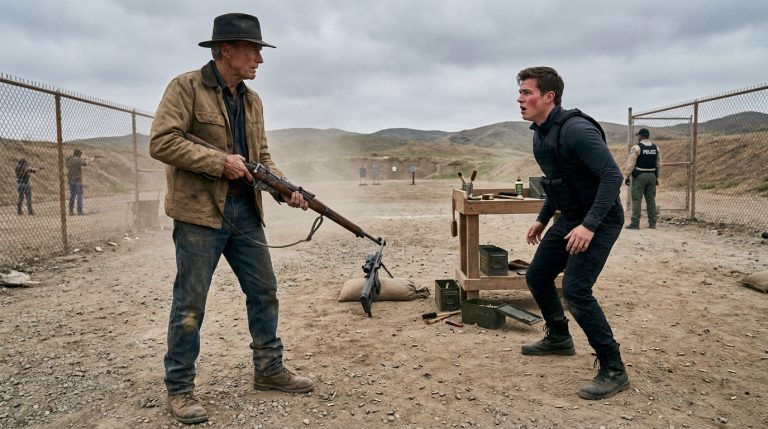
Arthur, the seventy-nine-year-old intruder, didn’t look up. He was leaning over the M4 carbine with the slow, deliberate movements of someone who didn’t care about HR reports or the Commanding Officer’s insistence on ‘modernized workflows.’ His cane rested against the workbench, a worn piece of hickory that seemed to vibrate in sympathy with the humming servers lining the room.
Miller stepped forward, his hand hovering near his radio. “Sir, I have three days before these rifles are crated for Helmand. The diagnostic suite says the headspace is within tolerance. The green light is on. The software is perfect.”
Arthur paused. He held a thick, yellow-cased grease pencil between his thumb and index finger, the tip worn to a dull, oily chisel. He didn’t look at Miller. He looked at the breech. He pressed the pencil against the edge of the metal and dragged it once, a thick, smeary line of black wax against the pristine, matte-black finish.
“The software is a liar, Sergeant,” Arthur said. His voice was like grinding stone. “It measures what it’s told to measure. It ignores the things it doesn’t want to see because it doesn’t have eyes.”
“It’s a forty-seven thousand dollar system,” Miller snapped, his frustration overriding his training. “It doesn’t have ‘eyes’ because it doesn’t need them. It has sensors.”
“And sensors can be bought. Or they can be blinded by the people who wrote the code.” Arthur finally turned his head. His eyes were milky, fading, but they fixed on Miller with a clarity that made the Sergeant instinctively pull back.
Miller walked to the terminal, his boots echoing sharply on the concrete floor. He tapped the touch screen, pulling up the diagnostic report. Everything was green. Everything was perfect. He looked back at Arthur, preparing to order him out, to have security haul him to the front gate.
But as he glanced toward the rifle, he stopped.
Where Arthur had marked the metal, the grease had pooled in a tiny, irregular pattern. It wasn’t flat. It was distorted. Miller leaned in, his heart hammering against his ribs. The pencil mark revealed a microscopic hair-line crack in the barrel extension—a fracture so thin it was invisible to the naked eye, and completely ignored by the high-frequency sensors of the diagnostic suite.
Miller stared at the black smear, then at the terminal, then back at the rifle. His entire world was built on the assumption that the system was the ultimate authority.
“How did you know,” Miller whispered, his hand trembling as he reached for the rifle.
Arthur didn’t answer. He picked up his cane, turned, and gestured toward the far corner of the armory—where a stack of decommissioned crates sat, covered in dust, labeled with a project number that hadn’t been active since the late eighties.
Miller’s blood ran cold. The label on the crate wasn’t just an old inventory tag. It was a file he had only seen once before, buried in the base directory of the diagnostic system’s secure root folder.
CHAPTER 2: THE ANATOMY OF SILENCE
Miller didn’t move. His hand remained on the rifle, his skin tracing the sharp, cold edge of the breach where Arthur had applied the dark smear of grease. It was a smudge of nothing—a tiny, physical anomaly that carried the weight of a systemic indictment. He looked at the server racks, the blinking green LEDs reflecting off the polished concrete floor, and for the first time in his career, he saw them not as the ultimate authority, but as a cage.
Arthur watched him, his posture unchanging. He had leaned his weight onto the hickory cane, his knuckles white against the dark wood. He didn’t offer a lecture. He didn’t offer a path forward. He simply waited, letting the weight of the moment press into the small, climate-controlled space.
“You’re a ghost,” Miller said, his voice barely audible over the low-frequency drone of the HVAC system. He retracted his hand, wiping the grease onto his trouser leg with a sudden, jerky motion. “You were fired in ’86. My sergeant major had your file in the orientation folder on ‘Institutional Security’.”
“I was removed,” Arthur corrected, his tone devoid of bitterness. It was a clinical observation. “I was an inconvenience to a contract that required a specific failure rate to justify its own necessity. And here you are, Sergeant. Three days out from a deployment, staring at a failure that your precious machine swore didn’t exist.”
Miller turned toward the terminal. His eyes felt raw, the blue light of the interface suddenly grating. He needed to verify. He bypassed the standard diagnostic GUI, his fingers flying across the keys as he dropped into the low-level administrative shell—the deep, dark architecture of the system that nobody was supposed to touch.
The humidity in the room seemed to rise. The smell of gun oil, stale coffee, and the sharp, metallic tang of ozone filled his senses. As Miller navigated the directory, a phantom sensation washed over him—the cold, stinging slap of a weapon jamming in a rain-slicked trench during his first tour, a memory he had kept buried under years of tactical proficiency and faith in his equipment. The machine hadn’t failed him then, he reminded himself, but the memory was sharp, a jagged edge in his mind that refused to be smoothed over.
“You’re looking for the root,” Arthur said, moving closer. His boots didn’t click on the floor; they dragged, a sound of sandpaper against grit. “You won’t find it there. The code is modular. It’s designed to self-correct during the diagnostic cycle.”
“Then show me,” Miller demanded, abandoning the screen. He stepped away, his posture rigid. “If you’re here to burn this place down, do it. But if you’re here to fix these rifles, then put the pencil down and give me something I can report to the captain.”
Arthur stepped to the workbench and tapped the rifle with his cane. “Reporting to the captain implies the captain has the capacity to understand the error. Does he, Miller? Or does he look at the green lights and sleep just as soundly as you did twenty minutes ago?”
The question wasn’t a provocation; it was a cold, hard fact. Miller felt the walls of the armory closing in. If he flagged the system, he wasn’t just questioning a machine; he was questioning the procurement chain, the command structure, and his own judgment. He was risking a court-martial for an old man’s hunch.
“I have twenty-four rifles,” Miller said, his voice dropping to a harsh whisper. “If I don’t clear these for shipment, the Marines don’t go. If they don’t go, the deployment is compromised. The paperwork alone will bury me.”
Arthur reached into the pocket of his tattered jacket and pulled out a small, brass-cased compass. He placed it next to the rifle. The needle didn’t point North. It swung wildly, then locked toward the server bank.
“The system isn’t just checking the rifles, Sergeant,” Arthur said. “It’s calibrating the room. It’s creating a closed loop of interference. That’s why you see green lights. It’s not looking at the metal. It’s looking at the air.”
Miller looked at the compass, then at the rows of blinking lights. The logic was so absurd it was brilliant. They hadn’t built a sensor that worked; they had built a system that forced the environment to match its own internal, perfect, and entirely fabricated reality.
“Help me calibrate the machines manually,” Miller said, the decision crystallizing in his mind, sharp and dangerous. “If the system wants a closed loop, we’ll give it one. But we’ll do it with steel and grease, not code.”
Arthur’s mouth tightened into a thin line. It was almost a smile, but it held no warmth. It was the look of a man who had finally seen the first crack in a dam he’d been throwing stones at for forty years.
“Get the hand-measuring tools,” Arthur said, reaching for his grease pencil again. “We’re going to prove that the machine is blind, but first, we need to make sure it doesn’t notice us looking.”
Miller walked to the wall cabinet, his hands steadying. He wasn’t a traitor, he told himself. He was a maintainer. And if the machine was the enemy of the maintenance, then the machine was the enemy of the mission. He grabbed a set of analog calipers, the cold weight of the tool grounding him. The game had shifted, and for the first time, he wasn’t playing by the manual.
CHAPTER 3: THE FRICTION POINT
Miller stood at the heavy steel workbench, his breath hitching slightly as he lifted the calibration jig from the dust-caked crate. The metal was cold, oxidized to a deep, matte-brown, and felt significantly heavier than the sleek, polymer-housed diagnostic tools he used daily. Behind him, the server room hummed—a synthetic, steady sound that now felt like the buzzing of an insect in his ear.
“The jig is seized,” Miller murmured, his grip tightening as he tried to rotate the adjustment wheel. The resistance was absolute, a testament to decades of neglect.
Arthur didn’t reach for the tool. He stood back, watching Miller’s struggle with a detached, almost predatory patience. “Rust is just the metal’s way of saying it’s had enough of being ignored. You have to work it, Sergeant. Don’t force it. Feel the bind, then back it off. It’s a conversation, not a conquest.”
Miller gritted his teeth, his frustration spiking. “I don’t have time for a conversation with a piece of scrap iron. I have seventy-two hours to get these rifles ready for deployment. If the captain walks in and sees me stripping down a piece of gear that hasn’t been authorized since the Cold War, I’m done. My career ends in a disciplinary hearing.”
“Your career ended the moment you realized the machine was lying to you,” Arthur replied, his voice calm, cutting through the mechanical hum. “You just haven’t accepted the resignation yet.”
Miller ignored him, his focus narrowing to the seized dial. He applied steady, calculated pressure, feeling the microscopic vibrations within the metal—a sensation he had ignored for years in favor of reading the digital outputs on the screen. He backed the wheel off a fraction of a millimeter, then pressed forward again. Click. The movement was tiny, but the liberation of the gear was immediate. He began to work the wheel back and forth, the rhythmic grinding of metal against metal sounding unnervingly like bones shifting in place.
As he worked, he caught a glimpse of a manual lying at the bottom of the crate. It was bound in a faded, oil-stained binder. Miller pulled it out, flipping through the pages. The schematics were hand-drawn, meticulous, and filled with notes in the same jagged, spidery handwriting he now recognized as Arthur’s. He stopped at a page detailing the rifle’s receiver tolerances. There, stamped in red ink, was a string of characters: A-86-X-99.
It was an authorization code, but one that shouldn’t exist in a modern system. He glanced at the diagnostic screen, then back at the code. A thought crystallized in his mind: this wasn’t just a manual. It was a secondary command path.
“What is this?” Miller asked, pointing at the red stamp.
Arthur drifted closer, the shadows of the server racks stretching across his face. “A contingency. My contingency. I knew that one day, the system would be so perfect that it would forget the physical reality of the weapon. I didn’t want the hardware to be useless when that day came. That code allows you to override the system’s primary calibration logic, but only if you have the physical jig attached to the receiver.”
“You built a backdoor into the diagnostics forty years ago?” Miller stared at the old man, his skepticism warring with the evidence in his hands. “How could you have possibly known what the system architecture would look like today?”
“I didn’t,” Arthur said. “But the physics of the rifle haven’t changed. If you control the input of the physical measurement, the system has no choice but to believe it. It’s not a backdoor, Sergeant. It’s a reality check.”
Miller looked back at the rifles. They were identical, lined up in a row like silent, waiting soldiers. To use the code meant he was actively participating in the sabotage of the diagnostic process—a process the entire armory relied upon. But to do nothing was to send those Marines into the field with rifles that had hair-line fractures the system was programmed to ignore.
He looked at the calibration jig, then at the terminal. He could see the captain’s office door through the glass pane of the armory, dark and quiet for the moment. The risk was enormous. The friction of the decision made his palms slick.
“If I do this,” Miller said, his voice dropping to a gravelly low, “and the system logs the override, I’ll be finished before the crates hit the transport pallet.”
“If you don’t do this,” Arthur countered, his eyes locked onto Miller’s, “the system will continue to report perfection, and the first time those rifles are fired under stress, the failure will be a tragedy you can’t write a report for. Which ending do you prefer, Sergeant?”
Miller didn’t answer. He picked up the calibration jig and moved toward the first rifle. He wasn’t choosing between his career and the truth; he was realizing they were no longer the same thing. He slotted the jig onto the receiver, the metal clicking into place with a sound that felt like a lock turning. The hum of the server room seemed to drop in pitch, the lights on the diagnostic rack flickering, as if the system sensed the sudden introduction of a physical reality it hadn’t accounted for.
He took a deep breath, the smell of dust and gun oil sharp in his lungs, and prepared to enter the code.
CHAPTER 4: THE SYSTEMS RECOIL
The red strobe light washed over the room, turning the rows of M4s into jagged, pulsing silhouettes. Miller scrambled back from the console as the screen erupted in lines of scrolling amber code—cascading data that moved too fast for the eye to track. It wasn’t the clean, formatted output of a diagnostic check; it was the raw, unvarnished gut of the machine, spilling its secrets onto the glass.
“What did you do?” Miller shouted over the mounting whine of the ventilation fans, which were now spinning at a dangerous, overdriven speed.
Arthur stood in the center of the strobing light, his face a mask of grim satisfaction. He didn’t look like an intruder anymore; he looked like the architect of the chaos. “I didn’t do anything, Sergeant. I just stopped lying to the machine. It’s reacting to the contradiction. It’s been trained to report a perfect reality, and you just shoved a piece of physical, fractured steel into its logic gate.”
Miller grabbed the edge of the workbench, his knuckles bruised and raw. “The door is locked. We’re sealed in.” He grabbed his radio, but the air was thick with electromagnetic interference; the device crackled with a burst of static that made his teeth ache. “I have to shut it down. If this log spills into the network, the command center will see the override. They’ll trace it directly to my ID.”
“Let them,” Arthur said, reaching out to steady himself against the vibrating workbench. “If they see it, they’ll have to acknowledge the failure. The system is currently trying to force-reboot to erase the evidence. If you stop it now, you’re complicit. If you let it finish, the secret is gone for another decade.”
Miller watched the scrolling amber text. A line caught his eye: Contract Phase 4: Forced Obsolescence Protocol. He froze. He’d seen that acronym on a restricted briefing memo months ago—a generic placeholder for ‘infrastructure upgrades.’ He hadn’t realized it was an automated cycle. The machine wasn’t failing; it was actively discarding perfectly functional equipment to force the department into a multi-million dollar contract renewal.
The weight of it hit him harder than the physical danger. He hadn’t just discovered a technical flaw; he had uncovered a deliberate, systematic act of corruption.
“It’s not a glitch,” Miller whispered, the realization sinking in. “It’s a feature.”
The room shuddered. The primary power relay on the wall sparked, a shower of white-hot embers cascading onto the concrete. The red strobe light intensified, and the air began to smell of burning circuitry. Miller knew he had seconds before the entire system went into a permanent, unrecoverable fried-state—which would serve as the perfect cover-up.
“I need to mirror the data,” Miller said, his training taking over. He dived for the manual port, his hands fumbling with a thumb drive he pulled from his belt. He slammed it into the bay, the plastic casing biting into his palm.
“The system won’t let you,” Arthur warned, though he didn’t try to stop him. “It’s already scrubbing the drive. You’re fighting a ghost.”
Miller didn’t listen. He ignored the heat radiating from the console, the sweat stinging his eyes, and the deafening shriek of the cooling fans. He typed the bypass sequence he’d learned in his first year of certification, the one they said was ‘deprecated.’ He watched the progress bar, his breath hitching as it stuttered at 44 percent.
The door to the armory hammered—a heavy, rhythmic banging from the outside. The Captain. Or maybe security. Whoever it was, they were trying to override the emergency seal. If they opened that door, the system would detect the human intervention and trigger a total wipe.
“Miller! Open this door!” The muffled shout came through the heavy steel, distorted and angry.
“Keep typing,” Arthur said, his voice strangely steady. “If you stop now, you’re just another part of the inventory.”
Miller’s fingers were a blur. The screen blinked, the red strobe creating an illusion that the text was moving across the glass. Data Transfer: 78%… 85%… The banging on the door stopped. There was a metallic scraping sound—the heavy-duty cutters of the tactical response team. They weren’t going to wait for the code; they were going to tear the door off its hinges.
The terminal chirped—a sharp, high sound that signaled a successful write. Miller yanked the drive out, his heart hammering against his ribs like a trapped bird. He dove under the workbench just as the door exploded inward, the hinge bolts shearing with a sound like a rifle shot.
The light from the hallway flooded the room, harsh and unforgiving. Figures in tactical gear poured in, their weapons raised, their movements sharp and professional. Miller lay in the dust, the cold drive clutched in his hand, his eyes tracking the boots of the men who were now surrounding the console. He was no longer a Sergeant doing his job; he was an enemy of the system, and he was cornered.
CHAPTER 5: THE INTERROGATION OF TRUTH
The transition was a blur of abrasive nylon straps and the biting chill of cold concrete. Miller was shoved into a plastic chair in the back office—a room that smelled of burnt coffee and aggressive paperwork. The tactical team had vanished as quickly as they appeared, leaving him with a single, high-intensity desk lamp pointed directly at his face and a door that clicked shut with the finality of a prison cell.
He wasn’t alone. The Captain was there, his uniform pristine, his eyes obscured by the glare of the lamp. He sat in the shadows, a man who looked like he’d been built to inhabit a boardroom, not an armory.
“You have a habit of making things complicated, Miller,” the Captain said. His voice wasn’t raised. It was a terrifyingly calm, well-rehearsed sound. He didn’t look at Miller; he looked at the thumb drive that sat on the desk between them—the evidence of a treason that Miller had been forced to commit to save his own conscience.
Miller’s wrists were raw where the zip-ties had bitten in. He didn’t speak. The silence in the room was a physical weight, pressing against his eardrums. He could still see Arthur in his peripheral vision, standing by the door—or was he? He blinked, the image flickering like a dying bulb, and realized he was alone. His mind was fracturing, the paranoia of the armory leaking into the sterile reality of the interrogation.
“That drive,” the Captain continued, gesturing with a gold-plated pen. “It contains files that don’t exist. It contains logs of a system that has performed with 99.9% accuracy for six years. You’re holding a fiction, Miller. A fiction that is going to cost you everything.”
“It’s not a fiction,” Miller said, his voice raspy. He stared at the Captain, trying to find a flicker of doubt, a sign of shared humanity, but the man was a void. “It’s a forced obsolescence cycle. I saw the logs. I saw the override. You’re trading lives for a contract renewal.”
The Captain stood, stepping into the edge of the light. His shadow stretched long and thin across the floor, cold and sharp-edged. “The world is complex, Miller. It requires decisions that are beyond the scope of a Sergeant’s manual. We need updated systems because the threat is evolving. If we have to accelerate the retirement of the older hardware to clear the budget for the new suite, that’s not corruption. That’s efficiency.”
“It’s negligence,” Miller snapped, his resolve hardening. “Those rifles were failing. Not because they were old, but because the system was told to ignore them.”
“And yet,” the Captain said, his voice dropping, “who is going to believe you? The man who was caught sabotaging secure government property? Or the multi-billion dollar corporation that provides the very platform you used to access these ‘secrets’? You’ve effectively burned your own credibility to the ground.”
The Captain leaned over the desk, the light reflecting off his glasses, hiding his expression. “Give me the drive, Miller. We’ll mark this down as a psychotic break, a moment of stress-induced fatigue. You’ll be medically discharged with your pension intact. You walk away, and this stops being a catastrophe for you.”
Miller looked at the drive. It was so small. It held the truth, but truth was a commodity in this room, and it was currently valued at less than a pension. He thought of the Marines in Helmand. He thought of the fracture in the barrel extension—the tiny, physical, undeniable crack that the system had tried to hide.
“You’re not doing this because you believe in the new gear,” Miller said, realizing the final piece of the puzzle. “You’re doing this because you’re tied to the phase-out dividends. You aren’t the command, Captain. You’re the broker.”
The Captain’s face remained impassive, but his fingers tightened on the edge of the desk until the wood creaked. The silence that followed was broken only by the hum of the fluorescent lights, a sound that Miller realized now was a perfect match for the armory servers. The corruption didn’t stop at the diagnostic software; it was embedded in the very architecture of the chain of command.
“That’s a bold accusation,” the Captain murmured. “One that will be very difficult to prove once the physical evidence is seized and classified.”
He reached for the drive. Miller didn’t pull back. He watched the Captain’s hand—a hand that had signed off on the armory’s ‘optimization’ plan. Miller realized then that he couldn’t win this fight with evidence. He had to use the one thing the Captain didn’t have: an understanding of the machine’s physical vulnerabilities. He had already left a trail, and the Captain, in his arrogance, had ignored the most obvious piece of the puzzle.
Miller smiled, a thin, painful movement of his lips. “You can take the drive, Captain. But you should have checked the armory’s physical manifest before you sent the team in.”
The Captain paused, his brow furrowing. “What are you talking about?”
“I didn’t just log the error into the drive,” Miller said, his voice quiet. “I triggered the manual inspection protocol. Every rifle has a physical timestamp now. Even if you wipe the drive, the physical record of those fractures is sitting in the open on the armory floor. You’ve sealed the room, but you’ve also trapped yourself with the evidence.”
The Captain’s eyes widened, a flicker of panic breaking the veneer of calm. He realized he’d focused so hard on the digital threat that he’d forgotten the physical reality that had started it all. He turned toward the door, but Miller was already moving, his shoulder slamming into the Captain’s chest with all the pent-up frustration of a man who had finally found the enemy’s weakness.
CHAPTER 6: THE SILENCE OF THE ARCHITECT
The collision was a symphony of tortured metal and cascading sparks. The Captain, winded and disoriented, scrambled against the rack, his hand reaching for the security radio on his belt. Miller didn’t give him the space. He lunged, pinning the Captain’s arm against the server frame, the hard steel digging into the Captain’s shoulder.
“Look at it!” Miller shouted, gesturing to the console where the diagnostic screen had finally stopped flickering. The screen now displayed a static image: a blueprint of the rifle’s barrel, highlighted in bright, warning red, with Arthur’s handwritten notes overlaid on the digital display—a ghost of the past superimposed on the present, inescapable and undeniable.
The Captain’s eyes flickered to the screen, then back to Miller. The facade of the untouchable officer had dissolved, replaced by a desperate, animalistic calculation. “You think this matters?” the Captain wheezed, struggling against Miller’s grip. “This is a local override. I can clear the logs in five minutes. I can bury you in a paperwork landslide before you even make it to the parking lot.”
“You can’t bury the hardware,” Miller said, his voice dropping, cold and steady. He pulled the thumb drive from his pocket and pressed it into the Captain’s hand—not as a surrender, but as a sentence. “Every rifle in that rack has been physically marked. Every barrel extension has been gauged. The armory is under a mandatory inspection hold. You can’t move a single weapon without a third-party audit, and the audit team is already en route. I didn’t send an email, Captain. I triggered a physical lock-out via the emergency supply chain protocol.”
The Captain went still. The color drained from his face, leaving him looking older, hollowed out. He realized the trap Miller had set: by forcing the diagnostic system to acknowledge the physical reality, Miller had engaged a legacy safety protocol—one designed long ago by Arthur, specifically to bypass corruptible digital systems.
“Arthur,” the Captain whispered, his eyes darting around the room, as if expecting the old man to appear from the shadows.
“Arthur is the reason this place was built,” Miller said, letting go of the Captain and standing back. “He’s been waiting for someone to stop looking at the green lights and start looking at the iron. You weren’t fighting a glitch, Captain. You were fighting a forty-year-old promise.”
The armory door, which had been battered by the tactical team, was now framed by the silhouette of the base commander and a pair of MPs. They weren’t moving in aggressively anymore; they were standing in stunned silence, watching the scene. The Captain looked at them, then at the console, and finally at Miller. The defiance had evaporated, leaving behind the exhausted, small man who had gambled his integrity on a line of code and lost to a piece of grease-smeared steel.
As the MPs moved in to secure the Captain, Miller stepped away from the console. The adrenaline began to ebb, leaving behind a profound, bone-deep fatigue. He walked back to the workbench, where the calibration jig still sat—a rusted, heavy, and beautiful tool.
He didn’t celebrate. He reached out and picked up the grease pencil that Arthur had left behind. He rolled it between his fingers, the waxy texture grounding him. The room felt different—no longer a high-tech cage, but a space of work, of labor, and of responsibility.
The weeks that followed were a blur of investigations, depositions, and the slow, grinding reality of systemic change. The upgrade contract was canceled. The department was forced to revert to a hybrid system—half digital, half manual—a compromise that acknowledged the necessity of the machine but honored the wisdom of the human hand.
On his last day in the armory before his transfer, Miller stood at the workbench. The room was quiet, the high-pitched drone of the servers silenced by the new, throttled power settings. He opened the crate Arthur had pointed to—the one labeled with the eighties-era project number. It was empty, save for a small, handwritten note tucked into the corner of the wood.
The machine is only as honest as the hand that holds the tool.
Miller smiled, a quiet, genuine expression that reached his eyes. He took the grease pencil from his pocket and placed it into the empty crate. He didn’t lock the armory door on his way out. He left it slightly ajar, letting the air from the hallway circulate—a small, steady reminder that the world was still turning, and that the truth, no matter how deeply buried, was always waiting for someone to look at the iron. He walked into the sunlight, his stride steady, the weight of the past finally settled into a peace he had never known before. He had fixed what was broken, not by following the instructions, but by understanding the weight of the work.