The Mechanic’s Secret Weapon: How One Detroit Soldier Outsmarted The Brass To Save His Unit
CHAPTER 1: THE MUD AND THE MAP
The rain in Northern France didn’t fall like American rain. It hung in the black air, cold and thick as motor oil, soaking through wool trousers until a man’s knees felt frozen solid.
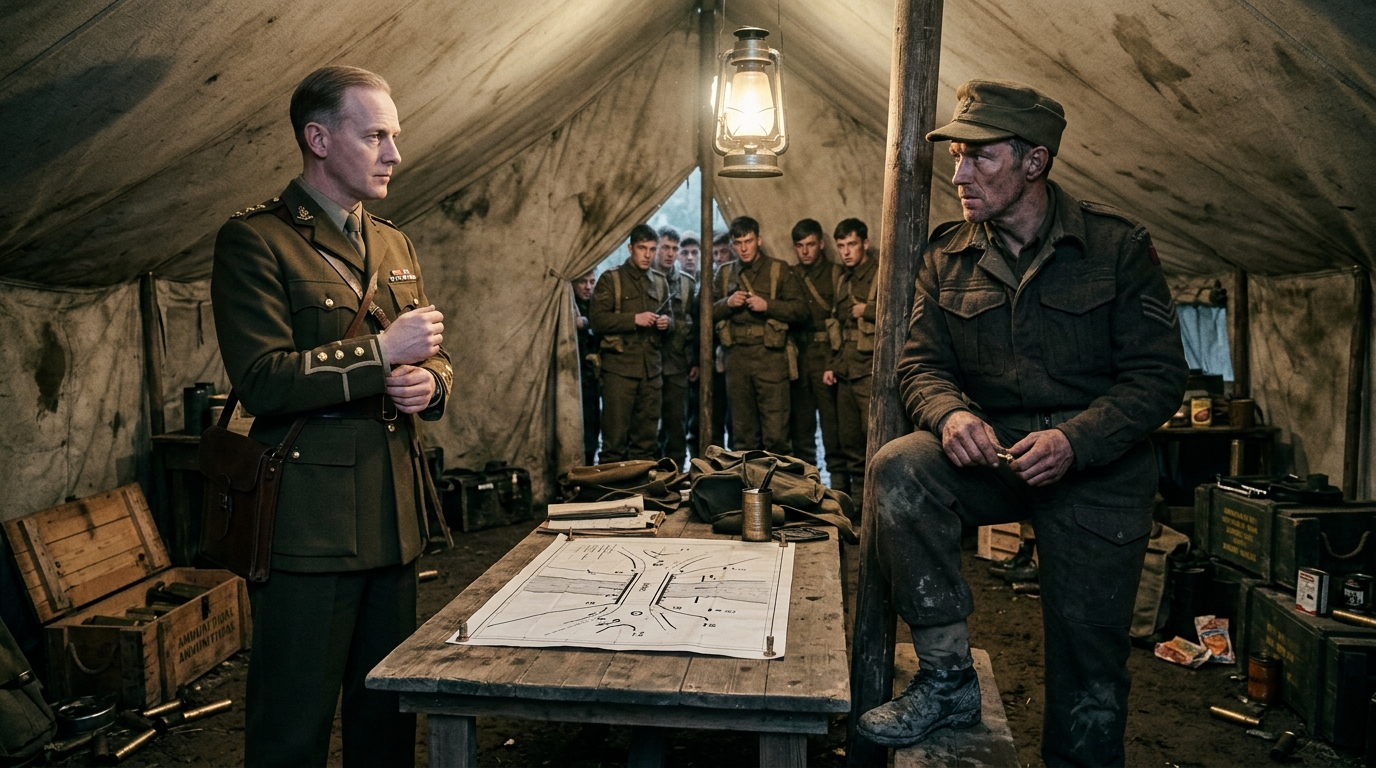
Sergeant William MacAllister leaned his hip against the wooden support of the forward command tent, scraping a crescent of thick gray clay from his boot heel with the flat edge of a brass threading adapter. The metal was cold against his calloused thumb. He rolled it over twice, feeling the precise, clean cut of the threads—a stark contrast to the sloppy, rushed orders bouncing off the canvas overhead.
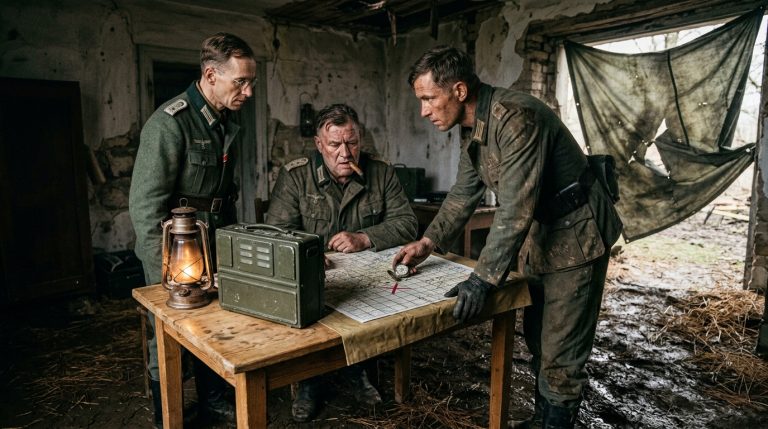
“Eight men. Trench knives and silence,” Colonel Vance said. He didn’t look up from the dry map table. His uniform was spotless, the golden eagles on his collar gleaming under the soft yellow glow of a kerosene lamp. “You crawl through the brush, clear the seven sentries on the span, and secure that bridge. No gunfire. If they hear a single shot, they blow the charges, and three miles of our armor grinds to a halt.”
Mac stopped rolling the brass adapter. He looked at the paper map pinned to the crate, then at the Colonel’s dry, pale hands resting beside a leather map case.
“With respect, sir,” Mac said, his voice flat, raspy from three days of damp air. “Seven men with overlapping fields of fire on open stone isn’t a stealth problem. It’s a butcher shop. The first guard you stick is going to scream. The second is going to yell. By the time my third guy hits the mud, their engineer in the bunker pushes the plunger.”
Vance finally raised his eyes. They were pale, cold, and entirely unbothered by the reality fifty yards down the ridge.
“It is a direct order, Sergeant,” Vance replied smoothly, adjusting the cuff of his jacket. “Standard infantry doctrine specifies quiet cold-steel infiltration for rigged objectives. You have your assignment. Disobeying it will mean a court-martial before the sun comes up.”
“Understood, Colonel,” Mac said.
He didn’t argue. A man who had spent ten years tuning carburetors in Detroit knew when an engine was rusted past saving; you didn’t argue with the rust, you just swapped the part. Mac slipped the brass adapter back into his deep jacket pocket, felt the heavy iron wrench tucked beside his ribs, and walked out into the dark.
CHAPTER 2: INTO THE BLACK
The blackness outside the tent wasn’t just night; it was a solid wall of French mud and wet timber. Mac kept his head down, the brim of his canvas cap channeling cold drops down the bridge of his nose.
Behind him, in the staging trench, eight men were silently checking their trench knives. Young boys, mostly. Kids from Ohio and Pennsylvania who still believed a clean uniform meant an honest command. They were greasing their blades, thinking they were about to execute a textbook heroics run because a man with silver eagles on his collar told them it was doctrine.
Mac didn’t head for the trench line. He swung wide, cutting past the supply wagon where the grease from a 2-and-a-half-ton GMC engine hung thick in the damp air.
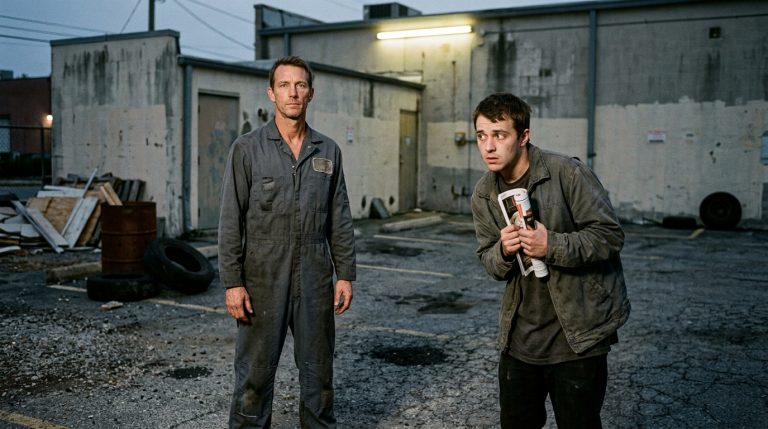
“Hey, Mac,” Dennis whispered from the dark, his voice barely cutting through the rain. He was huddled beneath a canvas tarp, wiping a pair of oil-stained pliers on his sleeve. “The squad’s forming up near the culvert. Where are you heading?”
“Scouting the approach,” Mac said, his voice flat. “Tell the squad leader to hold the line until I throw a signal. Nobody moves until I say the path is clear.”
Dennis paused, the pliers hanging loose in his hand. He looked at Mac, then down at the bulge beneath Mac’s field jacket where the heavy iron wrench rested against his ribs.
“The Colonel said team attack at 0300, Mac. Synchronized.”
“The Colonel’s sitting on a dry crate drinking black coffee,” Mac said. “Hold the squad.”
He didn’t wait for Dennis to process the breach of protocol. He turned his shoulder into the drizzle and slipped over the lip of the embankment.
The ground dropped away into fifty yards of dead space. Below lay the Cien River, a swollen, black snake churning against stone footings, and spanning it was the bridge—a long, narrow slab of timber and steel.
Mac dropped to his belly in the tall, soaked grass. He didn’t use the standard low-crawl taught in basic training; that was for parade grounds. He moved like an auto mechanic working under a suspended chassis, keeping his spine low, sliding his heels through the mud, using the natural dip of the wheel ruts to hide his profile.
A hundred feet ahead, the first German checkpoint flickered. A single hurricane lantern burned behind a wall of soaked sandbags, throwing jagged shadows across the road.
Mac stopped. He reached into his pocket, his calloused fingers finding the cold, threaded brass adapter. He didn’t pull it out. He just felt the hard edges, grounding himself in the reality of metal and thread while his eyes mapped the perimeter.
Seven guards. Two on the near approach, two walking the upper span, two on the far barrier, and one engineer tucked inside the sandbagged bunker at the center.
The floodlights weren’t sweeping. They were fixed, pointing down the main road, leaving the wet stone abutments in deep, ink-black shade. Mac watched the nearest sentry, a tall guard in a heavy wool coat, stamp his boots against the cold. The guard took a drag from a short cigarette, the tiny orange ember glowing brightly in the dark.
Mac shifted his weight. A loose pebble clicked under his boot.
The ember stopped moving. The guard turned his head slowly toward the ditch, the silhouetted long barrel of his rifle rising into the light.
Mac froze, his chest pressed flat into the cold sludge, holding his breath as the rain beat a steady, rhythm against the back of his neck.
CHAPTER 3: MECHANICS OF SILENCE
The boot came down six inches from Mac’s left hand.
Water squelched out from under the leather sole. Up close, the guard smelled of stale tobacco and wet wool. He swung his head toward the dark treeline, the rifle barrel tilted low, searching the shadows for whatever had made the sound.
Mac didn’t reach for a blade. He didn’t have the room, and a knife was messy—it gave a man time to gasp, to catch his breath for a shout.
Instead, Mac’s calloused fingers closed around the thick neck of the heavy iron wrench hidden against his ribs. He waited for the guard’s weight to shift onto his forward foot.
The guard took that final half-step. Mac drove his shoulder upward from the mud, hitting the back of the guard’s knee with a sharp, heavy shove.
The man’s leg buckled. As he dropped forward into the ditch, Mac slammed the flat side of the iron wrench cleanly across the base of the sentry’s helmet neck-guard.
The impact was a dull thunk, choked off instantly by the rain.
The guard went limp before his face hit the mud. Mac caught the falling rifle by the wooden stock before the sling could rattle against a belt buckle. He dragged the heavy coat deeper into the drainage ditch, wedging the unconscious sentry beneath a tangle of wet brush.
One down. Six to go.
Mac stayed low, crawling past the sandbag outer barrier toward the second checkpoint post.
The second sentry stood under the edge of a wooden overhang, looking out across the river. He wasn’t watching his flank; he was relying on the floodlight casting long, harsh shadows down the center of the span.
Mac reached into his coat pocket and pulled out the small brass threading adapter.
He didn’t use it as a tool. He tossed it lightly sideways onto the wooden decking of the near approach, thirty feet behind the sentry.
The tiny brass cylinder bounced twice—clink, clink—a sharp, metallic sound against the wet timber.
The guard spun, his rifle instantly shifting toward the sound on the deck. He stepped away from the overhang, turning his back entirely to the dark shadow beside the sandbags.
Mac moved in that single gap of motion. He closed the ten feet between them without rising above a crouch, swinging the iron wrench in a short, brutal arc that connected right behind the guard’s ear.
The guard dropped like a sack of damp grain. Mac caught him under the arms, easing the weight down onto the decking so the boots wouldn’t slam against the floorboards.
Mac straightened up in the dark under the overhang, wiping a streak of engine grease from his cheek.
His eyes drifted down toward the timber decking near his feet.
In the faint, amber spill of the hurricane lantern, he noticed something odd about the floorboards running along the center of the bridge. The wooden planks weren’t spiked flush like the rest of the road.
A thin, insulated black wire ran straight through a drilled notch between two boards, vanishing underneath the span toward the central bunker.
Mac knelt, running his bare thumb over the fresh wood shavings around the drill hole.
This wasn’t just a manual plunger setup. The charges weren’t waiting for a man to push a handle. The floorboards themselves were wired to a pressure circuit.
If an entire eight-man squad ran onto this bridge with cold steel drawn, their combined weight on those loose planks would trip the current before they ever reached the bunker door.
Vance’s direct order wasn’t just stupid. It was a guaranteed detonation.
CHAPTER 4: THE FALSE PLUNGER
Mac stayed low, crawling along the outer support girder beneath the roadbed until he reached the rear of the sandbagged bunker at the center of the span.
The bunker was small, crammed with damp sandbags and reinforced by heavy oak timbers. Inside, a single lantern glowed dim red, casting long, erratic shadows against the earth wall.
Through the narrow observation slit, Mac saw him. The German engineer sat on a wooden crate, his hands resting lightly on the T-handle of a heavy mechanical plunger. His eyes were glued to the main approach road, waiting for the sound of boots on stone.
Mac didn’t try to force the thick timber door. He reached around the side casing, his rough palm finding the main electrical junction box bolted to the rear frame.
He wedged the flat edge of his iron wrench between the iron casing and the wood.
With one hard, steady push, he popped the metal lid off the box.
Inside sat a dual-line relay switch. The line running to the plunger was completely dry—unwired, a dead line meant purely for show. The second line, connected directly to the floorboard pressure circuit he had just cut, ran straight down into the main river pylons.
Mac stared at the dry terminal screws in the box.
The German engineer wasn’t waiting for an order to push that plunger. The plunger was a decoy, designed to keep an attacking force focused on taking the bunker while their boots tripped the pressure circuit on the deck.
Mac reached into his coat pocket to pull out his utility snips, his knuckles brushing against a folded piece of paper he’d snatched off Colonel Vance’s map crate back at headquarters.
It wasn’t a tactical grid map.
In the faint red spill from the bunker slit, Mac opened the damp paper. It was a signed transfer order for Colonel Vance, assigning him to a rear-guard administrative depot in Paris, effective at 0600 hours—less than three hours away.
Vance wasn’t trying to secure this crossing for the armored column. He needed a loud, violent distraction at the river to draw German artillery attention north while his personal transport cleared the southern sector.
He had ordered an eight-man knife squad onto a bridge he knew was rigged to blow, purely to create a body count loud enough to cover his own exit.
A boot scraped against the gravel inside the bunker entrance.
Mac folded the paper back into his pocket, his jaw tightening until his teeth creaked, and gripped the iron wrench in his right hand.
CHAPTER 5: THE CORNERED ENGINEER
The German engineer stepped backward out of the doorway, turning to check the wire feed along the rear sandbags.
Mac didn’t give him room to set his feet. He lunged from the shadow of the doorframe, shoving his left forearm hard into the man’s upper chest and pinning him flat against the damp timber wall.
The engineer gasped, his eyes widening in the dim lantern light as he clawed at Mac’s sleeves. His right boot kicked out, catching the wooden crate and sending a cluster of loose glass insulators shattering across the floorboards.
Mac jammed the shaft of the iron wrench under the man’s chin, levering his head back against the beams to keep him from drawing a full breath for a shout.
“The wire’s cut,” Mac rasped in his low, gravelly voice, his chest heaving as he held the position. “The pressure floor is dead. The junction box is open.”
The engineer’s fingers dug into Mac’s wrists, his feet scraping frantically against the dirt floor, trying to gain traction. He didn’t try to reach for the T-handle plunger on the crate—he knew as well as Mac that the dry line went nowhere.
Instead, the man dropped his right hand toward his belt, fumbling with the stiff leather strap of a side holster.
Mac saw the movement in the red light. He drove his hip forward, trapping the engineer’s wrist against the sandbags before the leather flap could unbuckle.
“Don’t do it,” Mac grunted, his forearms trembling under the strain of holding a full-grown man pinned against oak timber. “Your perimeter guards are already in the ditch. Nobody is coming down this road.”
The engineer froze, his breath coming in sharp, ragged whistles through his teeth. His hand relaxed against his holster, but his eyes darted sideways toward the central wire conduit running up the main support post.
A tiny, secondary contact lever was mounted near the ceiling timber—a manual bypass bridge.
The engineer suddenly threw his entire weight upward, twisting his shoulder to break Mac’s grip and reaching a hand toward that ceiling contact.
Mac didn’t fight the force of the turn. He rode the momentum, pivoting on his heels and pulling the engineer down by his collar.
Both men hit the dirt floor with a heavy, dull thud.
Mac rolled instantly, pinning the engineer’s arm behind his back and jamming his knee into the small of the man’s spine. With his free hand, Mac pulled a length of scrap copper wire from his jacket pocket and wrapped it three times around the man’s wrists, twisting the ends tight with the flat jaw of his iron wrench.
The engineer lay breathing heavily against the dirt, his neck slick with sweat, staring up at the cut junction box.
Mac pulled himself up, his knees popping in the cold air, and stood over the bound man. He reached into his field coat and pulled out Colonel Vance’s signed transfer paper, letting the corner of the damp sheet brush against the lantern cage.
“Your trap was built on a pressure switch,” Mac said, wiping a smear of red dirt off his cheek with the back of his hand. “My Colonel’s trap was built on eight dead men.”
He turned toward the open doorway, holding the heavy iron wrench firmly at his side as the low, distant rumble of American diesel engines echoed up the river valley.
CHAPTER 6: THE UNBROKEN SPAN
The command jeep slammed its brakes in the clay, spraying dirty water across the road barrier.
Colonel Vance stepped out before the wheels stopped turning, his polished boots sinking instantly two inches into the sludge. His eyes darted past Mac, frantically scanning the empty approach timber, then locked onto the intact stone pillars of the bridge. A sharp twitch caught the side of his mouth as he realized there were no flames, no sound of mortar fire, and no smoking rubble.
“Sergeant,” Vance snapped, stepping toward the curb with his fingers resting on his leather holster strap. “Why aren’t those charges blown? Where is the engagement? I ordered a full knife assault on this objective at 0300 sharp!”
Dennis stepped out from behind the sandbag wall, holding a heavy roll of cut electrical wire in his hand, his eyes fixed cold on the Colonel. Behind him, the rest of the squad emerged silently from the treeline, their trench knives still sheathed at their belts.
“The perimeter is clear, Colonel,” Mac said. He didn’t raise his voice. He rolled the brass adapter across his knuckles once before slipping it into his pocket. “Seven sentries neutralized without a single shot. The engineer is bound inside the bunker.”
Vance’s neck reddened above his clean starched collar. He took another step forward, his jaw tight, weaponizing the full weight of his brass eagles.
“You disobeyed a direct tactical operational plan,” Vance said, his voice rising, sharp and breathless. “You bypassed squad deployment protocol! You left your commander blind on the grid! This is insubordination under active fire, Sergeant. I will have you stripped of rank and court-martialed before the morning column reaches this river!”
Mac reached into his field coat with his right hand.
He didn’t pull a weapon. He pulled the damp, folded sheet of paper he had taken from the command tent crate and held it out flat in his palm.
“You weren’t waiting for a grid report, Colonel,” Mac said smoothly. “You were waiting for explosions.”
Vance’s gaze fell onto the official headquarters stamp on the paper. The color drained from his face so fast his lips looked gray under the dim lantern light.
“That is classified command correspondence—” Vance began, reaching out a hand to snatch the document.
Mac didn’t pull the paper back. He simply stepped forward, letting the heavy iron wrench in his left hand drop against the steel hood of the jeep with a loud, metallic CLANG that made Vance flinch.
“Your transfer to Paris is signed for 0600,” Mac said, his voice as steady as an engine block. “You sent eight working men into an automated electrical trap so the noise would pull artillery away from your escape road to the south. You didn’t want us to save the bridge. You wanted us to die loudly.”
Dennis stepped up beside Mac, tossing the coil of cut copper wire onto the hood right beside the wrench.
“The armor’s coming up the road now, Colonel,” Dennis said softly, his knuckles white against his rifle stock. “And the advance vanguard commander is riding in the lead Sherman.”
Vance looked at the wire, then at the paper in Mac’s hand, then at the eight men standing in a quiet, unbroken line along the approach.
His mouth opened to bark another order, to cite military code, to threaten authority—but the words died in his throat. His shoulders sagged, the polished eagles on his collar suddenly looking small and useless against the cold French rain.
Mac folded the paper carefully, slid it into his inner pocket, and picked his iron wrench off the hood.
He didn’t yell. He didn’t demand an apology. He turned his back on the Colonel and walked out onto the center of the span, leaning his weight against the timber railing as the heavy steel treads of the first American tank rumbled smoothly onto the unbroken wood.
Mac pulled a clean rag from his pocket and began slowly wiping the gray river mud from the threads of his iron wrench.