The Cold Cadence of Autumn: A Grounded Tale of Survival in the Shattered Hurtgen Pines
CHAPTER 1: IRON IN THE PINES
The rot beneath the pine needles reeked of damp earth and old iron.
Oberfeld Klaus Brener pressed his chest against the soaked timber of a fallen oak, his gloved thumb tracing the jagged fracture on the glass face of his silver pocket watch. Click. The stem gave a dull, metallic snap in the heavy air. Across the ravine, the gray mist hung motionless between the trunks, thick enough to chew.
“Don’t touch the straps, Holtz,” Brener muttered, his voice flat, stripped of all weight.
Private Holtz froze, his knee sank three inches into the mud beside the protruding oak root. His fingers hovered an inch above the canvas flap of the abandoned olive-drab pack.
“It’s clean, Oberfeld,” Holtz whispered, his breath puffing white against the dark bark. “No wires. No tension.”
“Everything in this woods has tension,” Brener said. He slid forward on his stomach, the wet wool of his trousers dragging through the black slush. He reached out with a bare knuckle, feeling the seam of the canvas. Cold metal met his skin inside the flap. A sheet-metal box, painted drab green, stamped with white block lettering: SCR-300.
Strauss crouched two paces back, his old Mauser held low across his waist, his grey eyes fixed on the ridge to the west. “It’s small,” the old soldier observed, his jaw working on a piece of dried rind. “Weighs less than a supply crate.”
“It’s a radio,” Brener said, dragging the strap clear of the tangle of roots. The canvas gave a heavy, tearing sound as it pulled free from the suction of the clay. He didn’t lift it by the wire. He cradled the five-kilo frame against his ribcage, feeling the chill of the casing bite through his tunic.
A sharp crack shattered the stillness high in the canopy three hundred meters west. Not a rifle shot. A splintering top-branch under the weight of a spotter’s boot.
“Movement,” Fuchs grunted from the left flank, his mechanic’s hands already sliding the bolt of his Kar98 back a quarter-inch to check the brass round in the breach. “Two men. Heading down the dry creek.”
“We don’t shoot,” Brener ordered, clicking the pocket watch closed with a soft thrum. “We carry the iron back to the Major.”
“They left it behind,” Holtz muttered, wiping mud from his chin with a slick sleeve. “Why leave something like that?”
“Because they have ten more behind the ridge,” Brener said, pushing himself up off the rot. His knees popped in the wet chill. He didn’t look at the ridge. He turned his back to the enemy, clutching the heavy metal box to his chest like a stolen ledger, and stepped back into the shadows of the Hurtgen.
CHAPTER 2: THE COMMAND BUNKER
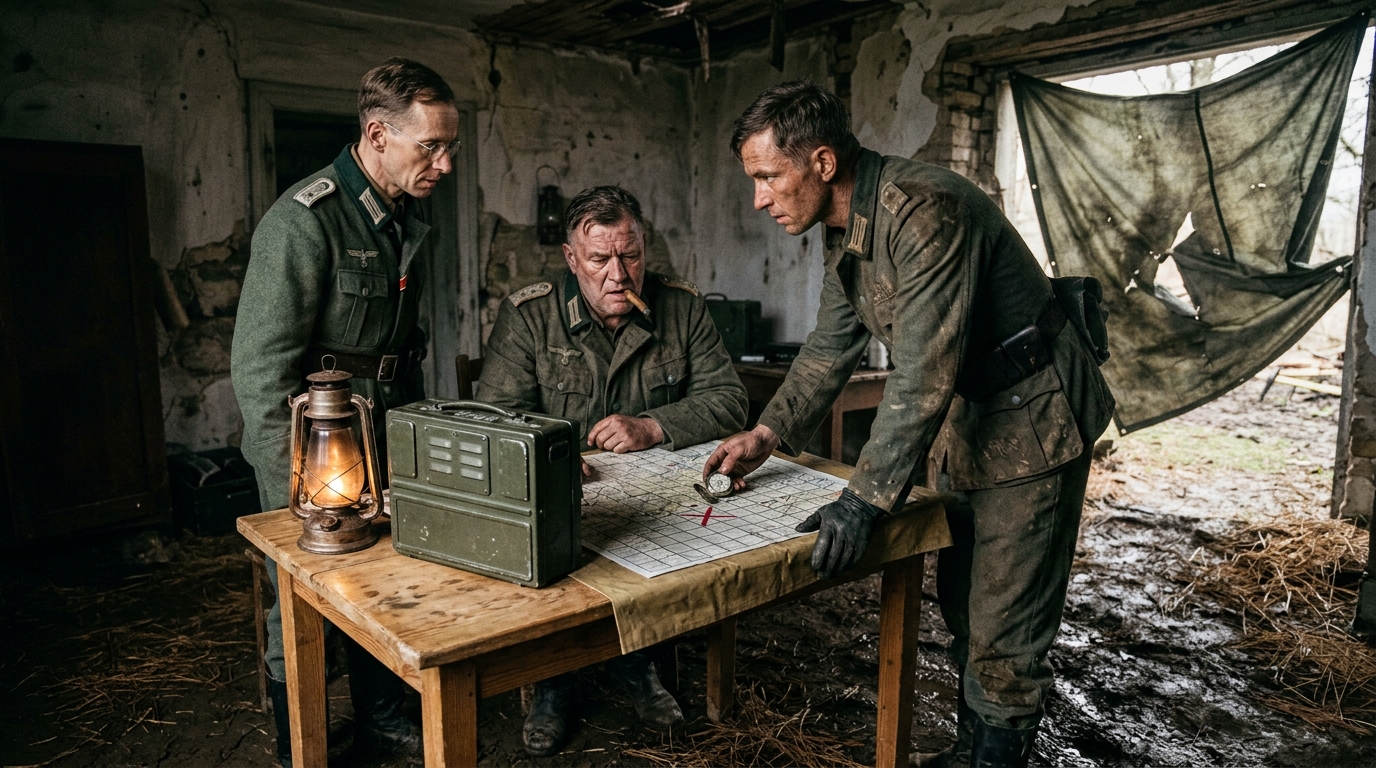
Major Friedrich Veesterhouse did not look up from the oilskin map stretched across the pine table.
His thumb, thick-jointed and scarred from a shrapnel tear in Russia, pressed down on the grid lines of sector 447. The tarpaulin covering the ruined eastern wall snapped violently as a gust of pine-scented wind whipped through the breach, scattering three dry pine needles across the paper.
“Grid four-four-seven,” Veesterhouse said. His voice sounded like dry gravel dragged over oak planks. “How far inside our screen?”
“Eight hundred meters, Herr Major,” Brener replied. He set the heavy canvas bag down onto the edge of the table. The wet cloth slapped against the wood, leaking a thin stream of dark, pine-scented water across a tactical overlay. “Their patrol scattered when Langanger’s machine gun opened up from the ridge. They dropped it in the creek bed.”
Veesterhouse finally raised his eyes. They were heavy, underlined by dark, purple hollows that spoke of three weeks without four continuous hours of sleep. He didn’t touch the bag immediately. He reached into his tunic pocket, pulled out a small, bent cigar, and pressed it between his teeth without lighting it.
“A radio,” the Major murmured, turning his head slightly toward the dark corner of the room. “Hauptmann Vogle.”
From the shadows near the cold brick fireplace, a thin man in a worn field jacket stepped into the dim light of the hurricane lantern. Hauptmann Ernst Vogle adjusted his round, wire-framed glasses with a quick, nervous flick of two fingers. His uniform was immaculate despite the damp, every button fastened to the throat.
“You called for signals, Herr Major?” Vogle asked. His eyes swept over the wet canvas, fixing instantly on the white stenciled lettering visible through the flap. SCR-300. His jaw tightened by a fraction of a millimeter.
“Tell me what we are holding, Ernst,” Veesterhouse commanded, gesturing toward the bag with a flat hand. “Brener’s boys think they brought back an American field telephone.”
Vogle stepped forward, his boots making no sound on the dirt floor. He pulled back the canvas flap with a practiced, methodical touch, revealing the olive-drab sheet-metal box and its array of heavy bakelite knobs.
“It is not a telephone, Major,” Vogle whispered, his voice dropping an octave as his fingers brushed the frequency dial. He turned the metal case over, his eyes scanning the stenciled panel on the face. “It is an FM transmitter-receiver. Galvin Manufacturing. The Americans call it a walkie-talkie.”
“FM?” Veesterhouse leaned over the table, his broad shoulders blocking the lantern light. “Not amplitude modulation?”
“Frequency modulation,” Vogle confirmed. He unlatched the lower battery compartment, peering inside at the rubber-sealed gaskets. “It cuts straight through the forest density. Our Torn.Fu.d2 sets bounce off the pine canopy and drown in static because of the iron deposits in the ridge soil. This thing… this thing ignores the trees.”
Brener shifted his weight, his worn jackboots grinding a stone into the dirt. He pulled his tarnished silver pocket watch from his pocket, his thumb clicking the stem open and shut in a quiet, rhythmic cadence. Click. Clack.
“Weight?” Veesterhouse asked simply.
“Five point four kilograms with the internal battery pack,” Vogle said. He picked up the unit with one hand to demonstrate, his arm showing no strain. “One infantryman carries it on his spine. He keeps his rifle in his hands.”
Veesterhouse stared at the metal box. The tarpaulin flapped again, a harsh, rhythmic slap that sounded like a rifle butt hitting wet wool.
“Our Torn.Fu.d2 weighs twelve kilograms,” Brener observed, his voice cutting through the wind. “And it takes two men to move it. One to carry the crate, one to turn the hand-crank generator.”
Vogle didn’t answer. He had reached into the canvas side-pocket of the American pack. His fingers pulled out a folded slip of heavy paper, stiffened by moisture. As he unfolded it under the lantern light, a small piece of cloth tape fluttered out, sticking to his thumb.
“What is that?” Veesterhouse demanded.
“A grid overlay,” Vogle said. His voice suddenly lost its technical detachment. He laid the small paper square on the table beside the main map. “Belongs to a Corporal Marcus T. Reeves. HQ Company, 222nd Infantry.”
Brener leaned in over Vogle’s shoulder. The paper was covered in penciled grid coordinates, but in the lower left quadrant—right over grid 447—a tiny, precise red cross checkmark was inked directly over the exact symbol representing their farmhouse command post.
“They aren’t searching for us,” Brener said, his thumb stopping dead on the watch stem. “They already know where the roof is.”
CHAPTER 3: THE SCRAMBLE AND THE SILENCE
“Can you plug into their channel?” Major Veesterhouse asked, his cigar shifting from one corner of his mouth to the other. “Hear what they’re saying?”
Hauptmann Vogle took his thumb off the paper, leaving a small, damp smudge right over the farmhouse coordinates. He pulled a brass screwdriver from his breast pocket and unthreaded the corner casing of the metal box.
“We can’t intercept them, Herr Major,” Vogle said, lifting the top panel. The smell of fresh varnish, heated copper coil, and dry battery chemical rose into the damp room. “The internal crystals are preset to fixed channel bands. Without their daily signal matrix, we’d be spinning dials in the dark across eighty distinct frequencies.”
“Then what good is it to us?” Brener asked. He snapped his silver pocket watch shut, the metallic click echoing in the ruined room.
“It tells us how they move,” Vogle replied flatly. He picked up the detached receiver lead, his wire-framed glasses sliding slightly down the bridge of his wet nose. “This isn’t a radio for sending reports to division headquarters ten miles back. It’s built for a sergeant sitting fifty yards from our machine-gun nest to talk to a battery three miles behind him.”
Veesterhouse reached down, his heavy, dirt-caked fingers lifting the brass-knobbed face of the set. “Voice,” he muttered to himself. “No Morse. No telegraph wire to run through the mud.”
“They don’t wait for lines to be laid,” Vogle said. He picked up a small wire brush, gently scraping a layer of dried mud from the power terminal. “Our signal teams spend two hours running wire through pine thickets every time we shift three hundred meters. The Americans just walk through the brush, flip a toggle, and speak.”
“And if we jam it?” Brener asked, leaning over the edge of the pine table. “Our station back at core—”
“—Is thirty kilometers away,” Vogle cut in, not looking up from the casing. “FM signals wrap around local ridges, but high-frequency jamming requires double the output power on the exact same band. We’d have to drag a six-ton transmitter truck right into this ravine. It would last four minutes before their spotters dropped high explosives on the exhaust pipe.”
A cold gust blew under the tarpaulin, snapping the heavy canvas against the stone wall with a loud crack.
Veesterhouse slowly walked toward the open gap, looking out into the gray, motionless fog of the Hurtgen. He spat the unlit cigar core onto the dirt floor.
“They don’t have better soldiers,” the Major said softly, his voice barely carrying over the wind in the trees. “They just have a shorter fuse.”
Vogle carefully aligned the sheet-metal cover back onto its gasket and tightened the four brass screws. He set the screwdriver down with a quiet clink on the wooden table.
“It’s clean,” Vogle said. “Battery has maybe six hours of charge left. But without their frequency card, it’s just five kilograms of dead steel.”
Brener looked at the red cross marked over their heads on the waterlogged overlay. “It isn’t dead,” he said quietly, touching the cold metal frame of the box. “It already delivered its message.”
CHAPTER 4: THE CRACK IN THE GLASS
The air in the room compressed instantly, popping Brener’s eardrums with a sharp, iron-tasting punch.
Fifty yards to the north, a hundred-year-old pine sheared at the trunk, its massive crown collapsing across the dry creek bed with a roar of tearing bark and shattered timber. Fine, gray mortar dust rained down from the farmhouse rafters, covering Major Veesterhouse’s oilskin map in a pale, chalky film.
“Impact,” Holtz shouted from the outer trench, his voice cracked with mud and fear. “Ranging round! Sector four-four-seven!”
Brener didn’t run for the cellar. He pulled his silver pocket watch from his tunic pocket and thumbed the stem open.
The second hand swept past the twelve. Click. Clack. He stood rooted beside the doorframe, watching the fine white powder settle over the dark brass dials of the captured SCR-300 on the table.
“Three hundred meters short,” Vogle said, his voice unnaturally level as he picked up his wire-framed glasses from the dirt floor and wiped the dust off against his sleeve. A tremor ran through his left index finger—just a tiny, involuntary twitch as he hooked the wire arms back behind his ears. “That wasn’t a random salvo. That was an adjustment call.”
“They’re walking it in,” Veesterhouse said. He didn’t drop to his knees. He simply leaned heavier against the pine table, his knuckles turning white where they gripped the rough wood. “One minute to the correction.”
“Forty-five seconds,” Brener corrected, staring at the cracked crystal of his pocket watch. The sweeping hand ticked over the three. “Their observer is sitting up on the ridge with a handset pressed to his ear. He doesn’t need to consult a battery liaison. He doesn’t need a runner.”
A second whistle tore through the upper branches—closer this time, a screaming tear that made the stone foundation beneath their boots shudder.
The explosion hit the eastern stone wall of the kitchen. A shower of pulverized red brick and black loam blasted through the canvas tarpaulin, shredding the thick fabric into flying rags. Veesterhouse was knocked sideways into the map table, his shoulder slamming hard against the pine frame, but his heavy boots caught the dirt floor before he fell.
Brener felt a sharp sting on his cheek as a flake of hot stone clipped his jaw. He didn’t wipe the smear away. He kept his eyes locked on the watch face.
“Thirty-two seconds,” Brener called out over the ringing in his ears. “They aren’t guessing. They have the precise battery elevation locked into their fire direction center.”
Vogle reached down, his fingers clawing through the scattered debris on the table until they closed around the handle of the American radio bag. He pulled it close to his ribs, holding the five-kilo box like a shield. “We move the command post or we die under this roof.”
“No,” Veesterhouse said, pushing himself upright with a growl. His eyes were bloodshot, the whites completely webbed with red veins from dust and exhaustion. “If we move now into the open woods, their forward observer sees the movement from the ridge. They switch from air-burst to anti-personnel shrapnel.”
Brener snapped the watch cover closed. The dull metal latch made a tiny, definitive click against the background rumble of falling branches.
“The radio didn’t give away our location, Herr Major,” Brener said, stepping over a pile of fallen masonry toward the table. “Our static position did. They marked this chimney three days ago.”
Veesterhouse looked at the red cross marked on the waterlogged paper under the dust. His jaw worked silently as he realized the cold, mathematical reality facing his squad.
“Holtz! Fuchs!” Brener barked toward the ruined doorway, his voice cutting clean through the smoke. “Prepare the packs. We aren’t defending a farmhouse anymore. We’re standing inside a bullseye.”
CHAPTER 5: THE CORNERED COMMAND
“We don’t move until I say we move,” Veesterhouse growled, his knuckles white against the splintered pine.
“Herr Major, with respect,” Brener stepped closer, his boots crunching over a heap of shattered stone tile. He held up his pocket watch, its cracked face reflecting the orange flicker of the lantern. “That second shell hit forty meters off the north wall. The next one comes through this ceiling. Their observer doesn’t even need to look through binoculars—he’s just ticking off grid squares.”
Vogle cleared his throat, a sharp, ragged sound against the hum of falling grit. He pointed a trembling finger at the edge of the captured overlay.
“Look at the margin,” Vogle whispered. “It isn’t just grid four-four-seven. There are four sub-sector coordinates listed beneath the corporal’s name. They didn’t just target the farmhouse—they registered every draw, every tree line within six hundred yards of this stone hearth.”
Veesterhouse stared at the smudged red cross. The audacity of it hit like a cold draft through a cellar floor: the enemy hadn’t stumbled upon their headquarters by chance. They had turned the entire forest sector into a pre-calculated kill box before a single foot patrol even made contact.
“They aren’t fighting us for ground,” Veesterhouse said, his tone turning dangerously quiet. “They’re just clearing a path for their supply trucks.”
“It’s arithmetic,” Brener said flatly. He tucked the pocket watch into his breast pocket and picked up his Kar98 from where it leaned against the table leg. “Cold, plain arithmetic. They have the battery, they have the radio, and they have the time.”
A dull thump echoed from the ridge—a third firing sequence, muffled by the pine needles and heavy mist.
“Out!” Veesterhouse barked, his hand slamming down once on the pine board before he grabbed his leather map case. “Vogle, take the captured box. Brener, clear the trench. We pull back to the dry creek bed before the roof comes down!”
Vogle snatched the canvas strap of the SCR-300, hauling the five-kilo metal box against his hip with a grunt of strain. He nearly tripped over a fallen lintel stone as he lunged toward the canvas-draped gap in the wall.
Brener didn’t wait to see if the Major followed. He hit the open doorway shoulder-first, bursting into the freezing mist just as a high, screaming rush of air filled the canopy above.
CHAPTER 6: THE DUSTY RETREAT
A fountain of red brick dust, shattered pine rafters, and black topsoil erupted high into the gray mist, raining heavy debris across the creek embankment.
Brener didn’t look back at the flames eating the remaining stone wall. He reached into his breast pocket, pulled out his silver pocket watch, and clicked the stem open.
Click. The glass face was thoroughly spiderwebbed now, a single hairline fracture splitting the minute hand down the middle, but the brass gears inside kept their steady, indifferent cadence.
“Eight minutes,” Brener said quietly, his voice barely rising above the hiss of burning timber.
Major Veesterhouse rolled onto his hip in the mud beside him, wiping a thick layer of wet clay from his jaw. He looked at the smoking crater where his command table had stood three minutes earlier.
“They didn’t even send an infantry squad to clear the position,” Veesterhouse spat, his eyes dull with the bitter realization of how small their defense had truly been. “They just placed the call.”
Hauptmann Vogle sat three feet down the slope, his knees pulled up to his chest, carefully wrapping the canvas strap of the captured American radio around his wrist. The olive-drab sheet-metal box was scratched and smudged with black soot, but its metal casing remained entirely intact—indifferent to the destruction around it.
“We can’t jam them,” Vogle said softly, adjusting his spectacles with a muddy knuckle. “We can’t out-talk them. And we can’t hide behind stone walls.”
“So we walk,” Brener said. He slid his Kar98 over his shoulder, feeling the damp leather strap bite into his coat. “We retreat to the secondary line at the ridge, clear of the pre-marked grid.”
“And when they mark that ridge?” Holtz asked from down the trench line, his voice small, clutching his rifle with pale, trembling hands.
“Then we move again,” Brener replied simply. He clicked his watch shut and tucked it deep inside his wool coat, right over his heart. “We don’t give them a static target. We force them to spend their time searching.”
Veesterhouse slowly stood up in the mud, brushing the wet oak leaves from his knees. He looked at Brener, then down at the soot-covered SCR-300 cradled in Vogle’s lap.
“It wasn’t a battle, Oberfeld,” the Major said quietly, the last of his command authority settling into a weary, practical resolve. “It was just an industrial calculation.”
“Yes, Herr Major,” Brener said, stepping out of the creek bed and leading the four-man patrol back into the dense, dark shadows of the pine canopy. “But calculations take time. And as long as we keep walking, we’re taking theirs.”
The four men moved east in a low, disciplined crouch through the damp woods, leaving the burning farmhouse behind. Behind them, the forest fell dead silent again, save for the steady drip of cold rain on pine needles and the faint, distant hum of another world moving through the fog.