The Iron Horizon Where Exhausted Defenses Face the Relentless Weight of Industrial Attrition
CHAPTER 1: DAWN BRIEFING
The ceramic cup stayed cold between my palms.
I turned it once, twice, feeling the rough edge of the chipped rim against my thumb while the operations officer droned on about fuel allocations.
Around the long wooden table, the other flight leaders sat in silence, their flight jackets smelling faintly of stale sweat and high-octane residue.
Nobody looked at the chalk board map on the back wall.
We all knew every pin on it by heart.
We knew which strips had been cratered overnight and which ones were down to their last hundred gallons of filtered gasoline.
“Fourteen thousand feet,” the officer said, tapping a wooden pointer against the sector grid. “Maintain altitude discipline. Conserve every drop.”
I set the teacup down on the scarred wood with a flat, dull click.
My shoulders ached from three years of the same damp bunk and the same grinding routine.
Outside the open hangar doors, the sun was just beginning to burn through the low gray mist hanging over the jungle perimeter.
The mechanics were already at work out on the revetments, cursing softly as they wiped down exhaust ports and patched canvas control surfaces with improvised dope.
There was no talk of glory this morning.
There was only the quiet, heavy realization that the spare parts bins were getting shallower by the week.
I pulled my leather helmet off the bench and tucked it under my arm, stepping past the rows of parked fighters whose metal skins showed the dull gray wear of endless salt air.
The engines would start when we cranked them, but the margin for error was shrinking down to a razor’s edge.
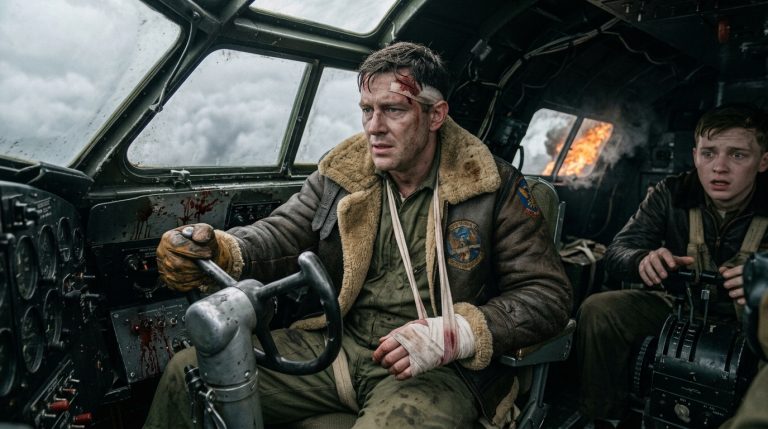
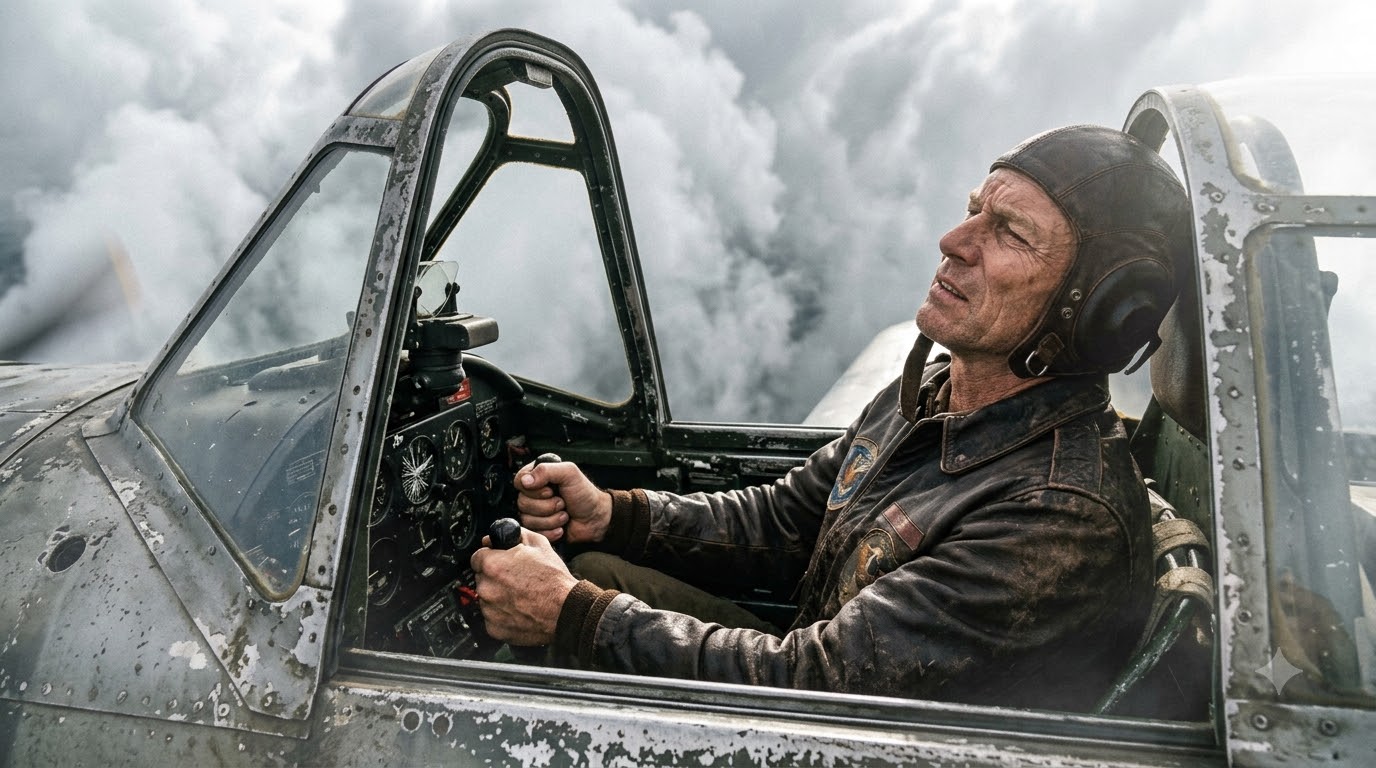
I climbed the wooden boarding ladder and dropped into the cockpit, pulling the leather harness tight across my chest.
The instrument panel stared back at me with its familiar, well-worn dials.
I reached out and flicked the magneto switch, feeling the cold resistance of the toggle beneath my glove.
CHAPTER 2: THE RISING HUM
The engine caught with a harsh, metallic cough that sent a familiar tremor through the entire floorboards of the cockpit.
I shoved the mixture control forward, watching the fuel pressure gauge bounce sluggishly before settling into a steady, vibrating hum.
Around the airstrip, three other fighters sputtered to life, trailing plumes of pale blue smoke against the damp morning grass.
There was no joy in the noise, only the mechanical necessity of keeping the airframe alive for one more rotation.
I glanced down at the instrument console, my gloved thumb brushing the edge of the altimeter glass.
A hairline fracture cut diagonally across the glass face, leaking a thin thread of clear oil that caught the pale morning light.
It hadn’t been there yesterday.
The vibration of the engine was slowly shaking the old instruments apart from the inside out, turning every gauge into a guessing game.
“Leader, Two,” a voice crackled through the headset, flat and dry over the static. “We are clear on the eastern pad. Heading out to fourteen thousand.”
“Acknowledged,” I murmured back, pulling the canopy track shut with a sharp, echoing snap.
We taxied out toward the packed-dirt runway, the tires bumping over roots and shell ruts that the maintenance crews barely had time to fill.
The air out over the Solomon chain was already shimmering with heat, promising another grueling patrol above a sea that offered no safe harbor if an engine let go.
I pushed the throttle forward, feeling the heavy surge of the fourteen-cylinder radial working against its limits to lift the weight off the ground.
The tail rose slowly, the horizon dipping as the wheels broke free from the dirt.
We climbed into the low, bruised clouds, heading north toward the sector grid where the routine patrols always started.
It was just another flight on paper, but the cockpit felt tighter today, the air heavy with the quiet certainty that the margins were gone.
CHAPTER 3: THE BROKEN TURN
The radio channel tore open with a sharp burst of interference that made my teeth ache behind clamped jaws.
I hauled back on the stick, banking our four-ship element hard into the thin vapor of a cloud bank while the altimeter needle twitched against the fractured glass.
That deep, sustained roar echoed through the heavy air again—not the familiar high whine of our radial engines, but a low, thunderous pressure that belonged to something altogether heavier.
“Leader, look high,” Dennis shouted over the open line, his voice tight with sudden strain.
I threw my head back, squinting against the blinding white glare bouncing off the cloud tops.
A dark blue shape flashed out of the sun, plunging downward with a speed that made our climbing airspeed look like standing still.
It didn’t roll or hesitate; it simply dropped like a stone, its massive nose aimed straight at our trailing element.
“Break left,” I yelled, kicking the rudder hard and hauling the control column into my ribs.
The old fighter groaned, protesting the sudden G-load as the engine coughed on a lean fuel mixture, but it obediently swung its nose around.
I pulled the stick tighter, expecting the usual turning duel, expecting the enemy to match our circle the way every fighter we had faced for two years had always done.
The blue machine didn’t turn.
It fired a short, blinding stutter of heavy tracer fire past our starboard wing, then simply hauled its nose upward in a vertical climb that left us behind in a haze of burnt oil.
I slammed the throttle wide open to the stop, but the manifold pressure gauge barely budged, locked firmly by our degrading fuel feed and worn-out supercharger.
There was no room to maneuver, and no extra horsepower left to give.
CHAPTER 4: THE SILENT DEBRIEF
The drop landing gear slammed against the tarmac with a hard, teeth-rattling jar that nearly shook my boots off the rudder pedals.
I taxied the fighter back to the revetment, cutting the mixture control and listening to the fourteen-cylinder radial sputter, choke, and finally die in a thick cloud of blue exhaust.
The silence that followed was heavy, broken only by the ticking of cooling metal and the low murmur of ground crew rushing toward the wing roots.
Dennis dropped out of his cockpit two planes down, slamming his canopy track shut with an aggressive wrench of his arm.
He walked over to my wingtip, pulling his leather helmet off and wiping a thick sleeve of grease across his forehead.
“We didn’t even touch them,” he muttered, staring hard at the fresh rivet leaks along the cowling. “They stay high, they dive fast, and when we pull up, they’re already gone.”
I didn’t answer right away, stepping down onto the dirt and feeling the damp heat of the jungle wrap around my collar.
I reached out and ran a gloved finger along the trailing edge of our starboard aileron, finding the fabric stretched taut and brittle under decades of salt and sun.
The mechanics were already swarming the airframe, their faces tight with quiet worry as they checked the oil pans and found them half-empty.
“How much fuel do we have left for tomorrow’s dawn run?” I asked, looking past Dennis toward the corrugated iron supply shed.
The crew chief stepped out from beneath the wing, holding a stained dipstick between two fingers with a deliberate lack of urgency.
“Enough to get airborne, Lieutenant,” the old mechanic said, his voice flat as he wiped the metal clean on his trousers. “Just don’t expect enough reserve to chase anything that climbs away.”
CHAPTER 5: THE CLOSING NET
I dropped the rag into the metal drum with a dull, echoing clatter that seemed to emphasize how empty the compound really was.
Dennis leaned against the propeller blade of our lead aircraft, his jaw set hard as he watched the evening patrol reports stack up on the operations desk.
“They’ve adjusted their sweep patterns,” Dennis said, his fingers drumming a nervous, uneven rhythm against the cold steel of the propeller hub. “They aren’t taking the bait on the low turns anymore.”
“They don’t have to,” I replied, pulling a worn leather notebook from my pocket and flipping to the latest sector tally. “When you hold all the cards, you don’t need to chase anyone into a trap.”
The numbers on the page didn’t lie; every day our patrol radius shrank by ten miles, constrained entirely by fuel consumption and the dwindling count of serviceable airframes.
The command staff back at headquarters still issued directives about holding the line and maintaining offensive spirit, but those orders felt hollow when translated into the gritty reality of our maintenance sheds.
We weren’t fighting an enemy tactic anymore; we were fighting an industrial machine that simply replaced its losses faster than we could count them.
I closed the notebook with a sharp snap that cut through the humid evening quiet.
“Get some rest,” I told Dennis, turning toward the dim glow of the briefing tent. “Tomorrow we fly defensive rings only. No chasing.”
He didn’t argue, which told me everything I needed to know about how thin our margins had become.
CHAPTER 6: THE DUSTY GRAY
The damp canvas fell back into place, sealing out the pale moonlight and leaving only the dim amber glow of a single hurricane lamp on the wooden desk.
Dennis sat on an overturned fuel tin in the corner, staring down at his boots while the silence settled over the compound like a physical weight.
There was no radio chatter left to monitor, and no morning patrol sheets to revise under the harsh light of dawn.
The horizon outside had finally narrowed down to what our worn machines and failing fuel could sustain—nothing more, and nothing less.
I reached out and picked up the chipped ceramic teacup, turning its rough rim slowly between my thumb and forefinger.
The illusion of infinite momentum, the comforting bedtime stories of unmatched spiritual superiority, and the blind faith in obsolete metal had all burned away to ash.
What remained was just the raw, unyielding truth of the dusty gray—the hard realization that wars aren’t won by isolated brilliance when facing an endless tide of industrial might.
I set the empty cup down on the bare wood, the small clink echoing clearly in the quiet room.
Outside, the first faint streak of pale gray light began to bleed across the jungle canopy, announcing another day without noise, without illusions, and without regret.