Steel, Blood, and Cold Determination: The Relentless Battle to Bring a Broken Crew Home Across Enemy Skies
CHAPTER 1: SHATTERED GLASS AND SILENCE
The blast tore through the laminated glass right between the two seats.
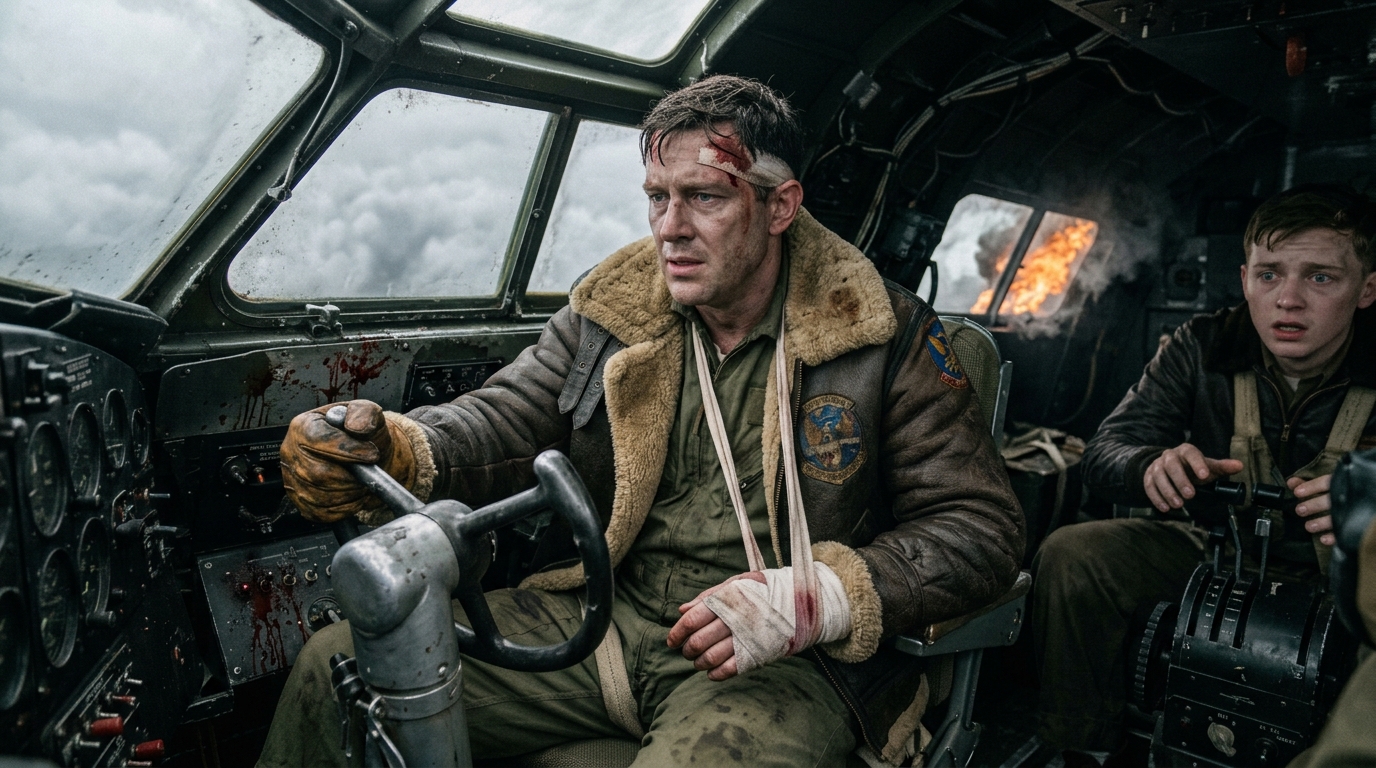
Pain flared across William Loi’s forehead as jagged splinters of steel and glass sliced into his skin. Warm blood blinded his left eye, running in a thick, sticky stream down his cheek to drip off his chin and onto the instrument panel.
Beside him, Lieutenant Murphy slumped forward instantly. The dead weight of his chest slammed directly into the control column, forcing the nose of the heavy bomber down into a steep, shrieking dive.
Loi tried to lift his right arm to grab the yoke, but his shoulder refused to answer. The limb hung completely dead at his side, nerves severed by flying metal, useless and heavy as lead.
The airspeed indicator spun past two hundred and fifty miles per hour, the metal frame groaning under the unnatural stress.
He didn’t hesitate. He hooked his left arm around Murphy’s collar, bracing his boots against the rudder pedals, and dragged the lifeless body away from the controls with a grunt of raw, desperate effort.
His left hand seized the cold aluminum yoke just as the altimeter ticked past eleven thousand feet.
Behind him in the fuselage, the intercom crackled with overlapping shouts of panic and pain as the crew assessed their wounds. Loi wiped the blood from his eyes with his sleeve, staring blankly at a shattered dash where gauges flickered and died.
The number two engine was a roaring torch of orange flame, streaming backward past the wing and threatening the main fuel cells.
There was no time to think, no room for regret, and no one coming to help them out of this sky.
CHAPTER 2: THE BURNING WING
The smell of scorched hydraulic fluid filled the flight deck.
Loi kept his weight braced against the left rudder pedal, his boots slick with the blood leaking from his torn forehead.
Beside him, the lifeless weight of Murphy slumped further against the center console, pressing uncomfortably into the throttle quadrant.
Loi shoved the dead co-pilot’s shoulder away with his shoulder, his right arm dangling useless and dead at his side like a broken spar.
Through the blackened glass of the side window, the number two engine was a roaring blowtorch of orange fire.
Flames licked hungrily along the aluminum skin of the inboard wing, casting a flickering, hellish light across the instrument panel.
The fire suppression system had failed to choke the blaze, leaving the windmilling propeller to feed oxygen directly into the heart of the engine.
Behind the armored bulkhead, the intercom buzzed with static and the fractured voices of wounded men reporting damage.
Staff Sergeant Dempsey was trapped in the radio room with both legs torn by shrapnel, unable to move toward the escape hatches.
Loi tightened his grip on the cold aluminum yoke, his fingers cramping from the sheer asymmetry of the flight controls.
The aircraft wanted to roll right, fighting every adjustment he made with his single functional arm.
He glanced down at the fuel flow gauges, noticing an odd, inexplicable stabilization in the reserve line feeding the outboard motor.
It made no logical sense given the severity of the shrapnel damage, but there was no time to question a temporary reprieve.
The altimeter ticked downward through ten thousand feet, pulling them deeper into the heavy gray soup of a mid-winter cloud bank over central Europe.
CHAPTER 3: ONE HAND ON THE YOKE
Lieutenant Mason scrambled up from the nose compartment, his boots slipping slightly on the blood-smeared metal floorboards.
He took his place in the right seat beside Loi, staring wide-eyed at the vacant, blood-soaked cushions where Murphy had just breathed his last.
“I don’t know how to fly this thing, William,” Mason muttered, his voice tight with rising panic as he reached tentatively toward the throttle quadrant.
“You don’t have to fly it,” Loi rasped back, his teeth gritted against the jagged pain tearing through his immobilized right shoulder. “Just keep your hands on the mixture levers and do exactly what I tell you.”
The heavy bomber shuddered violently as it plunged deeper into the freezing gray shroud of the cloud bank, completely stripped of exterior visibility.
Loi relied entirely on the flickering artificial horizon, his left leg cramping fiercely from holding the unbalanced rudder against the burning motor’s asymmetric drag.
Mason swallowed hard, his fingers trembling as he adjusted the fuel mixture on the three remaining engines to prevent an accidental stall.
“We’re climbing past eleven thousand,” Mason warned, watching the altimeter needle creep upward with agonizing slowness.
“Push it,” Loi breathed, sweat stinging the open cuts across his forehead. “If we stay low in these clouds, we won’t see the ridge until we hit it.”
Every muscle in Loi’s left arm burned with a white-hot agony, fighting the massive structural weight of an aircraft that violently resisted flying straight.
They were flying blind through enemy airspace on sheer stubborn willpower, bound together by the grim reality that quitting meant certain death for every wounded man in the back.
CHAPTER 4: CROSSING THE GRAY LINE
The silver shapes dove from eight o’clock high, trailing thin ribbons of black exhaust against the bleak European horizon.
Tail gunner Alfred Went shouted a warning over the damaged intercom, his twin fifty-calibers hammering a sharp, rhythmic stutter against the steel frame.
“They’re coming back around for the belly,” Mason called out, his hands slipping briefly on the blood-slicked throttle handles.
“Keep those engines locked,” Loi snarled through cracked lips, his left foot jammed hard against the rudder stop to counter the dead motor’s drag.
Twenty-millimeter shells walked across the vertical stabilizer, tearing aluminum shreds that fluttered backward into the freezing slipstream.
The enemy pilots recognized a crippled beast when they saw one, pressing their attack with cold, methodical precision.
Loi refused to yield an inch of altitude, forcing his battered bomber to maintain a grueling, agonizingly slow horizontal line toward the coast.
The instrument panel flickered as the dying battery reserves struggled to feed the remaining navigation dials.
“They’re lining up for another pass,” Mason warned, his voice cracking as he watched the lead fighter bank sharply into position.
“Let them try,” Loi muttered, his fingers numb on the yoke as he braced for the next kinetic shockwave.
CHAPTER 5: THE FINAL DESCENT
The altimeter wound downward with terrifying speed as the seized outboard engine dragged the right wing down into an uncontrollable arc.
Loi gritted his teeth, his left arm shaking violently under the immense physical strain of holding full left rudder and aileron against gravity.
“She won’t hold the line, William!” Mason shouted over the roar of the wind, his hands hovering uselessly above the locked controls.
“Leave her be,” Loi choked out, tunnel vision narrowing his sight until the instrument cluster became a blurred, glowing smear in the dark cockpit.
The freezing waters of the North Sea churned below them like a sheet of hammered lead, waiting to swallow the wreckage whole.
Every joint in Loi’s body screamed in protest, his paralyzed right arm dragging like dead weight while his left side approached absolute biological collapse.
They were spiraling downward into the gray expanse with no hydraulic pressure, no working radio, and barely enough fuel to keep the last sputtering cylinder coughing.
The horizon tilted at an unnatural angle, the sea rushing up to meet them with the cold certainty of an executioner’s block.
Loi pulled back with his last remaining ounce of strength, trading precious airspeed for a fraction of upward lift, refusing to let the machine take his men without a fight.
CHAPTER 6: WHEELS DOWN IN THE MUD
The grass runway at Red Hill rushed upward, a narrow strip of green swallowed by smoke and orange flame from the blazing inboard engine.
Loi hauled back on the yoke with his sole functional arm, ignoring the white-hot agony tearing through his paralyzed right shoulder.
Beside him, Mason braced his boots against the floorboards, holding his breath as the heavy bomber slammed down hard onto the turf.
The main landing gear shrieked in protest, the mechanical emergency cranks holding firm against the crushing impact of thirty thousand pounds of crippled metal.
There were no hydraulic brakes, no responsive pedal pressure—only rolling friction, wet grass, and gravity doing the work of stopping them.
The tail wheel dropped with a heavy thud, and the aircraft slewed violently to the left before Loi kicked the rudder over with his trembling left foot.
Smoke billowed from the cowling, wrapping around the wings as the bomber finally shuddered to a dead halt three thousand feet down the field.
Mason threw the top hatch open, letting the cold English air rush into the smoke-choked flight deck.
“Get the wounded out,” Loi ordered, his voice cracking as his fingers finally lost their grip on the aluminum controls, refusing to straighten from their cramped agony.
Emergency crews sprinted across the turf toward the smoking wreckage, shouting instructions and dragging hoses through the damp mud.
Loi sat frozen in the left seat, staring blankly out at the grey afternoon sky over England while the quiet weight of survival settled over the bruised frame of his crew.