The Gardener Son Who Outsmarted Hitler: How a Quiet Cambridge Outsider Cracked the Nazi Empire’s Most Impossible Code
CHAPTER 1: The Cold Room
The radiator beneath the drafty sash window gave a metallic ping, then went entirely cold.
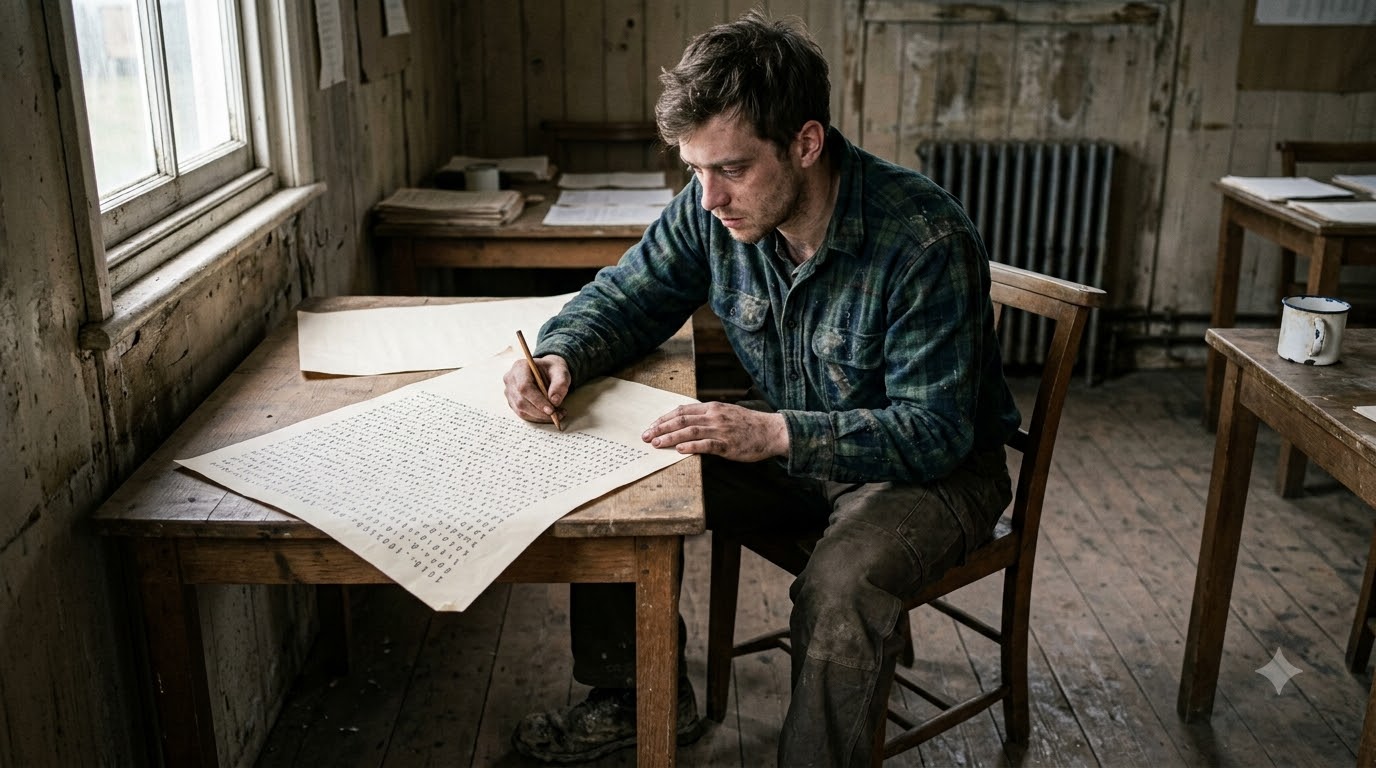
Bill did not look up from the table.
He rolled the worn wooden pencil between his thumb and forefinger, feeling the flat edges of the hexagon press against his calloused skin.
Across the cramped room, Major Tester’s footsteps creaked heavily against the unvarnished floorboards before fading down the corridor.
The senior officers in the mansion had stopped asking questions weeks ago.
They simply walked past the open door, glanced at the gardener’s son staring blankly into space, and walked on.
To the elite minds of Bletchley Park who had spent their lives mastering classical ciphers, Bill looked like a student who had wandered into the wrong building.
He was twenty-four, carrying the quiet exhaustion of an 18-mile bicycle ride through Lincolnshire frost that still lived deep in his knees.
On the table lay four thousand characters of raw data captured from German wireless stations.
Ones and zeros.
Dost and crosses.
They looked like meaningless static printed on cheap pulp, a wall of pure noise protecting Hitler’s personal communications from British eyes.
Every senior cryptanalyst had torn into the text and walked away empty-handed.
Bill picked up the pencil and drew a slow, heavy line across the grid.
The room smelled of stale tea, damp wool, and unwashed linoleum.
He did not have an expensive Cambridge pedigree or a room full of brilliant colleagues to debate theory with.
He had a sheet of paper, an old wooden desk, and the stubborn patience of a man who had spent his childhood watching his father coax stubborn green shoots out of poor soil.
The cipher did not care about titles or university crests.
It was a machine built by men, which meant it possessed a logic, however well hidden.
Bill stared at the columns until his eyes watered, waiting for the noise to show its seams.
CHAPTER 2: The Errant Key
The teleprinter ticker in Hut 5 spat a continuous ribbon of pale yellow tape across the scarred oak table.
Major Tester stood by the doorway, his fingers tapping an impatient rhythm against his leather holster.
—They made a mess of it in Athens, he muttered, tossing a crumpled intercept sheet onto the corner of Bill’s desk.
Bill did not look up from the grid paper.
The sheet was covered in four thousand characters of raw operational traffic, sent twice by two frustrated operators who had reused the exact same machine settings in flagrant violation of every security protocol.
A catastrophic human error.
Two identical streams encrypted with identical keys, crossing the airwaves between Greece and Vienna before landing in the interception logs at Nonington Pound.
Senior crypt analysts had spent ten days trying to peel back the plain text using standard cribs, only to hit a wall of impenetrable noise.
Bill picked up his worn pencil, feeling the familiar hexagonal edges press into his tired fingers.
The paper trembled slightly under the draft from the window.
He didn’t need the whole machine.
He needed the mathematical difference between the two overlapping messages.
When two identical keys encrypted different text, the key canceled out completely, leaving behind the raw mathematical skeleton of the German language itself.
Bill began splitting the five-bit characters into parallel streams, his pencil tip moving with a slow, mechanical rhythm across the forty-one columns.
Across the room, the teletype machine chattered like a frantic mechanical insect, spitting out another batch of intercept logs that no one else knew how to read.
CHAPTER 3: The Statistical Fault
The ink on the page smudged slightly under the heel of Bill’s palm as he shifted his weight on the hard wooden chair.
Around him, the mansion hummed with the quiet anxiety of hundreds of researchers chasing ghosts in the dark.
—Still nothing on the second impulse?
Major Tester’s voice cut through the stillness, sharp and dry like winter brushwood.
Bill did not lift his eyes from the grid.
He didn’t need to answer with words; the uneven column of forty-one rows spoke for itself.
When you treat a five-bit character as a single rigid block, the math dissolves into a bottomless well of random static.
By isolating each parallel bit stream and testing them one by one against the Kasiski method, the chaos began to peel back its layers.
The dots outweighed the crosses in column after column, forming a rigid statistical footprint that could never happen by pure coincidence.
It was a small victory, heavy with exhaustion and completely uncelebrated by anyone outside this drafty room.
Bill wiped a smudge of lead dust from his thumb onto his trousers, his mind already calculating the next variable.
The cipher was hiding something massive behind that first wall of numbers, and he was just getting started.
CHAPTER 4: The Twelve Wheels
The lines intersect across the cheap pulp paper like tracks in frozen mud.
He has never laid eyes on the device itself.
No German machine has ever fallen into British hands, and no blueprint exists in the filing cabinets downstairs.
Yet the numbers do not lie.
—Still staring at ghosts, Bill?—
Major Tester’s voice drops from the doorway, dry and skeptical.
Bill rolls the stub of his pencil between his fingers, watching the dust motes drift in the pale light.
Five regular chi wheels spinning constantly, five intermittent psi wheels moving by hidden rules, and two motor wheels controlling the whole intricate dance.
The prime numbers match up: forty-one, thirty-one, twenty-nine, all the way to fifty-nine.
It is a fifty-thousand-pin monster ticking away inside Hitler’s communication network.
And he has mapped every single gear without touching a single piece of steel.
CHAPTER 5: The Electronic Bridge
The vacuum tubes glowed with a faint, amber warmth against the damp chill of the workshop walls.
Tommy Flowers wiped grease from his thumb onto his apron, staring down at the sprawling mass of wiring and thermionic valves.
—They said the valves would burn out within an hour, Flowers muttered, tightening a terminal screw with a sharp twist of his pliers.
Bill leaned against the workbench, his fingers tracing the edge of a paper tape spool.
The traditional electromechanical switches were too slow, choking on the massive permutations of the German cipher stream.
By replacing mechanical gears with five thousand vacuum tubes running simultaneously, Flowers had built something the military establishment swore was impossible.
It wasn’t just a calculating tool.
It was an electronic lightning storm designed to execute Bill’s statistical algorithms at twenty-five thousand characters per second.
The machine hummed with a deep, rhythmic vibration that shook the floorboards beneath their boots.
—Let’s feed it the first tape,— Bill said quietly.
There were no blueprints, no captured enemy manuals, and no second chances.
The machine whirred to life, tearing through the paper ribbon as the raw decryption began to print out in the flickering light.
CHAPTER 6: The Final Decryption
The paper ribbon spooled across the iron floor, covered in legible German text that mapped every single fortification along the Normandy coastline.
Major Tester stared at the output, his hand hovering frozen over the corner of the desk.
—This covers every division from the Seine to the Channel.—
Bill wiped a smudge of lead and grease from his fingers with a scrap of cotton waste.
There was no cheering in the room, no triumphant speeches or cinematic handshakes.
Just the steady hum of vacuum tubes cooling down and the heavy weight of exhaustion settling deep into the floorboards.
June first arrived with the raw efficiency of an operational machine, feeding precise intelligence straight to Eisenhower’s headquarters just days before the fleet pushed out to sea.
The secret would stay buried under fifty years of official silence, locked behind government edicts and burned blueprints.
Bill packed his papers into a worn leather case, pulled his wool coat tight against the morning chill, and walked out past the gravel path toward the gate.
He didn’t need a monument or a medal to know what the numbers meant.
He had set his wheel positions, held the line against impossible odds, and left the world a little safer than he found it.