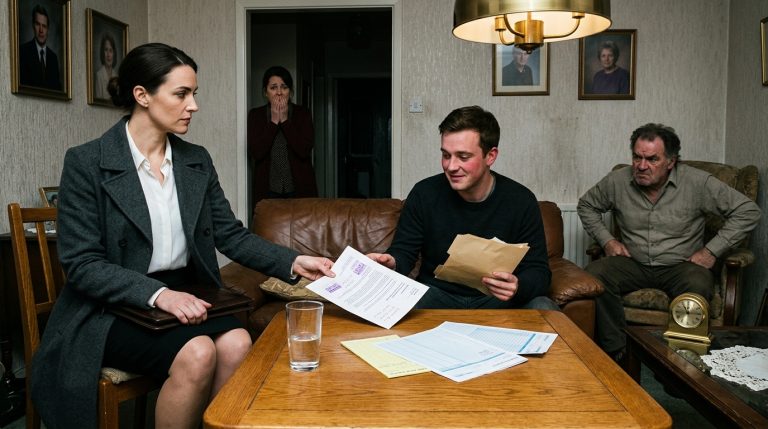
The Measured Siege: A Veteran’s Calculated Reclamation of Home and the Deconstruction of a Petty Tyrant
CHAPTER 1: THE CINDER BLOCK BORDER
The cinder block wall was ugly—brutally, offensively square against the humid afternoon air. It stood six feet tall, a fresh, gray scar bisecting the landscape that had been my anchor for twenty-four years. Beyond it, the back forty acres of timber were no longer a sustainable retirement plan; they were a landlocked island, cut off by the stroke of a pen and a shovel-load of mortar.
Karen Miller stood ten feet away, her blonde helmet of hair defying the humidity. She radiated the kind of self-righteousness that only comes from being the first person in history to hold power over a homeowners association. Her hands were on her hips, the floral mumu she wore acting as a tent for her inflated sense of importance.
“That road is HOA property now, Mr. Davidson,” she said, her voice devoid of any human resonance. “Your back forty is officially landlocked. Perhaps if you had kept your unsightly truck in a garage instead of your driveway, we wouldn’t have felt the need to prioritize community standards.”
I didn’t answer immediately. I studied the wall. The mortar was still pale, damp with the haste of its construction. I wasn’t looking at the stones; I was calculating the load-bearing stress of her hubris. In my head, I wasn’t in a suburban development; I was back in a theater of operations, assessing the perimeter, identifying the weaknesses in the fortification.
“Karen,” I said, my voice pitched low, intentionally stripped of any inflection. The cold calm I’d mastered in Fallujah settled into my gut like lead. “That is a county-recorded easement. It’s been my legal access since long before this development was a speck of dirt in a developer’s eye.”
She let out a sharp, dismissive bark of a laugh. “The county approved the new plat last month. Your dusty old papers are relics of a time that doesn’t exist anymore. This is now HOA common area. There will be a butterfly garden here by spring.”
A butterfly garden. She was prioritizing winged insects over my thirty-thousand-dollar oak contract, over the livelihood of my family, and over the integrity of my property. The absurdity of it was sharp, like a sliver of glass under the skin. I kept my face blank, a mask of iron. Anger, I knew, was a fire; it consumed everything in its path. Discipline, however, was the forge that shaped steel.
“You can’t just wall off an easement,” I repeated, ignoring the butterfly garden.
“I can,” she corrected, stepping closer, her nose wrinkled in disgust at my work boots. “And I have. You have thirty days to remove that monstrosity of a truck from the driveway. After that, the daily fines begin.”
She turned on her heel, her posture triumphant. As she walked away, the scent of her perfume—cloying and artificial—clashed with the smell of the raw, gray mortar. I watched her go, my eyes tracking her movement, already mentally drafting the first phase of the counter-operation. She was so convinced of her authority that she hadn’t bothered to check the roots of the land she stood on.
I stayed still until she reached the door of her stucco mansion. I didn’t reach for my phone; I didn’t shout. I simply turned back to the wall, reached out, and pressed my palm against the rough, cold surface of the cinder block. It was solid, sure, but it was sitting on a foundation of sand.
CHAPTER 2: THE CLUBHOUSE INFILTRATION
I did not pull my hand back immediately. I let the grit of the fresh concrete bite into my skin, testing the density, the structural arrogance of this barrier. It was a poorly executed partition—quick, cheap, and undeniably temporary. Karen Miller thought she had built a border. In reality, she had simply created a monument to her own lack of due diligence.
I left the wall, the silence of the afternoon ringing in my ears. The back forty was quiet, the usual hum of machinery and the steady rhythm of work replaced by a sterile, suburban stillness that felt like a held breath. My truck, that massive Ram 3500, sat in the driveway like a sentinel, its presence apparently enough to trigger Karen’s ire. I ignored the imaginary lines she had drawn and walked toward the house, my pace measured.
Inside, the house was cool, the air smelling faintly of Sarah’s coffee and old paper. She was waiting in the kitchen, her eyes searching my face before I even reached the doorway. She didn’t need to ask. The set of my jaw and the way I hung my keys—with a precision that bordered on surgical—told her everything.
“She’s dug in,” Sarah said, her voice soft but steady.
“She’s digging a grave,” I replied, pulling a chair out at the table. I sat down and opened the folder containing my original deed and the survey from twenty years ago. “She thinks she’s playing by the rules of her new neighborhood. She doesn’t understand that this land isn’t part of her neighborhood. It was here first.”
We spent the next hour reviewing the documents. I needed to know every inch of the legal ground beneath our feet. The HOA’s logic relied on a recent plat—a document that was essentially a map of their own desires—filed through the county without a proper title search. It was a bureaucratic sleight of hand. They had annexed the unincorporated land surrounding their subdivision, assuming that if they filed the paperwork and built the wall, reality would simply reshape itself to accommodate their aesthetic.
“The meeting is tonight, isn’t it?” Sarah asked, pouring me a fresh cup of coffee.
“Seven o’clock. Community clubhouse.” I traced the boundary lines on the survey with my index finger. “I’m going. Not to argue the wall, not yet. I’m going to observe. I need to see how they conduct their business, how much of their power is legal and how much is just theater.”
“Be careful, Marcus. Don’t give them anything to use against you.”
“I intend to give them exactly what they need to hang themselves,” I said, a grim, humorless smile touching my lips.
At six forty-five, I pulled into the parking lot of the Whispering Pines community clubhouse. It was a building that looked like it had been dropped into the landscape by an algorithm—too white, too new, surrounded by landscaping that was still trying to recover from the trauma of being planted. I walked through the glass doors. The interior smelled of industrial cleaner and aggressive air freshener.
The room was already half-full. Homeowners sat on folding chairs, looking uncomfortable and vaguely anxious, as if they were waiting for a roll call in a classroom. At the front, on a slightly elevated dais, the board sat behind a long, skirted table. Karen Miller was center-stage, tapping a gavel against the wood with a rhythmic, impatient sound. Bob, a man whose skin seemed to be permanently drained of color, fidgeted with a stack of papers, while Cynthia, the secretary, looked like she was trying to blend into the wallpaper behind her.
I stayed near the back, keeping my posture loose but alert. I wasn’t here to participate; I was here to map the terrain. I watched the way the neighbors looked at Karen. It wasn’t the look of a community toward a leader; it was the look of a population toward a border guard.
“The architectural review committee,” Karen announced, her voice projected with the practiced clarity of an amateur performer, “has finalized the ruling on the color palette for residential shutters. Any deviation from the approved ‘Sedona Slate’ or ‘Desert Dune’ will result in an automatic fine of one hundred and fifty dollars, effective immediately.”
A low murmur rippled through the room. A man near the front raised a hand, looking like he was expecting to be struck down for the audacity. “Karen? What about the shutters that were already painted charcoal grey by the builder?”
Karen didn’t blink. “The builder’s choices were provisional, and they are now obsolete. Compliance is mandatory within thirty days.”
I leaned against the back wall, my arms folded across my chest. She was creating a culture of constant, low-level anxiety. By keeping everyone off-balance, focused on their shutters and their mailboxes, she ensured they wouldn’t notice the larger, more systemic theft occurring on the perimeter of the property. She was a master of the distraction, but she was sloppy. She was arrogant.
I watched her eyes scan the room, looking for dissent. When they landed on me, I didn’t look away. I held her gaze, my expression completely neutral, until she was the one who had to break contact. It was a minor victory, a grain of sand, but it was the start of the pressure. I began to mentally track the exits, the acoustics of the room, and the way Bob and Cynthia deferred to her every glance. They weren’t a board; they were subordinates.
I took out my phone and switched it to silent, recording the session. I didn’t need a fight tonight. I needed evidence. I needed a record of the absurdity, a catalog of the petty laws that would inevitably be the evidence we would use to dismantle this entire charade. I watched her bang the gavel again, the sound echoing like a shot in the sterile, beige room, and I knew—without a shadow of a doubt—that she had no idea the trap was already closing around her.
CHAPTER 3: THE ARCHIVE HUNT
The air in the county records office felt fundamentally different from the atmosphere of the clubhouse. Here, the scent was not of aggressive floral air freshener or new carpet, but of slow, dignified decay—vanilla, dust, and the sharp, acidic tang of binding glue. It was an environment of stability, a stark contrast to the volatile, manufactured reality Karen Miller was trying to impose on the neighborhood.
I walked to the counter. The clerk, a woman in her late sixties with hair the color of a winter sky, looked up from a stack of ledger cards. Her eyes were sharp, seasoned by decades of watching people dig into the past.
“Back again, Mr. Davidson?” she asked. Her voice was like parchment rubbing against parchment. “Finding something, or hiding from someone?”
“A bit of both, I suppose,” I said, leaning my elbows onto the polished wood of the counter. “I need access to the land deeds for the original ranch partition, specifically around 1920 to 1930. The records for the northern edge of the old tract.”
She nodded, not needing to ask why. She had seen men like me before—men who understood that the truth wasn’t something you shouted; it was something you excavated. She reached under the counter and pulled out a heavy key ring, the brass keys clicking against each other with a sound like dry bones.
“Back room. Third aisle, bottom shelf. If it isn’t indexed in the master ledger, check the supplementary files. Some of those old ranch transactions were handled by the regional office, and they didn’t always make it into the primary books until years later.”
I thanked her and navigated the labyrinth of shelving. The aisles were narrow, the light dim and filtered through high, dust-caked windows. My boots clicked on the concrete floor, a rhythmic, solitary sound that seemed to measure the distance I was putting between myself and the petty tyranny of the Whispering Pines HOA.
I reached the bottom shelf, as instructed. The volumes were immense, leather-bound, and heavy enough that I had to grunt as I hoisted the first one onto a nearby wooden table. I spent the next two hours in a state of absolute focus. I wasn’t reading; I was scanning, my eyes moving with the practiced efficiency of a man looking for a target in a crowded field.
It was mid-morning when I found the first anomaly. I was tracking the chain of custody for the original 300-acre tract when I noticed a series of handwritten annotations in the margins of a 1923 transfer record. They weren’t standard legal notes. They were small, meticulous diagrams—meats and bounds descriptions—that didn’t match the modern county plat I had been shown at the meeting.
I pulled out my phone and began to photograph the pages, ensuring the clarity of every handwritten character. I moved to the supplementary files as the clerk had suggested. The index was erratic, a patchwork of different clerks’ handwriting, but then I found it: a thin, brittle envelope tucked into the back of a box containing minor property boundary adjustments.
Inside was a surveyor’s field note, dated April 1923. It wasn’t just a record; it was a map of intent. The drawing depicted the partition of the ranch, and there, running clear and straight across the northern boundary, was a corridor marked with a distinct red ink. I traced the line with my finger, feeling a strange, cold thrill.
This wasn’t the dirt track. The dirt track, the one that had been in use for years and that Karen Miller had so confidently blocked, was clearly marked as a secondary, informal route. The legal path, the one protected by the language of “perpetual and non-exclusive,” was a straight line that cut directly across the geography where the clubhouse and the first cluster of homes now sat.
I sat back, the air in the room suddenly seeming very thin. The HOA had built their entire foundation on a plat that ignored a century-old incumbrance—a legal ghost that didn’t just exist in the past, but held a superior claim to the very dirt their foundations rested on.
I stood up and paced the narrow aisle, my mind racing. This was the leverage I needed, but it was also a complication I hadn’t fully accounted for. If the easement ran where the maps suggested, it didn’t just border their development—it actively bisected the structural reality of the neighborhood.
I returned to the desk, the ledger still tucked under my arm. The clerk looked at me, her expression unreadable.
“Did you find your gold?” she asked, her voice dropping to a low, knowing tone.
“I found the map,” I said, placing the ledger back on the shelf. “I think I’ve started the war.”
I left the building and stepped out into the bright, harsh glare of the afternoon sun. The world looked different now. The neighborhood, the wall, the HOA—it all looked fragile, like a house of cards waiting for a breeze. I started my truck, the engine’s roar echoing in the quiet parking lot. I had a lot of work to do, and for the first time, I could see exactly where the first strike needed to land.
CHAPTER 4: THE SURVEYORS REVELATION
The air outside the county records office had a different quality—a thin, brittle edge that cut through the humidity. I didn’t rush to start the truck. I sat for a moment, the steering wheel cool under my grip, staring at the phone screen. The red line George had sketched wasn’t just a mark on a paper; it was a vector of intent. It sliced across the land with a cold, geometric precision that ignored the existence of stucco, faux Tuscan columns, and three-car garages.
I tapped the screen, zooming in on the point where the red line intersected with what was now Lot One—Karen Miller’s residence. The math was immutable. If the 1923 easement was the legal anchor, then the front door of her “showcase home” was essentially a doorway into an illegal obstruction.
The engine turned over with a deep, authoritative growl. I needed a professional eye, someone who knew the difference between a developer’s slick marketing drawing and a land-title surveyor’s reality. I put the truck in gear and headed toward the outskirts of town where George Peterson ran his private consultancy.
Halfway there, the engine sputtered. It wasn’t the clean, mechanical failure of a broken part, but a rhythmic, stuttering drag—a fuel-line clog, likely the result of bad diesel from the station near the archives. I steered the heavy truck onto the soft, dusty shoulder of the road, the gravel crunching violently under the tires. The silence that followed was heavy.
I climbed out, popping the hood to assess the damage. It was an inconvenience, but in the context of the war I was fighting, it was just another friction point. I pulled out my toolkit, the familiar weight of the wrench in my hand grounding me. As I worked, I watched the road. A developer’s SUV sped by, its tires kicking up a cloud of grit that coated my windshield. They were busy carving up the earth, oblivious to the fact that their foundation was fundamentally flawed.
By the time I got the line flushed and the engine humming again, the sun was beginning to dip, casting long, sharp shadows across the fields. I pulled into George’s drive ten minutes later. His office was a converted barn, the interior cluttered with drafting tables, high-end mapping software, and the smell of ozone and old coffee.
George was waiting, a magnifying glass already in his hand. He didn’t offer a greeting; he just pointed to the table where he’d been working.
“I took your photos from the records office and ran them through the CAD overlay, Marcus,” he said, his voice raspy. “I didn’t just trace the line. I geolocated it.”
He clicked a mouse, and a high-resolution satellite map of Whispering Pines Estates appeared on his monitor. He tapped a key, and a thin, vibrant red line materialized over the image. It looked like a laser sight. It started at the northern property boundary and shot forward, dead straight.
It passed through a manicured lawn, clipped the corner of a driveway, and then, with devastating, clinical indifference, it cut straight through the foyer of Lot One.
“Look at the measurements,” George said, zooming in. “It’s not off by a foot or two. It’s dead center. Whoever signed off on this lot’s site plan clearly never opened the original deed. They looked at the empty field, saw a flat surface, and laid their grid down like they were playing a game of Monopoly.”
I looked at the screen, the sharp edges of the red line burning into my retina. The irony was so perfect it almost felt like justice. Karen, the self-appointed warden of property values and bylaw adherence, had built her kingdom on a foundation of legal trespass.
“If we stake this out,” I said, my voice barely above a whisper, “it marks the boundary of my easement.”
“Exactly,” George replied, a slow, predatory grin spreading across his face. “And if she tries to tell you that you don’t have access, she’s not just arguing with a neighbor. She’s arguing with a 1923 legal record that gives you the right to maintain and improve that path. Including, if necessary, the removal of any structure obstructing it.”
“She’s been fining me for parking on my own driveway,” I said, looking at the screen. “She’s been trying to dictate the color of our lives based on her interpretation of the plat.”
“And now you know,” George said, turning to face me. “You have the map. The question is, are you ready to present the evidence?”
“Not yet,” I replied. “First, I need to make sure the rest of the neighborhood knows exactly what kind of ‘authority’ they’ve surrendered to. If I’m going to use this line, I need the people living around it to understand that her tyranny isn’t just unpleasant—it’s inherently illegitimate.”
I looked at the red line one last time, memorizing the coordinates. The mechanical hiccup on the road seemed like a lifetime ago. I didn’t need to destroy her life today, but I had the tools to start dismantling her certainty. I shook George’s hand, the grip firm and dry.
“Get me a hard copy of this overlay, George. A certified version. I’m going to need it when the time comes.”
I walked back out to the truck. The evening air was cooling, the shadows stretching further across the driveway. The red line was locked in my mind, a constant, unmoving truth. Karen Miller thought she was the architect of Whispering Pines. She had no idea she was just the tenant of a very inconvenient, very old, and very legal path.
CHAPTER 5: THE INSURGENCY
The neighborhood looked different through the lens of the red line. What had previously been a confusing sprawl of cookie-cutter homes now resolved into a map of vulnerabilities. I parked the Ram in my driveway, the truck’s bulk feeling like a declaration of defiance against the surrounding taupe and grayge monotony. I didn’t go inside. I walked down the street, my boots rhythmic on the pavement, feeling the weight of the hard-copy maps tucked inside my jacket.
I found Dave in his backyard. He was kneeling on the grass, a wrench in his hand, struggling with the bolts of his daughter’s swing set. He looked up when I approached, his face etched with a mix of frustration and exhaustion. He didn’t say anything at first; he just gestured to the pile of metal parts, a small monument to the HOA’s latest crackdown.
“Violation notice,” Dave muttered, pointing at a laminated card tacked to a post. “Two hundred dollars because it’s a ‘permanent structure’ that isn’t ‘visually harmonious’ with the streetscape.”
I stood over him, my shadow falling long across the grass. I looked at the notice—official, stamped, and utterly hollow. It reminded me of the logistical reports we used to get in the field, the kind that dictated supply lines based on bad intel, setting everyone up for failure. I felt a surge of cold, focused clarity. Karen Miller wasn’t just enforcing rules; she was managing a decline, forcing her neighbors into compliance to validate her own fragile sense of order.
“Dave,” I said, my voice low. “Stop taking it apart.”
He looked up, wiping his forehead with the back of a greasy hand. “What choice do I have? They’ll fine me every day until it’s gone. I can’t afford a daily hit to my bank account.”
“You won’t have to,” I said. I pulled the rolled-up map from my jacket. I didn’t unfold it—not yet. I needed to know if he was in. “I’m not just fighting for my road anymore. I’ve found something that changes the entire power dynamic of this neighborhood. But it’s going to require more than just me standing on my property line.”
Dave stood up, tossing the wrench into the grass. He was a tech guy, used to analyzing systems and identifying points of failure. He saw the look in my eyes—the cold, Marine-grade focus—and he stopped worrying about the fines.
“What are you talking about, Marcus?”
“I’m talking about a collective defense,” I said. “We have the documentation. We have the history. And now, I have the map that proves the entire HOA board is operating on a fraudulent premise.”
I watched him process this. The anger that had been simmering in him all week flared, but this time, it was directed. It wasn’t the reactive, helpless frustration of a man being bullied; it was the sharp, dangerous realization of a man who’d just found his way out of a dead end.
“Who else knows?” he asked.
“Just you, for now,” I replied. “But I need people who can document. I need people who aren’t afraid to let their names be attached to a class-action challenge. If we go individually, she’ll pick us off one by one, fining us into silence. If we go as a group—as a concerned homeowners committee—the legal overhead alone will force them to at least acknowledge us.”
“And the wall?” Dave asked, gesturing toward the north side of the neighborhood.
“The wall is a distraction,” I said. “It’s a symptom. When we go for the cure, the wall comes down as a matter of course.”
We talked for an hour, huddled over the maps in the fading light. As we spoke, I watched the neighborhood around us. Doors opened and closed. A dog barked. A garage door stuttered shut. For the first time, I didn’t see individual houses. I saw potential—people who were tired of the fines, tired of the aesthetic policing, and tired of being treated like tenants in their own homes.
I left Dave with a list of names—people I’d noticed over the last few months, neighbors who had been hit with similar, illogical violations. He was a better connector than I was; he had the tech, the reach, and the same quiet, simmering resentment that I had spent the last twenty-four hours sharpening into a blade.
As I walked home, I passed Mrs. Gable’s house. She was standing on her porch, staring at the empty space where her bird feeder used to be. The silence on her lawn was profound. I stopped, and for a fleeting second, the thought of the mission reports crossed my mind—how a small, unnoticed shift in a supply line could collapse an entire front.
I reached out and touched the gate of my fence. The metal was cold, the rust under the latch rough against my fingertips. I had the seeds of the army now. I had the map that would burn their legitimacy to the ground. And tomorrow, I was going to see Ben Carter, to make sure that when we finally pulled the trigger, the legal response would be absolute and inescapable.
Karen Miller thought she was playing a game of chess. She had no idea she was currently being surrounded by a force she didn’t even recognize as an enemy.
CHAPTER 6: THE DEPOSITION TRAP
The conference room in Ben Carter’s office was designed to intimidate. It was all glass, brushed steel, and recessed lighting that flattened the features of anyone who wasn’t sitting in the position of power. Ben sat at the head of the table, his posture relaxed, a stark contrast to the rigid, defensive stance adopted by Preston Vance IV, the HOA’s downtown attorney.
Then there was Karen. She sat across from us, wearing a suit that cost more than a month of my pension. She looked less like a neighbor and more like a CEO preparing for a hostile takeover. She had that same helmet of blonde hair, stiff and impervious, and a smile that didn’t reach her eyes—a thin, practiced curve of the lips meant to convey superiority.
“Let’s keep this efficient,” Vance said, his voice smooth and devoid of any human friction. “We’re here to address Mr. Davidson’s baseless claims of property interference. We have no interest in entertaining a fishing expedition.”
Ben didn’t react. He just placed a clean, unmarked legal pad in front of him and picked up his pen. “Efficiency is exactly what I’m after, Preston. Let’s start with the basics.”
I sat in the chair next to Ben, my hands folded on the table. I wasn’t there to speak; I was there to observe. I watched Karen’s eyes dart toward me, then away, with a brief, dismissive flick—the same way one might acknowledge a pest that had already been scheduled for extermination. She was confident. That was her flaw. She had never been forced to account for her reality, and she assumed that because she had the money, the title, and the attorney, the truth would simply bend to fit her narrative.
“Ms. Miller,” Ben began, his voice calm, measured. “You are the president of the Whispering Pines HOA. As such, you have a fiduciary duty to ensure the association complies with all recorded property encumbrances. Are you familiar with the legal requirements for property access in this county?”
“I am familiar with the governing documents of Whispering Pines Estates,” she said, her voice crisp. “The final plat approved by the county is the sole authority.”
“And you believe that plat nullifies any prior claims?” Ben asked.
“I don’t believe, I know,” she said, leaning forward. “That plat was reviewed by our counsel, surveyed by professionals, and approved by the county board. It is the absolute record of all property rights within the subdivision.”
I watched her face. There was no hesitation, no hint of uncertainty. She was reciting the mantra she’d been fed, and she’d come to believe it with the fervor of a convert.
Ben slid the 1923 deed across the table. It looked fragile in this modern, sterile room, a piece of history that refused to be dismissed. “Have you ever reviewed this document, Ms. Miller? It’s a deed, recorded in 1923, regarding the original partition of the ranch land that now comprises Whispering Pines.”
Karen didn’t even look down at it. She just flicked her eyes toward Vance.
“I’ve seen Mr. Davidson’s attempt to stir up trouble with antiquated paper,” she said. “It’s irrelevant. The plat is the law.”
“So, for the record,” Ben said, his pen hovering over the pad, “you are testifying under oath that there are no easements, recorded or otherwise, that encumber the property designated as Lot One—your property—other than those reflected on the current HOA plat?”
Vance started to lean in, perhaps sensing the edge of a cliff, but it was too late. Karen had already stepped over it.
“There are no such easements,” she said, her tone absolute. “My property is free of any such encumbrances. Mr. Davidson’s claim is a fabrication.”
The silence in the room changed. It went from the dry, professional stillness of a legal proceeding to something heavy, charged, and final. Ben didn’t look at her. He made a small, deliberate note on his pad, a rhythmic scratching sound that seemed to last for an eternity.
I looked at Karen. For a second, the mask slipped. She saw Ben’s lack of reaction, and the silence began to gnaw at her confidence. She shifted in her chair, the expensive fabric of her suit rustling loudly.
“Is there a problem, counselor?” she asked, her voice losing a fraction of its edge.
“No problem at all, Ms. Miller,” Ben said, finally looking up. His eyes were cold, professional, and entirely unbothered. “Thank you. That’s all for today.”
We ended the session five minutes later. As we walked out, Vance tried to maintain his veneer of arrogance, but he looked like a man who had just realized his client had left the front door wide open for an intruder. Karen didn’t look at us. She walked toward the elevator, her heels clicking on the tile with a hurried, sharp rhythm.
I followed Ben out to the parking garage. The air was thick with the scent of oil and concrete, a stark contrast to the sterile environment of the office.
“She did it,” Ben said, the moment we were out of earshot. “She lied under oath, and she did it with complete, unadulterated conviction.”
“She thinks she’s untouchable,” I said. “She thinks the world is made of plats and bylaws.”
“And tomorrow,” Ben said, pulling his keys from his pocket, “we’re going to show her what the world is actually made of. We’re going to show her the red line.”
I stood in the garage for a moment after he drove off. I could still see the red line on the map—the straight, uncompromising path that sliced through the heart of her home. The deposition wasn’t just a win; it was the mechanism that would trigger the collapse. The trap was set, the evidence was documented, and the countdown had officially begun.
CHAPTER 7: THE PHYSICAL RECKONING
The dawn of the survey day broke with a cold, unforgiving clarity. The sky was the color of a whetstone, and the air held the bite of impending frost. I didn’t reach for my work boots or the faded flannel I wore to the timber yard. Instead, I pulled on my old Marine Corps service alphas—the crisp, olive-green trousers and khaki shirt. I wanted them to know this wasn’t a dispute between neighbors; it was a formal engagement.
I arrived at the entrance of Whispering Pines at 08:30. The survey crew—three men in high-visibility vests—were already unloading their gear. Their truck sat idling, the exhaust plumes drifting horizontally in the morning wind. I stood by my Ram 3500, my arms crossed, watching the neighborhood wake up.
At 09:00 sharp, Karen Miller emerged from her home. She was dressed in black leggings and a hot-pink sweatshirt that read “GIRL BOSS” in glittering, faux-diamond lettering. She walked with a hurried, aggressive stride, her eyes locked onto the surveyors. Bob, the treasurer, trailed two steps behind her, looking as though he’d rather be anywhere else in the world.
“You are trespassing!” she shouted, her voice thin and piercing, cutting through the low rumble of the idling survey truck. She stopped ten feet from Frank, the crew chief. “I am ordering you to leave this property immediately. The HOA common area is private.”
Frank didn’t look up from his transit. He simply reached into his vest pocket, pulled out the court order, and held it out. “Ma’am, we are here under the authority of the Superior Court. We are surveying a recorded easement. Any interference will be documented as an obstruction of a judicial mandate.”
Karen’s face went through a rapid series of shifts—paling, then reddening, then settling into a mask of pure, unadulterated fury. She looked at me, her gaze sharpening, finally recognizing that this wasn’t just a nuisance; it was the inevitable conclusion of the war she had started.
“You,” she spat, her voice trembling. “You’re behind this.”
I didn’t answer. I didn’t feel the need. The silence I projected wasn’t empty; it was heavy with the weight of the 1923 deed and the deposition transcript that sat in Ben Carter’s briefcase.
“Proceed, Frank,” I said, my voice steady.
They began. It was a dance of precision—a rhythmic sequence of beeps, laser pulses, and hammer blows. Every time they planted a stake, they drove a piece of reality into Karen’s manufactured fantasy. The pink ribbons fluttered in the wind like warning flags.
They moved steadily across the lawn, bypassing the sprinkler system with surgical accuracy, and headed straight for the front door. The crowd had started to gather. I saw Dave near the curb, a look of grim satisfaction on his face. Mrs. Gable stood a few feet back, clutching a shawl tightly around her shoulders, her eyes wide as she watched the surveyors approach the porch.
Karen had retreated to the steps, her hands balled into fists at her sides. She looked diminished, the “Girl Boss” sweatshirt suddenly looking absurd and fragile against the backdrop of the cold, hard geometry of the survey markers.
“They’re going to hit the stairs,” Bob whispered, his voice cracking. He looked at Karen, waiting for a command, but she was frozen. She was staring at the pink ribbon tied to a stake now sitting less than three feet from her doorstep.
“The line continues,” Frank said, his voice flat and clinical. He adjusted his transit, squinting through the lens. “Right through the structure.”
He climbed the porch steps, his boots leaving muddy imprints on the pristine flagstone. He walked up to the front door, placed his hand on the wood, and then looked back at Karen. “Ma’am, you need to open the door.”
She didn’t move. She couldn’t. Her entire world—the rules, the plats, the fines, the exclusivity—was built on the assumption that she was the absolute authority of this space. But the easement was older than her authority, older than the house, older than the HOA. It was a fact of law that cut through her home like a blade.
The deputy, positioned by the curb, stepped forward. “Ms. Miller. The court order is explicit. You are obstructing a legal survey.”
I watched the moment of surrender. It wasn’t a sudden explosion; it was a quiet, internal collapse. I saw the tension drain from her shoulders, the wild light in her eyes dimming into a hollow, defeated stare. She reached into her pocket, fumbled with her keys, and pushed the door open.
Frank stepped inside, his equipment humming. Through the large picture window, I watched them work. I watched as they placed the stakes on her white tile foyer, marking the path of the 1923 easement. The red line was no longer a digital sketch on George’s computer. It was a physical, unavoidable reality in the middle of her living room.
I walked up the driveway, passing the pink stakes, and stopped at the base of the porch. Karen stood in the doorway, staring at the floor where the surveyor was currently measuring the width of my access. She didn’t look at me, but I knew she could feel my presence.
“It’s not about the truck, Karen,” I said, my voice quiet, cutting through the silence of the neighborhood. “And it’s not about the bylaws. It’s about the truth. And the truth doesn’t care about your plat.”
I turned and walked back to my truck. Behind me, the house—the showcase home, the seat of the HOA’s power—felt empty, already stripped of the authority it had tried so hard to project. I had the survey. I had the court order. And now, I had the space. The siege was over. All that remained was the cleanup.
CHAPTER 8: THE BULLDOZERS FINAL SILENCE
The engine’s roar had been a physical presence, a beast that breathed diesel and iron, but its sudden cessation left a void that was almost painful. My son, Mark, killed the ignition of the Caterpillar D9. The silence that rushed back into the neighborhood of Whispering Pines Estates was absolute, heavy, and thick with the smell of churned earth and scorched oil.
I stepped down from the crawler, my boots crunching into the dirt of the freshly opened easement. Behind me, the cinder block wall—or what was left of it—lay in jagged, pulverized heaps. It looked smaller now, reduced to mere construction debris rather than a declaration of sovereignty.
Karen Miller stood twenty feet away. She was draped in a thin, pale coat that did nothing to shield her from the evening’s chill. She looked smaller, too. The “Girl Boss” persona had evaporated the moment she realized that the law, the one she had weaponized against everyone else, had finally turned its gaze toward her. She was staring at the front door of her home—the house that now held a legal, court-ordered easement slice running directly through her foyer.
“You said you wouldn’t,” she whispered. Her voice lacked the screeching authority of our previous encounters; it was thin, brittle. “You said you just wanted the road.”
“I wanted justice,” I replied. I walked slowly toward her, the path beneath my feet hard-packed and unforgiving. I didn’t stop until I was within arm’s reach. I could see the fine lines of strain around her eyes, the way her hands trembled as she clutched her coat. “The road was just the instrument. You’re the one who decided to build your life on a legal lie.”
She didn’t try to defend herself. There was no mention of plats, no talk of architectural standards, no threats of fines. She looked past me at the bulldozer, at the neighborhood that had once been her silent audience and was now watching her undoing from behind closed curtains.
“What happens now?” she asked.
“Now, the HOA is placed into receivership,” I said, my voice steady. “The class-action settlement we negotiated covers every cent of the fines you leveled at these people. The proceeds from the sale of this property will fund the restitution. You’re moving, Karen. And for the sake of whoever buys this place, I suggest you disclose the easement.”
She let out a dry, hacking laugh that sounded more like a sob. She turned back toward her front door—the door that was now merely a gateway into a public access corridor—and disappeared inside. I didn’t watch her go. I didn’t need to see the end of her occupation.
I turned back to Mark, who was climbing down from the D9. He caught my eye and nodded, a silent acknowledgment of the work finished. We had done more than just clear a road; we had rebalanced the scales.
The next few weeks were a blur of paperwork, transition meetings, and the gradual, beautiful dismantling of the beige-tinted autocracy. The receiver arrived, a man with a tired face and a thick binder, and began the process of auditing the HOA’s accounts. We saw the bank accounts frozen, the petty fines rescinded, and the absurd lists of “approved colors” tossed into the shredder.
I was sitting in my workshop, weeks later, working on a piece of oak I’d harvested from the back forty. I was smoothing the edge of the wood, the rhythmic rasp of the plane steady and grounding. The world was quiet. The war was over, and the land was, as it had always been, waiting for the patient hands that knew how to nurture it.
Sarah walked in, bringing a tray with two mugs of coffee. She set it on the workbench, her hand resting momentarily on my shoulder. She looked toward the window, toward the north, where the road now stretched clear and open, free of walls, free of gatekeepers, free of the shadow of Karen Miller.
“It’s peaceful,” she said.
“It’s what it was supposed to be,” I replied.
I picked up a hammer and a small, bent nail—a piece of scrap from the wall’s demolition that I’d kept. I straightened the nail on the anvil, the steel ringing out with a clear, honest tone, and drove it into a mounting bracket for a piece of equipment I’d been meaning to fix since before the wall went up.
It was a small repair, but it felt monumental. The damage done to the community would take time to heal—the scars of petty tyranny don’t vanish overnight—but the foundation was sound. We weren’t just neighbors again; we were a community that had learned the hard way that when the law is used to divide, the truth is the only bridge that holds. I took a sip of the coffee, let the warmth settle into my chest, and turned back to the wood. I had a lot of work to do, and for the first time in a year, I had the quiet focus to do it right.