
The Corporate Strategist Turns a Devastating Family Betrayal Into an Absolute Financial Trap
CHAPTER 1: THE KITCHEN THRESHOLD
The brass key slid into the front deadbolt without a sound.
It was barely four in the afternoon, two hours ahead of schedule because the quarterly audit team finished early, but the polished mahogany floorboards of the foyer were already carrying voices from the kitchen.
Matthew’s laugh cut through the quiet first—that bright, easy sound that used to make six-hour workdays feel weightless.
“She actually pulled thirty grand straight out of her personal liquidity index this morning,” Matthew was saying, his tone dripping with the self-satisfied ease of a man who had never cleared a five-figure balance on his own merits. “Didn’t even ask for a line-item breakdown.”
“I told you a corporate girl was the play,” his mother, Evelyn, chimed in over the clatter of porcelain tea cups. “All that structure in her head, and she still leaves her personal ledger completely wide open.”
Noah stood entirely motionless in the entryway, her leather briefcase resting heavy against her knee.
Her right hand drifted slowly to her coat pocket, her thumb catching the cold, ridged brass casing of her grandfather’s mechanical desk clock—a small, solid habit she kept to ground herself during intense board negotiations.
She didn’t gasp; she didn’t drop her keys.
Ten years in corporate finance taught a person that panic was just expensive noise.
“How much longer until the primary debt threshold clears?” his father, Arthur, asked, his voice rough from decades of heavy cigars. “The collector calls are getting annoying, Matthew.”
“Two years, max,” Matthew replied smoothly. “Once she finishes funding the two-family wing conversion and wiping the primary burden, I’ll file the papers. Sarah’s already looking at floor plans for the master suite.”
A heavy, metallic click echoed inside Noah’s coat pocket as her thumb reset the internal spring of the brass clock.
The sound was swallowed completely by the ambient hum of the foyer’s air purifier.
She took one slow, deliberate breath, letting the icy reality settle into her ribs like lead weights, then pulled her hand free from her pocket.
She stepped backward toward the front door, turned the latch with deliberate force, and let the heavy oak frame slam shut with an echo that rattled the hallway mirror.
“I’m home!” Noah called out, her voice flat, even, and entirely devoid of heat.
The kitchen went dead silent for a fraction of a second before the chair legs scraped frantically against the tile floor.
Matthew appeared at the archway first, his arms open, a soft, boyish smile plastered across a face that suddenly looked like a stranger’s mask.
“Noah! Sweetheart, you’re back early—we were just talking about how hard you’ve been working for the family.”
Noah adjusted the strap of her bag, her eyes holding his with absolute, unyielding clarity.
“I know,” she said quietly. “I heard every word.”
CHAPTER 2: PAPER AND POLISH
“Noah! Sweetheart, you’re back early—we were just talking about how hard you’ve been working for the family.”
Noah didn’t lower her briefcase.
She let her weight rest evenly on the balls of her feet, her thumb still locked over the cold brass bezel of her grandfather’s clock inside her wool pocket.
“I heard you mention the line-item breakdown,” Noah said, her voice dropping into the flat, low register she used when a vendor attempted to bill twice for the same logistical run. “And the thirty thousand from this morning.”
Evelyn shuffled out from the kitchen behind her son, her hand instantly going to the delicate gold chain around her neck.
Her knuckles were white, but her chin remained tilted at that sharp, patronizing angle she reserved for service workers and young women who worked past five.
“Well, Noah, dear, you know how Matthew worries about the family image,” Evelyn said, forcing a high, breezy chuckle that died immediately in the tight silence of the hall. “We were just saying how remarkable it is that a corporate position allows you to handle these… administrative burdens so smoothly.”
“Administrative,” Noah repeated.
She walked past Matthew without touching him, setting her briefcase down on the solid oak dining table with a sharp, heavy thud.
She clicked the nickel latches open.
“I brought the updated ledger schedules for the secondary wing conversion,” Noah said, unrolling a thick sheaf of blue-lined ledger paper onto the polished wood. “Since Arthur mentioned the collector calls are getting frequent.”
Matthew stepped up beside her, his breath smelling faintly of sweet mint and expensive bourbon—a bottle she certainly hadn’t bought for the house.
He reached out to pat her shoulder, his palm heavy and warm, trying to exert that familiar, comforting pressure that had worked for eighteen months.
“Noah, honey, you don’t need to stress your head with the fine print tonight,” Matthew murmured, his fingers tightening slightly on her coat fabric. “Dad’s debts are complicated. Old family arrangements. You just give us the lump sum transfers, and I’ll clear the paper with the bank.”
“Old family arrangements don’t carry fifteen percent penalty compounding,” Noah said softly.
She pulled a thin, silver ballpoint pen from her inner coat pocket and clicked the tip out.
“I need your signature on the authorization schedule, Matthew. If I’m liquidating the remaining sixty thousand from my personal reserve index to satisfy the primary debt holding, the bank requires a secondary guarantor signature from the primary resident.”
Matthew hesitated, his eyes darting toward Evelyn, who gave a microscopic nod from the doorway.
He picked up the pen, his hand steady enough, and signed his name along the dotted line without reading the dense three-paragraph clause printed above it.
He didn’t notice that the document wasn’t a standard bank release.
It was a legally binding, personal indemnification affidavit—written on her company’s legal stationary—that explicitly assigned full personal liability of all primary and secondary debt obligations back to Matthew in the event of fraudulent misrepresentation.
“There,” Matthew said, flashing that easy, boyish smile again as he tossed the pen onto the table. “All settled. Now, why don’t you go take a warm bath while Mom and I finish setting up dinner?”
“In a minute,” Noah said.
She neatly folded the signed affidavit, slid it inside her leather portfolio, and walked toward the kitchen to fetch a glass of water.
She opened the pantry door to reach for the glassware, her eyes sweeping over the neatly arranged spices and canned goods Evelyn had organized with unearned authority.
Near the back shelf, tucked behind a cracked ceramic salt cellar, sat an antique tin filled with Evelyn’s index cards.
Sticking out from beneath a card for lemon square bar recipe was a thin sliver of cheap, yellowed carbon paper.
Noah reached in, her fingers moving with silent, precise efficiency, and slid the slip out.
It wasn’t a grocery receipt.
It was a duplicate wire confirmation slip from a regional credit union three counties over, dated four days ago.
The transaction amount was precisely twenty-five thousand dollars—transferred directly from Noah’s debt-relief allocation into a private shell corporation registered under the name LVR Holdings LLC.
At the bottom of the slip, typed in faint purple ink, was the primary beneficiary’s personal signature: Sarah Miller.
Noah stared at the purple ink for three seconds, her heart beat staying perfectly steady, perfectly cold.
She folded the yellow paper into a tight, crisp square and slid it deep inside the secret lining of her coin purse.
“Find what you’re looking for, Noah?” Evelyn’s voice cut sharply from the kitchen threshold, her shadow falling long across the pantry floor.
Noah closed the pantry door smoothly, turning around with a faint, polite smile that reached nowhere near her eyes.
“Just getting a glass,” Noah said, her voice smooth as glass. “I was just thinking about how much work we’re going to get done this month.”
CHAPTER 3: THE EVICTION PARADOX
“I was just thinking,” I said, setting the glass down on the counter with a quiet, solid click, “that three months is a long time to keep paying on an unverified note.”
Evelyn didn’t blink, but her hand twitched slightly against her sweater collar.
“Well, family doesn’t need audits, Noah,” she said, her voice tightening into that sharp, thin edge she used when a cashier took too long with her coupons. “Matthew’s handling the details.”
Three hours later, the living room smelled of stale roast pork and cold coffee.
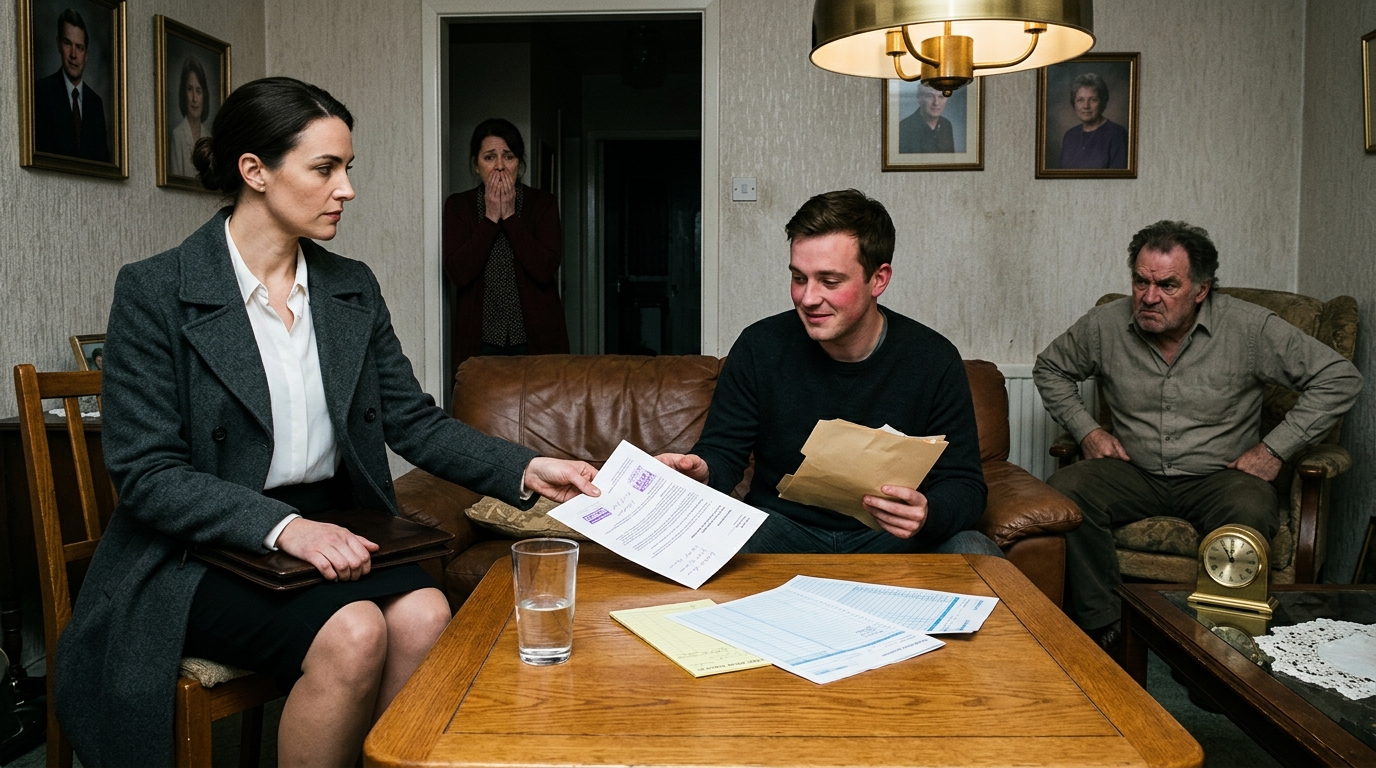
Matthew sat across the coffee table, leaning back on the leather sofa with his legs crossed, holding a manila folder like he was sitting in a boardroom he owned.
Arthur sat in the armchair beside him, his heavy jaw set, his thumbs hooked into his belt loops.
“We need to talk about the arrangement, Noah,” Matthew began, smoothing the front of his silk tie. “It’s time to streamline things. You’ve been working late, you’re stressed, and frankly, the living situation isn’t fitting the family’s long-term vision.”
I sat perfectly still on the edge of the cushion, my hands folded over my leather portfolio on my lap.
“What vision is that, Matthew?”
“I’m filing for dissolution,” he said, pushing a single sheet of paper across the wood toward me. “And as part of the separation, you’re going to move your things out to your parents’ place by Sunday. Mom and Dad need the main wing, and Sarah’s moving into the upper suite.”
Arthur gave a short, grunting nod. “It’s only fair. You’ve got a big salary, Noah. You can rent a nice apartment in the city. We’re doing you a favor letting you walk away without hassle.”
“A favor,” I repeated.
I didn’t pick up the paper.
I reached inside my coat pocket, pulled out grandfather’s brass clock, and set it squarely in the center of the coffee table between us.
The heavy, mechanical tick-tick-tick filled the quiet room like a slow countdown.
“You seem to think,” I said, looking straight at Matthew, “that because you live under this roof, you control the debt structure.”
Matthew let out a short, scoffing laugh. “Noah, don’t get hysterical. The house is on my family’s land. You paid for the renovations out of your own free will. You don’t hold the deed, so you don’t have any leverage here. You’re out.”
“I don’t need the deed,” I said softly.
I unzipped the portfolio and drew out three blue-lined accounting sheets alongside the yellow carbon wire slip I had taken from the pantry tin.
I slid them across the table, covering his dissolution paper.
Matthew glanced down, his smug grin wavering as his eyes hit the purple ink at the bottom of the wire confirmation.
“What is this?”
“That is the paper trail showing twenty-five thousand dollars of my debt allocations being funneled into LVR Holdings LLC,” I said, keeping my voice utterly flat. “Registered to Sarah Miller. And right beneath it is the personal indemnification affidavit you signed two weeks ago.”
Arthur leaned forward, his bushy eyebrows knotting together. “What is she talking about, Matthew?”
“It’s nothing—” Matthew snapped, his face flushing dark red as he grabbed the affidavit. “This doesn’t mean anything! You gave me that money!”
“—I gave you funds under the explicit written condition that they be applied directly to institutional debt,” I countered, leaning over the table. “By diverting them to a third-party shell account, you committed primary loan fraud. And because you signed that personal guarantor release, every single dollar of the remaining ninety-thousand-dollar balance immediately accelerated.”
“Accelerated?” Evelyn gasped from the hallway door, her hands flying to her mouth.
“It means the lender doesn’t wait three years,” I said, staring directly into Matthew’s widening eyes. “I triggered the default clause two hours ago from my office. The private lending company—the one your uncle set up to cash in on the interest—just received a formal freeze order on all associated personal accounts.”
Matthew stood up so fast his knee knocked the coffee table, rattling the brass clock.
“You can’t do that! This is my house! You’re the one who took on the debt!”
“And I stopped paying it,” I replied, standing up to face him, my posture straight and unyielding. “Which means as of five o’clock today, the lender is initiating immediate asset recovery proceedings against the primary guarantors. That’s you, Matthew. And your parents.”
Arthur slammed his fist onto the armrest. “You crazy woman! You’re trying to ruin us!”
“No,” I said, picking up my brass clock and sliding it back into my pocket. “I’m just balancing the ledger. Pack your things, Matthew. The sheriff’s notice for the financial audit arrives at eight tomorrow morning.”
CHAPTER 4: ABSOLUTE LIQUIDATION
“You can’t just freeze the accounts, Noah!” Matthew yelled, grabbing a fistful of bank statements and shoving them toward my face. “Sarah’s name is on that lease! If the bank holding company attaches a lean to LVR Holdings, they’ll seize her deposit!”
“Then Sarah shouldn’t have accepted stolen corporate loan distributions,” I said, my voice steady enough to cut through his panic.
Evelyn dropped to the edge of the sofa, her hands trembling violently against her knees as Arthur backed away toward the hallway phone.
“I’m calling my brother,” Arthur grumbled, his skin gray under the dim ceiling fixture. “He owns the lending firm. He’ll cancel the default.”
“Your brother’s shell company was dissolved by the state tax board three months ago, Arthur,” I said, pulling a folded court summons from my side pocket and placing it cleanly beside the brass clock on the table. “He was running an unlicensed private lending operation. When I handed over the wire logs to the state attorney’s office at four o’clock today, they froze his master settlement pool too.”
Matthew stared at the summons, his eyes darting across the red-stamped seal of the court.
“You… you reported my uncle?”
“I reported financial fraud,” I corrected him. “Every dollar I put into the house renovation was tied to a secondary contractor lien I personally underwrote. Since you can’t pay the ninety thousand dollars in accelerated debt, the court has ordered an immediate judicial sale of the property improvements to satisfy the secured creditors.”
“This is our land!” Evelyn shrieked, jumping up with her fists clenched at her sides. “You can’t sell our house out from under us!”
“I’m not selling your land, Evelyn,” I replied, taking a slow step toward the front entryway. “I’m liquidating the two-family addition I built on it. The court-appointed receiver arrives on Monday to fence off the northern wing for public auction.”
Matthew lunged forward, grabbing the sleeve of my wool coat with a white-knuckled grip.
“Noah, please! We can work this out! I’ll break it off with Sarah! I’ll tell her to leave! Just lift the freeze!”
I looked down at his hand on my sleeve until he slowly, weakly let his fingers slide off the fabric.
“You didn’t want a wife, Matthew,” I said softly, meeting his gaze with absolute, undisturbed calm. “You wanted a corporate balance sheet to pay for your choices. Now you have to pay for them yourself.”
I picked up grandfather’s brass clock from the table, slid it into my pocket, and turned the heavy brass handle of the front door.
The quiet apartment four miles down the boulevard smelled of fresh paint and clean linen.
I sat at my new small kitchen table, a steaming mug of black tea resting on the placemat beside my leather binder.
The morning sun filtered through the sheer blinds, casting long, peaceful squares of light across the hardwood floor.
I picked up my pen, checked the final bank balance on my tablet screen—the full reimbursement transfer, plus accrued interest and court-ordered damages, had cleared at midnight—and drew a single, neat line through the last entry on my ledger.
I set the pen down, reached into my pocket, and wound the brass clock until it gave a soft, reassuring click.