Forged in Sucking Mud and Rusted Iron: How Ordinary Men Carved an Empire Out of the South Pacific Jungle
CHAPTER 1: FIRST BITE IN MUD
The flat-bottomed landing craft groaned as it ground against the coral shelf.
Master Sergeant Miller spat a mouthful of bitter dust into the shallow surf and tightened his grip on the steering lever of the D7 tractor.
Around him, the jungle rose like a solid green wall, dripping with condensation and silent save for the shrill hum of insects.
There were six tractors, two scrapers, and a single grease truck sitting on the damp sand.
That was the entire inventory for a six-thousand-foot runway expected to handle heavy bombers in twenty days.
Miller wiped a streak of dark engine grease across his forehead, smearing it through the sweat stinging his eyes.
“Don’t just stand there looking at the canopy,” Miller muttered, his voice rasped by days of salt air and cheap tobacco. “The rain’s coming at noon, and this mud won’t move itself.”
The men around him—carpenters, electricians, and pipe fitters in their thirties and forties—didn’t offer cinematic cheers or heroic nods.
They simply unslung their gear, checked the diesel lines, and climbed onto the iron seats.
The first diesel engine sputtered, coughed a cloud of blue smoke into the humid air, and roared to life.
Miller shifted the D7 into low gear, dropped the heavy steel blade, and shoved it straight into the wall of roots and red clay.
CHAPTER 2: TWENTY DAY CLOCK
The exhaust stack chugged a thick plume of black smoke against the triple-canopy foliage, smelling heavily of unburnt diesel and damp earth.
Miller wiped his forearm across his eyes, smearing sweat and red dust into his skin while keeping his boot jammed hard against the clutch.
Twenty days.
That was the timeline handed down by command for a six-thousand-foot strip, and the calendar didn’t care about monsoon rains or malaria shakes.
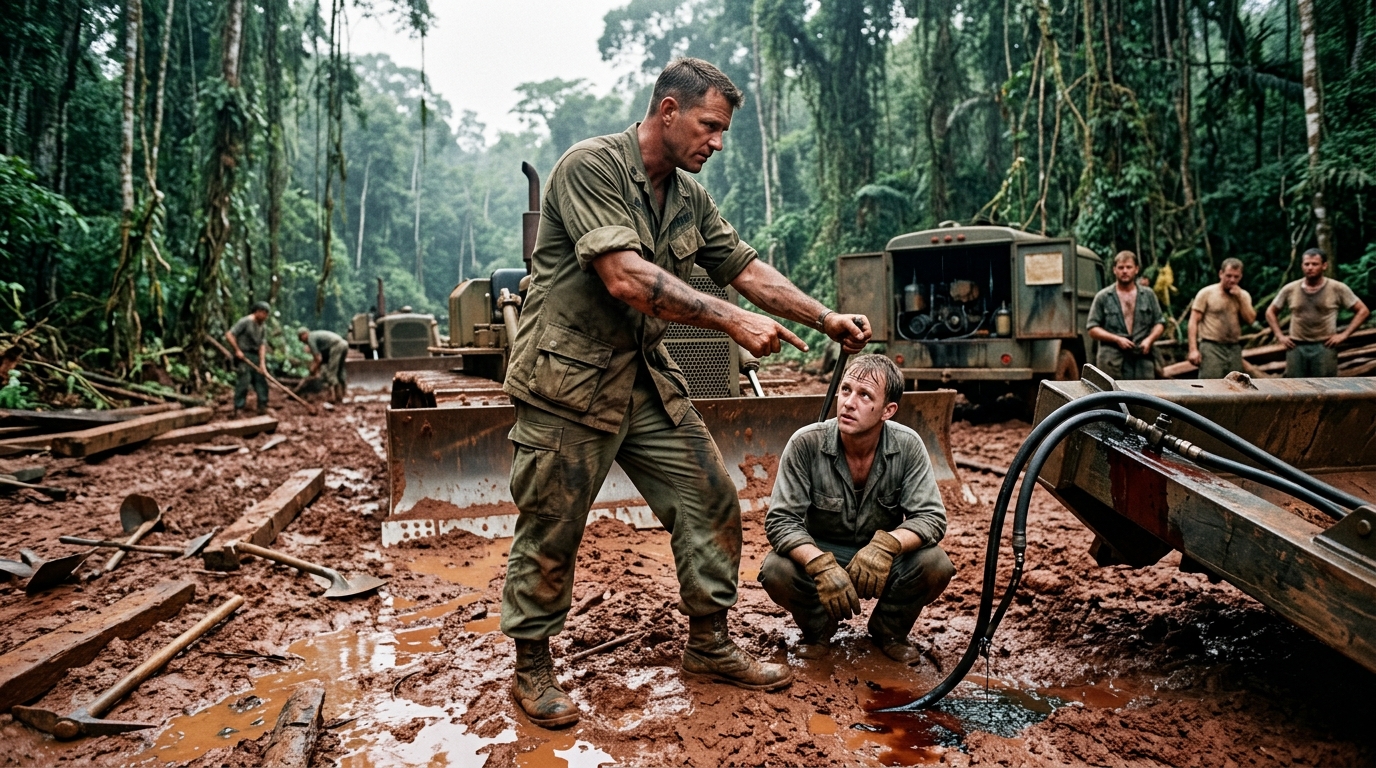
Off to the side of the clearing, a heavy steel scraper sat tilted at an awkward angle, its hydraulic line blown out under the immense pressure of the roots.
Dennis, the civilian mechanic drafted into service, crouched by the ruptured hose with a wrench in his hand, his face pale from intermittent fever.
“We don’t have a spare coupling,” Dennis called out over the engine roar, his voice cracking from thirst. “The supply ship isn’t due for a week, and this line won’t hold another patch.”
Miller didn’t shut down the tractor.
He dropped the transmission into neutral, let the diesel idle with a heavy, rhythmic thud, and stepped down into the ankle-deep muck.
The heat hit him instantly like a physical weight, thick with the scent of rotting vegetation and stagnant water.
He didn’t waste breath on complaints; there was no cavalry coming, and the nearest real machine shop was five thousand miles away.
“Cut a section of the fuel line off the old grease wagon,” Miller said, pointing a calloused finger toward the parked truck. “Clamp it down with double wire and wrap it in rubber sheeting. It has to hold until sunset.”
Dennis stared at him through sweat-matted hair, hesitation tightening his jaw before he nodded and dragged himself toward the wrecks.
Miller turned back to the tractor, grabbing the cold iron steering lever with a grip that left his knuckles white.
The twenty-day clock was ticking, and the jungle was giving up its ground only by the inch.
CHAPTER 3: TORPEDO JUNCTION TOLL
The harbor water at Palakulo Bay churned grey under the overcast morning sky as the heavy cruiser limped past the reef line.
Miller stood on the wooden pier, wiping black grease from his knuckles with an oily rag while watching the jagged silhouette crawl toward the makeshift docks.
Forty-five shell holes gaped across her superstructure like torn paper, and her forward turret was scorched a dull, dead black.
She had taken the combined weight of two enemy battleships in the dark waters off Guadal Canal and dragged herself four hundred miles south on patched lines and stubborn pride.
“She’s taking on water forward,” Dennis muttered, wiping his brow with a forearm while adjusting a portable pump valve. “The pumps are already straining against the tide.”
Miller didn’t answer right away; he tossed the rag aside and stared down at the rusted iron wrench resting in his palm.
There was no dry dock here yet, no heavy shipyard crane to lift her out of the salt water, and no spare parts waiting in a warehouse.
They had to shore up her bleeding hull using timber cut from the jungle ridge just hours prior and whatever plates they could salvage from supply wrecks.
“Get the timber crews moving,” Miller said, his voice flat and unyielding against the rising wind. “We patch her enough to float, or she stays on the bottom before she ever sees home.”
CHAPTER 4: THE HIDDEN ENGINE
Miller stood knee-deep in the drainage ditch behind the newly cleared tank farm on Aore Island, wiping corrosive salt spray from his stinging eyes.
Fifty thousand-barrel bolted tanks loomed out of the tropical haze like giant iron drums, connected by twenty-five thousand feet of twelve-inch steel pipeline stretching back toward the makeshift docks.
The air tasted faintly of refined gasoline and rotting jungle mulch, thick enough to coat the back of the throat with every breath.
Dennis scrambled up the muddy embankment, clutching a ledger book with pages warped and soaked from the daily afternoon downpour.
“The pump stations are dropping pressure on line three,” Dennis said, his voice tight with fatigue as he tapped a grease-stained finger against the paper. “A valve fitting near the storage manifold is hairline cracked, and we don’t have a replacement casting.”
Miller stared at the pipeline, his grip tightening instinctively on the heavy iron wrench tucked into his belt.
Enemy aircraft were ranging south from Rabaul again, and the fighter squadrons protecting Henderson Field four hundred miles north were burning through aviation fuel faster than tankers could dock.
There were no spare parts in the inventory, and waiting for a shipment from the mainland meant leaving the frontline dry.
“We don’t need a new casting,” Miller said, his tone flat and unyielding. “Pull the brass housing off the disabled generator, weld a sleeve from a discarded oil drum around the joint, and pack it with graphite grease.”
Dennis blinked, his jaw tightening as he weighed the makeshift fix against the immense pressure of the fuel lines.
“It won’t hold full pressure for long,” Dennis warned.
“It has to hold until the fleet gets back,” Miller replied, turning back toward the roaring pumps. “Keep moving.”
CHAPTER 5: THE STEEL COLOSSUS
Miller dropped the ledger onto the damp crate and broke into a steady, flat-footed run toward Palakulo Bay.
The massive floating dry dock, ten separate iron sections towed across thousands of miles of open ocean, was tearing itself apart at the seams.
One of the central pontoons had slipped during the final alignment process, plunging thousands of tons of steel into the soft coral shelf and dragging three support cables down with it.
Dennis was already waist-deep in the oil-slicked tide, shouting hoarsely over the grinding screech of stressed winches while trying to secure a jammed locking pin.
“The guide rail warped in the heat!” Dennis yelled, his face slick with sweat and salt as he fought a heavy iron lever. “If we don’t cut the cable right now, the whole section rolls over and crushes the drainage pumps.”
Miller didn’t hesitate; he grabbed a heavy acetylene torch from the deck rack, ignoring the burning sting of humidity in his lungs.
There was no crane left intact to lift the weight, and waiting for authorization from command would put the entire shipyard underwater before nightfall.
“Get back out of the trench!” Miller ordered, sparking the igniter with a sharp, violent snap of flint.
The blue flame roared to life, casting a harsh, pale glare over the dark water as he jammed the nozzle straight against the tensioned steel cable.
The metal squealed in protest, throwing a blinding cascade of white-hot sparks that sizzled into the tide around his boots.
CHAPTER 6: MILLION DOLLAR EXIT
Miller killed the torch feed, letting the heavy brass handle hang from its frayed cord as the silence of the tropical evening rushed back in.
The floating dock was locked solid into the coral floor, its massive iron pontoons resting level and secure against the tide.
Along the southeastern ridge, the thousands of Quonset huts, supply depots, and maintenance bays stood silent under a thick blanket of encroaching jungle vines.
The colonial authorities had refused to buy the surplus machinery, calling it worthless junk not worth the shipping cost back across the ocean.
Dennis stood beside him on the wooden ramp, wiping oil from his palms onto a rag while staring out toward the dark line of the harbor.
“They want us to just pack up and leave everything behind like it never mattered,” Dennis said, his voice dropping into a dry, tired rasp. “All of it dumped in the salt water.”
Miller reached down, pulling the cold iron wrench from his belt and tossing it lightly into an empty tool crate with a dull clang.
He didn’t care about the ledger books or what the bureaucrats said from thousands of miles away.
The airstrips had launched the fighters, the dry dock had patched the hulls, and the fleet had stayed in the fight because ordinary men refused to quit.
“Let them leave it in the bay,” Miller said, turning his back on the water and walking up the red clay road. “The job is done.”