The Land of Broken Promises: A Quiet Man’s Calculation to Reclaim the Ground Beneath Them
CHAPTER 1: THE MORNING CRUNCH
The morning air tasted of damp earth and coming rain, the kind of stillness that usually sat well with my coffee. Then came the purr—a high-end, synthetic sound that didn’t belong in the rolling hills of a farm that had seen four generations of sweat. Veronica Ashford’s silver Lexus rolled into my drive, gravel spraying against the base of the stone farmhouse like gravel-fire.
I didn’t turn around immediately. I stood by the stone boundary wall—the one my grandfather had laid with his own hands in 1952—and finished my coffee. The mug was ceramic, chipped at the rim, a stark contrast to the stainless-steel precision of the machine now idling behind me.
“Mr. Brewster,” her voice was clinical, stripped of any neighborly pretense. It was a scalpel of a sound.
I turned slowly. Veronica stepped out of the Lexus, her navy blazer looking like a uniform in the soft, gray light. Behind her, Marcus, the city inspector, lumbered out of a heavy utility truck. His mustache twitched as he checked a clipboard, his eyes darting toward the stone chimney as if calculating its worth in demolition fees.
“You’re early, Veronica,” I said. My voice felt rough, unused to social pleasantries, but my mind was a machine, clocking the distance between them, the angle of the sun, and the way Marcus gripped his pen.
She didn’t smile. She held up her sterling silver ruler, the metal flashing with a cold, unforgiving light. “We’re conducting a safety audit. The mortar on this boundary wall is crumbling. It’s a liability.”
“It’s stood for seventy years,” I replied, my gaze shifting to Marcus, who was already scratching lines onto a citation pad.
“Codes change, Mr. Brewster,” Marcus muttered, not meeting my eyes. “The world moves on.”
I felt the familiar, sharp pull of tension in my gut. This wasn’t about the mortar. It was about the garden behind me—the heirloom tomatoes and peppers that still held the ghost of Sarah’s touch. Every citation, every fine, every “safety hazard” was a calculated move to push me off the dirt that was the only thing I had left of her.
“And what’s the damage today?” I asked, keeping my hands deep in my pockets to hide the way they were curling into fists.
Marcus tore a bright yellow slip from his pad and stepped forward, the diesel fumes of his idling truck rolling over us like a shroud. “Eighty-five thousand for the driveway. Paving standards, Brewster. It’s a hazard to emergency vehicles.”
I looked down at the citation, the ink still wet. My lungs felt tight, but my pulse was steady. I was a hydrogeologist. I understood pressure. I understood that when you keep an aquifer squeezed long enough, the surface eventually gives way.
As I took the paper, a faint, metallic scent reached my nostrils—not the diesel, and not the garden. It was the sterile, sharp aroma of the courthouse basement. I looked back at the house, a sudden, cold realization prickling the back of my neck. My grandfather’s surveying trunk was still in the attic, locked and untouched since the eighties. I’d walked past it a thousand times, but today, in the shadow of their hovering figures, the memory of a specific file folder flared in my mind like an alarm.
“Is that all?” I asked, my voice dangerously calm.
Veronica watched me, her eyes narrow, searching for the crack in my resolve. She wanted a reaction. She wanted a broken man.
“For now,” she said, turning back toward her Lexus. “Compliance is due in thirty days. After that, we begin the foreclosure process.”
I watched them go, the dust settling back onto the gravel. I stood alone, the yellow paper a weight in my hand, and for the first time in two years, the grief felt secondary. The clarity of the war ahead was a cold, sharp, and terrifyingly welcome thing.
CHAPTER 2: THE BASEMENT ARCHIVE
The silence of the house was different once the sound of their engine faded. It wasn’t the peaceful quiet of a working farm; it was the suffocating stillness of a tomb waiting to be opened. I stood on the porch until the dust cloud vanished into the tree line, the yellow paper of the citation crinkling under my grip. Eighty-five thousand dollars. The figure felt abstract, a game of pretend played by people who didn’t understand the difference between the land they occupied and the land they actually owned.
I didn’t head for the kitchen or the garden. My boots hit the hardwood floor, echoing through the empty rooms like a metronome. My house felt smaller, the walls pressing in with the accumulated weight of three decades. I climbed the narrow, creaking stairs toward the attic—the place where the past was neatly packed away in cedar-lined trunks.
As I reached the landing, the temperature dropped. The air up here was stagnant, thick with the smell of dry rot and old paper. I found the trunk in the far corner, draped in a gray sheet that looked like a shroud. I pulled it back, and the dust billowed, catching the single beam of sunlight that pierced the attic window. It was my grandfather’s surveying trunk, heavy with brass, leather, and the weight of a man who didn’t trust the world beyond his fence line.
My fingers trembled as I fumbled with the rusted lock. It gave way with a sharp, metallic protest that echoed through the joists. Inside, the documents were organized with a precision that bordered on religious. Field notes, property maps from 1952, and finally, the heavy manila envelopes from the eighties.
As I lifted the first map, a sudden, sharp memory cut through the quiet—a phantom echo of Sarah’s laughter from the garden below, bright and fleeting. It was so vivid I almost turned, expecting to see her standing in the doorway, sun-drenched and smelling of basil and earth. But the doorway was empty. The ghost was just a reflex of a mind trying to find comfort in a space that had become a battlefield. I shook the feeling off, pinning my focus to the ink on the page.
I spread the survey out on the floor. The lines were intricate, drawn by hand with an accuracy that made modern digital plotting look like a child’s sketch. I traced the boundaries with my thumb. This wasn’t just a farm map. It was a legal blueprint of the entire area, including the footprint of the luxury sprawl currently known as Willow Spring Estates.
My eyes scanned the notes in the margin—notes written in my grandfather’s firm, unyielding script. Developer rights granted with strict limitation on structural permanency.
My breath hitched. I had spent years as a hydrogeologist, staring at borehole logs and subterranean water tables, reading the hidden strata beneath the surface. I knew how to look for the things that weren’t immediately visible. And there, buried in the fine print of the 1987 contract, was a clause I had read a dozen times in my youth without ever truly understanding. It wasn’t about the surface. It was about the foundation.
If the development rights were predicated on the completion of the sale, and the company had gone under—
I stood up, the paper rustling. The attic felt like it was shifting. If my grandfather hadn’t signed away the underlying deed, but only a restricted lease of development… then they didn’t own the land. They were tenants who had forgotten how to pay rent.
I looked down at the citation in my other hand, the eighty-five thousand dollars of “violation fees” demanded by Veronica. She was standing on my soil, holding a silver ruler, telling me my fence was non-conforming, all while her very presence was a breach of a contract that had probably expired decades ago.
The strategy clicked into place. It wasn’t a defense I needed; it was an offensive maneuver. I didn’t need to pay the fine. I needed to challenge the authority of the entity issuing it. I grabbed the file, my movements becoming rapid, efficient, and cold. I needed to get to the courthouse before the afternoon shift changed. I needed to see if the records matched the reality in this trunk.
As I made my way back down the stairs, I didn’t look at the empty rooms or the portraits of Sarah on the wall. I looked at the floorboards, the ones my grandfather had laid, and I felt the weight of the three hundred and forty acres beneath me. They were not just dirt; they were a mountain of leverage. And for the first time in years, the crushing weight of the fines turned into the iron-clad certainty of a trap being set.
CHAPTER 3: THE COUNTERSUIT
The descent from the attic felt like traveling back into the modern world. I carried the manila folders against my chest like a shield. My kitchen, usually a place of quiet routine, now felt like a command center. I laid the 1952 documents out on the wooden table, the surface still scarred from decades of use. Next to them, I placed the fifty-page legal monstrosity that Peton and Associates had served me yesterday—the two-million-dollar counter-suit for “adverse possession” and “unauthorized use.”
I poured a cup of coffee, the steam rising in the cold morning air, and sat down. My hands were steady. Outside, the morning sun was just beginning to hit the ridge, casting long, sharp shadows across the driveway where Veronica’s Lexus had been idling only hours ago.
I didn’t reach for the law-firm filing immediately. I let it sit there, an alien object in my sanctuary. When I finally opened it, the legal jargon felt like a thick fog. Adverse possession. Beneficial occupation. Continuous use. The words were designed to be barriers, meant to make a man like me feel small, uneducated, and easily discarded.
I read the first twenty pages with a predatory focus. They claimed the subdivision had “settled” the land through decades of undisturbed maintenance. It was a bold, arrogant argument—the kind of logic you build when you assume the person you’re targeting doesn’t have the stomach to look at the paperwork.
Then, I hit the footnote.
I leaned closer, the sharp scent of old paper from the attic files mingling with the harsh, chemical smell of the printer toner from the new document. Footnote 14. It cited a 1991 property assessment that supposedly established the neighborhood’s “presumptive ownership rights.” I cross-referenced the date with the documents I’d pulled from the attic—the ones my grandfather had meticulously labeled with the exact day the Clearwater Development Company went into Chapter 11.
There was a discrepancy. A subtle, granular error. The assessment mentioned in the counter-suit was dated six days before the bankruptcy court had officially frozen all land transfers. If that assessment existed, it was a fabrication—a post-dated document meant to provide a veneer of legality to a transaction that was, by federal law, void the moment the bankruptcy hammer fell.
I sat back, the chair groaning under my shift in weight. The realization was colder than the morning air. They hadn’t just filed a suit; they had built a trap that relied on me not knowing the timing of the 1991 collapse. They were betting on the fact that I would be too intimidated by the $2.3 million figure to audit the dates.
I didn’t feel anger. I felt the cold, sharp precision of a hydrogeologist finding the exact point where a rock formation could be cracked.
I picked up the phone. I didn’t call a lawyer. I called the records office at the county courthouse, keeping my voice neutral, transactional. I requested the public filings for the 1991 assessment mentioned in footnote 14.
“I’m sorry, Mr. Brewster,” the clerk said, her voice sounding small and distant. “Those files… there’s a backlog. Some of the older records are currently being transferred to the state archive for digitization.”
“I see,” I said, watching a hawk circle over the pasture. “And when will they be available for public inspection?”
“It’s hard to say. Maybe weeks. Maybe months.”
I hung up. The barrier was already being erected, a digital paper wall to hide the flaw in their foundation. They knew. That was the most important realization. They knew the timeline was the fracture point.
I looked at the counter-suit again, this time with a new sense of purpose. I wasn’t going to fight this in court on their terms. I was going to turn their own documentation against them. I started a notepad, writing down the sequence of events based on the 1991 bankruptcy filing, the dates of the assessment, and the signatures on the deeds. It was a simple timeline, but it was a weapon.
The house grew quiet around me. The ticking of the wall clock seemed to slow. I had thirty days before the eviction process moved to the next stage, but the clock had already started ticking in my favor. I didn’t have a legal team, but I had the original ink, the original signatures, and the original truth.
I stood up and went to the window, watching the boundary line where my property met the pristine, manicured lawns of the subdivision. The grass there was too green, too uniform, too much like a lie. I took a deep breath of the sharp, cold air.
If they wanted to claim adverse possession, let them. But they were going to find that this particular piece of ground was far more resistant to being “occupied” than they had ever imagined. I would not vacate. I would not pay. And by the time they realized the error in their own footnote, I would have the rest of the puzzle in my hands.
CHAPTER 4: THE FLORIDA CONNECTION
The sky didn’t just turn gray; it bruised, a deep, sickly purple that signaled a storm the likes of which I hadn’t seen since the year Sarah and I first moved into the homestead. I stood by the kitchen window, watching the rain begin to lash against the glass in heavy, singular drops. My attempt to reach the records office had left me with nothing but a dial tone and the knowledge that the wall between me and the truth was being built in real-time.
I grabbed my coat—a heavy, canvas thing that smelled faintly of motor oil and old garden soil—and stepped out onto the porch. The air was charged, the scent of ozone and wet dust already saturating the world. I needed to move, to do something, but the storm was closing the roads, turning the gravel drive into a treacherous wash of mud and sliding rock.
I didn’t head for the truck. I headed for the wellhouse.
It was a small, stone-built structure at the edge of the property, partially obscured by the overgrown vines that Sarah had loved so much. Veronica had cited it for “unpermitted modification,” a laughably transparent attempt to chip away at the history of the land. I pushed the door open, the rusted hinges groaning in the rising wind. Inside, the space was cool, smelling of deep, undisturbed stone and copper pipes. It was the only place on the property that felt completely outside the jurisdiction of the subdivision.
I pulled my cell phone from my pocket, the screen flickering in the dim light. I had one number left to call—the one Elellanar Patterson had unearthed, a retirement community on the outskirts of Tampa. My fingers, calloused and steady, dialed the digits as the wind began to howl around the stone walls.
The connection was awful. It sounded like a tempest was raging through the receiver itself.
“Hello?” The voice was thin, reedy, but sharpened by age. “Is this… is this a Brewster?”
“Yes,” I said, leaning my back against the cold, damp stone of the wellhouse wall. “Richard Sterling?”
“I’ve been waiting a long time, son,” the voice crackled. “Your grandfather was a man who understood the difference between the icing on the cake and the cake itself. I assume you’re calling because the cake is currently being stolen?”
I didn’t waste time on pleasantries. The storm pounded against the roof, a rhythmic, violent cadence that underscored the urgency. “They’re trying to foreclose, Mr. Sterling. They’re using a 1991 assessment to claim adverse possession.”
“They’re bluffing,” Sterling said, and the conviction in his voice cut through the static. “They don’t have a leg to stand on. When Clearwater went belly up, they didn’t finish the final payment. I have the bankruptcy filings, the correspondence, and the judge’s ruling—the one that specifically states the property rights revert to the original grantor.”
“They destroyed the county records,” I countered, my eyes tracing the outline of the well-head. “They have someone inside. The documents are missing.”
“Let them burn the copies,” Sterling said, and there was a grim, satisfied humor in his tone. “I have the originals. I kept them in my personal file precisely because I knew the paper trail in that county was a mess. It’s an equitable reversion, Clayton. It’s the law of the land. It’s not a request; it’s a reality.”
As he spoke, a flash of lightning illuminated the wellhouse, showing the cracks in the masonry, the ancient, sturdy craftsmanship that had survived for sixty years. The “rubber band” metaphor he used—the idea that the land was simply waiting to snap back—suddenly crystallized. I wasn’t fighting for something I had lost; I was reclaiming something that had never truly left.
“I’ll overnight the packet to you,” Sterling said. “You have the law. You just need the proof. And when you get it, don’t just file it in court. Use it to pull the foundation out from under them.”
We talked for another ten minutes, the storm outside rising to a deafening roar. Every detail he gave—the specific bankruptcy case number, the names of the court-appointed trustees, the exact clause in the 1987 lease—was a brick in the wall I was building to hold back the tide. When I finally hung up, the silence in the wellhouse was absolute, save for the rain.
I stood there in the dark, the phone in my hand, and looked out through the narrow door of the wellhouse. The subdivision was hidden by the rain, but I knew it was there, a cluster of artificial lights and manicured lawns, all of it held together by a legal fiction. They thought they had the high ground because they had the money, the law firms, and the power to issue citations. But they had forgotten the most basic rule of the land. You can build whatever you want on top, but you’ll never own the foundation.
I stepped out into the rain. The mud sucked at my boots, heavy and clinging, but I didn’t care. The path back to the house was obscured, but I knew every inch of this ground. I had the truth now, and for the first time, the weight of the fight wasn’t pulling me down. It was grounding me.
CHAPTER 5: THE INCINERATOR
The courthouse lobby was a cavern of polished marble and flickering, low-wattage fluorescence. My boots tracked mud across the pristine floor—dark, heavy patches of the farm I was fighting to keep. I didn’t care. Every mark I left felt like a reclamation of space that had been sanitized and partitioned against me.
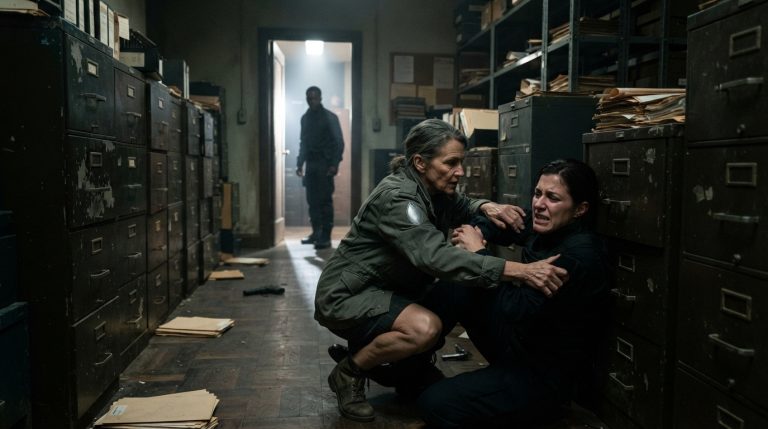
I headed straight for the basement. The air down here was different, laden with the smell of wet concrete and ozone. It was a utilitarian tomb for records that the world had forgotten, or worse, wanted to keep buried. As I rounded the corner toward the records room, I saw her.
Nancy, the county clerk, was hunched over a heavy metal cabinet. Her shoulders were tense, bunched up toward her ears like a bird bracing for a predator. The sound of my footsteps on the concrete floor reached her before I did. She spun around, her face pale, a cardboard box already packed and taped shut at her feet. It was marked Property Records 1980-1989.
“Mr. Brewster,” she breathed, her voice trembling. “You shouldn’t be down here. The area is… it’s restricted.”
I stopped a few feet away, letting the heavy, wet weight of my coat define the space between us. I didn’t reach for my files. I didn’t need them yet. I looked at the box, then back at her, letting the silence stretch until it became physical, a taut wire pulled between us.
“Restricted?” I asked, my voice steady, stripped of the fatigue that had been gnawing at me for weeks. “This is a public archive, Nancy. I’m a property owner. These are my records.”
“I’m just following protocol,” she stammered, her gaze darting toward the service elevator behind her. “Veronica—Mrs. Ashford—she said there were damages. Water leaks. The files are being moved to the city dump for disposal per standard maintenance procedure.”
The lie was so thin it was transparent, a pathetic attempt to cover a crime that had already been set in motion. The vertigo hit me then, a sudden, sickening tilt of the room. The flickering lights overhead seemed to strobe, making the shadows dance in ways that felt like a trick of the mind. Was the box even real? Or was I just seeing what I desperately needed to see to justify this war? I blinked, fighting the sensation of falling, anchoring myself by digging the heels of my boots into the concrete.
“Disposal,” I repeated, the word tasting like copper. “You’re burning thirty years of property history.”
“It’s not my fault,” she whispered, a tear tracking a clean line through the dust on her cheek. “I have bills, Clayton. I have a mortgage. She said—she said it was just paper. That nobody would notice.”
I took a step forward, and she recoiled, hitting the metal filing cabinet with a sharp, metallic clang that seemed to vibrate through the entire basement. I felt a surge of cold, analytical rage. This wasn’t about her mortgage. It was about the complete erosion of accountability.
“Where is she?” I asked.
“She’s waiting in the parking lot,” Nancy choked out. “She’s watching. Please, just… just take the box and go. If she sees you talking to me, I’m ruined.”
I didn’t take the box. I took my phone. I didn’t record a threat; I recorded her face, her shaking hands, and the label on the box. I needed the moment, the physical evidence of their fear. As I moved toward the elevator, I caught a glimpse of myself in the reflective surface of a glass door. I looked like a ghost—wet, mud-stained, and fueled by a singular, burning purpose.
I left her there, huddled against the steel, and made for the exit. My lungs burned with the cold, sterile air as I pushed through the double doors into the parking lot. The storm had broken, but the sky was still a bruised, ominous gray. There, idling at the edge of the lot, was the silver Lexus. It sat motionless, a shark in a sea of asphalt.
I didn’t try to hide. I walked straight toward the car, my boots heavy on the wet pavement. I saw Veronica’s silhouette through the tinted glass, her hand resting on the steering wheel, her posture rigid, untouchable. I stopped ten feet from the front bumper, looking at the reflection of the courthouse in the hood of her vehicle.
I didn’t speak. I just stood there, letting her see me. I wanted her to know that I had seen the box. I wanted her to know that I knew exactly what she was trying to burn, and that I was the one who had finally come to put the fire out. She didn’t move, but the Lexus’s engine revved—a sudden, aggressive growl that sliced through the quiet of the parking lot.
She wasn’t going to talk. Not here. But she was running out of moves, and I could see the panic in the way her knuckles had turned white against the wheel. She was trapped in the very infrastructure she had built to secure her own authority, and the walls were finally starting to close in. I turned my back on the car and started the walk to my truck, my heart beating with the rhythm of a coming storm. The evidence in the basement was gone, but the confession I’d just witnessed was worth more than a thousand files.
CHAPTER 6: THE SHELL GAME
The kitchen was cold. I hadn’t bothered to light the stove, the chill settling into my bones as I stared at the documents spread across the worn oak table. The forensic accountant, a contact Jessica had provided, had worked through the night, tracing the tangled web of the “Ashford Legal Defense LLC.” It was all there—black ink on white paper, the clinical reality of theft.
The numbers weren’t just impressive; they were brazen. Veronica had been systematically siphoning funds from the HOA under the guise of “emergency legal defense” for months. The special assessment—the $25,000 charge she intended to levy on every household—wasn’t meant to stop my claim. It was an exit strategy. She was planning to loot the community coffers and vanish before the title fraud collapsed the subdivision’s entire existence.
I picked up the report. My hands were steady, but my jaw ached from clenching it. She hadn’t just been attacking my family legacy; she had been cannibalizing the very people who elected her, using their fear of me as a smokescreen for her own grift. The audacity of it was almost surgical. She had created a narrative where I was the monster so that she could be the savior, and then used that role to bleed the victims dry.
The phone on the table chirped, the sound jarring in the silence. It was Jessica. I picked it up, pressing the receiver to my ear.
“Dad,” her voice was taut, vibrating with the same focused intensity I felt. “I’ve gone over the state business registration. The LLC is linked to an offshore holding account in the Caymans. She isn’t just taking the money; she’s layering it. This is a federal felony, not just civil embezzlement.”
“It’s more than that, Jess,” I said, looking out at the dark silhouette of the subdivision. “It’s a pattern. She didn’t just stumble into this. She’s been grooming the HOA board to accept these ’emergency’ assessments for months. She had the system primed.”
“I have enough to file an injunction against the special assessment vote,” Jessica continued. “But if we do that, we tip our hand. She’ll know we’ve looked into the money. She’ll run.”
“Let her,” I replied, the thought taking root like a dark seed. “If she runs, she abandons the house. If she stays, she faces the audit. Either way, the subdivision sees the balance sheet.”
I hung up and stood, walking to the window. The lights in the houses across the pasture were beginning to flicker off, one by one. Somewhere behind those walls, families were sleeping, oblivious to the fact that their ‘president’ was currently preparing to leave them holding the bag for a multi-million dollar fraud.
The feeling of vertigo from the courthouse visit had passed, replaced by a cold, hard clarity. This was the escalation. I had the records, I had the surveyor’s evidence, and now I had the financial smoking gun. The “Predator-Prey” dynamic had shifted. She was no longer the one wielding the silver ruler; she was the one staring into the maw of a reckoning she couldn’t outrun.
I checked the time. The HOA meeting was in less than twenty-four hours. Veronica would be there, wearing her navy blazer and her pearls, expecting to secure her payday. She expected a room full of sheep. She didn’t expect the man she’d spent three years trying to bury to be the one holding the spotlight.
I walked over to the corner of the kitchen and picked up the box of aluminum property markers I’d ordered. They were heavy, cold to the touch, and inscribed with the legal weight of the Brewster family land trust. Each one was a physical assertion of the truth. I began to load them into the bed of my truck, the metal clinking against the rusted sides.
I wasn’t going to win this in a courtroom—at least not solely. I was going to win this by stripping away the illusion of their authority, piece by piece, in front of the entire neighborhood. The risk of an injunction failure was there, sitting in the back of my mind, but I pushed it away. There was no going back now. The foundation of Willow Spring Estates was built on a lie, and I was going to be the one to show them the dirt beneath it. I climbed into the truck, started the engine, and let the rhythmic vibration of the old machine ground me. The road ahead was narrow, dark, and winding, but I knew exactly where I was going.
CHAPTER 7: THE COMMUNITY CENTER SIEGE
The community center was a low-slung building of glass and brushed aluminum, currently ablaze with the harsh, artificial light of a forced assembly. Cars lined the parking lot, an expensive, orderly array of status symbols that looked, to my eyes, like a fleet of ships anchored on someone else’s shore. My boots hit the pavement, the sound sharp and rhythmic. I carried the heavy box of aluminum markers, the metal edges biting into my palms, a tactile reminder of the boundaries I was here to assert.
Inside, the murmur of the crowd was a low-frequency hum, the sound of a hundred people who had been summoned under a pretext of emergency, all of them nursing a communal, simmering anxiety. As I pushed open the double doors, the air hit me—a mix of expensive perfume, stale coffee, and the metallic tang of fear.
Veronica stood at the front, her silhouette framed against the projection screen. She was in her element, the navy blazer tailored, the pearl earrings catching the overhead lights with a sterile, defiant glint. She was mid-sentence, her voice projecting a rehearsed, practiced authority that had governed this room for three years.
“…which is why we must act with urgency,” she was saying, her hands gesturing to a slide showing a $25,000 special assessment fee. “To protect our property values, to ensure the structural integrity of Willow Spring, we must authorize these funds.”
I didn’t stop in the back. I began to walk down the center aisle, the weight of the box drawing eyes toward me. A ripple moved through the rows—the recognition of the ‘disgruntled neighbor.’ Someone whispered, the sound spreading like static. Veronica stopped. She looked up, her gaze locking onto me, her confidence flickering for a micro-second before she masked it with a practiced, thin-lipped smile.
“Mr. Brewster,” she said, her voice dripping with artificial empathy. “This is a private meeting of the homeowner’s association. You are not a member.”
“I don’t need to be a member to speak on my own land,” I said, my voice cutting through the hum. I stopped at the foot of the stage, the box heavy in my arms. I didn’t set it down. I wanted them to see it.
“Mr. Brewster, I must insist you leave,” she said, signaling toward the door where a private security guard stood, looking shiftless and uncertain. “If you continue this disruption, we will be forced to involve the authorities.”
“The authorities are already involved, Veronica,” I said, my tone flat, stripped of all the emotion that had kept me awake for the last forty-eight hours. I looked out at the faces in the front rows—people I had walked past in the grocery store, people who had waved at me when they thought I was just the ‘old man in the farmhouse.’ They looked confused, their trust in her beginning to fray.
I reached into the box and pulled out one of the markers. PRIVATE PROPERTY. BREWSTER FAMILY LAND TRUST. I tossed it onto the stage. It clattered loudly, the sound echoing against the high ceiling like a gunshot.
“I’m not here to disrupt,” I said, addressing the room, not her. “I’m here to notify you. Every home in this room is built on land that has never legally left the Brewster estate. Clearwater Development committed title fraud in 1991, and for thirty-three years, you have been living on property that is currently undergoing a legal reversion process.”
The silence that followed wasn’t the silence of a meeting; it was the absolute, vacuum-sealed stillness of a room where the floor has just been pulled out. Veronica turned, her face a mask of furious white, her lips trembling. “He is lying! This is a fabrication, a desperate attempt to extort—”
“Is it?” I reached into my pocket and pulled out the copies of the original bankruptcy filings and the title insurance report Eleanor had commissioned. I didn’t shout. I didn’t need to. “I have the original deeds. I have the surveyor’s brass markers, still in the ground. And I have the financial trail of the shell company you used to embezzle the funds you’re asking for right now.”
The room erupted. It wasn’t a roar, but a chaotic, splintering sound of a hundred conversations starting at once. I saw Mrs. Henderson in the third row, her hand going to her mouth. I saw the man from the house on Maple Street standing up, his face twisted in sudden, sharp realization. The veneer—the matching mailboxes, the perfect lawns, the “architectural standards”—it was all shattering in real-time.
Veronica took a step toward me, her hand gripping the edge of the projector table, her composure finally breaking. Her eyes were frantic, searching the room for an ally who wasn’t there. “Security! Get him out of here!”
The guard took a tentative step, but he looked at the documents on the stage, then at the crowd, and he didn’t move. He knew the wind had changed. The power in the room had shifted, anchored not by the woman in the blazer, but by the stack of papers I had placed at her feet. I looked at her, really looked at her, and saw for the first time that she was just as terrified as the people she had been stealing from. She was a scavenger who had been caught, and the walls of her own construction were finally, inevitably, collapsing inward.
CHAPTER 8: THE SETTLEMENT
The transition from chaos to stillness was jarring. The moment the steel cuffs clicked around Veronica’s wrists, the air in the community center seemed to change—the frantic, pressurized electricity dissipated, replaced by the heavy, settled weight of reality. Veronica stood frozen, her shoulders hunched as the reality of her position hit her. The navy blazer, once a symbol of her manufactured power, now looked like a costume she had outgrown.
Detective Sarah Lucy stood beside her, her expression unreadable, professional. She didn’t grant Veronica the theatrics she seemed to be waiting for. She simply nudged her toward the door. As Veronica walked past the rows of chairs, the silence was absolute. Nobody spoke. The residents of Willow Spring Estates watched her go, their faces caught between anger, disbelief, and a profound, dawning relief.
I stood by the podium, my hands resting on the box of markers. The adrenaline that had propelled me for the last three days began to ebb, leaving behind a dull, throbbing fatigue in my muscles. This was the payoff. The antagonist was physically facing the consequences of her own tactical failures, and the mechanism of her downfall was the very legal framework she had attempted to manipulate.
The denouement was quiet, almost anticlimactic in its sincerity. Once the center emptied, I stayed behind. I walked to the garden beds that had been vandalized just weeks prior. The soil was still dark, damp from the storm. I knelt, feeling the friction of the grit against my palms. It was my land. It had always been my land.
I took the small garden spade I had carried in my truck—a tool passed down from my grandfather, the blade worn smooth by decades of use—and began to work the earth. The rhythm was hypnotic. I buried a new heirloom tomato plant, firming the soil around the base with a practiced, gentle hand. Symbolic closure. I wasn’t just planting a crop; I was anchoring the future of the farm.
Jessica arrived a few minutes later, her eyes reflecting the dim light of the overhead fixtures. She stood a few feet back, watching me. “It’s done, Dad,” she said. Her voice was soft, devoid of the sharp edge of a lawyer’s cross-examination. “The bank has frozen the HOA accounts, and the title investigation has officially flagged the entire subdivision for a state-mandated audit. Nobody is losing their homes, but the fraud has been exposed. The ground is clear.”
I nodded, standing up to wipe the soil from my knees. I looked at the spade—the wood of the handle, the rusted iron of the blade. It was a simple object, yet it had survived the fire, the lawsuits, and the systematic attempt to erase my history.
“What now?” I asked.
“Now, we live on it,” she said.
The following weeks were marked by a quiet, atmospheric peace. The subdivision, once a source of constant friction, began to settle into a rhythm of its own. Without the constant threat of citations, the atmosphere lifted. The “Residents Association” that replaced the HOA was a modest, pragmatic affair; they focused on the common areas and the maintenance of the infrastructure, not the height of fences or the color of mailboxes.
The settlement money from the title insurance company—a payout forced by the sheer, undeniable weight of the evidence Sterling had provided—arrived like a steady, calm tide. We didn’t keep it all. We established the Sarah Brewster Agricultural Scholarship, a permanent fixture at the university. Every year, five students would study the law, the soil, and the science of keeping a community rooted. It was poetic justice; the fraud that had targeted the farm was now funding the future of those who worked the land.
I walked the perimeter of the three hundred and forty acres one afternoon, the air crisp and clear. The brass markers Tom had helped me find were still there, buried just beneath the surface, waiting for the next generation to find them. The boundary was secure.
I reached the old wellhouse. I pushed the door open, the hinges, oiled and quiet, sliding effortlessly. Inside, the cool, stone air remained, smelling of deep, undisturbed peace. I sat down, my back against the stone, and allowed myself the first moment of deep emotional connection to the place I had ever truly felt. Sarah would have liked the garden this year; the heirlooms were thriving, growing in a patch of earth that was no longer contested, no longer measured by a silver ruler, and no longer subject to the whims of a stranger.
The struggle was behind us. The pain had left its marks—the exhaustion, the cost, the scars of the fight—but the land remained. It was, as my grandfather had believed, the foundation. I took a deep breath, the sound of the wind through the trees acting as a final, quiet benediction. I was home.