A Ghost Among Giants: The Silent Reckoning of Sorrow 6 and the Unraveling of a Modern Legacy
CHAPTER 1: THE WEIGHT OF THE VOID
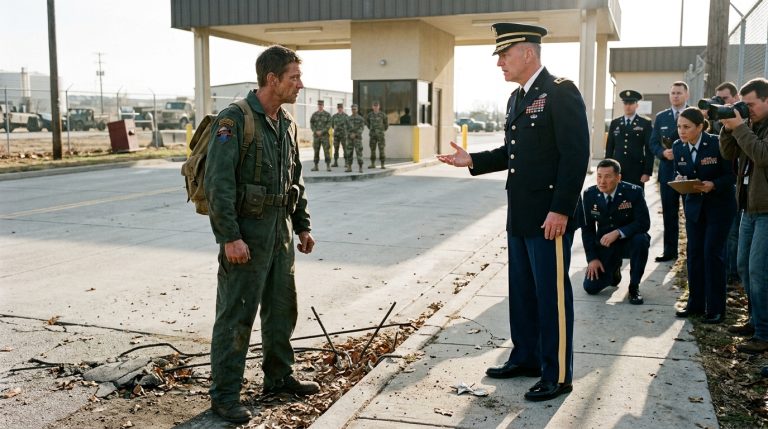
The parquet floor felt like a sheet of ice beneath Aara’s worn soles, a stark contrast to the polished heat of the ballroom she had just exited. General Hawthorne walked with a rhythmic, measured stride, his uniform stiff and smelling faintly of ozone and expensive dry cleaning. He was a man who took up space, but as Aara followed him down the long, artificially lit corridor, she felt the familiar, itching pull of a trap closing.
“They will be looking for you, Aara,” Hawthorne murmured, his voice a low vibration that didn’t quite reach his eyes. He didn’t turn back. He navigated the turn toward the executive offices with the ease of someone who had memorized every security camera angle. “The room tonight… it changed the topography of their world. Some people don’t like to be reminded that their kingdom is built on sand.”
Aara stopped, her hand ghosting over the frayed collar of her M65 field jacket. The silver teardrop patch on her sleeve seemed to absorb the dim fluorescent light, a black hole in the fabric of the corridor. “I didn’t come for an audience, Marcus,” she said, her voice thin but sharp as a razor. “I came because the debt is due. You know that as well as I do.”
Hawthorne halted. The sudden stillness of his body was predatory. He turned slowly, his face a mask of practiced, professional concern. “We can discuss the settlement in the archives. It’s safer. Away from the prying eyes of the staff.”
Aara watched his hands. They were steady, a general’s hands, but she noticed the slight, unnatural tension in his right index finger—a tell she had seen in men before they reached for a concealed sidearm or a panic button. She looked toward the end of the hall. A heavy, reinforced door stood open, revealing a room that smelled of dust and archival paper.
She walked past him, her eyes catching a discrepancy. On the wall beside the entrance, a small, recessed panel for the building’s lighting override was slightly ajar. It was a detail so minor that no one else would see it, but it screamed of recent, hasty activity. Someone had been waiting here.
“You always did prefer the shadows, Marcus,” she said, stepping into the room. The door behind her clicked—not with the sound of a latch settling, but with the distinct, heavy thud of an electronic mag-lock engaging.
Aara stood in the center of the dark archive, the only sound the faint, rhythmic hum of the building’s ventilation. The silence wasn’t empty; it was pressurized. She didn’t turn around. She stared at the rows of filing cabinets and felt the prickle of a gaze on the back of her neck.
“I’m not the hero they thought I was in that room,” she whispered to the darkness. “And you’re not the savior you think you are.”
Behind her, a shadow detached itself from the wall, and the distinct, metallic click of a safety being disengaged echoed in the small space.
CHAPTER 2: THE ANATOMY OF A TRAP
The click of the safety was not a sound; it was a structural shift in the air. Aara didn’t move. She didn’t breathe. She leaned into the stillness, her hand drifting toward the small, heavy utility knife she kept tucked into the waistband of her skirt—a habit formed in the 1960s that her mind had never quite managed to unlearn.
The archive was a tomb of paper and cold light. Through the periphery of her vision, she saw the silhouette shift. It wasn’t Hawthorne; the height was wrong, the posture too fluid. This was someone younger, someone conditioned for precision, not the bloated authority of a command office.
“General Hawthorne doesn’t like loose ends,” the shadow said. The voice was flat, devoid of emotion, the hallmark of someone who viewed killing as a clerical error to be rectified.
Aara shifted her weight, the parquet floor beneath her feet groaning in protest. She calculated the distance to the heavy oak table to her left. If she could reach the edge, she could use the metal filing cabinet as a screen. But as she tensed to move, the overhead fluorescent lights—the hum of which had been a constant, monotonous drone—flickered and died. The building’s power grid groaned, a distant mechanical strain that threw the entire corridor into a suffocating, absolute black.
The mag-lock on the door, deprived of its current, released with a hollow, metallic clack.
It was the disruption she needed, a chaotic variable that Thorne and his subordinates hadn’t factored into their sanitized security plans. Aara didn’t hesitate. She dropped to a crouch, her hands finding the cold, abrasive surface of the floor. She moved in a low, sharp diagonal, abandoning the center of the room. She felt the rush of displaced air as a projectile—likely a suppressed round—whistled through the space she had occupied a heartbeat before. It thudded into a stack of archival boxes, the scent of shredded cardboard and dust erupting into the stagnant air.
She reached the filing cabinet, her fingers brushing against the cold, industrial paint. She was no longer Aara Vance, the old woman in a faded jacket; she was Sorrow 6, a ghost navigating the blind. She mapped the room by the cooling hum of the ventilation and the erratic, uneven breathing of the person standing six feet away.
She took a breath, letting the sensation of the archive—the sharp tang of aging paper and the metallic bite of the heating ducts—flood her senses. She needed a distraction. She grabbed a heavy, brass-bound logbook from the top of the cabinet and hurled it toward the far corner of the room. It struck a metal shelving unit with the violent, ringing resonance of a bell.
The silhouette turned, a flicker of movement against the dark. Aara lunged. She didn’t strike to kill—she wasn’t a murderer, not yet—she struck to dismantle. Her hand, wrinkled and steady, swept upward, catching the assailant’s wrist with a practiced, bone-jarring impact. There was a sickening pop as she twisted, the leverage of her entire body weight focused on the radial nerve. The weapon clattered to the floor, sliding across the slick parquet.
The assailant gasped, a sharp, ragged sound of genuine, human pain. Aara didn’t give him room to recover. She stepped into his guard, forcing him backward until his spine hit the heavy, iron-latched cabinet. She leaned in, her voice a low, cold whisper that cut through the darkness.
“You’re playing with ghosts, boy,” she said, her grip unrelenting. “And ghosts don’t appreciate being followed home.”
She could feel the man’s heart hammering against his chest through his uniform jacket. He was terrified—not of her, but of the implications of failing a man like Hawthorne. He was just a cog, a piece of the architecture. She felt a surge of pity, but she crushed it. Pity was a luxury for people who weren’t carrying the memory of an entire unit on their shoulders.
“Who sent you?” she asked, her voice steady.
“General… General Hawthorne said you were a liability,” the man choked out, his voice shaking. “He said if you were seen, the… the orphanage files had to be purged.”
The words confirmed the truth she had feared since the gala. Hawthorne wasn’t protecting her; he was securing the destruction of the only evidence that tied his current success to the atrocities of the Umbra Level. He wasn’t just hiding a history; he was burying it, and he was using her as the shovel.
A sudden, sharp beam of light cut through the doorway. Someone had restored the power. Aara looked toward the entrance. A silhouette stood in the frame—too tall, too broad to be a captain. It was a figure she recognized, not by face, but by the rigid, arrogant carriage of the shoulders. Thorne.
He held a sidearm, his eyes scanning the dark, his face tight with a mix of fury and desperation. He saw Aara pinning his subordinate against the cabinet, and the look in his eyes changed from confusion to a cold, calculated realization.
“Step away from him,” Thorne commanded, his voice trembling with a nascent, ugly power. “That’s an order.”
Aara looked down at the man beneath her, then back to Thorne. She didn’t move. The trap had shifted, but she was still in the center of it. She realized then that this wasn’t just a confrontation; it was a purge, and she was the only witness left who could tell the story of the silver teardrop.
“You’re making a mistake, Colonel,” Aara said, her voice echoing in the sterile room. “Once you start pulling this thread, there won’t be enough of the Air Force left to hold the uniform together.”
Thorne didn’t blink. He raised the weapon, his finger tightening on the trigger. Outside, the distant, muffled sound of sirens began to rise, a reminder that the world beyond these walls was still watching, and that every second she spent in this room was pushing the boundary between her truth and his erasure.
CHAPTER 3: THE PRICE OF SILENCE
Aara didn’t blink. She held her gaze fixed on the bridge of Thorne’s nose, observing the microscopic twitch in his eyelid—the hallmark of an amateur playing a game he hadn’t yet learned to lose. Behind the barrel of the weapon, she saw the calculation: kill her and be a hero, or hold her and risk the truth of the Orphanage spilling out into a room full of people who still remembered the weight of a real war.
“You won’t shoot,” Aara said, her voice dropping into that register she hadn’t touched since the Ural Mountains. It was flat, devoid of the cadence of age, the voice of a weapon. “You’re too concerned with the paperwork, Colonel. And you’re terrified of what happens when the floor under this office finally gives way.”
Thorne’s jaw tightened. The silence in the archive was absolute, save for the hum of the cooling systems. The subordinate she had pinned against the filing cabinet was breathing in shallow, jagged gasps, his eyes darting between Aara’s steady hands and the weapon held by his superior.
“Step away,” Thorne repeated, though the authority in his voice was fraying at the edges. “This is an active secure area. You’re in violation of internal protocols.”
“Protocols,” Aara echoed, the word sounding like a curse. She slowly released the man beneath her, giving him a firm shove toward the wall. She kept her posture loose, ready to pivot, her hands visible but not empty. She didn’t have a weapon, but she had the truth—a more dangerous object than any firearm in the room.
She walked toward the door, passing within inches of the filing cabinets that held the redacted history of her life. She stopped beside Thorne, her eyes flicking to the security monitor mounted in the corner. The screen was a flicker of black-and-white static, but in the reflection of the glass, she saw the silhouette of someone standing in the corridor outside. It wasn’t a guard. It was the command sergeant major who had recognized her patch earlier. He was standing in the shadows, his presence a silent wall, watching the confrontation unfold with the grim patience of a man who had seen too many ghosts to be afraid of them.
Thorne followed her gaze and realized he was being watched. The realization stripped the color from his face. He wasn’t just facing Aara; he was facing a fragment of the institution he thought he commanded. He pivoted, his weapon lowering just a fraction—enough for Aara to know the moment of tactical supremacy had shifted.
“General Hawthorne is waiting for an update, Colonel,” Aara said, her tone deceptively polite. “Are you going to explain why you’ve turned the archives into a kill box, or shall I do the honors?”
Thorne lowered the weapon completely, though he didn’t holster it. His breath came in a ragged huff, his composure shattered by the dual pressure of the sergeant major’s silent oversight and the absolute, terrifying certainty in Aara’s demeanor. “You think you can just walk out of here? After everything you said?”
“I am already walking,” Aara replied. She stepped into the hallway, the transition from the stifling heat of the archive to the cool, sanitized air of the corridor feeling like a descent into deeper water.
The sergeant major stepped forward, his face a map of old scars and hard-won wisdom. He didn’t speak. He simply nodded to Aara, a subtle, almost imperceptible gesture of acknowledgment that felt like a secret pact. He looked at Thorne, and the disdain in his eyes was a physical blow. Thorne seemed to shrink in his immaculate uniform, his shoulders sagging, the shine of his position dimming under the weight of an unrecognized, older authority.
Aara walked down the corridor, her steps measured, her heart hammering against her ribs like a trapped bird. She knew this wasn’t a retreat. She was moving to the next position. She needed to get to her cache—the one she had buried in the concrete beneath the old aviation hangar, decades ago.
She turned a corner, and the light of the facility seemed to brighten, yet she felt colder than she had in the dark. She was being followed, but not by Thorne. There was a rhythm to the footsteps behind her—a heavy, methodical tread that belonged to a professional.
She didn’t look back. She navigated the maze of the base, her mind replaying the conversation in the archive. Hawthorne’s move to send Thorne hadn’t been an act of aggression; it was a distraction. He wanted her focused on the colonel so she wouldn’t notice the real threat: the quiet, specialized teams he kept off the books.
She slipped into a stairwell, the door clicking shut behind her. The air here was damp, smelling of oil and old dust. She moved down the stairs, her hand tracing the railing, her thoughts crystallizing into a single, pragmatic necessity. She had to become the ghost again. The era of the gala, of the public recognition, was over. Now, she had to dismantle the architecture of the orphanage, piece by piece, before Hawthorne turned her existence into a final, irreversible footnote.
She reached the ground floor and pressed her back against the cool concrete wall. Outside, the night was vast and unblinking. She checked the time—a simple, mechanical watch she’d carried for forty years. It was time. She stepped out into the night, the vast, open space of the tarmac ahead of her, the shadows stretching out like arms waiting to pull her back into the void.
CHAPTER 4: THE ARCHAEOLOGY OF A GHOST
The wind on the tarmac didn’t just blow; it scoured. It carried the scent of jet fuel and the dry, biting chill of a desert night, pulling at the threadbare fibers of the M65 jacket. Aara stood in the lee of a decommissioned transport plane, its massive fuselage looming over her like a skeletal ribcage of a fallen titan. She was deep within the restricted zone now, the place where the Air Force kept its “long-term storage”—an elegant euphemism for machinery too broken to fix and secrets too heavy to bury.
She knelt in the shadows of the landing gear, her fingers working the frozen soil. The ground here was packed hard, a composite of gravel and asphalt that defied the spade she’d scavenged from a maintenance shed three rows over. Her breath hitched in her chest—not from the exertion, but from the memory of the weight. Forty years ago, she had dug this hole while the base was asleep, her hands raw and bleeding, her mind a frantic, crystalline focus of survival.
The iron lock-box beneath the surface grated as she pried it loose. It was an archaic piece of engineering, heavy, rusted, and sealed with a wax-dipped lid that had held against the moisture of four decades. When the seal finally cracked, the smell hit her—a sharp, nostalgic punch of old tobacco, gun oil, and the dry, parchment scent of field notes written in a time that no longer existed.
She opened the lid, the hinges protesting with a high-pitched, metallic scream that sounded deafening in the silence of the tarmac. Inside, wrapped in a brittle, oil-stained cloth, lay the remnants of the Orphanage. There were no medals here. There were only maps, annotated with dates and locations that didn’t appear on any government survey, and a notebook bound in scarred, black leather.
She didn’t look at the maps yet. Her fingers hovered over the notebook. As she reached for it, her thumb grazed the side of the box, catching on a small, serrated protrusion near the hinge. She pulled her hand back, the sharp bite of cold metal stinging her skin.
She frowned, pulling the box into the faint, moonlight-bathed space beside the landing gear. Embedded into the underside of the box’s rim was a screw—a standard-looking piece of hardware—but the head was modified, featuring a tiny, recessed optical port. It didn’t belong. It was a high-tech tracking tag, so small and so expertly integrated that only someone who had spent their life looking for the seams in the world would have noticed the slight imperfection in the metal’s finish.
Someone had been here. Someone had found her cache and compromised it.
The realization hit her with the force of a physical blow. The “Orphanage” wasn’t just a memory; it was a active site of interest. She hadn’t been forgotten; she had been tracked, waited for, and her movements had been anticipated since the moment she stepped onto the base.
She shoved the box back into the shadow of the landing gear, her mind racing. If they knew about the cache, they knew she was coming for the notes. The notebook wasn’t just a ledger of missions; it was the only record of the “Umbra Level” psychological protocols Hawthorne had used to erase the team’s memories before they were sent to their deaths.
A sound broke the wind—the rhythmic, soft crunch of boots on gravel. It was coming from the direction of the hangar, slow and deliberate. She didn’t look up. She froze, her body instinctively mimicking the stillness of the plane’s frame.
Through the massive, dark archway of the landing gear, she saw the silhouette of a man. He moved with a practiced, feline grace, his weapon held at the low-ready position. He wasn’t a guard. He was a specialist—a cleaner. The way he scanned the area, his head turning in a slow, rhythmic arc, told her he was trained in the very techniques she had pioneered in the Ural Mountains.
He was looking for her.
Aara moved, her motion a blurred, fluid transition from kneeling to prone. She drifted behind the thick, rubber-treaded tire of the transport plane. Her heart, once a chaotic, panicked beat, slowed into the steady, mechanical rhythm of the hunt. She reached into her jacket, fingers finding the small, cold hilt of her knife. It was an old tool, worn to a nub, but it was reliable.
She had to close the distance. If she stayed here, the cleaner would use the drone sensors or infrared optics that were standard issue for his unit. He would see her heat signature against the cold metal of the plane, and then it would be over.
She crept around the perimeter of the landing gear, her movements silent, her breathing shallow. She calculated the distance—ten yards of open ground. To the cleaner, it was an empty stretch of tarmac; to her, it was a gauntlet.
She waited until he stepped into the sliver of moonlight cast by the hangar’s perimeter light. As he paused to scan the horizon, she lunged. She didn’t run; she glided, her body low to the ground. She was a shadow within a shadow, a ghost returning to the place where she had been forced to leave her soul behind. She reached the cleaner just as he turned, his movement sluggish, his training blinded by his own expectation of finding a frail, old woman, not a predator in the dark.
She drove her shoulder into his chest, the impact muffled by his tactical vest, and swept his legs. He went down with a heavy, muted thud. Aara was on him before he could recover, her hand pinning his wrist to the asphalt.
“You’re too loud,” she whispered, her voice a sharp, cold edge of steel against his throat.
The cleaner stared up at her, his eyes widening as he realized his mistake. He wasn’t looking at a victim. He was looking at the woman who had taught the very agency he worked for how to disappear.
CHAPTER 5: THE ECHO OF A GHOST
The cleaner’s breath hitched, a jagged, wet sound against the cold asphalt. He looked up at her, not with the expected defiance of a soldier, but with a hollow, wide-eyed recognition that turned Aara’s blood to ice. He didn’t fight. He didn’t reach for his backup weapon. He simply stared, as if he were trying to reconcile the frail woman before him with the ghost story that had been drilled into his mind during his own conditioning.
Aara pulled back, her knife still hovering near his throat. “Who trained you?” she demanded, her voice barely a whisper in the vast, empty space of the tarmac.
The man’s eyes flickered. He opened his mouth, but only a dry, rattling cough emerged. He was locked in a psychological loop, his training overriding his survival instinct. “Protocol… Seven,” he rasped, the words forced and mechanical. “The… the Orphanage is… a memory.”
Aara felt a phantom tremor in her own hands. Protocol Seven. It was the final stage of the Umbra Level training—a process of radical sensory deprivation and neurological reinforcement designed to strip a candidate of their identity until they were nothing more than a vessel for command. She had survived it; most of the others hadn’t. That they had replicated it—that they were actively training a new generation using her own trauma as a template—was a revelation that cut deeper than any blade.
She stood up, her joints protesting the sudden shift in posture. The tarmac was a vast, desolate expanse, and she was exposed. She shoved her knife back into her waistband and grabbed the cleaner by the collar of his tactical vest, dragging him toward the cover of a nearby service shed. He was dead weight, his body limp and unresponsive, as if the command to “purge” had left him a hollow shell.
Inside the shed, the air was thick with the smell of mildew and rusted machinery. Aara shoved the man into a corner, his head lolling against a crate of old flight manuals. She didn’t have time for a moral reckoning. She needed information. She began to strip the man of his gear, her movements efficient and devoid of hesitation. She found a encrypted comms-unit tucked into his inner pocket, along with a laminated keycard that bore the seal of the same secure archive she had just fled.
She turned the comms-unit over in her hands. It was high-end, military-grade hardware, pulsing with a faint, rhythmic blue light. It wasn’t just a radio; it was a beacon, likely broadcasting her current location to Hawthorne’s security grid. She smashed the unit against the edge of a steel workbench, watching as the circuitry sparked and died.
She needed to move. The cache wasn’t safe, and she couldn’t risk leaving the man behind. She took the notebook from the box, tucking it into her inner pocket. It felt like a lead weight, a record of lives discarded for the “greater good.”
She looked at the man in the corner. His eyes were focused on the ceiling, his breathing shallow. “You were never supposed to exist,” she said, more to herself than to him. “They just wanted the weapon, not the person.”
She slipped out of the shed, the night air hitting her face like a physical blow. She realized now that her objective had changed. She hadn’t just come to retrieve memories; she had come to witness the failure of the very system that had consumed her. Hawthorne thought he was securing a legacy, but he was actually curating a house of cards.
She began the long, silent trek toward the perimeter fence, her mind working in the tactical rhythm of an agent. Every step was a calculation; every shadow, a potential observation post. She felt the weight of the notebook against her chest—a secret that, if revealed, would shatter the pristine, sanitized reputation of the modern Air Force.
The path ahead was illuminated by the intermittent sweep of the perimeter lights. She waited for the rotation, her body tense, her senses locked on the faint sound of patrol vehicles in the distance. She was moving toward the Sergeant Major’s quarters—the only person on the base who knew what the teardrop truly meant. She didn’t trust him, not entirely, but in a world of ghosts, even a shadow could be a lighthouse.
She moved across the final stretch of the tarmac, her shadow long and distorted against the cracked, gray concrete. She was Sorrow 6, the last of the orphans, and for the first time in forty years, she was done running. She wasn’t just surviving anymore; she was beginning the process of taking the architecture down, beam by beam, until there was nothing left but the truth.
CHAPTER 6: THE RATS PATH
The silence of the tarmac was broken by the mechanical whine of a heavy-duty gate sliding shut. Aara froze in the center of the service shed, her hand instinctively pressing the notebook deeper into the lining of her jacket. The base was waking up. The missing comms-unit had not gone unnoticed, and the “cleaner” she had just neutralized was, by now, a missed check-in on Hawthorne’s board.
She needed to move, but the path to the sergeant major’s quarters—previously a direct sprint through the maintenance rows—was now bathed in the harsh, rhythmic sweep of searchlights. The perimeter was being tightened.
She looked toward the back of the shed. A heavy grate, rusted through at the hinges, led to the base’s drainage network—a subterranean labyrinth built during the Cold War. It was the “rat’s path,” a route she had mapped during her first week at the base decades ago. She didn’t hesitate. She kicked the grate, the metal groaning as it yielded, and slipped into the darkness below.
The descent was a transition into a different world. The air here was damp, cold, and heavy with the smell of stagnant water and oil. It was a suffocating, confined space, the concrete walls pressing in on her like a closing fist. She pulled herself through the narrow pipe, her elbows scraping against the abrasive concrete, her movements measured to avoid a single sound.
As she crawled, the weight of the notebook in her pocket shifted. She stopped to adjust it, and in the faint, ambient light filtering through the drainage gaps above, she saw it: a small, translucent smear of blue ink on the cover. She hadn’t noticed it before. It was a chemical marker, the kind used by high-end scanners to track the movement of sensitive documents through automated sorting systems.
The cache hadn’t just been monitored; it had been rigged. The notebook was a beacon.
She felt a surge of cold fury. Hawthorne wasn’t just hiding the truth; he was using her to conduct a field test. He was letting her “retrieve” the evidence so he could map exactly who she contacted, what she knew, and who else on the base might still be loyal to the memory of the Orphanage.
Aara stopped, her face pressed against the damp concrete. She had to ditch the notebook, but it was the only proof she had. If she left it behind, it would be destroyed, and with it, the legacy of the people who had died in the Urals. If she kept it, she was a walking target, leading Hawthorne straight to the few allies she had left.
She crawled forward again, the tunnel beginning to widen. She heard the rumble of water—a subterranean stream that fed into the base’s external filtration system. She reached the edge of a concrete ledge and peered down. The water was fast, dark, and deep.
She took the notebook from her jacket. For a heartbeat, she hesitated. Then, she pulled a small, silver pen from her pocket—one she had taken from the archive—and began to work. She didn’t need the whole book. She ripped out the pages containing the technical schematics and the list of Umbra Level handlers, stuffing them into the inner, waterproof sleeve of her jacket. The rest—the ledgers, the mission dates, the maps—she slid into a plastic evidence bag she’d scavenged from the cleaner’s vest.
She waited. She knew the patrol would be passing over this section of the drainage line within minutes. She listened, her ears tuned to the subtle vibrations in the concrete. When the heavy, thudding tread of security boots approached, she dropped the bag into the water.
The current caught it immediately, pulling it toward the perimeter gate, far away from her current trajectory. It would trigger the base’s downstream sensors, forcing Hawthorne’s men to chase a decoy while she made her way, silent and empty-handed, toward the sergeant major’s quarters.
She scrambled out of the pipe and into the maintenance tunnels, her pulse steady, her mind clear. She was no longer carrying the beacon, but she was carrying the truth. She moved through the dark, a shadow within the machine, the cold, sharp edges of the base’s architecture becoming her map. She wasn’t just a ghost anymore; she was the architect of her own escape, and the walls Hawthorne had built to keep his secrets were starting to look remarkably thin.
CHAPTER 7: THE ARCHIVE OF DISSOLVED MEN
The threshold of the secure vault was marked by a heavy, lead-lined door that shivered when Aara pushed against it. It didn’t slide with the ease of the office doors; it ground against the floor, a sound of heavy, industrial friction that seemed to alert the very architecture of the building. She slipped inside, the air-gapped chamber instantly silencing the outside world. Here, the hum of the cooling fans was louder, a low-frequency drone that rattled in her teeth.
This was the heart of the machine. The walls were lined with thousands of micro-drives, each representing a life that had been systematically purged from the public record. Aara moved down the central aisle, her eyes scanning the data-terminal designations. She wasn’t looking for her own name—she knew that was long gone—but for the “Orphanage” designation files.
She reached the primary workstation. It was an older model, ruggedized and stripped of any network interface. She pulled the salvaged access card from her jacket, the one she’d taken from the cleaner, and slid it into the reader. The screen flickered to life, bathing the cramped room in a cold, flickering white light.
The interface was archaic, a command-line environment that demanded precise, unforgiving input. Aara’s fingers hovered over the keys. She began to type, her movements practiced. She bypassed the initial login, but as she reached the subdirectory for “Umbra Level,” a secondary prompt blinked into existence: Authentication Required: Memory Anchor Pattern.
She stopped. A memory anchor wasn’t a password; it was a psychological trigger. It was a piece of information that only someone who had undergone the specific neurological conditioning of the Orphanage would know. She looked at the screen, her reflection staring back—a woman who had spent forty years pretending she didn’t know the answer.
She closed her eyes. She reached back, past the pain of the Urals, past the isolation of the Finnish embassy, to a moment in the dark. A memory of a voice, rhythmic and clinical, reciting a string of nonsense that, when reversed, formed a coordinate. She typed the string into the terminal.
The screen wiped clear. For a second, she thought she had failed. Then, a file tree began to populate.
The weight of the data was staggering. Thousands of pages of reports, medical assessments, and mission logs, all cataloging the systematic dismantling of her unit. Her finger traced the entries on the screen. She saw the name of the physicist she had extracted in ’68, the biological facility she had leveled in ’73, and the names of the teammates who had been “erased” alongside her. But as she scrolled deeper, she saw something else: a ledger of “re-tasking.”
The Orphanage hadn’t just produced expendable agents. It had produced assets that were sold to private interests, their identities wiped, their skills repurposed for high-stakes corporate espionage. Hawthorne wasn’t just hiding a military secret; he was the primary broker for an international syndicate that trafficked in ghost assets.
The terminal suddenly shuddered. A prompt appeared: Access Detected. Initiating Archive Purge. Time to Completion: 180 Seconds.
The room began to shift. A mechanical groan echoed through the vault as the storage drives began to cycle, preparing for a hard-wipe. The ventilation shifted, the air becoming thin and sharp as the room prepared to vent its internal atmosphere to prevent tampering.
Aara grabbed the master drive from the port. She didn’t have time to download the entire library. She had to take the core, the directory that linked Hawthorne to the syndicate. She yanked the drive free, the metal burning cold against her palm.
She turned to leave, but the heavy lead-lined door was already sliding shut. She rushed to the control panel, but the interface was already dead, the power redirected to the wipe cycle. She was trapped in a room designed to erase everything within it—including her.
She looked at the walls, the hum of the servers rising to a fever pitch. She reached into her bag, pulling out the small, manual override key she’d stolen from the technician earlier. It was a gamble, a desperate attempt to bypass the electronic lock by physically engaging the internal solenoid. She jammed it into the gap between the door and the frame, her shoulder braced against the cold, unyielding steel.
She pushed. Her muscles screamed, her breath coming in short, ragged bursts. The door shivered, but didn’t move. Beyond the metal, she could hear the heavy, rapid-fire tread of security teams converging on the vault. She was out of time, out of options, and the secret she held was about to become her epitaph.
CHAPTER 8: THE PROTOCOL OF FORGOTTEN CELLS
The sound was the worst part. It wasn’t just noise; it was a rhythmic, pulsing frequency designed to vibrate the very cells of the human brain. As Aara pressed her shoulder into the lead-lined steel, the hum grew into a roar. The purge cycle was not just deleting the data on the drives; it was triggering a broadcast, a low-frequency signal that flooded the room. It was the same signal she had heard in the dark, windowless rooms of her training—the “anchor” that had been used to silence her memory of the Orphanage.
Her vision blurred. The edges of the vault began to fray, the cold white light of the terminal distorting into the harsh, clinical glare of a laboratory. She wasn’t standing in a secure archive at Andrews; she was back in the chair, the electrode-mesh heavy and wet against her scalp.
Stay, a voice echoed in her mind. It was Hawthorne’s voice, but younger, colder. You are the ghost. You are the shadow. You do not remember the light.
She gasped, her head snapping back. The reality of the vault slammed into her, the smell of ozone and superheated electronics pulling her back from the abyss. She had to break the circuit. The purge wasn’t just destroying records; it was broadcasting a cognitive override to anyone within range—including the security teams approaching the door.
She looked at the terminal. It was glowing a fierce, angry red. She didn’t try to stop the process anymore; she realized the terminal was just a terminal. The true node of the protocol was hardwired into the room’s ventilation system, where the frequency was being modulated and pushed out through the vents.
She turned from the door, her legs trembling, and hauled herself toward the massive intake duct above the server racks. She climbed the rack, the sharp edges of the server housings slicing into her palms, but she didn’t feel it. She reached the duct, her fingers clawing at the heavy, bolted grate.
Outside, the heavy thud of boots slammed against the outer archive door. “Breach! Breach in Sector 4!” a voice shouted—the muffled, desperate cry of a man whose mind was already being rewritten by the frequency pulsing through the walls.
Aara drew her knife and jammed it into the gap of the grate’s frame. She didn’t use strength; she used leverage, her movements precise even as her own mind teetered on the brink of another flashback. The grate popped, clattering to the floor of the vault. She reached into the dark, tangled mess of the duct, her hand closing around the modulation cable—the primary lead for the audio-frequency transmitter.
She didn’t just cut it. She ripped it out, the resistance of the wiring tearing against the bulkhead with a spray of sparks. The room went instantly silent. The high-pitched whine died, and the servers began to spin down with a mournful, cascading groan.
The silence that followed was heavy, absolute.
Outside, the shouting stopped. A confused, hollow silence hung in the hallway. Aara dropped to the floor, her chest heaving. She felt the sudden, terrifying vacuum of a brain returning to its own internal silence. The memory of the lab, of the chair, was still there, but it wasn’t the master anymore. It was just a scar—a jagged, painful, but ultimately lifeless part of her history.
The vault door, deprived of the purge’s command signal, suddenly disengaged. It slid open with a soft hiss, revealing a corridor filled with bewildered security guards. They stood with their weapons raised, but their faces were slack, their eyes unfocused. The broadcast had reached them, but because she had severed the feed, they were left in a state of cognitive dissonance—like men who had forgotten what they were sent to do.
Thorne was among them. He stood at the front, his sidearm trembling in his grip. He looked at Aara, then at the smoking remnants of the terminal, and he looked smaller than she had ever seen him. He was a man whose entire command structure had just been silenced.
“What did you do?” Thorne whispered, his voice stripped of the arrogance that had defined him at the gala.
Aara stood, her knees shaking, her hand clutching the master drive she had pulled from the terminal. She felt the weight of the silver teardrop on her sleeve—the symbol of a memory that couldn’t be deleted because she was the one who had finally decided to remember it.
“I didn’t do anything, Colonel,” Aara said, her voice clear and resonant, slicing through the heavy, suffocating air of the archive. “I just stopped the noise. The rest of this… the rest of this is yours to account for.”
She walked toward them, not as a prisoner, not as a target, but as the only person in the room who knew exactly what lay behind the curtain. And as she stepped past Thorne, he didn’t raise his weapon. He stepped aside, his gaze falling away from hers, a man who had suddenly realized that the ghost he was chasing had been real all along.
CHAPTER 9: THE LAST ORPHANS DAWN
The dawn didn’t bring warmth; it brought a flat, clinical gray light that exposed everything. Aara stood on the tarmac, the master drive—a cold, metallic rectangle—pressed into her palm. Behind her, the archives of the Orphanage were silent, the purge cycle dead, the facility finally breathing the still air of the morning. Thorne was behind her, his men disarmed, his eyes fixed on the pavement, his career reduced to a pile of ash in the span of a single night.
General Hawthorne stood near the perimeter fence, his stature diminished. He didn’t look like a four-star legend anymore. He looked like an old man clutching at the fraying threads of a reality he had spent forty years stitching together. As Aara approached, he didn’t reach for a weapon, and he didn’t command his guards to move. He simply watched, his face a landscape of exhausted, hollow resignation.
“You’ve opened the vault, Aara,” Hawthorne said. His voice was not the booming command of a general, but a ragged, tired rasp. “But you have no idea what you’ve actually released.”
Aara stopped ten paces from him. She felt the chill of the morning air, the weight of the jacket she had worn for decades, and the silent, pressing history of every ghost she had carried home. “I know exactly what this is, Marcus. It wasn’t about security. It wasn’t about the country. It was about you. You built a machine to erase the people who did the work, so you could sell their ghosts to the highest bidder.”
Hawthorne’s gaze drifted to the drive in her hand. “The Orphanage was an experiment in sovereignty. We were creating assets that could not be tracked, could not be turned, and could not be remembered. And you—you were the masterpiece.” He let out a dry, mirthless laugh. “But you’re right. I let the hunger take hold. I let the syndicate dictate the missions. But the amnesia? That was never my invention. It was the price of your survival. We couldn’t let you remember what you had become.”
He took a step toward her, his shadow long and thin on the concrete. “The truth you’re carrying isn’t just a ledger of my crimes. It’s the proof that you aren’t human anymore. It’s the record of your own cognitive restructuring. You think you’re exposing me? You’re just providing the final piece of the experiment.”
Aara didn’t flinch. She watched him, seeing not the general, but the desperate, frightened man who had traded his soul for the illusion of control. She realized then that he was waiting for her to break, to succumb to the same psychological conditioning he had enforced on her, to crumble under the weight of the “experiment.”
She stepped closer, the distance between them closing until she could smell the stale, metallic scent of the base’s air on his uniform. “You think the truth is a weapon you can hold over me,” she said, her voice steady, cold, and final. “But the experiment failed, Marcus. Because I remembered. I remembered the Urals, I remembered the faces of the others, and I remembered the names you tried to scrub from the earth.”
She held up the master drive. She didn’t offer it to him. She turned her hand and let it fall. It clattered against the hard, unforgiving asphalt, skittering into the drainage grate at their feet.
Hawthorne lunged for it, his movements desperate, his face twisted in a mask of panic. He dropped to his knees, clawing at the grate, but the drive was gone—swept into the subterranean currents of the base, headed for the deep-water filtration system that pumped directly into the local municipal supply.
“It’s gone,” she said. “The proof, the ledger, the schematics. All of it is currently dissolving into the water supply of the city. By noon, it’ll be in the hands of the public, the press, and the people you spent forty years hiding from.”
Hawthorne slumped against the fence, his hands empty, his eyes fixed on the dark, impenetrable water below. The poetic justice of the moment was complete. He had used the base’s own architecture to hide his sins, and now that same architecture was delivering his undoing.
Aara turned away. She didn’t look back as the base security teams finally moved, their faces showing the confusion of men who had been woken from a long, state-mandated sleep. She walked toward the front gate, the sun beginning to crest over the horizon, bleeding gold into the gray sky.
She stopped at the perimeter gate, her fingers brushing the worn cuff of her field jacket. She reached into her sleeve, pulled off the black patch with the silver teardrop, and let it flutter to the ground. It landed in the dust—a simple, dark square in the light of the new day.
She walked out into the world. The silence of the base followed her for a few steps, then dissolved into the sound of birds, the hum of distant traffic, and the breath of a morning that belonged to no one but her. She was empty-handed, she was tired, and she was, for the first time in her life, unburdened. She had walked through the fire, and she had finally, truly, come home.