The Weight of Bronze: A Phantom’s Final Reckoning Against the Shadows of Kandahar
CHAPTER 1: The Weight of Steel
The Chesapeake wind wasn’t just cold; it had teeth. It shredded the thin fabric of Marcus Reeves’ jacket, biting into the skin he’d tried to harden against the world for four years. He stood at the threshold of the Naval Station Norfolk gate, his hands raised in that practiced, submissive arc that told the sentries he was harmless, while his brain mapped the killbox in agonizing detail.
“Sir, I need you to stay back,” Sergeant Vasquez said. Her voice was steady, but her pulse hammered in the soft, exposed skin of her neck—a physiological betrayal Marcus noted with the detached precision of a predator.
“I’m here for Danny Mercer,” Marcus said. His voice was a rusty gate, unused to the friction of conversation. “He’s at the hospital. He’s expecting me.”
Vasquez’s eyes flickered to the rucksack, then to the water bottle hanging from his belt—a relic of a life that hadn’t officially existed. “Sir, you aren’t in the registry. I’m going to need to see some form of identification. Now.”
Marcus watched the second MP, a kid barely out of basic, adjust his stance. The boy was leaning too far on his left foot, his weight distributed poorly for a quick draw. Amateur. If this went bad, he’d go down first. Marcus felt the bronze badge beneath his shirt, a heavy, solid weight against his sternum that felt like a heartbeat he’d forgotten how to carry.
“I don’t have an ID,” Marcus said, keeping his eyes locked on Vasquez. “But I have this.”
He moved slow, deliberate, the motion of a man who knew exactly what the reaction would be. He reached under his collar and pulled the chain free. The bronze badge caught the low, dying light of the November sun, the Roman numeral VI gleaming with a dull, ancient authority.
Vasquez’s expression shifted, the caution hardening into the sharp edge of professional suspicion. “What is that? That’s not issue gear.”
“It’s not gear,” Marcus replied. He felt the phantom weight of the bunker in Kandahar—the smell of burning plastic and cordite, the claustrophobic crush of the corridors. He suppressed it. “It’s a marker.”
The sergeant’s hand drifted toward her sidearm, not to draw, but to rest. “You’re making a mistake, sir. You’re holding stolen insignia. That’s a federal offense.”
Marcus watched the wind whip a loose hair across her eyes. She reached for her radio, her focus fracturing for a fraction of a second. It was the crack in the armor he’d been looking for. He didn’t move, didn’t run, but the air around him seemed to thicken, the tension vibrating in the cold air like a wire stretched to the snapping point.
“Look at the back,” Marcus urged, his voice dropping into the low, resonant register of a man who commanded rooms. “Don’t radio command yet. Just look at the coordinates.”
Vasquez hesitated, her thumb hovering over the transmit button. The young MP stepped closer, his jaw set in a display of misplaced courage. The world narrowed down to the small, scratched bronze disc in her hand—the only thing in the universe that could prove he was still a ghost who had walked out of hell.
“What is this?” she hissed, the suspicion in her voice beginning to fray.
“It’s the truth,” Marcus said.
Before she could answer, a black SUV crested the rise, its tires crunching the gravel with a heavy, deliberate sound that drowned out the wind. The headlights cut through the gloom, blinding and absolute. The game had just changed.
CHAPTER 2: The Perimeter Breach
The SUV’s engine idled with a low, predatory hum, a sound that vibrated through the soles of Marcus’ worn boots. The sergeant, Vasquez, hadn’t looked away from the badge yet. Her eyes were darting back and forth, from the Roman numeral VI to Marcus’ face, trying to reconcile the disheveled, hollow-eyed man before her with the legend she’d been trained to respect—or at least fear.
“I need to know,” she whispered, the professional veneer finally cracking, “how you have this. If you were really Devgru, you wouldn’t be under a bridge.”
“Circumstances change,” Marcus said, his voice flat, stripped of all ego. “People break. Missions end. But that badge? That stays.”
Before Vasquez could respond, the driver’s side door of the SUV groaned open. The sound was like a hammer striking an anvil. A figure emerged, tall and pressed, the silhouette of a man who owned every square inch of the base. Lieutenant Colonel Bradley Hutchkins didn’t walk; he advanced. His uniform was an affront to the grit on Marcus’ jacket, every brass button a sharp point of light under the security floodlamps.
“Sergeant,” Hutchkins barked, his voice carrying the authority of a man who’d never had to earn it in the mud. “What is this obstruction? I have a shift change occurring in three minutes, and this gate is not a parking lot for vagrants.”
Vasquez blinked, snapping back to her training. She shoved the badge toward him, her hand unsteady. “Sir, he claims—he has this. He says it’s from Devgru.”
Hutchkins took the bronze disc, his fingers curling around it with visible disgust. He didn’t even look at the coordinates. He just weighed it in his palm, feeling the friction of the metal, and then he looked at Marcus. His eyes were cold, calculating, the eyes of a career officer who saw assets and liabilities, and currently, Marcus was a liability.
“A flea market special,” Hutchkins muttered, his lip curling into a sneer. “You have a lot of nerve, coming here. You think you can trade on the legacy of real operators for sympathy? For access?”
“I’m not looking for sympathy, Colonel,” Marcus said, keeping his hands open, his weight shifted slightly onto his toes, ready for the physics of an escalation. “I’m looking for Danny Mercer.”
Hutchkins laughed, a sharp, barking sound that was echoed by the static on his radio. He went to key his mic, but his finger stopped. A sudden, jarring silence swallowed the gate. The steady chatter of the base radio—the routine reports of patrols and flight line status—had cut out completely. A ripple of unease crossed the Colonel’s face. He tapped the device, frowning.
“Command, this is Hutchkins. Report status.”
Nothing but white noise.
Marcus felt the hair on the back of his neck stand up. The air suddenly felt thinner, the ozone tang of the electrical box nearby sharpened by the sudden lack of ambient radio noise. It wasn’t a malfunction; it was an interference field. High-end. Military grade.
“You have a problem, Colonel,” Marcus said softly, his eyes scanning the tree line beyond the perimeter fence. “And it isn’t me.”
Hutchkins sneered, but the confidence was forced now. “Don’t try to distract me, you pathetic—”
“Quiet,” Marcus hissed, the command instinctive, honed by seventeen years of operating in the dark. He shifted his weight, his eyes locking onto a flicker of movement in the shadows near the guard shack—a shift in the dark that shouldn’t have been there. The butterfly detour had arrived; the gate wasn’t being guarded, it was being isolated.
The young MP, the one who looked like he hadn’t finished shaving, suddenly gripped his rifle, his knuckles white. He turned to Marcus, eyes wide with the realization that the silence wasn’t just a glitch.
“Sir,” the kid stuttered, “the perimeter sensors just went dark.”
Hutchkins finally looked at the gate, then at the darkened road leading to the base. The mask of arrogance began to slip, replaced by the confusion of a man who understood protocol but not survival. He looked at Marcus, and for a split second, the hierarchy of rank dissolved under the weight of an imminent, unseen threat.
“What did you do?” Hutchkins demanded, his voice thin.
Marcus didn’t answer. He didn’t have time. He reached out and gripped the sergeant’s wrist, pulling her toward the cover of the concrete gate pillar just as a sharp, rhythmic pinging sound began to echo against the metal of the guard station—the signature sound of a high-velocity impact.
“Get down!” Marcus roared.
The world exploded into a chaos of flying gravel and shattered glass as the gate erupted under a precision, suppressed barrage. Marcus wasn’t thinking about his own survival; he was thinking about the badge in Hutchkins’ hand, and the fact that he was currently the only man here who knew how to turn a killbox back into a defensive position.
CHAPTER 3: The Infirmarys Shadow
The concrete pillar groaned under the impact of high-velocity rounds, showering Marcus in a fine, grit-like dust. Beside him, Sergeant Vasquez was huddled, her breath coming in shallow, jagged gasps. Hutchkins was curled on the deck, his face a mask of shock, the bronze badge still clutched in his hand like a talisman that had failed to protect him.
Marcus didn’t waste oxygen on reassurances. He reached out, his hand firm on Vasquez’s shoulder, forcing her to look at him. “The pattern,” he whispered, his voice low and steady despite the chaos. “They aren’t closing the distance. They’re suppressing.”
“Who are they?” she managed, her eyes wide, reflecting the strobe-like flicker of gunfire against the base gate.
“Professionals,” Marcus replied. He looked at the cadence of the fire—disciplined, deliberate, three-round bursts. It wasn’t random violence; it was a surgical extraction of chaos. A detail nagged at him, a micro-mystery he couldn’t shake: the attackers were firing from the treeline, but the angle of the bullets suggested they were using standard-issue military suppression tactics, not the irregular hit-and-run style of local threats. They were using the base’s own security doctrine against it.
He didn’t wait. He shifted, his body moving with the fluid, calculated economy of a man who’d spent years in the dirt. He reached into the small of his back, pulling a discarded piece of jagged rebar from the base of the pillar. It was a crude tool, but in the dark, it was an extension of his will. He slammed it against the concrete—a sharp, metallic ringing intended to draw fire—and the moment the air whistled with returning lead, he surged forward, not toward the gate, but toward the side-gate maintenance tunnel.
“Move!” he commanded, grabbing Hutchkins by the harness of his tactical vest and hauling him up.
They scrambled through the gap, the sound of the gunfire muffled suddenly as they dove into the subterranean dampness of the storm drain. The transition from the blinding floodlights to the absolute, suffocating dark was jarring. Marcus felt the walls—rusted corrugated steel, slick with condensation—guiding them by touch. He counted his steps, his internal clock synchronized with the cadence of the fire above.
After three hundred yards of dragging the semi-conscious officer and the shell-shocked sergeant, they emerged behind the service entrance of the medical wing. The air here smelled of sterile antiseptic and something else—the faint, metallic scent of ozone that hung around the hospital’s internal power core.
Marcus didn’t stop. He navigated the back hallways, avoiding the main light sensors, moving through the periphery of the hospital like a ghost. He reached the ICU wing, finding room 402, and pushed inside.
Danny Mercer was lying there, a ghost in a gown, the rhythmic beep of a cardiac monitor the only sound in the room. His eyes snapped open as the door creaked. When he saw Marcus, his weary face lit up with a flash of frantic energy.
“You made it,” Danny breathed, his voice a dry rasp.
Marcus didn’t let him talk. He moved to the window, verifying the perimeter, then pulled a chair close to the bed. “They’re here, Danny. The gate is hot. They used military suppression patterns. They’re not just looking for a con artist; they’re looking for you.”
Danny’s hand trembled as he reached for a small, innocuous-looking medical chart holder on the side of the bed. He pulled out a folded slip of paper, sliding it across the tray. “It wasn’t just a mission, Marcus. It was an audit. I traced the money—the Kandahar slush fund—it didn’t go to the terrorists. It went through a shell corporation that maps directly to the JSOK intelligence office.”
Marcus stared at the paper. The names weren’t terror financiers; they were mid-level bureaucrats and career officers, names he recognized from his own time in the teams.
“They’re burning the evidence,” Danny whispered, his breathing hitching. “And they’re burning us because we remember the faces of the people who authorized that bunker raid. You aren’t just a veteran, Marcus. You’re the only man who can verify that the order for that extraction came from someone who shouldn’t have been in the room.”
Marcus looked at the monitor—the steady pulse of his friend, the man who had been the link to the past, and who was now the anchor for the future. He felt the weight of the bronze badge in his pocket, now burning with a new, dangerous truth. Layer one—the terror network—was a screen. Layer two was a betrayal from within the very walls that were supposed to be his home.
“I need you to listen,” Marcus said, leaning in, his voice cutting through the sterile hum of the machines. “We’re leaving this hospital tonight. I have a cache, and I have a way out. But you’re going to have to trust me, even if it means breaking every protocol you ever learned.”
Danny gripped his hand, a weak, desperate pressure. “I trusted you in the bunker, Phantom. I’ll trust you now.”
Outside, the first signs of a security sweep began—the methodical sweep of high-intensity flashlights against the hospital windows. They weren’t just looking for Marcus; they were clearing the room.
CHAPTER 4: The Vault of Secrets
The sterile, chemical odor of the ICU hallway clung to Marcus’ lungs, thick and cloying. He didn’t look back as he maneuvered the gurney carrying Danny toward the service elevator. The hospital was descending into a state of artificial night; the deliberate sabotage of the power systems had forced the facility into emergency lighting—a dim, sickly red wash that turned every corner into a potential kill zone.
“Easy,” Marcus whispered, his hands steady as he locked the gurney’s wheels. He stepped into the service elevator, his eyes scanning the control panel. He punched the button for the sub-basement. “When the doors open, we move to the maintenance tunnel. The cache is in locker 4-B. It’s keyed to the badge.”
Danny, pale and sweating beneath the thin hospital gown, looked up at him. His eyes were glassy, focused on the shifting numbers above the door. “You think they’ll expect us to go to the cache?”
“They’ll expect us to try and leave via the front perimeter,” Marcus said, his voice clipped, tactical. “They’ll expect us to run for the extraction point. They won’t expect us to go back into the belly of the machine.”
The elevator shuddered, descending into the bowels of the medical complex. When the doors slid open, they were greeted by the low, subterranean groan of the ventilation system. The air here was cooler, tasting of rust and stagnant water. Marcus pushed the gurney with a speed that defied the physical toll of his own exhaustion. He wasn’t just a man moving a sick friend; he was a machine of calculated intent, each muscle fiber in his body primed for the next variable.
They reached the storage area, a labyrinthine row of industrial steel lockers that smelled of ozone and damp concrete. Marcus stopped at 4-B, the metal surface cold and unforgiving under his palm. He slid the bronze badge into the narrow slot—an older, mechanical bypass he’d helped install during his time at the base. The lock gave a heavy, satisfying clunk, and the door swung wide.
Inside wasn’t gold or currency; it was hardware. A field-ready medkit, a stripped-down comms array, and a heavy-duty tactical satchel containing the tools of a trade he’d spent four years trying to bury. Marcus didn’t hesitate. He swapped his jacket for a reinforced tactical shell, checked the action on the Glock 19, and handed Danny a handheld scanner.
“Scan the drive,” Marcus said, pulling the paper Danny had given him from his pocket.
Danny’s hands shook as he manipulated the small, encrypted USB he’d managed to smuggle out of his own unit’s archives. As the scanner’s screen flickered to life, the data stream flowed—columns of account numbers, names of shell companies, and the signature of a high-level authorization code that Marcus recognized instantly. It was a digital fingerprint that belonged to the JSOK logistics director.
“Look at the routing,” Danny rasped, his finger tracing a line on the screen. “It isn’t just money laundering. It’s an intelligence trade. They were selling operational data on our missions to the highest bidder, using the Kandahar bunker raid as a cover to justify the ‘loss’ of intelligence. If we take this to the command, they’ll have to investigate their own internal structure. They’ll have to burn the whole house down.”
Marcus watched the flickering green text, the sharp edges of his resolve hardening. The decoy was simple: a list of terror financiers. The reality was a systematic betrayal by his own command structure. He realized then that the reason he was being hunted wasn’t for what he had done in Kandahar, but for what he had seen that night—the man in the expensive suit, the one who had thanked him, wasn’t a rescued diplomat. He was a CIA asset who had personally authorized the exchange of the data.
“We have what we need,” Marcus said, closing the locker door. “We don’t take this to command. We take this to someone outside their reach.”
A sudden sound—the metallic slide of a maintenance door closing far down the hall—caused Marcus to freeze. His training flared, a cold, sharp instinct. They weren’t alone. The hunters weren’t just clearing the rooms; they were tracking them through the sub-basement, closing the pincer.
“Danny, get up,” Marcus said, his voice a low, urgent blade. “We’re moving.”
He didn’t wait for a response. He pulled Danny to his feet, shielding him with his own body, and retreated into the darkness of the service tunnel. The path ahead was uncertain, a winding artery of pipes and shadow, but for the first time in four years, Marcus felt the weight of the badge—not as a burden, but as a map. He knew these tunnels. He knew the secrets they kept. And he knew that if they reached the exit, they wouldn’t be the ones running anymore.
CHAPTER 5: The Berlin Crossing
The ventilation shaft groaned, a low, mechanical protest against the weight of the two men pushing through the cramped, dust-filled space. Marcus led, his movements fluid despite the cramping in his shoulders. Ahead, the duct narrowed, terminating in a rusted grate that overlooked the loading docks.
“Stay low,” Marcus breathed, his voice barely a vibration against the metal.
He peered through the perforations. Below, the loading dock was bathed in the harsh, sodium-yellow glare of security lamps. Two black SUVs were parked at oblique angles, their doors open, framing the activity of four men in tactical charcoal gear. They were moving with systematic efficiency, sweeping the perimeter. They weren’t looking for a homeless veteran anymore; they were looking for a breach in their control.
Marcus’ pulse skipped as a sudden, sharp scent hit him—the smell of diesel mixed with the specific, acrid tang of burning plastic. It was a sensory phantom, a flicker of a memory from the Kandahar bunker. For a second, the yellow light of the loading dock distorted into the amber glow of a breached corridor. He saw the face of the man in the expensive suit again, the way he had smiled as he handed over the drive—that calm, predatory arrogance.
He blinked, shaking the intrusion from his mind. Not now. He reached out, his hand steadying Danny, who was shivering beside him.
“We need to bypass the dock,” Marcus muttered. “They’ve got sensors on the exits.”
“How?” Danny whispered, his face gaunt in the low light.
Marcus pointed toward the ceiling, to the complex spiderweb of cable conduits running toward the main utility hub. It was a perilous climb, requiring a level of physical exertion he wasn’t sure his body could sustain, but it was the only way to reach the secondary transit line. He began to unfasten the grate, the screws groaning as he turned them. Each movement was a calculated risk, a physical negotiation with the decaying infrastructure of the base.
They slipped out, crawling across the suspended catwalks above the dock. Below, the hunters moved with the silence of predators. One of them stopped, tilting his head as if listening to the wind. Marcus held his breath, pressing his back against a massive steel pipe. The heat radiating from it was intense, a burning, sharp sensation against his jacket.
“You feel that?” the hunter called out to his partner, his voice echoing through the vast space. “Something’s moving in the rafters.”
Marcus didn’t move. He became a part of the ironwork, his heartbeat slowed to a crawl. He saw the hunter raise a suppressed rifle, the optics glowing with a faint, infrared hue. The man’s gaze swept across the catwalk, passing inches from Marcus’ boots. It was an agonizing, prolonged second, the kind of stillness that turned minutes into lifetimes.
Then, the hunter lowered his weapon. “Just the venting. System’s cycling.”
They moved on. Once they were clear, Marcus signaled Danny to continue. They reached the secondary transit exit—a small, service-access hatch that led to the outer perimeter of the base. But as Marcus pushed the hatch open, he stopped.
The exit wasn’t clear. A vehicle was parked directly in front of the hatch—a sedan, its lights off, engine ticking as it cooled. Inside, a man sat, his profile illuminated by the glow of a screen. It was an operator, but not one of the hunters. He was waiting, checking his watch with the precision of a man who knew exactly what was coming.
Marcus realized then that the decoy Layer 1—the idea that Hakeim was merely hunting for a financial drive—was collapsing. This wasn’t just a retrieval operation. It was a containment exercise. They weren’t hunting him; they were waiting for him to bring them the proof that he existed.
“They’re not just cleaning up,” Marcus whispered to Danny, his eyes fixed on the operator below. “They’re forcing an endgame.”
He reached for his sidearm, the cold weight of the metal offering the only comfort he had. If they were to survive, they couldn’t just slip out. They had to break the perimeter, and they had to do it by striking the one place the hunters didn’t believe he was capable of hitting. He didn’t turn back. He dropped from the catwalk into the darkness of the transit area, determined to force the hand of the people who thought they were holding all the cards.
CHAPTER 6: The Safehouse Breach
Marcus pressed his ear to the hatch, the vibration of the sedan’s cooling engine feeding back through the steel. His heartbeat was a steady, rhythmic thrum—the only reliable thing in a world that had suddenly shifted from a hunt into a game of controlled movement. He looked at Danny, whose breathing had grown ragged, the pale light of the tunnel illuminating the deep, hollow lines of his exhaustion.
“They know we’re here,” Marcus whispered, the realization hitting him with the force of a physical blow.
The operator in the sedan hadn’t moved for ten minutes. It was too long for a stakeout and too deliberate for a simple perimeter check. They weren’t waiting to ambush; they were waiting to see how Marcus would exit. They were herding them into a specific kill zone, a path of least resistance that would lead Marcus straight into the arms of the very hierarchy he was trying to dismantle.
Marcus didn’t take the hatch. He backed away, his movements silent, calculated. “Change of plans,” he murmured. “We go through the wall.”
He reached into his kit and pulled out a small, high-density magnetic charge—a piece of gear he’d kept buried in the cache for years. He pressed it against the junction where the maintenance tunnel met the external masonry of the hospital’s storage wing. It wasn’t the way out he had planned, but it was the only way to break the pattern.
“Cover your eyes,” he commanded.
The detonation was minimal—a sharp, localized burst of pressure that cracked the masonry without sounding the alarm bells of the entire base. Dust and debris showered them, revealing the gray, biting cold of the outer perimeter. They crawled through the jagged hole, emerging into the biting wind that whipped across the tarmac of the secondary motor pool.
The base was unnervingly quiet. No sirens, no shouts. Just the vast, empty expanse of concrete and the distant, rhythmic hum of a generator. Marcus pulled Danny forward, their movements jagged, painful. They weren’t just running; they were retreating into the shadows of a place he had once called home.
They reached the safehouse, a squat, windowless utility building obscured by overgrown landscaping and rusted crates. Marcus keyed the old mechanical lock, the mechanism resisting him with a decade of accumulated grit. He forced it, the door swinging inward with a screech that seemed to pierce the silence of the entire base.
Inside, the room was exactly as he had left it years ago: a desk covered in outdated maps, a bunk with a thin, moth-eaten blanket, and the faint, lingering smell of stale coffee and stale intentions. He helped Danny to the cot, his own hands trembling as he checked the magazine of his Glock.
“We can’t stay here,” Danny rasped, his voice barely audible. “They’ll trigger the lockdown once they realize we bypassed the transit exit.”
“I know,” Marcus said, his mind racing. He went to the desk, flipping through the old files. He was looking for the secondary comms line, the one that didn’t run through the main base switchboard. He found it—a hardened, analog uplink designed for deep-cover operations.
He didn’t call Harding. He didn’t call the teams. Instead, he initiated a secure handshake on a frequency that hadn’t been used since the Kandahar mission. It was a gamble—a long-shot request to a contact who had gone dark before the mission even hit the headlines.
“Who are you calling?” Danny asked, watching Marcus manipulate the dials.
“The one person who knows why they chose the bunker,” Marcus said.
As the uplink connected, a voice hissed through the speaker—a voice that sounded like grinding stone, old and weary.
“Phantom? You’re four years late.”
Marcus felt a chill descend, colder than the wind outside. The connection wasn’t just an answer; it was a mirror. The man on the other end was the former JSOK logistics lead, the very person who had authorized the bunker raid.
“The drive, Marcus,” the man said, his voice dropping into a dangerous, chilling familiarity. “You think you have the proof. You think you’re the whistleblower. But you’re just the final piece of the audit. You weren’t supposed to survive Kandahar, and you weren’t supposed to survive today. You were always just an entry in the ledger.”
The realization hit Marcus with the weight of a collapsing mountain. Layer one—the terror network—wasn’t just a decoy. It was a justification. The mission, the raid, his own survival—it had all been engineered to create a series of ‘unfortunate losses’ that allowed the logistics office to write off black-budget assets. They didn’t want the drive because of what it held; they wanted it because they needed Marcus to return it, to finalize the paper trail that would erase the last four years of his own existence.
He had been running from the wrong ghosts. He wasn’t being hunted by enemies; he was being tracked by his own history.
“We’re coming for you,” Marcus said, his voice flat, devoid of emotion.
“I know,” the voice replied. “That’s why I left the door open.”
A red light on the control panel began to blink—a proximity alarm. The hunters hadn’t followed them; they had been waiting at the safehouse all along. Marcus turned, his weapon raised, as the door of the safehouse began to buckle inward under a methodical, heavy strike. The game of herding was over.
CHAPTER 7: The Spree Warehouse Ambush
The door didn’t just break; it detonated inward, showering the cramped safehouse in a spray of splintered wood and drywall dust. Marcus didn’t wait for the dust to settle. He shoved Danny behind the heavy steel desk, his Glock bucking in his hand as he put two rounds into the doorway. The muzzle flashes were blinding in the confined space, painting the room in jagged strobes of white.
“Out the window!” Marcus roared, his voice barely audible over the sudden, violent roar of suppressed gunfire stitching through the room.
He grabbed the satchel—containing the drive, the files, the truth—and heaved it through the back window, clearing the jagged glass with his elbow. He followed in a roll, hitting the damp, cold earth outside. The air was frigid, biting into his lungs. Behind him, the safehouse was already being illuminated by the rhythmic, sweeping beams of tactical lights.
They didn’t pursue him directly. That was the mistake they made. They assumed he would run for the perimeter. Instead, Marcus doubled back, moving through the narrow, garbage-strewn alleyway that ran parallel to the base’s motor pool. He knew the geography of this place better than the tactical teams currently tearing apart his former home. He knew that the only way to break the pincer was to create a vacuum.
He fired his remaining rounds into the fuel tank of a nearby transport truck. The explosion was muted, a low, churning boom that sent a shockwave through the alley, momentarily blinding the infrared sensors of the hunters tracking his heat signature. In that confusion, Marcus grabbed Danny, who was stumbling, his face white as a sheet, and dragged him toward the riverfront.
“Why are they still holding back?” Danny rasped, his breath coming in shallow hitches. “They have a clear line.”
“Because they’re waiting for the handover,” Marcus said, his eyes scanning the warehouse district ahead. “They think I’m still the operator they trained. They think I’m playing by the book. They’re waiting for me to go to ground, so they can contain the blast radius.”
They reached the Spree River, the black water churning sluggishly beneath the rusted girders of the old industrial district. A single, decrepit warehouse loomed ahead—the site of the meet. Marcus saw the vehicles parked in the semicircle, the familiar, methodical formation of an elite extraction team.
He didn’t head for the front. He moved like a ghost, keeping to the shadows of the rusted shipping containers. He reached the warehouse, finding the maintenance ladder he’d noted years ago. He climbed, his muscles screaming in protest, each movement a triumph of sheer, rusted resolve. He reached the catwalk, looking down into the belly of the warehouse.
Hakeim was there, flanked by his men, but the man Marcus was really looking for stood apart. It was the logistics lead from the JSOK, the man from the radio, standing under the dim, industrial floodlights with a digital tablet in his hand. He wasn’t armed. He didn’t need to be. He was the one holding the ledger.
Marcus watched the scene unfold with a detached, chilling clarity. Hakeim was merely an actor in a play he didn’t fully understand. The logistics lead stepped forward, his posture rigid, his voice echoing off the corrugated walls.
“You’re late, Phantom,” the man called out to the shadows.
Marcus leveled his weapon, not at Hakeim, but at the logistics lead. The decoy secret—the terror network—was a lie that had already served its purpose. The real mission was right here, standing under the lights, convinced that the architecture of their betrayal was too complex to be dismantled.
Marcus didn’t hesitate. He dropped from the catwalk, landing hard on the concrete floor, his boots making no sound. The entire warehouse froze. The men around Hakeim leveled their weapons, but they paused, looking to the man with the tablet for the final, terminal order.
“Drop the drive,” the lead said, his voice devoid of fear. “You bring it to us, and the records are sealed. You disappear, and your family’s legacy remains clean. You try to force a reveal, and you just become another casualty of a classified operation.”
Marcus looked at the drive in his hand—the tiny piece of silicon that contained the end of his life, and the beginning of the truth. He looked at Hakeim, the man who had been used as a shield, and then at the logistics lead, the man who had authored his ruin.
“I’m not here to play by your rules,” Marcus said, his voice carrying an icy, final weight. “I’m here to close the ledger.”
He shifted his weight, his finger hovering over the safety. The endgame hadn’t just arrived; he had forced it into the light.
CHAPTER 8: The Ledger Closed
The logistics lead didn’t reach for a weapon. He reached for the air, his fingers splaying as if he were conducting a symphony. “You don’t understand, Marcus. You think you’re exposing a crime. You’re exposing a system. If you kill me, the drive doesn’t disappear. The network just resets. The asset—the one you saved in Kandahar—he’s already in the air, heading to a secure extraction. You aren’t the hero; you’re the loose end.”
Marcus felt the truth settle over him like a shroud of ice. The diplomat, the “asset” he had saved in the bunker, was the architect of the betrayal. The logistics lead was just the bookkeeper.
“I don’t need you to believe me,” Marcus said. He didn’t fire at the man; he fired at the tablet in his hand. The device shattered, electronic sparks showering the concrete. “I just need you to be irrelevant.”
Hakeim’s men, sensing the shift in power, hesitated. The lead’s face lost its composure, his eyes widening as the digital ledger—his only bargaining chip—crumbled into plastic fragments. Marcus saw the crack in the facade: the panic of a man who realized his invulnerability was entirely dependent on a piece of glass and silicon.
“You’re a dead man,” the lead hissed, his composure disintegrating. He signaled his men, but it was too late.
Marcus was already in motion. He didn’t engage in a firefight; he engaged in a demolition. He kicked a heavy rack of industrial shelving into the path of the nearest guards, the roar of shifting metal echoing like a thunderclap. In the confusion, he didn’t aim to kill; he aimed to incapacitate. He struck with the precision of a surgeon, dropping two of the lead’s bodyguards with precise, non-lethal strikes to the nerve clusters of their necks.
Hakeim, seeing the tide turn, bolted for the exit. He didn’t care about the ledger or the CIA asset. He was a survivor, and he knew when a contract had gone sour. Marcus let him run. The real architect—the man on the tablet, the one who had orchestrated the entire Kandahar extraction—was the target.
Marcus pinned the logistics lead against a stack of crates, the cold steel of his KBAR knife resting against the man’s throat. “The asset. Where is he?”
The lead, gasping, choked out a location: a private airstrip twenty miles north. “He’s leaving, Marcus. You can’t stop it.”
Marcus didn’t kill him. He knocked him unconscious with the hilt of his blade, leaving him for the authorities that were already circling the warehouse—a silent, tactical response team he had signaled via Harding’s emergency override. He didn’t wait for them to arrive. He grabbed Danny, who was pale but alert, and exited the warehouse into the biting night air.
The drive was in Marcus’ hand. It contained the proof of the rogue officer’s identity—a name, a date, and the authorization signature that linked the CIA asset directly to the bunker massacre.
They reached the extraction point near the riverbank. A black helicopter sat in the dark, the blades already spinning, kicking up a storm of sleet and dust. General Harding was waiting by the door. His face was a mask of grim resolve as he saw Marcus emerge from the darkness.
“You have it?” Harding asked.
Marcus handed him the drive. “The ledger is closed. But the house is still burning.”
Harding took the drive, his hand gripping it tightly. “I’ll handle the rest. You’re done, Marcus. The debt is paid.”
Marcus looked back toward the horizon. He thought about the bridge, the cold, the four years of self-imposed purgatory. He thought about Danny, about the six bronze badges, and about the cost of the life he’d been granted.
He didn’t go back to the base immediately. He walked to the edge of the river, the water black and roiling beneath the lights of the distant city. He took the bronze badge from his pocket—the VI, the coordinates of the bunker—and he looked at it one last time. It was a relic of a life that hadn’t saved his family, but it was also the key that had restored his soul.
He didn’t throw it in the water. He held it in his palm, feeling the weight of it, the history of it, and then he closed his fist. He would keep it. Not as a penance, but as a reminder.
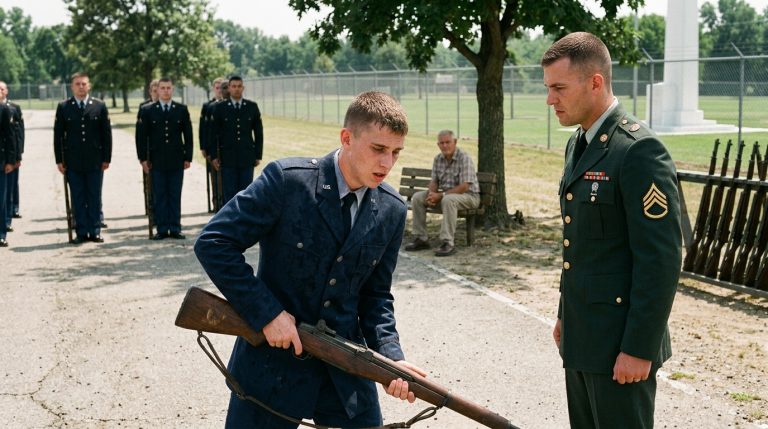
Three months later, the base was calm. The sun was setting over the flight line, casting long, golden shadows across the concrete. Marcus stood in front of the training squad, his voice steady, his eyes clear. He watched them drill, the precision of their movements, the sharpness of their focus. He saw a young trainee trip—a mistake in his footwork—and Marcus stepped forward, his hand steadying him.
“Focus on the foundation,” Marcus said, his voice calm. “You can’t build a life on top of a lie.”
He watched the trainee nod, the boy’s eyes bright with the same hunger he once had. Behind him, Sarah walked up, carrying two cups of coffee, the steam rising into the cooling air. She stood beside him, watching the horizon.
“They’re doing well,” she said.
“They’re learning,” Marcus replied.
He felt the scar on his eyebrow, the dull ache in his shoulder, the remnants of the life he’d lived in the shadows. He looked at his hands—they weren’t shaking. He had returned to the light, but he had brought the shadows with him, and in that synthesis, he had found his place. The mission wasn’t to save the world; it was to keep the ones you loved from losing their way. And for the first time, in the quiet hum of the base, Marcus Reeves felt at home. He wasn’t the man he had been before Kandahar, and he was finally, completely, at peace with the man he had become.