The Deep Water Reckoning: How a Quiet Fisherman Dismantled a Corporate Tyrant’s Illegal Lakefront Empire
CHAPTER 1: The Trespass
The water was black, perfectly still, and entirely indifferent to the woman screaming from the bank.
I held my rod steady. The line hummed, vibrating with the slight tension of a lure resting against the soft silt of the lake bottom. Twenty-three years. I’d stood in this exact spot—knees deep in the cold, spring-fed water—since the day I laid Sarah to rest. Back then, the pines were young, and the silence was something you could lean against. Now, the silence was being dismantled by the shrill, rhythmic screech of Margaret Windham’s voice.
“You’re trespassing, Mr. Blackstone! This is HOA-protected property!”
I didn’t turn. I didn’t blink. My focus was on the tip of the rod, watching for the subtle twitch that meant a bass was testing the bait. It was a calculated risk. I knew Deputy Morrison was sitting in his cruiser just beyond the treeline, likely nursing a cold coffee and praying I’d just leave so he wouldn’t have to deal with the paperwork of a middle-aged woman in a designer cardigan.
The air smelled of damp pine needles and the faint, ozone-heavy scent of the coming season’s frost. It was a sharp, clean smell—the kind that usually cleared my head. Today, it was tainted by the synthetic perfume Margaret insisted on wearing, a floral assault that seemed to travel across the water like a physical weight.
“Deputy! Do your job!” she shrieked.
I heard the heavy, reluctant thud of boot heels on gravel. Morrison was coming. He moved with the slow, deliberate pace of a man who knew he was being forced into a farce. I took one last, slow breath, letting the tension in my shoulders drop. I didn’t feel anger. Anger was too hot, too fluid. What I felt was a cold, crystalline clarity. I knew the boundaries of this lake better than I knew the back of my own hand. I knew exactly what lay beneath the surface, and I knew exactly what was about to happen to the woman currently turning purple on the dock.
“Theo,” Morrison said, his voice dropping into that weary, apologetic register he reserved for old friends he was about to disappoint. He stopped at the edge of the bank, refusing to step onto the damp shoreline. “She filed the complaint. It’s all official now. I have to ask you to leave.”
I stood up slowly, the water rippling around my waders with a sound like tearing silk. I turned to look at the dock. Margaret was there, arms crossed, her helmet-hair defying the gentle breeze. She looked smug. She looked like a woman who had never been told no in her life, and who had spent her entire corporate career turning simple existence into a hostile takeover.
“She’s persistent, isn’t she, Charlie?” I said, my voice quiet, cutting through the morning stillness.
“Just go, Theo,” Morrison urged, his eyes darting toward the binoculars Margaret had discarded on a patio chair. “Don’t make this harder than it needs to be.”
I looked at Margaret. For a second, the mask slipped. I saw the tremor in her jaw, the way her eyes darted to the camera she had strapped to the porch railing. She wasn’t just trying to evict me; she was building a file.
I reached down and began to reel in. The snap of my tackle box closing sounded like a gunshot across the lake. I looked Margaret dead in the eye, and for the first time, she didn’t look like a victor. She looked like someone who had just reached out to grab a shadow, only to find the blade hidden inside.
“Enjoy the morning, Margaret,” I said, my voice devoid of malice, heavy with a promise she wouldn’t understand for weeks. “It’s a beautiful day to be out on the water.”
I stepped out of the lake, the weight of the water leaving my boots, and walked toward my truck. I didn’t look back, even when I heard the sharp, frantic click of her heels against the wooden deck, following my progress with the desperate, hungry eyes of a predator who realized the trap might have been rigged from the start.
CHAPTER 2: The Paper Trail
The engine of my truck turned over with a familiar, rattling shudder that seemed to vibrate straight up through the steering wheel into my teeth. I didn’t pull away immediately. I sat there in the gravel drive, watching the rearview mirror. Margaret had retreated behind the picture window of her McMansion, but the reflection of the glass caught the flash of a lens. She was still watching. Still documenting. Still convinced that if she just collected enough data, she could redefine reality.
I put the truck into gear and let the tires crunch over the frost-hardened gravel, heading toward the county seat.
The drive was a meditation in controlled friction. I kept my hands at ten and two, feeling the road through the wheel. Every mile that put distance between me and the lake was a mile spent deconstructing the situation. Margaret was a creature of corporate logic: policy, compliance, enforcement. She thought the world was a boardroom. She didn’t understand that here, in the shadow of the valley, power didn’t come from a position title. It came from roots.
The memory of Sarah’s hand, calloused and warm, resting over my own on the fishing rod, flickered in my mind. She’d always said that if you fought the current, you’d drown, but if you understood the geography of the riverbed, you could make the water work for you. Margaret was fighting the current. I was just mapping the riverbed.
The county courthouse appeared through the morning haze—a brutalist slab of grey stone that looked like it had been dropped into the downtown center to absorb all the ambition and misery of the county. I parked in the back, the furthest spot from the entrance, and hauled my heavy canvas bag from the passenger floorboard.
Inside, the air was stagnant, tasting of stale coffee and the dry, papery rot of decades-old files. The floor was polished linoleum that squeaked under my work boots, a high-pitched, mocking sound in the quiet hallway. I headed straight for the land records office.
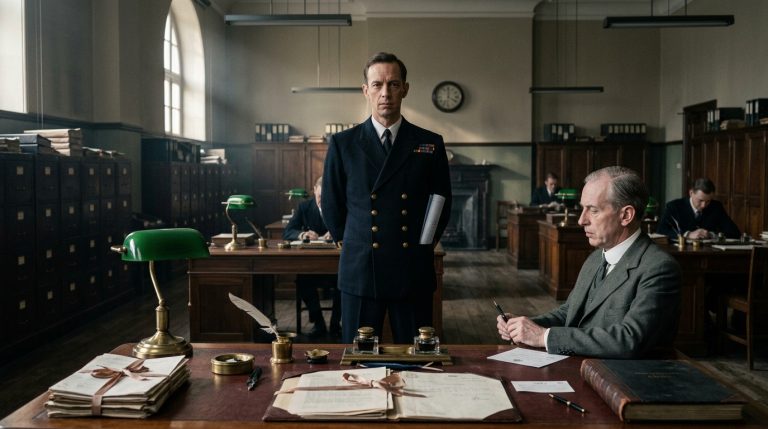
Joyce Miller was already at her desk, a small, bird-like woman who seemed to be composed entirely of spectacles and institutional memory. She didn’t look up when I approached, just continued to stamp a stack of documents with a rhythmic, mechanical thwack-shiff, thwack-shiff.
“Morning, Joyce,” I said.
She peered over the top of her glasses, her eyes sharp and unimpressed. “Theo Blackstone. You look like you haven’t slept, or you’ve been doing something you’ll eventually regret.”
“Maybe a bit of both,” I replied, setting my bag on the counter. “I need the 1958 survey records for Pine Ridge. Specifically, anything involving the Thompson Mining Company.”
Joyce paused, her stamp hovering in mid-air. She took her glasses off and polished them on her cardigan, the sound of the fabric rasping against the lenses loud in the small office. “Thompson Mining? Son, that’s deep-well storage. That’s back in the basement, in the archives they don’t let the public touch without a court order or a persistent temperament.”
“I’ve got the temperament,” I said, leaning in. “Margaret Windham just filed a formal trespassing complaint against me. She’s claiming the lake is a common area for the HOA. I think she’s skipping a few steps in the chain of title.”
Joyce’s expression shifted, a tiny, knowing glint appearing in her eyes. She liked a good puzzle, and she liked it even better when that puzzle involved a bully getting tripped up by their own ignorance. She stood up, her joints popping like dried kindling.
“Come around the back, then. But don’t you touch anything unless I tell you to. Those files are so old they’re practically sentient.”
We descended into the basement, a place where the light was perpetually dying and the smell of dust was a physical weight. Row upon row of metal filing cabinets stood like sentinels in the gloom. Joyce navigated the labyrinth with the instinct of a homing pigeon, eventually stopping at a heavy, rusted cabinet tucked into a corner.
She pulled the drawer open. It groaned, metal protesting against metal, and a cloud of grey dust billowed out. She pulled out a thick, leather-bound volume and laid it on a scarred wooden table.
“1958,” she murmured. “When your grandfather bought the land.”
I opened the book. The pages were yellowed, brittle as autumn leaves, and smelled of iron and damp earth. I began to flip, my fingers tracing the precise, fountain-pen handwriting of a clerk long dead. Deed after deed, survey after survey. I wasn’t just looking for a boundary line; I was looking for the authority that Margaret claimed to wield.
I found the entry for the property—the two-acre plot my grandfather had built the cabin on. Then, I dug deeper, into the attached annexes. My heart rate stayed steady, but my palms felt damp. I wasn’t finding boundaries. I was finding rights. Specifically, the transfer of lakebed ownership that the modern county website ignored because it was too complicated to map into their sleek, digital portals.
“Joyce,” I said, my voice barely a whisper in the echoing dark. “Look at this. The mineral extraction rights include ‘all related water-surface usage in perpetuity.'”
She leaned in, squinting. “That language… that’s not standard, Theo. That’s aggressive. That’s a company trying to ensure they can flood or divert anything they want to get to the copper.”
“And if they never extracted the copper?”
“Then the rights didn’t go away,” she said, her voice dropping to a conspiratorial hush. “They transferred. Like a mortgage. If they weren’t rescinded or bought back by the county, they’re still attached to the land.”
I stared at the faded ink. It wasn’t just a survey. It was a weapon. Margaret wanted a fight for the lake? She had no idea what kind of terrain she was stepping onto.
CHAPTER 3: The Surveillance
The walk from the courthouse back to my truck felt different than the walk into it. The air outside was thinner, sharper, and the glare of the midday sun hitting the chrome bumpers in the parking lot was enough to make my eyes ache. I didn’t rush. I walked with the deliberate, heavy-footed cadence of a man who now possessed a secret that tilted the world on its axis.
As I reached the truck, I saw a familiar silhouette hovering by the local coffee shop across the street. It was Margaret’s “security” hire—a kid who couldn’t have been more than twenty-two, wearing a tactical vest that looked like it had come straight out of a discount catalog. He was holding a phone up, aiming it not at the shop, but at the parking lot. At me.
I didn’t acknowledge him. I slid into the driver’s seat, the leather creaking under the weight of my exhaustion, and started the engine. The dash clock blinked 12:45. I needed to get back to the lake before she escalated whatever theatrical nonsense she had planned for the afternoon.
My thumb flicked the wiper stalk to clear the dust-filmed windshield, but the sprayer gave only a pathetic, gurgling cough. The fluid line was clogged. I pulled over to the shoulder of the main road, the gritty gravel crunching beneath the tires. I grabbed a small multi-tool from the glove box—a habit from my construction days—and stepped out to clear the nozzle.
That was when I felt it. The prickle on the back of my neck.
I looked up. A white BMW was idling slowly about fifty yards down the road, its windows tinted to a level that made it look like a featureless, moving monolith. She wasn’t just using the kid. She was shadowing me herself.
The wind shifted, bringing the smell of dry earth and overheated asphalt. I stood there, holding the thin wire of my tool, looking at the car. I didn’t turn away. I didn’t hunch. I stood tall, my shadow long and lean against the baked dirt of the shoulder. For a moment, we were locked in a stalemate—the observer and the observed. Then, the BMW accelerated, tires kicking up a spray of limestone dust as it swerved around me, the engine a low, synthetic hum that sounded entirely too clean for this part of the county.
I got back into the truck, my heart rate steady. My hands, however, were tight enough to turn my knuckles white against the wheel. She was panicking. You don’t shadow a man to a courthouse unless you’re afraid of what he’s digging up.
The drive home took an hour, and for every mile of it, I felt the presence of that BMW in my peripheral vision, even when it wasn’t there. When I finally turned onto the dirt road leading to Pine Ridge, the change in atmosphere was instant. The air grew cooler, scented with pine needles and the damp, organic rot of the marshlands.
I pulled into my drive and saw them: three new cameras mounted on the tall, steel poles Margaret had installed at the boat launch. They were sleek, black, and unblinking. As I stepped out of the truck, the metallic whir of the motors tracking my movement followed me like a predator’s head turning.
I walked toward the water, my canvas bag still slung over my shoulder. I didn’t head for the dock. I walked to the edge of the property line, where the gnarled roots of a dead oak tree marked the boundary of my grandfather’s original deed. I knelt down, digging my fingers into the cold, soft loam.
The cameras continued to track me. I could hear them clicking—a small, precise sound that signaled Margaret was watching every move, recording every breath, waiting for me to trip, waiting for me to do something that would allow her to call Charlie Morrison and finally have me escorted off the land in handcuffs.
I took the deed copy out of my bag, shielding it from the camera’s view with my body. I wasn’t going to play her game. She wanted me to be a “problem resident” she could manage. She wanted me to scream, to lash out, to be the volatile variable in her perfectly curated equation.
Instead, I looked up at the closest camera, stared directly into its glassy, unblinking lens, and smiled. It was a slow, quiet expression that didn’t reach my eyes.
“You’re paying a lot for these, Margaret,” I whispered to the empty air, knowing the microphone would pick up the vibration of my voice. “But you’re recording the wrong history.”
I turned my back on the lens and walked into the cabin, the heavy door clicking shut behind me. Inside, the silence was absolute. I set the canvas bag on the kitchen table and began to lay out the documents, page by yellowed page. I had the foundation. I had the rights. Now, I needed to make sure that when I finally pushed back, the entire house of cards she’d built around this lake would come down in a single, irreversible motion.
The room darkened as the sun dipped behind the ridge, casting long, sharp shadows across the floor. I sat in the dark, watching the red LED indicator of a camera light pulse through the window, rhythmic and hypnotic. She was waiting for a reaction. She would be waiting a long time.
CHAPTER 4: The Discrepancy
I didn’t move. I kept my hand on the heavy iron latch of the cabin door, my muscles coiled, waiting for the motor to resume its search. The silence was sharper than the noise. It meant someone had cut the power, or the unit had been disabled. Either way, it wasn’t the behavior of a machine experiencing a technical glitch. It was the calculated silence of someone who didn’t want to be heard.
I let the door click shut behind me and stayed in the shadows of the porch. The moon was a thin, jagged sliver behind the pines, providing just enough light to outline the stakes Margaret’s crew had pounded into the ground earlier that morning. They were stark, white vinyl markers—ugly, synthetic interruptions in the natural flow of the shoreline.
I stepped off the porch, my boots making no sound on the damp mulch. I moved toward the water, my eyes fixed on the survey markers. Margaret had been busy. She had cordoned off the entire northern curve of the lake, claiming it for the HOA.
As I approached the nearest stake, the air smelled of wet soil and the sharp, chemical tang of the vinyl plastic. I knelt beside it. There was something off. The stake wasn’t just driven into the earth; it had been hammered into the soft, spongy bank at an angle that defied the natural geometry of the property line. I pulled a small flashlight from my pocket, shielding the beam with my palm so only a sliver of light escaped.
The stake wasn’t sitting on soil. It was wedged into a metal protrusion—the top of an old iron survey pipe, rusted and buried deep, likely dating back to the mining operations of the forties.
I traced the line of sight. Margaret’s crew had ignored the historical marker and forced their own boundary three feet inside my grandfather’s historical perimeter. It wasn’t an accident. They were systematically choking off the access point to the deepest part of the lake, the area where the old spring fed the water.
A twig snapped behind me.
I didn’t turn. I stayed low, my hand closing around the cool, solid handle of the multi-tool in my pocket.
“Mr. Blackstone,” a voice called out. It was strained, lacking the usual corporate crispness.
I stood up, keeping my body angled away from the light. It was Jake Patterson, the surveyor. He was standing near the treeline, his vest looking like a second skin over his hunched shoulders. He looked terrified.
“You’re out late, Jake,” I said, my voice low and even.
“I… I had to come back,” he muttered, stepping into the dim light. “The crew, they didn’t do the mapping, Theo. They had the coordinates handed to them by the HOA’s legal rep. They told me to just drive the stakes. They didn’t want a survey. They wanted a fence line.”
I looked at the iron pipe, then at the vinyl stake. “You know what’s under here, don’t you?”
Jake nodded, his eyes darting toward the unblinking black eye of the camera mounted on the pole nearby. “They’re trying to bury the historical markers. If they get the vinyl stakes deep enough, if they get the fencing up and the permits approved, the county will just look at the new site map. They won’t bother digging up the history.”
“Why tell me now?” I asked.
“Because I looked at the old maps,” he confessed, his voice barely audible over the sound of the wind in the pines. “After you left the office, I pulled the 1943 files. I didn’t see the mineral rights before, but when I saw what they were asking me to do… I realized they weren’t just protecting the neighborhood. They’re trying to build on top of a legal ghost.”
He held out a small, folded piece of paper—a printout of the true coordinate grid. “I’m not a part of this anymore, Theo. I’m just a guy with a mortgage, but I’m not a thief.”
He turned and disappeared into the trees before I could respond. I stood alone in the dark, the piece of paper in my hand trembling slightly, not from fear, but from the cold, hard realization of what I was holding. Margaret wasn’t just a bully. She was an architect of erasure. She was trying to rewrite the physical reality of the lake to suit her narrative of control.
I looked back at the lake. The water was dark, deep, and silent, holding the truth in its depths, indifferent to the plastic stakes and the fake boundaries. She thought she was building a fortress, but she was only digging a deeper hole. I tucked the coordinate sheet into my jacket and headed back to the cabin. The game had shifted. It was no longer about a fishing spot. It was about the integrity of the earth itself, and I was the only one left to defend it.
CHAPTER 5: The Capital Trip
I didn’t pack a bag. I took only the folder, the iron-pipe coordinates, and the heavy, rusted key to the cabin door. I stepped out into the pre-dawn dark, the air thick with the promise of rain. The smell was sharp—the iron-heavy scent of an approaching storm that usually signaled the best fishing, but today it just felt like the scent of old, settled dust being stirred up.
I started the truck. The engine’s roar sounded dangerously loud in the hollow silence of the valley. As I pulled out, I checked the mirrors. The cameras were still. No whirring. No tracking. That silence was worse than the mechanical hum. It meant she had moved beyond observation and into something else—anticipation.
The drive to the state capital was four hours of relentless grey. Rain began to fall just as I hit the interstate, a fine, stinging mist that turned the road into a slick, reflective ribbon. My eyes stayed locked on the periphery, watching for the white BMW, but the road remained empty save for the occasional long-haul truck pushing spray into the air.
The state archives building was a monolith of stone and ambition, a place designed to make individuals feel small and temporal. I pushed through the revolving doors and into a lobby that echoed with the sound of my own footsteps. It smelled of floor wax and the faint, sweet decay of millions of documents being preserved in climate-controlled tombs.
“Help you?” the clerk asked. She was behind a glass barrier, her skin the color of old parchment.
“Thompson Mining,” I said, sliding the name across the counter like a gambler pushing chips. “1943 to 1962. Corporate transfers and subsurface mineral rights.”
She didn’t ask why. She didn’t care. She just pointed to a terminal and a row of microfiche drawers.
For three hours, I vanished. I went deep into the paper trail, tracking the dissolution of Thompson Mining. The company had gone bust in ’78, just as the records indicated, but the paperwork regarding their “recreational utility assets” was buried in a secondary index.
My fingers traced the lines of ink until they were stained with the carbon dust of decades. There it was: a transfer of title, witnessed by a notary in this very city forty years ago. The rights hadn’t been sold to the county. They hadn’t been surrendered. They had been bundled into a private trust specifically created to hold the lakebed and its “ancillary usage rights.” And the sole beneficiary of that trust?
Theodore Blackstone Sr.
I sat back, the air in the archives suddenly feeling too thin. The mineral rights were just the decoy. The true stake in the heart of Margaret’s empire was the lakebed itself—every square inch of the basin from shore to shore. It was private property, a physical holding that rendered her HOA bylaws not just unenforceable, but legally delusional.
I felt a sudden, sharp ache in my chest. It wasn’t the weight of the discovery; it was the realization of what my grandfather had done. He hadn’t just bought a fishing hole. He had bought a moat. He had seen the way the land was going, the way the corporate encroachment was coming, and he had anchored the family line to the bedrock of the valley.
I stood up, my knees stiff, and went to the printer. I paid for the copies, watching the pages slide out—clean, white, and heavy with the weight of the truth. As I tucked the papers into my folder, the lights in the archives flickered.
Thunder rolled outside, muffled by the thick stone walls. I stepped out of the archive and toward the exit, but the lobby was different. The glass doors were being blocked.
Two men in dark, unassuming suits stood by the main entrance. They weren’t law enforcement. They had the look of corporate muscle—the kind that didn’t work for the sheriff, but for the firm Margaret had hired. They weren’t blocking the door. They were waiting.
I gripped the folder to my chest, my knuckles brushing against the edge of the iron pipe coordinate printout still in my pocket. I knew what they were there for. They weren’t going to try anything in a public building, not while the cameras were watching, but they were sending a message.
I walked past them. The silence between us was like a high-tension wire.
“Mr. Blackstone,” one of them said. His voice was polite, and it carried the distinct, polished accent of someone who had never lived in a valley. “Mrs. Windham is very concerned about your recent… interest in archival research.”
I didn’t stop. I walked right up to the revolving door, my reflection in the glass looking older, grim, and entirely focused.
“Tell her to keep watching,” I said. “The research is done.”
I stepped into the rain. It was coming down hard now, a deluge that washed the world clean. I didn’t head for my truck. I headed for the side alley where I knew I could double back, because if Margaret was hiring muscle to haunt archives, she was already scared. And a scared predator, I knew, was a dangerous one.
CHAPTER 6: The False Victory
The community center was brightly lit, a beacon of synthetic warmth in the middle of a deluge. It smelled of floor wax and the kind of aggressive, floral air freshener that reminded me of Margaret’s own perfume. As I walked toward the entrance, I could see the silhouette of her entourage through the glass—a tight, naval-blazer-clad phalanx of supporters, their heads bent in what looked like coordinated prayer, or perhaps final instructions.
My boots, caked with the red clay of the archives’ alleyway, left muddy prints on the polished tile. I didn’t care. I pushed through the double doors.
The room was already full. The beige leather chairs Margaret had brought in from her own home—a power move, obviously—were arranged in a perfect semi-circle around a podium. Margaret stood behind it, her helmet-hair unmoving despite the humidity, her expression one of brittle, glass-like triumph. When she saw me walk in, she didn’t frown. She smiled. A sharp, predatory widening of the lips that didn’t reach the tension lines around her eyes.
“Ah, Mr. Blackstone,” she said, her voice amplified by the room’s PA system. “I’m glad you could join us. We were just discussing the non-compliance issues regarding the lakefront.”
The room grew quiet. There were about twenty people—the “concerned homeowners”—and I saw Betty Kowalski in the back, looking small and fragile in her cardigan, her eyes wide with terror. I gave her a microscopic nod, a signal to hold, just hold.
“I’m here to resolve them,” I said, my voice steady, the folder feeling like a solid brick against my ribs.
“Excellent,” Margaret said, clicking a remote. A PowerPoint presentation illuminated the screen behind her. It was a masterpiece of corporate gaslighting: charts showing “lake usage density,” “recreational liability percentages,” and, most offensively, a map of the lake where my property wasn’t even listed. It was just “Common Area – HOA Managed.”
She began to speak, her tone smooth, authoritative. She outlined the fine schedule, the new dock permits, and the “safety requirements” that would effectively turn the lake into a private country club. Her supporters nodded in unison, a rhythmic, mechanical motion that sent a chill down my spine. This wasn’t a meeting. It was a coronation.
She reached the climax of her presentation, her hand resting on a stack of “Enforcement Action” forms. “We have the sheriff’s office on standby, because we will not tolerate the degradation of our property values by individuals who refuse to recognize the necessity of community standards.”
She looked at me, a direct, piercing challenge. “Any final words before we put this to a vote, Mr. Blackstone? Any further… research you’d like to share?”
I stood up. My legs felt heavy, but my balance was perfect. I walked toward the podium, the floorboards groaning under my work boots. Margaret didn’t move, but the two men in dark suits—the same ones from the capital—shifted their positions by the wall, their eyes tracking my every movement.
I stopped ten feet from her. I didn’t open the folder yet. I just looked at the crowd.
“You’ve talked a lot about values,” I said, my voice cutting through the hum of the air conditioning. “You’ve talked about management, and liability, and community standards. But you’ve missed the most basic standard of all.”
Margaret’s smile faltered for a fraction of a second. “Which is?”
“The truth of the land,” I said.
I reached into my pocket and pulled out the iron pipe coordinate sheet—the one that proved the survey stakes had been placed with malicious, deceptive intent. I placed it on the podium.
“You didn’t manage this lake, Margaret. You staged a hostile takeover of property you don’t even have a deed for.”
The room erupted in a low, buzzing murmur. Margaret’s face turned that familiar, dangerous shade of crimson. She leaned into the microphone, her voice rising, losing its corporate polish. “That is a pathetic, desperate fabrication! We have the filings, we have the state approval—”
“You have a file of papers you wrote yourselves,” I countered, the calmness of my own voice acting as a leash on the chaos. I opened the folder. The documents looked like what they were: ancient, heavy, immutable laws of the land that no PowerPoint could overwrite. “And you have a sheriff who is going to be very interested in why you’ve been extorting monthly fees from your neighbors based on a boundary line you knew was false.”
Margaret slammed her hand on the podium. The sound was a sharp, cracking retort. “Arrest him! He’s threatening the proceedings!”
She looked to the men in the suits, her eyes wide, desperate. But they didn’t move. They looked at the folder, then at me, and then at the door. They were professionals, and they knew when a ship was sinking. They didn’t get paid enough to be named as co-conspirators in a land-title fraud case.
I didn’t need the sheriff. I didn’t need the men in suits. I just needed the silence that followed. For the first time, Margaret looked small. The power hadn’t been in the projector, or the blazer, or the signatures. It had been in the land itself, and I was the one who had finally turned the key.
CHAPTER 7: The Reckoning
I didn’t stop until I reached the county commissioner’s desk at the front of the room. Margaret was still standing at the podium, but her grip on the wood was loosening, her knuckles white. She looked like she was trying to calculate a way out of an impossible equation, but the numbers no longer added up to her favor.
“Commissioner,” I said, my voice projecting clearly into the microphone she had just abandoned. I laid the folder open. “This isn’t a dispute about gnomes or dock permits. This is a matter of record.”
I began to read, but not from the deeds. I read from the surveyor’s notes and the archive logs. I laid out the timeline of the “common area” annexation, the illegal fee assessments, and the targeted harassment of residents who had been here for decades. Every time I mentioned a date, I pointed to the corresponding document in the folder.
The room was still. Even the supporters in the navy blazers had stopped whispering. They were looking at Margaret now, not with loyalty, but with the cold, assessing eyes of people who suddenly realized they were being investigated by proxy.
“You wanted to enforce community standards, Margaret?” I asked, turning to face her.
She stood there, frozen. “It was for the benefit of the community,” she whispered, the corporate sheen finally cracking entirely. “Someone had to organize it. Someone had to manage the liability.”
“You weren’t managing liability,” I said, my voice dropping to a low, hard resonance. “You were creating it. And you were doing it on property that never belonged to your association.”
I handed a copy of the deed to the commissioner. He took it, his face unreadable as he studied the 1943 seal. His eyes widened slightly as he recognized the mineral rights language, the archaic, sweeping terms that basically turned the lake into a private fiefdom.
“Mr. Blackstone,” he said, his voice hesitant. “If this is verified…”
“It’s already verified by the land records office,” I interrupted, gesturing toward Joyce, who sat in the second row, her hands folded primly in her lap like a judge waiting to deliver a verdict.
The fallout was immediate. Margaret didn’t fight back; she didn’t have the tools. She tried to grab the microphone, but the deputy standing by the door—Charlie Morrison—stepped forward. He wasn’t there to arrest me. He was there to ensure that the rule of law actually meant something. He placed a hand on Margaret’s arm. Not aggressively, but with the finality of someone closing a file.
“Ms. Windham,” Morrison said. “I think we’re going to need to take a statement downtown. We’ve received several complaints today—not about trespassing, but about fraud.”
The irony was thick enough to choke on. The room broke into a low, chaotic rumble. I watched as Margaret was escorted toward the side exit, her head bowed, her designer blazer suddenly looking like a prison uniform in the harsh, unflattering light of the community center. She didn’t look at me as she passed. She looked at the floor, as if trying to find a crack she could slip through and vanish into.
As the doors swung shut behind her, the silence that rushed back into the room wasn’t the heavy, predatory silence of earlier. It was the quiet of a storm having finally blown itself out.
I stayed at the podium for a moment. My hands were finally shaking, the adrenaline of the last four hours starting to taper off, leaving a hollow ache in my joints. Betty Kowalski stood up in the back row and started to clap. It was a thin, hesitant sound at first, then it grew, joined by Frank, by the Johnsons, and even by a few of the people who had been wearing navy blazers.
I didn’t take a bow. I just picked up the folder. The battle was won, but the aftermath—the cleanup, the restoration, the simple process of reclaiming the space—was still ahead. I stepped off the stage, my boots clattering on the wood, and headed toward the back of the room. I felt tired, yes, but for the first time in six months, I felt clean.
I had defended the roots. I had honored the legacy. And as I reached the doors, I saw the rain had stopped. A sliver of moonlight was cutting through the clouds, reflecting off the wet pavement, promising that when I got back to the lake, it would be waiting, exactly as it had been for twenty-three years.
CHAPTER 8: The Denouement
The dawn that broke over Pine Ridge Lake was not the bruised, grey dawn of the previous week. It was a clear, wide-eyed blue, the kind of morning that felt like a fresh page. The air was scrubbed clean by the storm, carrying the scent of wet pine needles and the cold, mineral sharpness of the spring water.
I reached the boat launch. The white vinyl stakes were gone. In their place, the ground was scarred with small, circular depressions where the posts had been ripped out, but the earth was already beginning to heal. Nature, I’d found, was a quick study.
I walked to my dock. It was a sturdy, weathered structure of treated wood, grayed by years of sun and rain. One of the planks I’d repaired the night before the county meeting—the one Betty had stumbled on—was solid now, the galvanized screws gleaming in the morning light. I knelt and placed my hand on the wood. It felt cool, honest.
I took the old, rusted key from my pocket—the one to the cabin door—and held it up. For months, this key had felt like a defensive tool, a lock against the world. Now, it was just metal.
Margaret’s house, sitting on the opposite shore, looked different in the clear light. The binoculars were gone from the window. The black, robotic eyes of the cameras had been dismantled, leaving only empty, vertical poles that looked like barren trees. The house itself didn’t look like a palace anymore; it looked like what it was: a structure, empty and waiting for someone else to fill it. The Pattersons, the new owners, were already out on their patio, a pair of fishing rods leaning against the rail. They weren’t looking at me, or the lake, as a target. They were looking at the water as a source of peace.
I walked back into the cabin and sat at the kitchen table. The folder was still there, but I didn’t open it. I didn’t need to. The knowledge was etched into my mind: the 1943 deed, the trust, the perpetual ownership. It wasn’t about the power of the paper. It was about the fact that I had never lost the land, even when they told me I had.
I heard a soft knock on the door. It was Betty.
She stood on the porch, her hands tucked into the pockets of her cardigan. She looked like she had slept for the first time in months. She didn’t say a word, just walked over to the table and set down a small, painted ceramic gnome—the one with the tiny fishing rod. She placed it right in the center of the table, a ridiculous, vibrant pop of color against the dark wood.
“It’s a bit gaudy,” I said, a smile pulling at the corners of my mouth.
“It’s a bit of home,” she replied, sitting down across from me. “Theo, they’re talking about tearing down the rest of the HOA signs today. The council finally approved the restoration budget.”
“Good.”
“The lake feels… quiet again,” she added, looking out the window at the water. “Do you think it’ll last?”
I looked at the lake. The mist was rising, soft and ghostly, just as it had for twenty-three years. I thought about the mineral rights, the legal precedents, the layers of ownership that had nearly been erased by a woman who thought life was a spreadsheet. I thought about the way the water didn’t care about the laws of men, only the depth of the spring.
“The lake doesn’t change, Betty,” I said. “We just stop interfering with it.”
I stood up and went to the cupboard. I pulled out two mugs, the ceramic chipped at the edges, and started the coffee. The process was ritual—the grind, the pour, the slow, rhythmic drip. It was a real-time existence, one second following the other, without the weight of impending legal threats or the shadow of surveillance.
I walked back to the table and handed her a mug. We sat in silence, the steam curling up into the morning light. Outside, I saw the Patterson kids running down to the water, their laughter drifting across the lake like a clear, ringing bell. It wasn’t the silence I’d had when Sarah was gone, the silence of a wounded man trying to heal. It was the silence of a man who had finally stopped fighting his own house.
I reached out and touched the head of the gnome. It was cold, solid, and completely out of place. It was perfect.
I was no longer the man who had been defined by the trespasser. I was just Theo Blackstone, and I was going fishing. I finished my coffee, stood up, and picked up my rod. I didn’t look at the files. I didn’t look at the deed. I walked out into the morning, the ground under my boots solid, familiar, and mine. The water was waiting, and for the first time in a very long time, I had all the time in the world.