The Stubborn Chemist Who Shattered Naval Bureaucracy And Re-Engineered The Battle Of The Atlantic
CHAPTER 1: THE BLIND SPOT
The destroyer’s bow slammed into the black swell, sending a sheet of freezing spray across the steel bridge.
Azdic pings echoed through the cramped compartment, sharp and rhythmic, marking an invisible predator stalking the cargo convoy.
The operator’s voice cut through the hum of machinery, reporting the closing range as the ship accelerated into the dark water.
Three hundred yards. Two hundred. And then the crisp echoes collapsed into a wall of static.
The sound beam passed blindly overhead, creating a helpless ninety-second window where the target vanished into dead space.
On the aft deck, crews prepared the heavy depth charges, relying on guesswork and brute physics to blast the ocean floor.
It was a ritual of noise and fury that missed its mark nearly every single time, trading human lives for procedural comfort.
CHAPTER 2: ATTIC CHEMISTRY
Charles Good stared at the pencil sketches spread across the battered table in Nepawa, his fingers stained with sulfur and saltpeter.
The lamp oil flickered, casting long, jittery shadows against timber walls that had absorbed a decade of unauthorized explosions.
Out on the prairie, winter locked the town in frozen silence, but inside this small upstairs room, the air tasted of copper and sharp acid.
He didn’t care about the ledger books sitting unread downstairs or his mother’s anxious warnings about the floorboards giving way under too much weight.
He cared only about the velocity of a falling weight and the precise distance required to trigger a spark before the water swallowed all momentum.
A faint, out-of-place smell drifted from the corner—the unmistakable tang of scorched wire from a telegraph key that had no business being wired across the public street.
The town elders had forced him to tear down those lines years ago, claiming unauthorized signals were a nuisance to proper commerce.
They were wrong then, and the men sitting in comfortable London offices behind mahogany desks were wrong now.
Charles adjusted the heavy brass compass with cold, steady fingers, measuring angles that the military establishment claimed did not exist.
If the Admiralty refused to look at the math, he would simply force the math to look at them.
CHAPTER 3: THE LOCKED DOOR
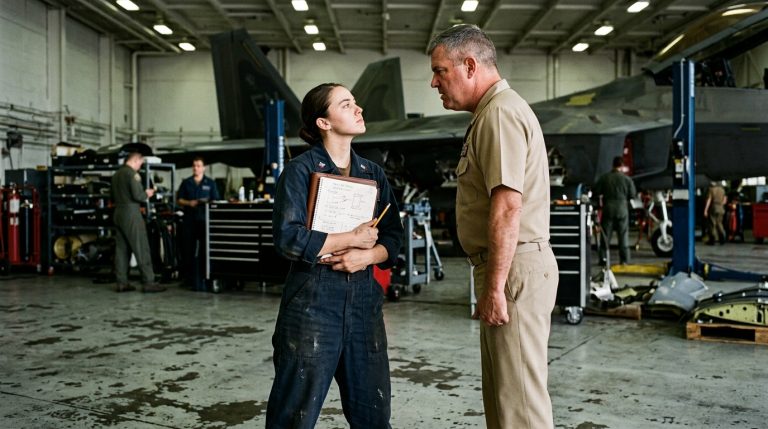
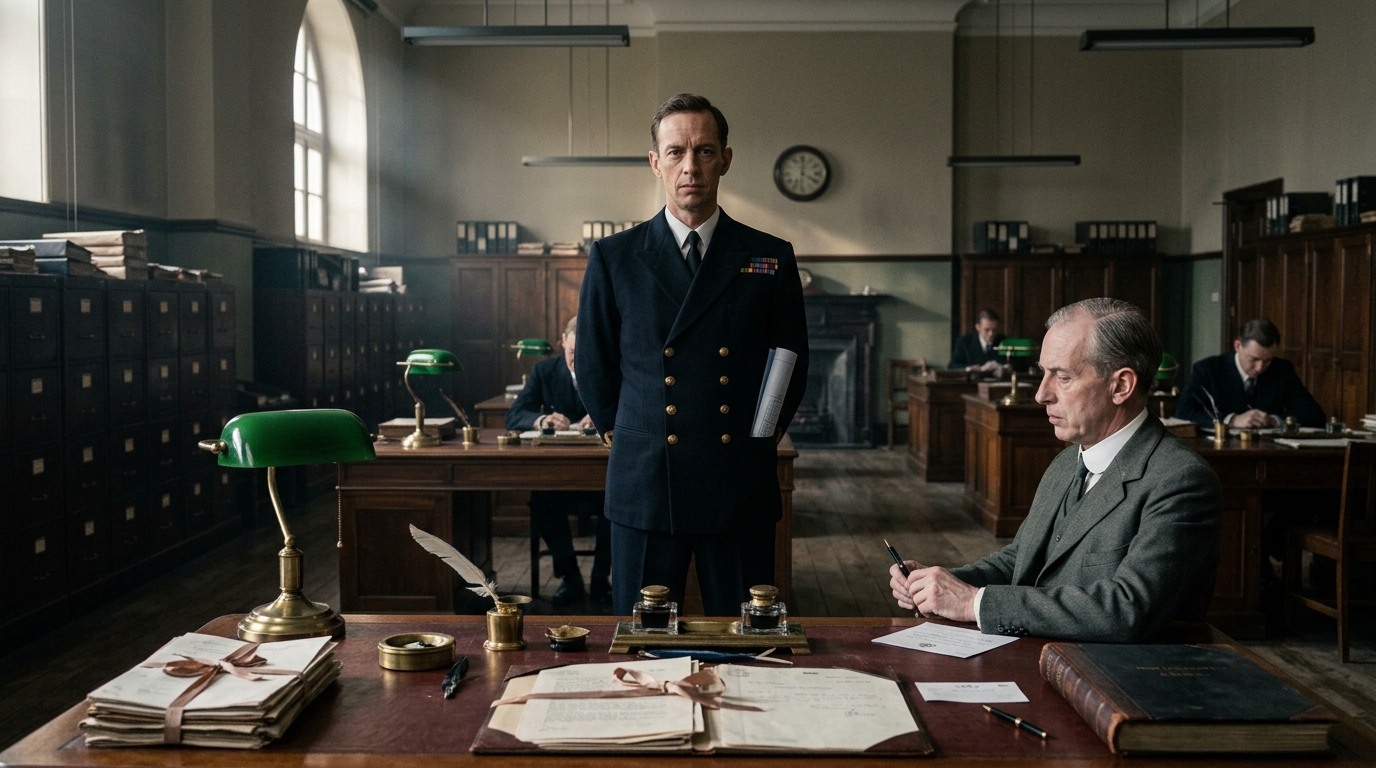
Charles stood before the tall oak doors of the Admiralty’s Ordinance Board, his woolen coat damp from the London drizzle.
A clerk in a stiff collar peered over half-moon spectacles, tapping a stack of damp files with a well-manicured finger.
— Your paperwork lacks the requisite departmental endorsement, Commander, — the clerk muttered, not even bothering to look up at the equations scribbled on the margin of the blueprint.
Charles tightened his grip on the rolled drawings, feeling the coarse grain of the paper press against his palm.
— The endorsement was filed through three separate auxiliary desks six months ago, — Charles replied, his voice dropping into a flat, steady register.
— Then I suggest you rejoin the queue and wait for the committee’s quarterly review in autumn.
The clerk slid the rejection slip across the polished mahogany surface, dismissing him with a practiced flick of the wrist.
There was no anger in the man’s face, only the impenetrable, soul-crushing comfort of a bureaucracy designed never to change.
Charles looked down at the missing stamp—the blank ink-space where an administrator had quietly buried the file rather than process an anomaly.
He didn’t argue, and he didn’t raise his voice.
Instead, he picked up the paper, folded it twice, and tucked it into his breast pocket alongside a stub of charcoal.
CHAPTER 4: THE SPIGOT BLUEPRINT
Metal components rattled against the workbench as Charles aligned the brass tubes with meticulous precision.
Lieutenant Commander Lucas wiped oil from his palms, staring skeptically at the twenty-four spigot arrangement clamped to the testing frame.
— The hydrostatic triggers will shatter upon hitting the water at terminal velocity, — Lucas warned, his fingers tracing a hairline fracture along a mock casing.
— That is why we are abandoning hydrostatic depth entirely, — Charles responded, tapping the table with a heavy wrench.
— If it misses, it sinks silently without tripping the fuse.
— And if it hits?
— Torpex detonates directly against the steel hull on contact.
Lucas chewed the inside of his cheek, studying the delicate spring-loading mechanism designed to arm only after a twenty-foot descent.
The physics were dangerously tight, allowing zero margin for manufacturing errors or bureaucratic delays.
They had no official foundry contracts and no approved budget from the Admiralty.
They only had an old musical instrument factory willing to bend sheet metal in the dead of night.
CHAPTER 5: THE CHECKERS BREACH
Military police stepped forward as the vehicle rolled to a halt near the gravel courtyard, their hands resting cautiously on holstered sidearms.
— State your business and present your authorization passes, — the sergeant demanded, blocking the path with an immovable stance.
Charles kept his hands flat against the wooden steering wheel, feeling the coarse grain beneath his palms while Captain Davies fumbled with an unrelated stack of old railway invoices.
— We are expected for the afternoon demonstration, — Charles stated evenly, his voice devoid of panic or false deference.
The guard squinted at the mismatched papers, hesitation flickering in his eyes before he waved the truck through the checkpoint.
They had bypassed the official scheduling desks entirely, using pure audacity to breach the country residence where Winston Churchill was currently resting before lunch.
A gravel path wound past manicured hedges toward the rear lawns where the prime minister’s private advisors stood discussing morning correspondence.
Charles climbed down from the cab, carrying a single wooden crate containing the heavy mortar components under his arm.
Lord Cherwell turned sharply at their approach, his expression hardening into immediate disapproval at the uninvited intrusion.
— You have no business being here, Commander, — Cherwell muttered, stepping back toward the main terrace.
— The prime minister is occupied and hungry.
— He has three minutes to look at a math problem that is currently sinking our Atlantic convoys, — Charles replied, setting the wooden crate down with a heavy, deliberate thud against the flagstones.
CHAPTER 6: THE IRON VERDICT
Winston Churchill paused mid-stride, eyeing the collection of crude steel tubes and spigot mountings with unconcealed skepticism.
— I was promised lunch, Commander, not a collection of spare plumbing parts, — Churchill rumbled, his cigar shifting slightly between his teeth.
— You were promised a solution to the Atlantic convoys, Prime Minister, — Charles replied, resting his hand firmly on the edge of the wooden assembly.
— The Ordinance Board claims your contraption violates thirty years of testing protocols, — Lord Cherwell interjected, stepping forward to block the view.
— The Ordinance Board is protecting its own paperwork while merchant sailors drown in oil-slicked water, — Charles fired back, his voice cutting through the damp morning air with unyielding weight.
Churchill stared down at the metal layout, his expression hardening as he absorbed the stark, mathematical reality of the ninety-second blind spot.
Instead of walking away to his postponed meal, the prime minister leaned heavily on his walking stick, gesturing sharply toward the open lawn.
— Set it up, — Churchill commanded, his eyes fixed on the gray horizon.
Moments later, twenty-four mock projectiles arched into the sky, landing in a tight, flawless elliptical pattern right where an unseen enemy was supposed to vanish.
The silence that followed was absolute, broken only by the distant rustle of wind through the estate trees.
Churchill did not speak for a long moment, watching the precise impact zone with grim vindication settling into his heavy features.
The following morning, First Sea Lord Admiral Sir Dudley Pound issued the direct order that shattered decades of bureaucratic obstruction.
The weapon was built, the convoys were saved, and the rusted machinery of institutional denial finally collapsed under the sheer weight of common-sense truth.