The Perimeter War: A Calculated Dismantling of the Whispering Pines Hegemony and Its Corrupt Architect
CHAPTER 1: THE SURVEY MARKER
The air in the woods was thin and tasted of damp earth and iron—the scent of a sanctuary under siege. I stood by the northern survey pin, my hand resting on the cold, unforgiving steel of the iron rod. It was a humble thing, a thin spike driven into the earth to define where my 10 acres of silence ended and her kingdom of synthetic order began.
Then, the sound came. It wasn’t the rhythmic crunch of a deer or the scuttle of a fox. It was the sharp, staccato snap of expensive leather on forbidden roots.
Karen Miller emerged from the brush. She was dressed for a garden party, her floral mumu swaying with a violent, impatient energy that seemed entirely out of place in the ancient, still woods. She looked like a jagged, colorful tear in the tapestry of the forest. In her hand, she held the Reconics trail camera as if it were a dismembered appendage, her knuckles white against the camouflage housing.
“This is a violation, Mr. Thorne,” she hissed, her voice a serrated blade cutting through the afternoon stillness. She stopped exactly three inches past the survey pin. She didn’t look at the trees; she looked at me, her eyes narrow, darting, and hungry for a reaction. “You are engaging in unauthorized surveillance. I have confiscated this device for the safety and aesthetics of Whispering Pines.”
I didn’t move. I didn’t reach for it. I watched the way her thumb brushed the lens of the camera—a greasy, possessive smear of motion. My heart rate stayed flat, a rhythm refined by years of clearing paths in places where the ground itself was wired to kill you. Here, the threat wasn’t an IED. It was a woman with a committee and a god complex.
“You’re standing on my property, Karen,” I said, keeping my voice level, stripped of everything but the cold reality of the map. “And you’re holding stolen property. My camera wasn’t pointed at your houses. It was pointed at the deer trails.”
She laughed, a brittle sound that lacked any warmth, like glass breaking in a freezer. “Deer? We all know the truth. You’re a voyeur. You’re watching us.”
As she spoke, I noticed something odd. Beneath her thumb, on the back of the camera housing, there was a streak of bright, neon-orange paint—a mark that hadn’t been there when I mounted it. It was identical to the paint used for the new ‘No Trespassing’ signs the HOA had recently installed along the common area boundary. She hadn’t just come to take the camera; she had come prepared to tag her territory.
The realization hit me with the weight of a stone. This wasn’t a random act of indignation. This was a tactical maneuver. She hadn’t just crossed the line; she had moved it.
“Put the camera on the ground, Karen,” I said, my voice dropping an octave, losing the conversational edge. “Step back over the survey pin. If you do, I walk away. If you don’t, you aren’t just a neighbor anymore. You’re a liability.”
Her eyes flickered. For a split second, the mask of the petty tyrant shifted, revealing a hollow, frantic exhaustion underneath. She gripped the camera tighter, her shoulder blades pinching together. She wasn’t just defending her aesthetic—she was holding onto that camera like it was a life raft.
“I am the president of this association,” she spat, her voice trembling now, losing its rehearsed cadence. “I don’t take orders from people who live in the bushes.”
She turned, her floral dress swirling around her like a shroud, and marched back toward the manicured perfection of the common lawn. I didn’t chase her. I stayed by the survey pin, watching her retreat. I pulled my phone from my pocket and tapped the app.
The video feed of the encounter was already synced to the cloud. I zoomed in on the orange mark on the camera casing. It was fresh. And as she crossed the property line, I saw her reach into her purse and pull out a spray-paint can, shaking it rhythmically.
She was marking the trees on her side. Or maybe, she was marking the ones on mine.
CHAPTER 2: THE ANATOMY OF A CRACK
I didn’t turn back toward the house immediately. I stood there by the survey pin, the cold steel of the iron marker biting into my palm as I leaned against the heavy oak. The forest, once a place of refuge where the only movement was the soft drift of shadows, now felt like a front line. Karen Miller hadn’t just trespassed; she had attempted to overwrite the geography of my life. The orange paint was a blunt, ugly punctuation mark on the silence.
I pulled my phone out again, the screen glowing in the encroaching twilight. The file was saved, a pristine digital ledger of her transgression. I tapped through the captured frames: her face, tight with that specific, corrosive entitlement; the clumsy, frantic way she wrestled with the strap; and that final, telling shake of the spray paint can.
My mind, conditioned by years of clearing routes through hostile terrain, defaulted to the old patterns. Assess. Isolate. Respond. In Iraq, if the ground was compromised, you stopped, backed out, and neutralized the threat before you took another step. You didn’t charge forward into a trap you knew was laid.
The woods felt different tonight. I found myself scanning the treeline not for the graceful, nervous flick of a deer’s tail, but for the deliberate, unnatural geometry of the HOA’s expansion. I looked at the way the manicured grass of Whispering Pines bled into my undergrowth—a line of razor-sharp transition. It was an assault on the organic. I remembered the feeling of sweeping a road, looking for the tell-tale mound of disturbed earth that meant death. Here, the “disturbed earth” was the pristine, chemical-heavy lawn of the Henderson house, looking too perfect, too fake, a mask for something rotting underneath.
I walked back toward the house, my boots crunching rhythmically on the path I had mowed. Every step was a measure of territory. I reached the deck and sat in the chair that faced the dark wall of trees. The house was a quiet, self-designed fortress of cedar and glass, invisible from the road, a design intended to keep the world at bay. Now, the world had come to my porch.
I opened the laptop on the small patio table. The cloud server had uploaded the day’s footage. I navigated to the directory labeled Events. There were dozens of clips—the usual procession of nocturnal wildlife—but I bypassed those. I went straight to the timestamps surrounding Karen’s intrusion.
I watched the footage again, not as a victim, but as an engineer. I slowed the playback down to half-speed, watching her movements. She wasn’t just angry. She was performing. She looked at the camera lens as if she were speaking to an audience I couldn’t see. Then, it struck me: the way she held the camera, the way she checked her surroundings before pulling out the paint can—it wasn’t the behavior of a woman acting on impulse. It was the rehearsed motion of someone accustomed to being watched.
Why bring the paint?
If this was about a camera she deemed “visually displeasing,” she could have just walked off with it. But the paint suggested a need to leave a signature. It was an act of dominance.
I switched to the broader security feed—the cameras mounted to the eaves of my house that covered the long, dark driveway and the side approach. I skimmed through the last forty-eight hours. There, at 3:15 a.m. yesterday, a figure had walked the path. A dark silhouette, moving with a familiar, jerky cadence. It wasn’t Karen. It was a man, dressed in dark clothing, carrying a heavy-duty drill. He had spent ten minutes by the survey pin, doing something to the base of the stake.
I zoomed in. The footage was grainy, but the infrared captured the metallic glint of the drill bit biting into the iron. He wasn’t pulling it out; he was securing something to it. A sensor? A signal booster?
I felt a cold prickle of awareness down my neck. They weren’t just watching the woods; they were networking it. My ten acres were becoming a node in whatever system they were building. The camera wasn’t just stolen property; it was a captured piece of their puzzle.
My phone vibrated. A notification from my home alarm system. Motion detected: Front perimeter.
I closed the laptop, my movements efficient and silent. I didn’t reach for a weapon, but I felt the weight of my hand tightening into a fist. I stepped off the porch and moved into the shadows of the woods, my eyes adjusting to the low light. This wasn’t about the camera anymore. It was about the fact that they thought they could turn my sanctuary into their laboratory.
I moved along the perimeter of the path, staying low, avoiding the open areas where the light from the HOA streetlamps bled over the boundary. I reached the survey pin and knelt. The man from the video had left a small, plastic casing attached to the iron rod. I touched it with the tip of my finger. It was warm—an active piece of electronics.
I didn’t dismantle it. If I ripped it out now, they would know I was onto them. Instead, I pulled out my phone and held it near the device, searching for active Wi-Fi or Bluetooth signals. A string of characters appeared on my screen: WP_HOA_NETWORK_09.
They were running a local mesh network across the entire border. And they were using my property as a relay.
I looked up toward the distant, beige-clad houses of Whispering Pines. The whole neighborhood was a ghost, a hollowed-out corporate entity masquerading as a community. And Karen wasn’t the lead engineer; she was just the one holding the paint can.
I stood up, the silence of the woods now heavy and full of intent. I wouldn’t just take my camera back. I would take their entire network apart, piece by piece, until the infrastructure of their control collapsed under its own weight.
I pulled a small, shielded notebook from my jacket, scribbled the network ID, and headed back toward the house. The game had shifted from defense to a much more dangerous, tactical offense. The survey pin was no longer just a line in the dirt; it was the first crack in their foundation, and I was going to make sure that crack shattered the whole lot of them.
CHAPTER 3: THE DEPUTYS DISMISSAL
The rain started not as a drizzle, but as a violent, atmospheric collapse. One moment, the woods were holding their breath in the humid, stagnant air; the next, the sky simply opened. The roar of the water hitting the canopy was deafening, a chaotic, white-noise wall that erased the distance between my house and the survey marker. I didn’t head for the front porch. I veered off the path, ducking into the dense, pine-needle-carpeted hollow where a natural rock overhang offered a dry, cramped sanctuary.
My breath was steady, but my mind was running in high gear, clicking through the implications of the mesh network. They weren’t just monitoring the perimeter; they were mapping every movement. If they were tracking me, they were likely tracking anyone who crossed that boundary.
I crouched in the dark, the scent of wet stone and pine resin thick in the air. The rain intensified, turning the forest floor into a network of miniature, mud-slicked ravines. My phone buzzed in my pocket—a low, insistent vibration. I pulled it out. Signal interference: Network dropped.
It wasn’t just the rain. They were actively scanning the frequency now, shutting down the mesh to prevent unauthorized intrusion. They knew someone had pinged the node.
I waited until the deluge settled into a steady, grey hum. I needed to move, but not back to the house. If they were watching the perimeter, they’d be checking the logs for a spike in activity at the survey marker. I moved out from under the rock, my boots sliding on the slick mud, and circled back toward the road—the long way, through the thicket where the HOA’s carefully groomed transition zone met the wilder, unmanaged slope of my own land.
I reached the blacktop of the cul-de-sac just as a patrol cruiser rounded the corner, its headlights cutting through the driving rain like twin swords. Deputy Miller.
I didn’t hide. I stepped out onto the shoulder, my hands visible, my posture relaxed but alert. The cruiser slowed, the tires hissing on the wet asphalt, and pulled to a stop ten feet away. The window rolled down, and the deputy’s face appeared, illuminated by the dashboard glow—weary, eyes lined with the cynical fatigue of a man who spent his life refereeing petty squabbles.
“Mr. Thorne,” he said, his voice clipped. “You’re out late in a hell of a storm.”
“I was checking my property line,” I replied, my tone neutral. I leaned against the hood, a calculated display of casual concern. “I noticed some tampering with the survey markers. Electronics, Deputy. Small sensors being installed on private boundary lines.”
The deputy sighed, a long, drawn-out sound that told me exactly how much he wanted to be anywhere else. He didn’t even turn off the engine. “Sensors? Mr. Thorne, I’m sure it’s just the HOA committee doing their routine checks. They’re sensitive about their property values. Look, I’ve had three calls tonight about downed limbs and a car hydroplaning. I don’t have time for a boundary dispute over a piece of hardware.”
“It’s not just a boundary dispute,” I pressed, keeping my voice low, measured. “It’s unauthorized electronic monitoring on a private, surveyed tract. That crosses a line.”
“Which line?” he countered, his eyes flickering toward the dark expanse of my woods. “The one you’re so sure about? Or the one they’re claiming? Because from where the Sheriff’s office sits, this looks like a civil headache that you’re trying to escalate into something criminal.”
He was reciting the script I’d anticipated. Karen had clearly gotten to him first, painting me as the aggressor, the paranoid loner with a penchant for high-tech surveillance.
“I have video,” I said, a faint note of caution in my voice. “Of the installation. And of the person who came onto my land to steal my property yesterday. I’m not looking for a headache, Deputy. I’m looking for an investigation.”
He looked at me, really looked at me, for the first time. There was a glimmer of something behind the cynicism—not quite empathy, but perhaps a flicker of professional curiosity. But then the radio crackled, a sharp, distorted burst of static, and the moment vanished. He turned back to the wheel.
“Bring the footage to the station,” he said, his tone final. “But I’ll be honest with you—unless there’s a threat of violence or a significant crime, we’re going to pass this to the DA’s office as a civil matter. My suggestion? Stop worrying about the lines and lock your doors. It’s a bad night to be playing guard dog.”
He put the cruiser in gear and drove off, his taillights disappearing into the curtain of rain. I stood there, the cold water soaking through my jacket, and watched him leave. He was right about one thing: it was a bad night. But he was wrong about the threat.
I turned and walked back toward the dark perimeter of the woods. The “civil matter” he was so quick to dismiss was the leverage they were using to hold the entire neighborhood captive. I didn’t need the deputy to fight this. I needed his apathy. As long as he thought it was just a squabble over survey pins and cameras, he wouldn’t interfere when the real investigation—the one that would reveal the financial rot beneath their beige-sided perfection—finally hit their doorstep.
I reached the edge of the woods and ducked back into the shadows. The rain was easing, replaced by the heavy, rhythmic dripping of the trees. I had a path forward, but it would require me to be more than just a man with a camera. I needed to become a ghost in their system, watching the watchers until the moment I had enough evidence to burn their entire network to the ground.
CHAPTER 4: THE NETWORK OF SHADOWS
The rain had stopped, leaving the forest in a state of dripping, saturated stillness. I didn’t head back to the house; instead, I moved parallel to the boundary, staying within the veil of the treeline. My target was the community mailbox kiosk—the central nervous system of Whispering Pines. It was a sterile, well-lit island of beige metal in the middle of the lush, rolling manicured lawns.
I approached from the south, where the drainage ditch cut a deep, muddy scar into the landscape, providing perfect cover. I knew from my days of mapping routes that people are creatures of habit. They visit the mail at specific times—early morning, or, for the more meticulous, right after the afternoon delivery.
The air was still cool, and the scent of wet asphalt and freshly clipped grass—the smell of the HOA’s artificial aesthetic—clung to my clothes. I stopped fifty yards out, hunkered down behind a thicket of overgrown briars. I wasn’t just observing the kiosk; I was observing the behavior of the residents. They moved with a hurried, guarded quality, their eyes constantly flicking toward the neighboring houses. It was a neighborhood of surveillance, where every lawn was a statement and every mailbox a potential point of violation.
A black sedan pulled up. It was David Fletcher. I knew his car from the research I’d done earlier—a practical, reliable vehicle that stood out against the sea of luxury SUVs that defined the rest of the street. He stepped out, checked his watch, and walked to the kiosk. He didn’t look around with the furtive, predatory energy of Karen’s loyalists; he looked like a man who was tired of being watched.
I emerged from the shadows, stepping onto the pavement with calculated intent. I didn’t rush. I wanted him to see me coming so he wouldn’t startle.
Fletcher froze as he caught sight of me. He reached for his keys, his knuckles whitening, but his expression softened as he recognized me. “Mr. Thorne,” he said, his voice dropping. “You’re a long way from your woods.”
“The woods are smaller than they used to be, David,” I replied, keeping my distance. “I found something. Or rather, I found the evidence of something.”
I held out the small, wet scrap of paper I had pulled from the drainage ditch near the boundary line earlier—a piece of an invoice, partially incinerated but still showing the header of the landscaping company and a signature. It wasn’t Karen’s. It was the name of a local construction firm that specialized in property liens.
Fletcher took the scrap, his brow furrowing as he studied it under the harsh LED of the kiosk. “Where did you get this?”
“Near the survey pins. They’re running a mesh network, David. They’re mapping the entire perimeter, and it’s not just for aesthetics. This firm—the one on the invoice—they aren’t landscapers. They specialize in forced foreclosures and title stripping.”
Fletcher’s face went pale. He looked at the paper, then toward the dark, silent houses of the HOA. “I suspected they were looking for ways to seize property, but I didn’t think they’d go this far. This isn’t just about HOA fees, Thorne. This is about taking the land from anyone who doesn’t conform. They’re using the bylaws as a justification for land theft.”
“Which is why the camera mattered,” I said. “It wasn’t just recording deer. It was recording the ‘maintenance’ crews doing more than just trimming hedges. They were installing the relay nodes for the network.”
Fletcher looked at me, a new, harder light in his eyes. He wasn’t just a disgruntled candidate anymore; he was a man who realized his home was part of a larger, systemic trap. “I have a meeting with Maria Sanchez tonight,” he said, his voice steady. “She knows the books. If I show her this, she might be able to find the corresponding entries in the HOA’s ledger. She’s been looking for a reason to go over the landscaping payments with a magnifying glass.”
“Do it,” I said. “But be careful. They know I’m onto them. The signal interference I picked up suggests they’re actively monitoring the local traffic now. Assume your phone is compromised.”
Fletcher nodded, a grim, silent acknowledgment of the danger. He slipped the invoice fragment into his wallet and looked toward the houses. “Why are you doing this, Thorne? You could just walk away. You have the land, you have the privacy. Why invite the conflict?”
I looked toward my own woods, where the darkness was absolute, unpolluted by the HOA’s artificial lighting. “Because a boundary only works if it’s respected,” I said. “Once they start moving the pins, it’s not a boundary anymore. It’s a target.”
He gave me a sharp, respectful nod and turned back to his car. I watched him pull away, the taillights fading into the gloom. I hadn’t resolved the conflict, but I had successfully bridged the gap between my isolation and their system. I was no longer a lone observer. I had an ally who knew the terrain from the inside.
As I walked back toward the dark treeline, the weight of what we were about to uncover settled over me—not as a fear, but as a resolve. The network was big, but every system, no matter how complex, has a central hub, and I was closer to finding it than they would ever realize. I slipped back into the woods, the damp earth beneath my boots a grounding reminder that whatever they built on top, the ground beneath still belonged to me.
CHAPTER 5: THE ACCOUNTANTS LEDGER
The community center building sat at the heart of the Whispering Pines development, a sprawling, low-slung structure of pale brick and tinted glass that looked less like a neighborhood amenity and more like a regional data-processing hub. As I approached, the streetlights hummed—a low, discordant frequency that vibrated in my teeth. For a fleeting second, the light seemed to pulse, casting elongated, stuttering shadows that made the sidewalk beneath me appear to ripple like disturbed water. I blinked, stopping dead, my hand flying to the brick wall to steady myself. The world tilted, a momentary lapse of equilibrium that felt less like physical exhaustion and more like the first prickling sensation of the very paranoia I’d spent weeks avoiding.
I took a deep, jagged breath, tasting the metallic tang of the damp air, and forced my focus onto the texture of the wall—rough, cold, and undeniably solid. It’s real, I reminded myself. The kickbacks are real. The network is real.
I pushed into the lobby. The center was quiet, lit by the harsh, flat glare of fluorescent tubes. Maria Sanchez was already there, tucked away in the back of the conference room, surrounded by an intimidating spread of leather-bound binders and loose-leaf spreadsheets that looked like the skeletal remains of a decade’s worth of secrets. She was a woman who lived in the absolute truth of numbers, and her presence was a sharp, clinical contrast to the disorientation I’d felt outside.
She looked up, her glasses perched low on her nose, her eyes scanning me with the precision of a laser. She didn’t offer a greeting; she simply tapped a finger on a spreadsheet.
“I’ve been going over the Prestige Landscaping accounts for three hours, Mr. Thorne,” she said, her voice devoid of fluff. “The numbers you showed me—the ones from the invoice fragment—they aren’t an anomaly. They’re the foundation. The landscaping contracts weren’t just overpriced; they were being used as a pass-through for capital acquisition.”
I sat across from her, pulling the scrap of paper from my pocket and smoothing it out on the table. It looked fragile under the harsh light. “A pass-through for what?”
“For the acquisition of adjacent titles,” she said, her tone growing tight with professional indignation. “Look at this column. These aren’t maintenance fees. They’re escrow installments. The HOA has been consistently over-budgeting for ‘beautification,’ and the surplus—the funds that Prestige was supposedly spending on flowers and sod—were actually being funneled into a holding company. A company that has been filing quiet title claims on the undeveloped lots surrounding the estate.”
She gestured to a map pinned to the wall, a detailed plat of the entire development. Areas shaded in light grey represented the common area; the deeper, darker shades were the private, wooded lots like my own. “They’re not just maintaining the neighborhood, Thorne. They’re consuming it. They use the HOA bylaws to harass owners into defaulting, and then this holding company—the same one Karen is listed as an ‘administrative consultant’ for—steps in to purchase the deeds at a fraction of the market value. They’re strip-mining the neighborhood.”
The scale of it hit me with a cold, visceral force. It wasn’t just petty tyrants and landscaping kickbacks; it was a sophisticated, predatory engine designed to manufacture foreclosures. The network—the mesh sensors, the ‘no trespassing’ enforcement, the endless stream of violation notices—it was all designed to build a case for neglect, to drive the owners until they cracked and walked away.
“Does Fletcher know?” I asked, my voice barely audible over the hum of the fluorescent lights.
“He knows now,” Maria said, tapping another page. “He’s currently at the precinct. He decided that if we wait for the special meeting, they’ll have time to purge the digital records. He’s filing a formal request for an emergency audit with the DA’s office. But, Thorne—” She paused, her gaze locking onto mine with a sudden, sharp intensity. “If this holds up, if we actually have the proof of the holding company’s involvement, it’s not just a civil suit. It’s a racketeering case. And people like Karen Miller don’t just lose a position. They get erased.”
I looked at the spreadsheets, the rows of figures forming a grim, relentless rhythm. I thought of the survey pin, the cold steel that had been my first point of contact with their reality. I realized then that my presence, the fact that I refused to play by their rules, wasn’t just an annoyance to them—I was an obstruction in their logistics chain. I was a holdout in an area they had already slated for acquisition.
“They’ll come for the board,” I said, a dark certainty settling in my gut. “If they know you’re looking at the books, they won’t wait for the meeting. They’ll try to wipe the slate.”
“That’s why I brought this,” Maria said, reaching into her bag and producing a small, encrypted thumb drive. She slid it across the table. “This is a ghost copy of the entire database. It’s the only one that exists. If anything happens to me, you need to be the one who ensures this gets to the federal authorities. Not the local police. Not the DA. The Feds.”
I took the drive. It was light, almost insubstantial, but it felt like a lead weight in my palm. The room seemed to expand, the walls pulling back, and for a second, I felt that same wave of vertigo return. I leaned into the table, forcing my hand to remain steady.
“Maria, why me?”
“Because,” she said, her voice dropping to a whisper, “everyone else in this community is afraid of losing their house. You’re the only one who already understands that the house was never the point. You’re the only one who was already ready to fight for the land.”
I stood up, the drive secured in my inner jacket pocket. Outside, the rain had stopped entirely, and the world was silent, save for the rhythmic, mechanical hum of the streetlights. I stepped out of the community center and back into the cold night air, the disorientation of the lobby forgotten. I had the ledger now. The conflict had just moved from a local dispute to something much larger, something that left no room for error. I turned my collar up against the chill, my eyes scanning the dark, manicured streets of Whispering Pines. The hunt was no longer theirs; it was mine.
CHAPTER 6: THE LEGAL AMBUSH
I didn’t stop to think. I didn’t reach for the drive. I moved. The lobby of the community center, which had felt like a fortress of truth just moments ago, instantly transformed into a box that was closing in on me. The fluorescent lights overhead flickered once, twice, then hummed with a frantic, electrical whine before shattering. Glass rained down, a crystalline hail against the polished floor, and the room plunged into a suffocating, artificial gloom.
I lunged for the service exit, my boots sliding on the scattered glass. The air in the hallway was thick with the ozone stench of fried circuitry. My phone, still connected to the local mesh, lit up with a rapid-fire sequence of red error alerts. Network Compromised. Signal Intercepted. They weren’t just monitoring the data; they were actively purging the local nodes.
I burst out into the back parking lot. The air was cool, but it offered no relief. My car, parked in the far corner near the treeline, felt like a beacon in the darkness. I sprinted, my lungs burning, the weight of the drive—now a dead weight of scorched silicon—bouncing in my pocket. As I reached the driver’s side, a pair of headlights flickered to life behind me. A black SUV, idling in the shadows of the recycling bins, pulled out to block my path.
It wasn’t Karen. It was a man in a crisp, non-descript windbreaker—the kind of professional muscle that belonged to a firm with much higher stakes than a neighborhood HOA.
I didn’t try to outrun him. I did the only thing the terrain allowed: I swerved. I dove between two large, locked dumpsters, the metal siding scraping my shoulder, and scrambled over the low retaining wall that marked the boundary of the neighboring property. I fell into a dense hedge of holly—sharp, unforgiving leaves tearing at my jacket—and rolled into the cover of the next lot.
I was in the ‘Henderson lot,’ the one Karen’s dog had defiled weeks ago. It was dark, the house itself silent, but my mind was already calculating the next move. If they had localized the drive, they knew I had the data. The next step wasn’t to recover the drive; it was to eliminate the source of the leak.
I moved through the darkness, keeping low, my senses calibrated for the tell-tale shimmer of infrared sensors. I could see the faint, rhythmic pulsing of the relay nodes installed on the utility poles. They were everywhere. The neighborhood wasn’t just a community; it was a closed-circuit loop, and I was currently the only thing outside of it.
I needed the physical backup Maria had mentioned. It wasn’t in the center. It was at the old security gatehouse on the southern edge of the property, a structure that had been abandoned years ago when the development was first built.
The sprint to the gatehouse was a tactical exercise in navigation. I avoided the paved streets, sticking to the soft, uneven ground of the drainage easements. My internal compass, refined by years of route-clearance, guided me past the sensors and the patrol patterns. My pulse was a steady, rhythmic thrum in my ears, the exhaustion of the chase kept at bay by a singular, freezing clarity.
When I finally reached the gatehouse, it was a skeletal, ivy-choked ruin. I slipped through a broken window, the glass crunching under my boots, and entered the dim, dust-filled interior. I found the loose floorboard in the corner—the spot Maria had described—and pried it up with the edge of my pocketknife.
Underneath, there was a heavy, waterproof document tube. I pulled it out, my hands shaking—not from fear, but from the adrenaline of the kill. I opened the cap and found not a drive, but a micro-SD card and a set of printed, notarized ledgers. This was it. The entire paper trail, the signatures, the shell company filings, the real-estate liens.
A sound at the door stopped me cold.
The heavy, metallic thud of a boot hitting the frame. A flashlight beam, sharp and blinding, swept across the room, illuminating the swirling dust motes.
“Mr. Thorne,” a voice said—cool, professional, and devoid of the pettiness that had defined Karen’s threats. “Hand over the ledger. You’re way out of your depth, and I’d prefer not to ruin a perfectly good suit finishing this tonight.”
I looked at the light, the source of their power, the blinding, artificial eye they used to control the darkness. I shifted my weight, feeling the cold, damp concrete beneath my feet. They thought they were the ones closing the trap, but they were standing in a building that hadn’t been touched in a decade, where the very structure was decaying, just like their carefully constructed lie. I had the ledger, and for the first time, I had a weapon that could hit back.
CHAPTER 7: THE COMMUNITY CRUCIBLE
The light was blinding, a concentrated cylinder of intensity that erased the room, leaving me nothing but a silhouette in the dust. I didn’t reach for the ledger in my pocket; I didn’t offer a word. I stayed frozen, my weight balanced on the balls of my feet, the cold, damp concrete of the old gatehouse acting as an anchor in a reality that felt increasingly brittle.
“The ledger, Thorne,” the man repeated, his voice calm, the kind of monotone patience that only comes from someone who has been paid to ensure the silence of others. “It’s an interesting antique. But it has no place in the future of Whispering Pines.”
A flash of memory—sharp, unbidden—tore through my focus. A breach in a compound wall in a far-off place, the smell of cordite and wet dust, the same blinding glare of an enemy searchlight. Back then, the protocol was simple: you didn’t surrender the position. You collapsed it.
I took a half-step back, my heel catching the uneven edge of the floorboard, and the sudden, jarring scrape of wood on concrete shattered the tension. The intruder reacted instinctively, his boot hitting the threshold. I didn’t wait. I lunged not at him, but at the light. I slammed my shoulder into the wooden support beam of the gatehouse, the structural decay of the building doing the rest of the work. The entire ceiling groaned, a cascade of dry rot and rusted piping raining down in a choking cloud of debris.
The flashlight spun away, hitting the wall and spinning in a frantic, wild circle. The man swore, his composure fracturing into a sharp, human edge of panic as the dust overwhelmed us both.
I didn’t try to fight. I moved. I knew this space—or at least, I knew the geometry of failure. I scrambled through the back window, the broken glass slicing through the fabric of my jacket, and hit the ground running. I didn’t look back to see if he was following. I sprinted into the woods, the darkness of the trees my only ally. I had the ledger, and I had a destination.
The community center was less than half a mile away, and the meeting—the one that would decide the future of the neighborhood—was already underway. I ignored the stitch in my side, the burning in my lungs, and the debris still caught in my hair. I moved through the woods with a single-minded intensity, my boots tearing through the underbrush, the weight of the document tube in my hand feeling like the only thing keeping me upright.
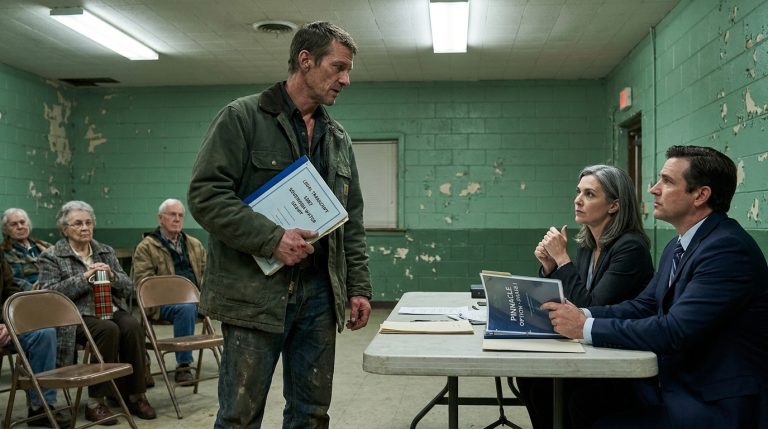
When I reached the rear entrance of the community center, I didn’t knock. I pushed the doors open and walked straight into the back of the room. The silence was immediate, a heavy, suffocating pressure. The hall was packed. Karen Miller stood at the podium, her back to me, her voice a sharp, rhythmic whip as she addressed the crowd about ‘budgetary restructuring.’
I didn’t wait for a spotlight. I walked down the center aisle, the sound of my boots on the polished floor echoing like gunshots in the high-ceilinged room. Heads turned. A murmur rippled through the crowd, turning into a stunned silence as people recognized the man who had been the target of the HOA’s hate-filled letters.
Karen stopped, her back stiffening. She turned slowly, her expression a fragile mask of outrage. “Mr. Thorne, this is a private meeting. You are not a member of this community and you have no—”
“I have the ledger, Karen,” I interrupted, my voice projected, steady, and devoid of the performative anger she expected. I reached into the tube and pulled out the notarized documents, holding them up for the room to see.
The man in the windbreaker appeared in the doorway behind me, his suit dusty, his expression a mixture of confusion and suppressed fury. He started toward me, but he stopped when he saw the crowd—two hundred residents, their faces slowly turning from confusion to a cold, collective realization.
“These aren’t maintenance logs,” I said, my voice echoing off the walls. “These are the title-stripping records for every property in this development. They didn’t just want your fees. They wanted your homes.”
The room erupted. It wasn’t the sound of an argument; it was the sound of a foundation cracking. People were rising, their chairs screeching against the floor, their eyes fixed not on me, but on Karen. She stood at the podium, her hands gripped so hard on the wood that her knuckles were bloodless. She looked toward the door, toward the man in the windbreaker, but he was gone, swallowed by the crowd.
She was alone.
I didn’t approach the podium. I didn’t need to. I simply placed the ledger on the nearest table, a physical weight in a room that was suddenly, violently filled with the truth. Karen’s gaze darted around the room, searching for an ally, a bylaw, a distraction—anything to re-establish the order she had weaponized for so long. But there was nothing left. The silence that followed was the sound of a reign ending, not with a shout, but with the sudden, undeniable realization that the game was over.
CHAPTER 8: THE FINAL SETTLEMENT
Karen didn’t collapse. She retreated. She backed away from the podium, her eyes darting across the sea of faces—people who had, until five minutes ago, been her subordinates, her props, and her victims. Now, they were a jury. I stayed where I was, my hand still resting on the ledger, the weight of the truth grounding me as the room surged forward. There was no violence, no shouting match; just the terrifying, relentless sound of two hundred people realizing they had been swindled.
The man in the windbreaker was long gone, but the damage he represented remained. I watched as David Fletcher stepped up to the podium, his voice—usually hesitant, now iron-hard—calling for an immediate vote to sequester the HOA’s remaining assets.
“Karen,” he said, and the way he said her name—without the ‘President’ or the ‘Mrs.’—stripped her of the last layer of her armor. “You aren’t going anywhere. The local police have been contacted, and the federal authorities are already en route. This isn’t a board meeting anymore. It’s a crime scene.”
Karen’s gaze flickered to me one last time. There was no rage left, only a hollow, terrifying vacancy. She knew. She knew that the landscaping kickbacks were merely the decoy—the “Layer 1” distraction she’d used to keep the homeowners focused on petty grievances while the real, systematic looting occurred in the shadows. The holding company, the predatory loans, the engineered foreclosures—that was the predator beneath the surface, and she had been nothing more than the bait. She hadn’t been the architect of the empire; she was its disposable frontline.
As the room dissolved into organized chaos—homeowners calling lawyers, police cruisers pulling into the lot, the flashing lights reflecting off the tinted glass—I stepped back. My work here was done. The mechanism of control she had built was being dismantled in real-time, the community reclaiming the agency she had systematically drained from them.
I left the center and walked back out into the night. The air was crisp, the storm having scrubbed the humidity from the landscape. I took the long way home, cutting through the woods where the silence had finally returned—a deep, ancient quiet that didn’t feel like a target anymore.
When I reached the survey pin, I knelt, placing my hand on the cold iron. It was just a marker, a piece of metal in the earth, but tonight it felt like a monument. I pulled my multi-tool from my pocket and, with a few precise, practiced motions, I unscrewed the sensor housing the mesh network had installed. I didn’t smash it. I didn’t throw it. I simply dismantled it, the components falling into the mud like discarded toys.
The house was dark when I finally stepped onto the porch. Inside, the silence was perfect. I walked over to the desk that had belonged to my grandfather and set the document tube down. I wouldn’t open it again. The ledger would go to the federal investigators in the morning, a final, lethal piece of evidence that would ensure the holding company and the puppet masters behind the HOA would never again threaten the integrity of this place.
I walked to the kitchen and made a cup of coffee. As I sat on the back deck, watching the first faint, grey light of dawn touch the tops of the oaks, I felt a strange, lingering calm. The fight had been brutal, a tactical endurance test, but the cost had been worth it. I had defended the line.
A small, familiar shape moved along the edge of the woods—a fox, its coat a vibrant copper against the muted tones of the morning. It paused, looked toward the porch, and then continued on its way, unbothered by the boundary, moving through the woods with a grace that was entirely oblivious to the human madness that had nearly consumed the soil beneath its paws.
I picked up the camera I’d retrieved earlier from the gatehouse, checked the housing, and mounted it back onto the old oak tree. I hit the power switch, watching the small, amber light blink into life—a silent, vigilant observer, not for a tyrant, but for the land itself. The neighborhood was changing. The beige vinyl of Whispering Pines would remain, but the fear was gone. The predatory cycle had been broken, and for the first time in years, the woods felt like a sanctuary again—a place where the only lines that mattered were the ones drawn by the sun, the seasons, and the quiet, persistent rhythm of the earth.