The Weight of a Whisper: A Master Craftsman’s Silent Restoration of a Broken Legacy
CHAPTER 1: The First Fracture
The John Deere 9Rx was a beast of steel and hydraulic ambition, but in the center of the McGregor barn, it looked like a dying leviathan. The main pivot joint, a cast-steel heart meant to withstand the crushing weight of thousands of acres of Iowa earth, had surrendered. A jagged, ugly wound tore through the metal, a fissure that seemed to mock the two young welders standing before it.
Jake, the lead, threw his welding gun down. The tool clattered against the concrete, a discordant, hollow sound that seemed to drain the remaining oxygen from the room. He wiped his face, leaving a smear of grease that looked like war paint, though there was no victory here.
“It’s scrap, Tom,” Jake barked, his voice vibrating with a brittle, defensive edge. He didn’t look at the farm owner; he looked at the floor, anywhere but at the gaping chasm they had spent forty-eight hours widening. “The micro-fractures are heat-stressed. The more we try to force it, the more the parent metal tears. You’re looking at a sixty-thousand-dollar subframe assembly and six weeks of downtime.”
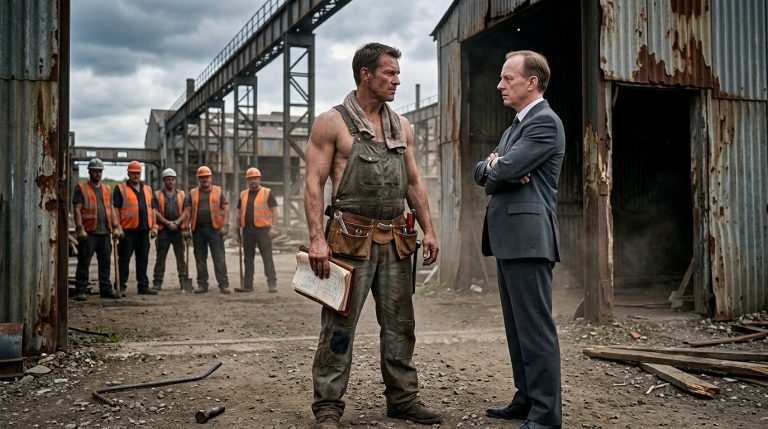
Tom McGregor stood a few feet away, his arms tightly folded across his chest. He was a man whose life was measured in commodity futures and planting windows, and right now, his watch was ticking toward ruin. His face had the pallor of someone witnessing a slow-motion car crash he couldn’t stop. “Six weeks?” he repeated, his voice barely a whisper. “Planting starts in seven days, Jake. If the equipment isn’t ready, the fields won’t get seeded. If they don’t get seeded, the bank takes the deed by October.”
Arthur Vance leaned on his broom, the bristles soft against the polished concrete. He watched the interplay, his faded blue eyes—the color of a winter sky—tracing the line of the fracture. He didn’t see a destroyed machine; he saw a conversation between forces that had been handled with arrogance. The metal wasn’t “defective.” It was being bullied.
He felt the familiar, low-frequency thrum in his own hands—a ghost sensation, a phantom limb of muscle memory that reached back across fifty years of shipyards, steam pipes, and the groaning of hulls in the North Atlantic. His right index finger tapped his knee. Long. Short. Long. A Morse code prayer for the steel.
“You can’t force a pulse that hard into cast,” Arthur said, his voice as soft as the dust motes dancing in the barn’s high, shafted light.
Jake spun around, his jaw tight. He looked at Arthur not as a man, but as an annoyance—a smudge on the lens of his own carefully cultivated professional identity. “What did you say, Pops? I’ve got half a dozen certifications in this truck and enough high-tech hardware to weld a spaceship. You’ve got a broom and a dustpan. Stick to the lawns.”
Tom didn’t even turn his head. He was staring at the tractor, his mind already calculating the interest rates on a desperate loan. Arthur didn’t flinch. He didn’t offer a rebuttal. He simply nodded, a slow, deliberate movement that acknowledged the young man’s pride without validating his conclusion. He turned his gaze back to the wounded frame, noticing a tiny, microscopic discoloration near the root of the fracture—a detail no one else was looking for, a subtle discrepancy that whispered of a structural imbalance that had existed long before the current crisis.
He turned away to resume his sweeping, but as he moved, his shoulder brushed the heavy steel of the tractor’s tire. He paused, his hand lingering for a heartbeat against the rubber, a silent, almost reverent touch. He knew something that was about to cost everyone in this barn their peace of mind.
CHAPTER 2: The Echo of the Hull
The silence of the McGregor barn was not a true vacuum. It was a textured thing, thick with the smell of diesel and the stagnant, metallic tang of ozone. Jake’s footsteps retreated toward the truck, the crunch of gravel outside sounding like the shifting of debris on a blackened deck. Arthur Vance didn’t move. He kept his palm pressed to the John Deere’s sidewall. The rubber was cold, unresponsive, yet it carried the faint vibration of the wind rattling the barn’s corrugated metal siding.
It was a sound that didn’t belong in Iowa. It belonged to the North Atlantic, to the deep, percussive groan of a carrier’s hull flexing under the assault of a gale.
His finger tapped against his leg again. Dot. Dash. Dot.
He closed his eyes for a split second, and the barn dissolved. The dim, yellow-washed concrete floor became the slick, oil-stained steel of the Forrestal’s flight deck. The smell of cut alfalfa was replaced by the acrid, choking stench of burning jet fuel and melting insulation. He felt the phantom heat of a bulkhead glowing cherry-red against his back, the desperate, clawing need to seal the metal before the fire reached the auxiliary magazine. The memory was not a ghost; it was a physical weight, a pressure on his lungs that made it hard to draw a full breath of the stagnant Iowa air.
“Art?”
The voice was thin, reedy, pulling him back to the surface. It was Tom McGregor. He was still standing by the tractor’s cab, his posture slumped, a man witnessing his own bankruptcy in real-time. Tom wasn’t looking at Arthur; he was looking at his phone, his thumb hovering over a contact for a salvage yard.
Arthur pulled his hand away from the tractor. His palm was dry, mapped with the silver, raised ridges of a dozen old burns—the calligraphy of his life. He took a slow, deliberate breath, pushing the vision of the Atlantic storm into the locked box where he kept everything else. He was not on a carrier. He was a groundskeeper. He was invisible. He was safe.
“The frame,” Arthur said, his voice raspy, a sound like dry leaves skittering across pavement. “The stress isn’t just in the joint, Tom. It’s in the chassis mounting. They’ve been tightening the bolts to compensate, pulling the metal into a tension it wasn’t designed for.”
Tom looked up, blinking as if he’d forgotten Arthur was still there. “Jake said the casting was defective. He said it was contaminated.”
“Jake is a man who reads manuals,” Arthur replied, his tone devoid of judgment, flat and utilitarian. “He doesn’t read the metal. The steel isn’t contaminated. It’s tired. It’s been pushed too hard, too fast, and no one bothered to check the balance of the load distribution before they started pouring heat into it.”
Arthur began to walk toward the back of the barn, his left leg dragging slightly—the limp was a subtle, rhythmic hiccup in his gait, a physical reminder of a steel plate that had fallen fifty years ago. He navigated around a stack of old fence posts, his movements as fluid and efficient as a man moving through a cramped engine room.
He didn’t need to look back to know Tom was watching. The silence that followed was different now—it had shifted from the awkward, dismissive quiet of earlier to a tense, expectant vibration. Tom had nothing left to lose, and in the bottom of his exhausted, panic-stricken mind, he was beginning to realize that the old man’s presence was the only anomaly in a situation that had already gone to hell.
Arthur reached his shed, a small, sagging structure nestled against the far perimeter of the property. The door creaked on its hinges, a sharp, protest-filled sound. Inside, the space was a sanctuary of order. A cot, tightly made; a bookshelf where the spines of naval history texts were perfectly aligned; and a workbench that held a collection of tools that had been polished until they shone like mirrors.
He didn’t turn on the overhead bulb. Instead, he pulled the chain on a small, hooded desk lamp, creating a tight, focused cone of yellow light. He sat down and reached under his workbench, pulling out the old, green-painted metal lunchbox. He rested his hands on the lid for a moment, letting the coolness of the steel seep into his skin.
He was not supposed to do this. He was supposed to mow the lawns, fix the fences, and remain a footnote in the lives of the people who owned the land. But the tractor… the tractor was a problem he understood in his bones. It was a symphony of tension and heat, and it was screaming for a solution that only he could provide.
He clicked the latches. Snap. Snap.
The sound was like a lock turning on a forgotten tomb. Inside, nestled in the dark, oil-stained felt, lay the tools of his trade. He picked up his chipping hammer, turning it over in his hand. The wood was worn dark by decades of his own grip. He felt a flicker of the old, dangerous calm rising within him, the same sensation that had once steadied his hand while the ship pitched and heaved beneath his feet.
He heard footsteps outside—tentative, hesitating. Tom was hovering. He was frightened of the mess, frightened of the cost, and most of all, frightened of placing his hope in a man who looked like he belonged to a different, vanished century.
Arthur stood up, the lunchbox tucked firmly under his arm. He didn’t look at the door. He knew who was there. He walked to the threshold, his gaze fixed on the distance where the dark horizon met the bruised, overcast sky.
“Don’t call the salvage yard, Tom,” Arthur said, his voice carrying clearly into the cool evening air. “Not yet. The steel still has something to say.”
He stepped out of the shed and began the walk back to the barn, the weight of the lunchbox a comforting, familiar anchor in the darkening world.
CHAPTER 3: The Offer of Finesse
The barn door groaned open, a long, rasping protest of rusted hinges that echoed into the rafters. Inside, the evening light had turned a bruised, melancholic purple, filtering through the high clerestory windows to coat the equipment in a layer of gloom. Tom McGregor was still there, sitting on a turned-over plastic milk crate, his phone clutched in his hand like a dead bird. He looked up, his eyes hollowed by a day of unrelenting stress.
“I didn’t call the yard,” Tom said, his voice flat. He sounded as if he were waiting for a death sentence.
Arthur didn’t respond immediately. He walked to the center of the concrete floor, the weight of the lunchbox steady against his hip. He didn’t look at Tom; he looked at the John Deere, at the jagged, scorched wound that the young welders had left behind. They had been careless, yes, but as Arthur leaned in, the beam of his small LED work light playing over the mess, he saw something else.
The cross-hatch pattern of the failed weld wasn’t just sloppy; it was aggressive. There was a frantic, almost violent lack of rhythm in the way they had tried to fill the gap, a series of short, biting arcs that suggested not just a lack of skill, but an ego that had been fighting the metal rather than listening to it. It was a signature of incompetence disguised as bravado.
Arthur set the lunchbox down on a stack of hay bales. He peeled off his worn chore coat, revealing a thin, flannel shirt stretched over a frame that was lean and corded with the residual strength of a lifetime spent hauling steel. He didn’t rush. He moved with the slow, deliberate grace of a ritual.
“Tom,” Arthur said, his voice quiet but carrying through the hollow acoustics of the barn. “This isn’t a problem of the machine. It’s a problem of approach. They treated this casting like a piece of pipe to be patched. It’s an articulated pivot. It carries the torque of this entire farm. You don’t patch it. You integrate with it.”
Tom stood up, his legs stiff. He walked over to the tractor, his movements hesitant, as if he expected the machine to bite him. “They said it was $60,000 for the part, Art. Six weeks. You’re telling me that after they failed twice, you can do it with… what’s in that box?”
“I’m telling you that I don’t need a hundred-thousand-dollar rig to do what’s necessary,” Arthur said. He knelt before the fracture. He reached into his lunchbox and withdrew a small, handheld wire brush. He began to work, the rhythmic shrit-shrit of the bristles against the steel the only sound in the barn. He wasn’t just cleaning the slag; he was feeling the surface, gauging the depth of the cracks, reading the heat-affected zones that Jake and Cody had left like scars.
The scent of burning metal still clung to the air, bitter and acrid, but as Arthur worked, he felt a strange, quiet peace. This was the work. This was the atonement. For years, he had lived in the shadow of things he had saved, ghosts of ships and men that flickered in the periphery of his memory. Here, in the quiet of an Iowa evening, the ghosts were silent. The only thing that existed was the steel, the cold, stubborn truth of the metal that needed to be persuaded into integrity.
“I need a heavy-duty extension cord,” Arthur said without looking up. “And I need you to go to the house. Get yourself a drink, or sleep, or whatever you need to do to stop vibrating like a downed power line. If you’re here, you’ll try to help. And you’ll only be in the way.”
Tom stared at him for a long moment. There was a look in the farmer’s eyes that Arthur recognized—it was the look of a man who had finally hit bottom and was terrified of the dark. “You’re really going to do it, aren’t you?”
“I’m going to try,” Arthur corrected. “Try is the only word that matters when you’re working on something this broken.”
Tom nodded slowly, a trace of something like hope—or perhaps just sheer, unadulterated desperation—flickering in his gaze. He turned and walked toward the barn door, his silhouette framed by the encroaching twilight. Before he exited, he stopped. “If you need anything, just shout. I’ll be on the porch.”
“I won’t,” Arthur murmured to the empty air.
He was alone now. He reached back into the lunchbox and pulled out a small propane torch. He ignited it, the flame a sharp, focused blue. He didn’t aim it at the fracture; he began to move it in a slow, hypnotic circle around the outer edge of the damage, gently, incrementally raising the temperature of the entire casting. It was a process of patience. It was the art of the hull surgeon, the steady hand that knew how to make metal yield without letting it shatter.
His finger began to tap against his knee again. Long. Short. Long. A language of patience. He was listening to the metal expand, feeling the minute, almost imperceptible shifts in the surface tension as the heat permeated the thick, unforgiving cast iron. This was the part the others had skipped. They had seen the gap and wanted to fill it. Arthur saw the gap and knew he had to heal the whole.
He sat back on his heels, the torch held in one hand, his eyes tracking the way the light danced on the darkened, scarred surface of the frame. He thought of the Forrestal, of the smoke that had been so thick he could taste it, the heat that had felt like a living thing trying to peel the skin from his bones. He had held his ground then, and he would hold his ground now. The stakes were different—a farm instead of a ship, a harvest instead of a war—but the gravity of the work was identical.
He moved the torch again, a millimeter to the left, a millimeter to the right. He was no longer Arthur Vance, the groundskeeper. He was the Chief. He was the man who kept the world from breaking. And for the first time in a long time, the weight in his chest felt lighter, as if the steel itself were pulling the ghosts out of him, grounding them in the firm, unyielding reality of the earth. He reached into his lunchbox once more, his fingers closing around the cold, familiar grip of his stinger. The preparation was almost complete.
CHAPTER 4: The Catastrophic Collapse
The wind didn’t just rattle the barn; it seemed to hunt for weaknesses, whistling through the gaps in the corrugated siding with a high, mournful pitch. Arthur saw the blue torch flame jump, the tip of it bowing toward the cold concrete. Without thinking, he shifted his body, using his own frame to block the draft, his shoulder pressing hard against the rough, cold steel of the tractor’s pivot joint.
The heat he had been cultivating, that delicate, even warmth, was under threat. If the temperature dropped too quickly, if the iron contracted against the thermal stress he’d been so carefully applying, the existing fracture could propagate—a quiet, crystalline snap that would be the death knell of the repair.
He held his breath. His right index finger, usually so steady, betrayed a momentary tremor—a flicker of the old, phantom fatigue. He didn’t pull away. He leaned harder into the machine, his breath hot and measured against the cast iron. He was not just a man with a torch; he was the equilibrium. He watched the light dance on the metal’s surface, a shimmer that told him the temperature was holding, barely.
Then, the wind died as abruptly as it had risen.
Arthur exhaled, a long, shaky sound that seemed to drain the last of the day’s tension from his muscles. He stood up, his knees cracking like dry kindling. He turned to glance toward the barn door. He could see the faint glow of a cigarette on the farmhouse porch—Tom was still there, watching, waiting, clinging to the hope that the old man in the barn wouldn’t fail him.
Arthur returned to his work, but his mind felt frayed. The memory of the carrier—the smell of the smoke, the way the bulkhead had groaned under the pressure of the fire—was pushing at the edges of his consciousness. He needed focus. He needed to be small, to be the groundskeeper, to be nothing more than the sum of his movements.
He picked up the chipping hammer, his grip firm. He tapped a small, stubborn ridge of slag near the bottom of the V-groove he’d spent hours grinding. Tink. Tink. The sound was clean, precise.
But as he stared at the fracture, he noticed something that made his blood run cold. It wasn’t the size of the crack, or the depth of it. It was the edges. He took his flashlight and angled it low across the surface of the metal. The marks left by Jake’s high-tech welder were not just sloppy—they were jagged, deep, and patterned.
Arthur leaned in closer, his eyes narrowing. The cross-hatch marks weren’t just the product of a heavy hand. They were etched with a strange, deliberate intensity, as if the person who had done them had been trying to hide something beneath the surface—not just an attempt to weld, but an attempt to fill the void with as much material as possible, as quickly as possible, to mask the fact that the underlying geometry of the joint had been fundamentally, irreversibly compromised by an initial, hidden cut.
Someone hadn’t just tried to weld this tractor. Someone had sabotaged it.
The realization hit him with the force of a physical blow. The tractor didn’t just break from stress; it had been cut—a precise, calculated incision—before the first pass of the MIG welder. The welders, Jake and Cody, hadn’t just failed. They had been tasked with the impossible. They had been part of a setup.
Arthur’s hand moved to his pocket, his fingers brushing the cool, solid weight of the chipping hammer. His heart rate, which had been so steady for hours, spiked. This wasn’t a groundskeeper’s task. This was something darker, something that smelled of industrial spite and deep, systemic greed.
He looked at the barn door again. Tom. Did he know? Was the farm’s collapse an accident, or was this place being liquidated by someone who didn’t want the harvest to happen? The questions crowded his mind, louder than the wind, more intrusive than the ghosts of the Forrestal.
He reached out and touched the cut. The edge was sharp, clean—an angle that no amount of heat stress could produce. It was the mark of an abrasive disc, a professional job.
He felt a sudden, sharp need for the familiar. He picked up his lunchbox, his movements erratic, the metallic clatter of tools inside sounding like a warning bell. He wasn’t just fixing a tractor anymore. He was walking into the middle of a conflict he hadn’t asked for, a battle that would require more than just a nickel rod and a steady hand.
He stepped back from the machine, the torch light casting long, distorted shadows against the barn wall. He felt exposed, visible in a way he had spent a lifetime avoiding. He looked up at the rafters, at the dark, silent expanse of the barn, and for a moment, he felt the immense, crushing weight of the secret he had just uncovered. The John Deere was no longer just a piece of broken equipment. It was evidence.
He needed to finish this, but the context had shifted. The repair was no longer about atonement. It was about survival. He turned off the torch, the barn plunging into a sudden, deep gloom, and stood in the dark, listening to the silence of the farm, wondering who else was watching.
CHAPTER 5: The Lunchbox Arsenal
The barn didn’t just feel empty; it felt staged. Arthur stood in the middle of the concrete, the silence pressing in against his eardrums. He reached for the lunchbox—his anchor, his archive, his arsenal—and the metallic click of the latch echoed like a gunshot. He needed to verify the damage. If this was sabotage, he needed to understand the mechanics of the intent behind it.
He opened the lid, the familiar scent of oil-stained felt and ancient, shielded arc rods rising to greet him. He pulled out his welding goggles, the thick, green circular lenses that had seen more fires than he cared to count. He slid them on. The world instantly dimmed, turning into a monochromatic gray-scale landscape.
He didn’t need the torch yet. He needed to see the ghost of the cut. He tilted his work light, angling the beam so it skimmed the surface of the steel at an extreme oblique. Under the filtered light of the goggles, the metal revealed its secrets.
There, beneath the scorched, frantic beads laid by Jake, was a clean, thin line. It was too straight, too precise to be a fatigue crack. It was a surgical strike. Someone had used a high-speed abrasive wheel, likely when the tractor was supposedly “in storage” or during the shift change when the barn was unsupervised. They had pre-weakened the structural integrity, ensuring that when the engine cranked and the hydraulic pressure surged during the first pass of the planting season, the machine would not just break—it would catastrophically fail.
Arthur’s breath hitched. This was not the work of a disgruntled employee; this was a move in a game of professional liquidation.
Clang.
The sound came from the far end of the barn—a heavy, metallic impact that sent a tremor through the concrete floor. Arthur spun, his hand instinctively going to the handle of his chipping hammer. The barn was still dark, the only light coming from the narrow, focused beam of his work light.
“Who’s there?” Arthur’s voice was low, devoid of panic but sharp with the authority of a man who had spent decades in the most dangerous environments on the planet.
Silence. Only the wind, whistling through the eaves again, sounding like a dying engine.
Arthur moved toward the sound, his limp barely perceptible as he navigated the shadows. He didn’t look like a groundskeeper now; he moved with the predatory, economic caution of a veteran patrolling a darkened hallway. He rounded the bulk of a large, stored combine harvester and stopped.
There, on the floor, was a heavy steel wrench. It lay where it had fallen, an obvious, almost mocking relic. He knelt, his fingers tracing the handle. It was cold, oily. He looked up toward the loft, toward the dark, cavernous space above the milking stalls. A shadow shifted—not a trick of the light, but the deliberate movement of a person retreating.
He didn’t call out again. Instead, he turned back to the tractor. If they were watching, if they knew he had discovered the cut, the dynamic of the “repair” had changed. He wasn’t just fixing a machine; he was baiting a trap.
He reached into his lunchbox, his fingers finding the slender, nickel-alloy rod—one of the last of his secret hoard. He had enough to make the repair, but he would have to make it count. He sat back, his mind racing, calculating the variables. If someone wanted this machine destroyed, they would return when the “repair” was supposedly finished to ensure the failure was absolute.
He began to prep the surface again, this time with a focused, surgical intensity. He didn’t just grind out the sabotage; he began to build a new structure entirely. He would use the sabotaged frame as a template, reinforcing the area with a series of structural gussets he was fashioning from the scrap metal stacked in the corner of the barn.
It was a technique he’d learned in the shipyards—the “Double-Blind” reinforcement. You fix the obvious, but you bury the real strength deep beneath the surface, where it can’t be easily compromised.
As he worked, his pulse began to settle. The phantom alarm of the Forrestal faded, replaced by the cool, hard clarity of the task at hand. He was no longer reacting to the sabotage; he was anticipating it. He understood the mechanics of the destruction now, and by extension, he understood the perpetrator. It was a coward’s tactic, a hit-and-run approach to infrastructure destruction.
He moved his torch, the flame steady, his hand as solid as stone. He began the first pass, the violet light erupting, a brilliant, beautiful star in the center of the dark barn. The sound of the arc was the sound of truth—a perfect, rhythmic roar that drowned out the wind, the ghosts, and the fear.
He didn’t see the shadow move again. He didn’t hear the footsteps. He only heard the steel singing under his command. He laid the first bead, the metal glowing, fusing, becoming something new—something that didn’t just hold the weight of the tractor, but held the weight of his own, long-hidden defiance.
The tractor was broken, but it was being reborn. And whoever was watching from the shadows was about to realize that the old man with the lunchbox was not the person they had expected to encounter. He was a wall, and the game of industrial spite had just hit its final, insurmountable obstacle.
He pulled the electrode back, the light dying, leaving his vision swimming with purple spots. He adjusted his goggles and took a breath. The repair was halfway through. The night was still young. And the barn, once a cathedral of agriculture, had become the arena for a war that only one man knew was being fought.
CHAPTER 6: The Captains Arrival
The crunch of gravel stopped abruptly outside the barn. Arthur didn’t freeze—that was a luxury he couldn’t afford. Instead, he became part of the shadows. He set his stinger down with practiced care, the metal meeting the concrete without a whisper of sound. He shifted toward the side of the tractor, his movements fluid, his limp a non-factor in the dark.
He knew that tread. It was too measured, too deliberate to be a farm hand. It was the heavy, rhythmic gait of someone who had spent decades counting paces on a deck.
The barn door groaned, but it wasn’t the violent rasp of before. It was a controlled, slow-motion opening. A figure stepped into the sliver of moonlight provided by the yard light: Captain Miles McGregor. He moved with a posture that ignored his age, his shoulders square, his eyes already adjusting to the gloom.
Arthur didn’t emerge immediately. He watched from the shelter of the combine harvester, his breathing shallow, his hands steady despite the adrenaline. The Captain wasn’t here to threaten him; the man’s aura was one of concern, perhaps even a quiet, burning indignation.
“I know you’re in here, Chief,” the Captain said. His voice was low, resonant, carrying no threat. It was the voice of a man who had commanded thousands and who was used to the quiet, reliable presence of his senior NCOs. “The barn has a specific stillness when you’re working. I’ve known that silence for forty years.”
Arthur stepped into the dim light. He didn’t salute, but he straightened, the unconscious habit of a lifetime. “Captain.”
The Captain’s gaze didn’t linger on Arthur; it swept over the tractor, lingering on the repair. He took a few steps forward, his boots crunching on the metal filings that littered the floor. He stopped in front of the frame. Even in the near-dark, he could see the difference. The repair was no longer just a weld; it was a structural masterpiece, a series of gussets and reinforcements that transformed the machine from a piece of agricultural equipment into something that felt armored, reinforced, and resolute.
“They cut it,” the Captain said. It wasn’t a question. He had clearly walked around the perimeter of the tractor, his keen eyes catching the surgical precision of the abrasive disc marks that Arthur had been forced to leave exposed during his repair.
“They did,” Arthur replied.
“I saw Jake and Cody leave,” the Captain continued, his voice hardening, turning into the tone he must have used when addressing a failing watch team. “They looked like men who had just seen a ghost. And now, I see this.” He gestured toward the frame. “You’ve turned a simple patch into a bunker. Why?”
Arthur stepped closer to the tractor, his hand resting on the reinforced steel. “Because they’re coming back, Captain. They didn’t just want to steal the time of a harvest. They wanted to ensure the machine would fail under load, likely on the edge of the north field, near the drainage ditch. A total loss. An unfixable catastrophe.”
The Captain leaned in, his face tight with anger. “Who? Who would gain from this?”
“I don’t know the name on the ledger,” Arthur said, his voice flat. “But I know the work. Whoever hired them is trying to bleed this farm dry, piece by piece. They started with the irrigation pumps in May, didn’t they?”
The Captain turned, his eyes wide. “How did you know about the pumps?”
“I’m a groundskeeper,” Arthur said, a thin, mirthless smile touching his lips. “I see what everyone else walks past. The pumps were stripped of their primary bearings, not worn out. This farm is being dismantled by someone who knows exactly how to make it look like bad luck.”
The Captain stood silent for a long time. The wind outside seemed to hold its breath. He reached out and touched the weld—the smooth, ripple-stacked steel that was the signature of a man who refused to allow chaos to win. “If this machine starts tomorrow, and it holds… if it holds, they’ll know their sabotage failed.”
“That’s exactly what I want,” Arthur said. “When it starts, I’ll be in the cab. If they have eyes on this field, they’ll have to show themselves to finish the job.”
The Captain looked at him, and in that gaze, Arthur saw the reflection of his own resolve. It wasn’t the look of a retired officer or a farm owner; it was the look of two men who had been through the fire and knew that the only way to survive was to hold the bulkhead, no matter how hard the sea hit.
“I’ll be in the north field,” the Captain said, his voice steady. “With the rest of the hands. If anything moves that isn’t supposed to, I’ll handle it.”
Arthur nodded. He picked up his lunchbox, the weight of it feeling like a promise. He wasn’t just a groundskeeper. He was the anchor. And as the Captain turned to leave, Arthur felt the final, cold clarity of the situation. The repair was done. The trap was set. Tomorrow morning, when the sun rose over the Iowa fields, the tractor would roar to life, and the truth of what was happening on the McGregor farm would finally have to answer for itself.
CHAPTER 7: The Arc of Restoration
The dawn didn’t break; it bled into the horizon, a thin line of bruised orange across the gray Iowa sky. Arthur sat in the driver’s seat of the John Deere 9Rx, his hands resting on the steering wheel. The cabin was a cocoon of modern technology, a stark contrast to the grease-stained, veteran hands that gripped the controls. He could feel the tractor through the seat, a massive, dormant beast that seemed to pulse with the rhythmic vibration of the world outside.
His right index finger tapped a final, frantic rhythm against his knee. Long. Short. Long.
Below him, the frame—his frame—held. He had spent the last hours of the night running a final, painstaking inspection, not just of the weld, but of every bolt, every hydraulic line, and every sensor mount. He had found the trace of the aerospace-spec oil near the intake, a lingering, synthetic perfume that identified the saboteur. They weren’t just farmers or local vandals; they were people with resources, people who thought they could play with the mechanics of a man’s livelihood as if it were a simple accounting error.
He heard the engine of a pickup truck idling near the edge of the barn—the Captain. And further out, near the treeline, the faint, unnatural sound of a vehicle engine struggling in the wet mud of the north field. They were in position.
Arthur took a deep breath, the air inside the cabin tasting of dust and stale coffee. He turned the key.
The engine didn’t catch immediately. It groaned, a deep, heavy sound of pistons fighting the cold, before the starter motor engaged with a violent, metallic shriek. Arthur didn’t flinch. He let it crank, listening to the cadence of the engine’s resistance. He was tuning the machine, his ears filtering out the mechanical noise to isolate the heartbeat of the pivot joint.
Clunk.
The engine roared to life, a guttural, earth-shaking thrum that made the barn’s corrugated roof shudder in sympathy. The vibration traveled up the steering column, through the frame, and into Arthur’s bones. He didn’t feel it as a mechanical failure; he felt it as a symphony. The repair held. The reinforced steel wasn’t just bearing the weight—it was singing with the power of the engine.
He engaged the transmission, the massive tracks outside shifting, gripping the concrete with a heavy, grinding authority. As the tractor began to inch forward, moving toward the open barn door and the rising sun, Arthur saw it: a shadow near the tool shed.
A figure, dressed in dark, non-descript work clothes, stepped out, holding a remote device. A detonator. A surge of pure, cold electricity coursed through the saboteur’s equipment—they were planning to trigger a secondary, internal hydraulic failure once the machine hit the main field.
Arthur didn’t panic. He accelerated.
The tractor lurched forward, the engine’s power spiking, and as he breached the threshold of the barn, he caught a glimpse of the Captain’s truck tearing across the north field toward the shed. The figure saw the tractor, saw the engine light, and realized the machine wasn’t failing—it was hunting.
The saboteur dropped the remote and turned, diving into the tall grass at the edge of the field.
Arthur stopped the tractor. He didn’t chase. He didn’t have to. The machine was solid, a immovable testament to the truth of the metal. He stepped down from the cab, his boots hitting the gravel with a heavy, final sound. The Captain’s truck screeched to a halt, and Miles McGregor jumped out, a radio in his hand.
“The field is blocked, Art! They won’t get far!”
Arthur looked at the tractor, then back at the dark, silent shed. He walked toward it, his limp gone, replaced by a stride of absolute, weary victory. He reached the remote device lying in the dirt and picked it up. It was a clean, professional piece of engineering, as cold and heartless as the person who had used it.
He looked at the Captain, who was watching him with a mixture of awe and relief. The barn stood behind them, the tractor idling, the sound of it a low, powerful growl that seemed to vibrate through the very ground they stood on. The sabotage had failed. The tractor was whole. And for the first time in his life, Arthur realized the truth of what he had done. He hadn’t just fixed a machine. He had repaired the world, one arc of light at a time.
He dropped the device into the dirt and ground it into the soil with the heel of his boot.
“The harvest,” Arthur said, his voice calm, ringing with a sudden, profound clarity. “The harvest starts today, Captain.”
The Captain nodded, a thin, satisfied smile on his face. “It does, Chief. It certainly does.”
Arthur turned back to the tractor. He could see the hands beginning to emerge from the farmhouse, the first light of day hitting the fields. The cycle was turning. The broken parts were being discarded, and the harvest—the proof of their labor—lay ahead. He reached into his pocket and pulled out his old, worn chipping hammer. He tapped it against his palm once, a final, resonant sound that vanished into the morning air.
CHAPTER 8: The Quiet Aftermath
The afternoon sun hung low, casting long, golden shadows across the fields that stretched toward the edge of the world. The tractor—that behemoth of steel he had brought back from the brink—was a distant, rhythmic hum, moving in precise, orderly lines across the north acreage. Tom McGregor was at the wheel, and for the first time in months, the lines were straight.
Arthur stood near the barn, his hands in his pockets. The heavy, metallic weight of the lunchbox was gone, replaced by the lighter, more fragile reality of his own existence. He watched the tractor turn at the headland, the movement fluid and powerful.
Captain Miles McGregor stepped out from the barn’s shadow, his pace unhurried. He stopped beside Arthur and looked out over the field. He didn’t say anything for a long time. There was a profound, atmospheric peace in the way the wind moved through the tall, unharvested stalks at the field’s edge.
“They won’t be coming back,” the Captain said, his voice quiet, devoid of the earlier thunder. “The local authorities found the site where they were camped. It’s empty. Whoever hired them knew the moment the tractor started that the game was finished.”
Arthur nodded. He felt a strange lightness in his chest, the kind of stillness that only follows a long, bruising storm. He had lived his life trying to outrun the ghosts of the ships he had saved, believing his skill was a dangerous artifact that needed to be buried in anonymity. He had thought that by becoming a groundskeeper, he was performing an act of penance—a way to diminish the impact he had on the world, to keep the consequences of his competence small and contained.
“You aren’t a groundskeeper, Arthur,” the Captain said, his eyes fixed on the distant machine. “You never were.”
“I was for a long time,” Arthur replied, his voice barely a whisper. “It felt safer that way.”
“Safety is a hollow goal for a man like you,” the Captain said. He turned to face him, his expression one of deep, abiding respect. “You were always a guardian. That’s why you were sent for, time and again. Because you were the only one who could see the structural truth of a thing, whether it was a ship or a farm or a man’s life.”
Arthur looked down at his hands—thick, gnarled, and scarred. For the first time, he didn’t see them as the hands of a man who needed to be hidden. He saw them as the tools that had held the line when everything else had been falling apart. He realized that the atonement he had been seeking wasn’t about disappearing; it was about accepting the weight of what he could do.
They walked toward the barn, the gravel crunching softly under their boots. Tom had done something he hadn’t told Arthur about. Mounted to the side of the machine, right next to the reinforced pivot joint, was a small, polished brass plaque. It glinted in the dying sunlight, a permanent, indelible mark of acknowledgment.
Arthur stopped before it. The engraving was crisp: Structural Integrity Preserved by CPO Arthur Vance, USN.
He reached out and brushed the metal with his thumb. It was smooth, cool, and solid. It wasn’t a medal, or a commendation, or a secret file in the National Archives. It was a witness. It was a tangible, physical declaration that his presence here mattered.
“You’re going to stay,” the Captain stated, not as a question, but as a recognition of fact.
“I have a fence line on the south side that needs patching,” Arthur said, a faint, genuine smile touching his lips. “And the irrigation system needs a look. There’s always work to be done.”
The Captain nodded, a look of profound relief crossing his face. “Then I suppose I’ll see you tomorrow, Chief.”
“Tomorrow,” Arthur agreed.
The Captain turned and walked toward his car, leaving Arthur alone in the quiet of the barn. He stood for a long time in the center of the concrete, surrounded by the tools and the scent of cut grass and warm oil. He felt the phantom pressure of the North Atlantic wind fade, replaced by the gentle, steady warmth of the Iowa afternoon. He was no longer the man trying to outrun his history; he was the man who had finally brought it home. He turned and walked toward his small shed, the rhythm of his footsteps perfectly synchronized with the distant, steady hum of the tractor in the field. He was whole. And for the first time in forty years, he was exactly where he was supposed to be.