The Iron Rusts at Dawn: A Weary Tank Commander Survives the Normandy Collapse Without Armor or Illusion
CHAPTER 1: The Pale Horizon
The air smelled of wet grass, burnt diesel, and stale grease.
Über stood beside his Panther tank, his heavy boots sinking slightly into the damp Norman mud.
He turned a dented brass cigarette case over and over in his numb fingers, never opening it.
Around him, the village of Trun was slowly waking to a quiet that felt entirely unnatural.
Seven tanks remained out of forty-five.
That was the entire arithmetic of his company as the gray light crept across the eastern hills.
His young loader, barely nineteen with grease permanently caked under his fingernails, muttered something about the weather clearing up nicely.
Über did not answer him.
He just looked up at the pale sky, watching the stars fade into a flat, empty gray.
The division commander had promised four hours.
Four hours to push fifteen thousand men through a gap shrinking by the minute.
Über knew the map as well as he knew his own hands, and he knew four hours was a fairy tale.
A sergeant from the rear guard limped past, his uniform scorched down the left sleeve.
“The road is clear for now, Herr Lieutenant,” the man rasped, his voice cracked from dust and screaming.
“For now,” Über said quietly, his thumb tracing the scratched hinge of the brass case.
The rumble of idle engines vibrated through the soles of his boots, deep and rhythmic like a dying pulse.
He climbed back up into the commander’s cupola, his joints aching with a heavy, bone-deep exhaustion.
There was no glory in the steel plate beneath him anymore, only a target waiting for the sun to climb high enough.
CHAPTER 2: The Open Slaughter
The engine compartment behind Über gave a low, mechanical cough before settling into a vibrating idle.
He twisted the periscope handle, watching the gray horizon suddenly strip away its protective cover.
Patches of bright blue opened above the orchards like tears in a canvas.
Across the narrow road, a supply truck loaded with fuel crates lurked near a stone wall.
A low, growing roar began to wash over the fields from the west.
It was not the deep thunder of tank tracks, but a sharp, tearing canvas sound that cut straight through the bone.
Four aircraft dropped out of the bright patches, skimming thirty meters above the hedgerows with terrifying casualness.
“Get out!” Über shouted down the intercom, his voice cracking against the steel ring.
The lead fighter banked lazily, its black-and-white invasion stripes gleaming in the sudden, merciless sunlight.
Two white trails hissed from beneath its wings, streaking straight toward the supply truck.
The vehicle simply ceased to exist, replaced instantly by a blossoming wall of black smoke and flying debris.
The shockwave hit the Panther’s side armor like a sledgehammer, rattling every spare track link on the hull.
Über threw himself out of the cupola, tumbling hard into the damp ditch beside the road.
The air instantly filled with the sharp, bitter reek of cordite and burning rubber.
Another flight screamed overhead, their twenty-millimeter cannon fire chewing up the asphalt in a steady, rhythmic zip.
A young private from the infantry detachment scrambled out of a nearby shell crater, his rifle clattering uselessly against a rock.
“The road’s dead!” the private screamed, his eyes wide and unblinking.
“Move through the orchard!” Über barked, dragging the soldier down as a burst of lead shredded the leaves above them.
There was no glory in the ditches, only the raw, exhausting struggle to keep breathing while the sky emptied its fire.
CHAPTER 3: Iron Coffins
Über pressed his shoulder hard into the wet soil, his breath coming in shallow, jagged gasps.
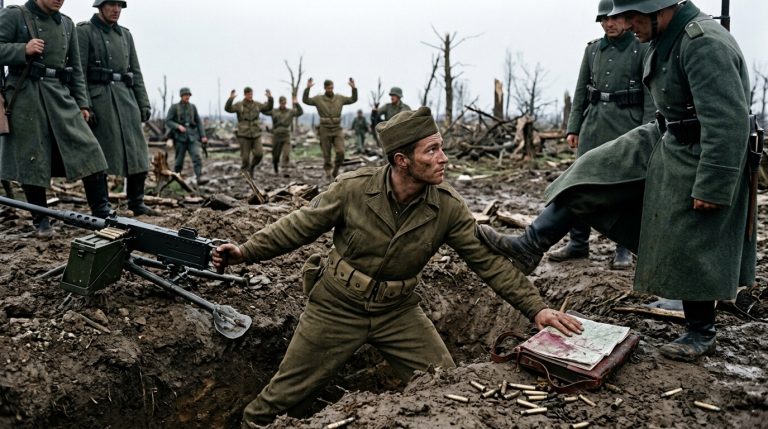
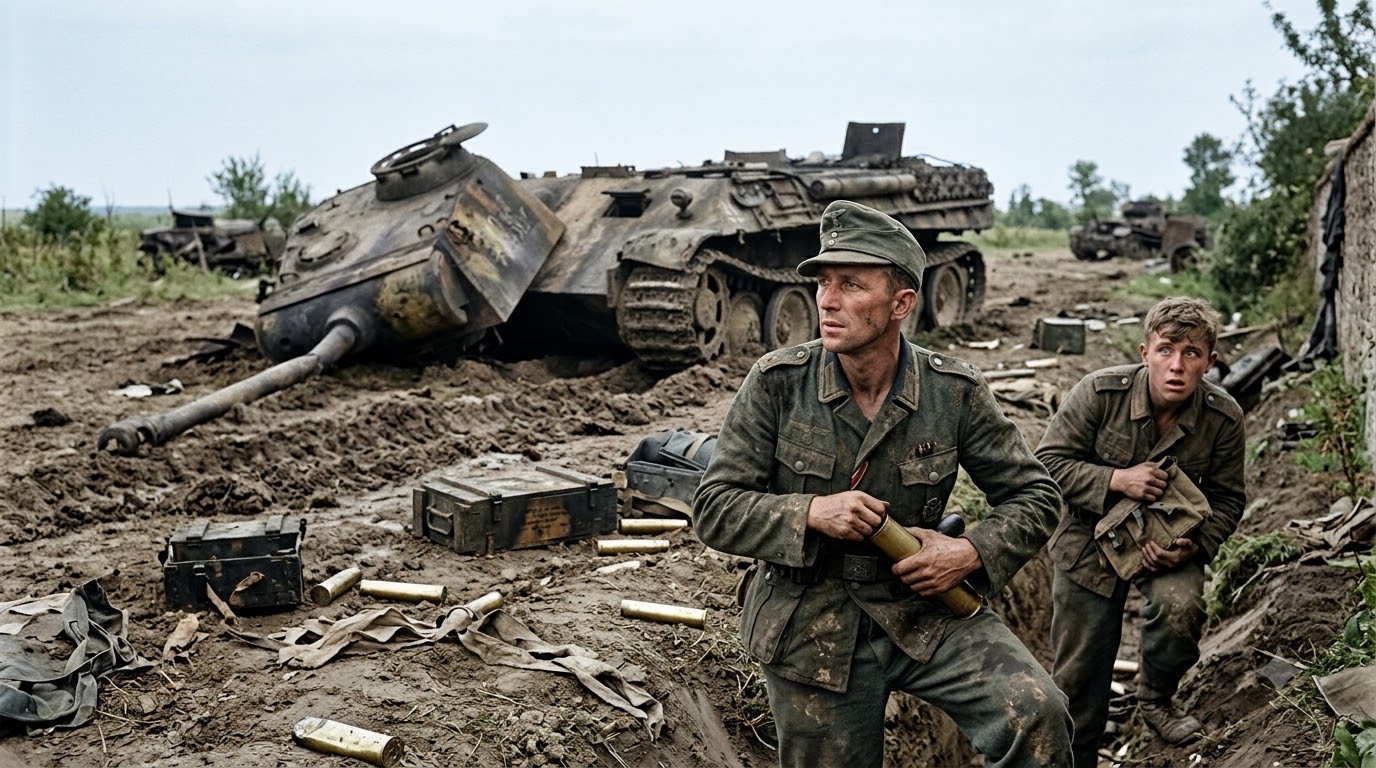
Above them, the Panther command vehicle sat silent in the open field, its thick steel turret blown completely off by the rocket impacts.
“They’re coming around again,” the young private hissed, his knuckles white as he clutched a discarded ammunition pouch.
Über wiped a streak of oily soot from his forehead, his gaze locked on the burning hulk of his machine.
Four months of industrial manufacturing, thousands of hours of crew training, reduced to twisted scrap in less than sixty seconds.
There was no heroic last stand to be made here, no clever tactical maneuver that could outsmart a rocket fired from three thousand feet up.
“We don’t run toward the road,” Über said, his voice flat and hard against the drone of distant engines.
“Then where?” the private demanded, his breathing turning ragged.
“The drainage ditch behind the orchard wall,” Über muttered, sliding his hand into his pocket to grip the cold, dented brass cigarette case.
A sharp clink echoed softly against his thigh as a small, polished brass shell casing rolled out from his pocket and settled into the mud—completely empty, devoid of powder, and entirely useless.
He stared at it for a fraction of a second before pushing himself up onto his knees.
Every joint in his body screamed with protest, but the open field left no room for hesitation.
CHAPTER 4: The Choke Point
The Dives River appeared through the smoke as a flat ribbon of murky water choked with debris.
Über gripped the collar of the wounded soldier’s tunic, his boots sliding in the greasy bank.
Around the single passable ford, hundreds of men and burning wagons formed a suffocating wall of confusion.
“Keep moving,” Über rasped, his throat raw from sulfur and dust.
A sergeant from a shattered artillery unit blocked their path, his face blackened by soot.
“The bridge at St. Lambert is gone,” the sergeant shouted over the rumble of distant explosions. “We have to cross here or nowhere!”
“Then we cross here,” Über replied, his voice dropping into a flat, unyielding register.
They waded into the waist-deep current, the water bitterly cold against bruised muscles.
Dead horses drifted past them, their bloated forms bumping softly against Über’s legs in the current.
Overhead, the steady hum of returning aircraft promised that the brief respite was ending.
They hauled themselves up the steep eastern bank, leaving the chaos of the crossing behind them.
CHAPTER 5: The Empty Cellar
Über dropped his weight onto an overturned wooden crate, his breathing echoing off the damp stone walls.
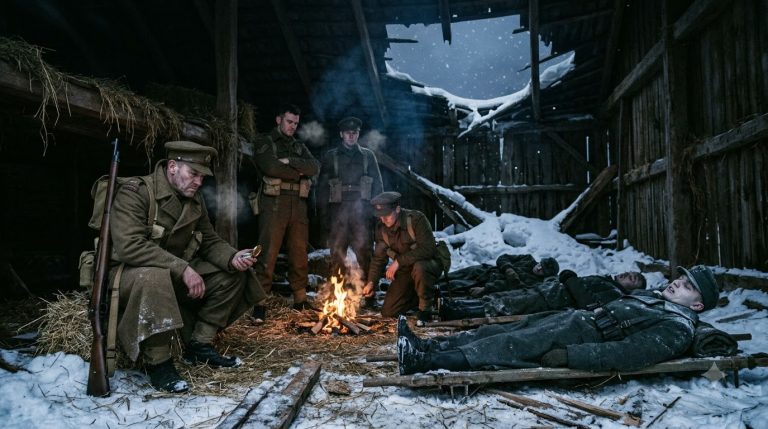
Sixteen men packed the dark cellar, their faces smudged with charcoal and dried blood.
A staff courier from army group headquarters pushed through the gloom, holding a damp paper directive close to a shielded lantern.
“The order stands,” the courier announced, his voice tight with manufactured conviction. “Hold the line at the Somme. Refit and regroup.”
Über stared at the courier, his jaw tightening until the muscles ached.
“Regroup with what?” Über asked, his voice dead flat. “The tanks are scrap metal in the ditches.”
“Tactical withdrawal,” the courier snapped back, tapping the paper against his knee. “The high command says the position is recoverable.”
Über reached into his pocket, his fingers brushing the cold, smooth metal of the dented cigarette case.
There was no recovery in a world where steel meant nothing against the open sky.
He looked up at the courier, refusing to nod, refusing to accept the delusion.
“Tell Berlin,” Über whispered, standing up to tower over the messenger, “that the road is dead.”
CHAPTER 6: The Eastern Bank
Über hauled himself up the steep embankment of the Seine, his muscles trembling with the sheer exhaustion of survival.
A personnel clerk stood beside a folding table in the mud, holding a ledger open against the wind.
“Name, rank, and unit,” the clerk barked mechanically, his pen poised above the paper.
“Über, Lieutenant,” he answered, his voice stripped of all inflection.
“Equipment status?” the clerk pressed, not even looking up. “How many tanks remaining?”
Über stared past the clerk at the thousands of disheveled men milling across the desolate flats behind them.
“Zero tanks,” Über said quietly. “Sixteen men.”
The clerk made a sharp scratch in the ledger with his nib and pointed a grease-stained finger toward the eastern camps.
“Fall in with the infantry reserves,” the clerk muttered, already looking toward the next survivor.
Über turned his back on the river, slipping his hand into his pocket to touch the cold metal of his empty brass case one last time.
The armored doctrine of his youth was dead, buried beneath the smoking craters of Normandy.
He walked toward the dim glow of the campfires, his boots crunching on the gravel, stepping into a quiet, heavy dawn where steel no longer ruled the earth.