The Iron Basin: A Legacy of Water, Stone, and the Heavy Cost of Keeping Ground
CHAPTER 1: THE FINE
The paper felt thin between my calloused fingers, the kind of cheap, bleached bond that screamed of bureaucracy rather than justice. Three hundred and fifty dollars. A fine, it said, payable to the Maplerest Hollow Homeowners Association. Violation cited: Unpermitted structure causing obstruction of natural waterway flow.
I looked up from the porch at the creek. The water was low, humming its familiar, rhythmic tune against the granite face of the dam my great-grandfather had set by hand in 1909. The stone was cool, solid, and had held for over a century without asking a single soul for permission.
I didn’t lose my temper. Losing a temper is a luxury for men who don’t have to manage 44 acres of legacy. I was a civil hydrologist; I knew exactly what this was. This wasn’t about the creek. It was a friction test, a probe into the structural integrity of my resolve.
I walked into the house, my work boots leaving faint, dried-mud patterns on the hardwood. I went straight to the shelf where the binder lived. It was already growing thick, populated by legal citations, property surveys, and the original deed that made no mention of HOA covenants, because when this farm was established, the very idea of a subdivision in the flood plane was a fever dream no one had dared to imagine.
I opened to the next blank page.
The white Lexus had been seen near the service road twice that week. Sandra Puit. She was precise, a former paralegal who understood that the game wasn’t won in courtrooms, but in the slow, grinding fatigue of attrition. She wanted me to fold. She wanted me to pay the fine, sign the document, and admit that her neighborhood’s mismanagement of their own drainage was my responsibility to fix.
I picked up my pen. I didn’t write an apology. I wrote down the code, the date, and the time, adding to the data set. Every letter she sent was a vector, and every vector had a corresponding reaction.
My phone buzzed against the table. A text from Gerald Watley, my attorney. He didn’t text often, which meant he had finally pulled the title records for Maplerest Hollow’s foundation.
I read the text, my eyes narrowing. There was a clause buried in their 1994 plat—a vague, potentially overreaching claim to watershed infrastructure. It was thin, arguably unenforceable, but it was enough for them to start the engine.
I set the phone down and walked back onto the porch. The sun was dipping below the ridge, turning the water a bruised, rusted orange. A piece of dry sediment flaked off the dam’s mortar, falling into the stream with a soft, barely audible splash.
They thought they were dealing with a farmer who would get tired of the paperwork. They had no idea they were dealing with the water itself.
The binder felt heavy in my hand, a solid, immutable thing. Tomorrow, I would draft the response. For now, I watched the creek, measuring the flow with my eyes, knowing that when the pressure finally reached the breaking point, the water wouldn’t choose sides. It would simply follow the path of least resistance.
But I was going to make sure that path didn’t lead through my home. I noticed a footprint near the south fence line, fresh in the dry earth—the shape of a sole that didn’t belong to me, and definitely didn’t belong on this side of the property line.
I wasn’t alone. And for the first time, I realized this fight wasn’t just about the dam; it was about who held the keys to the valley’s secrets.
CHAPTER 2: THE WATERSHED OF INDIFFERENCE
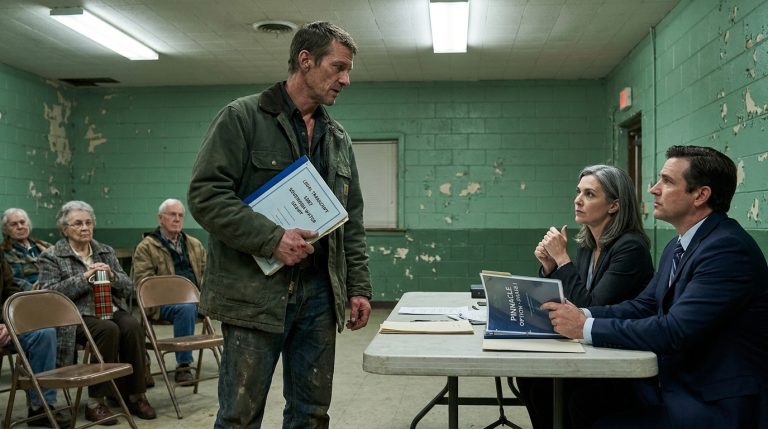
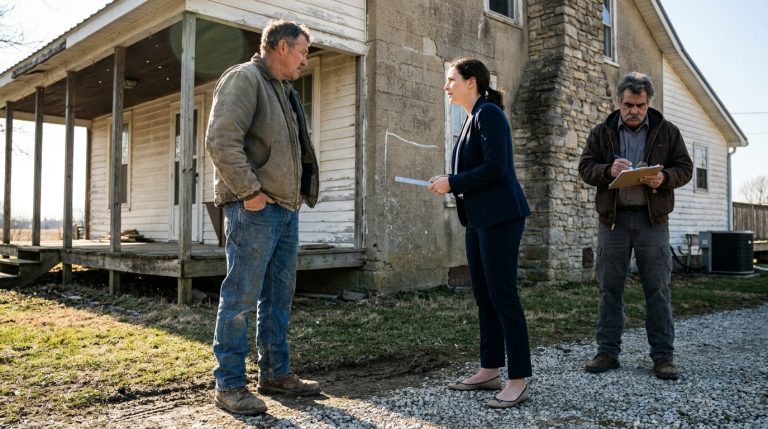
The Maplerest Hollow community room was a sterile, climate-controlled box that smelled faintly of industrial carpet cleaner and the lingering scent of stale coffee. It was a space built for order, for agendas, for the tidy maintenance of suburban life. It was not built for a hydrologist with a binder full of geological reality.
I sat in the back row, my laptop bag resting against the chair leg like a lead weight. I had spent the last two days drafting a meticulous response to the fine notice—citing Tennessee code, mapping the drainage history, and establishing the pre-existing legal status of the dam. It was a document of pure, cold logic. Sitting here, under the harsh, humming fluorescent lights, I felt the absurdity of it. Documentation relies on a listener; this room was designed to filter out anything that didn’t fit the approved narrative.
At the front of the room, behind a polished mahogany-veneer podium, stood Sandra Puit. She looked exactly as she had in the photos—composed, precise, dressed in a muted gray blazer that seemed designed to blend into the background of a boardroom. She spoke with a rehearsed fluidity, her voice amplified by the room’s lackluster sound system.
“We have a primary obligation to the safety and the ongoing drainage concerns of Maplerest Hollow,” she said, her gaze sweeping over the audience. She didn’t look at me, even though she knew I was here. She treated my presence as an administrative error, something to be managed rather than acknowledged.
A flash of memory hit me—the Tuesday in April 2019, the day my father died. He had been sitting at the kitchen table, his hands calloused from years of maintaining that exact creek bank, telling me about the planning meeting for this very subdivision. They don’t see the water, Daniel, he’d said, his voice raspy. They only see the maps they drew. And the water doesn’t care about their maps.
The memory made my jaw ache. I gripped the edge of my laptop bag, feeling the rough nylon texture. The room’s temperature felt suddenly too high, the air recycled and thin.
Derek Foss, sitting three rows ahead, stood up. He didn’t wait for the floor. “We’ve been hearing about this upstream obstruction for months, Sandra,” he said, his voice tight with a manufactured urgency. “When are we going to see some real action? My basement floor was damp after that storm last week. That’s not acceptable.”
A murmur rippled through the room—a wave of collective anxiety and misplaced blame. It was a perfect echo of a feedback loop I had seen a dozen times in the field, but here, it had a sharper edge. It was fueled by the fear of devaluation, the primal suburban terror of losing one’s home equity to something they couldn’t control.
“We are moving forward with the formal nuisance complaint, Derek,” Sandra said, her tone soothing, paternalistic. “We have retained counsel who is currently building the file. We are simply following the legal process to protect our community property.”
I didn’t wait for her to invite me. I stood up, the chair scraping sharply against the tile floor. The sound silenced the room faster than anything Sandra had said.
“The dam is on private property,” I said. My voice was steady, conditioned by years of presenting to federal regulators. “It predates this entire subdivision by eighty-five years. It is not an obstruction; it is an engineered component of a century-old flood control system. You don’t have jurisdiction, and the structural integrity is fully documented.”
I pulled the assessment report from my bag—not the copy, the original, with the engineer’s seal embossed on the front. I walked toward the front of the room. The aisle felt long, a stretch of carpeted earth I had to cross. The silence was thick, heavy with the weight of people who had already made up their minds.
“We aren’t interested in the opinion of a private landowner, Mr. Olden,” Sandra said. She hadn’t even looked at the report I was holding. She was staring past me, at the door, as if waiting for a signal that would allow her to move on to the next item on the agenda.
“This isn’t an opinion,” I replied, my voice dropping to that low, flat register I used when things went sideways in the field. “This is an engineering analysis of the watershed. If you attempt to alter the flow of Sycamore Creek without understanding the downstream attenuation capacity, you are not protecting your property. You are signing a flood waiver.”
Derek Foss turned around, his face reddening. “We didn’t move here to have some farmer’s junk backing up our water,” he snapped.
There was a roar of agreement, a messy, disorganized sound of people who wanted a villain to justify their stress. Sandra held up a hand, a gesture of hollow restraint. She knew exactly what she was doing. She wasn’t winning an argument; she was validating their bias.
I looked at them—really looked at them. They were people who believed the world was an organized, predictable place where you could pay a monthly fee to keep the chaos away. They were terrified, and Sandra was selling them the illusion of control.
“You’re making a mistake,” I said, my voice barely audible over the growing hubbub. I didn’t yell. I didn’t plead. I simply stated the fact as if I were recording a gauge reading.
Sandra’s face remained a mask of practiced neutrality. “Thank you for your comments, Mr. Olden. We have noted them for the minutes. Please return to your seat.”
I turned, the weight of the binder in my bag feeling like an anchor. I walked back toward the door, not the chairs. The air outside was cool and smelled of damp earth and coming rain. The hum of the meeting continued behind me—a muffled, rhythmic drone of people talking about things they didn’t understand.
I reached my truck, the metal cold under my hand. I didn’t head straight home. I drove the winding county road, the darkness of the valley pressing in on the cab. I had the file. I had the data. But sitting in that room, watching them trade logic for a sense of belonging, I realized the file wasn’t enough. Not yet. I needed to know exactly what they were doing in the south pasture.
I pulled over at the ridge overlook, looking down at the creek. The moonlight glinted on the water, a silver ribbon carving through the darkness. The dam was there, holding, waiting. I knew the water. I knew its nature. And as I watched the dark current, I knew that the next move wasn’t mine to make. It was theirs.
They were going to push. And I was going to be the wall that wouldn’t budge. I started the engine, the vibration humming through the frame, a low, mechanical growl of anticipation.
CHAPTER 3: THE SOUTH PASTURE TRESPASS
I sat in the idling truck for a long moment, the headlights cutting a pale, rectangular tunnel into the darkness of the pasture. The silence of the farm felt different tonight. It wasn’t the peaceful, heavy quiet of a valley at rest; it was the tense, coiled silence of a space that had been violated.
I didn’t turn off the ignition. I reached into the glove box, pulled out the heavy-duty flashlight—a custom-built unit with a focused, high-lumen beam—and stepped out. The grass was already heavy with the dew of a cooling night, brushing against my boots with a soft, persistent friction.
I moved toward the fence line. My steps were deliberate, measured. I wasn’t just walking; I was scanning. I had spent twelve years as a consultant for the Army Corps of Engineers, assessing infrastructure, checking for signs of stress, fatigue, and illegal access. I knew what to look for when someone had been where they didn’t belong.
The south pasture was a flat stretch of land that bordered the creek’s narrowest point, the exact area where the terrain naturally funneled toward the granite ridge. As I swept the beam along the fence line, the light caught a glint—not the natural shimmer of wet leaves or the dull matte of rusted wire, but something sharper, more precise.
I knelt in the dirt.
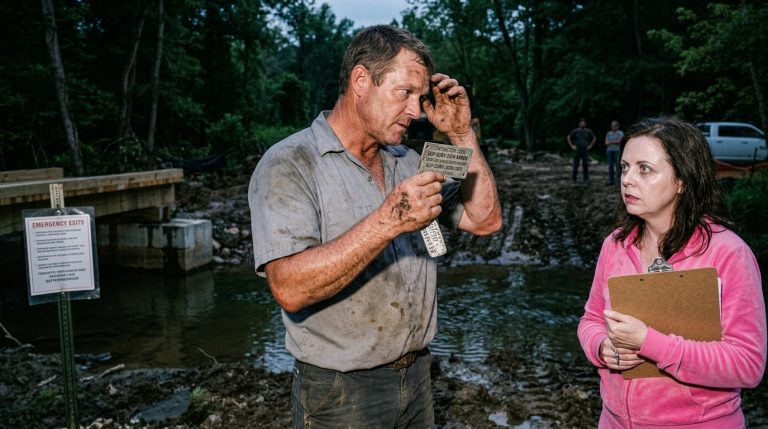
It was a stake, driven deep into the ground, a surveyor’s flag with a bright, synthetic neon-orange tip that looked like an open wound against the dark, organic soil. I pulled it free, the earth clinging to the metal with stubborn resistance. It wasn’t a standard property marker. It was a drainage depth indicator, the kind used to calculate outflow volume for industrial-scale development.
My heart didn’t race; it slowed. This was the mechanism. They weren’t just trying to intimidate me with fines. They were mapping the farm for a project they hadn’t yet disclosed—a realignment of the creek’s drainage path that would require the dam to be removed, permanently. They were building their own technical reality, one that relied on the assumption that I would never look closely enough at the dirt beneath my boots.
I looked up toward the dam. From this angle, it was a silhouette against the stars, a solid, immutable line of defense. And there, fifty feet away, I saw the tire tracks.
They were deep, the tread patterns cut into the clay with a heavy, aggressive force. I followed them, the beam of my light dancing over the disturbed ground. They led away from the creek bank, toward the old service gate I had locked months ago. The chain was still intact, but the post it was wrapped around had been shifted, the earth excavated and then crudely repacked.
I knelt again, the damp earth staining the knees of my jeans. Someone had used an industrial-grade hydraulic drill to probe the soil density right at the pivot point of the ridge.
I stood up, the stake still in my hand. The anger was there, but it was cold, refined, and directed. This was no longer a neighborly dispute over property aesthetics. This was a calculated, unauthorized engineering assessment of my foundation. They were testing the soil for the load-bearing capacity of a project they intended to build on my legacy.
I heard the sound then—a distant, mechanical hum. I turned off my flashlight and stood perfectly still in the darkness.
It was a vehicle. A low, rhythmic engine drone climbing the grade from the county road. I moved behind the thick trunk of an old-growth oak, my boots silent on the grass. The truck rolled to a stop at the gate—a white Lexus SUV, its headlights dimmed but still casting a diffuse, pale light across the grass.
I watched as the driver’s side door opened. Sandra Puit stepped out, followed by a man I didn’t recognize—he carried a heavy case, the kind designed for high-precision laser equipment. They didn’t see me. They were focused on the gate, on the very post they had compromised.
“The survey is clear, Sandra,” the man said, his voice carrying over the windless pasture. “The soil saturation at this level won’t hold if we divert the surge here. It’ll wash out the entire lower section of the subdivision before the storm even peaks.”
“We don’t need it to hold,” Sandra replied, her voice cold, professional, utterly devoid of the warmth she’d shown in the community room. “We just need to ensure the county sees the liability on his side, not ours. Get the readings. We need the data by morning.”
I stood in the darkness, my pulse slow, my mind clicking through the data points as if I were back in the Corps of Engineers briefing room. They were framing a narrative. They were creating a false trail of evidence to convince the county that my land was the source of their drainage problems, even while they knew perfectly well their own infrastructure was the culprit.
I had the proof. I had the witness. I had the stolen data.
I reached into my pocket and pulled out my phone, the screen dark, my finger poised. I didn’t reach for the sheriff. I didn’t yell. I stayed in the shadow of the tree, recording every second of the interaction, the audio capturing every word, the video framing their faces against the backdrop of my compromised fence line.
I wasn’t going to fight them with lawsuits this time. I was going to fight them with the one thing they couldn’t control: the absolute, documentable truth.
I waited until they had finished their readings and retreated back toward the SUV, the sound of the gravel crunching under their tires the only interruption in the silence. I didn’t move until they were gone, the red glow of their taillights disappearing over the ridge.
I walked back to my own truck, the neon orange stake still in my grip. My hands were steady. I set the stake on the passenger seat, a new, critical addition to the file. This wasn’t just a fine anymore; it was evidence of a crime. And in thirty days, when the court hearing arrived, I wouldn’t be walking in with just a binder of legal citations. I would be walking in with the blueprint of their own downfall.
The wind shifted, carrying the smell of ozone and wet stone. A storm was coming. I knew it, and for the first time, I felt a strange, grim comfort in the knowledge. The water was on its way, and it was going to find exactly where they had tried to redirect it.
I started the engine, turned around, and drove slowly back to the house. I had work to do. The file wasn’t just a record anymore; it was a trap. And they had just walked right into the middle of it.
CHAPTER 4: THE COUNTERCLAIM
Gerald’s office was a room built for slow, deliberate thought. Shelves of leather-bound case law lined the walls, and the air held the permanent, dry scent of old paper and dust. I walked in, the stake still in my hand, and placed it on his mahogany desk. He didn’t ask questions. He didn’t blink. He just adjusted his glasses, leaned forward, and looked at the neon-orange plastic with the same focused intensity he might apply to a landmark Supreme Court ruling.
“I found it on the south boundary, Gerald,” I said, my voice cutting through the quiet. “They’re drilling, mapping the saturation levels, and redirecting the runoff into the subdivision’s overflow. They’re manufacturing the evidence for their complaint, right under our feet.”
Gerald didn’t answer immediately. He picked up the stake, turning it over in his hands, feeling the weight and the jagged edge where it had been driven into the clay. He set it down with a soft, final thud.
“They’re reckless,” he said, his voice as thin and dry as the parchment in the office. “If they’re mapping for a drainage diversion, they aren’t just trying to win a nuisance claim. They’re trying to build a justification for permanent, structural alteration of the creek bed. They’re looking for a state-level permit to re-engineer the entire valley, and they’re using your farm as the sacrificial site.”
He reached for a thick, manila-colored file—my file. He opened it, adding a fresh sheet of paper to the back. “This changes the character of our response. Trespass is a misdemeanor, Daniel. But tampering with watershed infrastructure, especially when it involves misrepresentation to the county planners? That’s something else entirely.”
I sat across from him, my hands flat on my knees. The tension in my chest, which had been tight since the community meeting, began to resolve into something harder, more tactical. I wasn’t just defending a dam anymore. I was dismantling a machine.
“I have the audio,” I said. “I have the footage of them at the gate.”
Gerald looked at me, a flicker of something close to a smile touching the corner of his mouth. “Then we don’t just file a counter-claim. We file for an injunction. We halt their nuisance suit on the basis of bad-faith evidentiary tampering.”
We spent the next four hours working. There was no filler, no wasted motion. We processed the evidence, labeled the timestamps, and built the legal argument with the precision of a structural engineer. Every piece of documentation—the photos, the audio transcripts, the physical stakes—was woven into a narrative of systemic bad faith.
When we were done, the stack of paper in front of me felt like a physical weight, a solid, immutable blockade. I looked at the clock. It was past midnight.
“They’ll fight this,” Gerald said, closing the file. “They have the resources of a homeowners association and a lawyer who makes his living on the billable hours of these disputes. They will try to bury this in procedural delays.”
“Let them,” I said. “The water doesn’t care about their delays. And neither do I.”
I left the office and stepped out into the night air. The rain had started—a light, consistent mist that turned the pavement into a slick, reflective surface. I walked to my truck, my boots crunching on the wet asphalt. I wasn’t tired. The adrenaline was long gone, replaced by a deep, cold, and profoundly steady resolve.
I drove back toward the farm, the windshield wipers keeping a steady, rhythmic time. I thought about the dam, standing in the dark, silent and solid. I thought about the ridge granite my great-grandfather had cut by hand, and the layers of soil I had watched Sandra Puit’s contractor drill into earlier that night.
They were playing a game of surface-level optics. They thought they could win by controlling the story, by manipulating the images, by forcing the perception of the neighborhood. But they hadn’t bothered to look at the geology. They hadn’t bothered to understand the weight of the land, the depth of the aquifer that fed the creek, or the way the entire system reacted to being disturbed.
As I crested the final hill before the valley, I saw the lights of the farmhouses in Maplerest Hollow in the distance—small, isolated grids of yellow light set against the dark, vast expanse of the hills. They looked fragile. From this height, I could see the flood plane they were built on, the natural basin of the creek, and the narrow, jagged neck of the canyon where the dam stood.
They were building their lives on a foundation they couldn’t see, and they were letting someone like Sandra Puit navigate the path for them.
I pulled into my driveway, the gravel crunching under my tires. The house was dark, the only light coming from the moon reflecting off the pond. I walked down to the bank, the mist clinging to my jacket. I could hear the spillway—the low, consistent rush of water, a sound as old as the ridge itself.
I didn’t need to check the levels. I knew. I had the file. I had the injunction. And I knew exactly how the next thirty days would unfold.
I took the survey stake out of my truck, walked to the spot where I had pulled it from the pasture, and drove it back into the ground. It stood there, a small, bright orange marker in the middle of the darkness. A beacon. Let them come back. Let them try to map the site again. They weren’t just drilling into the earth anymore. They were drilling into a trap I had set with every document, every email, and every step I had taken since the day I returned.
I wasn’t just a farmer. I wasn’t just a neighbor. I was the one who knew how the water moved, and I was the one who was going to show them exactly what happened when you tried to stand in its way.
CHAPTER 5: THE REMOVAL
The engine of the excavator pulsed through the mud, a deep, rhythmic vibration that felt less like machinery and more like a tectonic shift. The operator—a man named Elias, whose face was a map of professional detachment—didn’t offer a greeting. He climbed into the cab, the metal hydraulics hissing as the boom articulated against the heavy morning air.
I stood twenty feet back, my hands shoved deep into the pockets of my jacket, watching the damp grass press down under the weight of the steel tracks. The air smelled of wet earth and diesel, a sharp, industrial contrast to the clean scent of the creek. This wasn’t a funeral; it was a demolition.
“Start at the north spillway,” I instructed, my voice flat, professional. “Section by section. Don’t touch the foundation stones until the crown is clear.”
Elias nodded, his expression unreadable behind the reinforced glass. He didn’t ask why. He was here to move earth, and he followed the specifications provided by the settlement. He swung the bucket, the heavy steel teeth biting into the mortared granite with a screech of shearing stone.
The first section of the spillway, a block of granite my great-grandfather had set more than a century ago, gave way with a shudder. It didn’t crumble; it separated. The mortar, brittle and aged, surrendered its hold. The block dropped into the shallow basin of the mill pond, creating a dull, heavy splash that rippled outward.
I recorded it. My phone was steady in my hand, the camera capturing the exact sequence of the deconstruction. I needed the visual proof, a timestamped record of the removal process.
The excavator moved again, the arm extending, the bucket digging deeper into the heart of the dam. The water, no longer held back by the granite wall, began to surge forward in a low, brown boil. It surged over the gap, churning up decades of silt and sediment that had settled in the pond bed.
Then, the machine faltered.
There was a sudden, metallic clang—the sound of steel striking something far denser than stone. The excavator’s arm jolted, the engine stalling out in a violent, shaking shudder that rocked the entire chassis. Elias cursed, his voice muffled behind the cab glass as he tried to restart the ignition. The machine wheezed, the hydraulics losing pressure.
I stepped forward, my boots sinking into the wet mud near the basin. “What happened?”
Elias jumped down, his boots squelching in the sludge. He wiped his face with a greasy rag, his eyes narrowed as he looked at the base of the dam, right where the bucket had struck. “Something’s down there, Mr. Olden. Something solid. I think we’ve hit the structural core, but it isn’t stone. It’s too uniform.”
I moved closer, the mist clinging to my eyelashes. I crouched by the water’s edge. The bucket had exposed a portion of the dam’s sub-surface—a smooth, dark surface that wasn’t granite. It was a metal casing, heavily oxidized, with a faint, embossed seal that caught the gray light.
It wasn’t a dam. Not entirely.
My heart stalled. I knew that seal. It was the stamp of the regional water authority from the early 1900s, but it wasn’t for a mill pond. It was for a pressure-relief system, one that had been integrated into the dam’s foundation during the turn of the century, a clandestine reinforcement to stabilize the underlying ridge.
It was a structural cap for the aquifer—the very thing my father had spent his entire life protecting, even if he hadn’t fully understood why.
“Leave it,” I said, my voice sharper than I intended.
Elias looked at me, perplexed. “I can’t clear the channel with that thing stuck there, Mr. Olden. It’ll tear the bucket off if I try to force it.”
“I said leave it,” I repeated, standing up. “Stop the machine.”
I watched as the steam rose from the stalled engine, curling into the gray morning mist. The pond was draining rapidly now, the water rushing around the metal obstruction, carving a jagged, unpredictable path through the mud. The structural integrity of the entire creek bank was shifting. I could feel the vibration under my feet—a subtle, ominous tremor that told me the ridge was already responding to the change in weight.
I had been right about the danger, but I hadn’t been right about the source. Sandra Puit thought she was destroying a nuisance. She was actually pulling the plug on a pressurized system that had been holding the valley’s water table in check for a hundred years.
If this cap was moved, if the pressure was allowed to drop, the entire slope of the ridge wouldn’t just erode—it would shift. The foundation of Maplerest Hollow was built on the stability of this exact spot.
I looked at the excavator, the idle, broken machine, and then at the exposed dark surface of the metal core. The decoy secret I had been fighting—the drainage easement, the data theft—it was nothing. It was just a distraction to get me to pull this structure apart.
Sandra didn’t know what she had requested. She thought she was erasing an eyesore. She was, in reality, triggering a geological collapse.
“Pack it up,” I said to Elias, who was still staring at the metal core. “We’re done for today. The ground is too unstable. We’re going to need a different approach.”
He didn’t argue. He started the engine, the machine grinding with protest, and began the slow, heavy process of backing out of the pasture. I stayed on the bank, my feet planted in the mud, watching the water swirl around the newly exposed metal.
I pulled out my phone and dialed Gerald. I didn’t wait for him to greet me. “Gerald, stop the demolition. We have a problem. And it’s a lot bigger than a property boundary.”
The rain started then—a cold, driving sleet that turned the mud into a freezing, grey slurry. I stood there, shivering, watching the water rush over the core. The trap had been triggered, but it wasn’t just catching Sandra Puit anymore. It was catching everyone.
The silence returned to the valley, heavier now, filled with the sound of the creek as it rushed over the broken dam, heading down toward the subdivision, carrying the secret of the ridge with it. I had the truth, but the water was already moving. And I was the only one left standing on the bank, watching the tide go out.
CHAPTER 6: THE RISING SURGE
The weather was no longer a forecast; it was a physical presence. The low-pressure system, stalled over the plateau for the last twenty-four hours, had turned the valley into a churn of grey, freezing sleet. I stood by the bank, my hands raw from the cold, watching the water. It was moving with a velocity I had never witnessed on Sycamore Creek. The removal of the dam had done exactly what my model predicted, but the model hadn’t accounted for the aquifer collapse triggered by the broken core.
The creek was no longer just draining the watershed; it was pulling at the very foundation of the ridge. The bank at my feet vibrated, a low-frequency thrumming that traveled up through the rubber of my boots. I looked back toward the farm, toward the house, then down the slope toward the distant, hidden lights of Maplerest Hollow. They had no idea. They were asleep, or they were busy pulling wet carpet out of their basements, completely oblivious to the fact that the entire southern ridge was beginning to saturate beyond its load-bearing capacity.
My phone rang—the screen slick with sleet. It was Gerald.
“The county planning board is calling an emergency session, Daniel,” his voice was tight, barely audible over the wind. “Sandra is pushing for an expedited emergency permit to ‘fix’ the drainage. She’s claiming the removal of the dam created a safety hazard that only a full-scale diversion can solve. She’s moving to bypass the environmental assessment.”
“She can’t,” I shouted, my voice snatched away by the gale. “The ridge is moving, Gerald. If she tries to force a diversion now, the pressure on the aquifer will shatter the foundation. You need to stop that hearing. Tell them the core isn’t just a dam foundation—tell them it’s a geological stabilizer.”
“I can’t stop a hearing with a theory, Daniel! I need the report. The final, full hydrological impact study. The one you’ve been building.”
“It’s not finished,” I said, looking at the dark, exposed metal of the core, now half-submerged in the surging current. “But the data is. Get to the farm. I have the drive, but I need you to bring the physical copies of the original 1909 survey. We need to show the commissioners exactly what this ridge was built to hold.”
I ended the call and started toward the house, but the ground beneath me gave a sudden, sickening slide. I dropped to one knee, digging my fingers into the freezing mud. A fissure, narrow and dark, opened up ten feet away from the creek bank, running parallel to the ridge line. It wasn’t erosion; it was a slip-plane failure.
I looked back at the house, a solitary beacon in the storm. I knew that if I didn’t reach it, if I didn’t secure the documentation and the backup of the model, the entire story would die here in the mud, and the subdivision would have no warning when the ridge finally gave way. I pulled myself up, ignoring the burning in my lungs, the physical weight of the air, the sheer, crushing reality of the collapse.
I stumbled toward the barn, the wind howling around the eaves. My legs felt heavy, as if the soil itself was trying to claim me. I reached the barn door, the iron latch freezing cold, and shoved it open. Inside, the air was still, smelling of dry hay and dust, a fragile pocket of sanctuary. I bypassed the main desk and went to the heavy steel safe in the corner.
I punched the combination, my fingers numb. The heavy door swung open, revealing the binders—the full history of the Alden farm, the records of my father, the legacy of my great-grandfather. I grabbed the master file, the one that contained the real data, the one that connected the structural core to the aquifer.
A crash echoed from outside—not the wind, but the sound of the equipment I had left near the creek being swept away by the rising water. The creek had breached its bank. It was coming up the pasture, a slow, inevitable tide of brown, debris-filled water.
I strapped the case to my back, tightened the buckles, and stepped back out into the sleet. The darkness was absolute now, broken only by the erratic swing of the security light. The ridge was groaning—a sound like metal being twisted, a low, grinding friction that resonated in my teeth.
I ran, not toward the house, but toward the higher ground near the county road where I had left my truck. I needed to reach Gerald, I needed to reach the board, I needed to get the truth into a room with lights and lawyers and the power to stop what was coming.
The path was a slick, dangerous slide, the earth shifting beneath every step. I fell, slid, recovered, my breath coming in ragged, freezing gasps. My mind flickered—was I actually seeing the ground slide, or was this the exhaustion, the hallucination of a man who had stared at data for too long? No, the vibration in the ridge was real. The smell of the earth being torn open was real.
I reached the road, my breath hitching as I saw the lights of a car approaching through the rain. It wasn’t Gerald. It was a white Lexus, slowing, its headlights sweeping over the road, over me, illuminating the mud-caked, desperate figure standing in the middle of the lane.
The window rolled down. Sandra Puit stared at me, her face pale, her eyes wide with a mixture of confusion and a flicker of something else—fear. She had come to check the site. She had come to see if her project was still viable.
“You,” she said, her voice small, lost.
“You’ve triggered a slide, Sandra,” I yelled, the sound of the rain drowning out my own words. “Get out of the valley! You don’t know what you’ve done!”
She looked past me, toward the ridge, toward the sound of the water, and for a moment, the mask of the HOA president shattered completely. She saw it. She finally saw the scale of what she had played with. The ground beneath her Lexus shook, the road surface cracking like a dry, brittle shell.
I didn’t wait for her to understand. I turned, hit the gas in my truck, and drove toward the lights of the county, leaving the sound of the ridge behind me, leaving the subdivision to the water, leaving the truth to the storm. I had the file. I had the data. And the game was over.
CHAPTER 7: THE COURTROOM OF CONSEQUENCE
I drove through the dark, the windshield wipers struggling against the deluge. The Harland County Courthouse appeared as a monolithic silhouette, lit by the harsh, flickering amber of streetlamps. I didn’t care about the legal protocols, the bailiff, or the formal decorum. I burst through the heavy oak doors, the file clutched against my chest like a shield. My jeans were caked in mud, my jacket torn from the crawl through the ridge brush, and I was shivering, not from the cold, but from the adrenaline.
The courtroom was packed. The air inside was humid and stale, thick with the scent of damp wool and nervous energy. Sandra Puit sat at the defense table, her posture rigid, her hands clasped tightly. When she saw me, her eyes darted toward her attorney, Philip Graves, who was mid-sentence in a dismissal motion. The judge, Harlon Elbeckett, looked up over his spectacles, his expression shifting from annoyance to immediate, sharp attention.
“Mr. Olden,” Judge Beckett said, his voice cutting through the hum of the gallery. “This court is in session. You are remarkably late, and significantly disheveled.”
“The ridge is collapsing, Your Honor,” I said, my voice raspy, every word a tactical strike. I walked to the prosecution table and dropped the file—the master file, the one that held the 1909 survey, the core data, and the evidence of the site tampering—directly onto the wood. “It was never a dam removal project. It was a structural stabilization cap that kept the aquifer from shifting. Sandra Puit’s team drilled into the core, compromised the pressure seal, and the resulting shift is currently dismantling the entire south slope of the valley.”
The room erupted into a murmuring wave of confusion and panic. Sandra’s attorney stood up, his face reddening. “Your Honor, this is preposterous. This is a dramatic attempt to stall a legitimate property—”
“Quiet, Mr. Graves!” Beckett barked, slamming his gavel. He turned his attention back to me. “You claim the ridge itself is failing? That this is not merely a drainage issue?”
“I have the data,” I said, opening the file to the 31-page hydrological impact study I had built. “I have the records of the drilling, the trespass logs, and the structural engineering baseline that predates this entire subdivision. The subdivision isn’t just flooded, Your Honor. It is built on a geological fault line that the dam’s foundation was engineered to bridge. By removing the stone face and drilling into the metal core, they’ve triggered a slow-motion liquefaction event.”
I saw the moment of truth hit Sandra. She didn’t look at me. She looked at the floor, her face draining of color. She knew. She had seen the stake, the maps, the warnings—she had chosen to bury them. The gallery, filled with the residents of Maplerest Hollow, grew deathly silent. They weren’t just neighbors and complainants anymore; they were people realizing their homes were standing on the literal edge of a precipice.
“I need an immediate injunction against all further site activity,” I continued, my voice steadying. “And I need the county engineers to verify the structural integrity of the ridge line before the saturation level hits the critical threshold.”
Judge Beckett didn’t hesitate. He looked at the file, then at the gallery, and finally at Sandra Puit. “Mr. Watley, you have the floor. File the motion. I want the site cordoned off and a geological survey team on-site within the hour. Mr. Graves, if your client has obstructed this data, I will personally see that the HOA board is held liable for every cent of the restoration costs.”
The transition was violent and absolute. The courtroom stopped being a place of legal argument and became a staging ground for emergency management. I stood back as the deputies began to usher people out, the energy in the room shifting from litigation to survival. I felt the physical exhaustion catch up to me, a sudden, heavy wave that made my vision blur.
Gerald walked over, placing a steady hand on my shoulder. “You did it,” he whispered, his voice uncharacteristically soft. “The truth is on the record.”
I looked at the file on the table—the rows of data, the survey maps, the proof of a legacy that I had fought for four generations to keep. Sandra was being led toward the side exit, her head down, her legal defense collapsing into a frantic scramble of phone calls and apologies. The irony was suffocating. She had sought to make her neighborhood the most secure, predictable place in the county by erasing the “nuisance” of my family’s work. In the end, it was that work—that hidden, iron-bound foundation—that had been the only thing keeping her home from sinking into the earth.
I didn’t feel pride. I didn’t feel victory. I felt the specific, heavy exhaustion of a man who had done his job. I looked toward the window, the rain still lashing against the glass, reflecting the lights of the courthouse in the black, wet night. The storm was still out there, the water still rising, the ridge still groaning, but the legal mechanism was locked. The machine had been stopped.
“It’s not over,” I said, looking at Gerald. “The ridge is still moving. We have to go back. If we don’t guide the runoff, the foundation will still shift.”
“The team is being dispatched, Daniel,” Gerald said. “Your role in this part is done. You’ve given them the data. Now, they have to use it.”
I looked down at my hands—calloused, mud-stained, trembling with the after-effects of the struggle. I had fought this fight with binders, with certified mail, with engineering models, and with the cold, hard logic of the land. The courthouse was empty, the lawyers and the litigants gone, leaving only the record. I walked out of the courtroom, the silence of the hall feeling like a reprieve. I had held the line. And for the first time in three years, I knew exactly what would be left when the water finally receded.
CHAPTER 8: RESTORATION
The drive back to the farm was a slow, deliberate march through the wreckage. The road was lined with mud, debris, and the abandoned equipment of a project that had been halted mid-stride. As I turned onto the gravel lane leading to the creek, the silence of the valley was broken only by the rhythmic, heavy thud of tires on wet earth. The valley looked different in the aftermath. The storm had left a scar, a raw, exposed gouge along the ridge where the ground had begun to fail.
I didn’t head for the house. I drove the truck straight to the creek bank, parking it where I could see the work that lay ahead. The metal core—the clandestine cap that had held the aquifer in check for a century—was exposed, glinting dully in the fading, bruised light of the evening. It wasn’t just a piece of engineering; it was the anchor of the valley.
Earl Briggs was already there. He had been waiting for the site to be cleared, his heavy-duty equipment idling near the pasture edge. He didn’t offer a greeting, but when he saw me pull the original foundation stones—the ones I had recovered from the creek bed—out of the back of my truck, he simply stepped forward to help. We worked in silence, the rhythm of the manual labor acting as the final, necessary purge of the last few months of legal warfare.
We spent the next week rebuilding, not as a demolition, but as a homecoming. We reinforced the core with the same hydraulic lime mortar my great-grandfather had used, but we backed it with a concrete foundation that would anchor the ridge against the pressure I now understood. Every stone was placed with intentional weight. I watched as the face of the dam rose, layer by layer, matching the grain and the color of the granite ridge, until the seam between history and necessity disappeared.
The pay-off was quiet. It wasn’t a ticker-tape parade; it was the sound of the water. As the pond began to fill again, the spillway started its low, constant melody, the same sound that had haunted my childhood and grounded my adulthood. I watched the water rise, the surface smoothing out until it mirrored the trees, the ridge, and the sky. The tension that had defined every waking hour of my life for the past two years began to bleed away into the depths of the pool.
Poetic justice arrived in a letter from Margaret Halt, the new HOA board president. The neighborhood had reached a settlement with the county, and the costs were being levied against the assets of the former board, including the proceeds from the sale of Sandra Puit’s house. She would never return to the valley, and the subdivision would spend the next decade paying for the mistake of their own ignorance. The court had upheld the original title, the prescriptive easements, and the integrity of the farm’s status, securing my family’s land against any future attempts at bureaucratic overreach.
The cool down was a slow, methodical return to the routines of the land. I spent the mornings walking the fence line, checking the creek levels, and documenting the stability of the ridge. The fissures had sealed, the aquifer pressure had equalized, and the land was finding its balance again. I felt the physical exhaustion fade, replaced by a quiet, durable strength.
I took the small, neon-orange survey stake from the barn—the last of the artifacts of the trespass—and walked to the center of the restored pasture. I drove it into the ground, not as a marker, but as a souvenir. I would leave it there, a testament to the fact that I had been right, and that I had held the line.
Finally, I went into the barn and stood in front of the photograph of my grandfather, Edmund Alden. He was laughing, the same way he had in 1962, his face alive with a joy that had nothing to do with property, legal files, or the weight of a dam. I understood his laugh now. It wasn’t just about a sibling slipping on a rock. It was the laugh of a man who knew his place in the world, who knew the land would endure long after the arguments had ceased, and who knew that the only thing worth fighting for was the ability to stand, knee-deep in the water, and be fully present in the life you were living.
I reached out and touched the frame, a gesture of closure. The valley was silent, save for the water, the heron, and the wind through the pines. The file was closed, shelved in the library of my home, a record of the fight. But the dam was full, the creek was clear, and for the first time since my father’s death, I felt that I wasn’t just maintaining a property—I was living on a home.