The Gentle Architecture of Grace: A Former Judge’s Fight for Dignity in an Oak-Lined Haven
CHAPTER 1: THE ASHES OF THE GARDEN
The strawberry harvest was meant to be the first success of Eleanor’s Grove. It was the fruit of two years of labor, of long nights spent reading irrigation manuals, and of quiet mornings when I could almost hear my late wife’s voice in the rustle of the leaves. Now, the crates sat overturned in the driveway, the berries bruising under the harsh sun, a chaotic splash of red against the manicured, sterile gray of the gravel.
My crew stood against the whitewashed fence, a row of men who were as much a part of this farm as the soil itself. Hector, my foreman, looked toward me, his shoulders rigid. There was no fear in his eyes, only a weary, familiar disappointment. He had seen this kind of intrusion before, the way a person’s life could be upended by a single phone call from someone who decided they didn’t like the color of his skin or the accent of his prayers.
“Mr. Thorne?”
The voice was thin, syrupy, and perfectly groomed. I turned. Karen stood at the edge of the driveway, the heels of her shoes sinking slightly into the soft earth of the flowerbed she had once warned me about in a formal notice. She wore a beige pants suit that looked like it had been pressed with the intent to crush. Behind her, two black SUVs idled, their engines a low, rhythmic growl that drowned out the chirping of the orchard birds.
“You really should have listened to the binder, Marcus,” she said, flicking her wrist in a gesture that was meant to be dismissive but landed with the weight of a decree. “We have property values to maintain. Oak Haven isn’t a refuge for… whatever it is you’re trying to build here.”
I felt the silence in my chest, the familiar stillness I had carried for thirty years on the bench. I looked at the strawberries, then back at her. She wasn’t just a neighbor; she was a symptom. She was the manifestation of a world that measured success in clean lines and exclusionary walls.
“These men are my family, Karen,” I said. My voice was low, devoid of the heat she clearly expected. It was the tone of a judge who had already weighed the evidence and found the defendant wanting. “And you have just committed a profound error in judgment.”
She laughed—a short, brittle sound like breaking glass. She didn’t see the man who had spent his life interpreting the cold, hard reality of the law. She saw a tired old man in a dusty work shirt, a hobbyist playing at being a farmer. She didn’t see the hornets’ nest she was currently nudging with a stick.
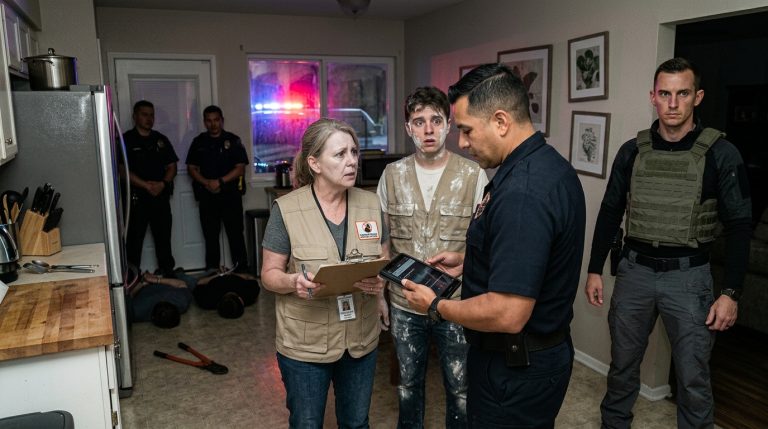
Before I could answer, Agent Diaz stepped out of the lead SUV, his uniform crisp and his expression unreadable. He looked at the harvest, then at the men, and finally at me. He looked as tired as I felt.
“Sir,” Diaz began, his hand resting near his holster, “we have a report of undocumented workers.”
I reached into the cab of my truck and pulled out the thick, waterproof folio. It was heavy, a physical manifestation of my meticulous nature. I didn’t rush. I didn’t plead. I simply held it out.
“Every document is here, Agent,” I said, my gaze never leaving Diaz. “But there’s something else you should know. The person who called that report in? She isn’t concerned with the law. She’s concerned with her property values. And she just lied to a federal officer.”
As Diaz took the folio, I caught a flicker of movement behind Karen. She was checking her watch, her smugness starting to crack at the edges as she realized the scene wasn’t ending with handcuffs and drama, but with paperwork. Then, I heard it—the faint, rhythmic clicking of a gate latch. I turned, expecting to see Arthur, but it was someone else entirely, standing in the shadows of the old barn, holding something that didn’t belong.
CHAPTER 2: THE PAPERWORK PARADOX
The silence that followed my statement wasn’t empty; it was pressurized, like the air in a courtroom moments before a judge delivers a life-altering sentence. Agent Diaz stood frozen, the thick folio in his hands, his eyes flicking from the meticulously organized documentation to Karen’s face. She had expected to see me stutter, to see my men dragged away in cuffs while she stood by as the savior of the neighborhood’s property values. Instead, she was looking at a man who had spent three decades mastering the art of the iron-clad defense.
Her gaze darted toward the driveway where her black SUVs sat, the engines still idling. She took a half-step forward, her floral-print scarf fluttering in the stagnant heat. “You’re trying to confuse them,” she hissed, her voice barely carrying past the hood of the truck. “It’s a bluff. I have the HOA board’s mandate. I have the power to protect this community from blight.”
“Power, Karen, is a delicate thing to handle,” I replied, my voice steady, the calmest thing in the yard. “You’ve weaponized a federal agency based on a lie. That is a threshold you cannot cross without consequence.”
I shifted my weight, feeling the dry dust of the driveway crunch beneath my boots. The sensory reality of the moment was thick—the sharp, chemical scent of the strawberry jam that had bled into the gravel, the metallic tang of the idling SUVs, and the sight of Hector, my foreman, standing perfectly still, his eyes locked on mine with a silent, iron trust. He knew, as I did, that the law was not just a book of rules; it was a shield, provided you knew how to hold it.
Diaz looked at me, then back at Karen. “Ma’am,” he said, his voice dropping into that professional, dangerous register that signaled the end of patience. “I have reviewed these files. They are complete. Your report regarding undocumented laborers is, at best, a misunderstanding, and at worst, a criminal act of filing a false statement. I suggest you step back while we conclude our business.”
Karen’s mouth opened, then clicked shut. She looked like a beached fish, her face flushing a mottled, angry red that clashed with the beige of her suit. She spun on her heel, her movements jerky and uncoordinated, and marched toward her own car. She was still trying to maintain the aura of the empress, but it was frayed, the edges of her authority visibly unraveling in the afternoon sun.
As the ICE agents began to pack their equipment, their movements brisk and efficient, I turned away from the spectacle. My primary task was not to watch Karen crumble; it was to ensure my crew felt the ground beneath them again.
“Hector,” I said softly, walking over to the fence. The wooden rails were warm to the touch, familiar and solid. “Take the crew to the packing shed. I’ve got this handled.”
“She is a mean woman, Judge,” Hector said, his voice low, lacking his usual rhythmic cheer. “She will not stop.”
“She won’t,” I agreed. “But she’s playing a game she doesn’t understand. She thinks this is a fight about tomatoes and compost. She doesn’t realize she’s handed me the very evidence I need to dismantle her entire house of cards.”
As I turned to go toward the farmhouse, I saw a figure approaching from the access road. It was Arthur Vance, his posture hunched, his hands clutching a bundle of letters as if they were a lifeline. He stopped at the edge of my property, his eyes wide with a mixture of terror and hope. He had seen the ICE vehicles, seen the conflict, and he looked like a man standing on the edge of a precipice.
I walked toward him, leaving the noise of the federal vehicles behind. The transition from the high-stakes confrontation with Karen to the fragile, human desperation of Arthur was a jarring reminder of what was truly at stake. It wasn’t just my farm; it was the quiet, steady lives of everyone living in the shadow of Karen’s ego.
“Judge Thorne?” Arthur started, his breath hitching. “I… I saw them leave. I saw what you did.”
“It’s alright, Arthur,” I said, keeping my posture relaxed, unthreatening. I felt the weight of the folio still tucked under my arm—the physical proof that the law was a tool, but it required a steady hand. “Come inside. Let’s get out of this heat.”
We walked toward the house, the old farmhouse that smelled of floor wax and history. This was the front line now—not a courtroom, not a battlefield, but a kitchen table where the truth could be unraveled, thread by agonizing thread. As I opened the door, I felt a familiar, cold determination settle in. Karen had wanted a war. She had brought the law to my doorstep. She was about to find out that a judge, even a retired one, never truly stops being a judge.
CHAPTER 3: THE BINDING OF THE VOW
The kitchen of Eleanor’s Grove was a sanctuary designed for contemplation, not for the frantic energy of an unfolding crisis. Yet, as Arthur sat across from me, the light from the afternoon sun casting long, weary shadows across his face, the room felt smaller, crowded by the sheer volume of his grief. He had laid the documents out in a fan shape, a deck of cards dealt by a dealer who had been cheating from the start.
“She didn’t just want the ramp gone, Judge,” Arthur whispered, his fingers trembling slightly as he touched a notice marked with the embossed seal of the Oak Haven Estates. “She wanted the cost to be a warning. To me. To everyone.”
I looked down at the paper. It was a formal fine, typed in a font that screamed rigid, artificial authority. The reasoning was absurd—a violation of the ‘aesthetic consistency standards’ due to the composite material of the ramp. But it was the subtext that mattered. I had spent my life analyzing the distance between what was written and what was intended. This wasn’t just a fine; it was a psychological tax on his agency.
I reached out, my hand steady, and pulled the document closer. The paper felt thin, cheap, and abrasive against my fingertips. “Arthur, tell me about the contractor,” I said, my voice soft, inviting him to bridge the gap between his fear and the truth. “The one she insisted you use for the replacement.”
He looked up, a flicker of confusion crossing his brow. “She gave me a list. Said it was the only approved vendor for ‘structural modifications to community-facing property.’ A company called Evergreen Solutions. They charged three times the estimate I’d gotten from the local carpenter.”
I paused. The name hit a resonant chord. In the quiet of my office, I had already begun sketching out the connections, the thin, ghostly lines of a larger architecture of greed. Karen was not just a meddlesome neighbor; she was a gatekeeper, and gatekeepers always profit from the gates they build.
“Do you have the invoices?” I asked.
He fumbled through his bundle, producing a second sheet. It was clean, printed on high-quality stock—a stark contrast to the fine notice. I scanned it. There was no physical address for Evergreen Solutions, only a PO Box and a name that looked suspiciously generic. My mind began to map the implications. If Karen were directing homeowners to a specific contractor, one that seemingly existed only on paper, then the fines were not just penalties; they were a funnel, a siphon designed to move capital from the residents’ savings into a private account.
“Arthur, I need you to understand something,” I said, leaning forward. The warmth of the coffee mug in my hand served as a grounding anchor. “This isn’t about dandelions or wheelchair ramps. This is a deliberate, systematic exploitation of this neighborhood’s trust. She isn’t enforcing the bylaws. She is weaponizing them to fund a private interest.”
Arthur’s eyes widened, the realization washing over him. The anger that had been simmering beneath his exhaustion began to sharpen, turning into something more potent, more dangerous. “What do I do, Judge?”
“You don’t do anything,” I said, a faint, cold smile touching my lips—not one of triumph, but of resolve. “You keep these documents safe. You find the others, the ones who have been forced to pay these ‘approved’ contractors, and you ask them to keep their records, too. We don’t fight her in her arena, Arthur. We don’t play by the rules she wrote.”
I stood up and moved to the bookshelf, my fingers tracing the spines of leather-bound volumes—the accumulated wisdom of centuries of legal precedent. I pulled down a folder, a place where I had begun documenting the inconsistencies in the HOA’s behavior. The room felt heavy with the scent of damp earth drifting in from the open window, a reminder of the garden I had vowed to protect.
“She thinks she’s the queen of a castle,” I continued, turning back to him. “But she’s forgotten the most basic rule of real estate: she doesn’t own the ground underneath her. She’s built her authority on the silence of the people she’s bullied. If we break that silence, the castle doesn’t just lose its power—it loses its foundation.”
Arthur rose slowly, his movements tentative but purposeful. He looked at the documents on the table with new eyes. They weren’t just letters of defeat anymore; they were pieces of a puzzle.
“I’ll talk to the others,” he said, his voice stronger, shedding the thin veneer of his intimidation. “There’s a couple, the Millers… they had trouble, too. I think they still have the notices.”
“Good,” I said, accompanying him to the door. “But be careful. Keep it quiet. Don’t let her know we’re looking behind the curtain yet. When we reveal the truth, we do it all at once, with enough weight to make it impossible for her to spin it away.”
As Arthur stepped out into the twilight, the air cooling the warmth of the farmhouse, I watched him walk toward the access road. He was a small figure in the growing dark, but he carried a new weight—the gravity of evidence. I closed the door and returned to my desk, sitting in the silence that Eleanor and I had cherished for so long. The battle was no longer an isolated skirmish; it was a campaign. And as I looked at the notes on my desk, I knew the next piece of the puzzle lay in the financial records I had yet to see, the ones Karen would guard with everything she had left.
CHAPTER 4: THE THREADS OF DISCOVERY
The farmhouse had fallen into a heavy, twilight silence after Arthur left. I remained at the dining room table, the documents he had brought fanned out before me like a map of a territory I had thought I knew, but was now seeing with new, unsettling clarity. My desk lamp cast a pool of amber light over the invoices from Evergreen Solutions, the paper crisp and mocking in its professional veneer.
I reached for my fountain pen, the smooth, cool weight of it in my hand a familiar comfort from the years I had spent behind the bench. It was a tool of precision, and that was exactly what this required. I wasn’t just looking for irregularities; I was looking for the pulse of the fraud. I began to cross-reference the dates on the invoices with the county property records I had accessed earlier.
The pattern began to emerge—a rhythmic, almost mathematical cadence. Every time a homeowner filed a grievance about maintenance, a new ’emergency’ assessment followed, and within days, an invoice from Evergreen Solutions would be processed by the HOA. It was elegant in its cruelty. She wasn’t just stealing; she was creating the very conditions that necessitated the theft.
My gaze shifted to a photograph of Eleanor on the mantle, the soft light catching the silver frame. I remembered the garden we had planned—the way she would insist on planting heritage seeds, even when the soil was stubborn and the season short. She used to say that if you wanted to change the character of the soil, you couldn’t just throw down fertilizer; you had to work the earth, inch by inch, until the structure itself shifted.
I looked back at the papers. Karen was trying to force a sterile, beige perfection onto a living community, but her method was a hollow shell. Arthur’s comment about his wife’s spirit being broken didn’t just register as a legal grievance; it hit a deeper, more personal chord. It wasn’t about the composite material of a ramp; it was about the way a person’s world was slowly, incrementally diminished by an authority that claimed to care about ‘standards.’
I reached for the phone. Ben Carter, my former clerk, answered on the second ring. His voice was sharp, analytical, the voice of a man who thrived on finding the loose thread in a tangled garment.
“Marcus,” he said, skipping the formalities. “I’ve been digging into the bank routing numbers you sent over. You weren’t kidding. These accounts don’t track to any registered landscaping business. The trail leads to a holding company, and the registered agent is a woman named Karen Miller. It’s her maiden name.”
“Is there a link to the HOA’s master account?” I asked, my voice barely a whisper in the quiet farmhouse.
“Direct,” Ben replied. “The HOA fees are being diverted into this holding account before being ‘distributed’ as landscaping expenses. It’s classic shell-company embezzlement. But there’s more. I found a series of transfers to a personal brokerage account. She’s not just paying for the work; she’s siphoning the surplus. This isn’t just petty neighborhood greed, Marcus. This is significant.”
“Keep digging,” I said. “Don’t tip your hand. I want a complete paper trail before we make a move. We’re going to need this to be airtight.”
After I hung up, I sat in the dim light for a long time. The evidence was coalescing, turning from vague suspicions into concrete facts. But the tactical problem remained: how to break the community’s reliance on her without letting her know we were already inside her defenses.
I stood and walked to the window. The Oak Haven Estates stretched out before me in the dark—a collection of shadows and silhouettes, each house representing a person who had been made to feel like an intruder in their own home. I realized then that my initial plan—a pure, clinical legal victory—might be insufficient. If I simply sued her, she would remain the victim in the eyes of those who feared the unknown. To truly change the ‘soil’ of the neighborhood, I had to do more than prove she was a thief. I had to show the residents that their collective voice was stronger than her individual grip.
I began to draft a plan, not for a lawsuit, but for an open invitation. I would host a gathering—not a protest, but a dialogue—under the guise of an ‘informational session’ on the community’s bylaws. I needed to see who would show up, who was still listening to the whispers of fear, and who was ready to step into the light. The act of gathering would be the first step in reclaiming the space she had monopolized.
The physical act of writing the invitations felt therapeutic. Each one was a small gesture of defiance, an invitation to trust. I finished the last one and sealed it, the envelope sliding across the desk with a sharp, crisp sound. The night was quiet, but under the surface, the community was changing. I could feel it in the way the air shifted, in the resolve that was beginning to take root in the soil of Eleanor’s Grove, ready to spread. I was no longer just protecting my farm; I was tending to the neighborhood itself, and I knew that once the seeds of truth were sown, they would be impossible for Karen to prune away.
CHAPTER 5: THE ECHO OF THE GAVEL
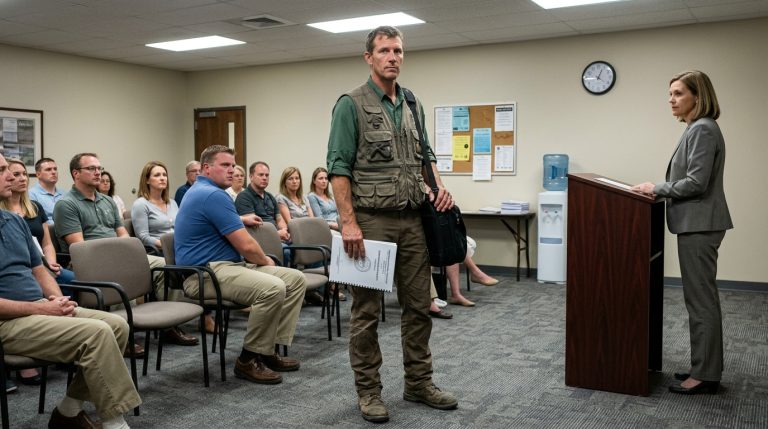
The clubhouse was a space designed for community leisure—soft carpet, beige walls, and the lingering, synthetic scent of industrial cleaning agents. Tonight, however, it felt like an arena. As I pushed open the double doors, the ambient temperature seemed to drop. Every eye in the room turned toward me, a collective movement that was punctuated by the sharp, rhythmic rapping of a gavel against a wooden podium.
Karen stood at the front, her floral print jacket looking garish under the harsh fluorescent lights. She was already mid-sentence, her voice projecting with a desperate, practiced authority that failed to mask the tremor in her hands. “—and so, I must warn you all,” she was saying, “that there are those among us who seek to dismantle the standards that keep this community safe. They are not neighbors; they are agitators who wish to see our property values plummet.”
I walked down the center aisle, the heels of my boots clicking against the hard floorboards in a cadence that felt like a slow, deliberate march. I didn’t rush. I didn’t break eye contact with her. I simply let the space between us grow thinner with every step. When I reached the row where Dave and Arthur were seated, I paused, nodding to them. Their faces were grim, their resolve mirrored in the stiff set of their shoulders.
Karen’s gaze flickered to me, and for a split second, the mask slipped. I saw not the confident president of a homeowner’s association, but a woman terrified of the very shadows she had been casting. She stopped mid-sentence, her hand still gripping the gavel.
“Mr. Thorne,” she said, her voice dripping with an artificial, rehearsed sweetness. “You are just in time for our closing remarks. We were just discussing the recent… unauthorized attempts to disrupt our budgetary process.”
“I believe the purpose of this meeting, as stated in the petition, was a review of board conduct, Karen,” I said, my voice cutting through the tension. It was the same tone I had used in a courtroom to bring an unruly witness back to reality. “And I think the community has a right to hear what has been happening with their money.”
A ripple of low-frequency murmur moved through the room. I could see the Millers near the back, clutching a folder of documents—the very evidence we had painstakingly gathered over the last few weeks. The air was thick, suffocating, saturated with the smell of nervousness and rising indignation.
“This is not a venue for your personal grievances,” Karen snapped, her composure fracturing. She banged the gavel once, twice, a frantic display of power that only served to highlight her lack of control. “You are out of order! If you continue this behavior, I will have you removed.”
“By whom, Karen?” I asked, looking around the room at the faces of our neighbors. “The people who have been paying these fines? The people whose money has been siphoned away into accounts that don’t belong to this community?”
I stepped onto the dais, moving into her space. I felt the friction of the moment—the way the room held its breath, waiting for the impact. This was the moment I had been preparing for, the inhale before the structural collapse. I pulled a single sheet of paper from my coat—not a legal motion, but a simple ledger summary Ben had finalized just hours ago.
“You talk about standards,” I said, my voice rising just enough to fill the hall. “But let’s talk about the standard of Evergreen Solutions. A company with no address, no license, and no employees. A company that has been paid over two hundred thousand dollars of this community’s funds over the last three years.”
Karen went deathly pale, her grip on the gavel whitening her knuckles. She looked toward the two board members sitting beside her, but they were already leaning away, the distance between them and her growing with every word I spoke. The betrayal was palpable, a shift in the gravity of the room that left her standing alone at the center of the stage.
“That is a lie,” she whispered, the words lacking the conviction of her earlier theatrics. “You are trying to ruin me because you can’t stand the order I’ve brought to this neighborhood.”
“Order is built on trust, Karen,” I replied, standing only a few feet away from her. “And you have built this on a foundation of theft. The community has the right to see the truth. That is what this meeting is for.”
As I turned to the audience, the clubhouse felt like a pressure cooker. I saw the look of realization dawning on the faces of people who had been bullied for years. The tide wasn’t just turning; it was crashing. I knew the moment we presented the full ledger, the decoy secret—the idea that she was merely incompetent or overzealous—would be shattered forever, revealing the ugly, hard reality beneath. But as the murmur in the room grew into a roar of indignant questioning, I saw her eyes dart toward the side exit, a final, desperate thought of escape crossing her mind. I had her, but the beast would not surrender without a fight.
CHAPTER 6: THE DISMANTLING OF THE EMPIRE
The clubhouse erupted. The sound was not a single shout, but a cacophony of voices finally finding their strength after years of enforced silence. I stayed on the dais, my eyes locked on Karen. She looked less like a person than a ruin; the floral jacket that had seemed so imposing minutes ago now appeared disjointed, the fabric bunching awkwardly as she shuddered under the weight of the collective gaze.
Then came the sirens. They weren’t the distant, fading wail of a city patrol; they were sharp, intrusive, and close. The vibration of them seemed to rattle the very foundation of the clubhouse.
“What is that?” someone shouted from the back. The room, which had been boiling over with righteous anger, suddenly froze. The doors to the clubhouse were pushed open, not by a member, but by the cool, evening air. A shadow lengthened across the carpet as silhouettes in dark windbreakers moved with practiced, efficient speed toward the front of the room.
Karen’s head snapped toward the entrance, her face draining of all color. “No,” she whispered, the sound barely audible against the hum of the departing crowd’s confusion. “No, this is a mistake. I am the President!”
She didn’t look at me; she looked at the doorway as if it were a physical gate to an abyss. I stepped down from the dais, my movements slow and deliberate. I didn’t need to say a word. The look on the faces of the agents—clinical, unimpressed, and deeply professional—told the entire story. They weren’t here for a neighborhood discussion. They were here for an arrest.
I watched as they moved through the thinning crowd, bypassing Dave and Arthur as if they were scenery, their eyes fixed solely on the woman at the podium. She didn’t bolt. She seemed, for the first time in her life, to have lost the capacity for motion. She simply stood there, a broken artifact of her own making, while the lead agent—a man with graying temples and a look of absolute, dispassionate authority—approached her.
“Karen Miller,” he said, his voice level, echoing in the suddenly silent hall. “You are under arrest for federal charges of wire fraud, mail fraud, and embezzlement.”
The room seemed to hold its breath. I felt the sharp bite of the autumn wind through the open doors, a cold, cleansing current that swept away the stagnant, synthetic scent of the clubhouse. I looked at Dave, who was standing a few rows away. His jaw was tight, but there was a flicker of something in his eyes—not glee, but a profound, weary peace. He had been fighting for years for the right to fly a flag, for the right to exist without someone measuring the height of his pole. Now, that battle had shifted from a petty, localized tyranny to a matter of record.
As they led her out, her movements were stiff, her dignity having vanished somewhere between the gavel strikes and the arrival of the blue lights outside. She didn’t look at anyone. She didn’t offer a defense. She was just a woman being guided into the gray, sterile interior of a government sedan.
I followed them out to the parking lot. The air was crisp, tasting of iron and dried leaves. The community gathered in the doorway, a sea of faces illuminated by the pulsing red and blue lights reflecting off the beige stucco of their homes. It was a surreal, jarring scene. For years, this space had been a site of enforcement, a place where rules were the primary language. Now, it was a site of restoration.
“She’s gone,” Arthur said from behind me, his voice trembling. He stood beside his wife, who had managed to navigate the ramp—the ramp he had been forced to build twice—and for the first time, she looked out at the neighborhood, not with fear, but with a quiet, observant curiosity.
“The person is gone,” I replied, watching the taillights of the sedan turn the corner and disappear into the darkness. “But the work isn’t done. The records, the audit, the process of healing—that has to start now, from the inside.”
I looked at the clubhouse, the beige walls glowing under the harsh glare of the security lights. It was just a building, and yet, it felt as though the very architecture of the neighborhood had been altered. The weight of the evening, the friction of the confrontation, and the sheer momentum of the legal process—it had all converged into this single, quiet moment of aftermath.
I walked back toward my truck, my boots crunching on the gravel. I was tired, a deep, marrow-level exhaustion that I hadn’t felt since my final days on the bench. But as I passed the access road, I noticed the Millers standing near their driveway. Their playset, painted that forbidden shade of blue, sat in the glow of their porch light. It looked sturdy, real, and completely, perfectly okay. They nodded to me as I drove past, a gesture of simple, unspoken acknowledgment.
The battle had moved from the arena of the clubhouse to the cold, methodical halls of the justice system, and as I turned into my own driveway, I felt the familiar, protective weight of Eleanor’s Grove around me. The storm had passed, but it had left a transformed landscape in its wake. The next steps would be about reconstruction—of records, of reputations, and of the trust that had been stolen away. I had done what I had set out to do, but as I sat in the dark of my truck, I realized the true victory wasn’t her defeat; it was the fact that for the first time in years, the silence in the neighborhood didn’t feel like fear. It felt like space—space to grow, to heal, and to finally exist.
CHAPTER 7: THE ARCHITECTURE OF TRUST
The sun rose over Oak Haven Estates with a clarity I hadn’t seen in years. The air was crisp, holding the scent of damp earth and the promise of a changing season. I stood in the middle of my garden, a weathered claw hammer in my hand, looking at the trellis that had been damaged during the height of the HOA’s “compliance” maneuvers. It was a simple structure, but it had been a casualty of the conflict, snapped and splintered by the sheer negligence of those who hadn’t cared for the life it supported.
Repairs were a quiet business. They didn’t have the kinetic energy of a courtroom confrontation or the adrenaline of a community revolt, but they were, in many ways, more vital. I measured the wood, the grain smooth and silvered under my calloused thumb. This was the work I had envisioned when I bought this place, the labor that honored Eleanor’s memory—not the legal briefs or the strategy meetings, but the tangible act of putting something back together.
Dave appeared at the gate, his posture less rigid than it had been in months. He was carrying a small box of supplies—galvanized screws, a new level, a bit of twine. He didn’t say a word as he entered, just stepped into the rhythm of the work. He took the other end of the trellis, his movements steady, his focus entirely on the wood. We worked for a long time in a companionable silence that felt like a foundation.
“The audit is underway,” he said finally, his voice low, matching the quiet intensity of the morning. “The accounting firm found another three accounts hidden under those shell companies. It’s worse than we thought, Judge. Much worse.”
“It usually is,” I replied, driving a nail with a single, clean strike. “When people build a kingdom on a secret, they rarely stop at just one.”
“The Millers are organizing a neighborhood committee,” Dave continued, his eyes scanning the yard. “They want to make sure the bylaws are rewritten. They want to strip away the clauses Karen used to weaponize the community. They want to make sure no one else is ever forced to tear down a playset again.”
I paused, the hammer resting against my thigh. This was the true, secondary effect of the legal dismantling. The community wasn’t just healing; it was actively auditing its own culture. They were looking at the rules that had held them captive and deciding, collectively, what kind of people they actually wanted to be. It was a Kintsugi process—the fracture was still there, a jagged line in the history of the neighborhood, but it was being filled with something stronger, something that acknowledged the break.
“The rules should protect the space, Dave,” I said. “Not define the people in it. If they focus on that, they’ll be fine.”
We finished the trellis, the wood braced and sound, ready to support the weight of the climbing roses. As I set the hammer down, I felt the familiar ache in my shoulders—a good, honest fatigue. It was a far cry from the mental exhaustion of the federal investigation, the endless nights of document review, and the cold precision of the legal war. This exhaustion ended in a solid, finished thing.
Later that morning, Arthur arrived. His wife was with him, sitting in her wheelchair, her hands resting in her lap as she looked out over the rows of vegetables. She didn’t say much, but her eyes held a soft, receptive light. She watched the farm, the way the light played across the leaves, the way the crew worked with a quiet, efficient rhythm that had finally returned to the land.
“We were thinking,” Arthur said, his hand resting on the back of his wife’s chair. “We want to host the next community dinner here, in the barn. Not as a protest, not as a meeting. Just… a dinner. To welcome everyone back.”
I looked at the barn, its doors wide open to the breeze, the space inside filled with the memories of a thousand dinners Eleanor and I had shared. It was a space designed for connection, and it seemed only right that it should be the place where the neighborhood finally shed the last of the fear that had been forced upon it.
“I’d be honored,” I said.
As I walked back toward the house, I realized that the ‘decoy’ secret—the idea that this had all been about money—had served its purpose. It had been the lever we needed to move the mountain. But the core truth was shifting beneath my feet. The money, the fraud, the legal indictments—those were merely the mechanics of the ending. The true story was the restoration of a people who had been convinced they were enemies, only to realize they were neighbors. I reached the porch and sat down, the wooden steps warm under me. The path ahead was still long, but the trajectory was clear. We weren’t just fixing a trellis or rewriting a set of bylaws; we were defining a legacy, one that Eleanor would have recognized, and one that, finally, felt like home.
CHAPTER 8: THE HARVEST OF PEACE
The barn doors creaked open, admitting a slice of golden, afternoon light that illuminated the dust motes dancing in the air. Inside, the long tables were already being set for the community dinner. It wasn’t the sterile, organized setting of a clubhouse meeting; it was an organic, messy, vibrant arrangement of mismatched chairs, platters of home-grown food, and the low, rhythmic hum of neighbors who were actually talking to one another.
I walked toward the center of the barn, my boots making no sound on the packed earth floor. Dave was there, helping the Millers carry in a massive bowl of potato salad, their children darting between the tables with the unburdened joy of kids who no longer had to worry about the shade of their playset. Arthur was near the back, adjusting the seating for his wife. He looked up as I approached, and the look of quiet, unadorned gratitude in his eyes was the most significant verdict I had ever received.
The truth of what had happened—the embezzlement, the shell companies, the systematic greed—had been laid bare, a cold, clinical reality that the legal system was now processing. But standing here, amidst the people who had been the victims of her reign, I realized the legal outcome was only the mechanical end of the story. The real end was this: the refusal of a community to be defined by the fear she had tried to impose.
I took my seat at the head of the table, the wood worn smooth by decades of use. The atmosphere was light, a stark contrast to the stifling, high-tension climate of the last few months. There were no more binders filled with restrictions, no more fear of the “violation notice” that could arrive at any moment to upend a life. In their place was a genuine, tentative curiosity between people who had spent years as strangers, or worse, as unwitting antagonists in a game they hadn’t chosen to play.
“To the neighbors,” Dave said, rising from his seat and raising a simple glass of iced tea. The room quieted, the murmur of conversation fading into a resonant, expectant silence. “To the people who decided that we were worth more than a set of rules, and to the man who reminded us that justice isn’t just a law—it’s how we treat the person living across the street.”
He looked at me, a silent, powerful acknowledgement. I didn’t stand. I didn’t offer a grand speech. I simply raised my glass, feeling the cool condensation on the surface, and caught the eye of each person around the table. In that moment, the final layer of the mystery was fully unraveled: it was never about the law itself. It was about the dignity we afforded one another when no one was watching.
As the dinner progressed, the stories began to flow. They were small, human things—a memory of a grandmother’s garden, the struggle of a first year at university, the simple, profound joy of having a space to exist without scrutiny. I listened, my heart steady and calm. Eleanor would have loved this. She would have seen the grace in the way Arthur held his wife’s hand, the way the Millers laughed with Hector’s crew, and the way the community had, quite literally, rebuilt its own foundation.
Later, as the sun began to dip below the horizon, casting long, amber shadows across the fields, I excused myself and walked out to the porch of the farmhouse. The evening was settling into a deep, resonant peace. The garden was thriving, the tomatoes heavy on the vine, the strawberries already beginning their next cycle.
I picked up the hammer I had left by the trellis earlier that day. It was a small thing—a tool for repair, for maintenance, for the simple, daily act of tending to what was broken until it was whole again. I realized then that my retirement—the one I had initially thought was being stolen—had actually just begun. It wasn’t a retirement of silence and solitude as I had once imagined in my grief; it was a retirement of engagement, of participation in the slow, beautiful process of living among others.
Justice, I understood, was not a lightning strike. It was this: the light on the porch, the shared meal in the barn, the quiet, persistent growth of a community that had learned to trust itself. I looked out over the rolling hills of Eleanor’s Grove, the wind rustling through the trees like a soft, approving sigh. The war was over, but the work—the real, meaningful work—was just beginning. I hung the hammer on its hook, turned off the porch light, and went inside to join the laughter that was still echoing, vibrant and alive, from the barn.